April 2008
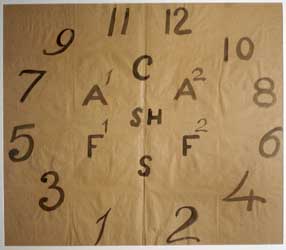
This diagram, explained by a note written by Henry I. Bowditch, shows the arrangement of members of the Boston Anti-Man-Hunting League as they would surround a man-hunter, concealing him until he consented to release the person he was attempting to kidnap. The League was a secret society founded in Boston in 1854 to resist the Fugitive Slave Law of 1850. The diagram, in pencil and watercolor on brown paper, places the slave hunter in the center (SH), surrounded by the speaker of the committee (S), a member to take hold of the hunter's head (C), two members to take hold of the arms (A1 and A2) and two for the feet (F1 and F2), and twelve additional members to form an outer circle to ward off intruders while the committee conveyed the victim to safety. Bowditch's note continues, "One plagued in this way would not invite others to come & run the same risk of annoyance."
Henry Ingersoll Bowditch was a prominent Boston physician and abolitionist, born in 1808 to mathematician Nathaniel and Mary (Ingersoll) Bowditch of Salem. (See the online presentation of an image of Henry I. Bowditch.) While traveling in England in 1833, Bowditch attended the funeral of William Wilberforce, whose antislavery writings had deeply affected him, and upon his return to Boston in 1834, he fell under the sway of William Lloyd Garrison, becoming an enthusiastic participant in the nascent, and as yet unpopular, antislavery movement in Boston. After witnessing a Boston mob's 1835 attack on William Lloyd Garrison, Bowditch pledged in his diary to devote "his whole heart to the abolition of that monster slavery." In response to the 1842 arrest in Boston of George Latimer, a freedom seeker, Bowditch allied himself with William F. Channing and Frederick S. Cabot to form the "Latimer Committee," editing the Latimer Journal and North Star, a triweekly antislavery newspaper issued between November 1842 and May 1843. Bowditch remained committed to the antislavery crusade throughout the 1850s, lecturing and assisting other freedom seekers, and in 1854, he was a founding member of the Boston-Anti-Man-Hunting League. Ironically, Bowditch's own son, Nathaniel, was killed during the Civil War, which had been sparked by the debate over slavery. After the war, Bowditch continued to practice medicine in Boston, taught at Harvard Medical School, and in 1869, founded and served as the first chairman of the Massachusetts State Board of Health. He died in January of 1892 at the age of eighty-three.
The Boston Anti-Man-Hunting League was a secret society founded in 1854 in response to the kidnapping of Anthony Burns. More than 100 of Boston's leading citizens and reformers pledged to aid freedom seekers and resist the Fugitive Slave Law of 1850 by whatever means necessary, including kidnapping the kidnappers themselves. Affiliated with the League of Massachusetts Freemen, the Boston group included such reformers as Samuel Gridley Howe, John A. Andrew, Bronson Alcott, Theodore Parker, Samuel May, Jr., and Henry Ingersoll Bowditch. The Massachusetts Historical Society holds a collection of the League's records, which includes minutes of meetings, constitutions, lists of members, and miscellaneous papers.
Bowditch, Vincent Y. Life and Correspondence of Henry Ingersoll Bowditch. Boston: Houghton, Mifflin, 1902.
"Henry Ingersoll Bowditch," American National Biography, vol. 3. New York: Oxford 1999.
"Henry Ingersoll Bowditch," Dictionary of American Biography, vol. 2. New York: Charles Scribner's Sons, 1929.
The MHS has several manuscript collections pertaining to Bowditch and his antislavery activities including the Boston Anti-Man-Hunting League Records, 1846-1882; Bowditch Family Papers, 1800-1894; Henry Ingersoll Bowditch Papers, 1822-1903; and Papers Related to the George Latimer Case, 1842-1888.