
Collections Online
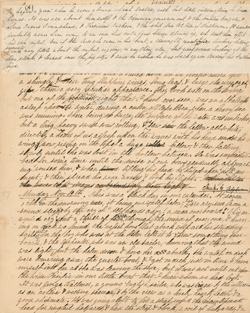
Two Years before the Mast: A Personal Narrative of Life at Sea, manuscript page 37
To order an image, navigate to the full
display and click "request this image"
on the blue toolbar.
-
Choose an alternate description of this item written for these projects:
- MHS 225th Anniversary
- Main description
[ This description is from the project: Witness to America's Past ]
Richard Henry Dana, Jr., the son of poet and essayist Richard Henry Dana and Ruth C. (Smith) Dana, entered Harvard in 1831 but was forced to abandon his studies after two years due to eve trouble resulting from a bout with measles. Convinced that a sea voyage and hardy outdoor life would cure his eyesight, Dana signed on as a common sailor on the brig Pilgrim, commanded by Francis A. Thompson, bound from Boston for California to trade on the coast for hides. The brig sailed from Boston on 14 August, 1834, rounded Cape Horn, and arrived at Santa Barbara on 14 January, 1835. There, after sixteen months of trading up and down the coast, Captain Thompson received orders to exchange ships with Captain Edward H. Faucon of the Alert. Consequently, Dana returned to Boston aboard the Alert on 22 September, 1836. The voyage had succeeded in strengthening his eyesight and in building his character in other ways, as noted by his biographer Charles F. Adams:
He went away a town-nurtured, college stripling of nineteen; he returned a robust man of twenty-one. The heroic treatment to which he had recourse settled the difficulty with his eves; thereafter they gave him no more trouble. (FN 1)
Dana returned to Harvard and graduated in June 1837 at the head of his class, whereupon he immediately entered law school.
During his few leisure hours at sea, Dana kept brief notes in his journal and then expanded them into a full account of the voyage. (FN 2) This account was subsequently lost at the wharf in Boston with his trunk containing all his possessions collected on the voyage. Later, during law school, Dana reconstructed his account from the brief journal entries, which fortunately were not left in the trunk. He read the manuscript (shown here) to his father and to his uncle-by-marriage, the artist and poet Washington Allston, who advised him to publish it. He turned to Harper's of New York for this project, with William Cullen Bryant to help him negotiate a contract. The book was published in 1840, the year Dana was admitted to the bar. For "one of the most successful American books of the century, and the best book of its kind ever written," Dana received only a flat fee of $250 and two dozen printed copies from Harper's. (FN 3)
Dana's purpose in writing the book was to give an account of sea life "before the mast," or from the view of the common sailor, and to ensure that this much-maligned segment of society would be treated with justice in the future. An English edition soon appeared, and his London publisher paid him an honorarium greater than his fee from Harper's. Other foreign editions followed, and Dana was much celebrated at home and abroad for his work. In fact, when he returned to California on a visit in 1859, he found (somewhat to his astonishment) that he was a celebrity there, and that almost everyone had read the book, it being the only work available for many years that described the California coast in some detail. (FN 4) In 1868, the original copyright expired, and he brought out a revised "author's edition" under a much more lucrative arrangement with Houghton Mifflin Company. This edition contained an added chapter, "Twenty-Four Years After," which described the 1859 visit and updated information on the crew of the Pilgrim and other characters mentioned in the original book. (FN5)
Soon after the book's publication, Dana began to specialize in admiralty cases in his law practice, and he went on to a distinguished career in law. In 1841, he published his manual The Seaman's Friend, which became a standard work on maritime law. While Dana was opposed by nature to the excesses of the abolitionists, he allied himself with the Free-Soil movement in politics, and was the attorney for the defense of the persons involved in the rescue of the freedom seeker Shadrach in Boston (1851), and in the Anthony Burns case (1854). Upon witnessing Shadrach's rescue in Boston, Dana noted in his diary for 15 February, 1851, "How can any right-minded man do else than rejoice at the rescue of a man from the hopeless, endless slavery to which a recovered fugitive is always doomed." (FN 6)
Dana was elected a resident member of the Massachusetts Historical Society in 1858. While in Rome writing a treatise on international law, he died suddenly of pneumonia in 1882.
The large collection of Dana Family Papers (collection guide) at the Massachusetts Historical Society consists primarily of the papers of four generations of the Dana family: diplomat and jurist Francis Dana (1743-1811), Richard H. Dana (1787-1879), Richard H. Dana, Jr., and attorney Richard H. Dana (1851-1931). Richard Henry Dana, Jr.'s papers include correspondence, legal papers, diaries, and other miscellaneous volumes. The Society also holds the logs kept by Captain Edward H. Faucon (who exchanged ships with Captain Thompson in California) for the ship Alert from 28 November, 1834 to 20 May, 1835, and the brig Pilgrim, 21 May, 1835 to 6 July, 1837.
Sources for Further Reading
1. Adams, Charles Francis. Richard Henry Dana: A Biography. 4th ed. Boston: Houghton Mifflin and Co., 1895, 1:14.
2. Dana, Richard Henry, Jr. Two Years Before the Mast. A Personal Narrative. Boston: Houghton Mifflin and Co., 1911, p. xii.
3. Adams, Charles Francis. Richard Henry Dana: A Biography. 4th ed. Boston: Houghton Mifflin and Co., 1895, p. 26.
4. Dana, Richard Henry, Jr. Two Years Before the Mast. A Personal Narrative. Boston: Houghton Mifflin and Co., 1911, p. 468.
5. Adams, Charles Francis. Richard Henry Dana: A Biography. 4th ed. Boston: Houghton Mifflin and Co., 1895, pp. 25-27.
6. Dana Family Papers, vol. 151, MHS.