
Collections Online
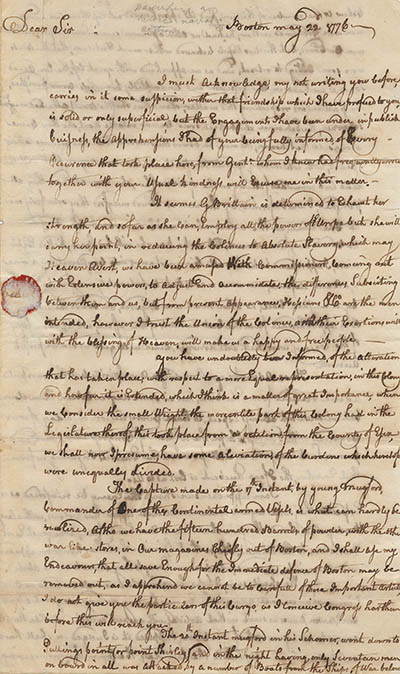
Letter from Azor Orne to Elbridge Gerry, 22 May 1776
To order an image, navigate to the full
display and click "request this image"
on the blue toolbar.
-
Choose an alternate description of this item written for these projects:
- Main description
[ This description is from the project: Object of the Month ]
This 22 May 1776 letter was sent by Azor Orne of Marblehead to his fellow townsman Elbridge Gerry, then serving in the Continental Congress in Philadelphia. Orne informs Gerry of James Mugford’s successful capture of 1500 barrels of gunpowder from the British ship Hope and his death two days later in the Battle of Shirley Gut off the coast of Winthrop, Mass.
James Mugford and the Battle of Shirley Gut
When the British evacuated Boston in March of 1776, several ships were left along the Massachusetts coast as protection and to warn ships arriving from England that Boston was no longer in British hands. At the same time, colonial ships began operating as privateers, ever on the lookout for an inbound British ship laden with supplies and armaments. In May of 1776, James Mugford, Jr., of Marblehead aboard the ship Franklin with 20 hands, sailed out of Beverly and into Revolutionary War history.
He soon spotted the British transport ship Hope under full sail and heading toward Boston. She had been part of a ten-ship convoy, but lost touch with the others in a heavy fog. Calculating that the wind would prevent the British ships at anchor from reaching Hope before Franklin could capture her, he and his crew audaciously approached, boarded, and captured the ship with little resistance. As had been rumored, the ship was loaded with munitions—something the colonists were short on—and Mugford hastened to get his prize into Boston before the British ships caught on.
He chose the narrow and twisting channel between Deer Island and Shirley point as the most direct route, but as the tide was low, Hope ran aground. Soon after, John Glover of Marblehead arrived on the scene and, recognizing the value of the cargo, moved it into Boston overnight using small boats; Hope floated free in the morning and was brought to anchor in Boston Harbor.
Not one to rest on his laurels, Mugford set sail back to Beverly and soon found himself grounded in Shirley Gut, accompanied by the Lady Washington who anchored nearby. Knowing that they were sitting ducks, Mugford made preparations lest Franklin and Lady Washington should be attacked. As he expected, the British, having spotted Franklin aground, attacked; swarming the two American ships (manned by 28 between them) using small boats and many times the number of sailors. The crews of Franklin and Lady Washington engaged in a ferocious hand to hand battle for over half an hour, fighting valiantly and driving off the much larger British force. In the last moments of the battle, however, Mugford was killed. His last words were to inspire his crew—“I’m a dead man! Don’t give up the vessel! You will be able to beat them off!”
In the morning, Franklin floated free and bore the body of Mugford back to Marblehead where he was greeted as a fallen hero. Monuments to his memory exist in Marblehead and in Winthrop.
The three protagonists from Marblehead
This letter demonstrates the nature of the close-knit maritime community of Marblehead, Massachusetts, during the Revolution. Although the three men served in vastly different roles during the Revolution--Elbridge Gerry a member of the Continental Congress; Azor Orne a Major General of the Massachusetts Militia; and James Mugford, Jr., a privateer—the three Patriots would undoubtedly have known each other well and even shared family or mercantile ties. On the eve of the Battles of Lexington and Concord, in fact, Orne and Gerry, along with Jeremiah Lee, were forced to hide in a cornfield together on that chilly evening as British troops passed by the tavern in Menotomy where they were staying. Elbridge Gerry (1744-1814) would go on to serve as James Madison’s vice president. Azor Orne (1731-1796) was a delegate to the Hartford Convention in 1780 and a member of the Massachusetts legislatures that approved the Massachusetts state constitution and the United States Constitution. Had Mugford not met his untimely demise at Shirley Gut, who knows what prizes he would have captured for the colonies.
For further reading:
Allen, Gardner Weld. A Naval History of the American Revolution Boston: Houghton Mifflin Co., 1913
Clark, William Bell. George Washington’s Navy: Being an Account of His Excellency’s Fleet in New England Waters Baton Rouge: Louisiana State University Press, 1960
Dolin, Eric Jay. Rebels at Sea: Privateering in the American Revolution New York: Liveright, 2022
Dowdell, Vincent J. “Captain Mugford and the Powder Ship: A Tale from the Old Navy,” United States Naval Institute Proceedings, vol. 82, no. 12 (Dec. 1956), p. 646