MHS News
From the President
Published: Wednesday, 8 September, 2010, 9:15 AM
 Nonprofit institutions across the country have faced serious challenges over the past few years as a result of the ongoing economic downturn. Organizations have dealt with the consequences in a variety of ways, ranging from massive budget cuts to attempts to maintain business as usual for as long as possible.
Foreseeing the impact that the downturn would have on the Society's operating budget, in spring 2009 the MHS Board of Trustees and staff moved decisively to reduce expenses while maintaining the quality of core services. At the same time, they quietly leveled a fundraising effort among the Society's closest friends to create a stabilization fund. The resulting Strategic Initiative is a three-year effort to raise a minimum of $900,000 in unrestricted funds to fill the gap in the operating budget in the challenging years ahead and preserve the Society's programs and services.
We are gratified that, to date, we have successfully raised $1 million dollars for the Strategic Initiative from over two dozen Trustees, Overseers, Fellows, Members, and foundations. Fundraising for the Strategic Initiative will continue on a limited basis in order to maintain a consistent, conservative draw on the endowment while avoiding additional, damaging cuts.
The combination of judicious budget cutbacks and focused fundraising assures that the MHS is positioned not only to survive but to take advantage of the eventual economic up-turn. By calling on the Society's dedicated friends to sustain our mission as well as our finances, we expect to build a bright future for the MHS. For more information on how you can support the Strategic Initiative, please contact Director Development Nicole Leonard at nleonard@masshist.org.
JQA Twitter Feed Inspires New Font
Published: Tuesday, 7 September, 2010, 1:51 PM
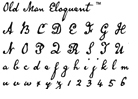 We are always happy to see new projects that are based on the collections housed at the MHS and are delighted to learn of a new font--aptly named Old Man Eloquent--designed to match the hand of John Quincy Adams. It was on the tails of the first anniversary of John Quincy Adams's tweeting debut that we were introduced to Old Man Eloquent.
Independent type designer Brian Willson, a follower of the Society's John Quincy Adams Twitter feed, found inspiration for his latest font one day while reading the brief journal entry for that day 200 years earlier. Willson realized that plenty of samples of Adams's penmanship must exist and soon found himself on the MHS website. "I spent a long time there that first day, reading journal entries, admiring Adams's bold, no-nonsense script. There were plenty of samples of his alphabets. Plus, I'd yet created no truly bold-weighted penmanship font." He knew that he had found his next project.
As with all such projects, Willson explains, he began by poring over the extant material for just the right alphabets, both upper and lower cases as well as numerals, punctuation, and any other special glyphs (i.e., ampersands, dollar signs, old-style double-s). Once he has chosen all of the available characters, he uses a digital bitmap-graphics program to enlarge them and hand-trace the outlines using vector-graphics tools. The designer uses his own judgment at this stage to determine how raggedy the font will be, how rough or how fine the flourishes.
Once the hand-tracing is complete, each vector graphic is pasted into a font-creation program, and then the real work begins. Many hours go into balancing each character and making sure its optical size matches the others. Each must then be mated with every other character to ensure a perfect cursive alignment. Invariably, several modern marks are missing from old materials (e.g., the Euro symbol), so these must be created from scratch.
Willson estimates that it takes at least 200 hours to create a full-featured historical pen font. In the case of Old Man Eloquent, with its 450-plus characters and both a regular and a bold style, the total was closer to 400. "But," he remarks, "the hours tend to fly by. In part because of the idea that I'm somehow helping connect the modern world to the historical one, somehow spinning a thread across the ages."
Willson, well known for his historical penmanship fonts, began his foray into font design with the simulation of a colleague's handwriting. When he met with success, he turned to handwriting of the 1800s and developed Texas Hero based on the writing of Thomas J. Rusk. This was followed by Houston Pen, Lamar Pen, and Emily Austin. He explains part of the pleasure he finds in creating his historical fonts, "something about the old way of writing--in fact, something about the contents of the old letters and journal entries themselves--placed me in an oddly pleasant paradox, as if I had one foot in the modern, digital world, and one the long-gone world of writing with an inkwell and quill pen." To view and purchase Old Man Eloquent along with Willson's other fonts visit: www.oldfonts.com.
ScanPro 2000: Not Your Mother's Microfilm Machine
Published: Monday, 2 August, 2010, 1:26 PM
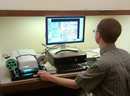 The MHS recently acquired an exciting new piece of hardware through a grant from the Ruby W. and LaVon P. Linn Foundation: the ScanPro 2000, a compact microfilm viewer, scanner, and printer. Fundraising efforts led by MHS Fellow Frederic D. Grant resulted in the generous gifts of four donors and one charitable trust that have enabled the MHS to order two additional machines, which we expect to receive this fall. Light years ahead of the older, analog machines currently used at the MHS, the ScanPro, and its accompanying PowerScan software, will make the MHS collections more accessible to researchers.
The enhanced features include superior printing, digital scanning, image editing, and incredible zoom capabilities that create a much more user friendly, and potentially more fruitful, research trip to the library. The library staff was very impressed during the first demonstration of the machine when a microfilm reel containing pre-Revolutionary War diaries with dark images not legible on other machines was quickly adjusted to create clear, readable images.
The most extraordinary feature of the ScanPro is the printing and scanning capability. With a single mouse click the machine creates either a print out or a scan of the selected area in just a fraction of a second. The scans can be loaded onto a flash drive and brought home, or e-mailed directly from the work station to a personal e-mail account. The quality of the printouts and scanned images is vastly superior to the quality of the printouts provided on our non-digital machines.
In order to create such beautiful scans, the ScanPro allows researchers to edit the individual frames of the microfilm by cropping and rotating and adjusting the brightness and contrast of the images. The spot editing feature allows researchers to enhance a selected area of a frame, adjusting the brightness and contrast of a particularly dark spot to make a cohesive, legible image. This is particularly helpful for newspaper images, where the illustrative matter tends to be much darker on microfilm than the text. Finally, the powerful zoom feature allows researchers to see things in the microfilm that can barely be seen in the original document.
The ScanPro 2000 is currently available for use in the MHS library. Researchers that cannot visit the library can request digital files to be e-mailed to them by the library staff. Please see details at http://www.masshist.org/library/visit.cfm#reproduction under "low resolution digital files."
"Precious Metals: From Au to Zn" Opens 2 August
Published: Friday, 2 July, 2010, 8:00 AM
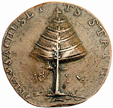 On 2 August the MHS will open a new exhibition Precious Metals: from Au to Zn. The Massachusetts Historical Society (MHS) is taking the opportunity to show off some of its numismatic treasures while the American Numismatic Association (ANA) is in Boston hosting the World's Fair of Money at the Hynes Convention Center.
Special guest curator John W. Adams and MHS Curator of Art Anne E. Bentley have planned an exhibition to highlight many of the rare and unique pieces in the collection. A sampling of what will be on view includes the New England three pence and shilling, the 1776 Massachusetts Pine Tree copper penny, a piece of original Massachusetts Bay stock, the February 1690/1 Massachusetts Bill of Credit, the full set of Washington-Webster silver Comitia Americana medals, Indian Peace Medals of colonial and federal issue, a number of Washington medals from the Baker series, and some fascinating pieces from the Vernon medal series. Precious Metals: From Au to Zn will open on 2 August and remain on view into September in the Society’s building at 1154 Boylston Street.
Regular public hours are from 1 to 4 PM Monday through Saturday. There are special ANA morning hours from 9 AM to noon on August 10-14. If convention attendees plan to research the MHS collection while in town, please contact Anne Bentley (abentley@masshist.org or call 617-646-0508) in advance to make an appointment, as time and space are limited.
MHS Receives NEH Sustaining Cultural Heritage Collections Grant
Published: Friday, 11 June, 2010, 2:44 PM
 We are pleased to announce that we have received a Sustaining Cultural Heritage Collections grant for $351,784 from the National Endowment for the Humanities (NEH). The grant will be used in a multi-phase effort to analyze risks to the collections and to identify appropriate preventive preservation actions necessary for collection protection. As well, we are very proud to announce that the project has been designated a National Endowment for the Humanities “We the People” project. “We the People” is an initiative that encourages and strengthens the teaching, study, and understanding of American history and culture through the support of projects that explore significant events and themes in our nation's history and culture and that advance knowledge of the principles that define America.
“The MHS is pleased that the NEH has recognized the importance of our collections in this way as we would not be able to properly fulfill our mission if our collections were lost or damaged due to disaster or theft,” commented MHS President Dennis Fiori. “Maintaining access to our collections through proper preservation and continued security measures is of utmost importance as we experience growing use from researchers visiting the library and interested citizens attending public programs and exhibitions.”
About the National Endowment for the Humanities
Created in 1965 as an independent federal agency, the National Endowment for the Humanities supports learning in history, literature, philosophy, and other areas of the humanities. Additional information about the National Endowment for the Humanities and its grant programs is available at www.neh.gov. Any views, findings, conclusions, or recommendations expressed in this release do not necessarily reflect those of the National Endowment for the Humanities.
older posts
 Current newsletter