MHS News
New Website Uncovers Passages Written by Jefferson That Have Been Hidden for Centuries
Published: Friday, 9 April, 2010, 4:04 PM
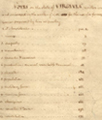 The manuscript of Notes on the State of Virginia, Thomas Jefferson’s only full-length book is now available online at www.masshist.org/thomasjeffersonpapers/notes. Created by the Massachusetts Historical Society (MHS), the website enables visitors to see and interact with passages that were previously hidden from view due to the methods used by Jefferson for inserting changes onto handwritten pages. The website provides evidence of not only Thomas Jefferson's meticulous approach to writing but also an ingenious way to view passages that have been obscured for centuries.
Using recent advances in technology—including faster computer processors, faster bandwidth speeds, and the ever-increasing capabilities of web browsers—the website developed by the MHS allows the reader to interact with color digital images of Jefferson's complex manuscript; read each manuscript piece in sequence or jump to specific pages or numbered queries—the topical chapters that Jefferson used to organize his published work; or remove the attachments and see the original passages written by Jefferson.
Work on this website began years ago when the MHS made conservation work on the manuscript of Notes on the State of Virginia a priority. It was in dire need of conservation treatment because the manuscript had been tightly bound in a modern leather cover. Wear-and-tear was beginning to take a toll on the paper, and there was considerable risk of tearing and decay along the edges of sheets. MHS applied for and received funding from Save America’s Treasures, a federal program, to conserve the manuscript and digitize selections of it.
Once conservation work was complete, each full and partial page—both front and back—were scanned. After experimenting with the digital images, the MHS realized that its existing web delivery system—designed to present a predictable sequence of manuscript pages—wasn't adequate to display Jefferson's complicated manuscript. However, recent changes in technology enabled the MHS to develop a website that fully conveys the elaborate nature of Jefferson’s revision process and allows users to “flip up” or “remove” the attachments—just as someone handling the paper manuscript would.
The online manuscript of Notes on the State of Virginia is part one of a larger effort planned by the MHS to present a scholarly electronic edition with annotations conveying how the manuscript relates to various significant published editions.
Image: Detail of Table of Contents page from Thomas Jefferson's Notes on the State of Virginia
MHS Announces "A More Interior Revolution"
Published: Thursday, 25 February, 2010, 11:01 AM
 On Monday, 22 March, to commemorate the bicentennial of Margaret Fuller’s birth, the MHS will open a new exhibition titled “A More Interior Revolution”: Elizabeth Peabody, Margaret Fuller, and the Women of the American Renaissance. Guest curator Megan Marshall, author of the acclaimed biography The Peabody Sisters: Three Women Who Ignited American Romanticism, has selected letters and journals written by Fuller and Peabody, together with writings and works of art created by other women who participated in the literary renaissance in New England between 1830 and Fuller’s death in 1850. The exhibition draws upon the collections of the Massachusetts Historical Society and the Concord Free Public Library.
During this period of intellectual and social ferment, a remarkable cohort of women writers, poets, and artists emerged in the Boston area. Fuller would later leave Boston for a career in journalism in New York and then go on to participate in the social upheaval in revolutionary Europe, before dying in a shipwreck during her return voyage to America. Elizabeth Palmer Peabody remained here and, as she wrote to William Wordsworth, saw “a more interior revolution in the making” in which “grand souls indeed [both men and women] … would do in the republic of letters, in the temple lofty sciences,” what the founding fathers had accomplished “fifty years since in politics.”
The MHS will host a special Fellows-and-Members-only opening reception on 20 March as well as two public gallery talks in conjunction with the exhibition. "The Lost Letters of Margaret Fuller" by Stephen T. Riley Librarian Peter Drummey will be held on Saturday, 27 March, at 11 AM and 1 PM as part of the MHS Annual Open House. On Friday, 23 April, at 2 PM, Leslie Perrin Wilson, Curator of the William Munroe Special Collections at the Concord Free Public Library, will give a talk entitled "No Worthless Books": Elizabeth Peabody's Foreign Library and Bookstore, 1840-1852. The MHS also will sponsor a three-day conference, Margaret Fuller and Her Circles, 8-10 April 2010. For information on the conference program, please visit the conference webpage.
“A More Interior Revolution” is free and open to the public from 22 March until 30 June, Monday through Saturday, 1:00 PM to 4:00 PM.
Image: Detail from Margaret Fuller's letter portfolio, Italy, c. 19th century, lacquer with nacre inlay
MHS Goes Prime Time with SJP
Published: Thursday, 25 February, 2010, 10:58 AM
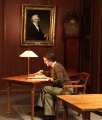 Over one year ago, on 27 January 2009, there was a rare celebrity sighting at the MHS, which we were unable to announce until today. Actress Sarah Jessica Parker, best known for HBO's Sex and the City, visited the reading room to work with material from the Society's manuscript collections as part of filming for the inaugural episode of NBC’s new series Who Do You Think You Are? The program, an American adaptation of the hit British documentary series by the same title, follows well-known celebrities as they discover their proverbial roots, researching their ancestors in an attempt to learn more about their families and themselves.
During her visit, Ms. Parker registered as a researcher and followed the standard MHS rules that apply to researchers working in the reading room. The one, highly unusual exception was that the Society allowed the film crew to follow her and record her as she researched her ancestors. Reference librarian Elaine Grublin spent some time with Ms. Parker in the catalog room, helping her identify and call for the material she wanted to see, and then brought the manuscripts to her in the reading room. Ms. Parker's examination of the materials led to some surprising discoveries.
Unfortunately, the MHS cannot disclose which documents Ms. Parker requested to see or what she learned from her research. Instead, tune in to the series debut on NBC on Friday, 5 March, 2010, at 8:00 PM to learn more about the Society’s role in Sarah Jessica Parker’s journey of genealogical discovery and enjoy the MHS and its reading room staff’s 15 minutes of fame.
Image: Reference Librarian Elaine Grublin in the MHS reading room
41 Presidents and Counting: Presidential Letters at the MHS
Published: Thursday, 25 February, 2010, 8:00 AM
 The MHS announces the completion of a special new subject guide, "Presidential Letters at the Massachusetts Historical Society: An Overview," which brings together descriptions of all known letters written by American presidents found in the Society's manuscript and autograph collections. Already renowned for the thousands of letters of Presidents John Adams, John Quincy Adams, and Thomas Jefferson in its collections, the MHS also holds more than 3,500 letters written by all U.S. presidents through George H. W. Bush, which are now described in this guide. While the guide emphasizes letters written during each president's term of office, it includes an overview of letters written throughout the lifetime of each president. The Society's top three holdings by president (without the Adamses and Jefferson) are George Washington, James Monroe, and Theodore Roosevelt. One collection that is particularly rich in presidential manuscripts, the Edward Everett papers, contains correspondence from 14 presidents. Support for this project was generously provided by MHS Trustee L. Dennis Shapiro through the Arzak Foundation. Read a recent President's Day Beehive blog post or view the new subject guide.
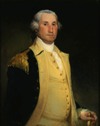
Image: George Washington by Joseph Wright, 1784, completed by John Trumbull, 1786, commissioned by Thomas Jefferson
Franklin's Silence Dogood Essays Now Available Online
Published: Friday, 29 January, 2010, 4:03 PM
 Benjamin Franklin's first published prose consisted of 14 essays that he wrote under the pseudonym Silence Dogood. In these essays, published as letters to the editor of a Boston newspaper, The New-England Courant, between March and October 1722, the 16-year-old Franklin writes in the voice of the outspoken widow Silence Dogood, telling the story of her life and commenting on social and political issues such as higher education, freedom of speech, the rights of women, religious hypocrisy, and the vice of drunkenness. These witty, satirical pieces, described as the first essay series in American literature, foreshadow Franklin's later success as the author and publisher of Poor Richard's Almanack. The digitization of the Silence Dogood essays was made possible with the support of the Richard Saltonstall Charitable Foundation. Read the essays.
older posts
 Current newsletter