MHS News
Well-behaved Woman Makes History
Published: Thursday, 15 October, 2009, 12:00 AM
MHS Presents Kennedy Medal to Noted Harvard Scholar
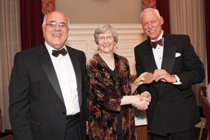 Approximately 100 guests were in attendance on the evening of 14 October as Prof. Laurel Thatcher Ulrich was honored as the 10th recipient of the John F. Kennedy Medal of the Massachusetts Historical Society at the Harvard Club of Boston. Ulrich, a Corresponding Fellow of the MHS since 1991 and 300th Anniversary University Professor at Harvard University, was presented with the medal as part of the Society’s 60th Annual Dinner. She addressed the Fellows and Members of the nation’s oldest historical society with a talk entitled “A Mormon Apostle in Boston: Sightseeing, Riot, and Martyrdom.”
“Throughout her career Professor Ulrich has mixed very distinguished scholarship with an ability to cross conventional academic boundaries, which has greatly enriched our understanding of history,” stated Bill Clendaniel, chair of the Society’s Board of Trustees. “In addition, she has helped make American history relevant and thought-provoking to a wide audience through her PBS documentary and the popular use of her phrase ‘well-behaved women seldom make history.’ That she is the first woman to receive the Kennedy Medal also gives the Society particular pleasure.”
Professor Ulrich has taught at Harvard University since 1995. Formerly professor of American history at the University of New Hampshire, she is the author of many articles and books on early American history, including A Midwife’s Tale, which won the 1991 Pulitzer Prize for History. During her tenure as a MacArthur Fellow, she worked on the production of a PBS documentary based on A Midwife’s Tale. In The Age of Homespun (2001), she explored museum artifacts as sources for history, an approach she has taken in much of her recent teaching. Some people know her best for the sentence that escaped from one of her scholarly articles and now appears on tee shirts, bumper stickers, and other paraphernalia. Her 2007 book, Well-behaved Women Seldom Make History, tells the story behind the “accidental slogan” and asks what it means to make history. This year, Professor Ulrich is serving as President of the American Historical Association.
The John F. Kennedy Medal is the Society’s highest possible honor. Shortly after President Kennedy’s death, the Society received several gifts designated for use in any appropriate way to perpetuate President Kennedy’s memory as an active member of the Society and a great friend of historical scholarship. The MHS determined to create a medal in President Kennedy’s name and commissioned eminent artist and MHS Fellow Rudolph Ruzicka to design the medal. Since then, the Society has presented 10 honorees with the Kennedy Medal, awarded from time to time to persons who have rendered distinguished service to the cause of history. It is not limited to any field of history or in fact to any particular kind of service to history. The previous recipients of the medal are Samuel Eliot Morrison (1967), Dumas Malone (1972), Thomas Boylston Adams (1976), Oscar Handlin (1991), Edmund S. Morgan (2002), Alfred DuPont Chandler, Jr. (2003), Bernard Bailyn (2004), John Hope Franklin (2005), and Arthur M. Schlesinger, Jr. (2006).
In addition to honoring the fallen American president, the Kennedy Medal naturally connected Sen. Edward M. Kennedy, also an MHS Fellow, to the Society in a personal fashion. He and his sister, Jean Kennedy Smith, were involved in past conferrals of the medal, including the MHS bicentennial dinner in 1991 where he presented the Kennedy Medal to Oscar Handlin and the 2006 evening honoring medal recipient Arthur M. Schlesinger, Jr. Earlier this past summer, Senator Kennedy was invited to present the medal to Ulrich. Due to the senator’s passing and the grief of his family, MHS President Dennis Fiori and Chair of the Board Bill Clendaniel presented the medal to Ulrich on behalf of the Society.
Image Credit: Michael Lutch
John Brown: Martyr to Freedom or American Terrorist—or Both?
Published: Monday, 28 September, 2009, 4:54 PM
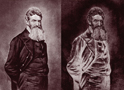
Abolitionist John Brown’s raid on the federal arsenal at Harpers Ferry on 17 October 1859 was one of the major events leading up to the Civil War and remains one of the most controversial episodes in American history. To commemorate the 150th anniversary of the raid, the MHS will explore Brown's legacy through an exhibition and series of corresponding programs.
The exhibition John Brown: Martyr to Freedom or American Terrorist—or Both? consists of personal papers, photographs, broadsides, engravings, weapons, and artifacts that illuminate Brown’s life together with evidence of the continuing arguments about the morality and meaning of his actions. Beginning with Richard Henry Dana, Jr.’s remarkable diary account of meeting Brown at his hard scrabble Adirondack farm, long before Brown came to national prominence, the exhibition will document his violent career in “Bleeding Kansas" in the 1850s, and the strong support he received from abolitionists in Massachusetts—five of his chief financial supporters, the “Secret Six,” lived in the Boston area. The exhibition will focus on the events at Harpers Ferry in 1859, Brown’s trial and execution later that year, and the controversy about how to interpret his life and these events that has continued ever since. Visitors can see examples of the weapons Brown stockpiled for the attack and one of the last letters he sent to his family from jail while he awaited execution in Charlestown, (now West) Virginia. For the debate on the interpretation of his life and death that began almost immediately after his execution—including in the rooms of the MHS, where many members had known and/or supported him—the Society will show letters and documents about Brown gathered by MHS members during and after the Civil War. Was Brown a freedom fighter or a terrorist? A brave Christian martyr or a murderous former horse thief? A patriot or a traitor? Come examine the historical evidence and decide for yourself.
The exhibition opens on 12 October with an Open House from 11 AM to 4 PM in conjunction with the Fenway Alliance's Opening Our Doors Festival. The exhibition will be open to the public Monday-Saturday, 1:00-4:00 PM, from 12 October-23 December.
The MHS is also part of a team of organizations presenting John Brown and New England, a series of public programs commemorating the anniversary of the raid at Harpers Ferry. The MHS will contribute two lectures to the series, which is funded in part by Mass Humanities. The first lecture, The Kaleidoscope of History: John Brown after Fifteen Decades, will be presented on 27 October by Bruce Ronda, professor and chair of the Department of English at Colorado State University. On 7 November, David S. Reynolds, distinguished professor at the Graduate Center of the City University of New York, will discuss Warriors for Freedom: John Brown and Henry David Thoreau. For more information on these events, visit the MHS online calendar.
Reorganizing the Hive
Published: Monday, 28 September, 2009, 4:53 PM
MHS Launches New Homepage
 On 9 September 2009, the MHS launched its new homepage to an overwhelmingly positive response. The impetus for the redesign was the desire to represent the scope and depth of the Society's extensive—and constantly expanding—digital content without making the homepage appear too cluttered. The MHS also wanted to recognize the different needs and interests of its audiences—researchers, educators, and members of the general public interested in American history. The previous homepage had an enormous range of materials that were invaluable to these groups. Unfortunately, as time went on and the amount of information on the homepage increased, it became crowded and difficult to manage—there was too much information and not enough organization.
The new MHS homepage tackles this problem by streamlining the content and changing the focus from advertising all of the Society's extensive digital resources to connecting visitors with what they are looking for. A large banner informs all website visitors of new exhibitions, digital collections, and important events. The space below the large banner is organized into three sections by the ways different audiences use the MHS—Research, Classroom Tools, and Browse. Each of the three sections features a spotlight on a particular resource, as well as links to online materials geared toward the interests of the three target audiences. A series of tabs on the right-hand side of the page provide visitors with the latest MHS news, events, and blog posts, as well as ways to become more involved with the MHS. A more comprehensive search tool, which provides a keyword search of the entire web site, is located in the top right-hand corner of the homepage.
Regular visitors to the site may find that important tools and favorite features have moved from their former locations but are still easily available on the homepage or from one of the drop-down menus. ABIGAIL, the MHS online catalog, has moved slightly but is still on the right-hand side of the homepage. The Object of the Month will appear in the banner at the beginning of each month and will always be available via the Online pull-down menu. The myriad other digital content originally highlighted on the homepage has been compiled into a list of online resources entitled MHS Collections Online, which is also available under the Online pull-down menu.
The new homepage design is the result of months of work from a wide cross-section of the MHS staff and is the third part of a four-part plan to update the MHS website. The earlier stages included a review of the website's text and a complete overhaul of the web infrastructure. The fourth part of the plan is a redesign of the remainder of the website, including the pull-down menus, which is planned for 2010. Feedback and questions about the new homepage are welcome and may be sent to enews@masshist.org.
MHS Hosts Fulbright Fellow
Published: Monday, 28 September, 2009, 4:52 PM
 In late August the MHS welcomed Prof. Svetlana Korotkova from the Department of World and Russian History of the Russian State University—Higher School of Economics in Moscow. Professor Korotkova, a Fulbright Fellow studying the role of women in colonial America, will be visiting the Society until the end of December. She is the third Fulbright scholar the Society has hosted since 2004; all three are from Moscow. In 2004-2005, Andrey Isserov, then a Ph.D. candidate in history at Moscow State University, conducted research in U.S.-Russian diplomatic relations in the 1820s; during the fall of 2007, Prof. Natalia Suchugova of the Foreign Languages Department of the Russian State University for the Humanities studied Russian-American diplomatic relations in the early 19th century.
Prof. Korotkova will give a Brown Bag presentation on her research on a date to be determined later this fall. Please check the MHS online calendar periodically for more information.
Recent MHS Grant Announcements - September
Published: Monday, 28 September, 2009, 4:51 PM
Support Received from the LOC, Mass Humanities, MCC, and Linn Foundation
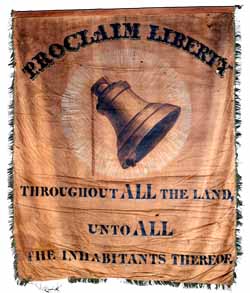 The MHS’s Education and Public Programs Department continued its successful pursuit of grant funding. The department received $15,000 in funding from the Library of Congress (LOC) for its program entitled The End of Slavery: Document and Dilemmas. MHS staff will take 20 documents from the LOC From Slavery to Freedom digitized collections and 20 documents from the MHS African Americans and the End of Slavery and Images of the Antislavery Movement in Massachusetts digitized collections to develop educational materials for teachers based on both institutions' resources. Working with Boston-area teachers, the MHS will create curriculum units available through the MHS website. These materials will then become the core of a wide range of professional development programs for educators, including primary source-based workshops to be held at the MHS in 2010 and conference presentations with partners at local and national conferences for historians and educators.
The MHS was also part of a team of organizations awarded funding by Mass Humanities for John Brown and New England, a series of public programs commemorating the 150th anniversary of John Brown's raid on the federal arsenal at Harpers Ferry. John Brown and New England is a collaborative project of the MHS, American Antiquarian Society, Thoreau Society, Worcester State College, and Mechanics Hall. The MHS will contribute two lectures to the series. The first, The Kaleidoscope of History: John Brown after Fifteen Decades, will be presented on 27 October by Bruce Ronda, professor and chair of the Department of English at Colorado State University. On 7 November, David S. Reynolds, distinguished professor at the Graduate Center of the City University of New York will discuss Warriors for Freedom: John Brown and Henry David Thoreau. For more information on these events visit the MHS online calendar.
On a separate note, the MHS received a matching grant of $22,100 from the Massachusetts Cultural Council (MCC), a state agency. This grant was awarded through the MCC's Organizational Support Program and will help the Society create and promote exceptional public programs and exhibitions to the community. As an investment in the MHS, the grant signifies that the Society provides a high level of quality in its programs, services, and administrative ability. The staff of the MHS would especially like to recognize MHS Fellow Gov. Deval Patrick and the state legislators who supported the MCC, and in turn the MHS, particularly Sen. Steven A. Tolman and MHS Fellow Rep. Byron Rushing.
Last but not least, the Trustees of the Ruby W. and LaVon P. Linn Foundation awarded the MHS Library a grant to replace a traditional microfilm reader with a microfilm scanner. The new equipment produces high resolution digital scans of microfilmed manuscripts, allowing researchers and staff to print, e-mail, or save the relevant pages to a CD, USB drive, or hard drive. The microfilm scanner will also give the MHS the capacity to create direct digital scans of 60 years of microfilm, simultaneously preserving its collections while making them more accessible to researchers around the world. Researchers interested in taking advantage of the new scanner should contact the Reference Librarian before visiting the Library to determine when it will be installed.

older posts
 Current newsletter