PREVIOUSLY UNKNOWN ABIGAIL ADAMS LETTER: A blend of business, news, and political observations
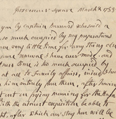 BOSTON, June 2011—The Massachusetts Historical Society is pleased to announce that it recently acquired a letter that Abigail Adams wrote on 2 March 1788 to Dr. Cotton Tufts, the Adamses' financial agent in the United States for the period that they were abroad. Judge Lawrence T. Perera donated the letter as a gift in memory of his father, Guido R. Perera. It is a classic example of Abigail’s correspondence with Dr. Tufts, blending business issues and personal news with astute political observations. Adams Papers Managing Editor Margaret A. Hogan comments, “We had no previous record of this letter. Abigail’s comments on the state of politics in Europe, and her observations concerning events related to the U.S. Constitution, make this a valuable letter for scholars interested in the Adamses and the history of the era.”
Married to John Adams, Abigail was an invaluable partner to him as his political career developed. After his election to the First Continental Congress in Philadelphia in 1774 and throughout the Revolution, Abigail was often left alone to raise the children, manage the farm, supervise the household and tenants, and care for extended family and friends. The letters she exchanged with John and other family members reveal her cares and worries, document her frank opinions and advice, and give an extraordinary view of everyday life in 18th-century New England.
In 1784, Abigail joined her husband in Europe, where he had been on diplomatic missions since 1779. This letter to Dr. Tufts was one of the last letters Abigail wrote from her home in Grosvenor Square, London, to the United States prior to her return in June 1788. Cotton Tufts, a cousin of Abigail’s, was one of the Adamses’ most important correspondents while they were abroad. He, in fact, helped to negotiate the purchase of the house now known as the Adams National Historical Park that John and Abigail would make their home upon their return to Massachusetts.
Along with her comments on the increasingly tenuous situation in France, where the financial and political crisis would shortly lead to revolution, Abigail’s thoughts on the American government and the need for it to be put on a stronger footing are especially noteworthy. Consideration of the new U.S. Constitution by the individual states was ongoing at this time—Tufts himself represented Weymouth as a delegate to the Massachusetts ratifying convention—and Abigail makes clear her own position: “How necessary is it my dear sir, for our own National honour & dignity Safety & security, that we should not cavil away our present advantages, but that our Government should assume a New & more respectable form, and by experience, rectify what we find amiss—” Also remarkable in this letter is Abigail’s particular appreciation for “the writer of those excellent paper”—Publius, the pseudonym used collectively by Alexander Hamilton, John Jay, and James Madison—in authoring the Federalist Papers.
read more
HISTORY DRAWN WITH LIGHT: Early Photographs from the Collections of the Massachusetts Historical Society
 BOSTON, March 2011—In 1840, almost as soon as photography arrived in America, the Massachusetts Historical Society began to collect images of notable figures, artifacts, and landscapes recorded with "the pencil of nature." Examples of these early photographs will be on display 11 March to 3 June, 2011 in the Society's exhibition, History Drawn with Light: Early Photographs from the Collections of the Massachusetts Historical Society. Visitors can view one of Boston's oldest photographs, taken of the Old Feather Store by MHS Member Francis C. Gray, together with portraits and views by early daguerreotype artists such as Albert S. Southworth and Josiah J. Hawes, and the later work of professional and amateur photographers who documented 19th-century American history as it unfolded. The exhibition is free and open to the public, Monday through Saturday, 1 PM to 4 PM.
One of the first demonstrations of Louis Daguerre’s new and revolutionary photographic process, the daguerreotype, took place in the Tremont Street rooms of the Historical Society. The MHS photograph collections began almost immediately with the receipt of a “well delineated specimen of a new art,” a daguerreotype view of the oldest building in Boston. Some of the first daguerreotypes made in Boston were of architectural landmarks, but improvements in photographic technology in the 1850s brought about a revolution in urban photography. Advances in camera design and the mass production of film negatives made it possible to systematically record streetscapes and create high-angle, panoramic views such as a large panorama of the Boston waterfront in 1877 which will be on view as part
of this exhibition.
Early daguerreotype portraits were physically uncomfortable, time-consuming, and expensive to make, yet they quickly became extraordinarily popular. By 1850, Boston was home to forty-three daguerreotype studios, including the notable firms of (Albert S.) Southworth and (Josiah J.) Hawes; and John A. Whipple—who soon would be joined in partnership by James W. Black. The exhibition features a range of daguerreotypes from the stern 1851 portrait of Daniel Webster by Southworth & Hawes to an evocative profile of Annie Adams Fields by Southworth & Hawes in 1853 to a curious image of Seth Eastman on Dighton Rock by Horatio B. King in 1853.
The introduction of small, “instantaneous” cameras and magnifying stereoscopic viewers in the late 1850s allowed photographers to create life-like, three-dimensional images of everyday human activity. The popularity of stereoscopic city views meant that in the aftermath of the Great Boston Fire of 1872, photographers were able to create before-and-after pictures of the enormous destruction caused by the fire. Visitors will have the opportunity to use a modern stereoviewer to view reproductions of these before and after stereoviews, as well as being able to view the orginals.
The Civil War saw an enormous increase in the number and types of photographs available to the public. Abolitionists enlisted the new medium in their cause and distributed powerful images of the cruelty of slavery. One such image is the iconic daguerreotype of Captain Jonathan Walker’s branded hand taken in 1845. Mass production made the visual record of the war truly democratic as senior officers and political figures appeared side by side with ordinary soldiers in carte de visite albums. The exhibition includes portrait albums; tintype and ambrotype photographs of Civil War officers and soldiers, camps and battlefields; and some portraits of the famous Massachusetts 54th Infantry—the first African American regiment raised in the North.
The introduction of dry-plate negatives and hand-held cameras in the 1870s and 1880s simplified photography and dramatically increased the number of amateur photographers. The dry-plate revolution made photography a popular pastime, but also led to the rise of a new category of technically accomplished amateurs who saw photography as a new form of artistic expression. Examples of the amateur photography movement that flowered in the 19th-century are on view, including notable portraits by Marian (Clover) Adams and early examples of high-speed photography by the inventor Francis Blake.
Generous support for this exhibition is provided by Eaton Vance Investment Counsel and The William L. Saltonstall Memorial Fund at the Massachusetts Historical Society.
read more
New Henry Adams’ Letters Uncovered: Offer Rare Personal View of Wife’s Tragic Suicide
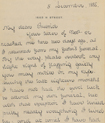 BOSTON, November 2010—An astonishing discovery of 13 hand written letters was made while settling the estate of a descendant of Anne Palmer Fell. Written by Henry Adams—historian, novelist, intellectual, and grandson of President John Quincy Adams—these letters offer a rare personal view of his wife’s tragic suicide. The letters have been donated to the Massachusetts Historical Society (MHS) by the Marian Vans Agnew Smith Living Trust.
In the published correspondence of Henry Adams there are 21 letters from Henry Adams to Anne Palmer Fell. However, these 13 letters appear to be unknown, making their discovery all the more significant. And what makes the letters so remarkable is the personal nature of the correspondence. Natalie Dykstra, Associate Professor of English at Hope College and author of a forthcoming biography of Clover Adams to be published by Houghton Mifflin Harcourt, characterizes the letters as “an extraordinary literary find. This collection expands and enriches our understanding of the crucial time period following Clover’s suicide,” Professor Dykstra states. The letter Adams wrote just a month after his wife’s death, in particular, “reveals his broken heart. It’s a potent mix of doubt, self-reproach, determination, and a cry for a great love lost. This letter unveils, and in a new way, how Henry Adams would survive the death of his wife.”
Henry Brooks Adams, grandson of President John Quincy Adams, and Marian “Clover” Hooper Adams were married on June 27, 1872. Falling into a bout of depression after the death of her father, Clover committed suicide in December 1885. The recently discovered letters disprove the generally accepted claim that after her death, Henry never mentioned her name again. In a letter dated January 1886—just a month after Clover’s death—Henry not only mentions Clover by name but provides insight into how he was dealing with her loss, “Even now I cannot quite get rid of the feeling that Clover must, sooner or later, come back, and that I had better wait for her to decide everything for me… The only advice I have for you is to get all the fun you can out of life. The only moments of the past that I regret are those when I was not actively happy. As one cannot be always actively blissful, one must be contented with passive content, but it is a poor substitute at best, and makes no impression on the memory. My only wonder is whether I could have managed to get more out of twelve years than we got, and if we really succeeded in being as happy as was possible.”
read more
MHS Exhibition: "Precious Metals: From Au to Zn"

MHS Exhibition will Showcase its Numismatic Treasures: 2 August through 2 October
The Massachusetts Historical Society (MHS) is taking the opportunity to show off some of its numismatic treasures while the American Numismatic Association (ANA) is in Boston this summer hosting the World's Fair of Money. Opening on 2 August, “Precious Metals: From Au to Zn” will be on display in the Society’s building at 1154 Boylston Street.
read more