MHS News
 Current newsletter
The Private Jefferson: From the Collections of the Massachusetts Historical Society
Through the Society’s collections, uncover one of the most famous yet enigmatic and private Americans, Thomas Jefferson.
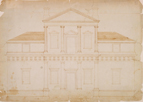 Thomas Jefferson has been described as an "American Sphinx." As the drafter of the Declaration of Independence and the third President of the United States, he is one of the most famous Americans. Nevertheless, he is an enigmatic figure. Through a selection of architectural drawings, writings and correspondence, and record books from the collections of the Massachusetts Historical Society, a new exhibition at the MHS seeks to pull back the veil and uncover the private Jefferson. Kicking off a year-long 225th anniversary celebration, The Private Jefferson: From the Collections of the Massachusetts Historical Society is on display through May 20, Monday through Saturday, from 10:00 AM to 4:00 PM.
Divided into four sections—architecture, writings, politics, and farm and garden—the exhibition will enable visitors to explore different aspects of Jefferson’s complex personality. The public can discover how Jefferson used architecture to work out practical and technical design issues as well as larger philosophical issues. They can see how his political ideas are expressed through his writings and select correspondence between family and friends. They can gain insight into Jefferson’s personal story of writing the Declaration of Independence and see how the text celebrated today evolved from his original draft. And visitors can understand how Jefferson’s role as plantation owner, experimental gardener, and meticulous record-keeper shaped his beliefs in how the nation would achieve economic and political independence.
Architecture
The MHS holds more than 400 of Thomas Jefferson's architectural drawings, the earliest comprehensive record of the career of an American architect. While other collections of his drawings document a single building or building program, the MHS collection contains drawings for all of Jefferson's major architectural projects. A dedicated disciple of Venetian architect Andrea Palladio, Jefferson designed his home, Monticello, to be a model of the correct use of the classical orders of architecture. He also busied himself with drawings to illustrate the proper shape for a molding, how to hang window curtains, or the correct way to construct a staircase. Drawings of Monticello, including the ca. March 1771 final elevation of first version (above); a ca. 1778 drawing of an Ionic portico and dome for a decorative outbuilding (left); and the ca. August 4, 1772, “Final drawing of the basement and dependencies” (subterranean work rooms) are on display. There are preliminary plans for Poplar Forest, the octagonal retreat that Jefferson built for himself in Bedford County, Virginia as well as drawings for the original design of the Virginia State Capitol in Richmond, a modern government building in the form of a classical temple, and studies for the University of Virginia, Jefferson's vision of what an academic community should be.
Writings
The Society’s collection includes thousands of letters written to Jefferson as a private citizen (and copies of his replies). It also holds one of the most celebrated literary exchanges in American history—Jefferson’s correspondence with John and Abigail Adams found in a total of 380 letters. A selection of these letters, along with his letters to family and friends, allow visitors to begin to understand Jefferson’s personal and political views. Included is Jefferson’s last letter to John Adams, written March 25, 1826, in which he compares their roles in the Revolution to the Argonauts of Greek mythology as well as a letter to Abigail Adams written August 9, 1786, in which Jefferson discusses shopping for her in Paris as well as what she has bought for him in London. This section also highlights the much-annotated manuscript of his only book, Notes on the State of Virginia, and Jefferson’s catalog of his immense personal library.
Politics
The exhibition continues with the most public of all American historical documents, the Declaration of Independence. Visitors are able to glimpse the personal story of the creation of the document that lies behind the official story that we celebrate today. Jefferson was so concerned with the manner in which the Continental Congress had "mutilated" his draft of the Declaration that he circulated copies of his original manuscript (left) to show friends and colleagues what he had intended. John Adams’s handwritten copy demonstrates—perhaps even better than Jefferson’s copy—the evolution of the text from Jefferson’s original rough draft. The first printing of the Declaration of Independence by John Dunlap on July 4-5, 1776, as well as a broadside printing of Pres. Thomas Jefferson’s first inaugural address on March 4, 1801, in which he calls for national reconciliation, are also on display.
Farm and Garden
Jefferson was a plantation owner—an agriculturalist on a very great scale—and an experimental gardener. His farm and garden books contain detailed records of his estates, calculations and observations of planting and construction, and his notes on experimental and decorative planting over the course of almost sixty years. Both will be on display. His farm records are primarily an account of agricultural business affairs, and therefore contain information about the central dilemma of American history—slavery—on almost every page. These records are supplemented by drawings and sketches for slave quarters, planting beds, agricultural equipment, and decorative details and architectural follies for his garden. Included in this section are letters between Jefferson and his granddaughters Anne and Ellen Randolph about his gardening plans in retirement.
The Coolidge Collection of Thomas Jefferson ManuscriptsOne of the Society’s greatest treasures is the Coolidge Collection of Thomas Jefferson Manuscripts. The collection is comprised of letters, journals, record books, accounts, and more than 400 architectural drawings—almost 9,500 documents in all—collected by Jefferson’s descendants who lived in Massachusetts and donated them to the Society.
Companion Publication
The Private Jefferson: Perspectives from the Collections of the Massachusetts Historical Society, a full-color, extensively illustrated publication with essays by Henry Adams, Peter S. Onuf, and Andrea Wulf, and published by the MHS is available for purchase online or at the Society.