
April 2026
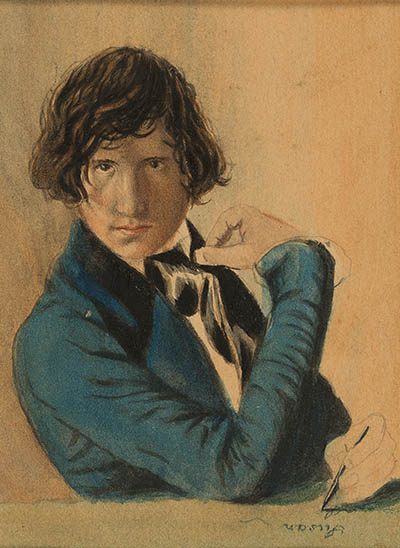
This diminutive self-portrait by Boston artist Samuel Worcester Rowse was executed in the first half of the 1840s. It depicts the young man striking a dramatic pose as he pens a letter to “Susan.” The boldness of this painting stands in contrast to the genteel crayon portraits that were the bread and butter of his artistic career.
Samuel Worcester Rowse was born in Bath, Maine, in 1822, one of seven children born to Edward Rowse, a merchant, and his wife Mercy Blake. When Samuel was young, the family lived in Augusta, Maine, but by the age of 18, Samuel had moved to Boston and begun his artistic career, as an 1840 notice in the Kennebec Journal confirms: “We have been presented with a fine, and we suppose pretty accurate likeness of Gen. Harrison, from the lithography of E. W. Bouvé … The work was done we understand by Samuel Rowse, a young man formerly of this town.” From 1840 to the mid-1850s, Rowse worked for various lithographers in Boston including Bouvé and Tappan & Bradford and provided illustrations for books and illustrated magazines including Ballou’s Pictorial and Gleason’s Pictorial.
Beginning about 1855, Rowse established a studio and began to produce the portraits that would make his artistic reputation. Working in crayon (made of charcoal or chalk), rather than oil like most professional artists of the time, gave Rowse’s portraits their distinctive style. The medium allows for subtle effects in light and shadow, creating portraits that were, as Patricia Hills notes, “of course, real people, but they were also, more importantly to Rowse and his sitters, idealized images of decorum and gentleness … [that] charmed a generation.” Bolton’s Early Portrait Draughtsmen lists some 41 portraits of Boston and Cambridge intellectual and literary figures immortalized by Rowse including Ralph Waldo Emerson, Henry David Thoreau, and Nathaniel Hawthorne, as well as members of the Bullard, Longfellow, Lowell, Norton and Shaw families.
In 1864, Rowse was elected to Boston’s Saturday Club, but in the 1870s, he decamped for New York City, splitting his time between there and Europe for the remainder of his life. He died in 1901 at Morristown, N.J., where he was living with his nephew, and was eulogized by his hometown Daily Kennebec Journal as “a painter of wide fame.” Even the Dallas Morning News carried an obituary of Rowse noting
When a great artist dies in Europe, the fact meets with universal record and regret; in this country it goes without even a newspaper mention; at least in the case of Rowse, who in crayon portraiture was acknowledged to be without a rival at home or abroad … some fifteen years ago he laid aside his work forever, rich, famous, and sought for. He eventually became to the art world a memory. He belonged to no cliques or academies, never exhibited his work … It is doubtful if Rowse had any ambitions or cared for fame … He never sought society; it had to seek him, and in return he gave it honest coin, and had perhaps more admirers than those who strive for such.
The Susan to whom Rowse is writing in his self-portrait is Susan Watkins Smith, later Heath. Born 20 February 1823 to John Smith and Sarah Locke of Dover, New Hampshire, she married George W. Heath of Boston in September of 1846, allowing us to date Rowse’s self-portrait to the first half of the 1840s. She was married less than six months before her death from consumption in March of 1847. A 22 November 1927 letter from Ann Hibbard to Henry M. Seaver in the Hibbard-Seaver Papers in the MHS gives the history of the painting and its connection to their family
It is the portrait of a painter who boarded in Boston (either Province House Court or Suffolk Place, now no more) with my grandmother [Sarah] Smith, mother of John, Sarah Hibbard, Mary Jane Deming, and Susan, whose portrait in oils you have. This artist, whose name you will see on the back of the picture (W. Rowse), made this painting for the aforesaid Susan, your mother’s Aunt Susan for whom she was named. You will see where Mr. Rowse wrote “Susan” in the picture. It is not a great work of art but is interesting … I remember when he used to exhibit in the Boston Art Club …
Bolton, Theodore. Early American Portrait Draughtsmen in Crayons New York: Frederic Fairchild Sherman, 1923; read the online version.
Emerson, Edward Waldo. The Early Years of the Saturday Club Boston: Houghton-Mifflin, 1918
Hills, Patricia. “Gentle Portraits of the Longfellow Era: the Drawings of Samuel Worcester Rowse,” Drawing, vol. 2, no. 6 (March-April 1981), p. 121-126
Sullivan, Mark W. Picturing Thoreau: Henry David Thoreau in American Visual Culture Lanham: Rowman & Littlefield, 2015