October 2025
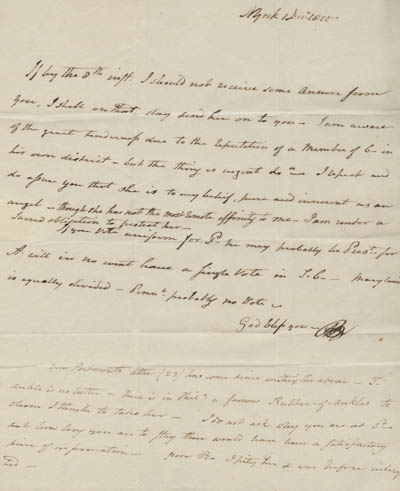
This letter of 1 December 1800 from Aaron Burr to Dr. William Eustis of Boston enlists Eustis’s help in finding a suitable accommodation for a young woman named Susan Lewis—the daughter of Maria Reynolds, Alexander Hamilton’s erstwhile paramour.
Maria Lewis was born on 30 March 1768 in Dutchess County, New York, the daughter of Susannah Van Der Burgh and her second husband Richard Lewis. Maria married James Reynolds in 1783 and their daughter Susan was born two years later. In 1791, Maria Reynolds became embroiled in an affair with Alexander Hamilton; blackmail ensued and, although the affair was largely kept under wraps at the time, it would explode into notoriety six years later upon Hamilton’s publication of the "Reynolds Pamphlet"
Meanwhile, in 1793, Maria filed for divorce from her husband on the basis of his adultery. In a striking coincidence, her divorce lawyer was none other than Aaron Burr, Hamilton’s longtime frenemy. Burr was locally well regarded as a divorce lawyer, so it is not surprising that Maria should choose him, although whether Burr was aware of her liaison with Hamilton (and she aware of his connection to Hamilton) at the time is unclear. Nancy Isenberg muses on Burr's motivation: did he have "Pity for an abused wife? Or was he actually protecting Hamilton by freeing Maria from the clutches of her manipulative husband?" No matter, Maria's divorce was granted by the courts in 1795 and she married Jacob Clingman (one of James Reynolds's co-conspirators in speculation). The couple moved to Virginia, but by 1800, she had divorced Clingman and returned to Philadelphia, daughter in tow and reputation in tatters.
In December of 1800, Aaron Burr again interceded for his former client—arranging for his friend William Eustis to take Maria's daughter in, far away from the stain of her mother's infamy. Burr wrote that Susan (who went by her mother's maiden name Lewis) was "pure and innocent as an angel ... I am under a Sacred obligation to protect her." In April of 1801, Burr further instructed Eustis, "The object is to give her the kind of education that may enable to gain a livelihood, if that should depend on her own exertions. Economy is desirable—but nothing which is done by the patron must be done meanly." Eustis placed Susan Lewis in a respectable boarding school and both men hoped for the best.
A recurring theme in ensuing letters between Burr and Eustis is an emphasis that Susan is not Burr's daughter. Burr states this clearly in his letter—"she has not the remote affinity to me," while Eustis notes that Burr's alleged paternity "gained a pretty general credence which has been confirmed by the consignment to E—" in his letter to Burr of 11 August 1803. Eustis also frets about the damage to his reputation should his guardianship of Susan fail.
Unfortunately, all of Burr's and Eustis's good intentions were for naught. By the summer of 1803, Susan had eloped with a young Bostonian named Francis Wright, Jr., of whom Eustis opined, "This young man's character ... is every thing which one would wish not to have combined in a friend, or a friend's friend ... the young man has I believe from his proficiency been educated to dissipation without acquiring any one decent trait as the world says—I regret exceedingly the event which has cast the destiny of our charge into such keeping."
The union of Susan and Francis was short-lived, "three weeks seems by this to be the period in which satisfaction is to be had or conviction that none is to be had there." Susan returned briefly to her former lodgings in Boston, but by August was lodged in "a house reputed to be frequented by young men." Eustis duly reported to Burr that, "I see nothing to be expected for our unfortunate charge but a gradual declension from reputable life down to what length or depth god only knows ... to have the plant fail or be blasted in this soil is not pleasant to me—and that this will be the case cannot I think be doubted."
Sadly, that seems to be the case. In his article about the Reynolds Affair, historian Jacob Katz Cogan sums up Susan's life after Boston and death at age 39:
Susan Lewis's desultory and luckless childhood affected her in ways we will never understand. Thrice married and twice divorced, she bore at least two children, both raised by their maternal grandmother Maria. After she left her third husband, Lewis ... grew "fierce and unmanageable ... until she became unfit for society." She died in New York City "in misery and poverty, amongst a wretched class of human beings."
Her mother, however, seems to have achieved some measure of respectability and acceptance in Philadelphia society at last. She married Joseph Mathieu, a French physician, raised Susan's children, and was an active church member before her death in 1828. The paths of Alexander Hamilton and Aaron Burr crossed for the last time at Weehawken, New Jersey, on 11 July 1804.
Burr, Aaron. Political Correspondence and Public Papers of Aaron Burr, Mary-Jo Kline, ed. Princeton: Princeton University Press, 1983
Letters referencing Susan Lewis can be found under the dates of 1 December 1800, 18 April 1801, 11 June 1803, [31 July 1803], and 7, 9, and 11 August 1803
Cogan, Jacob Katz. "The Reynolds Affair and the Politics of Character," in Journal of the Early Republic, vol. 16, no 3 (Fall 1996), p. 389-418
Hamilton, Alexander. The Papers of Alexander Hamilton, Harold C. Syrett, ed., vol. 21 New York: Columbia University Press, 1974
Isenberg, Nancy. Fallen Founder: The Life of Aaron Burr New York: Viking, 2007