Latin: The Other Adams Family Business

by Gwen Fries and Rhonda Barlow, The Adams Papers

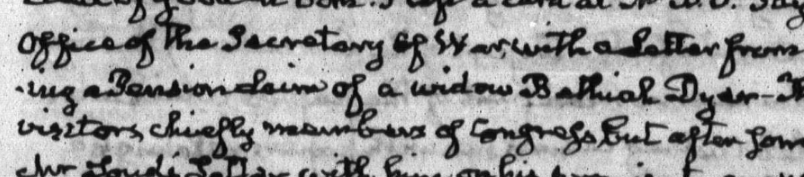
On 4 October 1815, twelve-year-old John Adams II sat down at a desk outside London to write a letter to his grandfather. The middle child of John Quincy and Louisa Catherine Adams had spent several years of his life being raised by John and Abigail on their farm, Peacefield, while his father and mother served in a diplomatic role in St. Petersburg, Russia. Now reunited with his parents, John II wanted to write a letter to his grandfather to show how far his education had come. His little brother, Charles Francis Adams, had just composed a letter in French. Not to be bested, John II was going to do it in Latin.

The problem was John II was an indifferent scholar. He loved to be the center of attention, stalking his aunts and cousins around Peacefield and chattering incessantly. What he possessed in charm and charisma, he lacked in concentration. Thus, his father insisted on looking over the letter before it was sent. John Quincy, ever the perfectionist, had some thoughts.

Rarer than an extant copy of a child’s Latin is an extant draft of a Latin composition. We’re given a clear visual of how he thought through each word of the letter and how his father refined it. I could see the juvenile writing and the interlineated corrections, but I had to tag in Adams Papers research associate Rhonda Barlow to make sense of what I was seeing. She translated John II’s letter thus:

My dear grandfather,

I received your letter from you on 23 July beginning that you were awakened by a morning bombardment. You say that you have no taste for noisy rattling and clapping, but I have and my brothers have.

I am a student at Ealing which has 275 boys served by Dr. Nicholas from the schools of Oxford[.] I am very pleased with him.

It is the first time that I ever wrote a letter in Latin, and thus you will expect I make many mistakes.

I am your obedient grandson

J Adams

Then she translated John Quincy’s interlineations:

My Dear Grandfather

I received your letter written by you on the 23d of the month of July where you reported that you were awakened by a morning bombardment.

You say that you take no pleasure in applause and toasts but they are pleasing to my brothers and I.

I am a student in the school of Dr. Nicholas, at Ealing, where I have 275 fellow-students. Our teacher, the doctor, is an alumnus of Oxford University, and I am very grateful.

This letter is my first in the Latin language, Dearest Grandfather, I wish you to receive it kindly; and that you forgive its many faults.

Farewell, my grandfather, and love, your most humble and most loving grandson.

J. Adams

Barlow explained to me that JQA’s edits were in the spirit of conforming more to classical Latin. The one exception to this is the word “bombarda,” which John II likely plucked out of the Ainsworth Latin Dictionary, and which his father and grandfather enjoyed. (To be fair to the tweenager, classical Latin wouldn’t have a word to mean gun, and it’s the noisy nature of guns that’s key to the sentence.)

The letter went from the composition of a careless child to the product of a skilled linguist. “Your classical letter of the 4th. of Octr, does you honour, upon every Supposition that I can make,” his delighted grandfather responded on 14 Dec. 1815. However, a hint of suspicion crept in amongst the praise. “If you have composed it yourself, it is highly honourable to the Skill and care of your Preceptors and to your own Application to your Studies; All of which must have concurred in producing Such a proficiency in so Short a time.”

The Adams Papers editorial project at the Massachusetts Historical Society gratefully acknowledges the generous support of our sponsors. Major funding of the edition has been provided by the Packard Humanities Institute, the National Endowment for the Humanities, and the National Historical Publications and Records Commission.

A Perilous Transformation: The Soldiers of Fort Washington & the Siege of Boston

by Aaron Peterka, MHS Early Career Scholar Committee & Mentorship Program Member

Over the course of 250 years, the grass-covered mounds of Cambridge’s Fort Washington morphed from a necessary military fortification to a lasting monument to the American Revolution’s early perils. It is also a monument to another kind of metamorphosis: that of a colonial citizen army outside Boston in 1775-76 to the professional Continental Army that emerged victorious at Yorktown in 1781. Diaries from the MHS archives, like that of Boston merchant William Cheever, clearly illustrate the hazards for the New Englanders who faced the British, who, though besieged, were still mobile and active in late 1775/early 1776.

In one entry dated November 9, 1775, mere weeks before Fort Washington’s construction began, Cheever noted that “Several Companies” of British regulars crossed over to “Phip’s Farm” and “brought off some Cattle at noon day under Cover of a Ship in the River, Cannon on Charlestown point, and their own Floats.” He recorded a similar raid that took place on February 14, 1776, wherein the night before, “a Number of the Light Infantry and Grenadiers went over to Dorchester Neck and burnt 4 or 5 Houses” and took several prisoners. Moreover, as the Americans continued to entrench in front of Cambridge, the British did likewise in Boston. Cheever noted on December 4, 1775, that the “regulars have a Battery just above the Copper-Works” in west Boston, as well as colonial artillery dueling British ships “at the head of the Charles River,” as the British attempted to keep the Americans from “carrying on their Works on a Rise at Phips’s Farm.” Soldiers like Private Obadiah Brown of Gageborough, Massachusetts, could easily supplement Cheever’s observations, as Brown recalled an ordeal on February 20, 1776, where the British “Regulars fired all Day” at him and his comrades as they dug trenches at “Leachmore point.”

Such accounts bring to life the hardships and precarity of the Revolution’s earliest days, and it is to this narrative of trial and peril, so carefully preserved in the MHS’s collections, that Fort Washington belongs. However, that narrative not only includes the challenges of containing a worthy foe, but also the complex characters of those soldiers who held the line in bastions like Fort Washington.          

Photo of 3 cut-out statues standing in a park-like environment
Life-size renderings of colonial soldiers at Fort Washington today.
Courtesy of Aaron Peterka.

In the summer and fall of 1775, General Washington hardly held those soldiers in high esteem. He lamented their apparent self-centeredness, poor discipline, and civilian attitude, writing to Lieutenant Colonel Joseph Reed on November 28, 1775, that “such a dirty mercenary Spirit pervades the whole, that I should not be at all surprised at any disaster that may happen.” Granting generous furloughs just to keep up enlistments, the general also despaired over the Connecticut regiments’ refusal to extend their service beyond their original term, fearing that absent soldiers and expiring enlistments would weaken his army to the point of disintegration. “[O]ur lines will be so weakened that the Minute Men & Militia must be call’d in for their defence,” Washington ruefully observed, and “these being under no kind of Government themselves, will destroy the little subordination I have been laboring to establish.”

The diary of the aforementioned Private Brown allows for a glimpse into Washington’s conundrum. Oftentimes, Brown stood “gard” or performed “feteague” duty at the “Leachmore point” fort from January to March 1776. But interspersed throughout his terse entries are observations of drunkenness and ill-discipline; the kind that would drive mad a professional soldier like Washington. In one instance on February 7, 1776, “Two Sodiers Drank 33 glases of Brandy and Gin one Died.” Five days later, Brown witnessed another soldier receiving “39 lashes” for an unspecified indiscretion. And on February 16, 1776, Brown recalled that “orders came for one Shilling to be taken out of the Sodier wages for Every Cartridg Lost,” a stark reflection of the dire shortage of shot and powder that threatened the army, as well as the general unmilitary air that characterized the army in New England. And despite its successful re-occupation of Boston in March 1776, this same army would endure defeat after defeat in the coming years, and through the miseries of Valley Forge, painfully transform into the Continental Army that would ultimately prevail at Yorktown. Fort Washington is a testament to the beginning of that metamorphosis.

It is this complicated history of which Fort Washington is a part. It is a reminder of the challenges and contradictions that shaped the Revolution and this country’s birth: the fierce independent spirit that drove the colonists to rebel and made them poorly disciplined soldiers; the uncertainties of maintaining adequate supplies and manpower; and the looming threat posed by the growing might of the British army in Boston. In a time when the United States remains the world’s superpower, its military might thus far unmatched in the 21st century, it is easy to forget these truths. And yet, Fort Washington continues its silent vigil; a memorial that compels all who reflect upon it to remember “the times that try men’s souls.”      

Further Reading:

“From George Washington to Lieutenant Colonel Joseph Reed. 28 November 1775,” Founders Online, National Archives. https://founders.archives.gov/documents/Washington/03-02-02-0406.

Thomas Paine. Common Sense and Other Works. New York: Fall River Press, 2021.

Silent Sentinel, Silent Witness: Reflections upon Fort Washington & the Siege of Boston

by Aaron Peterka, MHS Early Career Scholar Committee & Mentorship Program Member

At 95 Waverly Street in Cambridgeport, a silent sentinel still keeps watch. Its four earthen mounds, cradling three eighteen-pound cannons, still face eastward towards Boston, standing at the ready for a long-departed foe from a long-ago war. This is Fort Washington. A relic from the beginning of the American Revolution, this unimposing redoubt is all that remains of the fortifications that besieged the British army in Boston from April 1775 to March 1776. As the country marks the Revolution’s semiquincentennial anniversary, it is all together appropriate to reflect upon Fort Washington and its testimonial to the perilous origins of an army and the embryonic country for which it fought.

Photo of a grassy area with some cannons. Large buildings and trees are in the background.
Facing east, Fort Washington’s three 18-pounder guns positioned between earthworks dug by the Continental Army besieging Boston in 1775-1776.
Courtesy of Aaron Peterka.
Photo of a grassy mound with two cannons on it
Looking west into Cambridge. Although not the originals, the cannons date from the Revolutionary era, while the gun carriages are from the 1850s.
Courtesy of Aaron Peterka.

Fort Washington’s service began on a simple piece of paper upon which General George Washington penned a letter to Lieutenant Colonel Joseph Reed on November 27, 1775. When he first arrived in Cambridge that July to take command of the fledgling Continental Army, he found the fortifications woefully inadequate for a siege, with “shallow redoubts on Winter Hill and Prospect Hill,” a “crude abatis on the Boston Road,” a mere trench stretching across Roxbury’s main street, and a single “breastwork on Dorchester Road.” Rightly concerned with such vulnerabilities, the general labored to improve the American defenses through the coming months, and it was under this labor in the fall of 1775 that he informed Reed that he “caused two half Moon Batteries to be thrown up, for occasional use, between Litchmores point to command that pass, & rake the little rivulet which runs by it to Patterson’s Fort.” Washington also commissioned the construction of three other fortifications “between Sewells point, & our Lines on Roxbury Neck” to further reinforce the American lines.

These fortifications are clearly visible on the Henry Pelham Map from 1775 in the Massachusetts Historical Society’s collection, with Fort Washington appearing as the “3 Gun Battery” sitting along the Charles River just before it empties into Boston Harbor. Today, modern Cambridge surrounds the fort, but in 1775, it commanded both the river’s mouth and the southernmost extremity of a meadow that is now part of the MIT campus. This strategic position contributed to Washington’s goal of preventing a British “Sortee, when the Bay gets Froze” and securing Cambridge from attack. Designed to accommodate roughly 50-60 soldiers, the earthen redoubt took the name of the American general-in-chief, its garrison scanning the marshy approaches for any sign of British encroachment. Although there is no record of the fort having ever fired its guns in anger, it nevertheless served an important purpose; a brick in the greater wall that Washington designed to restrict General William Howe’s freedom of movement. And yet, Fort Washington’s service transcends the realm of strategy.

Beyond its military utility, Cambridge’s redoubt gives testament to the harsh realities that confronted the infant American army outside of Boston. In another letter to Reed dated November 28, 1775, Washington conveyed his fears of dwindling gun powder supplies, writing that the vital commodity was “so much wanted, that nothing without it can be done.” Also weighing heavily upon Washington was the omnipresent threat of British spoiling attacks and counter-strikes. Indeed, the general expressed his expectation that the British would interfere with the digging of the “Letchmores point” earthworks, “unless Genl Howe is waiting the favorable moment he has been told of, to aim a capitol blow.”

Facing a growing force of British regulars with an army of untrained civilian-soldiers and his supplies dangerously low, General Washington confided to Reed that had he been able to foresee the dismal state of affairs outside Boston, “no consideration upon Earth should have induced me to accept this Command.” Thus, Fort Washington is both a literal product and reflection of the crisis of 1775, wherein the siege of Boston, even the survival of the Revolution, was in doubt. Erected out of military exigency, the Cambridge earthworks remain a physical reminder that no cause, no revolution, no fight for independence, is ever guaranteed.     

Further Reading:

“From George Washington to Lieutenant Colonel Joseph Reed. 27 November 1775,” Founders Online, National Archives. https://founders.archives.gov/documents/Washington/03-02-02-0401.

“From George Washington to Lieutenant Colonel Joseph Reed. 28 November 1775,” Founders Online, National Archives. https://founders.archives.gov/documents/Washington/03-02-02-0406.

“Fort Washington,” https://historycambridge.org/Cambridge-Revolution/Fort%20Washington.html.

Robert Middlekauf. The Glorious Cause: The American Revolution, 1763-1789. Oxford: Oxford University Press, 1982.

The Diaries of Henrietta Maria Schroeder Stout, Part I

by Susan Martin, Senior Processing Archivist

I’d like to introduce you to a young woman named Henrietta, whose diaries form part of the Stout family papers here at the MHS. This post will be the first in a multi-part series.

Color photograph of one page of a manuscript volume with some creases and stains. In the center is a black and white photograph of a white girl wearing a dark coat, dark hat, and dark gloves. She is standing, and her fingers are interlocked in front of her. Below the photograph is written, in black and white ink, “Myself, age 13, taken March 1889.” Along the side of the photograph is written, “This picture no more looks like me than it looks like a crow.” At the top of the page is written, “This book is to be my companion wherever I go.”
Inside front cover of Henrietta M. Schroeder’s 1889 diary, including her photograph, taken March 1889, and the text: “This picture no more looks like me than it looks like a crow.”

Henrietta Maria Schroeder, or “Yetta,” was born in New York on October 9, 1875. Her father, Francis Schroeder, had been a diplomat, ambassador to Sweden, and superintendent of the Astor Library. Francis had had two children with his first wife, Caroline (née Seaton), and four with his second wife, Lucy (née Langdon). Henrietta was Lucy’s third child.

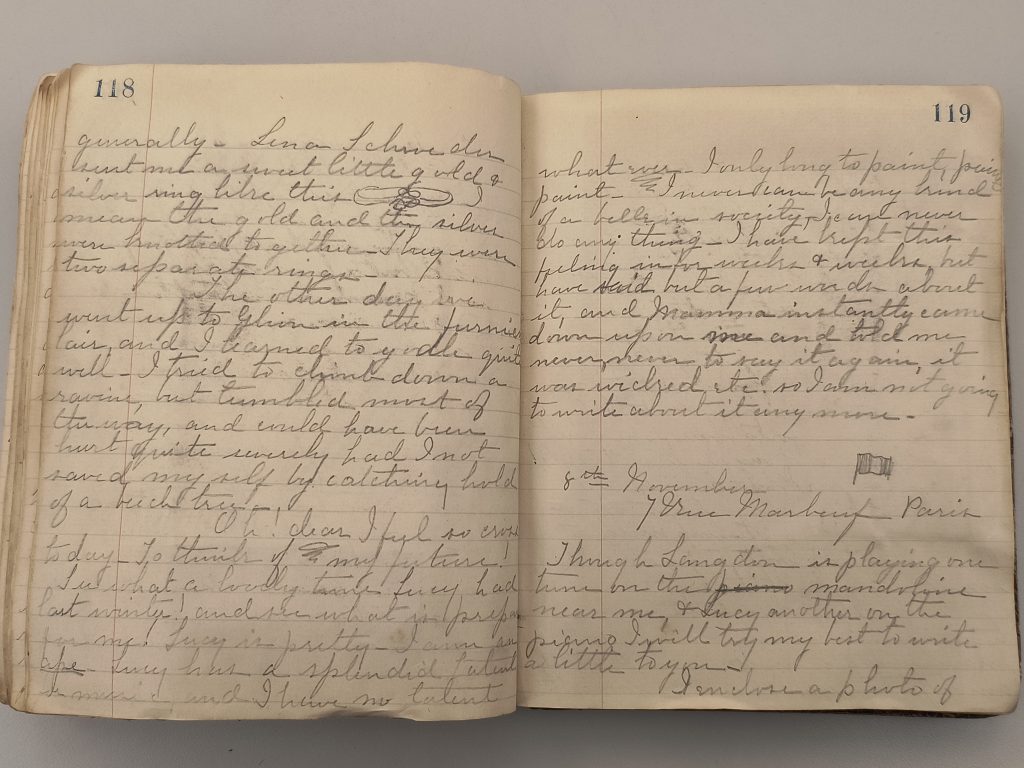
The Stout collection includes four of Henrietta’s diaries, two kept as a young teenager and two kept in her twenties. The first starts on June 27, 1889, when she was thirteen and on a trip through Europe with her mother and three siblings, Langdon, Lucy, and Harry. I was immediately drawn to the diaries because of how lively, creative, and sometimes laugh-out-loud funny they are. I think Henrietta will sound familiar to anyone who knows (or is) a thirteen-year-old. To give you a taste of her style, here’s an entry she wrote about the ocean voyage to Europe.

In the first place I was ill: not actively so, but I was ill. Days and days passed which seemed like years, but still I was ill, at last Mamma called the doctor, and such a doctor, […] and he gave me some lime water, & some awful stuff that tasted just like pepper and vinegar, but he cured me just the same! […] He is the most “blasted English don cher know” thing I ever saw, and I burst out laughing every time I see him. He waxes his mustache into spears about 4 inches long.

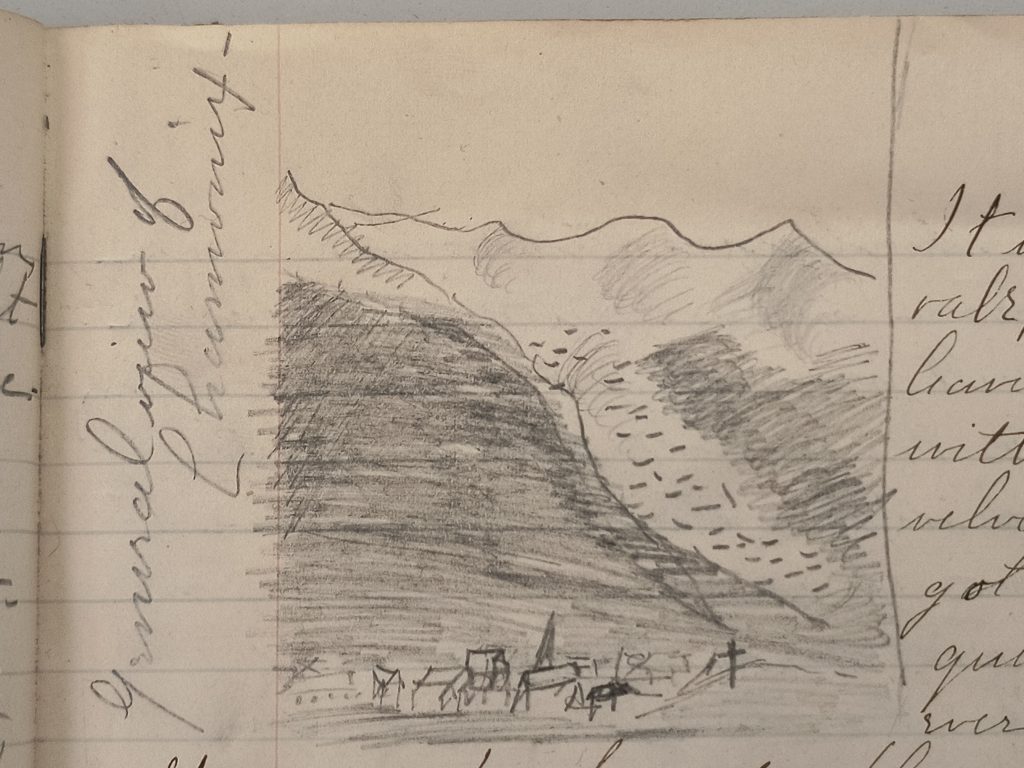
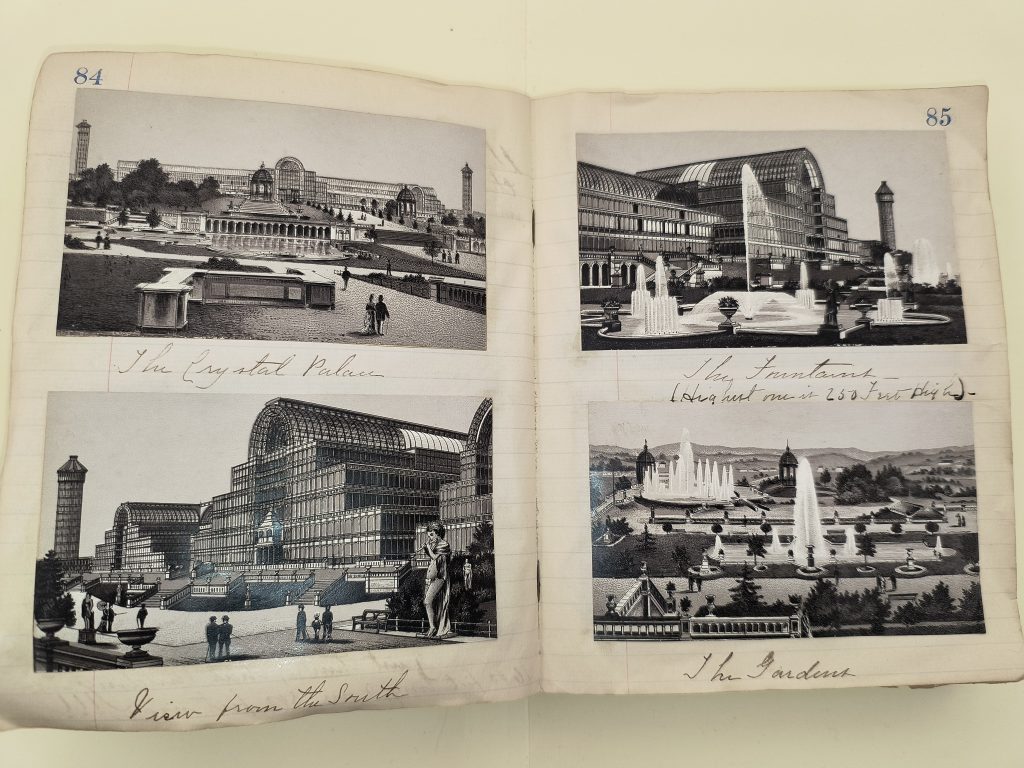
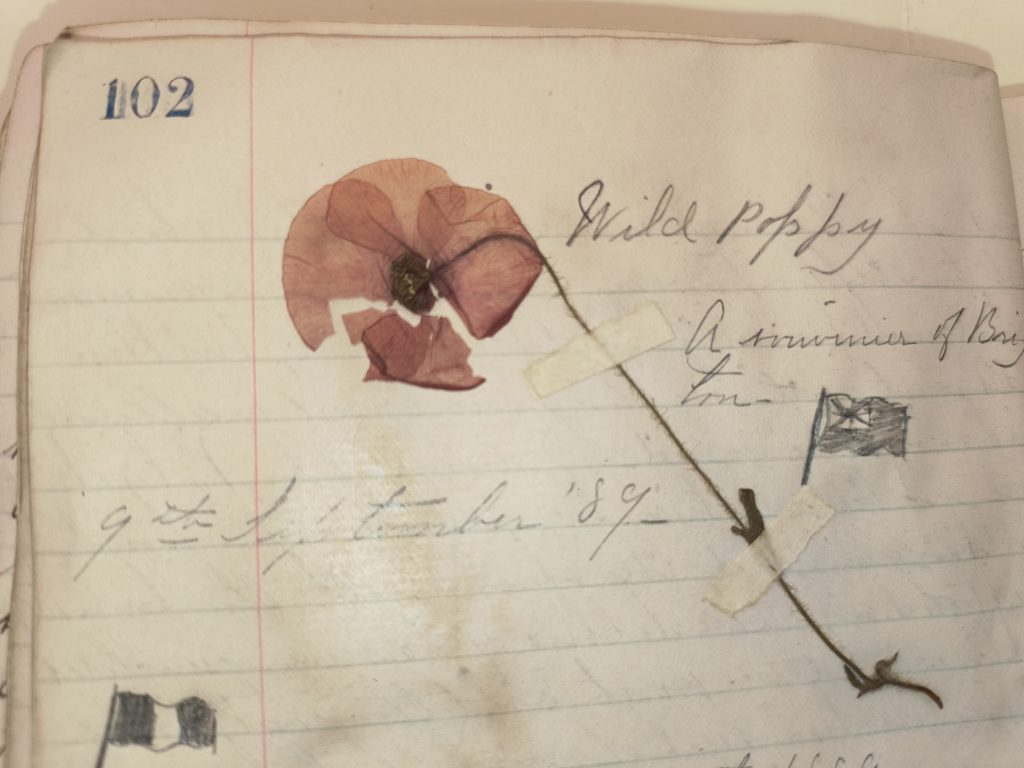
In addition to Henrietta’s entertaining run-on sentences and stream-of-consciousness anecdotes, the diaries also contain her original sketches and objects she added as illustrations or keepsakes. Here’s a partial list of items she pasted or pinned to the pages: letters, photographs, ticket stubs, menus, flowers, feathers, leaves, ribbons, wax seals, a piece of lead from a pencil-making factory, a piece of stone from Chester Cathedral, and a pouch of sand from the shores of Loch Katrine. You can see how overstuffed the volume is.

Color photograph of a volume on a table. The cover has a marbled pattern and the letters “IV” written on it in black ink. The pages of the volume are bulging out of its binding.
The 1889 diary of Henrietta M. Schroeder

As you can imagine, volumes like this are a preservation nightmare for archivists and conservators. Organic and acidic material will stain and degrade the pages. In most cases, all we have the time and the resources to do is stabilize the volume and prevent any further deterioration by housing it in an appropriate container and storing it in our climate-controlled stacks. We also often interleave the pages with tissue to protect them.

But the very same thing that makes these diaries tricky from a preservation standpoint also makes them interesting from a historical standpoint. The inserted material is fully integrated into the narrative, adding context and (literal!) texture to Henrietta’s stories. I love how free-wheeling and genre-bending it all is, this first diary in particular. Henrietta has taken a volume that cost her, she says, just 28 cents and turned it into a unique, interesting, and very fun historical document.

Color photograph of one page of a manuscript volume. At the top of the page is written, in black ink, the heading: “Myself.” Pasted to the page are three photographs of the same girl at different ages. Next to the photographs are written, “Age 1 ½ or 2,” “Age 5 or 4,” and “Age 11.” The page includes handwritten text around and between the photographs.
Page of Henrietta M. Schroeder’s 1889 diary including three photographs of herself at different ages

I look forward to telling you more about Henrietta in future Beehive posts.

Volunteer as a Judge for Massachusetts History Day!

by Alexandra Moleski, Massachusetts History Day Program Coordinator

Four young students are looking at a trifold exhibit board, the student in the middle pointing their finger at a label on the board

Calling all history enthusiasts–the 2026 Massachusetts History Day (MHD) contest season is here and judge registration is officially open! The MHD team has a lot of fun updates this year, and we would love to have you join us. All you need is a love of history–no experience or prior knowledge required!

Massachusetts History Day is a project-based learning program in which students grades 6-12 conduct research on a historical topic of their choice and present their work as a documentary, website, performance, paper, or exhibit. And this year, we’re thrilled to launch a new project category–the podcast! Students will have the opportunity to explore the 2026 theme Revolution, Reaction, Reform in History through storytelling.

We’ve also added two new contests this year: the Boston Metro Regional Showcase at the John F. Kennedy Presidential Library and Museum, and the Western MA Regional Showcase at Mater Dolorosa Elementary School.

We are so grateful to our MHD judges, and we are so excited that a new project category and two new contests allow us to welcome many more enthusiastic judges this contest season. Judging is a great opportunity to learn from and celebrate our student historians and their hard work. You will:

  • Be assigned to a small judging team, as well as a specific age division and project category
  • Review student research projects and their project paperwork
  • Interview the students using sample questions provided to you
  • Work with your team to determine the rankings and provide written feedback for each project
  • Receive a judging orientation and all the information you need beforehand
  • Enjoy breakfast, lunch, coffee, and sweet treats on us!

Visit https://www.masshist.org/masshistoryday/judges for more information on MHD contests, the judging experience, and how to register.

Are you an educator? Join us as an MHD judge and earn professional development points. Teachers who judge at a contest/showcase will receive 10 PDPs per event.

No Such Thing as a Bad Question

By Rakashi Chand, Reading Room Supervisor

As the leaves begin to turn and the air grows crisp, it can only mean one thing: American Archives Month is here! Although #AskAnArchivist Day officially falls on October 16th, we asked our own staff what questions they are asked most often to help demystify and amplify archives and archival work. Read on as we celebrate American Archives Month and get answers to frequently asked questions! 

Objects on a table including a manuscript box, book cradle, cloth gloves, latex gloves, and a magnifying glass.

Brandon McGrath-Neely, Library Assistant II:

The question I get the most, other than white gloves, is: So who actually uses an archive? It’s exciting to be able to answer: ANYONE! Many people don’t know that the archives are free and open to the public – you don’t have to be a professor or author!

Stephanie Call, Curator of Manuscripts:

I often get asked by potential donors “why do you want this stuff? My family wasn’t (wealthy, important, famous, etc.)” And that’s the point—how else would historians and students of history know how the average person or family lived in specific time periods or during historical events? That’s how we relate to history—not through the extraordinary, but through the ordinary, everyday experiences of people who were just living their lives.  So, people shouldn’t be afraid to contact an archive about their family papers! They could be more interesting and historically relevant than they think.

Hannah Elder, Assistant Reference Librarian of Rights and Reproductions:

Q: What are personal and family papers? 

A: According to SAA, personal and family papers are records created by an individual or group of individuals closely related, relating to their personal and private lives. Some examples common at the MHS are letters, journals and diaries, recipe books, account books, and scrapbooks. 

Samantha Couture, Nora Saltonstall Conservator and Preservation Librarian:

“What is the letter you are working on about?”

Answer: I only know what’s in the catalog record- I don’t get to read the documents, but I need to make sure they are able to be handled safely by researchers who will read every word!

Nancy Heywood, Lead Archivist for Digital & Web Initiatives:

How do you decide what to digitize?

The MHS needs to consider the condition of the collection, the size of the collection, and the capacity and schedule of the digital production team as we determine which items get into the digitization queue. The  MHS usually requires some funding (either from grants, or projects) to take on larger projects (either full collections, or selected series, for example, a set of diaries or volumes).  The  MHS does have some capacity to work on digitization projects in support of events, or anniversaries, or themes that would benefit from additional digitized content on our website.  Digitization includes lots of detailed workflow steps relating to preparing the original materials, reviewing existing metadata and descriptions, creating master and derivative images, creating metadata for the delivery system, and loading and testing the digitized content on our webserver.

Rakashi Chand, Reading Room Supervisor:

Questions that I am asked often include

Why don’t I need to wear gloves to handle this letter?

Answer: We have found that the loss of dexterity can lead to a tear on a delicate page, so the best way to handle manuscripts is with clean hands and care.

Why can’t I use flash to take a picture of this letter?

Answer: Flash and direct sunlight can damage manuscripts, art and artifacts.

Where do you keep all of these documents?

Answer: We store all our material in temperature and humidity-controlled stacks. 

Are there any risks involved in being an archivist?

Paper cuts, sharp Hollinger box corners, poisonous 19th century book pigment, lifting heavy boxes on a daily basis, red rot on our clothes, and ladders… lots of ladders. 

Susan Martin, Senior Processing Archivist:

Probably the question I get the most (aside from the one about gloves) is: 

Can just anybody come in to do research there? Do you need to pay or be a member?

I tell them no, it’s free—all you need to do is register and provide a photo id.

Another one I’ve gotten is: Do we just collect the records of famous people?

I explain how historians are interested in the lived experiences of people from all walks of life. People are also surprised we collect up to the present day.

Sometimes I get asked what’s the weirdest thing I’ve found while processing.

Hands down, it was a piece of wedding cake from 1919. It was wrapped up and hard as a rock.

Grace Doeden, Library Assistant II:

Q: Are the stacks haunted?

A: I can neither confirm nor deny…But I often catch an ominous feeling on the 5th floor. Wait, is that Jeremy [Belknap]’s spirit in the cage? Oh, no, it’s just Peter [Drummey, MHS Chief Historian].

Neighbors in the Northeast

by Elizabeth Hines, 2024-5 NERFC Fellow

When is it the right time to make war on one’s neighbor? The colonies in New England and New Netherland debated this question in the early days of European expansion, just as countries do today. The Massachusetts Historical Society’s collection contains material that sheds light on a little-known almost-war between neighbors on North America’s shores: the time New England’s planned attack on New Netherland was cancelled by news of a peace treaty. The MHS is one of the most important archives historians can use to trace this dramatic story.

The Dutch colony of New Netherland was located to the east and south of the New England colonies, in what is now New York.

illustrated map depicting Manhattan
Vingboons map of Manhattan, 1639: a facsimile from the Library of Congress
From the New York Public Library

In Europe, England and the Netherlands declared war against each other in 1652, in what would later become known as the First Anglo-Dutch War. In North America, the copy of John Hull’s diary held by the Massachusetts Historical Society provides wonderful commentary on the growing tensions between New England and New Netherland at this time. The English colonists accused the Dutch of plotting against them with Indigenous groups. Hull, the Massachusetts Bay Colony mintmaster, described the visit of two commissioners from New England to New Netherland to discuss these accusations as “something that might further clear the righteousness of the war, or prevent it.” He was clear about the motivation of the visit, as many English colonists were clamoring for war with New Netherland.

The Endicott Papers contain a letter of instruction to those commissioners that reflects previous frustrations. The letter insists that that “delays, slow and unsatisfying treaties… may not be admitted” from the Dutch. One of the signatories of the letter was John Endecott, the Governor of the Massachusetts Bay Colony:

Portrait showing man in black cap with white beard against a black background
Portrait of John Endecott
Massachusetts Historical Society

Endecott also wrote to John Winthrop, Jr., one of the magistrates of the Connecticut Colony, about New Netherland. Other letters to Winthrop are transcribed in the Winthrop Family Transcripts. John Haynes, the Governor of the Connecticut Colony, wrote to Winthrop with news of English naval victories over the Dutch forces in Europe. The painting below shows one of the major naval battles of the war:

Painting depicting many sailing ships in a battle at sea with a stormy sky behind them
“The Battle of Terheide, 10 August 1653,” Jan Abrahamsz. Beerstraten
Rijksmuseum, Amsterdam

By 1654, the government in England responded to the desires of some colonies and decided to extend the war to North America. They sent ships of officers and soldiers to New England to plan an attack on New Netherland. Hull recorded in his diary that they were there “to root out the Dutch if they would not submit to the power and government of England.” The officers aimed to recruit 500 colonists to join their forces. However, in the middle of their planning and recruiting, a ship arrived with news from Europe: England and the Netherlands had signed a peace treaty, and the First Anglo-Dutch War was over. The attack on New Netherland was cancelled, and the English and Dutch colonies would remain neighbors for another decade.

Since the English colonists would take over New Netherland in 1664, why does their aborted attack in 1654 matter? It was a first step toward the eventual absorption of New Netherland into English North America. It provides an early example of colonial outposts becoming part of strategy in European wars. And the discussions among the colonists and the administrators in England about territory and sovereignty would contribute to their developing conceptions of empire. The Massachusetts Historical Society’s collection helps us to understand this story better and to see how it expands our view of early imperial history.

From Medicine to Mysticism: The Life and Times of Dr. Gertrude Van Pelt

by Susan Martin, Senior Processing Archivist

I was recently encoding the guide to the William Minot III papers, a collection processed back in 2007 by another MHS archivist, when a unfamiliar name caught my eye: Dr. Gertrude Van Pelt. A female physician in the late 19th century understandably piqued my curiosity. Little did I expect what I would find.

Gertrude Wyckoff Van Pelt (1856-1947), originally from New Jersey, was a physician with degrees from Holyoke College, Cornell University, and the Women’s Medical College of Philadelphia. She interned at Boston’s Women’s Hospital and studied medicine in Paris and Vienna. Her papers form part of this particular collection because her sister married William Minot III, a Boston lawyer.

But today I’d like to tell you about Van Pelt’s decades-long work in the Theosophical movement.

Theosophy, founded by Helena Blavatsky in 1875, is defined at the website of the Theosophical Society in America as “a body of knowledge that tells us about our place in the universe and why the world is the way it is.” Blavatsky called it “the ancient Wisdom-Religion,” a search for eternal truths and universal brotherhood.

Van Pelt joined the Theosophical Society in Boston in 1893 and soon became a prominent figure in the movement. She published articles, delivered speeches, and, in 1900, was recruited by Theosophist leader Katherine Tingley to relocate to Lomaland, a Theosophical enclave on the Point Loma peninsula of San Diego. There Van Pelt served in Tingley’s cabinet and as superintendent of the Raja Yoga School and Lotus Home. She remained a Theosophist until her death in 1947 at the age of 91.

Black and white screenshot of a print advertisement. The top half is a photograph depicting several buildings of various sizes on a hill in the background, some with domed roofs, and a road in the foreground leading to the buildings through a gate. The bottom half reads: “Raja Yoga Academy (Unsectarian) for Boys & Girls. Address Gertrude Van Pelt, M.D., Directress, Point Loma Homestead, Point Loma, California.”
Advertisement for the Raja Yoga Academy in New Century Path, a Theosophical magazine published at Point Loma, 1905

I found literally hundreds of references to Van Pelt in old newspapers, but most of them center around one incident. In November 1902, Van Pelt brought eleven Cuban children into the country via New York to study at the Raja Yoga School. It was not her first trip for this purpose, but this time the group was stopped, interrogated, and detained at Ellis Island for over a month. American officials weren’t concerned about potential trafficking or the implications of imperialism and racial paternalism. No, they feared these “possible objectionable aliens” might become public charges.

The incident became a media firestorm, as historian Jacqueline D. Antonovich explains in her excellent Ph.D. dissertation. The takes came fast and furious; most newspaper articles cast doubt on the motives and teachings of the Theosophists. Meanwhile, Albert G. Spalding—a former professional baseball player, founder of the Spalding sporting goods company, and fellow member of the Theosophical Society—visited Van Pelt at Ellis Island and wrote his version of what happened.

In the end, the children were cleared to stay in the country and taken on to Lomaland. I love this picture of Van Pelt and the children.

Black and white photograph of a white woman with dark hair and eleven Cuban children of various ages in various positions on the front steps of a large building. Four of the children are seated at the front, and the rest are standing. All of them wear dark clothing. At the right of the image is a large white pillar, and at the back is the door into the building. The caption at the bottom begins with the heading: “Safe in California.”
Photograph of Dr. Gertrude Van Pelt and eleven Cuban children after their detention at Ellis Island, taken at Point Loma, California, published in Out West magazine in January 1903

Unfortunately, Van Pelt’s letters in the William Minot III papers predate her move to Point Loma in 1900 and don’t really discuss her Theosophical work. The Garrison family papers contain the only first-hand account of Lomaland that I could find in the MHS collections. Anna Percy lived there at the same time as Van Pelt and described it in great detail in correspondence to her family; one letter is 20 pages long.

Van Pelt’s correspondence does, however, include interesting remarks on her medical studies in Europe and on the artwork of her companion Susan Mary Norton (1855-1922). And the letters she wrote to her 15-year-old niece Katharine (later the wife Henry Morse Channing) are very endearing.

To investigate MHS holdings related to any of these individuals and/or subjects, search our online catalog ABIGAIL or the MHS website.

Stories, Schemes, and Sounds from the Dictionary of Americanisms

by Nate Grosjean, Visitor Services Coordinator

Finding myself at something of a perpetual loss for words these days, I decided to visit the MHS reference room in search of some new (rather, quite old) words to liven up my vocabulary. Fortunately for me, the library has a number of works pertaining to American slang terms, colloquialisms, and dialects.

My favorite, John Russell Bartlett’s Dictionary of Americanisms: A Glossary of Words and Phrases Usually Regarded as Peculiar to the United States, 3rd ed., is a curious and complicated document. Published in 1860, just one year before the start of the Civil War, it draws together a wide range of phrases and expressions, from the botanical to the political to the whimsically unusual. Prior to its publication, Bartlett served for three years as “Commissioner on the Mexican Boundary,” a position which exposed him to the linguistic frontiers of south/western states like Texas, New Mexico, and California.

Title page of John Russell Bartlett’s Dictionary of Americanisms: A Glossary of Words and Phrases Usually Regarded as Peculiar to the United States.
Title page of John Russell Bartlett’s Dictionary of Americanisms

To illustrate his definitions, Bartlett included excerpts from a variety of sources from American literature, journalism, and print culture. Reading through this dictionary, one gets a sense of the many ways and spheres in which language developed: the project of creating a distinctly American language was entwined with the project of creating a distinctly American artistic and literary identity. Readers also get a hearty helping of intrigue, humor, and drama, and Bartlett’s best entries always include a story. Here are just a few!

“Acknowledge the corn. An expression of recent origin, which has now become very common. It means to confess or acknowledge a charge or imputation.”

Per the Pittsburgh Com. Advertiser, a man with two flatboats traveled to New Orleans “to try his fortune” selling corn and potatoes. Once there, he decided to go gambling (a beloved 19th-century vice), and lost spectacularly. Having no more money, he bet away his flatboats of corn and potatoes; only later did he learn that the flatboat of corn had sunk in the river. When his creditor arrived the next day to claim his winnings, the man craftily replied: “Stranger, I acknowledge the corn—take ‘em; but the potatoes you can’t have, by thunder!”

“Patent Safe Game or Operation. A system of trickery practised in our large cities on verdant gentlemen from the country.”

Citing Scientific American, Bartlett devotes almost two full pages to the explanation of this scheme. Three collaborators pose as a kind friend of the victim, the designer of a safe, and a cop. Their elaborate plot to rob their “Sucker” involves a small safe with a hidden compartment, a rigged gamble, a phony check, a chase sequence, and, of course, ample skullduggery. Sound complicated? It sure is! Read the full story at this link, complete with dramatic dialogue.

An open printed book with entries, including the Patent Safe Game or Operation.
Patent Safe Game entry

I’ll end with a selection of sounds from the dictionary. Onomatopoeia has a way of speaking for itself…

“Caswash! Dash! splash! The noise made by a body falling into the water. See cachunk.”

“Cachunk! A word like thump! describing the sound produced by the fall of a heavy body. Also written kerchunk! A number of fanciful onomatopoetic words of this sort are used in the South and West … These words are of recent origin.”

“Cawhalux! Whop! The noise made by a box on the ear.”

“Keslosh! Keswosh! Kewosh! Plash! Splash! The noise produced by a body falling flat into the water.”

“Kesouse! Souse! The noise made by a body falling from a small height into the water.”

“Keswollop! Flop! The noise made by a violent fall to the ground.”


Further Reading:

John Russell Bartlett. Dictionary of Americanisms: A Glossary of Words and Phrases Usually Regarded as Peculiar to the United States, 3rd edition. Boston: Little, Brown and Company, 1860.

Historical Note on the John Russell Bartlett Papers, Rhode Island Historical Society, Manuscripts Division.

Mitford M. Mathews, A Dictionary of Americanisms On Historical Principles. Chicago: University of Chicago Press, 1956.

Eric Partridge, ed. Paul Beale, A Dictionary of Slang and Unconventional English, 8th ed. New York: Macmillan, 1984.

Washington and Adams: A Tale of Two POTUSes

by Sarah Hume, Editorial Assistant, Adams Papers

The latest Adams Presidential Library rotating exhibit has arrived! The relationship between George Washington and John Adams unfolds through documents and artifacts in Washington and Adams: A Tale of Two POTUSes, on view at the MHS through mid-December, 2025.

The two men met in 1774 during the First Continental Congress. Adams immediately found Washington to be a talented military man of good character. When the time came for the Continental Congress to choose a leader for the new army, Adams had the perfect man in mind; he recommended George Washington as commander.

“Mr. Washington, who happened to sit near the Door, as soon as he heard me allude to him, from his Usual Modesty darted into the Library Room,” Adams wrote. “A Gentleman whose Skill and Experience as an Officer. . . would command the Approbation of all America, and unite the cordial Exertions of all the Colonies better than any other Person in the Union.”

The Washington and Adams families grew close during and after the American Revolution, with a 15-year-old John Quincy Adams even hanging a portrait of Washington in his room. Upon Washington’s inauguration as the nation’s first president, Abigail Adams observed, “He appears to be the most sensibly affected with the supreme and over Ruling providence which has calld him to Rule over this great people rather to feel Humble than Elated.”

handwritten letter
Abigail Adams to John Adams, 7 May [1789]

Behind the scenes, Washington, and Adams as vice president, worried about setting precedents for the new nation. They corresponded about protocols for congressional recesses, informal visits, and the correct title to use for the chief executive. Washington submitted a list of queries to Adams about best practices. “Many things which appear of little importance in themselves and at the beginning may have great & durable consequences from their having been established at the commencement of a new general Govt.,” Washington noted.

With the election of 1796, the nation chose Adams as its second president, the first peaceful transfer of power between two US executives. Even so, Adams feared the public would find him “less Splendid” than Washington, whose popularity and military background differed from Adams’s public reception and diplomatic experience. “He Seem’d to me to enjoy a Tryumph over me,” Adams wrote of Washington. “Methought I heard him think Ay! I am out and you fairly in! see which of Us will be happiest.”

Adams, however, would not let Washington stay retired for long. In September 1798, he nominated the Virginian once again to command the nation’s army, despite Washington’s “sorrow at being drawn from [his] retirement” (Washington to Adams, 25 Sept. 1798).  When Washington died a year later, Adams guided a mourning nation through the loss. The legacy of the two remained intertwined and their relationship continues to be a topic of interest.

a cream handkerchief with a circular illustration in the center showing Washington on his deathbed with mourners standing over him. Around the illustration are text boxes in homage to Washington.
Washington death bed memorial handkerchief

See these documents and more in the new rotating exhibit Washington and Adams: A Tale of Two POTUSes and keep an eye on the MHS Calendar of Events for a gallery talk that will be announced later this fall!

The Adams Papers editorial project at the Massachusetts Historical Society gratefully acknowledges the generous support of our sponsors. Current funding of the edition is provided by the National Endowment for the Humanities and the Packard Humanities Institute.