This Week @ MHS

By Dan Hinchen

Last week saw the close to the seminar season here at the Society and as summer approaches the calendar opens up a bit. Still, there are some great programs coming up this week to experience. Here is what is on tap at the MHS this week.

First, on Wednesday, 15 May 2013, come on in for a Brown Bag Lunch discussion as Reiner Smolinski of Georgia State University presents “Cotton Mather encounters the gods of Egypt: The Transatlantic Enlightenment and the Origin of Pagan Religions.” The presentation is based on Prof. Smolinski’s ongoing work for his forthcoming intellectual biography of Cotton Mather. Brown Bag lunches are free and open to the public and begin at noon.

The following day, Thursday, 16 May, the MHS hosts “The Tender Heart & Brave: The Politics and Friendship of Charles Sumner & Henry Wadsworth Longfellow.” This talk, co-sponsored by the Longfellow House-Washington National Historic Site and the Boston African American National Historic Site, examines how the fiery abolitionist Sumner and the genteel poet Longfellow became the closest of friends. Dramatic readings of actual historic documents such as letters, journals, poetry, and speeches will show the deep personal relationship shared between the two men. The reading, done by author Stephen Puleo and the Longefellow House’s Rob Velella, takes listeners from the earliest friendship to antislavery advocacy of these two men, from personal triumphs and tragedies to their final years, weaving through the events of the nation during their lifetimes, including the Emancipation. Mr. Puleo, author of “The Caning: the assault that drove America to Civil War” will provide commentary and sign copies of his book. Reservations are requested for this event at no cost. Please RSVP. Contact the education department for more information at 617-646-0560/education@masshist.org. Program begins with a reception at 5:30pm, talk begins at 6:00pm. 

And on Saturday, 18 May, come to 1154 Boylston at 10:00am for a free building tour, The History and Collections of the MHS. This 90-minute, docent-led tour takes guests through all of the Society’s public rooms while providing information about the history and collections of the institution. The tour is free and open to the public. No reservation is required for individuals or small groups. Parties of 8 or more should contact the MHS prior to attending a tour. For more information please contact Curator of Art Anne Bentley at 617-646-0508 or abentley@masshist.org.

Finally, there are only two weeks left to view three current exhibitions, all focusing on varying aspects of the path to Emancipation in the mid-19th century. Exhibits are open to the public six days a week, Mon-Sat, 10:00am – 4:00pm. The present displays are on view until Friday, 24 May, so do not miss them!


Stephen Greenleaf Bulfinch Diary, Post 21

By Elaine Grublin

The following excerpt is from the diary of Stephen Greenleaf Bulfinch.

Monday, May 11th 1863

I must leave to history the public events of this agitating time; but I have sadly to record that my dear pupil and friend, Frank A. Eliot, was killed in the recent battle at Chancellorsville, near Fredericksburg, Va. He was captain of the Phila [Braves?], – about 35 years of age, – brother of Dawes and William G. Eliot. We hope that an honorable end of this awful strife is near.

A Fair Trial for the Boston Massacre Soldiers

By Emilie Haertsch, Publications

In the aftermath of the tragic Boston Marathon bombings, the question remains of how to handle the trial of suspect Dzhokhar Tsarnaev. There has been a public outcry for punishment, and it seems unlikely that the defense will be able to obtain an unbiased jury in a case as high profile as this. But this is not the first time that the desire for punishment has clashed with procedure in Boston’s legal history. On National Public Radio, Cokie Roberts rightly made the connection between this current case and the Boston Massacre trial of almost 250 years ago, when John Adams, in providing legal defense for the British soldiers involved in the Massacre, dealt with similar issues.

In 1768 the British Parliament stationed troops in Boston to protect customs commissioners, since they collected the unpopular taxes on imports and feared for their safety. Bostonians resented the presence of troops in their city and animosity grew between the locals and soldiers over the next year and a half. On March 5, 1770, tensions came to a head. A crowd gathered to harass the sentry posted outside the Custom House, and Capt. Thomas Preston and a small group of soldiers came to his aid. When the crowd refused to leave, the British soldiers fired on them. Three members of the crowd were killed instantly, and two later died from their wounds. The captain and his soldiers were placed in jail.

Following the Boston Massacre deaths, some Patriot leaders used propaganda to enflame feelings of rancor in Boston towards the British. Paul Revere created a famous engraving of the scene with uniformed British soldiers firing at close range into a crowd and a sign that read “Butcher’s Hall” hanging over the Custom House. Many Patriots hoped that the pressure of public opinion would lead to a murder conviction for the soldiers and aid the cause for independence.

The level of outrage in Boston made it very unlikely that the soldiers would get a fair trial. Government and judicial officials delayed the beginning of the trial in hopes that time would calm public opinion. Amidst this tumult, John Adams, Robert Auchmuty, Jr., and Josiah Quincy, Jr., were hired to defend the soldiers. The trial began on November 27, 1770.

The defense could not make the argument that the soldiers fired in self-defense without also hurting Boston’s reputation, so they tread carefully. In addition, since Capt. Preston was found to be not guilty, the soldiers could not claim they were following his orders when they fired. Adams opened his defense dramatically with a quotation from the Marquis Beccaria: “If I can but be the instrument of preserving one life, his blessing and tears of transport, shall be a sufficient consolation to me, for the contempt of all mankind.” He argued that because it was impossible to tell which soldiers fired the fatal shots, finding all of the soldiers guilty would inevitably lead to the wrongful conviction of some innocents.

On December 5, 1770, the jury delivered its verdict: six of the soldiers were found not guilty, and two were found guilty of manslaughter. None were convicted of murder. The soldiers who were convicted of manslaughter were branded on their right thumbs with the letter “M.”

The verdict quieted the mood in Boston and reflected well on the colonies internationally. Years later, Adams wrote in his diary that he believed a “Judgment of Death against those Soldiers would have been as foul a Stain upon this Country as the Executions of the Quakers or Witches, anciently.”

The Society has in its collections several manuscripts related to the Boston Massacre; there is a good introduction to them here. Robert Treat Paine prosecuted the soldiers, and you can learn more about his papers here. You can also read more about Adams’s views on the Boston Massacre and trial in this previous post.

Whist & Poetry in 19th Century Brookline

By Andrea Cronin, Reader Services

Of the many social club records held by the Massachusetts Historical Society, the Brookline Whist Club’s records are unique. Established in early 1874, the Whist Club’s members gathered to socialize with crackers, cheese, and sherry and to play whist. The club’s record book curiously holds far more whimsy than winning records; it does not contain proceedings of the organization or lists of appointed officers, but rather a volume of poetry produced during the Saturday evening meetings.

The Brookline Whist Club record book contains many poems created by members of the club, including Thacher Loring, Robert S. Peabody, Moorfield Storey, and Charles Storrow. The poetry was most likely later recorded into the volume by a single unknown individual, but in most cases the individual poets are identified. Boston lawyer and financier Moses Williams recited this small poem as recorded into the volume.  

Moses.

A flight of fancy takes me,
the divine afflatus shakes me,
And I quiver with the thoughts of that thro me thrill,
As before my sight them passes,
Such a group of lads and lasses
That my song with sweetest memoirs of I would fill

For those readers wondering, “what is in the world is whist,” whist is a 17th-century English card game closely related to bridge, which was hugely popular in the 19th century. Four people play in two partnered teams, using a 52-card deck. Each player is dealt 13 cards. The object of the game is to win tricks, which is accomplished by playing the highest value card of a particular suit in each round. According to a longtime member of the club, Edward Stanwood in Annals of the Brookline Whist Club, 1873-1907, his club played by the following rules:

Short whist is the game. Five points constitute a game. If more than eight members are present, the waiting member is taken in at the table at which a rubber is first finished, when the players “cut out,” “the highest out.” At the conclusion of the next rubber the newcomer stays and the other three cut out; then one of the two who have been longest playing retires; and finally the fourth man retires sua sponte. If ten members are present they retire from and enter the game by twos. Each member keeps an account of the number of games he has won and lost.

If you would like to read more poetry produced by the Brookline Whist Club, please visit the library to view the Brookline Whist Club record book. You can learn more about the club’s background in Edward Stanwood’s Annals of the Brookline Whist Club, 1873-1907.


This Week @ MHS

By Dan Hinchen

It is time again for the weekly forecast of events here at the MHS! There are three public programs on offer in the week to come and with spring finally settling into its normal routine, plenty of reasons to take a walk and visit 1154 Boylston.

First up, on Tuesday, 7 May, is the last in the Early American History Seminar series for the season. Sarah Bilder of Boston College Law School and Pauline Maier of MIT present “Madison’s Hand: Revising the Constitutional Convention.” This seminar focuses on the most prominent remnants of the Convention in Philadelphia during the summer of 1787, Madison’s Notes with his revisions, and ask what it means to take seriously that Madison’s notes on the Convention are notes. Two hundred and twnty-five years after the writing, the use of changing technology allows a revisiting of the original manuscript to suggest that Madison revised his notes far more extensively than was previously understood, demonstrating that Madison’s own understanding of the Convention, the Constitution, and his own role change dramatically betwee 1787 and the end of the 18th century. This seminar begins at 5:15pm and is free and open to the public. RSVP required. Subscribe to receive advance copies of the seminar paper. This is the last seminar at the MHS until the fall so come get your fix before the summer!

The following day, Wednesday, 8 May, come to attend the annual Jefferson lecture at the MHS. This year, Susan R. Stein of Monticello discusses “New Perspectives on Jefferson’s Monticello: House, Landscape, and Family.” This talk uses a wide lens to focus on recent restoration and interpretive efforts including Monticellos’ work spaces beneath the house, public rooms, and upper floors, as well as the principal street of the plantation, Mulberry Row. Also included will be description of Monticello’s free and enslaved communities. Ms. Stein is the Richard Gilder Senior Curator and Vice President for Museum Programs. Registration is required for this public program at no cost. Please RSVP. Pre-Talk Reception at 5:30pm, program starts at 6:00pm. Contact the education department at 617-646-0560/education@masshist.org for more informaiton or to reserve a spot.

And on Saturday, 11 May, after a few weeks off, our public tour resumes. “The History and Collections of the MHS” is a tour of the Society’s public rooms that touches on the history and collections of the MHS, including some of the art and architecture on view in the public spaces. Tours are led by an MHS staff member or docent and last about 90 minutes. Tour begins in the lobby at 10:00am and is free and open to the public. No reservation is required for individuals or small groups. Parties of 8 or more should contact the MHS prior to attending a tour. For more information please contact Curator of Art Anne Bentley at 617-646-0508 or abentley@masshist.org.

Finally, the three current exhibitions on view are available six days a week, Monday-Saturday, 10:00am – 4:00pm. These exhibits are only around for three more weeks so be sure to get a glimpse before they go!

Advertising in America

By Dan Hinchen, Reader Services

If you are someone who regularly reads Boston newspapers, then you probably have noticed a few advertisements within the pages. In fact, on a given day you might find several pages worth of advertisements in a single issue. And then there is the Sunday edition which comes with an entire section composed solely of ads. Occasionally, these can be useful to inform about upcoming events, special deals at a department store, or penny-saving coupons at the grocery story. More often, though, they can seem a bit of a nuisance and waste of material, taking up space and distracting from the articles.


But did you know that the first time a paid advertisement appeared in an American newspaper it happened here in Boston?


By the start of the 18th century, the New England colonies were thriving and the population was steadily increasing along with its wealth, enterprise, and intelligence. Even foreign countries began to look at Massachusetts with interest, and colonists desired acquaintance with affairs in England, Europe, and the other colonies in British America. “Such increase of population and trade must naturally call for a publication, of the common character of newspapers.”[i]

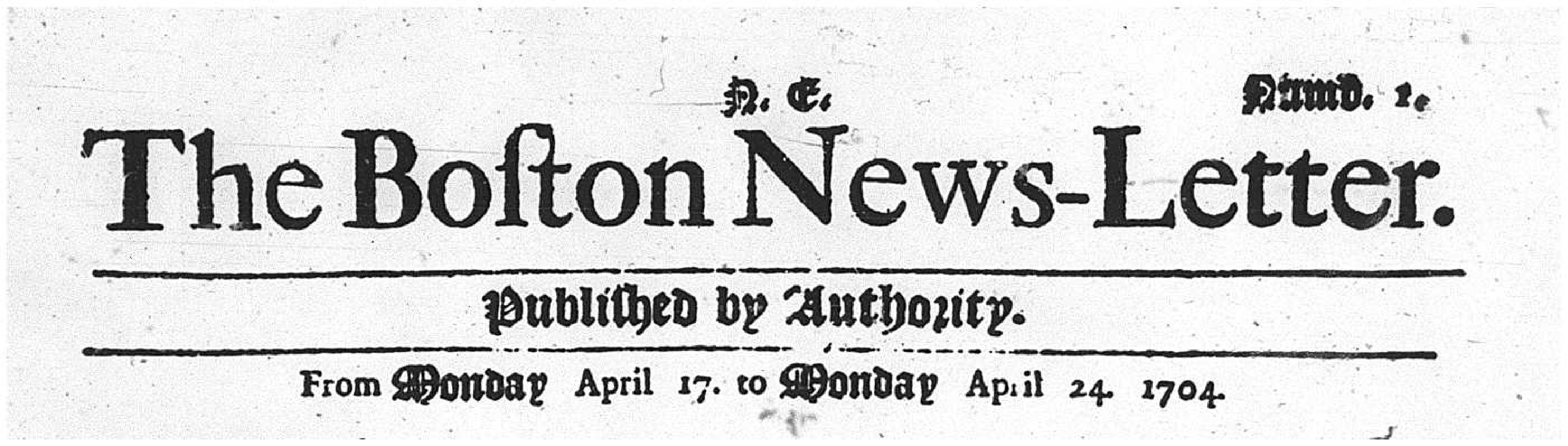
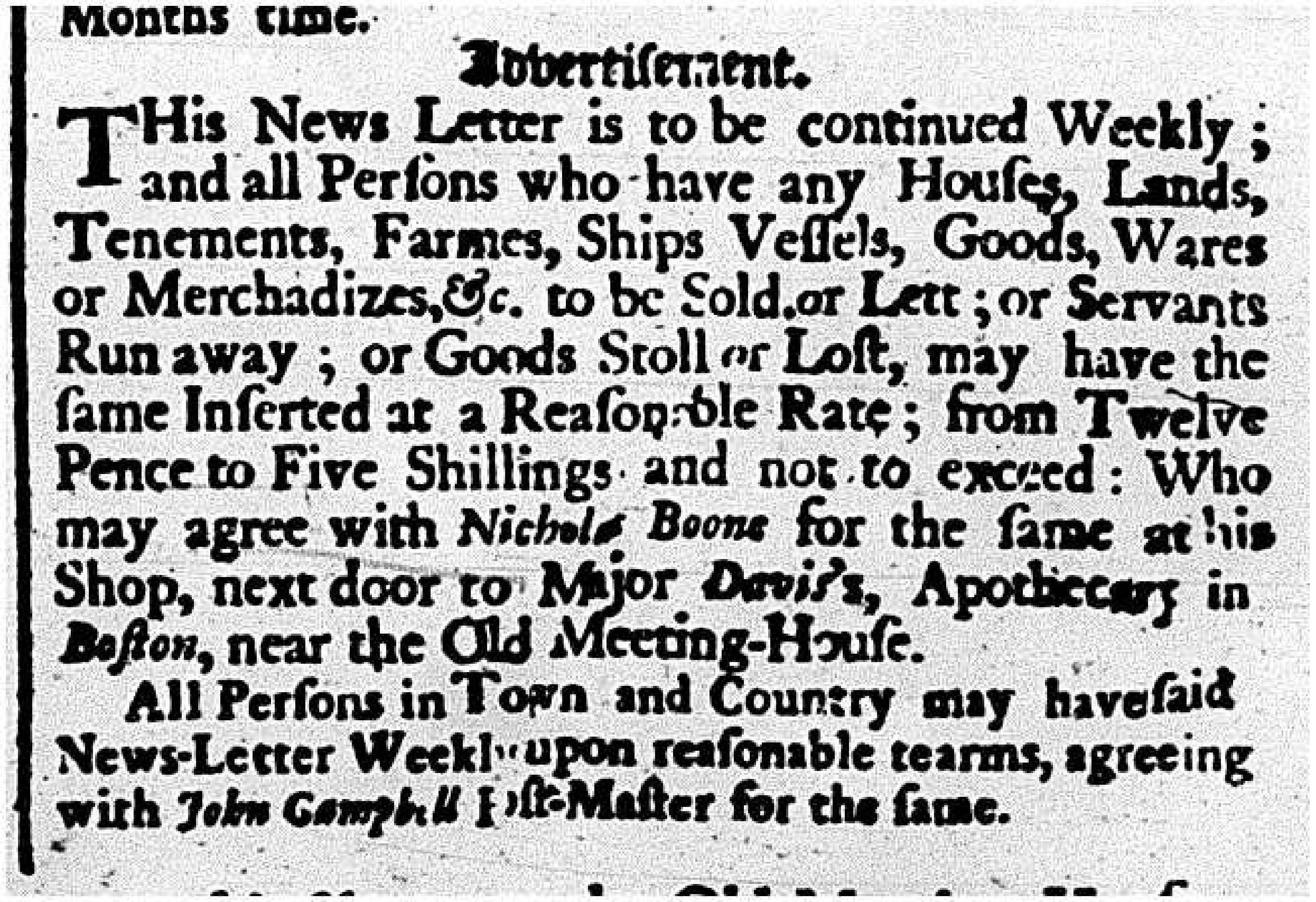
The Boston News-Letter, the first regularly published newspaper in the British Colonies of North America, began publication on 17 April 1704. This newspaper was “published by authority” and featured all of the latest news from London, though with the time it took to cross the Atlantic, there was usually a delay of three months or so. At the very end of the inaugural issue, publisher John Campbell included a short paragraph announcing that any person could insert a small notice at a “reasonable rate.”


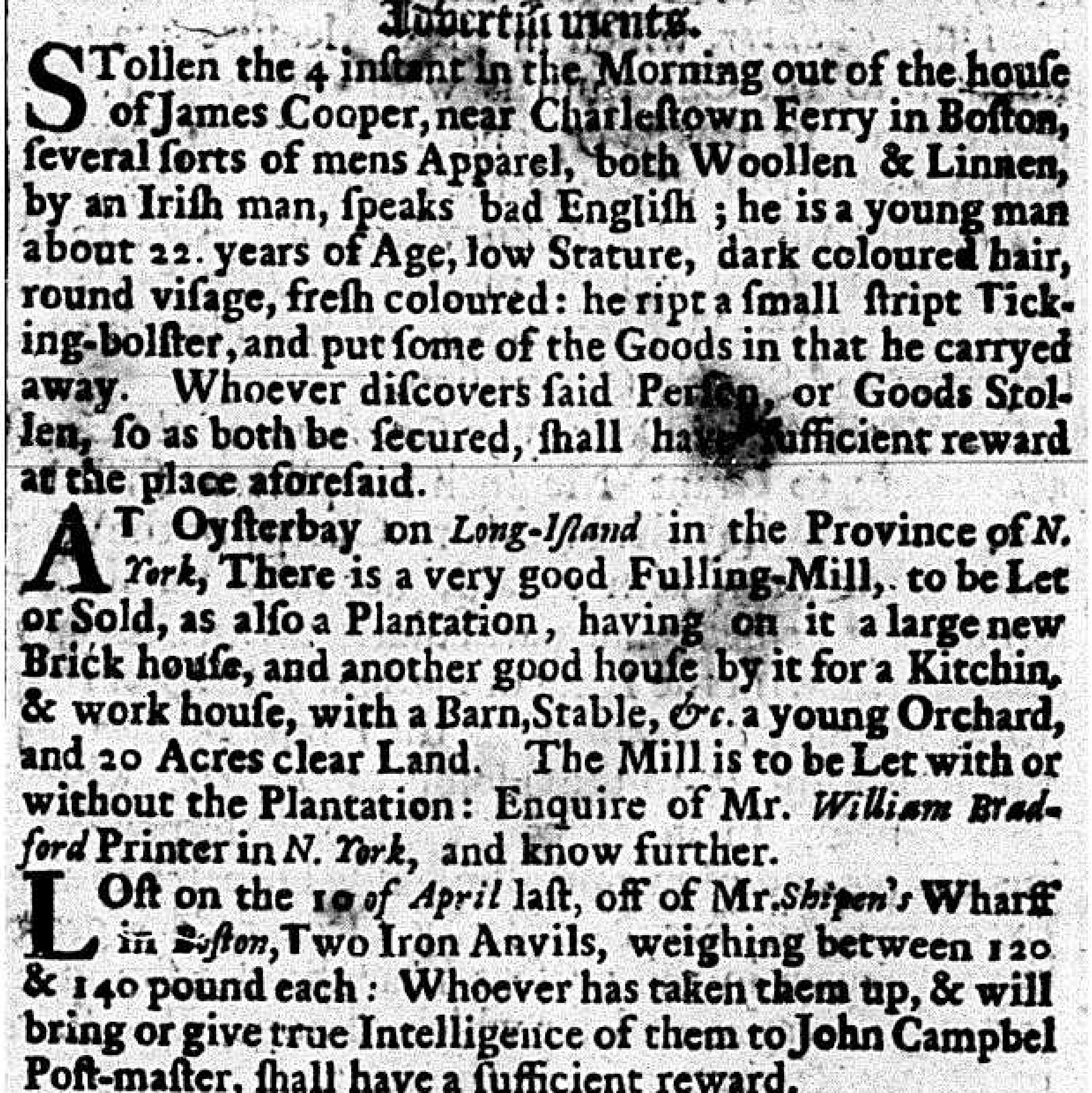
It was only two weeks later in issue number three, dated 1 May – 8 May 1704, 309 years ago this week that the first three paid advertisements appeared. The ads called for the recovery of stolen goods, information about lost anvils, and even information about real estate available on Long Island, New York.

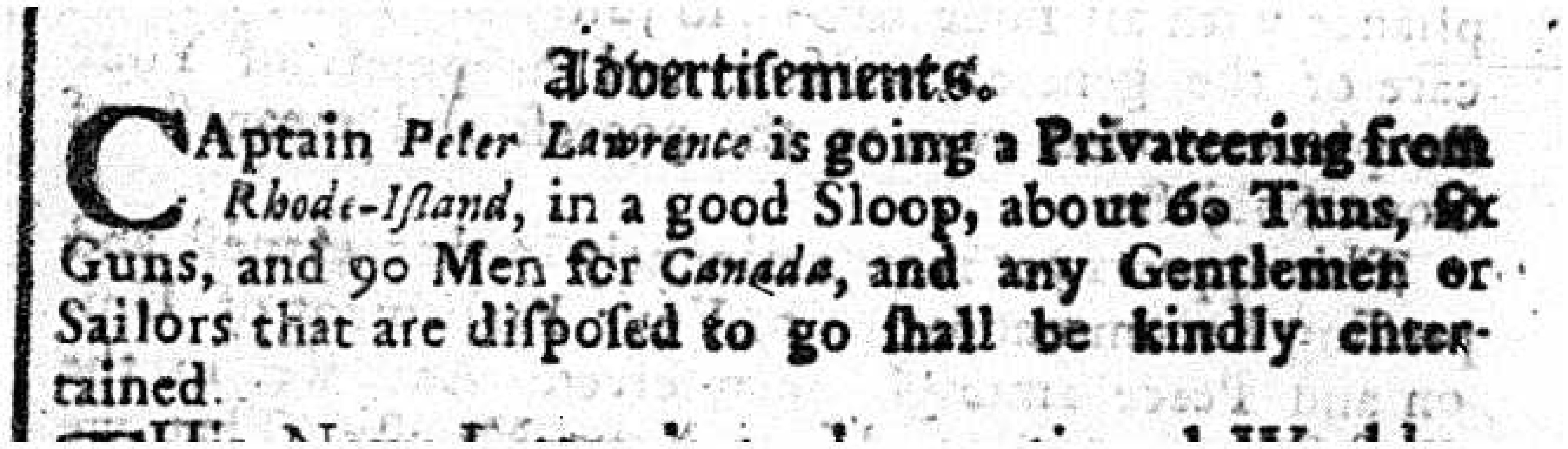
While these ads appear to be regarding fairly mundane matters, readers only had to wait a couple of weeks for this new “social media” to get more interesting. In issue number five, 15 May-22 May 1704, readers looking for adventure got their opportunity.

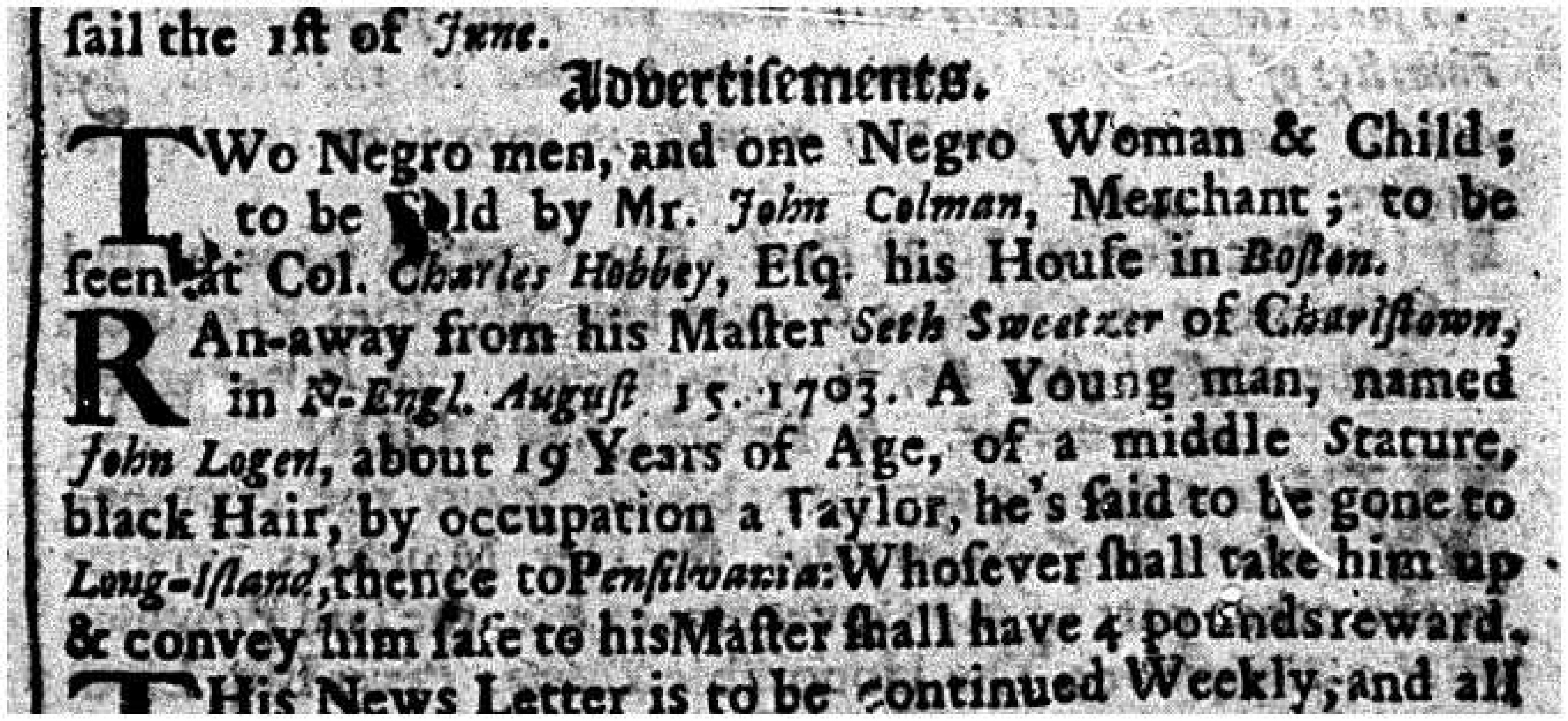
Sadly, only two weeks later, one would also see two ads that, by today’s standards, are a bit more insidious. In issue number eight, we are reminded that Massachusetts was not always a cradle of liberty and that people were property.

What do you think today’s advertisements will look like to researchers in 300 years? Maybe they will wonder how we ever got by driving automobiles relying on fossil fuels or how we kept time with something as simple as a Cartier watch. Will they look at personal ads as a definition of human interaction in our time?

To see more examples of the early days of advertising in American newspapers, consult our online catalog, ABIGAIL, or visit the library at the MHS to see what other early Massachusetts newspaper titles we have in our collections!


[i] Bradford, Alden, History of Massachusetts, for two hundred years: from the year 1620 to 1820, Boston: Hilliard, Gray, 1835. 

“My whole mind is at home”: The Letters of Civil War Sharpshooter Moses Hill, Part 2

By Susan Martin, Collection Services

A few weeks ago, I introduced you to Moses Hill of the 1st Massachusetts Sharpshooters, whose letters form part of the Frank Irving Howe, Jr. family papers. When we left Moses, in January 1862, his company was traveling along the C&O Canal. Unfortunately, weather and camp conditions were very poor, and illness became a major problem. Moses wrote to his wife Eliza: “I do not dred a Battle so much as I do sickness.” And with good reason: many soldiers died from typhoid and other diseases that winter.

However, each Union victory renewed Moses’ hope that the war would end soon and he would be home with his family by spring. His two children were growing fast. 13-year-old Lucina was now 5 feet and 1 inch tall, and Moses was impressed with the letters he received from her. The proud father bragged:

I think Lucina must of improved very much at school for she wrote me the best letter that she ever wrote before. I could not of believed she wrote so well as she wrote in that letter. I must say it was the best wrote letter that I have received since I left home.

His son George, or “Bub,” had been just two years old when his father left for the war, and Moses longed to see “the little fellow.” He drew pictures for Bub at the bottom of his letters, mostly rabbits, roosters, and other animals. In March 1862, Eliza sent him a photograph of their son, which he cherished:

I found a letter here when I got back to Camp. I found a great preasant in it. I found bubs picture. It is every thing to me. I shall kiss it every time I get a chance.

Moses’ homesickness is palpable. The separation from his family was both an emotional and a physical pain. And although the collection contains very few of the letters they sent to him, it’s clear the feeling was mutual. He assured his wife:

Dear Eliza you wrote that you dremped that I come home and I did not take any notice of you. Your Dream will never come to pass for if I come home or live to come home, and do not take notice of you and family I am mistaken. I think of home as much as you do of me and I think more. Why should I not out here in virginia. I think I ought to….You do not know what war is.

Moses had begun his military service, if not with enthusiasm, at least with optimism. But by March 1862, he had already taken part in many battles, and the war was taking its toll. He wrote: “I am sick of it. I want to come home I asure you but here we are.” On 27 Mar. 1862, the 1st Massachusetts Sharpshooters left for Yorktown, Va., where they would play a pivotal role in the month-long siege that spring. Please check back at the Beehive for the next installment of Moses Hill’s story.

Harbottle Dorr Launched

By Peter Steinberg, Collection Services

The Massachusetts Historical Society (MHS) holds an important collection of Revolutionary-era newspapers assembled, annotated, and indexed by a Bostonian shopkeeper named Harbottle Dorr, Jr. The Society has just launched a digital presentation of this collection. Dorr’s index terms and annotations offer a fascinating glimpse into his perspective and reactions to events, issues, and people discussed in newspapers of his time.

On Monday, 27 August 2012, I posted on The Idiosyncratic Index Subjects of Harbottle Dorr, Jr. In that blog post, I highlighted some of the more quirky index entries from Volumes 1 and 2 of the Harbottle Dorr, Jr. Annotated Newspapers collection, and also mentioned that a second posting would be forthcoming. Were you holding your breath? The wait is over! You can exhale now.


Volume 3

Cold Water, the Pernicious effects of drinking too much in hot weather &c. 212
Dogs Mad, Symptoms of 11
Drowned Persons Recover’d 638
Earth opening & swallowing Person’s at Quebec     601
Mcdougal Capt. presented with venison (in Prison)     50
Rum Danger of drawing it by candlelight      192
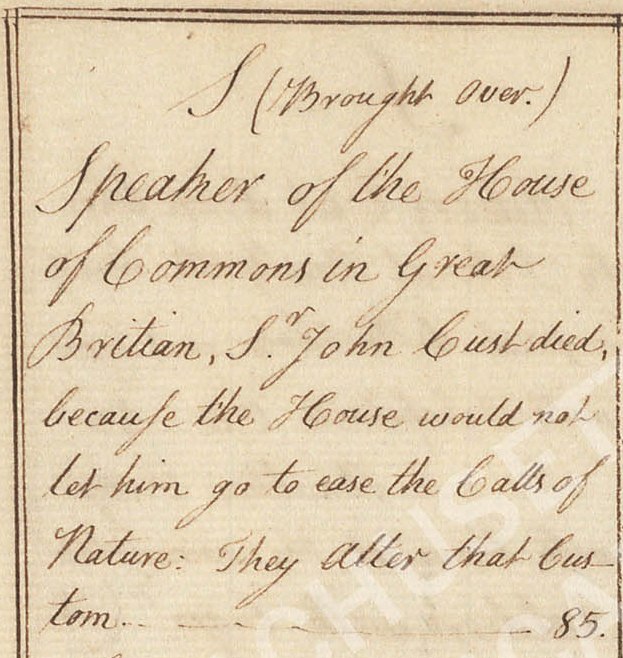
Speaker of the House of Commons in Great Britain Sir John Cust died because the House would not let him go to ease the Calls of Nature; They Alter that Custom      85
Tea, Ladies of Boston sign not to drink any vid. Under Agreement 31.
Thunder Terrible, Broke on a Magazine & produced terrible Consequences. 418.

Volume 4

Auctioneer put up the Ministry for sale. 470.
America of what vast importance to Great Britain: the extent of it: will be the greatest Empire in the World: the King of Great Britain in time it’s probable will fix his empire there, & great Britain become dependant on her, &c. 148.
Denmark Queen of, imprisoned (for attempting to poison the King.) with her paramour, &c. 52.
Deposition of John Mills, respecting a Tar Barrel put on the Beacon. 328.
Goal never intended as a place of Punishment. 24.
Giant at Hingham. 194.
Gun Powder Since found out, mens lives have been preserved, & c, & c, * 891.
Herculaneum City of in Naples, discovered, after being 1700 years buried by an eruption of Mount Vesuvius. 77.
Hillsborough Lord, on his intended resignation: a miserable wretched Creature. 164
Lemmons, wine, &c: a great hardship, to oblige the Americans to enter them in England. 198.
Snow, will make Puddings in the Room of Eggs. 223.

The indexes are now all transcribed and encoded, and available on the new website (www.masshist.org/dorr). The MHS has worked hard to make it as easy to use as possible, and are confident you will find the images stunningly clear and, while Harbottle Dorr, Jr. did have very good handwriting, we hope that the transcriptions provided will be accurate and helpful.

Since I have your attention, perhaps you will allow a sidebar? We are not yet presenting on the website transcriptions of the annotations from the newspaper issues themselves, but in working with the newspapers and their digital surrogates, we noticed from time to time humorous marginal commentary. Here is one such annotation that Dorr made to a speech by “his Excellency Sir Francis Bernard,” which was published in The Boston Evening-Post from 3 June 1765. It is in Volume 1, numbered by Dorr page 95: “This Speech the House did not Answer, perhaps they did not understand it. Who could?”

Not thinking myself better than Dorr, I have endeavored to read and understand Bernard’s Speech. Bernard begins by admitting, “I have no Orders from his Majesty to communicate to you; nor any thing to offer myself but what relates to your internal Policy: I shall therefore take this Opportunity to point out such domestic Business as more immediately deserves your attention.” I take this that the gentlemen of the council were hijacked – as you are right now by me – by Bernard’s ego! The rest of the speech is on Bernard’s desire to see an increased production and export of “Pot-Ash, Hemp and the carrying Lumber to the British Markets.”

Harbottle adds another personal opinion on two of Bernard statements in this same speech:

“The general Settlement of the American Provinces, which has been long ago proposed, and now probably will be prosecuted to its utmost Completion, must necessarily produce some Regulations, which, from their Novelty only, will appear disagreeable”

and

“In an Empire, extended and diversified as that of Great-Britain, there must be a supreme Legislature, to which all other Powers must be subordinate.”

To these Dorr writes, “Now the Wolf shews himself notwithstanding his Sheeps Cloathing.”


This Week @ MHS

By Dan Hinchen

As the spring rolls on and we enter a new month it will be a busier week here at the MHS with plenty of public programs to take part in. First on the list is a rare Sunday program happening on 28 April 2013. Join Jayne Gordon, MHS Director of Education and Public Programs, for an afternoon walking tour in Concord, MA. “Authors & Abolitionists” is a leisurely two-mile walk that explores the involvement of authors and Concord-residents like Emerson, Thoreau, and the Alcotts and their neighbors in antislavery efforts in Concord, hotbed of 19th-century abolitionist sentiment, and beyond. The walk, starting at 2:00pm, begins and ends at the Concord train depot and is coordinated with the Sunday train schedule. Walk leader Jayne Gordon is a resident of Concord who has worked at many of the town’s historic site and teaches the Concord history course required of all town guides. Registration Required. Fee $25/$15 (F/M); Free for MHS Fund Giving Circle members. Light refreshments included. For more information contact the education department at 508-577-4599 / education@masshist.org.

Next up, stop by the MHS on Tuesday, 30 April, for the next installment in the Immigration and Urban History Seminar series. This panel discussion, “19th-century Immigration, Nativism, and Politics” will focus on two papers. Mimi Cowan of Boston College highlights the ways in which participation in volunteer military groups sometimes helped immigrants combat nativism and, at other times, fueled nativists’ concerns about foreigners in her paper “Honorable Citizens: Ethnic Militias in Chicago, 1855-1879.” “African American and Irish Political Coalitions in Boston, Massachusetts, 1881-1890,” by Millington Bergeson-Lockwood, George Mason University, identifies three areas where African Americans and Irish immigrants established coalitions and laid claim to participation in the founding events of the United States as well as a histori resistance to oppression. Comment in this discussion provided by Evelyn Stern, University of Rhode Island. This program is free and open to the public, though RSVP is required. Subscribe to receive advance copies of the seminar papers. Discussion begins at 5:15pm.

Two events will happen on May Day this week. First, on Wednesday, pack a lunch and hit the MHS at noon for one of our Brown Bag Lunch talks. This week, Katelyn Crawford of the University of Virginia will present “Transient Painters, Traveling Canvases: Portraiture and mobility in the British Atlantic, 1750-1780.” Ms. Crawford’s project examines the paintings and portraitists working within the 18th-century British Atlantic world to demonstrate the impact of mobility on artistic practice and portraiture on identiy construction. She considers a network of about ten portraitists, the canvases they produce, and the travel of both individiuals and images throughout the British Atlantic and identifies a shift in the construction of artistic communities ans artists took to the sea. Her project reveals visual convergences and divergences that illustrate the development of regional identities within imperial conventions. This event is free and open to the public.

And on Wednesday evening, 1 May, head over to the Coolidge Corner Theatre, 290 Harvard St. in Brookline at 6:00pm for an MHS-sponsored author talk with Nathaniel Philbrick. The bestselling author of Mayflower and In the Heart of the Sea turns his attention toward the story of the first major battle of the American Revolution in his new book “Bunker Hill: A City, A Siege, A Revolution.” This book explores this, the bloodiest battle of the coming Revolution and the point of no return for the colonists in rebellion. Mr. Philbrick is a New York Times bestselling author, recipient of the National Book Award, and finalist for the Pulitzer Prize. This event is co-sponsored with Brookline Booksmith and will take place at the Coolidge Corner Theater in Brookline. For directions, please visit http://www.coolidge.org/. Tickets are available from the Brookline Booksmith and are $5 per person.Please visit brooklinebooksmith.com/tickets or call 617-566-6660 to reserve your space. When you purchase the book, you receive one free ticket and the option to purchase a second ticket for $5.

Finally, on Friday, 3 May 2013, MHS Librarian Peter Drummey will present an exhibition spotlight, “The Three Lives of Anthony Burns.” This program will explore the heroic, and tragic, life of Anthony Burns through documents on display at the Society. Who was Anthony Burns? How was his rendition – his return from Boston to slavery in 1854 – a turning point in the Abolitionist stuggle? What happened to him after he was free and his celebrity faded? Come by the MHS at 2:00pm to hear the answers to these questions. And while you are here, be sure to check out the three complementary exhibitions currently on display until May 24.

Fenway Garden Society: From Victory Gardens to Historic Landmark

By Emilie Haertsch, Publications


When the United States entered World War II after the bombing of Pearl Harbor, the nation’s food resources were already stretched thin. Once operating at a surplus, U.S. farmers were sending a large portion of their crops overseas to aid the Allies and alleviate the growing food shortage in Europe. With U.S. troops heading to war, there was an ever greater demand for food as only well-fed soldiers could serve at full strength.

In response to the increasing need for food, the U.S. government implemented the Food Rationing Program in 1942, which called on U.S. citizens to conserve their food consumption and avoid waste. In conjunction with rationing, the government also asked civilians to plant “Victory Gardens” and consume the produce they grew. The slogan “Food For Freedom,” originally coined during World War I, was repurposed to great effect.

There is evidence of this very garden movement in Boston’s Fenway neighborhood today. Among the 49 areas obtained for gardens by the Boston Victory Garden Committee, one large plot was established in what is now known as the Back Bay Fens. Area community members could apply for their own plots to aid the war effort, and receive instruction if they were novice gardeners. In order to encourage better gardening and crop yield, Victory Gardeners also held contests and exhibitions.

The gardens remained in this form until the war was drawing to a close and the need for food rationing in the U.S. lessened. In 1944, a group of plot-holding gardeners who feared losing usage of the land assembled with the goal of continuing their urban gardening beyond the war. They established the Fenway Garden Society, and the MHS has their papers in its collections.

The Fenway Garden Society held its first meeting on 15 October 1944, with 23 members in attendance. According to the meeting notes, the society’s object was to “promote the planting and growing of vegetables for home usage.” The society continued to be part of the war effort into 1945, when Chester Bowes of the War Food Administration in Washington, D.C., “wrote stating more food would be necessary.” However, by 1946 the National Victory Garden Commission had dissolved and the society shifted its focus to the general benefits of gardening.

They continued to hold contests to encourage good gardening, giving out small cash prizes and the coveted gold star to winners. They also wrote open letters to gardeners to encourage them to become involved in the society’s work and promote knowledge of gardening.

The Fenway Garden Society often faced an uphill battle in maintaining the piece of land used for the garden plots in what continues to be a highly desirable part of Boston. In one of their first open letters in 1946 they referenced “a petition asking for the gardens for this year, and expressing appreciation for them in the past” and encouraged prospective and current gardeners to sign. There would be many more occasions when the society’s members would have to advocate to maintain their land. Throughout the years, attempts have been made to build hospitals, schools, and parking lots on that land, and it has only been through the Fenway Garden Society’s efforts, and media and legislative support, that the community gardens have remained.

Today the Fenway Victory Gardens are a Boston Historic Landmark. The Fenway Garden Society still exists today and tends the same land in the Fens, which now consists of 500 individual plots cultivated by a diverse group of gardeners.