
Clara E. Currier’s Diary, April 1925

by Hannah Elder, Associate Reference Librarian for Rights & Reproductions

Today, we return to the transcription of Clara E. Currier’s 1925 diary. Currier was a working-class woman who lived in or near Haverhill, MA. Her diary records her daily activities – from fiber arts to paid employment to observations of the natural world – providing insight into daily life a century ago. You can find entries for January, February, and March in past blog posts.

April has a lovely start for Clara, making a hat, calling on friends and family, and celebrating Easter. In the middle of the month, though, she comes down with measles. For nearly a week, she has daily visits from her doctor, is attended to by Mary, and is bed-bound. Even after her high fever breaks and she starts to receive visits from friends, Clara is weak and has to start easing back into daily life, including sitting up, dressing, and leaving her bed. We will continue to follow her path to recovery in May.

Apr. 1, Wed. Fair, out for the day, went to Newburyport A.M, started to make a hat and went to Haverhill to Rebekah (Kenoya) and saw lovely work, Mae Jenney went with me.

Apr. 2, Thurs. [$]19. Fair, mended.

Apr. 3, Fri. Fair, went up to town.

Apr. 4, Sat. April showers, cooked and sewed, went up town and called on Mrs. Dennis.

Apr. 5, Sun Fair, went to church, Sizzie came over to dinner and we called on Mr. + Mrs. Charles Gould, looked at Uncle Will’s cellar, over to Union Cemetery and called at Delia’s.

Apr. 6, Mon. Fair, sewed.

Apr. 7, Tues. Fair, Mary came down, sewed, went to Grange, degrees.

Apr. 8, Wed. Fair, Mary sewed and went home at night, went up to Stephen’s with her.

Apr. 9, Thurs. [$]15.58 Fair, went up town, finished my hat, Blanche called.

Apr. 10, Fri. Rained in evening.

Apr. 11, Sat. Fair, went down to Grace Nealand’s for afternoon and evening.

Apr. 12, Sun. (Easter) Fair and cool, cloudy at night, went to church, S.S, and vesper service at Market St., and then went to Haverhill to a pageant. Wore my new hat.

Apr. 13, Mon. Snowed during night and in morning cleared away, and soon melted. Went to class meeting and helped serve refreshments.

Apr. 14, Tues. Fair, feeling mean, Blanche came over for the evening.

Apr. 15, Wed. Rainy, then cleared, worked in morning, had Dr. Murphy and went to bed with measles, thunder shower, Mary came down. Blanche came to the door.

Apr. 16, Thurss. [$]19. Fair, having a hot time in bed, no cold things. Dr. came

Apr. 17, Fri. Fair, Still hot and sweating. Dr. came.

Apr. 18, Sat. Fair and warmer, all broken out but still very hot so had Dr. and my temperature was 102°. Etta was over and brought grape juice.

April 19, Sun. Started to snow around 10 o’clock and had a regular N.E. snowstorm. Some better but Dr. found my temperature 100 ¾°. Mrs. Dennis came over.

Apr. 20, Mon. Ground all white with snow, cold and windy. Dr. came and found temperature normal, measles starting to go, have had them very hard.

Tues. Apr. 21 Fair and 20° above, Frank called, corner class sent a basket of fruit and candy.
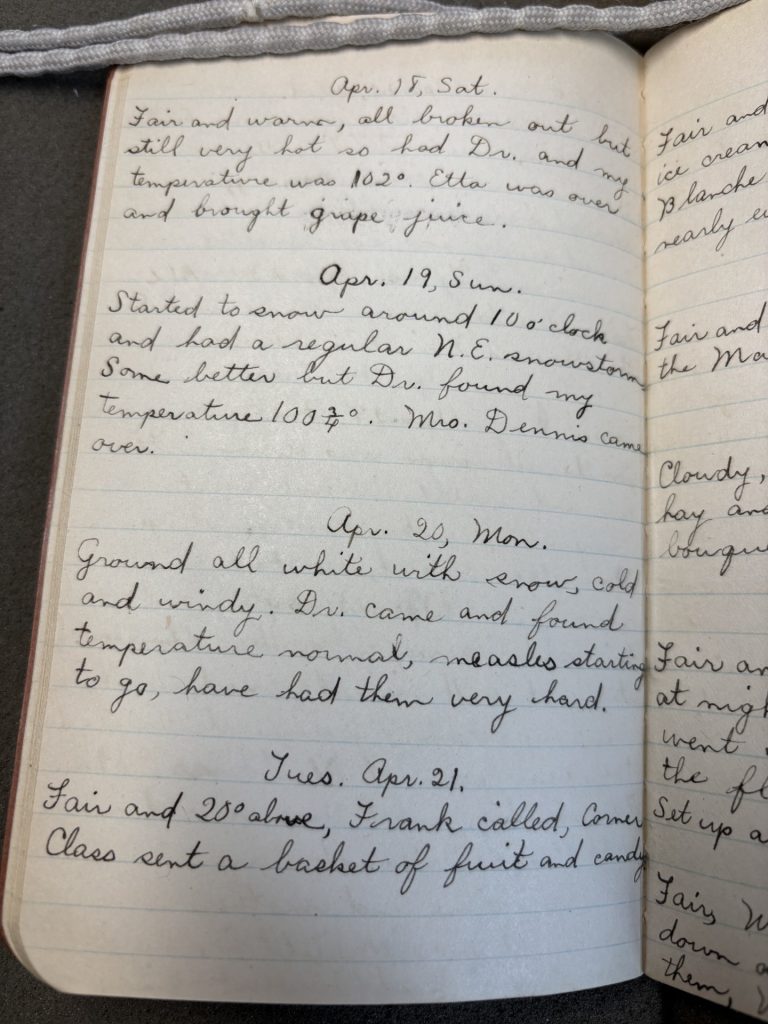
handwritten text in a journal
Diary entries for 18 to 21 April, chronicling Clara’s measles

Apr. 22, Wed. Fair and warm, Etta came over, brought ice cream, Delia (ice cream) called in the evening. Blache came to the door, Sizzie came nearly every day.

Thurs. Apr. 23 [$]9.12 Fair and windy, warm, Mary went to the Mason’s Minstrel Show.

Apr. 24, Fri Cloudy, William was down with hay and called, Rebekahs sent bouquet of cut flowers, set up.

Apr. 25, Sat. Fair and warm, Thunder shower at night and rained hard, Mary went up town, Grange dedicated the flag pole at Victoria Park. Set up awhile.

Apr. 26, Sun. Fair, William and mother came down and Mary went home with them, Was dressed for first time. Sizzie came to stay nights with me.

Apr. 27, Mon. Fair, sat up but weak. Blanche came over.

Apr. 28, Tues. Fair, got dinner and read a little.

Apr. 29, Wed. Dull and cold, Feel rather weak and shaky. Mr. Jackson called.

Apr. 30, Thurs. Rainy, Sizzie went to Grange play.

If you are interested in viewing the diary in person in our library or have other questions about the collection, please visit the library or contact a member of the library staff.

*Please note that this diary transcription is a rough-and-ready version, not an authoritative transcript. Researchers wishing to use the diary in the course of their own work should verify the version found here with the manuscript original.

This line-a-day blog series is inspired by and in honor of MHS reference librarian Anna J. Clutterbuck-Cook (1981–2023), whose entertaining and enlightening line-a-day blog series ran from 2015 to 2019. Her generous, humane, and creative approach to both history and librarianship continues to influence the work of the MHS library.

The Tragedy of the Titanic

by Rakashi Chand, Reading Room Supervisor

I simply gasped when one of our researchers called me over to her desk in the reading room to look at a diary entry by a young woman, Amelia Peabody, writing about the sinking of the Titanic—and the darkness that the tragedy spread over the nation.

Amelia Peabody was born in 1890 to Frank Everett Peabody and Gertrude Bayley, a wealthy family that kept a summer house in Marblehead and a winter residence at 120 Commonwealth Avenue in Boston. Amelia studied sculpture and became an accomplished artist, horsewoman, farm owner, breeder, and philanthropist. Amelia would go on to inherit both the estate of her father and her stepfather, William Storer Eton.

Amelia Peabody in 1912

Amelia’s world was greatly impacted by the Titanic disaster, with friends and acquaintances on board the ill-fated ship and the unsettling realization that all in Amelia’s circle could well have been on board.   The following transcription is the 23 April 1912 diary entry, part of the Amelia Peabody Papers.

April 23, Tuesday

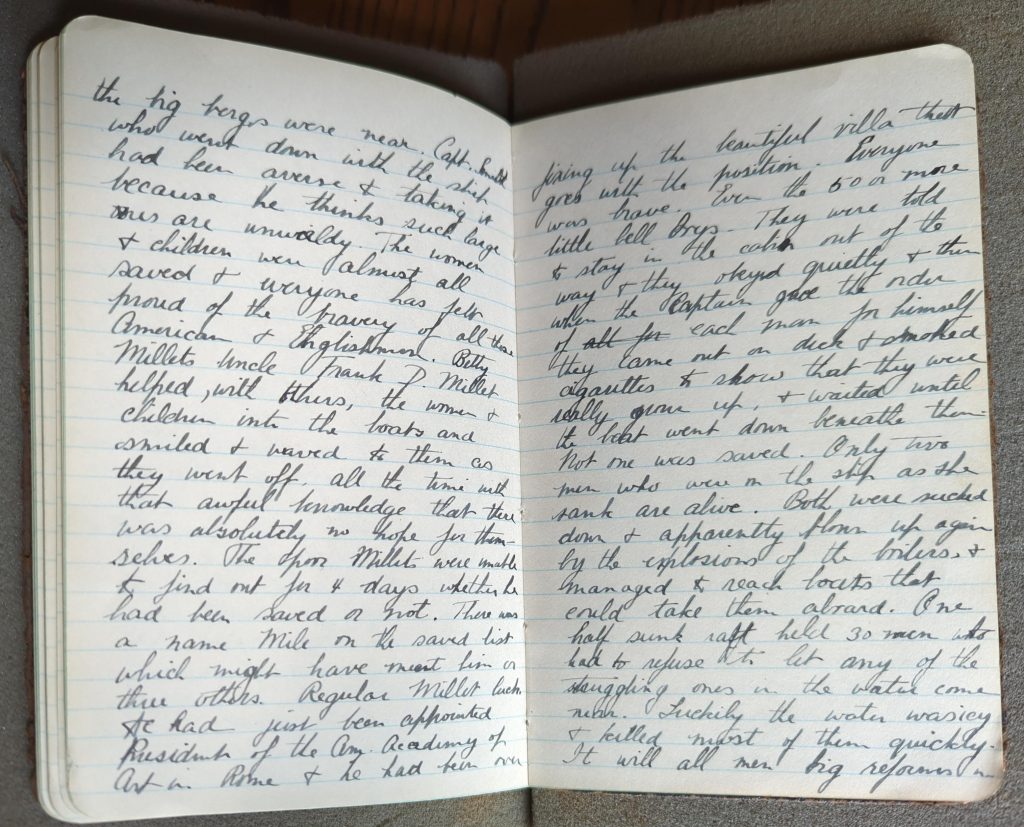
One of the world’s greatest disasters has happened since I last wrote. On Sunday night at 11:45 April 14th the new steamer Titanic hit an iceberg and two hours later she sank with some 15 hundred on board- almost 7 or 8 hundred were saved, picked up by the Carpathia about 4 hours later from the life-boats. The horrible part about it is that probably all or almost all would have been saved if there were life-boats enough. As it was, every available boat was filled & the men left behind had nothing to do but wait for the end. It was a smooth night so that the berg wasn’t seen until a quarter of a mile away which is only a few minutes for a boat of that size. They were going too fast, but they didn’t think the big bergs were near. Capt. Smith who went down with the ship had been averse & taking it because he thinks such large ones are unwieldy. The women & children were almost all saved & everyone has felt proud of the bravery of all these American & Englishmen. Betty Millets Uncle Frank D. Millet helped, with others, the women & children into the boats and smiled & waved to them as they went off, all the time with that awful knowledge that there was absolutely no hope for themselves. The other Millets were unable to find out for 4 days whether he had been saved or not. There was a name Mile on the saved list which might have meant him or three others. Regular Millet luck. He had just been appointed President of the Am. Academy of Art in Rome & he had been over fixing up the beautiful villa that goes with the position. Everyone was brave. Even the 50 or more little bell boys- They were told to stay in the cabin out of the way & they obeyed quietly & then when the Captain gave the order of all for each man for himself they came out on deck & smoked cigarettes to show that they were really grown up, & waited until the boat went down beneath them. Not one was saved. Only two men who were on the ship as she sank are alive. Both were sucked down and apparently blown up again by the explosion of the boilers, & managed to reach boats that could take them aboard. One half sunk raft held 30 men who had to refuse to let any of the struggling ones in the water come near. Luckily the water was icy and killed most of them quickly.

Pages from Peabody’s 23 April 1912 journal entry

As the week went on, the tragedy of the Titanic continued to loom. On Wednesday, 24 April, Amelia wrote about rehearsals and performances of a show she was part of that was “great fun & quite worth all the trouble. . . . The Titanic however threw a subconscious gloom over it all.” Then, in her next entry on Monday, 29 April, she wrote “Nobody comes to call except Sundays & then I’m usually out. Even Betty isn’t coming in on account of her Uncle, whose body has been recovered, by the way.”

Visit the Library to learn more and make your own discoveries while exploring the words and worlds of people like Amelia Peabody.

Further Reading:

Amelia Peabody by Linda Smith Rhoads (Boston, 1998).

Archivist as Detective: Finding Sarah

by Susan Martin, Senior Processing Archivist

Close-up color photograph of the last line of a handwritten letter, reading “In the bonds of friendship yours Sarah.” The text is written in dark ink on yellowed paper, and the name Sarah is underlined.
Detail of letter from Sarah to her cousin, March 1: “In the bonds of friendship yours Sarah”

In my last post, I introduced you to a woman named Sarah, of New Braintree, Massachusetts, and a letter here at the MHS that she wrote to a cousin, probably in 1874. Thankfully she’d mentioned a few friends or relatives in the letter, and I could identify them using digitized copies of published genealogies. But who was Sarah?

Some of the people she mentioned in her letter were Lucius Prouty, the Peppers, Miss Wood, Dwight, Hattie Prouty, Lizzie Whipple, and Frank. I’d zeroed in on the children of Homer R. Prouty of North Brookfield, Massachusetts, for three reasons: many of these names appear in that branch of the family, North Brookfield is right next to New Braintree, and the time period was right.

But I didn’t know Sarah’s connection to the Proutys. (I should note that it was common at the time for people to refer to relatives by their full names, when so many names were reused. For example, if you had a sister Mary and a cousin Mary, you’d likely refer to your cousin by her full name to distinguish her.)

I searched the Prouty genealogy for Sarahs (79 results), backed out a generation to expand my search to cousins and aunts, and even clicked through Prouty and Pepper plots at Walnut Grove Cemetery, but I couldn’t turn up anyone that seemed likely to be our correspondent. When I’m stuck, I find it usually helps to go back to the original letter for more clues.

I was confident I had the right family. Brothers Lucius, Charles, and Dwight were all mentioned in the letter. Lucius married Miss Pepper, and Dwight and Charles both married Misses Wood. Hattie (Harriet) was the wife of another brother. Lizzie Whipple baffled me at first, until I stumbled on Elizabeth Quimby (Allen) Whipple, buried in New Braintree. This name stood out to me because the mother of Lucius, et al., was none other than Nancy (née Allen) Prouty. So I dove into the Allen genealogy.

Lizzie was, in fact, a first cousin of the Proutys in Sarah’s letter. She also had a 17-year-old son Frank, who turned out to be the linchpin of my investigation. Sarah had written, “Frank is at Poughkeepsie and hopes to recieve [sic] his diploma about the first of April.” Frank Herbert Whipple was indeed attending Eastman Business College in 1874.

Lo and behold, Lizzie had a sister Sarah. I initially discounted her because she was married, and our correspondent wasn’t. Then I saw that she didn’t marry until 1877. I’d finally found the woman who wrote the letter.

Sarah E. Allen was born in 1831 and died in 1906. Census records confirm she worked as a dressmaker before her marriage at the age of 45 to Charles Curtis Rice, a telegraph lineman. I couldn’t identify the letter’s recipient, her “dear Cousin,” but was glad I could at least give Sarah her due and add her to the MHS catalog.

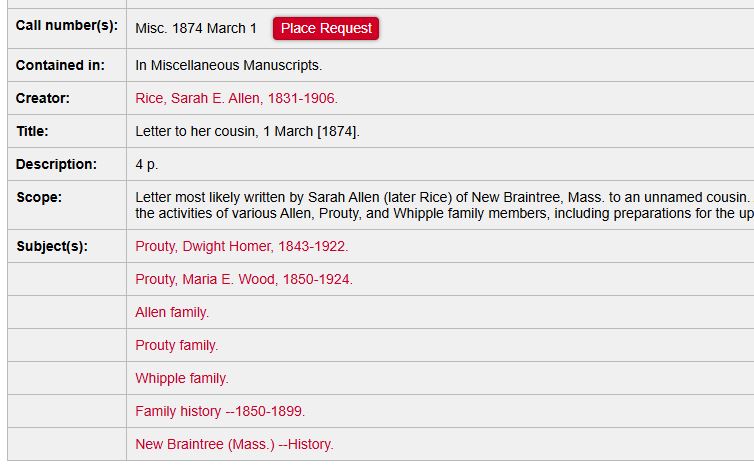
Alt text: Color screenshot of an online library catalog record describing a letter written by Sarah E. Allen Rice to her cousin on March 1, 1874.
Catalog record for Sarah’s letter in MHS catalog ABIGAIL

Massachusetts Association Opposed to the Further Extension of Suffrage to Women

by Hilde Perrin, Library Assistant

While March’s Women’s History Month has just concluded, women’s history is still present in our collections here at the MHS. Our collections are full of inspiring women, many of whom advanced and advocated for women’s rights through their lives and work. But the complexity of history also means that many women worked against women’s rights, and their material has also been preserved. Through working on a project to create a subject guide of women’s suffrage materials held by the MHS, I discovered that we own a large collection of anti-suffrage material from the debate around women’s right to vote and the passage of the 19th amendment. Among this material are the records of the Massachusetts Association Opposed to the Further Extension of Suffrage to Women. Established in 1895, this association worked to combat the rise of feminist suffragists and argued that the vote should not be extended to women. While it is often assumed that women’s suffrage was hampered by men, these records show that there were also women who felt strongly opposed to suffrage and organized against it.

Donated to the MHS by the estate of Mrs. Randolph Frothingham in 1946, the records contain several copies of bylaws and overviews of the work of the association, which detail the belief held by these women, and the pattern of work they took part in to share their views. Women over the age of 21 who were “interested in the welfare of their state” were encouraged to become members, with no membership fee limiting their participation. The association advanced its cause through three branches of work: legislative, educational, and constructive. The legislative work included contacting and informing members of the legislature about their opposition to women’s political rights. The educational branch promoted print material, including pamphlets and magazines, and organized public audiences to increase the general knowledge of their cause. The constructive work focused on building the membership of the association, mainly working through members and local community organizations to build relationships and encourage the spread of anti-suffrage ideals.

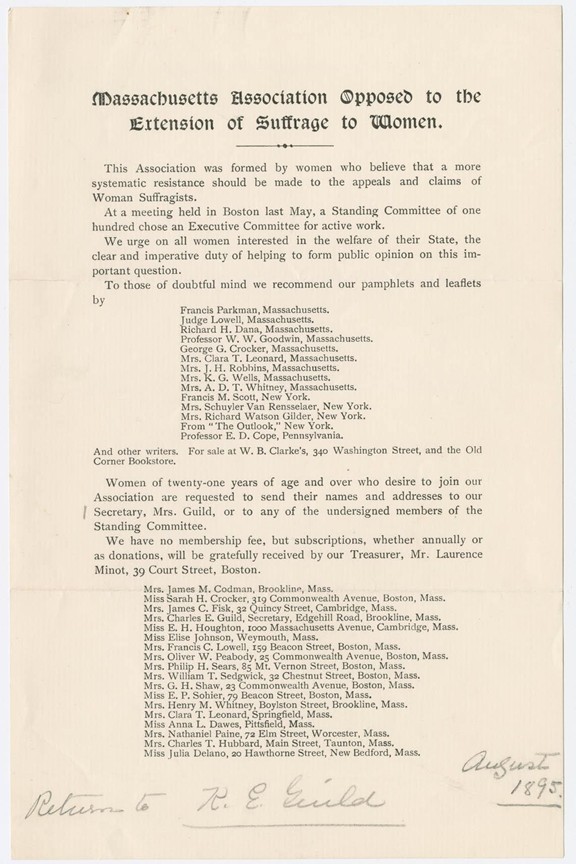
Printed document titled "Massachusetts Association Opposed to the Extension of Suffrage to Women" with information about the organization and its members
Document from the Massachusetts Association Opposed to the Further Extension of Suffrage to Women records

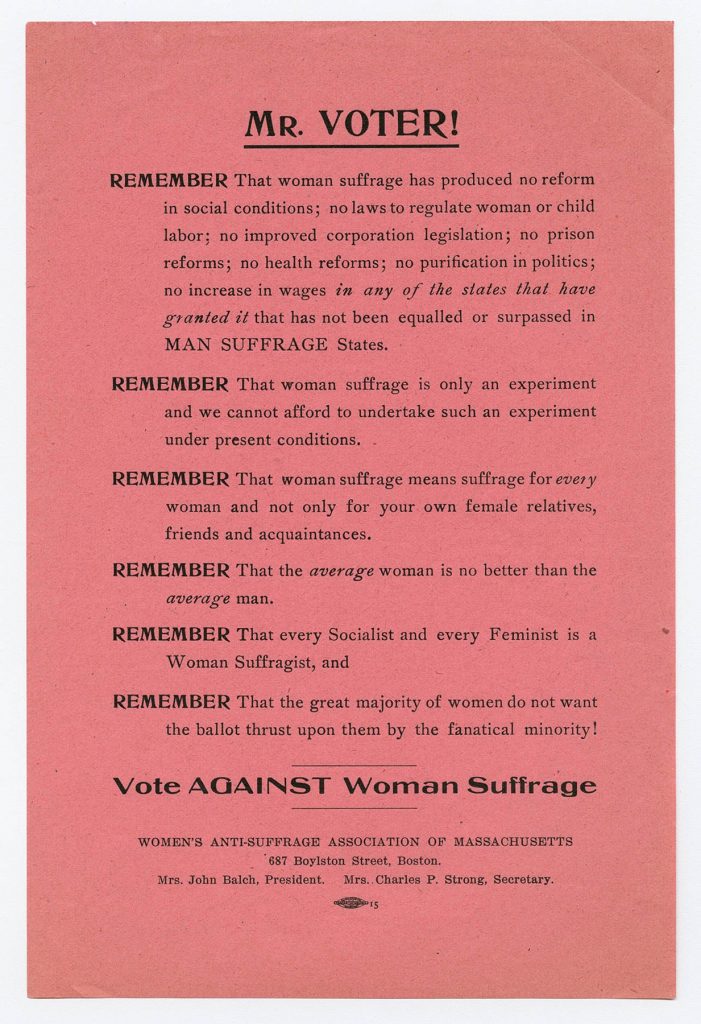
An example of the educational material circulated by the anti-suffrage association includes a pamphlet addressed to “Mr. Voter.” Printed on red paper, it reminds male voters that women’s suffrage is “an experiment,” and that “the great majority of women do not want the ballot thrust upon them” by what the pamphlet calls a “fanatical minority.” Reminding readers that the “average woman is no better than the average man,” the pamphlet urges the reader to “Vote AGAINST woman suffrage.” The pamphlet typifies the association’s anti-suffragist sentiment, reminding us of the complexity that exists within our collections and history at large.

Printed document on red paper titled "Mr. Voter!"
Mr. Voter! Circular by the Women’s Anti-Suffrage Association of Massachusetts

For more information about the women’s suffrage movement in Massachusetts, visit the digital feature “Massachusetts Debates a Woman’s Right to Vote,” and be on the lookout for a new subject guide coming out in the next few months about our women’s suffrage materials!