
Four Months in the Life of a Traveling Salesman

by Susan Martin, Senior Processing Archivist 

I’d like to tell you about a small collection at the MHS that includes a truly wild diary. It was written in 1838 by Samuel Leonard of Bridgewater, Massachusetts, as he traveled throughout the Southern United States exhibiting cotton gins to potential buyers.
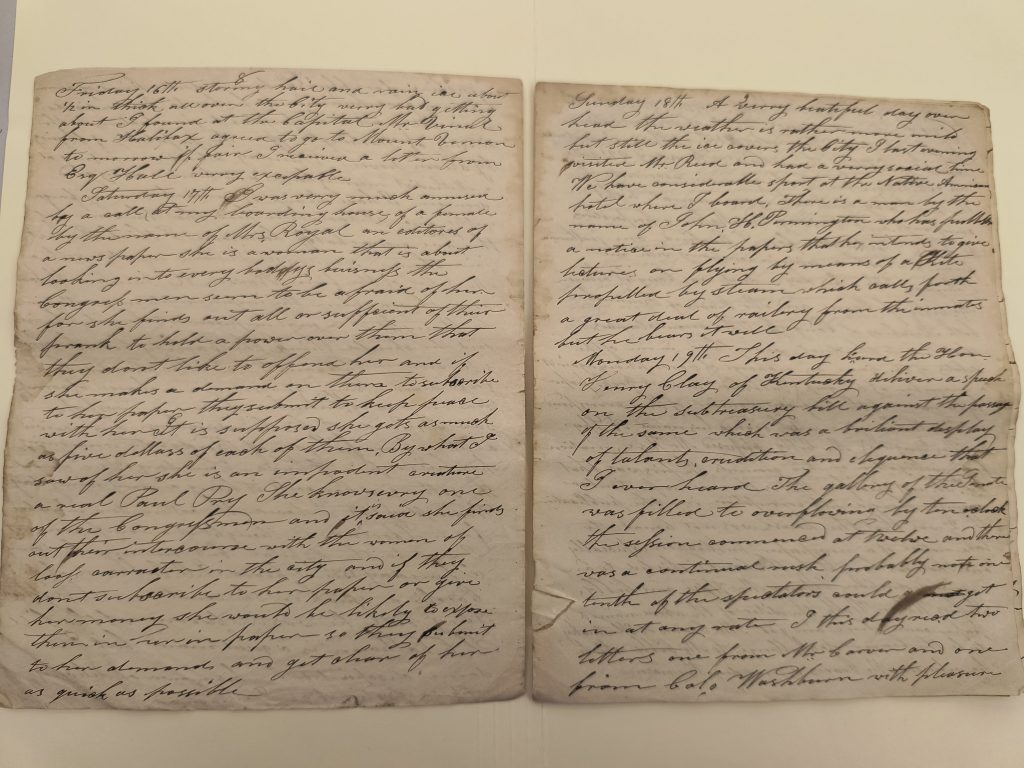
Color photograph of two manuscript pages covered with writing in black ink. The pages are slightly torn and stained in a few places, and the ink is smeared in the lower right corner. There’s a bulge across the middle of the pages where they were previously folded.
Pages from the diary of Samuel Leonard, 1838

The diary is wild because of all the historical “timelines” Leonard crossed in just a four-month period. He was like a 19th-century Forrest Gump. It was fun to research and catalog because I never knew what was coming next.

The diary is 48 pages long, and the first four pages are missing, but we join Leonard on 3 February 1838 in Washington, D.C. From there, he traveled to multiple Southern states, including South Carolina, Georgia, Florida, Louisiana, Mississippi, and Tennessee. Here’s the highlight reel:

  • In D.C., he met John Pennington, who had “a moddle and drawing of a machine for flying he is a droll kind of a man but verry good humoured he has to Bear ridicule from all quarters he proposes to give lectures to the citizens of Washington on the possibility of flying by steam power.”
  • He also met Anne Newport Royall, “an editores[s] of a news paper she is a woman that is about looking into every boddys business the Congress men seem to be afraid of her for she finds out all or sufficient of their prank to hold a power over them.”
  • On 24 February, Congressman Jonathan Cilley of Maine was killed in a duel with Congressman William Graves of Kentucky at the Bladensburg Dueling Grounds in Maryland. Leonard wrote, “I saw the carriage that brought in the corps[e], but I had no inclination to see the body.”
  • At a hotel in Charleston one night, Leonard “was awoke by the cry of Murder in the yard.” The cause of the commotion was none other than Junius Brutus Booth, the father of John Wilkes Booth. “Being crazy by liquor,” he had attacked fellow tragedian Tom Flynn with an andiron. Leonard editorialized, “This is what I call a real tradgady.”
  • In Florida, he traveled through the thick of the Second Seminole War, writing about a recent alleged attack on white settlers “six or seven miles from this place.” From old newspapers, I learned he was probably referring to the Purify family near Tallahassee.
  • He witnessed a fire that destroyed a whole city block in downtown Mobile, Alabama.
  • His steamboat nearly capsized into the Mississippi River during “a verry severe tempest […] it was so dark I could not see my hand before me.”
  • Not long after, he was on the steamboat Tuscumbia when a fireman fell into the Cumberland River and drowned.
  • Lastly, he visited “the old General,” a.k.a. Andrew Jackson, at the Hermitage in Tennessee. Leonard found the former president “verry free and sociable but his health was not good.” It should be noted that this time, the Cherokee people were being forcibly removed from their ancestral lands as a result of the Indian Removal Act signed by Jackson eight years earlier.
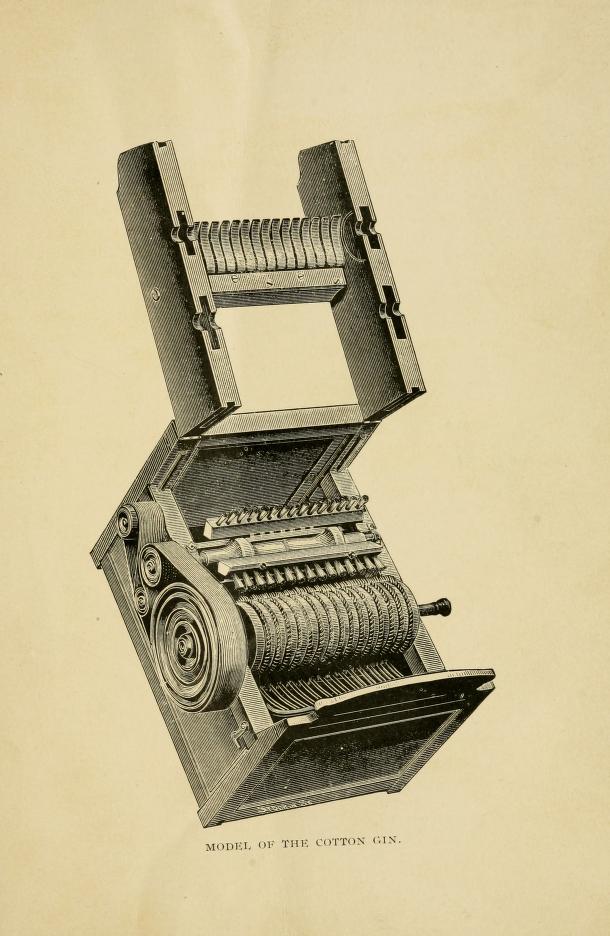
Black and white illustration of a box-like machine with gears, brushes, and other components. The machine is propped up on its side, and the lid is open to reveal the inside. Text along the bottom reads: “Model of the Cotton Gin.”
Model of the cotton gin, from The Story of the Cotton Gin by Edward Craig Bates (1899)

Leonard encountered enslaved Black people nearly everywhere he went and witnessed auctions of trafficked Africans. In one instance, he carefully noted the price paid for each person. About one “heartrending” auction, he wrote, “it is hard business to separate husband and wives parents and children, brothers, and sisters.” Given that Leonard made his living selling a machine that helped to perpetuate and expand slavery, there’s no indication that he ever reckoned with his own complicity.

Samuel Leonard’s diary is fascinating for so many reasons. To dive even further into his life, the MHS holds another collection of his papers.
Clara E. Currier’s Diary, June 1925

by Hannah Elder, Associate Reference Librarian for Rights & Reproductions

Welcome back to the transcription of Clara E. Currier’s 1925 diary. Currier was a working-class woman who lived in or near Haverhill, MA. Her diary records her daily activities—from fiber arts to paid employment to observations of the natural world—providing insight into daily life a century ago. You can find entries for January, February, March, April, and May in past blog posts.

June is a less eventful month than April and May, which I’m sure is a relief for Clara. She endures hot and changeable weather, recording multiple thunderstorms throughout the month. She also plays donkey (a four-player card game), goes on her usual calls, and works. She also reports on the health of those in her community and works on new hats for herself and for friends.

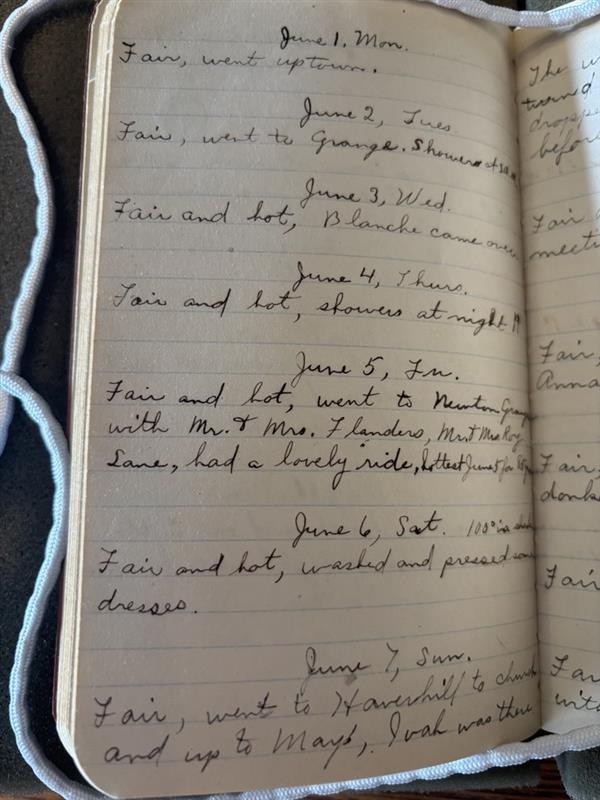
June 1, Mon. Fair, went uptown.

June 2, Tues. Fair, went to Grange. Showers at 3 a.m.

June 3, Wed. Fair and hot, Blanche came over.

June 4, Thurs. Fair and hot, showers at night. [$]19

June 5, Fri. Fair and hot, went to Newton Grange with Mr. + Mrs. Flanders, Mr. + Mrs. Roy Lane, had a lovely ride, hottest June 5 for 85 years.

Jue 6., Sat. 100° in shade Fair and hot, washed and pressed some dresses.

June 7, Sun. Fair, went to Haverhill to church and to Mary’s, Ivah was there. The wind came out east and it turned cold and the temperature dropped nearly 50° from the day before.

A page of a lined notebook with handwritten entries.
Clara’s diary entries for June 1-7, 1925

June 8, Mon Fair and cooler, went to class meeting, Blanche called.

June 9, Tues. Fair, went over to Blanche’s, finished Annah’s hat.

June 10, Wed. Fair, thunder shower, played donkey downstairs.

June 11, Thurs [$]19 Fair, sewed.

June 12, Fri. Fair, went to W. Newbury grange with the Flander’s, had a fine time.

June 13, Sat. Fair, no work, washed and cleaned my bedroom, went up home.

June 14, Sun. Fair with a little shower, Sizzie and I came back. Bernice March had a boy baby yesterday morning.

June 15, Mon. Fair with a shower at night.

June 16, Tues. Showers in A.M then cleared, went to Grange. Rode home with Earl Currier.

June 17, Wed. Fair with shower at night, sewed.

June 18, Thurs. [$]17.10 Fair, Showers in morning went down to see Cody, saw Uncle Will’s house and Gertie and they brought me home.

June 19, Fri. Fair, sewed.

June 20, Sat. Fair with thunder shower at night. No work, washed and cooked, went to Haverhill and got a new coat $19.50. Sewed.

June 21, Sun. Fair with a little shower at night, went to church and S.S, called on Mrs. F. Jewell and Gertie.

June 22, Mon. Fair, sewed.

June 23, Tues. Fair, went downstairs to play donkey.

June 24, Wed. Fair, trimmed my outing hat.

June 25, Thurs. [$]17.10 Rain, Sizzie and I went up to Etta’s to supper. Mr. Jackson see us home.

June 26, Fri. Fair, went up town.

June 27, Sat. Fair, worked all the forenoon, went up town in evening.

June 28, Sun. Fain, wrote letters and called on Aunt Abbie.

June 29, Mon. Shower early, then cleared and shower at night.

June 30, Tues. Rained early, cleared, went up town and Mary and Charles and Mabel. Sent a card to Bernice Marsh who is very sick.

If you are interested in viewing the diary in person in our library or have other questions about the collection, please visit the library or contact a member of the library staff.

*Please note that this diary transcription is a rough-and-ready version, not an authoritative transcript. Researchers wishing to use the diary in the course of their own work should verify the version found here with the manuscript original.

This line-a-day blog series is inspired by and in honor of MHS reference librarian Anna J. Clutterbuck-Cook (1981–2023), whose entertaining and enlightening line-a-day blog series ran from 2015 to 2019. Her generous, humane, and creative approach to both history and librarianship continues to influence the work of the MHS library.

Announcing the 2025-2026 MHS Research Fellows

by Cassandra Cloutier, Assistant Director of Research

The Research Department is pleased to announce the 2025-2026 cohort of research fellows. Each year, the Massachusetts Historical Society provides financial support for scholars utilizing our unique collections on American history to produce original scholarship.  

The MHS typically offers various short-term fellowships as well as NEH-funded long-term fellowships each award season. Short-term fellowships support four to eight weeks of research while long-term fellowships require a minimum of four months in residence at the MHS. Unfortunately, after the selection of this year’s long-term fellows, the NEH funding for this fellowship program was terminated. Although four scholars were selected for long-term fellowships, the awards will not be distributed.

This year’s awarded projects span the sixteenth century to the present and investigate topics such as the history of commodities, borderlands, and various religious traditions. Others reexamine women in the transcendentalist movement, colonial-era witch trials, and, of course, the American Revolution. Congratulations to the fellows selected to receive this year’s awards! We look forward to welcoming these scholars to the MHS and learning more about the following projects in the coming year.

MHS-NEH Long Term Fellows

  1. Nicole Breault, Assistant Professor, University of Texas at El Paso, “Set the Watch: Policing and Governance in Early America”

  2. Alexander Clayton, Assistant Professor, University of Vermont, “The Living Animal: Menageries and the Nature of Empire”

  3. Leland Jasperse, Humanities Teaching Fellow, The University of Chicago, “Theories and Practices of Intimate Friendship in the 19th-Century New England Literary Scene”

  4. Jonathan Schroeder, Lecturer, Rhode Island School of Design, “Harriet and John Jacobs: Their Worlds and the Worlds They Made”

New England Regional Fellowship Consortium (NERFC)

NERFC Fellows Visiting the MHS

  1. Andrew Abrams, Ph.D. Candidate, College of William & Mary, “Days and Hours: Labor, Technology, and Temporality in Early America”

  2. Robert Colby, Assistant Professor, University of Mississippi, “William and Sarah Jackson’s Civil War”

  3. Amy Finstein, Associate Professor, College of the Holy Cross, “In the Center Yet on the Side: Elisabeth May Herlihy and the Mechanics of American City Planning, 1910-1950”

  4. Ella Hadacek, Ph.D. Candidate, University of Notre Dame, “Going to Rome: British and American Women’s Conversion to Catholicism, 1840-1930”

  5. Claire Lavarreda, Ph.D. Candidate, Northeastern University, “Cultural Transformation in the Process of Text Production: Indigenous Catholicism in New France and New Spain, 1521-1701”

  6. William Morgan, Ph.D. Candidate, Indiana University Bloomington, “A Long Revolution: Emancipation, Black Politics, and Radical Memory in New England”

  7. Tristan New, Ph.D. Candidate, Boston University, “The People, the Courts, and the Contested Revolution in Massachusetts, 1772-88”

  8. Ariel Silver, Assistant Professor, Southern Virginia University, “The Conversationalists”

  9. Evelyn Sterne, Associate Professor, University of Rhode Island, “Faith in Crisis: Religion in Boston During the Great Depression”

  10. Rachel Walker, Associate Professor, University of Hartford, “Free Radicals: Fringe Thinkers and the Fight for Liberty in Nineteenth-Century America”

  11. Tingfeng Yan, Ph.D. Candidate, University of Chicago, Colonial Society Fellow, “Administration and the Making of the Constitutional Order in Founding-era America”

  12. Yuan Yi, Assistant Professor, Concordia University, “Yellow Cotton: Nankeen, Biodiversity, and Material Culture in the Early Transpacific World”

  13. Carolyn Zola, Postdoctoral Fellow, Library Company of Philadelphia, “Public Women: Urban Provisioners and the Rise of American Capitalism”

Fellows Not Visiting the MHS

  1. Anne Bardaglio, Ph.D. Candidate, University of Maine Orono, “Island Time: Cultural Production of Sense of Place in the Gulf of Maine and Bay of Fundy, 1850-1920”

  2. Jacqueline Beatty, Associate Professor, York College of Pennsylvania, “Engendering Orientalism in the Empire of Liberty”

  3. Emily Bingham, Visiting Honors Faculty Fellow, Bellarmine University, “Study Abroad: Youth, Power, Learning, Love”

  4. Kathryn Gindlesparger, Associate Professor, Thomas Jefferson University, “Old Money: The Language of Philanthropy and the Foundation of American Higher Education”

  5. Genevieve Kane, Ph.D. Candidate, Boston University, “Climate Resilient: An Environmental History of Boston’s Waterfront and its Architecture since the Nineteenth Century”

  6. Brian Knoth, Associate Professor, Rhode Island College, “A Creative Research-based Exploration of the Original Songs and Poetry Written on New England Whaling Ships”

  7. Cecilia Márquez, Assistant Professor, Duke University, “Latinos on the Fringe: Latinos and the Right since World War II”

  8. Erica McAvoy, Graduate Student, University of New Hampshire, “’For the Use of Said Parish:’ Black New Englanders, the Congregational Church, and the Intersection of Opportunity and Oppression in the 18th Century”

  9. Arrannè Rispoli, Ph.D. Candidate, University of California, Los Angeles, “Murder and the Mundane: Capital Punishment and the Architecture of Black Criminality in Early New England”

  10. Christine Sears, Associate Professor, University of Alabama in Huntsville, “Mariners and Labor in the Early American Republic”

  11. MaryKate Smolenski, Ph.D. Candidate, Boston University, “The Loyalist Legacy: Memory and Material Culture of New England Loyalists, 1776 – 1976”

  12. Gretchen Starr-LeBeau, Professor, Principia College, “Between the Law of Divine Love and the Law of the State: The Global Growth of Christian Science to 1950”

  13. Alicia Svenson, Ph.D. Candidate, Northeastern University, “Turning Craft into Technology: Standardization within the U.S. Stone and Brick Industries, 1880-1940”

  14. Peter Twohig, Professor, Saint Mary’s University, “Women’s Activism and the ‘Third Wave’ of Occupational Health, 1970-1985”

  15. Claire Urbanski, Independent Scholar, “Settler State Spiritual Violence and the Human Sciences: from the Anatomy Acts to the Army Medical Museum”

  16. Karen Weingarten, Professor, Queens College, CUNY, “The Birth of the Radical Abortion Rights Movement: A Collective Biography of an Activist, a Journalist, a Doctor, and a Lawyer”

Suzanne and Caleb Loring Fellowship on the Civil War, Its Origins, and Consequences

  1. Robert Colby, Assistant Professor, University of Mississippi, “William and Sarah Jackson’s Civil War”

Short-Term Fellowships

  1. Kathryn Angelica, Visiting Assistant Professor, Purdue University Fort Wayne, “Community Strongholds: Creating, Maintaining, and Defending African American Institutions for the Vulnerable in the United States” (African American Studies Fellowship)

  2. Lydia Burleson, PhD Candidate, Stanford University, “Early Constructions of the American-Native Self” (Samuel Victor Constant Fellowship from the Society of Colonial Wars in Massachusetts)

  3. Vincent Calvagno, Undergraduate Student, Adelphi University Honors College, “Aquatic Appropriation: Water and Property in Colonial New England” (W. B. H. Dowse Fellowship)

  4. Kate Culkin, Professor, CUNY–Bronx Community College and Graduate Center, “’One Cannot Do Everything for One’s Self:’ Pragmatic Collaboration and Artistry in the Career of Sarah Freeman Clarke” (Andrew W. Mellon Fellowship)

  5. Julie Dobrow, Lecturer, Tufts University, “Mrs. Emerson’s House” (Ruth R. Miller Fellowship)

  6. Xiaoyu Gao, Ph.D. Candidate, The University of Chicago, “Empire of Copper: British and American Global Trade, Chilean Copper, and the Transformation of the Chinese Monetary System (1800-1862)” (Andrew W. Mellon Fellowship)

  7. Simon Gilhooley, Associate Professor, Bard College, “The Declaration of Independence as Constitutional Authority in the Long Nineteenth Century” (Andrew W. Mellon Fellowship)

  8. Sara Gregg, Associate Professor, Indiana University-Bloomington, “Parallel Lives:  The Making of a Marriage” (Louis Leonard Tucker Alumni Fellowship)

  9. Sarah Gronningsater, Assistant Professor, University of Pennsylvania, “Rejecting the 1778 Massachusetts Constitution: Local Democracy, Race, and the Possible in the Revolutionary Era” (Benjamin F. Stevens Fellowship)

  10. Morgan Hardy, Ph.D. Candidate, University of Tennessee, Knoxville, “Changes in the Sea: How Nature Shaped Sustainability in the Early American Cod Fisheries” (Mary B. Wright Environmental History Fellowship)

  11. Matthew Karp, Associate Professor, Princeton University, “Millions of Abolitionists: The Republican Party and the Political War against Slavery” (Andrew W. Mellon Fellowship)

  12. Chloe Kauffman, Ph.D. Candidate, University of Maryland, College Park, “’If women are curious, women like also to speak’: Unmarried Women, Sexual Knowledge, and Female Mentorship in the Eighteenth-Century Anglo-Atlantic” (Alyson R. Miller Fellowship)

  13. Bianca Laliberté, Ph.D. Candidate, Université du Québec à Montréal, “The American ‘Indian’ in the Eye of the American Revolution: A Critical Inquiry into the American Fabrication of Art History” (Andrew Oliver Fellowship)

  14. Jonathan Lande, Assistant Professor, Purdue University, “The Civil War Battles of Frederick Douglass and His Soldier Sons” (Andrew W. Mellon Fellowship)

  15. Lucia McMahon, Professor, William Paterson University, “’All learning and culture is centered in them’:  An Early History of Women and Yoga in America” (C. Conrad & Elizabeth H. Wright Fellowship)

  16. M. Michelle Morris, Associate Professor, University of Missouri – Columbia, “The Devil Comes to Hartford: The Hartford Witchcraft Trials of the 1660s” (W. B. H. Dowse Fellowship)

  17. John Morton, Visiting Assistant Professor, Saint Joseph’s University, “Networks of Faith: Missionaries, Priests, and the Building of the US-Canadian Border” (C. Conrad & Elizabeth Wright Fellowship – Declined)

  18. John Nelson, Assistant Professor, Texas Tech University, “A Renegades’ History of the Revolutionary Borderlands: Contesting Race and Nation in the Early American West” (Massachusetts Society of the Cincinnati Fellowship)

  19. Robert O’Sullivan, Postdoctoral Fellow, University of Notre Dame, “Revolutionary Nationalism, European Imperialism and Anti-Slavery: Irish-American Global Consciousness in the Era of Emancipation, 1840-1865” (Malcolm and Mildred Freiberg Fellowship)

  20. Steven Pitt, Associate Professor, St. Bonaventure University, “Bloodwood: The Rise of American Capitalism” (Samuel Victor Constant Fellowship from the Society of Colonial Wars in Massachusetts)

  21. Arrannè Rispoli, Ph.D. Candidate, University of California, Los Angeles, “Murder and the Mundane: Capital Punishment and the Architecture of Black Criminality in Early New England” (Andrew W. Mellon Fellowship)

  22. Sophie Rizzieri, Graduate Student, The University of Notre Dame, “Americans Abroad: Bridging Worlds of Law in the Eighteenth-Century British Atlantic” (Kenneth & Carol Hills Fellowship)

  23. Sarah Rodriguez, Assistant Professor, University of Arkansas, Fayetteville, “Constitutional Revolutions: The US and Mexico in the Age of Civil Wars, 1855-1870” (Elizabeth Woodman Wright Fellowship)

  24. Andrew Schocket, Professor, Bowling Green State University, “Several Degrees of Persons: How the First Census Made the Nation” (Andrew W. Mellon Fellowship)

  25. Michael Schoeppner, Associate Professor, University of Maine-Farmington, “Living Illegally: Free Black Migrants, Border Controls, and Belonging in the Early United States” (Andrew W. Mellon Fellowship)

  26. Madelaine Setiawan, Graduate Student, Texas A&M University, “Our Friends, the Enemies: How Southern Unionist Women were Remembered or Forgotten” (Military Historical Society of Massachusetts Fellowship)

  27. Amy Sopcak-Joseph, Associate Professor, Wilkes University, “’From the Fair, To the Brave’: Gender and the Bunker Hill Monument” (Louis Leonard Tucker Alumni Fellowship)

  28. Ella Starkman-Hynes, Graduate Student, Yale University, “A Different Kind of Mirror: Examining the Role of Alternate History in Civil War Memory” (Louis Leonard Tucker Alumni Fellowship)

  29. R.B. Tiven, Ph.D. Candidate, CUNY Graduate Center, “One Person, One Vote: the Politics of the Nineteenth Amendment” (Abigail Bowen Wright Fellowship)

  30. Rachel Wiedman, Ph.D. Candidate, University of Tennessee, Knoxville, “Stern and Aggressive, as Befitted the Times: Masculinity, Statesmanship, and the Transformation of Northern Political Culture in the Civil War Era” (Marc Friedlaender Fellowship)

  31. Claire Wolnisty, Associate Professor, Austin College, “‘Commanded by a Woman’: Women and the Nineteenth-Century International Trade in Enslaved People” (Louis Leonard Tucker Alumni Fellowship)

  32. Joseph Wrobleski, Ph.D. Candidate, University of Maine, “Wabanaki Legalities:  Indigenous Sovereignty, Property, and Jurisprudence on the Maritime Peninsula, 1700-Present” (Samuel Victor Constant Fellowship from the Society of Colonial Wars in Massachusetts)