

by Aaron Peterka, MHS Early Career Scholar Committee & Mentorship Program Member
On July 22, 1798, U.S.S. Constitution set sail on its first deployment. Two hundred twenty-seven years later, “Old Ironsides,” the world’s oldest commissioned warship still afloat, serves as a living link to its illustrious past. Yet, the heavy oak hull responsible for its name is but a part of a design that made Constitution so formidable.
When naval architect Joshua Humphreys planned the country’s first frigates, he was fully aware that the navy would be at a numerical disadvantage to its British and French rivals. Thus, the need for a fast, agile ship with enough firepower to outrun, outmaneuver, or outfight a two or three-deck enemy ship-of-the-line. Such a ship would “‘render those of an enemy in a degree useless, or require a greater number before they dare attack our ship.’” From this necessity Constitution was born.
At 175 feet long and a beam of 43.5 feet, U.S.S. Constitution was wider and longer than the average British frigate; its narrower frame and higher “length-to-beam ratio” enhancing its speed and maneuverability. Furthermore, its reinforced spar deck allowed the ship to carry heavier cannons and carronades, and its unique integrated deck design prevented keel distortions caused by uneven weight dispersal at opposite ends of the ship. Humphreys’ system connected the spar, gun, and berth decks through a series of stanchions, knees, and planks, which evenly distributed the weight from the gun deck through the decks below. Six pairs of “diagonal riders” resembling those in a Pennsylvania Dutch barn channeled that weight to the center of the keel. The result was a solid 44-gun frigate that carried 55 and cruised at a top speed of 13.5 knots.
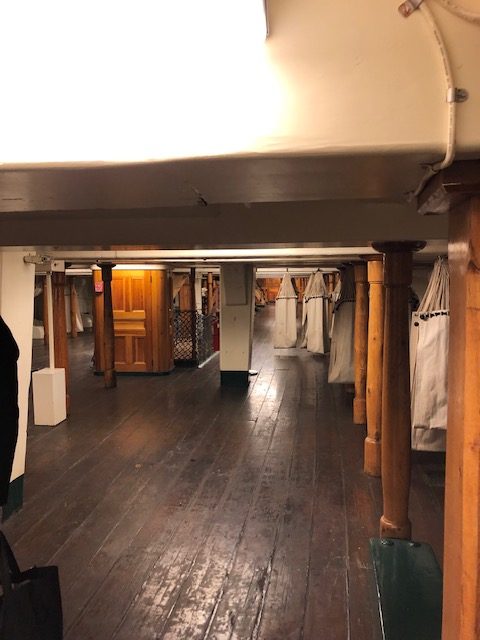
Courtesy of Aaron Peterka
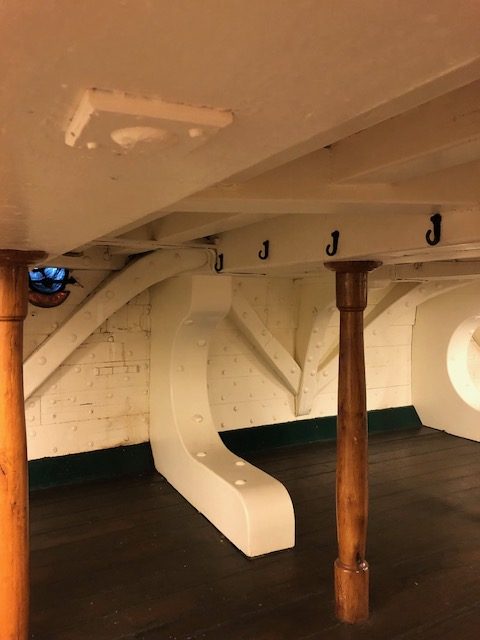
Courtesy of Aaron Peterka
Constitution’s innovations would serve it well during the War of 1812 with Great Britain and are visible throughout various holdings at the Massachusetts Historical Society. Its firepower is unmistakable in the de-masted wreck of the British H.M.S. Guerrière in D. Kimberly’s engraving of that famous 1812 sea battle, as is Midshipman Frederic Baury’s account of Constitution having “Shott away” H.M.S. Java’s masts, bowsprit, gaff, jib, and spanker booms. The Society’s detailed 1800 broadside engraving of Paul Revere and Son at their Bell and Cannon Foundry reflects how that company produced the frigate’s copper bolts, as well as its 242-lb bell and 10 carronades. Moreover, its speed and agility are also evident in records like Baury’s letter to his mother during the War of 1812 declaring, “‘Our Ship Sails remarkably fast and I think thus but Little Danger of our being Taken.’” His logbook observation of H.M.S. Java’s attempt to “rake” Constitution, which the ship “avoided by wearing” (changing course by turning its stern through the wind) confirms his confidence.
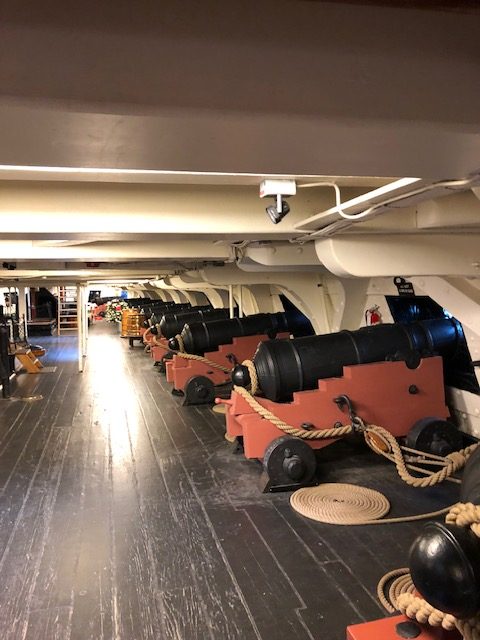
Courtesy of Aaron Peterka
At its height, U.S.S. Constitution was one of the most feared frigates at sea, and fortunately, this history is not lost. Today, people can see and touch it through the MHS’s physical & online collections and by touring the ship at the Charlestown Navy Yard. By doing so, visitors are stepping aboard one of the most innovative warships of its time; one that was fast, nimble, and undefeated.
Further Reading:
“Paul Revere’s Cannons.” Paul Revere’s Cannons | Paul Revere Museum The Paul Revere Heritage Site | Canton, MA.
Tyrone G. Martin. A Most Fortunate Ship: A Narrative History of Old Ironsides. Annapolis: Naval Institute Press, 1997.
“U.S.S. Constitution Facts.” January 11, 2023. https://ussconstitutionmuseum.org./uss-constitution-facts/.