
by Susan Martin, Senior Processing Archivist
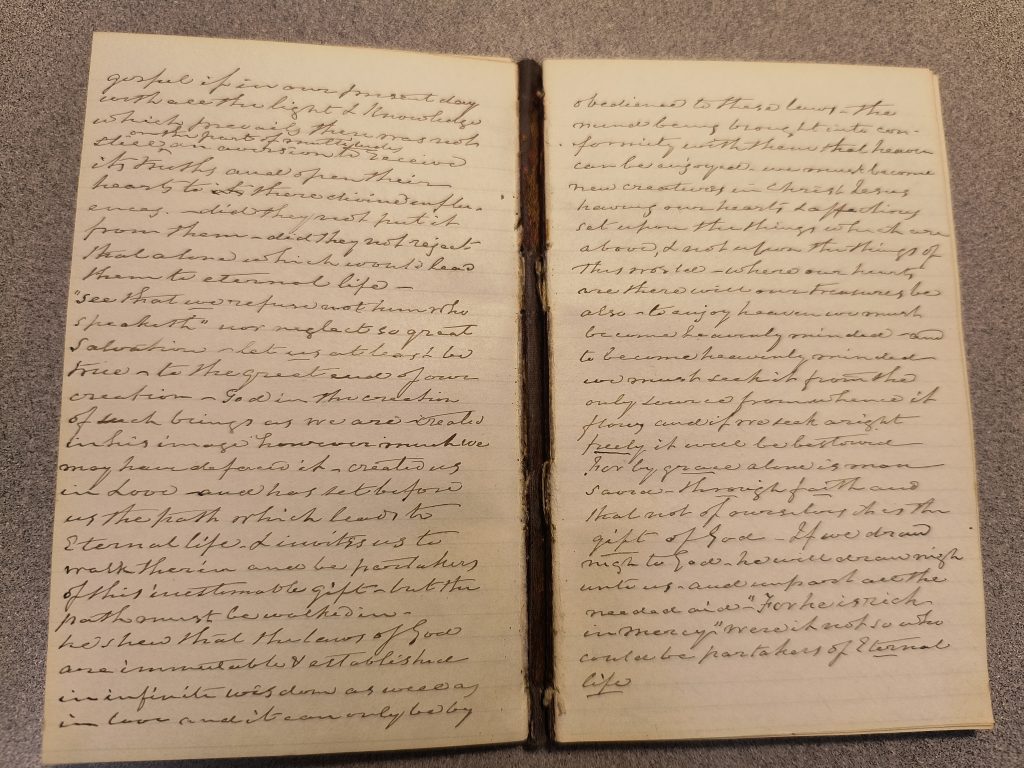
“Reflections on the past year 1848 – The past year has been a most wonderful one, full of import[an]t & stirring events – big with the fate of Empires and Nations; never has the civilized world been so shaken. There have been overturnings and uprooting[s] of political systems, such as no other Era in the worlds history ever witnessed in so brief a space. – The whole civilized world is in motion, the people claim rights, and the despots of the world tremble, and will have finally to yield.”
Thus begins Robert Waterston’s 1849 diary, one of our collections here at the MHS.
In 1848, a year that has been called the “Spring” or “Springtime” of nations, a wave of revolutions had swept across Europe, including (but not limited to) France, Germany, Austria, Hungary, Italy, Denmark, and Poland. Other significant events of the year included the discovery of gold in California, the publication of The Communist Manifesto, the Treaty of Guadalupe Hidalgo, the Seneca Falls women’s rights convention, and the ongoing famine in Ireland.
Although Waterston’s diary begins with this summary of 1848, most of its entries date from several months later, September to December 1849. However, many of the revolutions that had started the previous year were still going strong.
Waterston, a prosperous merchant in Boston and an immigrant from Scotland, had personal and professional ties to Europe. On the whole, he was optimistic about the future of the continent, writing that “progress must be, as it always has been, slow, but these upheavings of nations give promise that a better day is approaching.”
He got his news from letters and newspapers carried across the Atlantic Ocean on ships. A typical diary entry reads: “The Niagara arrived at Halifax on Wedy morng […] The most import[an]t news she brings is…” He wrote often and at length about developments in Europe and his hope for the end of “despotic power” everywhere. He was a pacifist and apparently acquainted with some participants in the International Peace Congress of 1849, including Elihu Burritt.
But Waterston also wrote about several local events that clearly affected him. The first was the shipwreck on 7 October of the St. John, a brig carrying refugees from the Irish famine that went down off Cohasset, Massachusetts, killing 99 people. “What an awful scene it must have been,” Waterston lamented.
Another tragedy he discussed was the disappearance and death by apparent suicide of a young man named Leonard M. Knight, a clerk in his counting room. Knight was reported missing on 30 October and found nearly three weeks later floating in the Charles River.
And the year ended with a bang; on 1 December, Waterston heard, “to my utter astonishment,” about the arrest of Harvard professor John White Webster for the murder and dismemberment of George Parkman. Bostonians were “struck with horror,” and Waterston described the fallout of the arrest over the next several days.
The diary of Robert Waterston is a fascinating snapshot of a tumultuous time, both in Boston and around the world. It’s my favorite kind of diary, covering topics both big and small, full of details about his daily life and personal reflections, as well as reactions to world affairs. If you’re interested in doing research at the MHS on a particular time period or event, you can search our catalog for the subject “Diaries,” which are cataloged by year.
For the story of how Robert Waterston helped another Scottish immigrant, Walter Cran, see this previous post.