By Rakashi Chand, Reading Room Supervisor
As the leaves begin to turn and the air grows crisp, it can only mean one thing: American Archives Month is here! Although #AskAnArchivist Day officially falls on October 16th, we asked our own staff what questions they are asked most often to help demystify and amplify archives and archival work. Read on as we celebrate American Archives Month and get answers to frequently asked questions!
Brandon McGrath-Neely, Library Assistant II:
The question I get the most, other than white gloves, is: So who actually uses an archive? It’s exciting to be able to answer: ANYONE! Many people don’t know that the archives are free and open to the public – you don’t have to be a professor or author!
Stephanie Call, Curator of Manuscripts:
I often get asked by potential donors “why do you want this stuff? My family wasn’t (wealthy, important, famous, etc.)” And that’s the point—how else would historians and students of history know how the average person or family lived in specific time periods or during historical events? That’s how we relate to history—not through the extraordinary, but through the ordinary, everyday experiences of people who were just living their lives. So, people shouldn’t be afraid to contact an archive about their family papers! They could be more interesting and historically relevant than they think.
Hannah Elder, Assistant Reference Librarian of Rights and Reproductions:
Q: What are personal and family papers?
A: According to SAA, personal and family papers are records created by an individual or group of individuals closely related, relating to their personal and private lives. Some examples common at the MHS are letters, journals and diaries, recipe books, account books, and scrapbooks.
Samantha Couture, Nora Saltonstall Conservator and Preservation Librarian:
“What is the letter you are working on about?”
Answer: I only know what’s in the catalog record- I don’t get to read the documents, but I need to make sure they are able to be handled safely by researchers who will read every word!
Nancy Heywood, Lead Archivist for Digital & Web Initiatives:
How do you decide what to digitize?
The MHS needs to consider the condition of the collection, the size of the collection, and the capacity and schedule of the digital production team as we determine which items get into the digitization queue. The
MHS usually requires some funding (either from grants, or projects) to take on larger projects (either full collections, or selected series, for example, a set of diaries or volumes). TheMHS does have some capacity to work on digitization projects in support of events, or anniversaries, or themes that would benefit from additional digitized content on our website. Digitization includes lots of detailed workflow steps relating to preparing the original materials, reviewing existing metadata and descriptions, creating master and derivative images, creating metadata for the delivery system, and loading and testing the digitized content on our webserver.
Rakashi Chand, Reading Room Supervisor:
Questions that I am asked often include
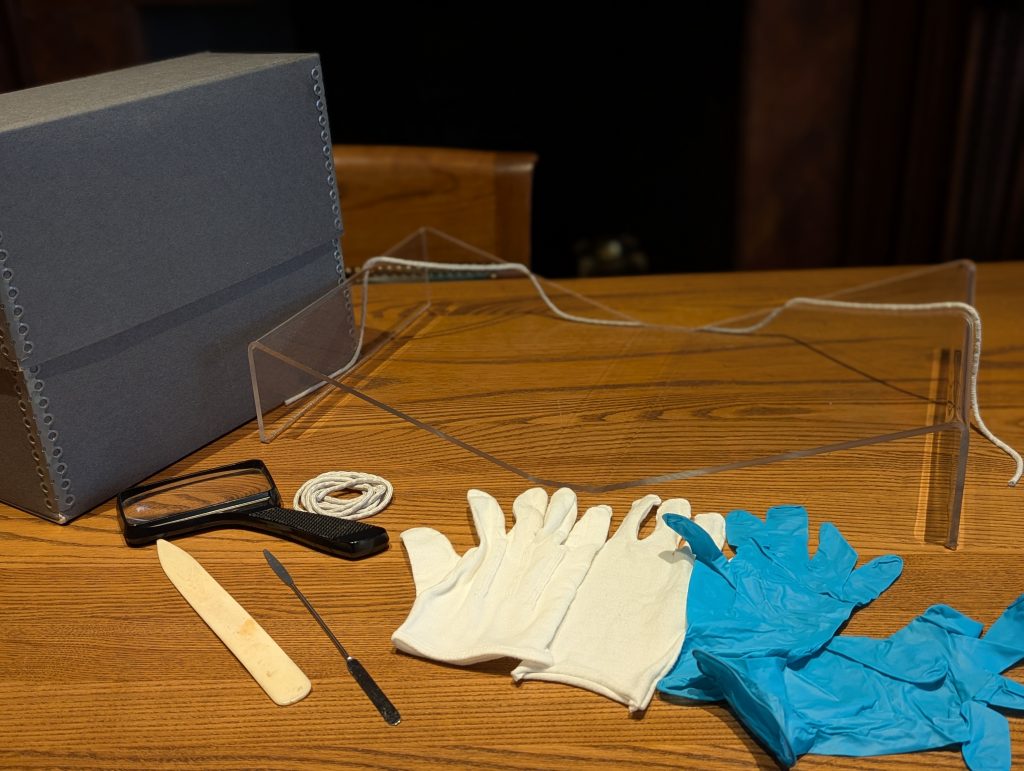
Why don’t I need to wear gloves to handle this letter?
Answer: We have found that the loss of dexterity can lead to a tear on a delicate page, so the best way to handle manuscripts is with clean hands and care.
Why can’t I use flash to take a picture of this letter?
Answer: Flash and direct sunlight can damage manuscripts, art and artifacts.
Where do you keep all of these documents?
Answer: We store all our material in temperature and humidity-controlled stacks.
Are there any risks involved in being an archivist?
Paper cuts, sharp Hollinger box corners, poisonous 19th century book pigment, lifting heavy boxes on a daily basis, red rot on our clothes, and ladders… lots of ladders.
Susan Martin, Senior Processing Archivist:
Probably the question I get the most (aside from the one about gloves) is:
Can just anybody come in to do research there? Do you need to pay or be a member?
I tell them no, it’s free—all you need to do is register and provide a photo id.
Another one I’ve gotten is: Do we just collect the records of famous people?
I explain how historians are interested in the lived experiences of people from all walks of life. People are also surprised we collect up to the present day.
Sometimes I get asked what’s the weirdest thing I’ve found while processing.
Hands down, it was a piece of wedding cake from 1919. It was wrapped up and hard as a rock.
Grace Doeden, Library Assistant II:
Q: Are the stacks haunted?
A: I can neither confirm nor deny…But I often catch an ominous feeling on the 5th floor. Wait, is that Jeremy [Belknap]’s spirit in the cage? Oh, no, it’s just Peter [Drummey, MHS Chief Historian].