
by Susan Martin, Senior Processing Archivist
I was recently encoding the guide to the William Minot III papers, a collection processed back in 2007 by another MHS archivist, when a unfamiliar name caught my eye: Dr. Gertrude Van Pelt. A female physician in the late 19th century understandably piqued my curiosity. Little did I expect what I would find.
Gertrude Wyckoff Van Pelt (1856-1947), originally from New Jersey, was a physician with degrees from Holyoke College, Cornell University, and the Women’s Medical College of Philadelphia. She interned at Boston’s Women’s Hospital and studied medicine in Paris and Vienna. Her papers form part of this particular collection because her sister married William Minot III, a Boston lawyer.
But today I’d like to tell you about Van Pelt’s decades-long work in the Theosophical movement.
Theosophy, founded by Helena Blavatsky in 1875, is defined at the website of the Theosophical Society in America as “a body of knowledge that tells us about our place in the universe and why the world is the way it is.” Blavatsky called it “the ancient Wisdom-Religion,” a search for eternal truths and universal brotherhood.
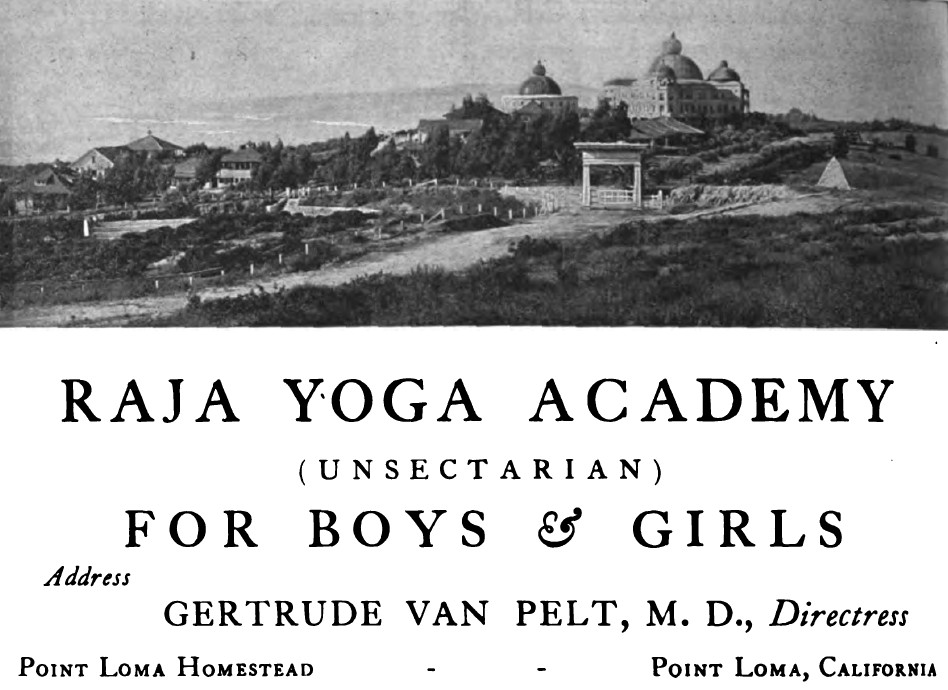
Van Pelt joined the Theosophical Society in Boston in 1893 and soon became a prominent figure in the movement. She published articles, delivered speeches, and, in 1900, was recruited by Theosophist leader Katherine Tingley to relocate to Lomaland, a Theosophical enclave on the Point Loma peninsula of San Diego. There Van Pelt served in Tingley’s cabinet and as superintendent of the Raja Yoga School and Lotus Home. She remained a Theosophist until her death in 1947 at the age of 91.
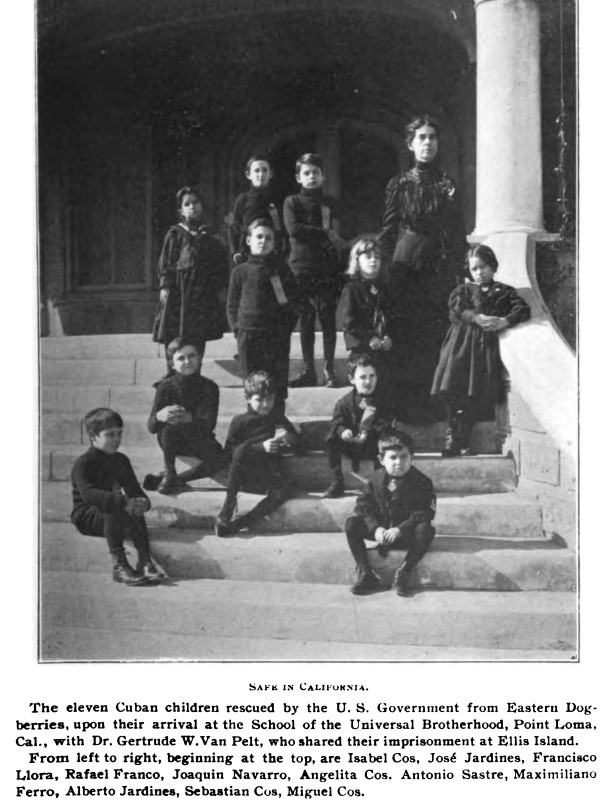
I found literally hundreds of references to Van Pelt in old newspapers, but most of them center around one incident. In November 1902, Van Pelt brought eleven Cuban children into the country via New York to study at the Raja Yoga School. It was not her first trip for this purpose, but this time the group was stopped, interrogated, and detained at Ellis Island for over a month. American officials weren’t concerned about potential trafficking or the implications of imperialism and racial paternalism. No, they feared these “possible objectionable aliens” might become public charges.
The incident became a media firestorm, as historian Jacqueline D. Antonovich explains in her excellent Ph.D. dissertation. The takes came fast and furious; most newspaper articles cast doubt on the motives and teachings of the Theosophists. Meanwhile, Albert G. Spalding—a former professional baseball player, founder of the Spalding sporting goods company, and fellow member of the Theosophical Society—visited Van Pelt at Ellis Island and wrote his version of what happened.
In the end, the children were cleared to stay in the country and taken on to Lomaland. I love this picture of Van Pelt and the children.
Unfortunately, Van Pelt’s letters in the William Minot III papers predate her move to Point Loma in 1900 and don’t really discuss her Theosophical work. The Garrison family papers contain the only first-hand account of Lomaland that I could find in the MHS collections. Anna Percy lived there at the same time as Van Pelt and described it in great detail in correspondence to her family; one letter is 20 pages long.
Van Pelt’s correspondence does, however, include interesting remarks on her medical studies in Europe and on the artwork of her companion Susan Mary Norton (1855-1922). And the letters she wrote to her 15-year-old niece Katharine (later the wife Henry Morse Channing) are very endearing.
To investigate MHS holdings related to any of these individuals and/or subjects, search our online catalog ABIGAIL or the MHS website.