
The Diaries of Henrietta Maria Schroeder Stout, Part II

by Susan Martin, Senior Processing Archivist

This is the second part of a series. Read Part I here.

A few weeks ago, I introduced you to a precocious 13-year-old girl named Henrietta Schroeder. Her diaries in the Stout family papers are a really fun read.
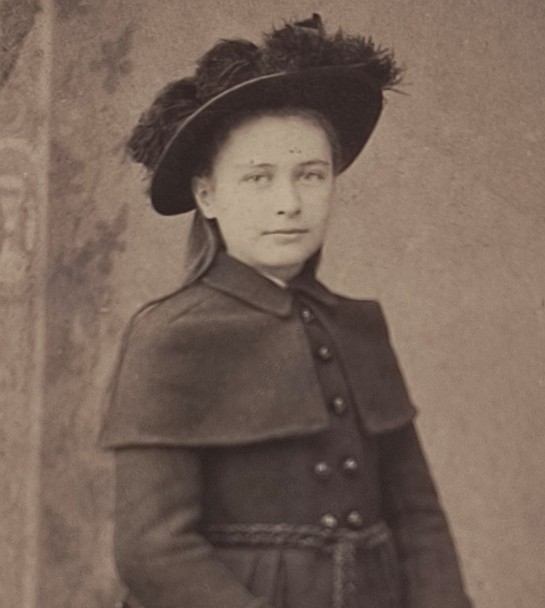
Black and white photograph of a white girl wearing a dark coat, a dark hat decorated with feathers, and straight hair hanging loose down her back.
Photograph of Henrietta Maria Schroeder, age 13, taken March 1889

When we last saw Henrietta, it was June 1889, and she was on her way to Europe on the S.S. Alaska with her mother, sister Lucy, and two brothers Langdon and Harry. Her father Francis Schroeder had died three years before.

Henrietta had a rough voyage; she got both sunburned and seasick (though “not actively so”!) Worse still was how much she missed her “most beloved and most loving friend” Caroline Bowen Wetherill, or “Lina.” Caroline was nine months younger than Henrietta and lived in Philadelphia. My best guess is that the two girls met in Jamestown, R.I., a popular vacation destination at the time. Henrietta’s diary includes a photograph of Jamestown and references to seeing Caroline there.

Henrietta wrote often in her diary about her “darling” Caroline. She described their last goodbye (“the last figure I saw kissing her hand to me through the window of the closed carriage”) and attached on facing pages both some flowers Caroline had sent and a folded-up “wish” to be opened when they saw each other again. The friends even had pet names for each other: “Lul-i-nun” for Caroline and “Yud-e-tub” for Henrietta. Try as I might, I couldn’t identify the source of the names.
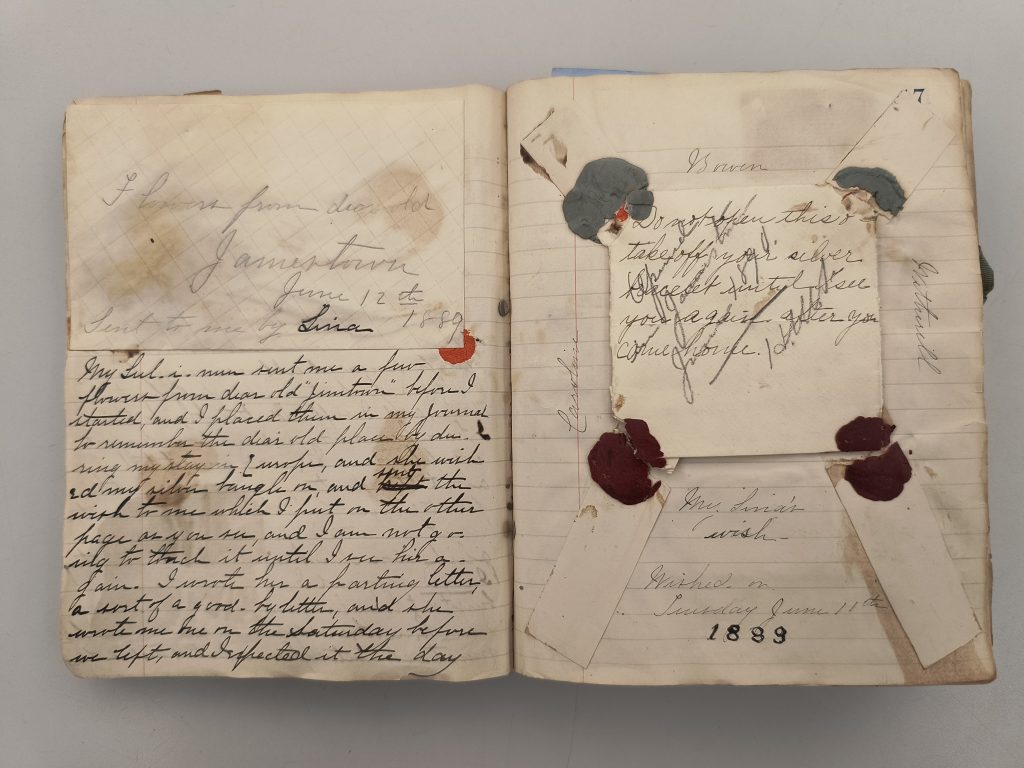
Color photograph of two pages of a volume. Attached to the left page is an envelope labeled in pencil, “Flowers from dear old Jamestown June 12th 1889 sent to me by Lina.” Below the envelope is more writing in black ink. Attached to the right page is a folded-up piece of paper, sealed by wax on four sides, and labeled in black ink, “Do not open this or take off your silver bracelet until I see you again after you come home.” The wax seals have been broken. Both pages are stained and discolored.
Two pages from the 1889 diary of Henrietta Schroeder

After landing at Liverpool, the Schroeder family visited Chester, England, before traveling north to the Lake District. Henrietta seemed to enjoy sightseeing, and though she got some details wrong, her breathless descriptions would make an entertaining guidebook. She was especially awestruck by how old everything was.

While touring Chester Cathedral, which was undergoing renovation, Henrietta took—with the permission of the guide—a centuries-old piece of crumbling wall as a memento. The Schroeders also visited Chester’s ancient Roman baths, and Henrietta exclaimed, “just think, before Christ!” Later at their Lake District hotel, she slept in a large canopy bed that, she wrote excitedly, dated back to the reign of Elizabeth I. In a quieter moment, she summed it up this way: “No matter where you go, you step on graves.”

It’s around this time we get a glimpse of another side of Henrietta: her temper. One day when Lucy and Langdon went rowing with their mother, Henrietta stayed back with her younger brother Harry. Unfortunately the rowing party didn’t come back when they said they would.

“I was simply frightened out of my wits […] Twelve came, and still not a sign of them, and then half past twelve, and then I thought surely they were drowned or something, and I began planning out what to sell, to get a little money and pay for the bills of the hotel, and to telegraph to Grandpa for some money, and then one o’clock came, and with it in sailed Lucy as large as life […] I tell you, I gave it to her!!!!!!”

The stream-of-consciousness style of Henrietta’s diaries sometimes makes it hard to pinpoint exact dates and places, but July 4, 1889, found her at Lake Hotel in Keswick. She was enjoying the trip, but felt disappointed at having to spend Independence Day in the U.K., writing, “It will seem so horrid not to have any racket, you know it is a black day over here in England. Oh! how mean!” She celebrated by rising early, going into the woods, and belting out patriotic songs to no one in particular.

I hope you’ll join me next time for more of Henrietta’s adventures.
Latin: The Other Adams Family Business

by Gwen Fries and Rhonda Barlow, The Adams Papers

On 4 October 1815, twelve-year-old John Adams II sat down at a desk outside London to write a letter to his grandfather. The middle child of John Quincy and Louisa Catherine Adams had spent several years of his life being raised by John and Abigail on their farm, Peacefield, while his father and mother served in a diplomatic role in St. Petersburg, Russia. Now reunited with his parents, John II wanted to write a letter to his grandfather to show how far his education had come. His little brother, Charles Francis Adams, had just composed a letter in French. Not to be bested, John II was going to do it in Latin.

The problem was John II was an indifferent scholar. He loved to be the center of attention, stalking his aunts and cousins around Peacefield and chattering incessantly. What he possessed in charm and charisma, he lacked in concentration. Thus, his father insisted on looking over the letter before it was sent. John Quincy, ever the perfectionist, had some thoughts.

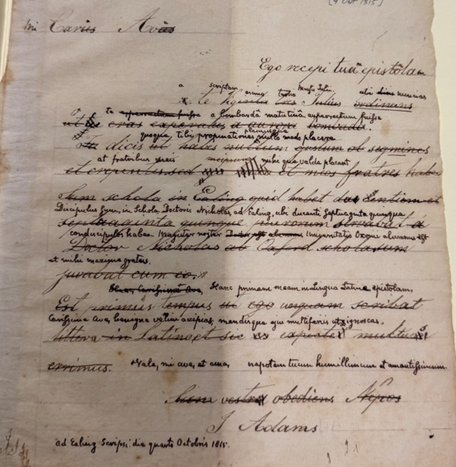
Rarer than an extant copy of a child’s Latin is an extant draft of a Latin composition. We’re given a clear visual of how he thought through each word of the letter and how his father refined it. I could see the juvenile writing and the interlineated corrections, but I had to tag in Adams Papers research associate Rhonda Barlow to make sense of what I was seeing. She translated John II’s letter thus:

My dear grandfather,

I received your letter from you on 23 July beginning that you were awakened by a morning bombardment. You say that you have no taste for noisy rattling and clapping, but I have and my brothers have.

I am a student at Ealing which has 275 boys served by Dr. Nicholas from the schools of Oxford[.] I am very pleased with him.

It is the first time that I ever wrote a letter in Latin, and thus you will expect I make many mistakes.

I am your obedient grandson

J Adams

Then she translated John Quincy’s interlineations:

My Dear Grandfather

I received your letter written by you on the 23d of the month of July where you reported that you were awakened by a morning bombardment.

You say that you take no pleasure in applause and toasts but they are pleasing to my brothers and I.

I am a student in the school of Dr. Nicholas, at Ealing, where I have 275 fellow-students. Our teacher, the doctor, is an alumnus of Oxford University, and I am very grateful.

This letter is my first in the Latin language, Dearest Grandfather, I wish you to receive it kindly; and that you forgive its many faults.

Farewell, my grandfather, and love, your most humble and most loving grandson.

J. Adams

Barlow explained to me that JQA’s edits were in the spirit of conforming more to classical Latin. The one exception to this is the word “bombarda,” which John II likely plucked out of the Ainsworth Latin Dictionary, and which his father and grandfather enjoyed. (To be fair to the tweenager, classical Latin wouldn’t have a word to mean gun, and it’s the noisy nature of guns that’s key to the sentence.)

The letter went from the composition of a careless child to the product of a skilled linguist. “Your classical letter of the 4th. of Octr, does you honour, upon every Supposition that I can make,” his delighted grandfather responded on 14 Dec. 1815. However, a hint of suspicion crept in amongst the praise. “If you have composed it yourself, it is highly honourable to the Skill and care of your Preceptors and to your own Application to your Studies; All of which must have concurred in producing Such a proficiency in so Short a time.”

The Adams Papers editorial project at the Massachusetts Historical Society gratefully acknowledges the generous support of our sponsors. Major funding of the edition has been provided by the Packard Humanities Institute, the National Endowment for the Humanities, and the National Historical Publications and Records Commission.

A Perilous Transformation: The Soldiers of Fort Washington & the Siege of Boston

by Aaron Peterka, MHS Early Career Scholar Committee & Mentorship Program Member

Over the course of 250 years, the grass-covered mounds of Cambridge’s Fort Washington morphed from a necessary military fortification to a lasting monument to the American Revolution’s early perils. It is also a monument to another kind of metamorphosis: that of a colonial citizen army outside Boston in 1775-76 to the professional Continental Army that emerged victorious at Yorktown in 1781. Diaries from the MHS archives, like that of Boston merchant William Cheever, clearly illustrate the hazards for the New Englanders who faced the British, who, though besieged, were still mobile and active in late 1775/early 1776.

In one entry dated November 9, 1775, mere weeks before Fort Washington’s construction began, Cheever noted that “Several Companies” of British regulars crossed over to “Phip’s Farm” and “brought off some Cattle at noon day under Cover of a Ship in the River, Cannon on Charlestown point, and their own Floats.” He recorded a similar raid that took place on February 14, 1776, wherein the night before, “a Number of the Light Infantry and Grenadiers went over to Dorchester Neck and burnt 4 or 5 Houses” and took several prisoners. Moreover, as the Americans continued to entrench in front of Cambridge, the British did likewise in Boston. Cheever noted on December 4, 1775, that the “regulars have a Battery just above the Copper-Works” in west Boston, as well as colonial artillery dueling British ships “at the head of the Charles River,” as the British attempted to keep the Americans from “carrying on their Works on a Rise at Phips’s Farm.” Soldiers like Private Obadiah Brown of Gageborough, Massachusetts, could easily supplement Cheever’s observations, as Brown recalled an ordeal on February 20, 1776, where the British “Regulars fired all Day” at him and his comrades as they dug trenches at “Leachmore point.”

Such accounts bring to life the hardships and precarity of the Revolution’s earliest days, and it is to this narrative of trial and peril, so carefully preserved in the MHS’s collections, that Fort Washington belongs. However, that narrative not only includes the challenges of containing a worthy foe, but also the complex characters of those soldiers who held the line in bastions like Fort Washington.          

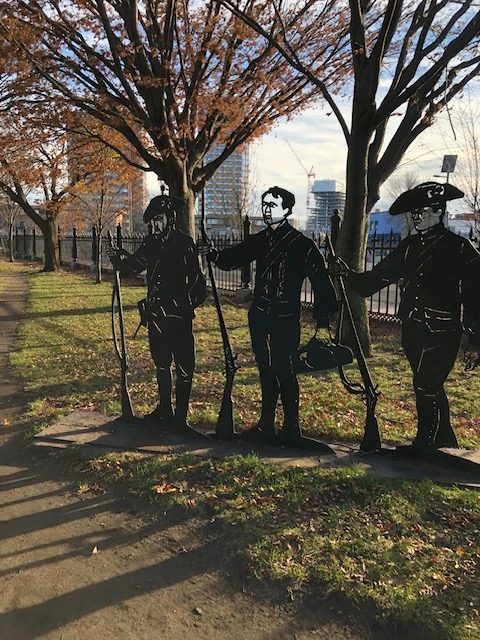
Photo of 3 cut-out statues standing in a park-like environment
Life-size renderings of colonial soldiers at Fort Washington today.
Courtesy of Aaron Peterka.

In the summer and fall of 1775, General Washington hardly held those soldiers in high esteem. He lamented their apparent self-centeredness, poor discipline, and civilian attitude, writing to Lieutenant Colonel Joseph Reed on November 28, 1775, that “such a dirty mercenary Spirit pervades the whole, that I should not be at all surprised at any disaster that may happen.” Granting generous furloughs just to keep up enlistments, the general also despaired over the Connecticut regiments’ refusal to extend their service beyond their original term, fearing that absent soldiers and expiring enlistments would weaken his army to the point of disintegration. “[O]ur lines will be so weakened that the Minute Men & Militia must be call’d in for their defence,” Washington ruefully observed, and “these being under no kind of Government themselves, will destroy the little subordination I have been laboring to establish.”

The diary of the aforementioned Private Brown allows for a glimpse into Washington’s conundrum. Oftentimes, Brown stood “gard” or performed “feteague” duty at the “Leachmore point” fort from January to March 1776. But interspersed throughout his terse entries are observations of drunkenness and ill-discipline; the kind that would drive mad a professional soldier like Washington. In one instance on February 7, 1776, “Two Sodiers Drank 33 glases of Brandy and Gin one Died.” Five days later, Brown witnessed another soldier receiving “39 lashes” for an unspecified indiscretion. And on February 16, 1776, Brown recalled that “orders came for one Shilling to be taken out of the Sodier wages for Every Cartridg Lost,” a stark reflection of the dire shortage of shot and powder that threatened the army, as well as the general unmilitary air that characterized the army in New England. And despite its successful re-occupation of Boston in March 1776, this same army would endure defeat after defeat in the coming years, and through the miseries of Valley Forge, painfully transform into the Continental Army that would ultimately prevail at Yorktown. Fort Washington is a testament to the beginning of that metamorphosis.

It is this complicated history of which Fort Washington is a part. It is a reminder of the challenges and contradictions that shaped the Revolution and this country’s birth: the fierce independent spirit that drove the colonists to rebel and made them poorly disciplined soldiers; the uncertainties of maintaining adequate supplies and manpower; and the looming threat posed by the growing might of the British army in Boston. In a time when the United States remains the world’s superpower, its military might thus far unmatched in the 21st century, it is easy to forget these truths. And yet, Fort Washington continues its silent vigil; a memorial that compels all who reflect upon it to remember “the times that try men’s souls.”      

Further Reading:

“From George Washington to Lieutenant Colonel Joseph Reed. 28 November 1775,” Founders Online, National Archives. https://founders.archives.gov/documents/Washington/03-02-02-0406.

Thomas Paine. Common Sense and Other Works. New York: Fall River Press, 2021.