

By Gwen Fries, Adams Papers
John Quincy Adams was a public servant for more than fifty years. When we think of him, it’s easy to fall into a highlights reel of his life—partying with princes as a diplomat, advancing the cause of science education as president, and especially raging against the Gag Rule and the “slavocracy” in his congressional career. Sounds like he’s an absolute rock star. Where does the “servant” part come into it?
Recently I was reading a book by Tony Benn (1925-2014)—a British MP who, like Adams, was a politician for fifty years and kept a daily diary of how humdrum that seemingly glamorous life could really be. “Much of the casework,” he wrote, “fell into the same category as the palliative care offered by hospices. Support was needed whether or not you could actually solve the problem for a particular constituent. The people who wrote to me or queued up at my advice centers to tell me their problems wanted to be heard and wanted me to listen.”
I instantly thought of Adams.
Adams’s diary is full of his constituents. He truly did view himself as their servant, advocate, and protector, as is clear from the time he dedicated to each one. On 17 December 1836, for instance, the 69-year-old congressional representative listened to the Collector of Customs at New York complain about merchants skirting consular fees. He tucked that away in his brain to bring up with the Committee of Manufactures the next week. Next, he heard out a disgraced English ophthalmologist who wanted to complain about his lot in life. (Again, palliative care.) Then, the elderly statesman walked through the rain to the Department of War to deliver a letter from a Plymouth widow seeking her husband’s pension. He carefully notes her name in his diary: Bethiah Dyer. He languished in the waiting room as the office was “beset with visitors,” then wouldn’t leave until he had the Secretary’s word that he would follow up with him.
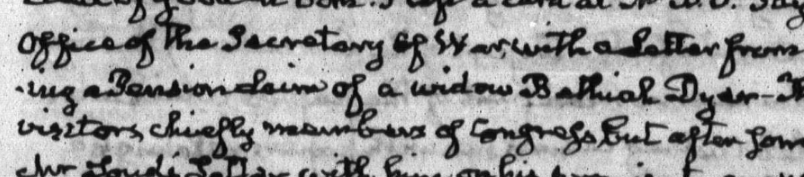
This is one of about 17,000 days of JQA’s life that went that way. One of the most brilliant men of his age sitting in an unassuming room and just listening. Most people wanted something from him, but many came simply to gawp at him as a living curiosity. Anne Royall in her 1826 Sketches of History, Life, and Manners, in the United States wrote that JQA possessed “a calmness peculiar to him.” He was willing to sit silently and listen as long as you wanted to talk, giving you his undivided attention. “What most distinguishes his features, is his eye,” she wrote. “It is. . .one of such keenness that it pierces the beholder. He has the steadiest look I ever witnessed.”
The miracle of Adams’s devotion to his constituents is his further devotion to recording their dearest hopes and fears in his diary. Because of this, posterity has a window into the lives of thousands of ordinary Americans and their faith in the democratic process.
The Adams Papers editorial project at the Massachusetts Historical Society gratefully acknowledges the generous support of our sponsors. Major funding for the John Quincy Adams Digital Diary was provided by the Amelia Peabody Charitable Fund, with additional contributions by Harvard University Press and private donors. The Mellon Foundation in partnership with the National Historical Publications and Records Commission also supported the project through funding for the Society’s digital publishing collaborative, the Primary Source Cooperative.