

By Susan Martin, Senior Processing Archivist
This is the fourth part of a series. Read Part I, Part II, and Part III to catch up.
“Here I am in London, as big as life.”
These are the words 13-year-old Henrietta Schroeder wrote in her diary on August 15, 1889. She was on a European tour with her widowed mother and three siblings. The family had been traveling up and down the U.K. and would now spend three weeks in and around London before moving on to the continent.
Late Victorian London was a booming, bustling metropolis. The population of inner London alone was already over four million, quadruple what it had been at the start of the century. In 1889, it was the most populous city in the world, and Henrietta was very excited to be there.
As I’ve mentioned before, the Schroeders were indefatigable tourists, and in her diary Henrietta described the sights they saw and shared her unfiltered opinions. She thought Westminster Abbey was “lovely” and especially liked Poets’ Corner and the tomb of Queen Elizabeth. While there, unable to help herself, she had “leaned over, and touched the tomb of an old Saxon king, dated 616!!!” This was presumably King Saeberht of Essex.
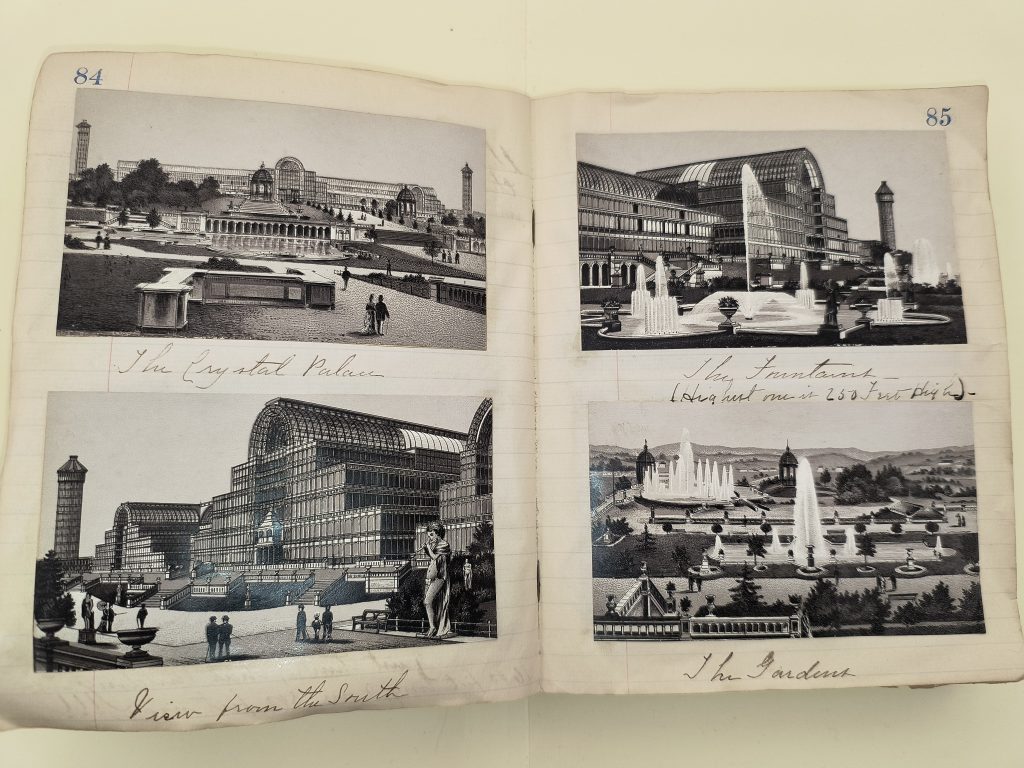
The family also visited the Victoria & Albert Museum in South Kensington, took a trip up and down the Thames to see the West and East India Docks, oohed and aahed over the Queen’s golden jubilee presents on display at Windsor Castle, and of course spent some time at the massive Crystal Palace. Henrietta pasted several prints of the building into her diary.
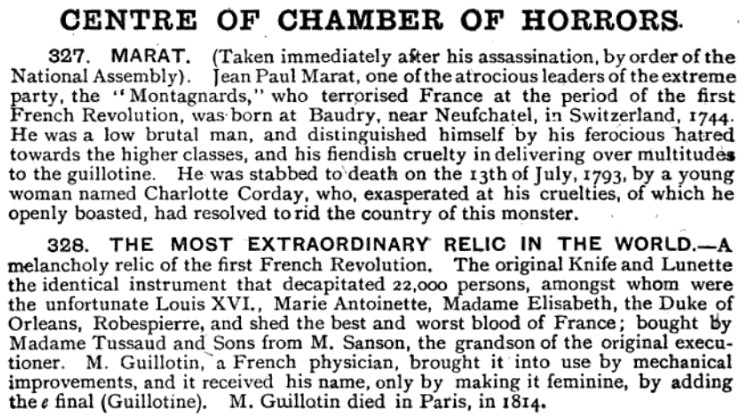
One attraction that didn’t overly impress Henrietta was Madame Tussaud’s Wax Museum, but that was probably because her mother didn’t allow her into the Chamber of Horrors. The Chamber of Horrors was home to what promotional material at the time called “the most extraordinary relic in the world,” the blade of a guillotine from the French Revolution.
Like many teenagers then and now (and a lot of adults, let’s be honest), Henrietta was fascinated by the more macabre parts of history. Her diary is full of references to historical figures who’d been imprisoned or stabbed or beheaded or tortured. She’d been delightfully spooked by the dungeons at Carlisle Castle. Now, after touring the Tower of London, she breathlessly recounted how she
“walked over the site of the scaffold where lady Jane Gray, Anne Boleyn and others were beheaded. And by the way, I saw the scaffold itself, STAINED WITH BLOOD!!”
Later she wrote about Canterbury Cathedral.
“You know that Thomas â Becket was murdered there? well, there is a little place marked where Tommie stood when he was murdered, and I stood on it too.”
In late August, the Schroeder family visited with some distant relatives in the wonderfully named village of Stoke Poges. Henrietta had mentioned the Gilliats before, but it wasn’t until this diary entry that I had enough information to identify them. The Schroeders were apparently guests at Duffield House, the home of Algernon Gilliat. He had three twenty-something sons, the youngest of whom later became both a footballer and an Anglican minister. If my research is correct, Algernon’s aunt married Henrietta’s uncle’s half-brother.
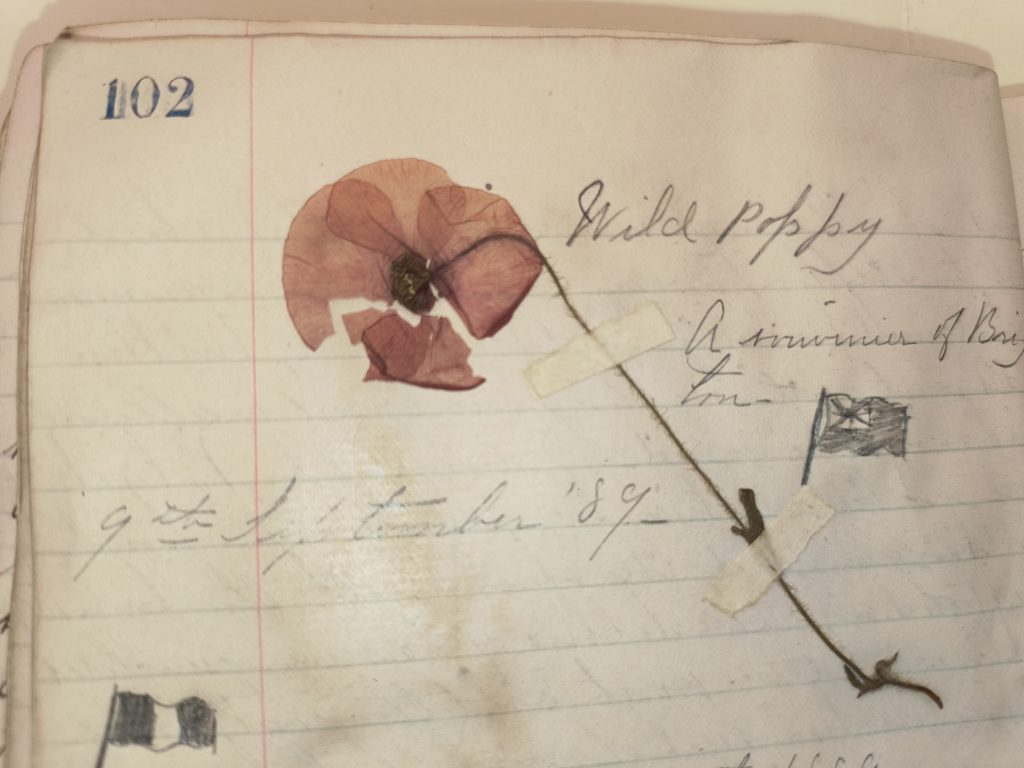
The U.K. portion of Henrietta’s diary ends, I think poignantly, with a single wild poppy she pressed into the volume on September 9, 1889. She explained, “When I pressed it, it turned purple, but it was scarlet once upon a time. The fields are red with them.”
Stay tuned for more about Henrietta in my next post.