

By Morgan S. Hardy, Mary B. Wright Environmental History Fellow (2025-2026)
It had been eleven years since loyalist Samuel Quincy left his hometown of Boston, Massachusetts. The Harvard-educated lawyer and friend of both John Adams and John Hancock fled Boston after the fighting at Lexington and Concord in 1775. Despite his self-exile, Samuel Quincy missed the comforts and staples of New England. In particular, he missed the taste of freshly salted Atlantic cod. In a letter dated March 4, 1786, Quincy wrote, “My Mouth has watered for their salt-Fish ever since your last letter.” Then, lamentingly, Quincy wrote, “I fear I never shall taste the Relish of the Quintal you say you bought for me.” Quincy never returned to Massachusetts after passing away in 1789.
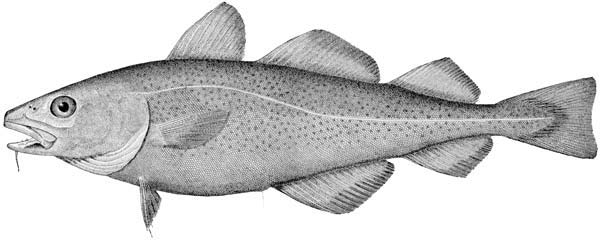
From George Brown Goode, The Fisheries and Fishery Industry of the United States, (Washington, D.C.: Washington Government Printing Office, 1884), plate 58A. Drawing by H. L. Todd.
Salted Atlantic cod was New England’s most profitable export in the eighteenth century. This export was made possible through “curing,” a commercial process designed to prevent decay and turn perishable fish into durable products. However, only about two-fifths of the cured fish qualified as “merchantable” and were shipped to Spain, Portugal, and Italy for substantial profit. The remaining three-fifths were labeled as “refuse” fish. These badly cured, oversalted, or sunburned fish, among others, were sent to feed chattel slavery on Caribbean plantations. Fishers, shoremen, fishmongers, and parliamentary lobbyists all knew that nature influenced how well a fish cured.
Various weather conditions and fierce storms were among the notorious factors affecting the daily fishing life in New England. Fishers had to be hardy persons who were “oblig’d to life at the Mercy of the Winds, and [who] are often expos’d to Storms.” Good weather was always preferred for fishing, but it was never guaranteed. In September 1775, a giant storm struck the North American coast from Virginia to Newfoundland. A storm surge, over thirty feet high, wrecked the coast and caused chaos among the Newfoundland fishing fleet. It’s estimated that 4,000 people, mostly fishers, lost their lives. Storms and unpredictable weather emphasize the vulnerability of eighteenth-century fishing communities, making it tough to find, secure, and process salted Atlantic cod.
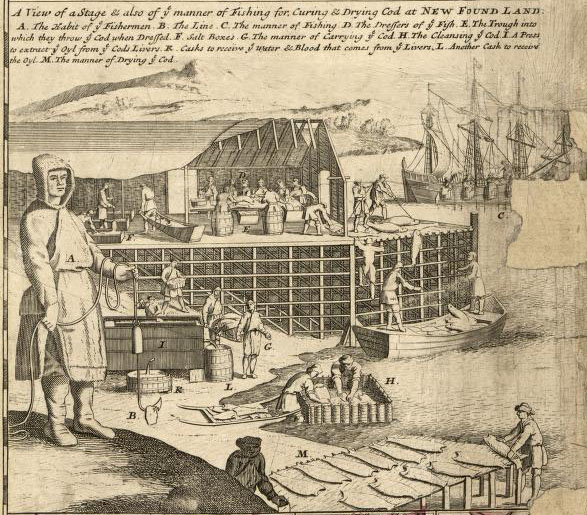
Library of Congress, Geography and Map Division.
Being exposed to the “inclemencies of the severest weather [and] the dangers of the turbulent Atlantic” meant that New England fishers had to read the signs of the weather. This was helpful not only to avoid disasters while fishing but also for locating baitfish. New England fishers caught large amounts of baitfish, including herring, alewives, capelin, and squid, to catch other species such as the prized Atlantic cod and mackerel. John Knox, a Scottish philanthropist aiming to expand England’s fishing industry, reported in 1785 that “young herring always come in a body some time in June [but] their stay depends on the wind and weather.” Knox also noted that “herring shoals are subjected to the “tides, currents, and bays.” New England fishers relied on their understanding of weather patterns and the ocean’s depths to efficiently find, catch, and process the fish that supported their livelihoods. This knowledge was gained through extensive time at sea.
Samuel Quincy’s home of Boston was supported by fishers who understood that the environment posed a challenge to curing cod effectively. A fisher’s work, toil, and knowledge of the sea proved invaluable in making cod a profitable export and a local favorite. Salted cod’s unique, briny flavor was still prevalent to Samuel Quincy after almost a decade of fleeing Boston. Perhaps the next time you find yourself in Boston, try the salted cod—and remember that nature has been undermining human schemes for centuries.
Further Reading:
Letter from Samuel Quincy written from Tortola, March 4, 1786, Quincy Family Letters, Massachusetts Historical Society. Please note that a quintal was about 112 pounds of salted cod.
For how fishers were exposed to the elements, see “The Importance and Management of the British Fishery Consider’d,” (London, 1720), Folger Shakespeare Library, Washington, DC.
Chuck Lyons, “The Independence Hurricane: Chuck Lyons Examines the Events Around a Massive Storm That Brought Destruction to Newfoundland, and Likely Helped to Determine the Outcome of the American Revolution,” History Magazine 14.4 (Toronto: 2013): 24–26.
For inclemencies and herring, see John Knox, “A View of the British Empire: More Especially Scotland: with some Proposals for the Improvement of that Country, the Extension of its Fisheries, and the Relief of the People,” Volume 1 (London, 1785), Massachusetts Historical Society.