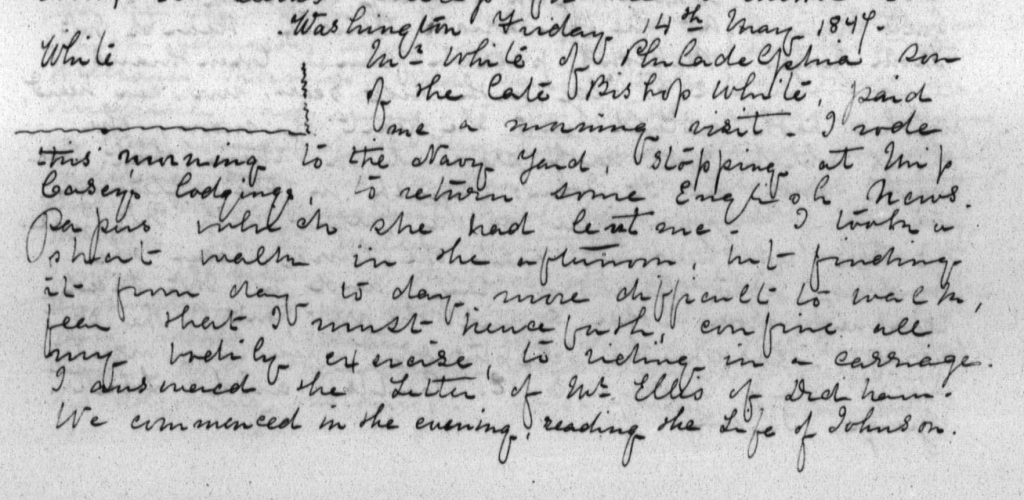
As the weather warms it’s time to be out of doors, and the best way to enjoy the weather is to take a walk—just like John Quincy Adams. His parents encouraged him in both diary writing and walking, he notes in many of his diary entries, and he kept a diary from the age of 11 in 1778 until his death in 1848, at age 81. He was a believer in walking for exercise even in inclement weather. On 22 November 1792 he wrote, “Very cold. exercise by way of punishment, walked a great deal.” He lamented how his commitments prevented him from his favorite exercise on 14 July 1811, “My occupation, my Company, and the weather prevented me the whole day from my usual exercise of walking.” And towards the end of his life, on 14 May 1847, he found it hard to walk, “I took a short walk in the afternoon, but finding it from day to day, more difficult to walk, fear that I must henceforth, confine all my bodily exercise, to riding in a carriage.”
by Neal Millikan, Series Editor for Digital Editions, The Adams Papers
The 15,000+ page diary kept by John Quincy Adams from 1779 to 1848 is now fully accessible online as the John Quincy Adams Digital Diary. A publication of the Adams Papers Editorial Project at the MHS, the Digital Diary is also one of four founding member projects of the Primary Source Cooperative, a collaborative digital editions publishing platform hosted by the Society.
The Digital Diary is presented as verified transcriptions paired with manuscript images of related entries. Biographical and historical context is supplied through essays on the major personal and professional divisions of Adams’s life, and people and historical topics are also identified for each date entry. Through the project’s participation in the Primary Source Cooperative, advanced federated search features allow users to track individuals or subjects both within and across the Cooperative editions.
John Quincy Adams often kept multiple versions of his diary, and the Digital Diary provides transcriptions of the entries in each of his 51 diary volumes. These include his “Rubbish,” almanac, and line-a-day diaries. The edition also integrates Adams’s earliest diaries, which were previously published in two letterpress volumes by the Adams Papers.
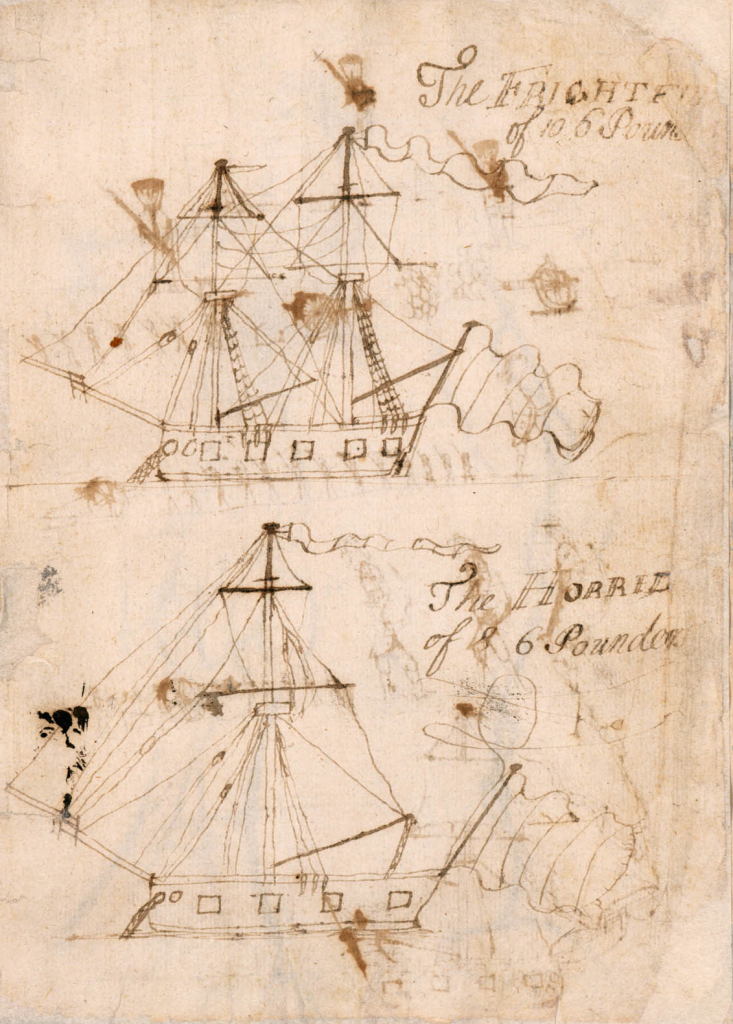
John Quincy Adams’s sketches of ships named the Frightful and the Horrid on the inside back cover of his diary, 1780
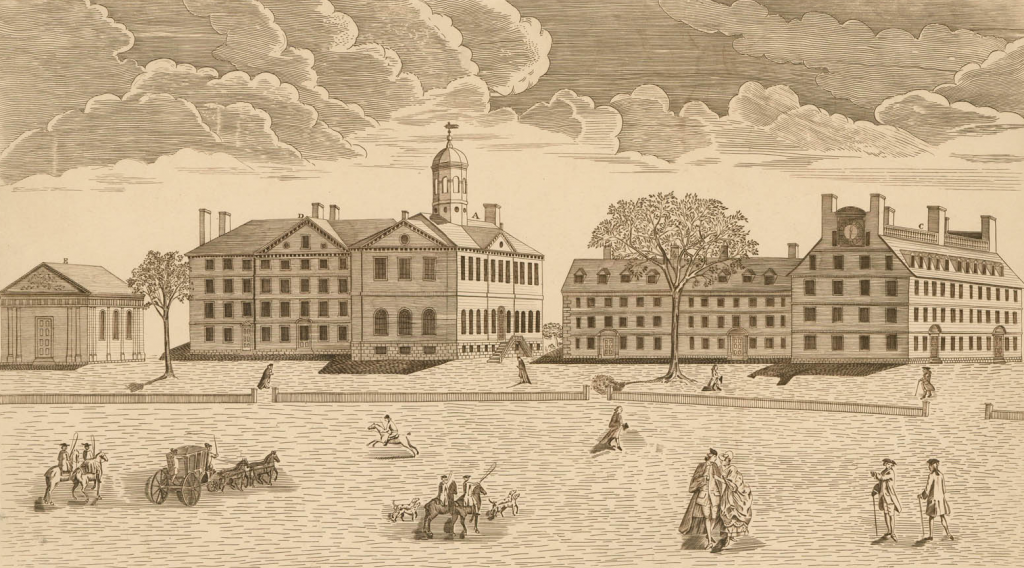
With revised transcriptions, the more than 1,500 pages in this section of the diary chronicle John Quincy Adams’s travels in Europe, as he accompanied his father, John Adams, on a diplomatic mission in 1779 and subsequently attended schools in the Netherlands and France. It also records his travels to St. Petersburg as secretary and interpreter during Francis Dana’s mission to Russia. With John Quincy’s return to the United States in 1785, the diary provides insights into Adams’s preparation for and studies at Harvard College and his legal training in Newburyport.
“A Westerly View of the Colledges in Cambridge in New England”; facsimile engraving by Sidney L. Smith of a drawing by Joseph Chadwick after Paul Revere’s 1767 engraving of Harvard College
Thanks to the efforts of many staff members, interns, and volunteers who contributed to the project since its inception in 2016, the full corpus of John Quincy Adams’s diary is now freely accessible and searchable online. Supplemental content will continue to be added via the Digital Diary and the Adams resources portion of the MHS website. This includes a timeline of Adams’s life and visualizations of the diary data via the Cooperative’s partnership with the Digital Scholarship Group at Northeastern University.
Come check it out and let us know what you think! Truly, we’d love to hear from you at adamspapers@masshist.org.
The Adams Papers editorial project at the Massachusetts Historical Society gratefully acknowledges the support of our sponsors. The Amelia Peabody Charitable Fund provided major funding for the John Quincy Adams Digital Diary, along with generous contributions by Harvard University Press and a number of private donors. The Mellon Foundation in partnership with the National Historical Publications and Records Commission also supports the project through funding for the Society’s digital publishing collaborative, the Primary Source Cooperative.
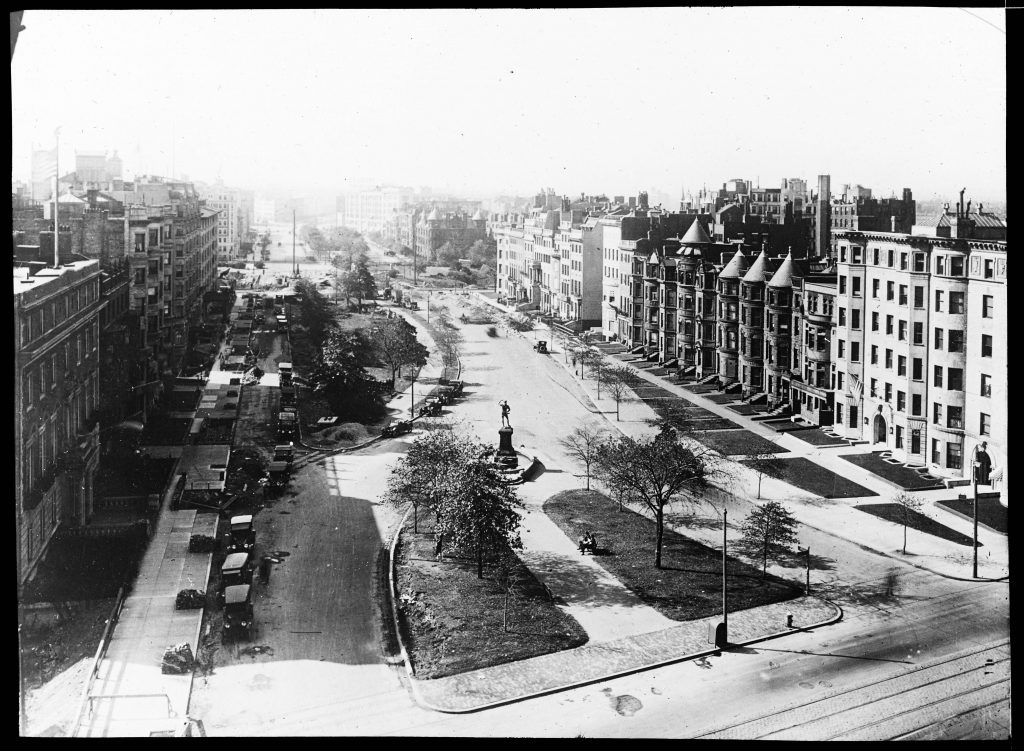
“View of Commonwealth Avenue looking east from Charlesgate East, Boston.” (ca. 1910), from the Arthur Asahel Shurcliff Collection of Glass Lantern Slides, #6.19.93.
The story leading up to the Statue’s unveiling is convoluted. In between the MHS 1880 and the 1887 meeting, the efforts of the Norsemen Memorial committee had fallen away to Eben Norton Horsford alone (though interestingly a committee of the same name funded the statue’s restoration and preservation endowment 100 years later). By then, Horsford had thrown himself into a passion project to find archeological evidence of Viking settlements on the Charles River. This, then, also put him in frequent opposition with members of the MHS, themselves prominent writers of American History. In multiple subsequent publications Horsford airs his grievances with his biggest “critics and censors”[1], MHS members Francis Parkman, Justin Winsor, Henry W. Haynes, and Thomas W. Higginson.
Winsor’s public feud comes from a quote within his eight-volume publication, Narrative and Critical History of America (1884-89), deeming Horsford’s research for his 1888 book Discovery of America by Northmen: Address at the Unveiling of the Statue of Leif Erikson, Deliverd in Faneuil Hall Oct. 29, 1887 as “the most incautious linguistic inferences, and the most uncritical cartographical perversions.” According to a review by Wisconsin prof Julius Olson[2], the 1889 publication by Horsford, The Problem of the Northmen, had been published in direct reaction to Winsor’s harsh words and the opinion of the MHS’s committee on his statue.
Within its pages we learn that the Norseman Memorial project “was long delayed, though ultimately carried out” despite a lack of evidence that Vikings had ever been to New England. Horsford elucidates: “it is quite true that members of the Massachusetts Historical Society discouraged the efforts of the immediate friends of Ole Bull and the two millions of Scandinavians of the West and East who sympathized with him, in his patriotic wish to recognize in a monument, to be set up in Boston, the services of Leif Ericson in the discovery of America. It is also true that they virtually caused the rejection of the city government of Boston of the offer by the late Mr. Thomas [Gold] Appleton of $40,000 for the erection of a memorial in Scollay Square to the Discovery of America by Northmen”.[3]
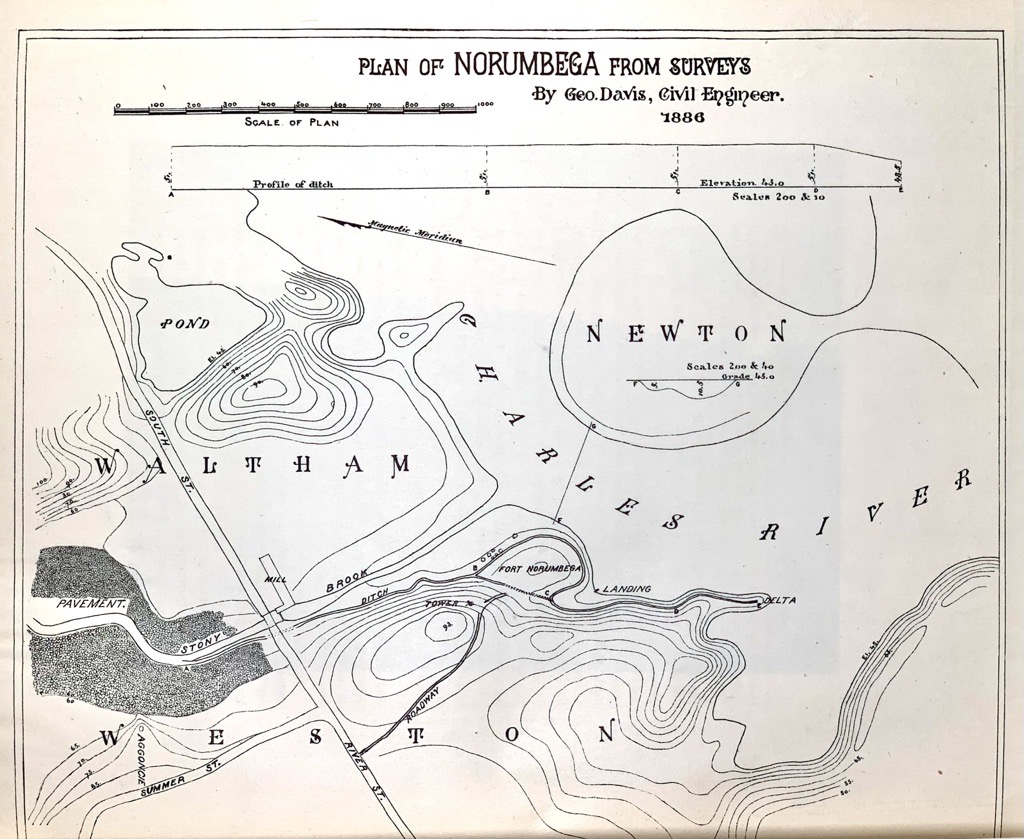
In a quest to find said evidence, Horsford had taken Winsor out to investigate the site of an old ditch and embankment in Weston. Winsor proclaimed it an early attempt to found the city of Boston, publishing an article saying as much, and ignoring Horsford’s idea that it was, in fact, the remains of a large and permanent Viking settlement.
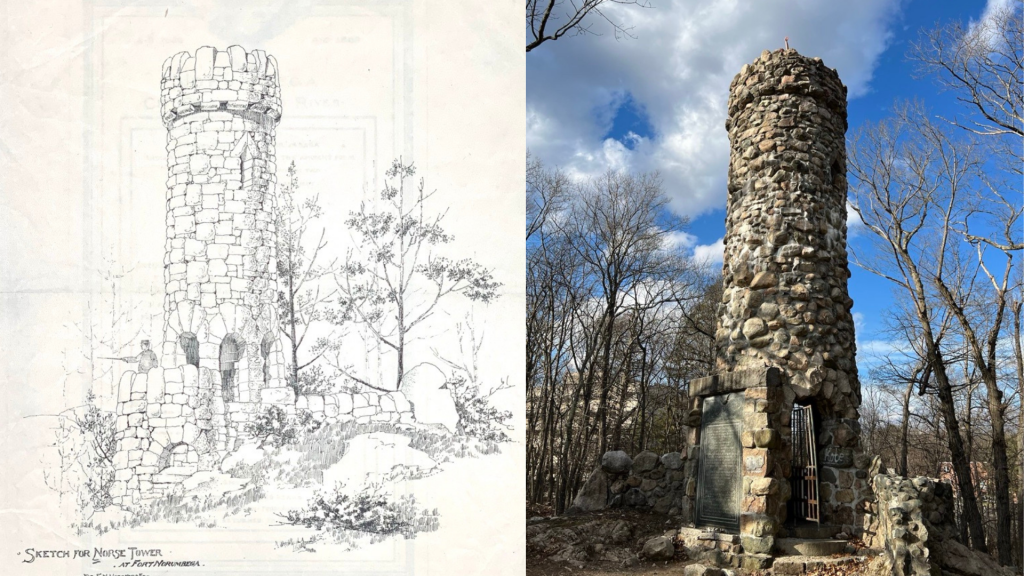
Horsford continues, “I left the episode to be forgotten. It had not occurred to me that the memory of the excursion to Stony Brook was to take unhappy form and be so lasting, until I was stung with the charge of “perversions,” in a work to be sent as authoritative over the world”. Undaunted by these feelings, in 1889 Horsford erected a giant stone tower on Weston’s bank of the Charles to commemorate the Stony Brook site, now dubbed Fort Norumbega, as evidence of a fantastical “lost city of New England”, an ancient Norse citadel complete with stone seaports in nearby Watertown.
“Plan of Norumbega from Surveys,” in Defenses of Norumbega (1886).
To Be Continued… in pt. 3!
[1] Horsford, Eben Norton. The Defenses of Norumbega and a Review of the Reconnaissances of Col. T. W. Higginson, Professor Henry W. Haynes, Dr. Justin Winsor, Dr. Francis Parkman, and Rev. Dr. Edmund F Slafter. Boston: Houghton, Mifflin and Co. as The Riverside Press, Cambridge (1891): p. 8.
[3] Horsford, Eben Norton. Problem of the Northmen. A Letter to Judge Daly, the President of the American Geographical Society, on the Opinion of Justin Winsor, that “though Scandinavians may have reached the shores of Labrador, the soil of the United States has not one vestige of their presence”. Cambridge: John Wilson and Son, University Press, (1889): pp. 7-8.
I’ve written for the Beehive many times about my particular affection for manuscript diaries at the MHS, and this post will be no exception. Today I’d like to tell you about the diary of Lester Locke Downing of Cambridge, Massachusetts.
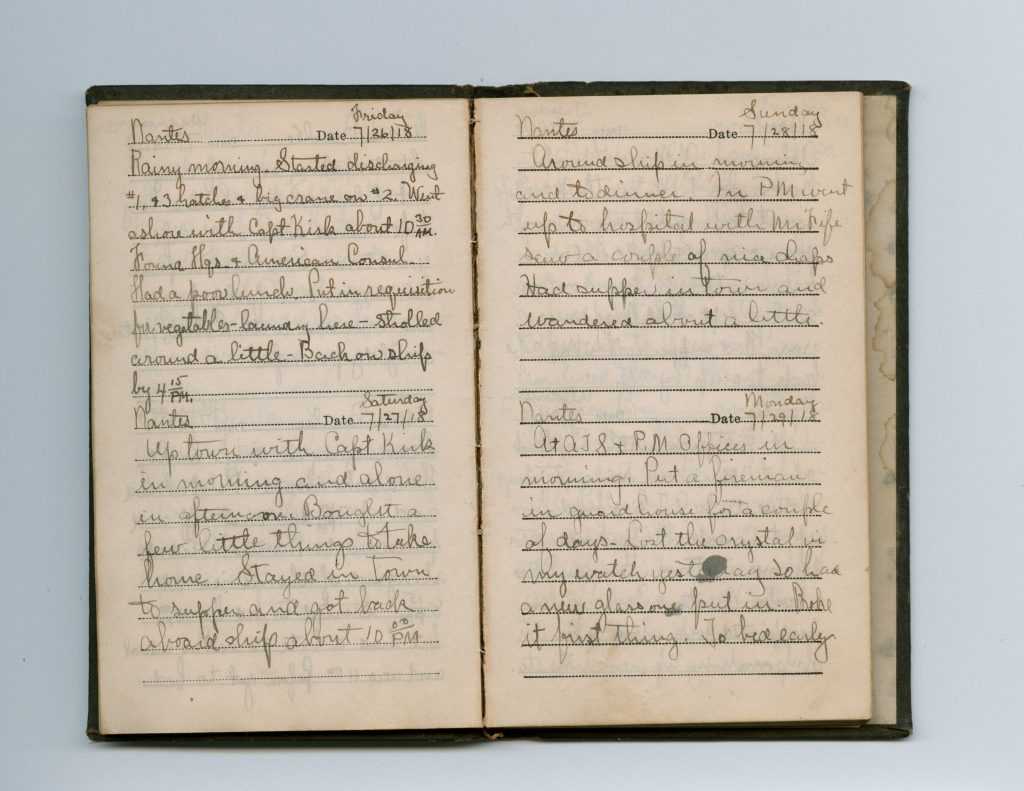
Diary of Lester Locke Downing, 1918
Downing served as a second lieutenant in the U.S. Army Transport Service during World War I. This pocket diary documents his service between 18 May and 20 December 1918 and his voyages back and forth between New York and France on the transport ship Osage. In these seven months, the Osage made three trans-Atlantic round trips as part of a large convoy. Downing’s brief but evocative entries really paint a picture of what his life at sea was like, both the monotony and the ever-present fear of submarine attack.
Downing didn’t have a lot of room to write in this small volume, but he managed to describe everything from how difficult it was to keep the convoy together (“At daybreak we were last ship in convoy. Speed of convoy is 10K. By 4:00PM in middle again. Only able to hold our own by not zig-zagging fully.”) to sightings of other ships, airplanes, airships, and animals (“Saw large school of porpoises & several large fish or turtles.”). His duties onboard included working on manifests, and in his down time, he usually read or played cards.
Whenever the ship was in New York for re-loading, Downing’s wife Elinor (née Haines) and mother Helen Adele (Locke) Downing came down from Massachusetts to visit with him for a few days, go to the movies, and eat out at restaurants. Then it was back to the ship and to France. The Osage landed at various locations to discharge cargo, including Saint-Nazare, Nantes, and Brest.
Because the diary entries are so short, the juxtapositions can be abrupt and jarring. For example, one day Downing wrote: “Passed to port a convoy eastbound. Tank steamer and 5 masted barge ahead also another steamer all westbound with us. A fine day. Pulled Captains tooth in afternoon. Mans body floated by in PM.” Other times, the lack of context makes an entry particularly eerie: “About 10:15AM passed a[n] empty life boat full of water.”
The convoy was in constant danger from enemy submarines, of course. Downing wrote about a few close calls, including this one in the middle of August: “Had submarine warning about 5:00PM. Right in our vicinity. Quite anxious. Steamer stern of us smoking.” He also mentioned a fellow sailor named Adolph Steinberg who suffered from trauma or mental illness (Downing used the words “demented” and “crazy”) and had to be left with the Medical Corps at Saint-Lazare.
What was the Osage’s cargo? The ship was transporting ordnance and chemical weapons, including picric acid, chlorine gas, explosive shells, and shrapnel. Picric acid was used extensively both as an explosive and as an antiseptic for the treatment of burns and trench foot. Chlorine gas, weaponized by both Allied and Central powers, attacked the respiratory tract and killed by asphyxiation.
Downing was on his third trip to France when he heard that Germany had signed the armistice. His entry that day was a bit anticlimactic: “Had had suspicions for some time.”
Lester Locke Downing was born on 16 March 1889, graduated with a degree in mechanical engineering from the Massachusetts Institute of Technology, and worked at Crowell & Thurlow Steamship Company in Boston. He was also an avid philatelist. He died on 25 July 1974 at the age of 85.
By Samantha Couture, MHS Nora Saltonstall Conservator & Preservation Librarian, and Lauren Gray, Reference Librarian
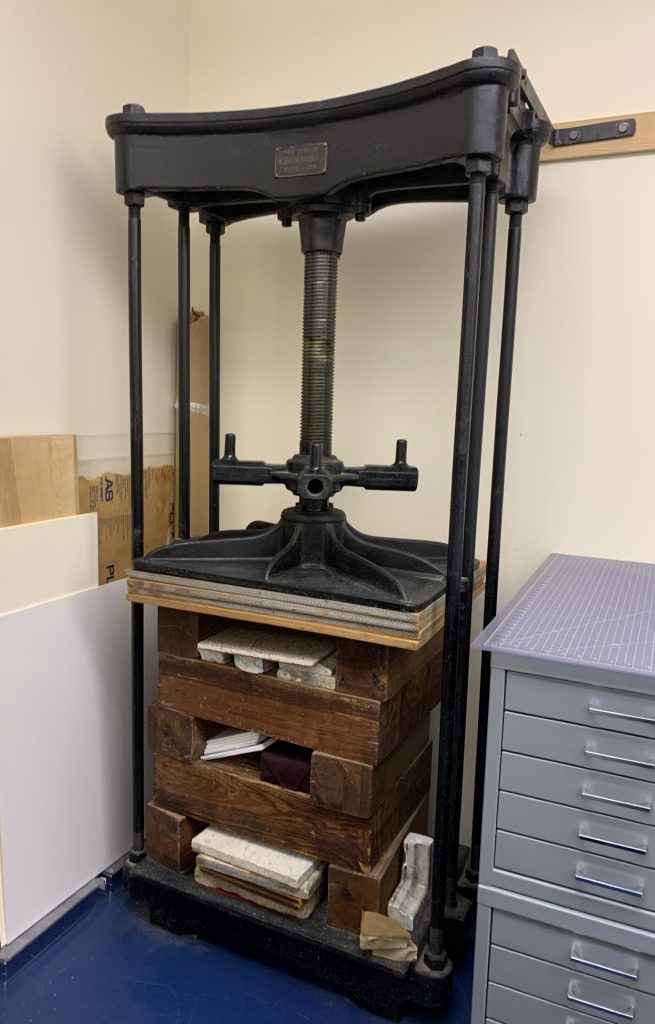
Standing press in the MHS conservation lab, photograph taken by Samantha Couture.
Welcome to Part 2 of our series on conservation at the MHS. The ability to perform conservation treatment is an integral part of providing access to our collections and making sure they will be available far into the future. We will discuss past conservation methods, how the field has developed, what conservation at the MHS has looked like, and the standards we adhere to today.
Book and paper conservation as a discipline is relatively new. Before the twentieth century, libraries and archives valued documents and books mainly for the text’s intellectual and historical content, rather than for the physical characteristics of the object. Treatments focused on repairs that were sturdy and allowed the item to be handled and read. It was very common to discard damaged bindings and other pages or inserts considered unnecessary.
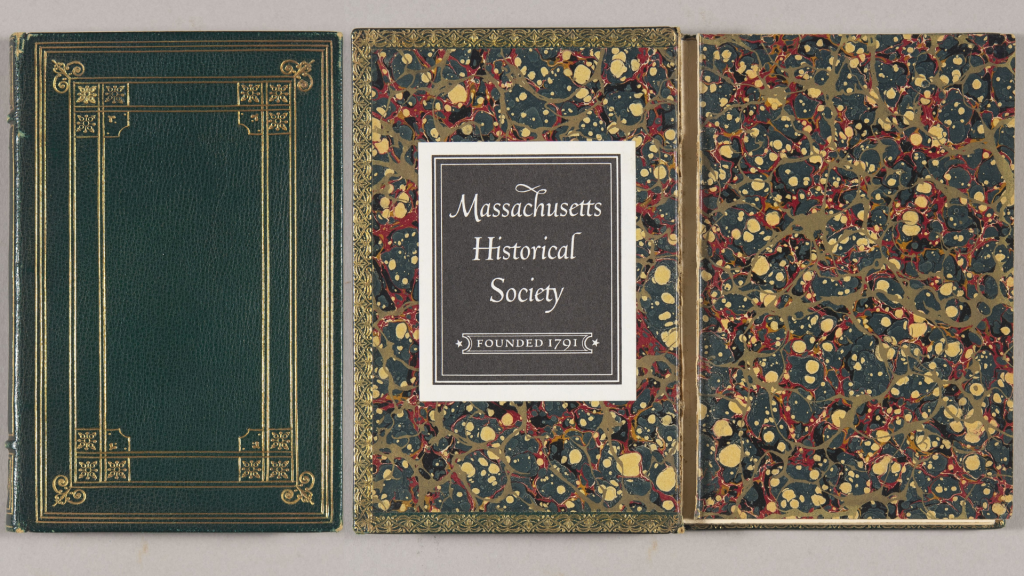
However, there were individuals interested in the history that can be revealed by the physical characteristics of a book or document. William Blades, from Part 1 of this series, rails against bookbinders who routinely removed original bindings to trim the margins and put on new modern bindings. This was common practice, even at the MHS. One example in the MHS collection is William Bradford’s manuscript, “A ‘dialogue’ or the sum of a conference betweene some young men born in New England, and some ancient men which came out of Holland and old England 1648.” Sometime in the late 1800’s, this thin pamphlet was bound into a smart new Victorian leather binding with elaborate gold tooling. The fragile pages were sewn into a text of blank pages, but it made it difficult to see all the text, and turning the pages put a great deal of stress on the paper. We will look at how Samantha chose to treat this document later in our series.
William Bradford’s manuscript “A ‘dialogue or the sum of a conference betweene some young men born in New England, and some ancient men which came out of Holland and old England 1648.” Front cover on the left, inside front cover to the right. Photograph taken by Samantha Couture.
In the 20th century, chemist and paper conservator William J. Barrow was very influential in the development of library and archives conservation. From the 1930s through the 1960s, he ran the W.J. Barrow Research Laboratory in Virginia. He collaborated with institutes such as the National Bureau of Standards and the Government Printing office. Barrow was an important link between the scientific and library and archive communities. He conducted many early accelerated aging tests, developed de-acidification techniques, and promoted the awareness of acid in modern papers and the damage it causes. [1]
Since Barrow’s time, conservation researchers have studied prevailing treatments and guided conservators in choosing the best methods. Conservators today need an understanding of the chemistry and materials used to reverse or slow the deterioration of paper. We have learned that many of our books and documents are stable without deacidification so long as the storage materials, building environment, and handling practices are suitable for long term preservation.
MHS has a long tradition of repairing manuscripts and books, which has evolved into today’s modern conservation lab. In 1837, a committee was formed to find “the best mode of preserving the manuscripts of the Society.” [2] In 1910, a bindery was created, and manuscripts were ‘silked’ (a technique that involved attaching sheer silk to support fragile paper) and bound into volumes. By 1972, the first conservation lab was built, allowing for the deacidification of manuscripts. [3] Anne Bentley, Curator of Art & Artifacts Emerita, was the paper conservator for the MHS from 1973 to 1998. During that time, she conserved many crucial documents, including the washing and deacidification of Thomas Jefferson’s manuscript for his book, Notes on the State of Virginia. She oversaw the creation of the second conservation lab built in 2000. Ms. Bentley continues to support the work of preserving our collections as a source of expertise and institutional knowledge.
Modern conservation practice is a blending of art, craft, and science. Many traditional techniques of book and paper conservation are still used, having been proven safe and effective by current research. Two presses from the original bindery are still used frequently in the lab. These sit alongside a chemical fume hood, a water de-ionization system, and testing and analytical tools to enable sophisticated and complex treatments of our archival material. Treatments follow the American Institute of Conservation’s guidelines and code of ethics, which emphasizes retaining original materials, using reversible techniques whenever possible, and documenting treatments with written reports and photographs.
In our next installment, we will look closely at a few examples of repairs and treatments in the lab.
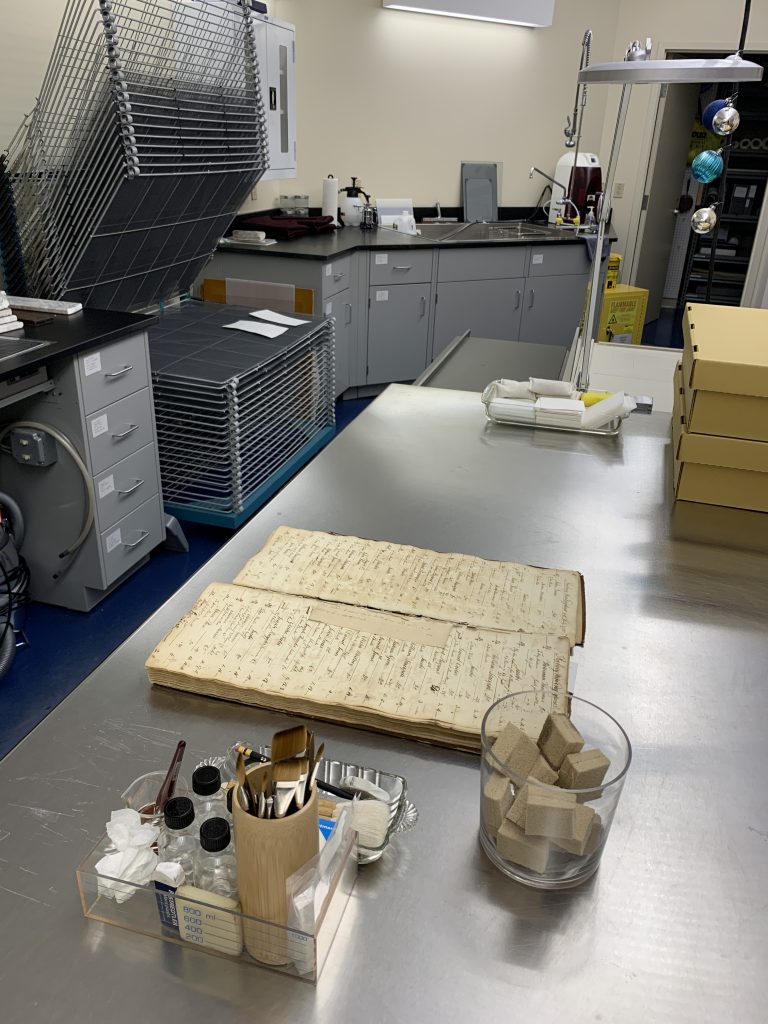
MHS Conservation Lab. Photograph taken by Samantha Couture.
[1] William James Barrow: A Biographical Study of His Formative Years and His Role in the History of Library and Archives Conservation From 1931 to 1941, Sally Roggia
Advisor: Paul N. Banks Submitted in partial fulfillment of the requirements for the degree of Doctor of Library Science in the Graduate School of Library Service, Columbia University, 1999
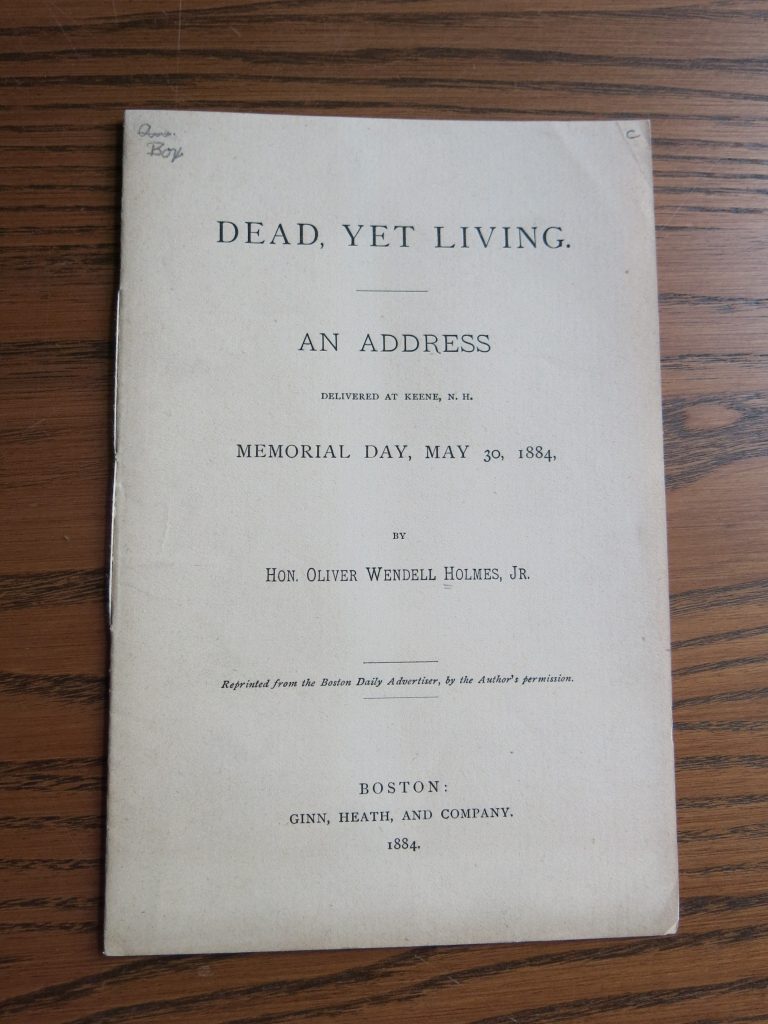
The Massachusetts Historical Society will be closed Saturday, May 25th and Monday, May 27th in honor of Memorial Day, so I thought I would look at some of the ways people have celebrated this day in the past. One popular way was by listening to speeches highlighting the importance of Memorial Day and why it mattered. Referred to as “Memorial Day Addresses” in our catalog, these speeches were a way to remind people exactly what the day was about. Memorial Day finds its origins in Reconstruction, the time after the Civil War. It was originally referred to as “Decoration Day” and centered around visiting the graves of loved ones who died in the Civil War and enjoying a picnic afterwards. This tradition was kept alive in the popular barbecues of my childhood, though without the graves. Traditions have certainly changed but it’s always interesting to look back at a snapshot of time and see what changed and what remained the same.
Cover of Oliver Wendell Holmes’ 1884 address
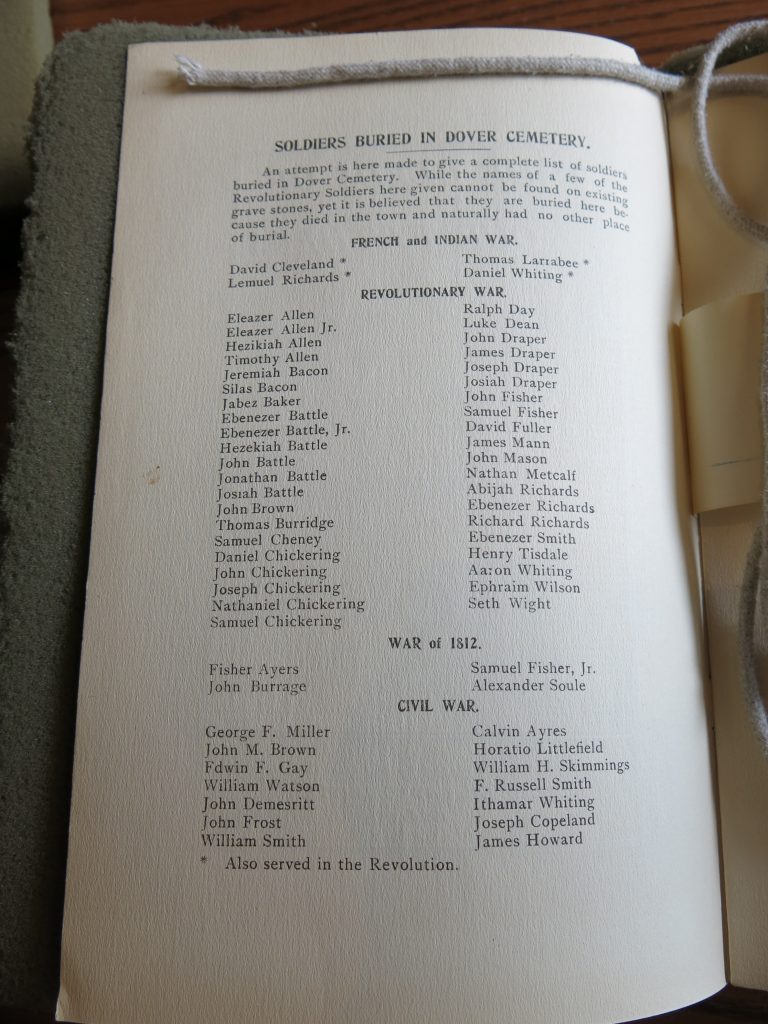
While today Americans tend to associate Memorial Day with more modern wars with still living veterans, the addresses I looked at, from 1881 to 1904, tied the holiday explicitly to both the then-recent Civil War and to the American Revolution. Many of them linked back to what were considered the origins of the United States and the founding principles. Reading through the addresses, many speakers viewed the wars America had fought as part of a tradition of patriotism and strong morals. Nowhere is this more evident than in Frank Smith’s 1904 address in Dover, Mass., which outlines in almost excruciating detail every war or conflict the town had sent men to, from fighting the indigenous peoples to the Spanish American War, in 1898. The published speech also includes a list of the soldiers who had died and were buried in the Dover Cemetery, a demonstration of the honor Smith felt they deserved. The connection between war and patriotism is made over and over again in these addresses, despite ostensibly praising and honoring peace.
List of all Dover’s fallen soldiers, included in Frank Smith’s 1904 address
That patriotism covers more than just the Union itself though. Most of the speakers also strongly tie these actions to the character of the region. This pride in being New Englanders is a key part of the argument these speakers are making—that these wars demonstrate the superiority of American ideals and that nowhere are these ideals more truly upheld than here. This call to sacrifice includes both men and women, though in very different ways. The picture of the idealized soldier in most of the speeches is a striking one. He is brave, strong, and true, the perfect specimen, willing to die. And the women take care of the home, work in the jobs that are left behind, and mourn the men who die on the battlefield. The men die and the women suffer. These addresses remind listeners to do their duty and do it faithfully, regardless of the cost.
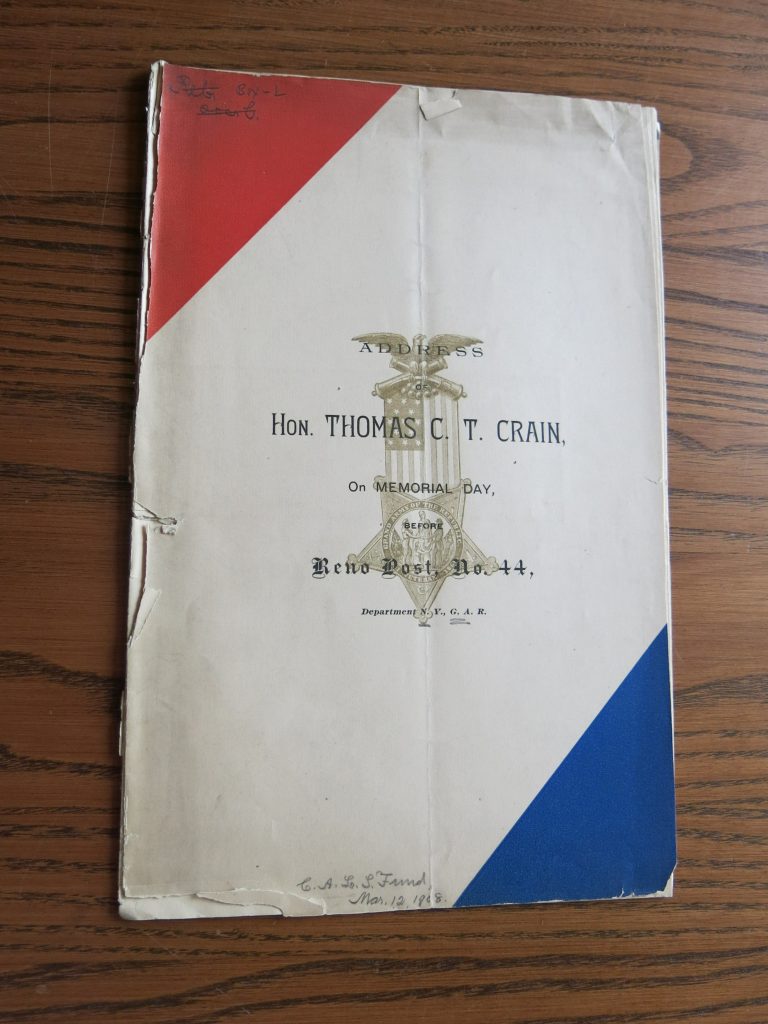
Cover of Thomas Crain’s 1891 address
There is a somberness to these addresses, but that is tempered by the sense of how honorable it is to fight and die in a war. This view of war is contradicted in our own collections, however. Susan Martin writes here and here about veterans who disagreed with the way the Revolution was commemorated, an interesting counter to the lofty language and ideals expressed by the speakers even within a similar time period.
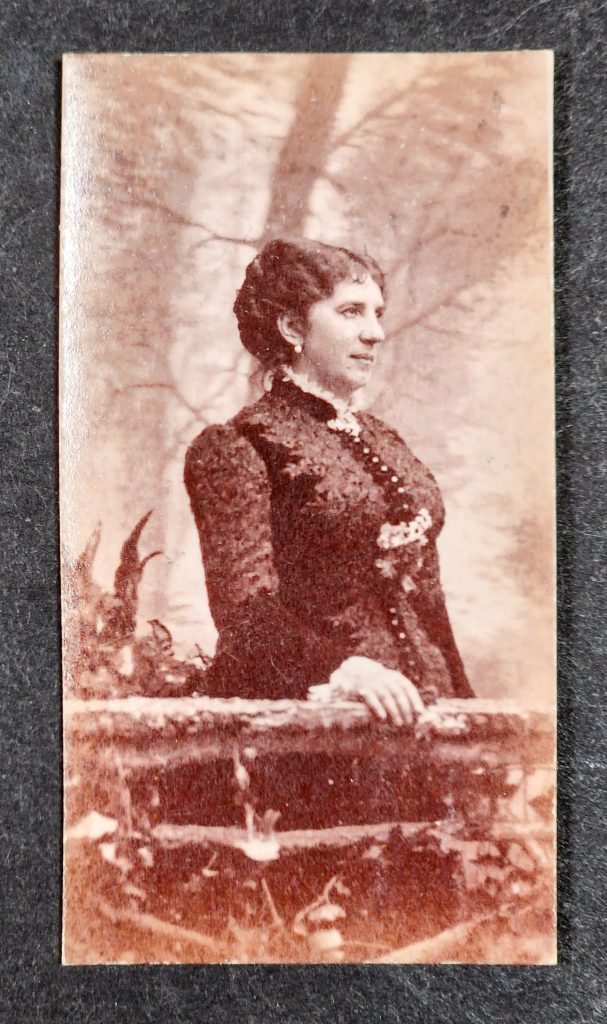
Portrait of Elise Hensler, Slade-Rogers family photographs, [ca. 1905-1911], removed from Slade-Rogers family papers (Ms. N-2393)
Dear Gentle Reader, although you and I may have never heard of Miss Elise Hensler, a woman infamous in Milan for her operatic prowess, and her daughter born out of wedlock, she caught the attention of a King and is now a Countess! Young ladies may read her story and swoon, but it was not all a fairytale ending.
Elise was born in Switzerland, but her family moved to Boston when she was young. She received a stellar education in the arts and languages, excelling in both. As a young adult, it was apparent that her voice deserved a European education, and off she went to Paris, bidding her sister and parents a fond farewell. Elise embarked on a European adventure unlike any other. While her family received regular letters and visits from Elise, their own heartbeats increased as they heard details, and tales, of Elise’s life in Europe. A gifted young opera singer, Elise joined the Teatro alla Scala in Milan. Her lure was undeniable and at the tender age of nineteen Elise gave birth to her daughter, Alice. The bond between mother and daughter was lifelong, even as Elise’s own life was about to change dramatically.
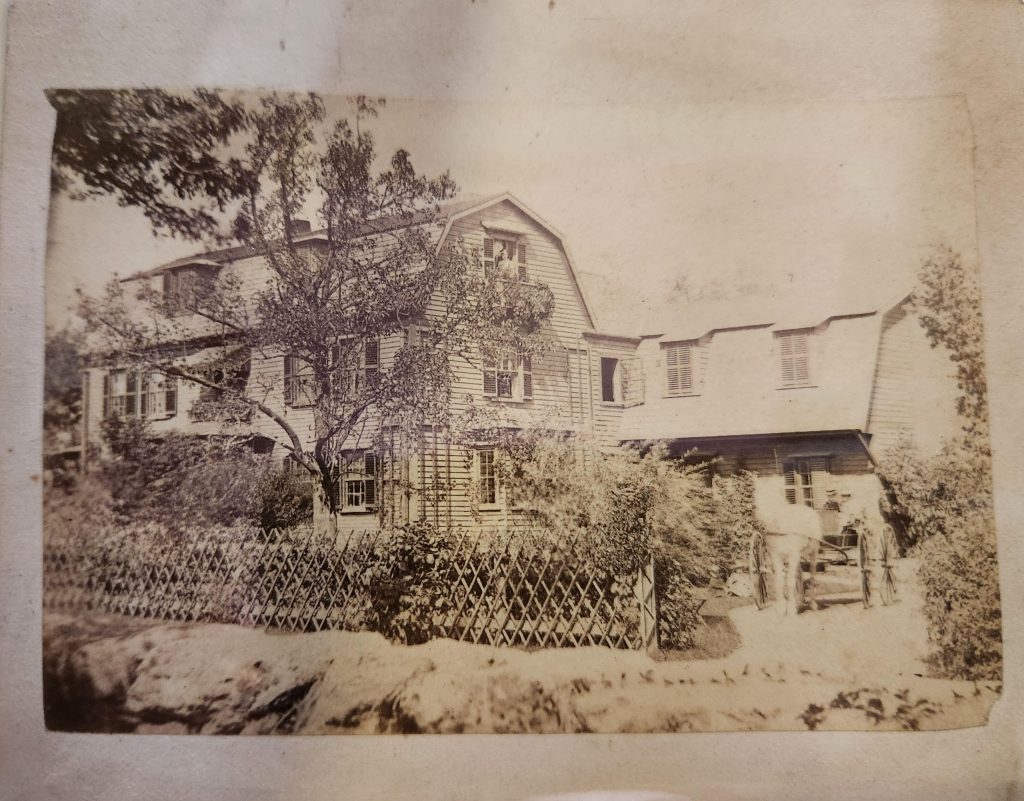
Elise’s sister was Mina Louise Hensler, who married Daniel Denison Slade in 1856, a doctor of medicine, but was also an expert in horticulture and zoology. Mina and Daniel had twelve children and lived in Chestnut Hill, Massachusetts. The letters between Elise and her sister Mina are among the many letters in the Slade-Rogers Family Papers at the MHS. Nineteenth century life In Chestnut Hill was pleasant, but the letters arriving from Portugal must have been enthralling, and indeed everyone waited for word from Elise.
Photograph of the D. D. Slade house in Chestnut Hill, MA
Starting in February of 1860, Elise performed at the Teatro Nacional Sao Joao in Oporto Portugal, followed by the Teatro Nacional de Sao Carlos in Lisbon. On April 15th, 1860, Elise performed Guiseppe Verdi’s opera A Masquerade Ball, and captivated an audience member, King Ferdinand II of Portugal. Ferdinand was king-consort and widower of Queen Maria II, a prince of the royal house of Saxe-Coburg and Gotha, nephew to Ernest I and King Leopold I of Belgium. Ferdinand was known as the King-Artist, a patron of the arts and an artist himself, educated in music and drawing, and fluent in multiple languages.
Soon Ferdinand and Elise were unabashedly in love and shared common interests in language, architecture, gardening, painting, ceramics, sculpture, and arts. Their courtship withstood the scrutiny of Portuguese society, and nine years later, the letter announcing their marriage finally arrived in Chestnut Hill.
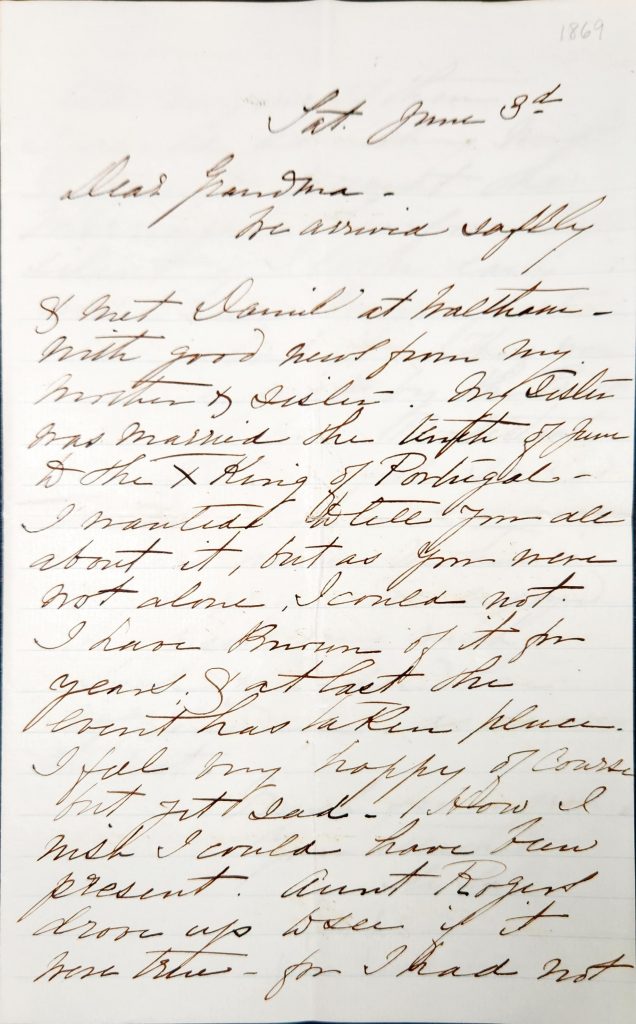
On Saturday, June 30th Mina writes with great excitement to Grandma:
Sat. June 30
Dear GrandMa,
We arrived safely I met Daniel at Waltham-With good news from my mother and sister. My sister was Married the tenth of June to the X King of Portugal–I wanted to tell you all about it, but as you were not alone, I could not. I have known about it for Years. & at last the Event has taken place. I feel very happy of course But [a bit] sad–How I Wish I could have been Present. Aunt Rogers drove up to see if it Were true–for I had not told any of them.
I feared something might Happen to prevent the Marriage–therefore kept Silent-I hope daily now to hear more particularly about it. They were Married first by the Priest And then by her Protestant Minister. I feel so glad at last …
Letter from Mina Slade to Grandma, 30th June 1869
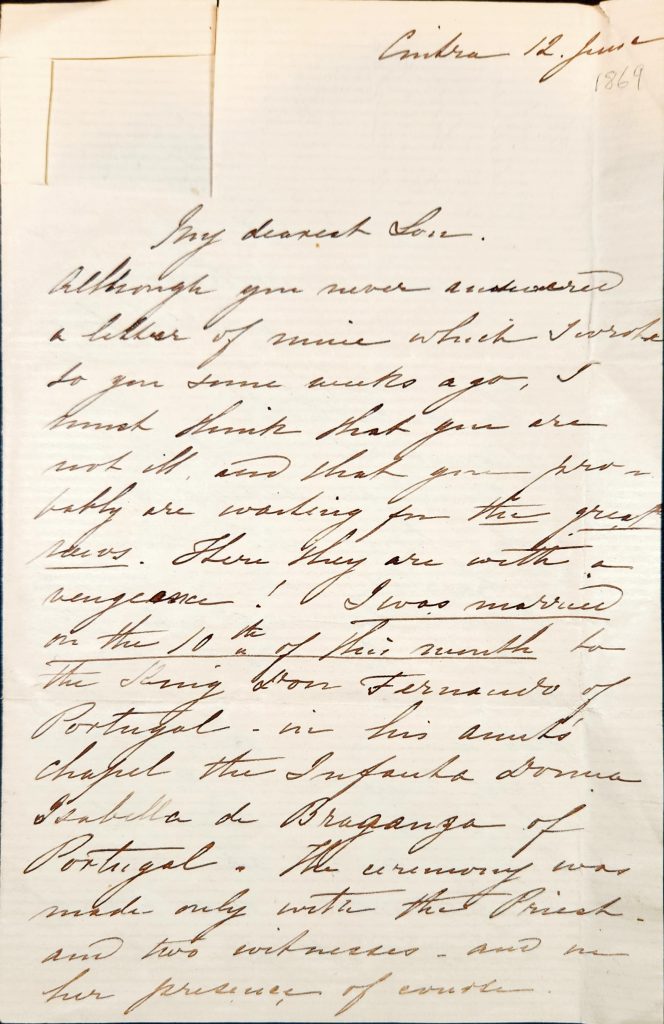
And the very next letter in the folder, sent on June 12th, 1869 (received on July 5th in Chestnut Hill) were the particulars Mina was waiting to hear…
My dearest love,
Although you never answered a letter of mine which I wrote to you some weeks ago, I must think that you are most ill and that you are probably waiting for thegreatnews. Here they are with a vengeance! I was married on the 10th of this month to the King Don Fernando of Portugal – in his Aunts’ Chapel the Infanta Donna Isabella de Braganza of Portugal. The ceremony was made only with the Priest and two witnesses – and in her presence of [court?]
It was her Royal Highness that arranged everything- for it’s not an easy matter for a King to marry a protestant when he is Catholic – now my dearest love I hope you and Daniel are satisfied! This act shows you what a noble hearted man is the King for I never [live] any acts of my life [from] [him] , and his thinking and worthy of [his] makes me more happy than you can imagine – you can easily imagine what the feelings of mother are! – how my dearest – Kiss Daniel for me – and all your children.
I forgot to tell you that after the ceremony in the Catholic Chapel, was over, we returned to the [strong] Palace, and there we went through the protestant ceremony of marriage – you can have nothing to say to that now I hope – try and get well over you Family Way* andthen come and pay a visit to your sister, the Countess of Edla! This title was given to me by the Duke of Ernest of [ Caboung?] – [condrine] to the King, and [twas?] the head representative of the King’s family [(My king I mean?)]
I suppose you won’t resist the temptation to have this printed in the papers, but please do it simply, without my comments.
Mother is very happy- I hope you are [so do?] when you read these news – write to me immediately – put you letter in an envelope addressed to me
My happiness
Would be so great
Could I kiss you – I hope
It may be soon-
Love me and believe me ever you affect sister
Elise D’Edla
Letter from Elise to Mina June 12th, 1869
Because Elise was a commoner, she was given the title of Countess of Edla on her wedding day, allowing the King to marry her. The media tried to portray Elise poorly as a single mother in a 19th century European Court, but she was talented and capable, rising above the rumor mill. However, she was never fully accepted as Ferdinand’s wife and was ostracized and scrutinized by the Portuguese Court. Elise fought endlessly with the media’s portrayals of her life, and unlike any fairytale, she was often lonely.
King Ferdinand named Elise universal heir to his properties and estate, including the Royal Palace. When he died on December 15th, 1885, Elise was thrust into a years-long battle with the Royal family. Intimate details of the battle for the estates are found in the collection held at the MHS. In the end, Elise chose to live with her daughter, Alice, and her son in law, in Portugal, never to return to Boston. Her simple epitaph reads: “Here lies Elise Hensler, widow of His Majesty King Ferdinand II of Portugal, born in 1836 and died in 1929”.
What does modern Portugal and its tourism industry owe to Elise, the Bostonian, who could have claimed the Royal palace and all properties as her own? Over the years she worked to promote the arts and culture in Portugal, and as historians look back, her influence on modern Portugal is becoming more apparent. From benefactor of the Park of Pena to patron of Portugal’s modern masters, Elise continued to work towards the expansion of art, music and the preservation of architecture. Discredited, ostracized, criticized, but secretly admired, Elise was a Boston girl who fell in love with a king and his country. It is time for Elise to take her place.
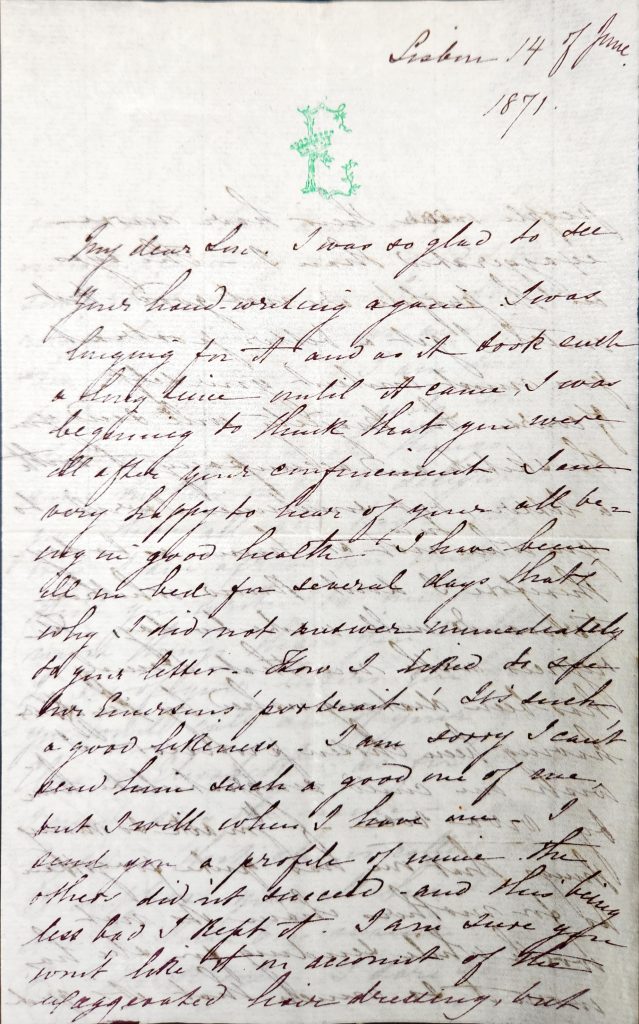
The stationery of the Countess of Edla
Visit the Library of the Massachusetts Historical Society to learn more about Elise and read about the battle over her inheritance.
Hopefully, the readers of this lurid tale of love, loneliness, and the trials of a Countess has entertained and delighted. Sincerely, Lady Chand.
Commonwealth Avenue: that grand road snaking its way out of Boston and into the adjoining city of Newton, an eleven-mile stretch of boulevard from the Public Gardens to Auburndale-on-the-Charles, where it abruptly ends at the juncture of I-90 and I-95. At its head is Commonwealth Avenue Mall, a picturesque greenway home to an array of statues of historical figures leading up to the Garden’s entrance.
Gazing dramatically into the shadows of an overpass, Leif Erikson, dressed in a short chainmail tunic straight from the nineteenth-century imagination, looks practically glamorous posed with fist planted on his hip, bronze locks billowing behind him. Originally marking the end of the Mall, the statue relocated to nearby Charlesgate in 1917, and a stone’s throw from the MHS.
In our most recent podcast episode, “Events That Did Not Happen”, Peter Drummey and Dr. Kanisorn Wongsrichanalai sit down to discuss the origins of the statue, and how the MHS fits into its narrative.
Leif Erikson statue on Commonwealth Avenue Mall.
The Norsemen Memorial
This all began in December of 1876, during a reception honoring the Norwegian violinist Ole Bull1, in which Rev. Edward Everett Hale proposed a tribute to Bull’s devotion to the city and the formation of a “committee of the Norsemen Memorial”. The goals of the committee were twofold. 1) to erect a monument commemorating the Norse discoverers of America, and 2) the preservation of Dighton rock (including briefly gifting it to Denmark)2. The committee was full of prominent Bostonians such as Governor Alexander Rice and Mayor Samuel Cobb, but the one that would come to be emblematic of this whole affair was Eben Norton Horseford (whose life is better outlined in the podcast), a former chemistry professor made wealthy by his patented Rumford baking powder.
In 1880, Hale’s cousin, William Everett, brought the matter of the committee and the statue to the MHS: “I desire, sir, to call the attention of the members to a scheme which is assuming somewhat serious proportions; in which, if it is really judicious, the Historical Society ought to help; against which, if it is otherwise, it is our duty to protest. I mean the scheme for erecting a monument to some person called the first discoverer of New England; not, however, John Cabot, or Sebastian Cabot, or Verrazzano, but an indefinite Northman, to whom, if I may be allowed a very bad pun, it is proposed to put up a Leif statue.”3
The next time the statue was mentioned was at the November 18874 meeting, at which time a committee was selected to have a final word on the validity of the statue, which had by then been unveiled with great celebration the previous month. By December, there was a verdict: “there is the same sort of reason for believing in Leif Erikson that there is for believing in the existence of Agamemnon. They are both traditions accepted by the later writers; but there is no more reason for regarding as true the details related about his discoveries than there is for accepting as historical truth the narrative contained in the Homeric poems.”
“’river flowing through a lake into the sea” Vinland Map of the Northmen” from Problem of the Northmen (1889); image credit Internet Archive.
To be Continued…
1 Bull was a strong proponent of Carl Christian Rafn’s theories of Vikings discovering America before Columbus, a theory which had been published earlier in the century to wide interest. Much of Bull’s feelings on the matter are expressed in his memoir written posthumously by his wife, Sara Chapman Bull, a resident of Cambridge (see pp.270-76 of the memoir for details of the statue committee’s creation).
2 I first saw an account of this in the ‘preface to the new edition’ of Rasmus Bjorn Anderson’s America not discovered by Columbus, 1877, which proved to be interesting on its own, as this particular copy was also inscribed on the front flyleaf: “Mr. Mauk, from his devoted friend and admirer Ole Bull Cambridge Nov 1879”, with a second inscription made “To Francis R[ussell] Hart Esq. With kindest regards Olaf Olsen, Oslo 1930”.
3 Proceedings of the Massachusetts Historical Society [First Series], vol. XVIII (May 1880), p.79-81. The pun, as best I can tell, is based on an archaic verb usage of the word “leif” to mean ‘willing’ or ‘glad’.
4 Proceedings of the Massachusetts Historical Society, Second Series, vol. IV (November-December 1887), p.12, 42-44.
Sara Georgini, Series Editor, The Papers of John Adams
Huzzah for a new volume of The Papers of John Adams! Volume 20, which features Adams’ first term as vice president, is NOW available to read for free in the Adams Papers Digital Edition of the Massachusetts Historical Society website. In 301 documents, it offers a backstage pass to the drama of the first federal Congress, as George Washington and his cabinet shielded a fragile new nation pledging peace in a war-torn world. Maintaining “neutrality, as long as it may be practicable,” was the chief goal. For, as Adams advised Washington: “The People of these States would not willingly Support a War, and the present Government has not Strength to command, nor enough of the general Confidence of the nation to draw the men or money necessary, untill the Grounds, causes and Necessity of it Should become generally known, and universally approved.” Far from the national capital of Philadelphia, a sudden storm of events clouded the United States’ future. Volume 20’s spotlight on the understudied Nootka Sound crisis reveals how the violent interplay of imperial powers guided American prospects well after revolutionary soldiers laid down their arms.
America attracted adventures and entrepreneurs flying various flags in order to pocket big profits. John Meares, a former British naval officer, set up shop in Canada’s Nootka Sound in 1788 by using a blend of British and Portuguese colors. Meares leveraged a key hinge in global economic power. Nootka Sound functioned as a fur trade hotspot and as a gateway to the fabled Northwest Passage. Meares’ establishment of a trading post simultaneously agitated long-held notions of Spanish dominion, British opportunity, and American neutrality. Spanish Navy commodore Don Esteban José Martinez retaliated the following spring. He seized four of Meares’ ships and arrested the crews, bolstering the Spanish claim to the region. Meares sent petition after petition to the British foreign ministry seeking aid, and Anglo-Spanish relations dipped to a new low. What began as a local brawl over trading rights escalated into a clash of European powers by June 1790. Like many Americans, Adams watched tensely. British and Spanish ministries ramped up fleets and threats.
The press hurled reports and misinformation at a dizzying pace, and the vice president’s worry grew. Maybe British militias were training in Detroit, Michigan. And Spanish Army officers planned to invade St. Augustine, Florida. Or William Pitt the Younger launched secret talks with Latin American revolutionaries, plotting full British control of the region’s gold and silver mines in the wake of a Spanish defeat. Americans, who had largely evaded the global conflicts that raged in the 1780s, eyed the Nootka Sound crisis with real fear. Would the British strike through French Louisiana? What if they sought safe passage across neutral American lands to quell the Spanish? Whatever the United States decided, how would the big choice play in Europe—treaties sunk, ministers recalled, trade lost for another generation or two? Washington needed to know. Adams was first and loudest to weigh in. He urged Washington not to permit the trespass of foreign troops, citing law of nations theory and using his diplomatic experience to sketch a few scenarios of the Anglo-Spanish dispute.
Then John Adams took one more step forward. While he prickled at the secondary nature of his government role, Adams relished the chance to let his statesmanship shine. So Adams pushed for the expansion of the American diplomatic sector, reasoning that greater crises loomed ahead. The United States needed to recruit and assign more ministers to foreign courts. “It is a Misfortune that in these critical moments and Circumstances, the United States have not a Minister of large Veiws, mature Age Information and Judgment, and Strict Integrity at the Courts of France Spain London and the Hague,” Adams observed. “Early and authentick Intelligence from those Courts may be of more importance than the Expence: but as the Representatives of the People, as well as of the Legislatures, are of a different opinion they have made a very Scanty Provision for but a part of Such a system. As it is, God knows where the Men are to be found who are qualified for Such Missions and would undertake them.” To learn about the final resolution of the troubles at Nootka Sound—and how Vice President John Adams perceived opportunities for national progress despite periods of deep diplomatic crisis—you can start reading Volume 20 of The Papers of John Adamshere.
The Adams Papers editorial project at the Massachusetts Historical Society gratefully acknowledges the generous support of our sponsors. Major funding for The Papers of John Adams is provided by the National Endowment for the Humanities, the National Historical Publications and Records Commission, and the Packard Humanities Institute.
I want you to imagine the work of an 18th century American woman. What is she doing? Is she sewing and cooking and cleaning? Does she leave her home for work?
Now I want you to ask yourself where that image came from—what conjured it in your mind?
In historical anthropological theory there’s a recognition of recency bias—our understanding of the past is informed by our assumptions about our present. This is complicated in the West by our beliefs about linear “progress.” We’re apt to believe current Western society is “the best it’s ever been” and our modern inequities are deeply rooted in history—progress necessitates as such.
Working in public history I run into the same fallacy again and again, especially when discussing Western women’s lives in the 18th century and earlier. Believe it or not, most strict Western gender roles don’t come from centuries long history of labor separation. Instead, most are rooted in the late 19th and early to mid-20th century (recent, by history standards!). As a quick example: the average marrying age of English women during the first half of the 18th century was 26[1], in 1850 America it was 23[2], and in 1960 it was around 20.[2]
Now that we’ve reset our assumptions, what can we learn about how and why women worked in 18th century Boston? Newspapers are a valuable tool, giving us a peek into daily 18th century life. Browsing the advertisements in the Harbottle Door Annotated Newspaper Collection reveals many examples of the ways 18th century women supported themselves, their families, and their community. While reading and sorting through clippings I noticed women earned money in roughly three ways: through entrepreneurship, wage work, or indenture.
While outnumbered by advertisements for male-operated businesses, it’s not uncommon to see women advertising their wares, often in their own shops!
In her study of women’s labor in 18th century cities Karin Wulf found women were more likely to operate businesses relating to “domestic labor” like sewing or cooking. [3] Mrs. Mecom’s millenary business falls into this category. This is not to say that women were confined to gendered businesses—women like Rebeckah Walker operated all kinds of businesses in all kinds of fields. Neither were women limited to retail. Women frequently placed ads for their service-based businesses ranging from teaching to operating taverns and coffeehouses.
Women most often came business after their husband’s death. Upon being widowed, if the husband’s estate was uncomplicated (which typically included those in the merchant class or lower) the sole ownership fell to their wife, who could then choose to carry on the business.[3]
The second category of paid women’s work is wage work—what we would probably think of as regular employment or gig work, depending on the situation. Many but not all of these jobs also fell into domestic labor categories including household management, laundry, and wet nursing (which seems to be a whole separate industry![4]).
Four separate advertisements from The Boston-Gazette, and Country Journal (15 March 1773, 19 November 1770, 15 March 1773) advertising work for women in a tavern, wet nursing, and tending a shop. (Interesting to note the publishers Edes & Gill seem to be doing a lot of leg work facilitating advertisements. I imagine it gets busy in that print shop!)
The third category is by indenture, where women signed a contract and in exchange received wage, food, and lodging. While certainly not all rosy, Kent’s research on female domestic servants in 18th century London suggests some young single women preferred indentured contracts to other forms of wage earning. Women earned about 1/3 the amount a man would earn for day labor, and the pattern holds even when comparing skilled trades, like a mantua-maker (dressmaker) to a tailor (men’s suits and clothes). Non-indentured working women often barely made enough money to cover housing and meals. An indenture contract came with “diet and lodging” included, meaning indentures were one of the few ways women could earn disposable income.[1]
We can’t talk about the ways women provided for themselves without acknowledging the ways women were denied control of their own livelihood. You cannot look through an 18th century newspaper without directly confronting the flippancy of enslavement and the dehumanization of Black people, free and enslaved.
While beyond the scope of this blog post, I encourage you to learn more about enslavement in Boston by reading Dr. Jaime Crumley’s blog post on the enslaved parishioners of Old North and The City of Boston Archaeology Program’s “Boston Slavery” online exhibit.
Advertisements both selling and seeking enslaved people appear in almost every edition of 18th century Boston newspapers. While unclear if this ad is seeking enslaved workers or paid domestic workers, the advertiser’s racism is clear as day. The Boston-Gazette, and Country Journal, 31 August 1772.
Married women, while part of a partnership, were still subject to the whims of their husbands.
While these ads paint a bleak picture, most of the time an 18th century husband was not the sole controller of the household, financially or otherwise. Karin Wulf calls the 18th century urban landscape one of financial “interdependence” rather than independence[3]. Both sides of the relationship entered a marriage with financial value, and both had to work to secure economic stability. Eliza Haywood wrote in 1743/44 London “You cannot expect to marry in such a Manner as neither of you shall have Occasion to work, and none but a Fool will take a Wife whose Bread must be earned solely by his Labour and who will contribute nothing towards herself.[4][1]”
[1] Kent, D. A. “Ubiquitous but Invisible: Female Domestic Servants in Mid-Eighteenth Century London.” History Workshop Autumn, 1989, no. 28 (1989): 111–28.
[2] Fitch, C., & Ruggles, S. (2000). “Historical Trends in Marriage Formation: Perspectives on Marriage and Cohabitation.” In L. Waite, C. Bachrach, M. Hindin, E. Thomson, & A. Thornton (Eds.), Ties that Bind: Perspectives on Marriage and Cohabitation (pp. 59-88). Aldine de Gruyter.
[3] Wulf, Karin. “Women’s Work in Colonial Philadelphia.” In Norton, Mary Beth., and Ruth M. Alexander (Eds). Major Problems in American Women’s History : Documents and Essays. 3rd ed. Boston: Houghton Mifflin, 2003.
[4] Shepard, Alexandra. “Working Mothers’ in Eighteenth-Century London”, History Workshop Journal, Volume 96, Autumn 2023, Pages 1–24, https://doi.org/10.1093/hwj/dbad008