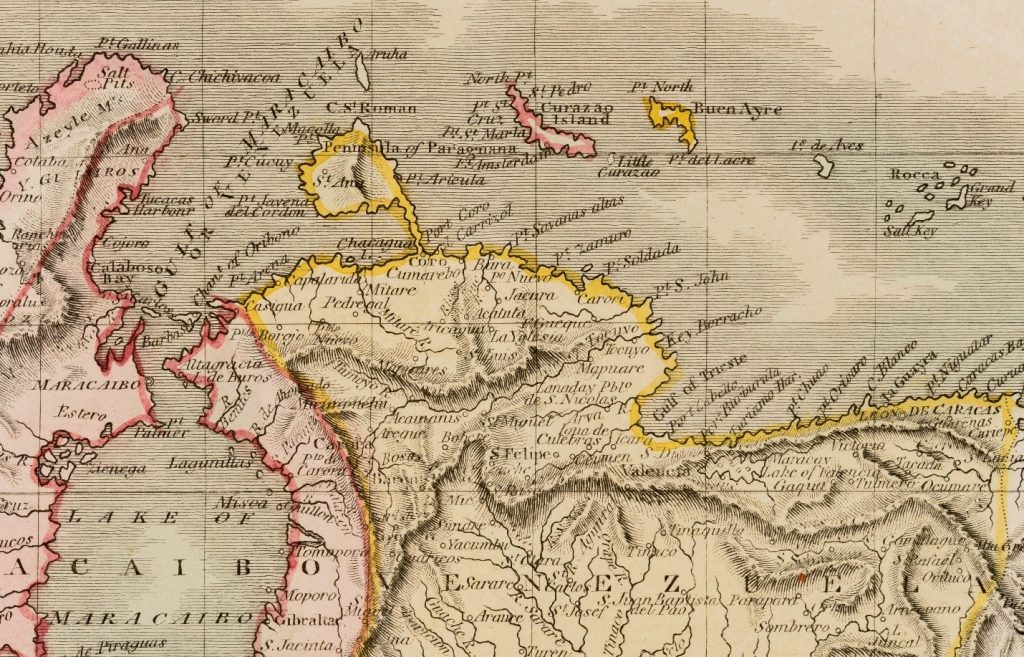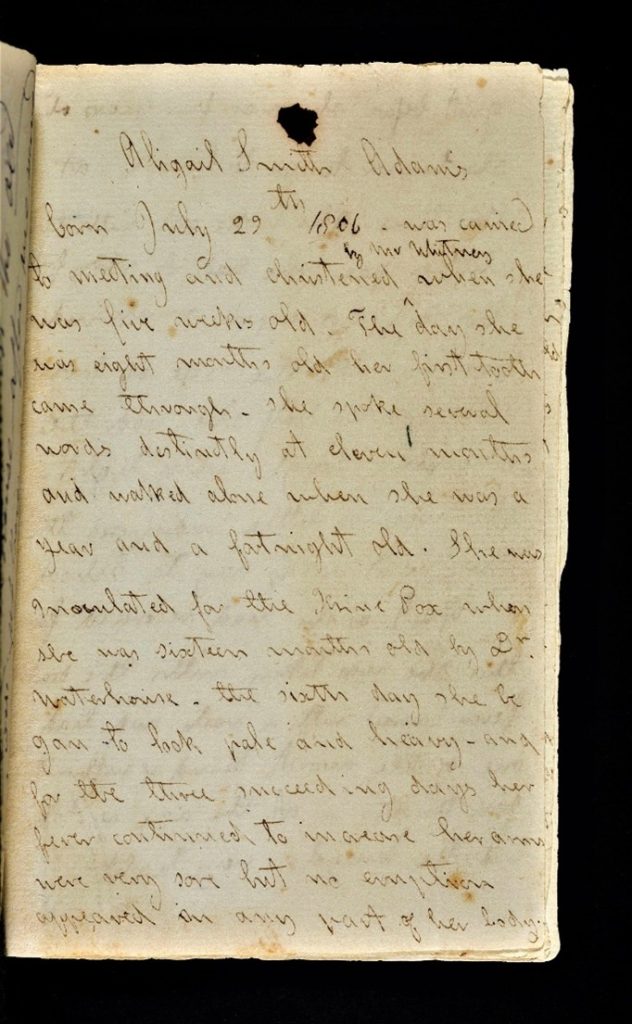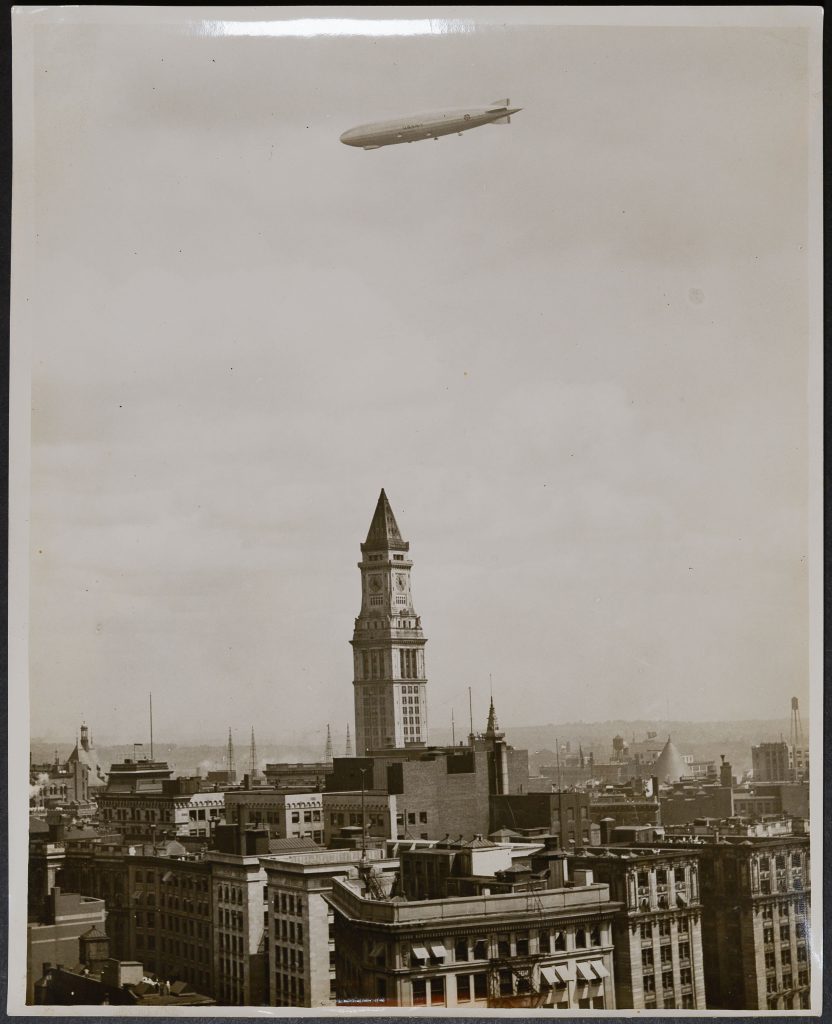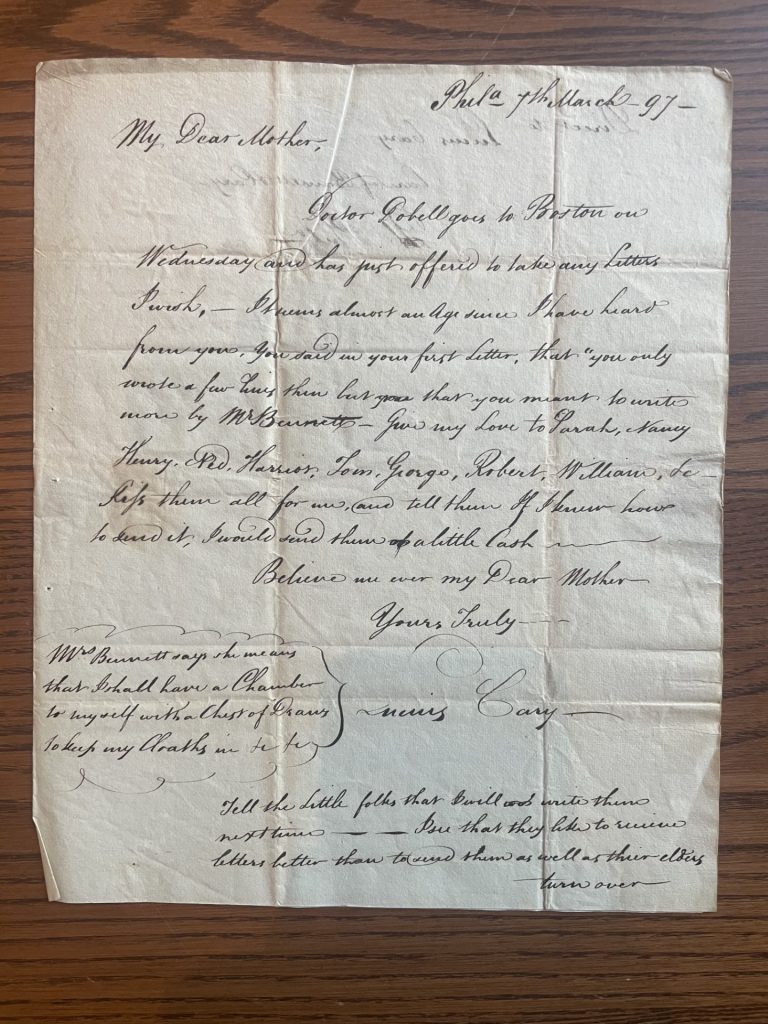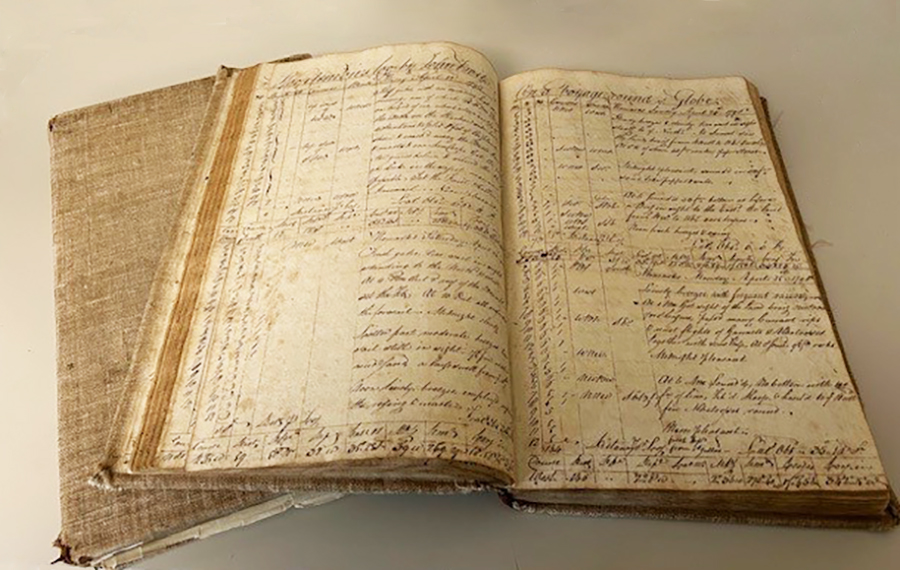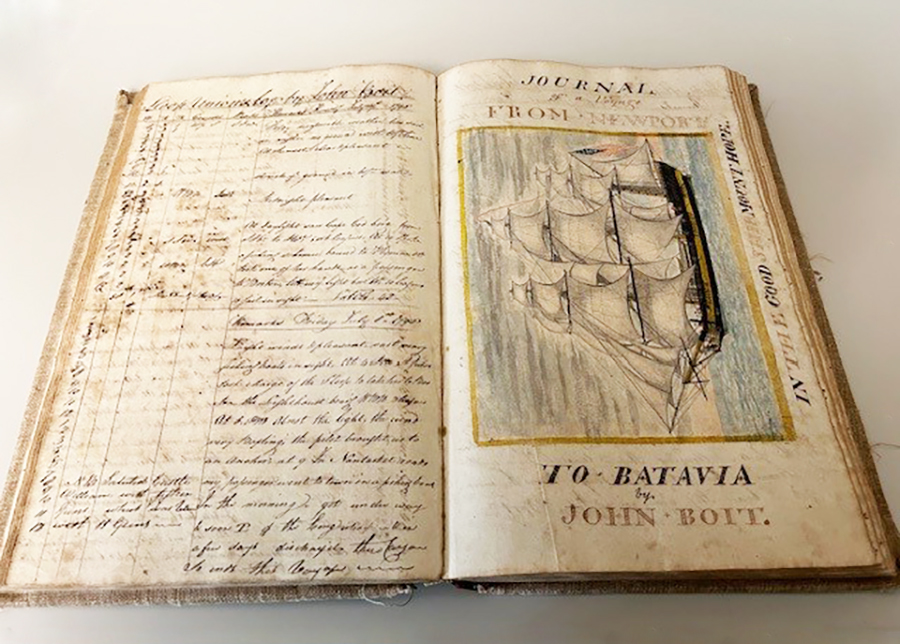
The MHS has held a collection of ships’ logs kept by John Boit, Jr. since his descendant, John Boit Apthorp, donated them in 1919. Three volumes kept by Boit on trading voyages from 1790 to 1802, including a log of the Columbia, document voyages to the Northwest Coast to trade for fur before sailing on to the Sandwich Islands (now Hawaii) and to China in the early years of the newly-opened China Trade. Boit served as a captain’s mate on the Columbia and other vessels before taking command of the Union.
Two volumes covering the Union’s voyage from Newport, R.I., to China via the Northwest Coast had reportedly disappeared when the collection was sent offsite to be microfilmed, probably in the 1960s or 1970s. Until now.
Rusty Farrin of Farrin’s Country Auctions in Randolph, Maine, recently contacted the MHS to report the recovery of two of Boit’s logbooks that were discovered in a storage locker. Farrin’s research revealed that the volumes had been part of the Society’s collection and he generously returned them, as he said, “back where they belong.”
John Boit logbooks
The voyage of the Union spans the two volumes and includes stops in the Falkland Islands, Nootka Sound and other locations in British Columbia, Macao, Canton, and Mauritius from August of 1794 to July of 1796. One volume also documents a voyage from Boston to Charleston, S.C., Dublin, Ireland, and back on the ship Eliza, 1793-1794, and the second includes a voyage from Newport to Batavia in the Dutch East Indies and back on the Mount Hope, 1801-1802. Both volumes include long narrative passages that describe the locations where they anchored, including encounters with indigenous people, as well as watercolor drawings of the vessels and land formations seen along the way.
We are enormously grateful to Mr. Farrin for ensuring these volumes made their way back to the MHS.
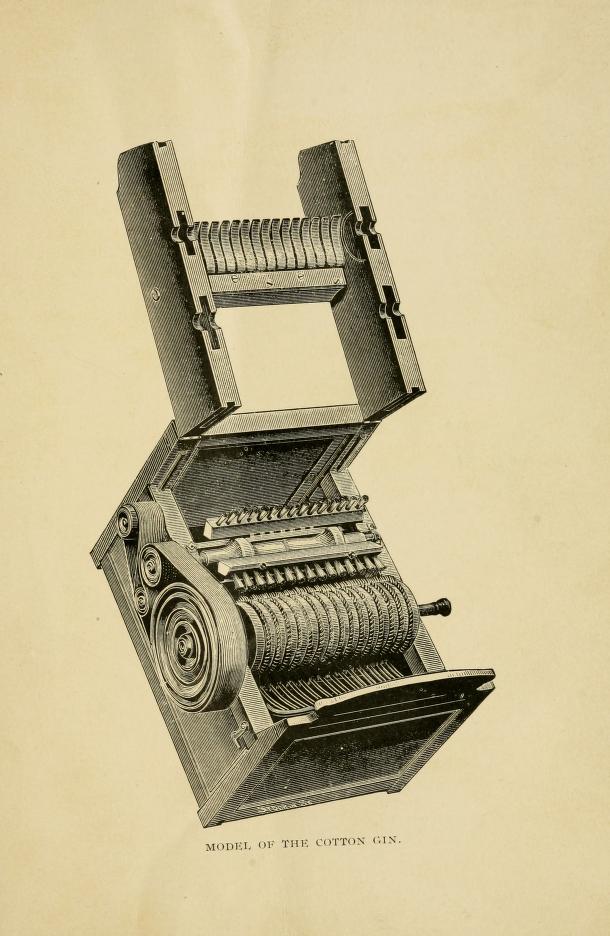
I’d like to tell you about a small collection at the MHS that includes a truly wild diary. It was written in 1838 by Samuel Leonard of Bridgewater, Massachusetts, as he traveled throughout the Southern United States exhibiting cotton gins to potential buyers.
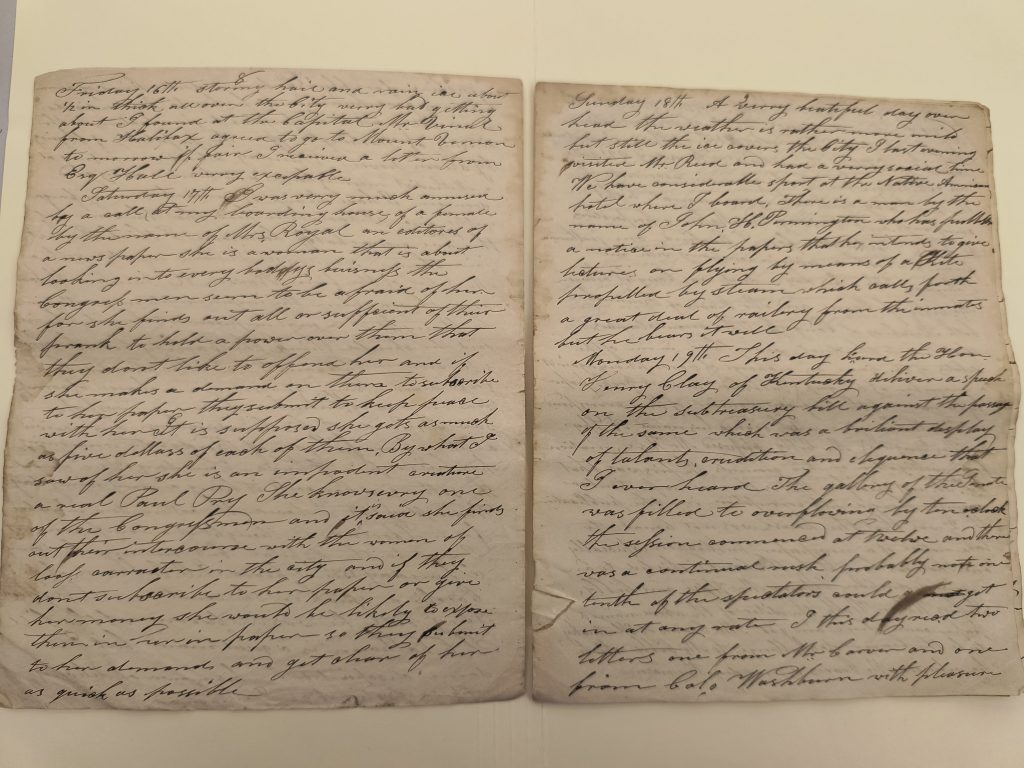
Pages from the diary of Samuel Leonard, 1838
The diary is wild because of all the historical “timelines” Leonard crossed in just a four-month period. He was like a 19th-century Forrest Gump. It was fun to research and catalog because I never knew what was coming next.
The diary is 48 pages long, and the first four pages are missing, but we join Leonard on 3 February 1838 in Washington, D.C. From there, he traveled to multiple Southern states, including South Carolina, Georgia, Florida, Louisiana, Mississippi, and Tennessee. Here’s the highlight reel:
In D.C., he met John Pennington, who had “a moddle and drawing of a machine for flying he is a droll kind of a man but verry good humoured he has to Bear ridicule from all quarters he proposes to give lectures to the citizens of Washington on the possibility of flying by steam power.”
He also met Anne Newport Royall, “an editores[s] of a news paper she is a woman that is about looking into every boddys business the Congress men seem to be afraid of her for she finds out all or sufficient of their prank to hold a power over them.”
On 24 February, Congressman Jonathan Cilley of Maine was killed in a duel with Congressman William Graves of Kentucky at the Bladensburg Dueling Grounds in Maryland. Leonard wrote, “I saw the carriage that brought in the corps[e], but I had no inclination to see the body.”
At a hotel in Charleston one night, Leonard “was awoke by the cry of Murder in the yard.” The cause of the commotion was none other than Junius Brutus Booth, the father of John Wilkes Booth. “Being crazy by liquor,” he had attacked fellow tragedian Tom Flynn with an andiron. Leonard editorialized, “This is what I call a real tradgady.”
In Florida, he traveled through the thick of the Second Seminole War, writing about a recent alleged attack on white settlers “six or seven miles from this place.” From old newspapers, I learned he was probably referring to the Purify family near Tallahassee.
He witnessed a fire that destroyed a whole city block in downtown Mobile, Alabama.
His steamboat nearly capsized into the Mississippi River during “a verry severe tempest […] it was so dark I could not see my hand before me.”
Not long after, he was on the steamboat Tuscumbia when a fireman fell into the Cumberland River and drowned.
Lastly, he visited “the old General,” a.k.a. Andrew Jackson, at the Hermitage in Tennessee. Leonard found the former president “verry free and sociable but his health was not good.” It should be noted that this time, the Cherokee people were being forcibly removed from their ancestral lands as a result of the Indian Removal Act signed by Jackson eight years earlier.
Leonard encountered enslaved Black people nearly everywhere he went and witnessed auctions of trafficked Africans. In one instance, he carefully noted the price paid for each person. About one “heartrending” auction, he wrote, “it is hard business to separate husband and wives parents and children, brothers, and sisters.” Given that Leonard made his living selling a machine that helped to perpetuate and expand slavery, there’s no indication that he ever reckoned with his own complicity.
Samuel Leonard’s diary is fascinating for so many reasons. To dive even further into his life, the MHS holds another collection of his papers.
by Hannah Elder, Associate Reference Librarian for Rights & Reproductions
Welcome back to the transcription of Clara E. Currier’s 1925 diary. Currier was a working-class woman who lived in or near Haverhill, MA. Her diary records her daily activities—from fiber arts to paid employment to observations of the natural world—providing insight into daily life a century ago. You can find entries for January, February, March, April, and May in past blog posts.
June is a less eventful month than April and May, which I’m sure is a relief for Clara. She endures hot and changeable weather, recording multiple thunderstorms throughout the month. She also plays donkey (a four-player card game), goes on her usual calls, and works. She also reports on the health of those in her community and works on new hats for herself and for friends.
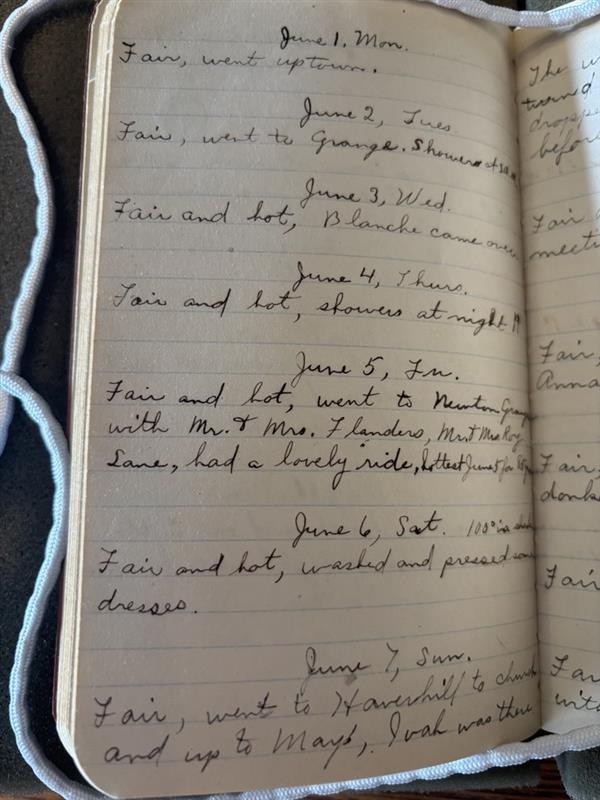
June 1, Mon. Fair, went uptown.
June 2, Tues. Fair, went to Grange. Showers at 3 a.m.
June 3, Wed. Fair and hot, Blanche came over.
June 4, Thurs. Fair and hot, showers at night. [$]19
June 5, Fri. Fair and hot, went to Newton Grange with Mr. + Mrs. Flanders, Mr. + Mrs. Roy Lane, had a lovely ride, hottest June 5 for 85 years.
Jue 6., Sat. 100° in shade Fair and hot, washed and pressed some dresses.
June 7, Sun. Fair, went to Haverhill to church and to Mary’s, Ivah was there. The wind came out east and it turned cold and the temperature dropped nearly 50° from the day before.
Clara’s diary entries for June 1-7, 1925
June 8, Mon Fair and cooler, went to class meeting, Blanche called.
June 9, Tues. Fair, went over to Blanche’s, finished Annah’s hat.
June 10, Wed. Fair, thunder shower, played donkey downstairs.
June 11, Thurs [$]19 Fair, sewed.
June 12, Fri. Fair, went to W. Newbury grange with the Flander’s, had a fine time.
June 13, Sat. Fair, no work, washed and cleaned my bedroom, went up home.
June 14, Sun. Fair with a little shower, Sizzie and I came back. Bernice March had a boy baby yesterday morning.
June 15, Mon. Fair with a shower at night.
June 16, Tues. Showers in A.M then cleared, went to Grange. Rode home with Earl Currier.
June 17, Wed. Fair with shower at night, sewed.
June 18, Thurs. [$]17.10 Fair, Showers in morning went down to see Cody, saw Uncle Will’s house and Gertie and they brought me home.
June 19, Fri. Fair, sewed.
June 20, Sat. Fair with thunder shower at night. No work, washed and cooked, went to Haverhill and got a new coat $19.50. Sewed.
June 21, Sun. Fair with a little shower at night, went to church and S.S, called on Mrs. F. Jewell and Gertie.
June 22, Mon. Fair, sewed.
June 23, Tues. Fair, went downstairs to play donkey.
June 24, Wed. Fair, trimmed my outing hat.
June 25, Thurs. [$]17.10 Rain, Sizzie and I went up to Etta’s to supper. Mr. Jackson see us home.
June 26, Fri. Fair, went up town.
June 27, Sat. Fair, worked all the forenoon, went up town in evening.
June 28, Sun. Fain, wrote letters and called on Aunt Abbie.
June 29, Mon. Shower early, then cleared and shower at night.
June 30, Tues. Rained early, cleared, went up town and Mary and Charles and Mabel. Sent a card to Bernice Marsh who is very sick.
If you are interested in viewing the diary in person in our library or have other questions about the collection, please visit the library or contact a member of the library staff.
*Please note that this diary transcription is a rough-and-ready version, not an authoritative transcript. Researchers wishing to use the diary in the course of their own work should verify the version found here with the manuscript original.
This line-a-day blog series is inspired by and in honor of MHS reference librarian Anna J. Clutterbuck-Cook (1981–2023), whose entertaining and enlightening line-a-day blog series ran from 2015 to 2019. Her generous, humane, and creative approach to both history and librarianship continues to influence the work of the MHS library.
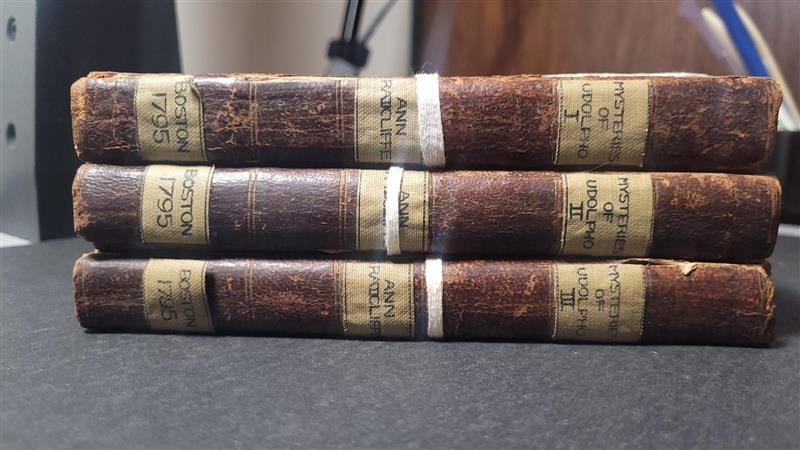
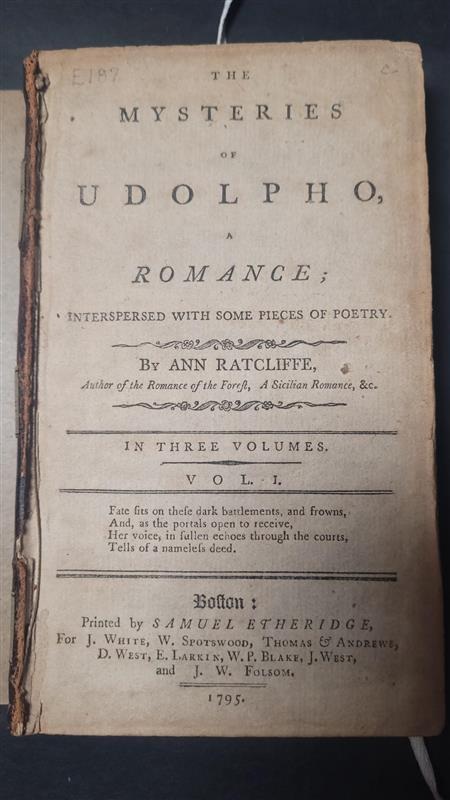
I was first introduced to author Ann Radcliffe through rare book collector Rebecca Romney’s book Jane Austen’s Bookshelf. Ann Radcliffe (1764-1823) pioneered the genre of Gothic Romance and her books awed and influenced both Rebecca Romney and Jane Austen. In the Massachusetts Historical Society’s catalog, ABIGAIL, I discovered that the MHS owns a 1795 Massachusetts printing of The Mysteries of Udolpho, Radcliffe’s most famous novel, which was originally published in England in 1794. I decided to read the three-volume set and experience the book just as someone would have in the 1790s when the book was originally published.
The three volumes of The Mysteries of Udolpho
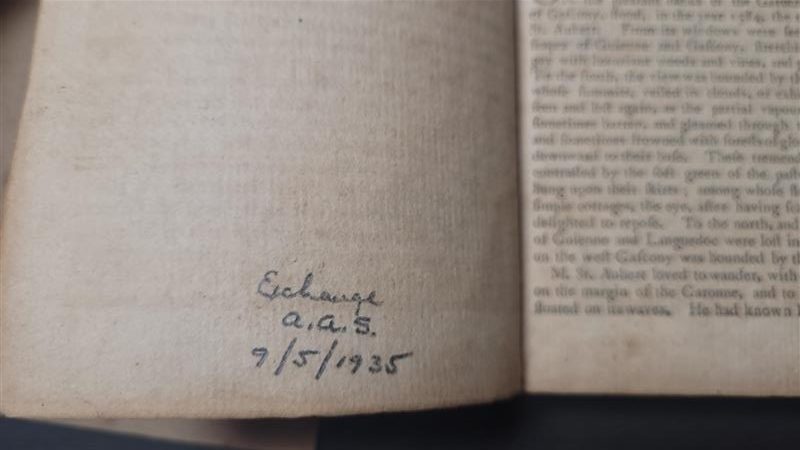
The MHS copy of The Mysteries of Udolpho was printed by Samuel Etheridge in Boston. A large number of contributors helped publish this book in a process known as combination. Combination publishing was very common at this time, as it allowed for groups of publishers to publish multi-volume, highly sought books together. This ensured that they all paid the same for the novel and protected against the potential loss of funding when printing a large number of books. The publishers for this copy are J. White, W. Spotswood, Thomas & Andrews, D. West, E. Larkin, W. P. Blake, J. West, and J. W. Folsom. In the very back of the first volume the name Johnson is inscribed, who may have been the original owner of this book. The MHS came into possession of the book in 1935 by an exchange with the American Antiquarian Society. The MHS also has a copy on microfilm and when I first came upon the book, it was unclear if it was the same printing. After a look at both, I determined that they were published in different years and places, with the physical book being an earlier edition by about 10 years.
Note from the exchange with the American Antiquarian Society
The Mysteries of Udolpho is a three-volume book, detailing the adventures of a girl named Emily whose evil uncle whisks her away to Castle Udolpho deep in the mountains. I won’t spoil the suspense of the book for anyone else who wishes to explore it, but every day I’ve read some of the novel it has stayed with me after I left the MHS. I’ve enjoyed imagining what it would have been like to read the novel when it originally was published, as well as discovering how this book became part of the MHS’s collection. I would greatly recommend The Mysteries of Udolpho to anyone, and if you find yourself wanting to do as I did, come visit the MHS library to read this early printing of the famous novel.
Title page of volume one
This find would not have been possible without Reference Librarian Hannah Elder, who recommended Rebecca Romney’s book Jane Austen’s Bookshelf to me and then aided me in my research to learn more.
I’m happy to announce that the records of the First Baptist Church of Boston are open for research at the MHS. This fascinating collection consists of about 47 linear feet (over 15 shelves) of records dating all the way back to the founding of the church in 1665!
The First Baptist Church of Boston is one of the oldest Baptist churches in the country. Back in 17th-century Puritan Massachusetts, forming a new church “without the approbation of the Magistrates & the said churches” of the colony was illegal. So was Baptist doctrine specifically: anyone known to “openly Condemn or oppose the Baptizing of Infants” could be banished. In establishing their church, the founders of First Baptist were breaking the law, and early congregants were fined, imprisoned, threatened with exile, and otherwise persecuted.
The church started in Charlestown; moved to the North End, downtown Boston, and the South End; and since 1882 has been located in the Back Bay at the corner of Commonwealth Avenue and Clarendon Street, about a 20-minute walk from the MHS.
First Baptist Church of Boston, 1915, from the frontispiece of its 250th anniversary booklet (Vol. 151)
Between 1941 and 2019, the First Baptist records were held on deposit at Andover Newton Theological School. (Records on deposit are stored and cared for by an archival repository, but the donor retains ownership.) In 2019, the church deposited the collection at the MHS, but processing was held up by the COVID-19 pandemic and subsequent backlog.
In one sense, this collection was different than most collections I process because it was already arranged and described. I made some changes and encoded the collection guide for the MHS website, but could mostly work with what I had. The records include minute books, account books, reports, receipts, committee records, pew deeds, pew accounts, correspondence, congregational records, records of the Sunday School and other church groups, marriage record books, and printed material.
To introduce you to the collection, I’d like to showcase the oldest record book in the collection, a vellum-bound volume of meeting minutes dating back to the first meeting of the church on 28 March 1665.
First page of First Baptist Church of Boston minute book (Vol. 1), 28 March 1665
Although the volume has obviously seen better days, it’s striking to think about what exactly is documented here, the importance of this moment in the religious history of Massachusetts. The people listed on this page, “Gathered togather And Entered into fellowship & Communion each with other, Ingaigeing to walke togather in all the appointments of there Lord & Master,” were taking a real risk to practice their faith.
Another page in the same volume, dated 2 June 1776, refers to the “dispersed Condition” of the congregation and the “melancholy Situation […] occasioned by the Commencement of Hostilities by the British Troops, on the ever memorable 19. of April 1775.”
Detail of First Baptist Church of Boston minute book (Vol. 1), 2 June 1776
Unfortunately, many of the over 300 volumes in the First Baptist collection are fragile and/or covered in “red rot”—a sticky, rust-colored residue that comes from decaying leather bindings—so they must be handled with care. Conservation will be ongoing, but we wanted to make this collection available to the public in the meantime. Our expert librarians can assist any interested researchers in the MHS Reading Room.
Alaina Scapicchio, Ph.D. Candidate, University of South Florida
In 1992, a significant anniversary loomed large over the city of Salem, Massachusetts. Three hundred years prior, the infamous months-long witch trials had turned the lives of residents in Salem Village, Salem Town, and the surrounding areas upside down. The commemoration of those events in the late 20th century, for some Salemites, seemed no different.
While on fellowship at the Massachusetts Historical Society, I came across a tantalizing folder tucked in a massive collection of records from the Massachusetts chapter of the American Civil Liberties Union (ACLU). This folder was simply titled “Salem Witches, 1992.” As a Ph.D. candidate working on a dissertation that examines commemoration and memory of witch trials in the US, I could imagine what the file might contain but thought it best to dampen my excitement until it was in my hands.
If you’ve worked in a reading room before, you’ll know that there is a certain level of decorum expected from researchers. So, I’m sure you can imagine the difficulty of stifling a shout of joy and the urge to jump up-and-down at my table upon opening the folder. Those emotions were brought on by the letterhead and the signature on the first page inside.
Letterhead for the Witches League for Public Awareness and signature of famous Salem witch Laurie Cabot.
Laurie Cabot is a significant figure in Salem history for several reasons, primarily because she was a harbinger of a shift in the city’s population and economic landscape. Cabot moved to Salem in the late 1960s as a practicing Witch and in 1970 opened up The Witch Shoppe, the first occult store in the city. As a spiritual leader, Cabot attracted many Witches, Wiccans, and New Age religious practitioners to the area over the next few decades. Amidst the backdrop of a collapsing industrial economy, many of these new residents followed in Cabot’s footsteps and opened up metaphysical shops in Salem’s historic downtown–a tourist boon. Governor Michael Dukakis even named Cabot the city’s “Official Witch.”
While I was familiar with Cabot’s influence on the city, this was my first time encountering the organization Witches’ League for Public Awareness. Luckily, a brochure in the back of the folder provided their vision statement.
Vision statement from Witches’ League for Public Awareness brochure.
It quickly became clear from the contents of this folder that the Witches’ League was needed more than ever in 1992. Apparently, as the tercentenary anniversary of the witch trials descended upon the city, so too did numerous groups of Christian Fundamentalists to protest any recognition or celebration of Witchcraft. This ACLU file contains a letter from a concerned Salem resident who was surrounded by one of these groups while on a walk with her children and asked about her religious beliefs. In another letter from Cabot to the Civil Rights Division of the Attorney General’s office, she claimed that one specific Methodist organization had “targeted local businesses for coercive treatment aimed at their immediate closure, or to cause the removal of certain items from their business fare.” Letters from the aforementioned office and from the Mayor of Salem confirm Cabot’s claims to be true, as they informed her that they would be prepared to take “immediate action” against the perpetrators should they return.
However, it was not simply these rogue religious agents that the Witches’ League had a problem with. In fact, they often took greater issue with a more legitimate body. The Salem Witch Trials Tercentenary Committee was created by the city’s municipal government to develop educational and commemorative events for 1992 in remembrance of the 300th anniversary of the trials. They estimated that this milestone anniversary could attract nearly one million visitors to the ‘Witch City’ and the committee sought to provide tourists with opportunities to spend their money there all year long. All of these events were to culminate in the dedication of a memorial to the twenty victims killed during the panic.
Prior to discovering this folder, I had seen references in newspaper articles about local Witches in Salem who were unhappy with some of the language included in the Salem Witch Trials Memorial and who felt the city was purposefully leaving them out of events during the tercentennial year. These sentiments are made crystal clear by Cabot in a few of the letters she copied the ACLU in on. She even blamed the city outright for some of the incidents mentioned above, arguing “Because of the misuse of the term “Witch” and “Witchcraft” by this City, it’s [sic] agencies, and these out-of-state organizations, a substantial number of Salem’s citizenry, businesses, and tourists are being placed at risk.” Cabot had chastised the city just two months prior for their linking of Puritanical understandings of witchcraft with the Devil. She was not the only one either. In a printed copy of the “North Shore Sunday Feedback” included in the folder, another Salem Witch accused the committee of adopting “the Puritans’ superstitious and half-demented definition of Witchdom as its own…”
In 1992, Salem’s modern-day Witches were not going to let the delirium that had overtaken hundreds in 1692 repeat itself. They organized and wrote to their local government officials and the ACLU to ensure that their religious rights were protected. Since Witchcraft had been recognized by the federal government as a valid religion, officials had to respond to their statements of distress. The Salem Tercentenary Committee, however, did not. The Witches’ League may have been able to protect their practitioners, but they could not salvage their image in the eyes of many Salemites— a struggle that continues today.
Materials Referenced:
Emerson Baker, “Witch City?” in A Storm of Witchcraft: The Salem Trials and the American Experience (New York: Oxford University Press, 2015), 256-286.
Alaina Scapicchio, ““Memories Rescued from the Mire of Oblivion”: The 1885 Rebecca Nurse Monument and Salem Witch Trials Commemoration,” USF Tampa Graduate Theses and Dissertations, 2022. https://digitalcommons.usf.edu/etd/10354
Mary B. W. Tabor, “‘The Witch City’ Dusts Off Its Past,” New York Times, Sept. 9, 1991.
Christopher White, “Salem as Religious Proving Ground,” in Salem: Place, Myth, and Memory, eds. Dane Anthony Morrison and Nancy Lusignan Schultz (Boston: Northeastern University Press, 2004), 43-61.
The life experiences of Hilda Chase Foster (1891-1974) ran the gamut—from the social minefield that was Boston high society to service as a Red Cross Nurse in the European theater during both World Wars. The Hilda Chase Foster Papers, held as a collection by the Massachusetts Historical Society, are comprised primarily of Hilda’s extensive correspondence with various family members. They are supplemented by photographs and film records of her family’s homes and her own global travel during the 1920s–1950s and ephemera related to her personal experience of the defining geopolitical events of the first half of the twentieth century.
It is a remarkable collection, both in terms of its content and, in a more metatextual sense, its insight into the role of the MHS as a repository of historical records.
The wealth of the collection’s contents is relatively self-evident. The photographs and ephemera range from Hilda Chase Foster’s formal portrait in Court Dress (worn for her presentation to George V and Queen Mary at Buckingham Palace) to her Massachusetts-issued ration card from World War II. The breadth of the material, chronologically and geographically, creates an extraordinarily comprehensive portrait of the privileged lifestyle enjoyed by a particular portion of Boston society.
Hilda’s presentation at Buckingham Palace May 11, 1932
What excited my particular interest, though, is this collection’s demonstration of the intersection between that very rarified societal existence and the great socio-political upheavals of the era. In an account of her experiences in “the Great War,” Hilda writes:
“So many girls were going overseas and were not sticking to their jobs or were hunting up their husbands that the Red Cross wanted me to go before a Notary Public to promise three things: that I was not married (I couldn’t go if I was married); that if I married over there I would come straight home; that if I had a brother over there in the service I would not hunt him up. (At first no girls could go over that had brothers in Europe, but they had to rescind that because practically everybody had a brother in the service.)”
Foster’s description of evolving bureaucratic regulations might have been written by any of the thousands of young women who served as Red Cross nurses during the War. Less universal, perhaps, is her recollection of how she and her family navigated them:
“Father always made a fuss. . . .Finally Father said, ‘You’ve got to go see Dr. Edsell. I don’t think you’re strong enough. You’re too thin!’ Dr. Edsel was the top man at Massachusetts General, and Father was a trustee.”
Hilda’s tone is casual and familiar, but to pass off her writings as insignificant would be a disservice to the material. In just a few sentences of personal reminiscence, Hilda provides us with information that may be conceived of as equally fascinating to those with an interest in social, medical, or military history, to say nothing of chroniclers of local Bostonian institutional history. This collection serves as a reminder that insightful sources are to be found in what may usually be relegated to the margins of the historical record, and that to adhere too firmly to a rigid division between historical subfields is to miss out on a wealth of material.
Hilda and her brother, Reginald, in Paris in 1918/1919
Hilda in a gas mask as an ambulance nurse in Cambridge, UK in 1941
Acknowledgements:
The materials that comprise the Hilda Chase Foster Papers were given to the Massachusetts Historical Society by Anne Farlow Morris (grandniece of Hilda Chase Foster) in 2001, with an addition given in 2014. Anne Farlow Morris compiled the materials during her research in the late 1970s for a book entitled The Memoirs of Hilda Chase Foster. The memoir was privately printed by the MHS in 1982, and a copy is held in the MHS print collection.
In the early 20th century, Aroline C. Gove traveled to the French city of Carcassonne. While exploring the medieval city, she was amazed by a stunning castle, complete with towers, a moat, and a drawbridge. Surrounded by beautiful arches, soaring vaults, and gorgeous stained glass, perhaps she thought, “I wish I had this back home.” But while others simply dreamed of living in their own fortress, Aroline decided she would make it a reality: she would build a castle of her own.
Gove was president and general manager of the Lydia E. Pinkham Medicine Company, founded by her mother, who was a businesswoman and inventor. She was also a successful real estate investor with an excellent oceanside property in Marblehead, Massachusetts. She decided that she would build her castle here, overlooking the Atlantic Ocean.
Carcassonne viewed from the shore during construction, 1935
Gove hired the architectural firm Smith & Walker to design the building. The group had worked on various projects around New England, including churches, post offices, and dozens of private residences. They had already worked closely with Gove on several real estate projects. Smith & Walker’s design was heavily inspired by the French castle Gove had explored during her travels. In its center was a three-story round tower with a cone-shaped roof. Four wings extended from this center tower. This layout was described as “cruciform,” because it formed the shape of a cross. From the sea, the home’s stone walls and dark roof contrasted against the crashing waves. From land, stone gateways led to the fairy-tale tower in the center of the structure.
To build the castle, Smith & Walker hired over 35 different building contractors. These contractors brought and installed materials like cut stone, white marble, and “exotic wood.” They even installed a state-of-the-art sound system: “The house is equipped throughout with victrola and radio with a large control loudspeaker concealed in the apex of the tower.” Supposedly, President Franklin D. Roosevelt personally wrote Gove a letter thanking her for hiring so many workers during the Great Depression. All told, Aroline C. Gove’s castle cost her about $500,000.
Entrance to Carcassonne during construction, 1935
Many of Smith & Walker’s records are available at the MHS. Exploring the Philip Horton Smith Architectural Papers offers a unique opportunity to see behind the scenes of the construction process. Architects and contractors can use detailed correspondence, ledgers, and receipts to see how the various pieces literally came together. Local historians can see how Marblehead Neck changed over time. If you’re like me, and you just like looking at interesting buildings, you can look through the scrapbooks kept by Philip Horton Smith, including progress photos and a stunning watercolor Christmas card of Carcassonne.
Carcassonne Christmas card, 1935-1939
Sadly, Gove passed away in 1939, only four years after her beautiful home was built. The building has since passed hands a number of times, but continues to stand as a beautiful work of art. Want to build a castle of your own? Dig into the Philip Horton Smith Architectural Papers and see how they did it 90 years ago.
by Hannah Elder, Associate Reference Librarian for Rights & Reproductions
Welcome back to the transcription of Clara E. Currier’s 1925 diary. Currier was a working-class woman who lived in or near Haverhill, MA. Her diary records her daily activities – from fiber arts to paid employment to observations of the natural world – providing insight into daily life a century ago. You can find entries for January, February, March, and April in past blog posts.
When we last heard from Clara, she was recovering from a bout of measles. In May, we continue to follow her path to recovery, as she ventures further out of the house, returns to work, and has a follow-up with her doctor. She also returns to work, resumes her sewing and crocheting, and socializes with family and friends. In the second half of the month, she begins to record a time, almost always 6 p.m., on the first line of her daily entry. I haven’t found explanation of it and it does not continue into May. Perhaps that is the time she wrote the entries, or the time she took the tonic from the doctor. If I ever find out, I will be sure to let the blog know.
May 1, Fri. Fair, Blanche called, Mary and Charles came down and done some things for me, went out of doors for a few min. Mr. + Mrs. SeeGro called with fruit from the Grange.
May 2, Sat. Fair, went out to Vigeant’s store Wrote my pledge card .50[¢] for current expenses and .35[¢] for benevolences. Sizzie went home.
May 3, Sun. Fair, Thomas came down and took me home.
May 4, Mon. Showers (thunder).
May 5, Tues. Dull, went out a little ways with Charles for a ride.
May 6, Wed. Fair, went out for a walk.
May 7, Thurs. Fair, went out to walk. sewed on dress,
May 8, Fri. Fair, went out for a walk, crocheted and worked on my dress.
May 9, Sat. Fair, went for a walk and a ride with Charles, sewed and crocheted, legs still weak.
May 10, Sun. Fair, Gertie came up with our dowry, rode back with them and called on Uncle Will, has been sick but better.
May 11, Mon. Rainy, started in to work after being out 3 ½ weeks, pretty tired.
May 12, Tues. Fair.
May 13, Wed. Fair, walked over to Blache’s.
May 14, Thurs. Dull and chilly, went over to the Dr’s and he gave me a tonic, paid $14.
May 15, Fri. Rainy, read.
May 16, Sat. Fair, Sizzie and I went to Haverhill with our checks, called on Aunt Frannie, did some mending.
May 17, Sun. Fair, went to church and S.S. went over to Blanche’s.
May 18, Mon. Fair.
May 19, Tues. Fair, went to Grange. 6 P.M.
May 20, Wed. 6 P.M. Fair, did some mending.
May 21, Thurs [$]18.62 Fair, Blanche and I went to ‘The Butlers’ at the church.
May 22, Fri. 6 P.M. Fair, went up town.
May 23, Sat. Dull, went up home, made Mary’s hat. Found a $.
May 24, Sun. Fair with some rain at night, William brought me back.
May 25, Mon. 6 P.M. Rainy and cleared at night, went to Corner Class.
May 26, Tues. 6 P.M. Fair, went up to Stephen’s after work.
May 27, Wed. 6 P.M. Fair, Blanche came over to cut out dress.
May 28, Thurs. [$]20.14 6 P.M. Fair, went up town at noon called on Mrs. Dennis for a few minutes.
May 29, Fri. 6 P.M. Fair, went out to store.
May 30, Sat. Dull with thunder showers P.M, went out to see parade and then went up home. Worked on Annah’s hat.
May 31, Sun. Fair, went to church and out in the woods, William brought me home.
Diary entries for 20 to 31 May
If you are interested in viewing the diary in person in our library or have other questions about the collection, please visit the library or contact a member of the library staff.
*Please note that this diary transcription is a rough-and-ready version, not an authoritative transcript. Researchers wishing to use the diary in the course of their own work should verify the version found here with the manuscript original.
This line-a-day blog series is inspired by and in honor of MHS reference librarian Anna J. Clutterbuck-Cook (1981–2023), whose entertaining and enlightening line-a-day blog series ran from 2015 to 2019. Her generous, humane, and creative approach to both history and librarianship continues to influence the work of the MHS library.
by Hannah Elder, Associate Reference Librarian for Rights & Reproductions
Today, we return to the transcription of Clara E. Currier’s 1925 diary. Currier was a working-class woman who lived in or near Haverhill, MA. Her diary records her daily activities – from fiber arts to paid employment to observations of the natural world – providing insight into daily life a century ago. You can find entries for January, February, and March in past blog posts.
April has a lovely start for Clara, making a hat, calling on friends and family, and celebrating Easter. In the middle of the month, though, she comes down with measles. For nearly a week, she has daily visits from her doctor, is attended to by Mary, and is bed-bound. Even after her high fever breaks and she starts to receive visits from friends, Clara is weak and has to start easing back into daily life, including sitting up, dressing, and leaving her bed. We will continue to follow her path to recovery in May.
Apr. 1, Wed. Fair, out for the day, went to Newburyport A.M, started to make a hat and went to Haverhill to Rebekah (Kenoya) and saw lovely work, Mae Jenney went with me.
Apr. 2, Thurs. [$]19. Fair, mended.
Apr. 3, Fri. Fair, went up to town.
Apr. 4, Sat. April showers, cooked and sewed, went up town and called on Mrs. Dennis.
Apr. 5, Sun Fair, went to church, Sizzie came over to dinner and we called on Mr. + Mrs. Charles Gould, looked at Uncle Will’s cellar, over to Union Cemetery and called at Delia’s.
Apr. 6, Mon. Fair, sewed.
Apr. 7, Tues. Fair, Mary came down, sewed, went to Grange, degrees.
Apr. 8, Wed. Fair, Mary sewed and went home at night, went up to Stephen’s with her.
Apr. 9, Thurs. [$]15.58 Fair, went up town, finished my hat, Blanche called.
Apr. 10, Fri. Rained in evening.
Apr. 11, Sat. Fair, went down to Grace Nealand’s for afternoon and evening.
Apr. 12, Sun. (Easter) Fair and cool, cloudy at night, went to church, S.S, and vesper service at Market St., and then went to Haverhill to a pageant. Wore my new hat.
Apr. 13, Mon. Snowed during night and in morning cleared away, and soon melted. Went to class meeting and helped serve refreshments.
Apr. 14, Tues. Fair, feeling mean, Blanche came over for the evening.
Apr. 15, Wed. Rainy, then cleared, worked in morning, had Dr. Murphy and went to bed with measles, thunder shower, Mary came down. Blanche came to the door.
Apr. 16, Thurss. [$]19. Fair, having a hot time in bed, no cold things. Dr. came
Apr. 17, Fri. Fair, Still hot and sweating. Dr. came.
Apr. 18, Sat. Fair and warmer, all broken out but still very hot so had Dr. and my temperature was 102°. Etta was over and brought grape juice.
April 19, Sun. Started to snow around 10 o’clock and had a regular N.E. snowstorm. Some better but Dr. found my temperature 100 ¾°. Mrs. Dennis came over.
Apr. 20, Mon. Ground all white with snow, cold and windy. Dr. came and found temperature normal, measles starting to go, have had them very hard.
Tues. Apr. 21 Fair and 20° above, Frank called, corner class sent a basket of fruit and candy.
Diary entries for 18 to 21 April, chronicling Clara’s measles
Apr. 22, Wed. Fair and warm, Etta came over, brought ice cream, Delia (ice cream) called in the evening. Blache came to the door, Sizzie came nearly every day.
Thurs. Apr. 23 [$]9.12 Fair and windy, warm, Mary went to the Mason’s Minstrel Show.
Apr. 24, Fri Cloudy, William was down with hay and called, Rebekahs sent bouquet of cut flowers, set up.
Apr. 25, Sat. Fair and warm, Thunder shower at night and rained hard, Mary went up town, Grange dedicated the flag pole at Victoria Park. Set up awhile.
Apr. 26, Sun. Fair, William and mother came down and Mary went home with them, Was dressed for first time. Sizzie came to stay nights with me.
Apr. 27, Mon. Fair, sat up but weak. Blanche came over.
Apr. 28, Tues. Fair, got dinner and read a little.
Apr. 29, Wed. Dull and cold, Feel rather weak and shaky. Mr. Jackson called.
Apr. 30, Thurs. Rainy, Sizzie went to Grange play.
If you are interested in viewing the diary in person in our library or have other questions about the collection, please visit the library or contact a member of the library staff.
*Please note that this diary transcription is a rough-and-ready version, not an authoritative transcript. Researchers wishing to use the diary in the course of their own work should verify the version found here with the manuscript original.
This line-a-day blog series is inspired by and in honor of MHS reference librarian Anna J. Clutterbuck-Cook (1981–2023), whose entertaining and enlightening line-a-day blog series ran from 2015 to 2019. Her generous, humane, and creative approach to both history and librarianship continues to influence the work of the MHS library.