by Lila Teeters, University of New Hampshire, and Andrew W. Mellon Fellow at the MHS
I came to the Massachusetts Historical Society to conduct legal history. I spend most of my time researching Native American citizenship in the United States, with a particular focus on the lead up to the 1924 Indian Citizenship Act. The cartons awaiting my gaze at MHS belonged to Robert G. Valentine, who served as the commissioner of Indian affairs from 1909 to 1912. This period was critical in the development of policies guiding Native citizenship in the United States, and Valentine’s papers provide an unparalleled look into the ideological underpinnings of federal policies. While I came for legal history, I left with an additional lesson on pedagogy.
People often ask me if I am a teacher or historian first. My master’s degree is in teaching social studies, and I taught high school history for four years before starting my PhD. My answer to their question is usually wonky, as I try explaining that each of those roles encompasses the other. A teacher and historian are one, I say, earning accusations of being sophist. Perhaps it is no coincidence then that some of my favorite archival moments occur when I see my historical actors teaching others about their chosen craft. These sources are usually irrelevant to my primary research, and I tuck them away to be considered later.
As a PhD candidate trying to finish my dissertation, I am particularly drawn to my actors’ advice on writing. The process feels (to use a popular millennial phrase) very “meta,” particularly when the people I write about give advice about the act itself. Composing a person’s history comes with a certain amount of responsibility (a well-worn claim that once again earns me accusations of sophistry), and weighing subjects’ advice feels like a way to honor that responsibility.
Hence my excitement when I came across writing exercises tucked within Valentine’s notes. Valentine taught English and composition classes at the Massachusetts Institute of Technology from 1896-1902, and his papers contain lecture notes, assignments, and musings on prose and pedagogy. One of the exercises he recommends is about depth: “In order for you to determine the qualities of mind,-wealth, discipline, and understanding, which you possess, it is useful to write a very short sketch of
Someone you know,
like
dislike
are indifferent to
a view,
familiar
unfamiliar
a thought
a feeling
a machine
a process
a story
an argument
history”
He recommended that each sketch be around 200 words.[1] Valentine wanted his students to determine if they had the deep knowledge of a subject to condense its essence down to a 200-word meditation—a written crucible of sorts. Compress to assess.
Valentine is an actor whom I find maddening. While I “know” him only through his writings and his policies as Indian commissioner, I at once like, dislike, and am indifferent to him. My “very short sketch” of him encompasses all three:
Born in 1872, Roger G. Valentine was a civic-minded man directed by principle and prejudice. A son of Massachusetts, a father and husband, Valentine assumed the role of commissioner of Indian Affairs in 1909. While he forswore essentialist racial classification of Native Americans, Valentine held other racist views, claiming that Natives needed to be taught self-respect, self-support, and good citizenship. Many of the policies he promoted operated from these paternalist assumptions. Valentine prized civic engagement and held citizenship and patriotism in the highest regard. As commissioner, he attempted to root out corruption, separate church from state, and solicit feedback from Native people. Yet he assumed one of his most prized possessions—US citizenship—would likewise be prized by all Natives. His administration created “competency commissions,” which assessed the “fitness” of individual Natives to be citizens of the United States. While he acknowledged the harm done by American policies, soldiers, and citizens, he almost never questioned why some Natives did not want to become citizens. A controversy, one that threw Valentine’s integrity into question (he and I believe rather unfairly), prompting his resignation in 1912. A long list of joined organizations and committees show his appetite for civic engagement went unabated until he died in 1916 at the young age of 43.
It is comforting to know that Valentine found writing difficult. His papers are speckled with frustrated marginalia and rabid reworkings. He would most likely quibble with my sentence structure just as I grumble at his passive voice. I like the image: historian and subject, united briefly through our common craft.
[1] “Notes from RGV’s composition class, 1902-1903,” carton 17, folder 21, Robert G. Valentine family papers, Massachusetts Historical Society.
by Ashley Williams, Processing Assistant and Library Assistant
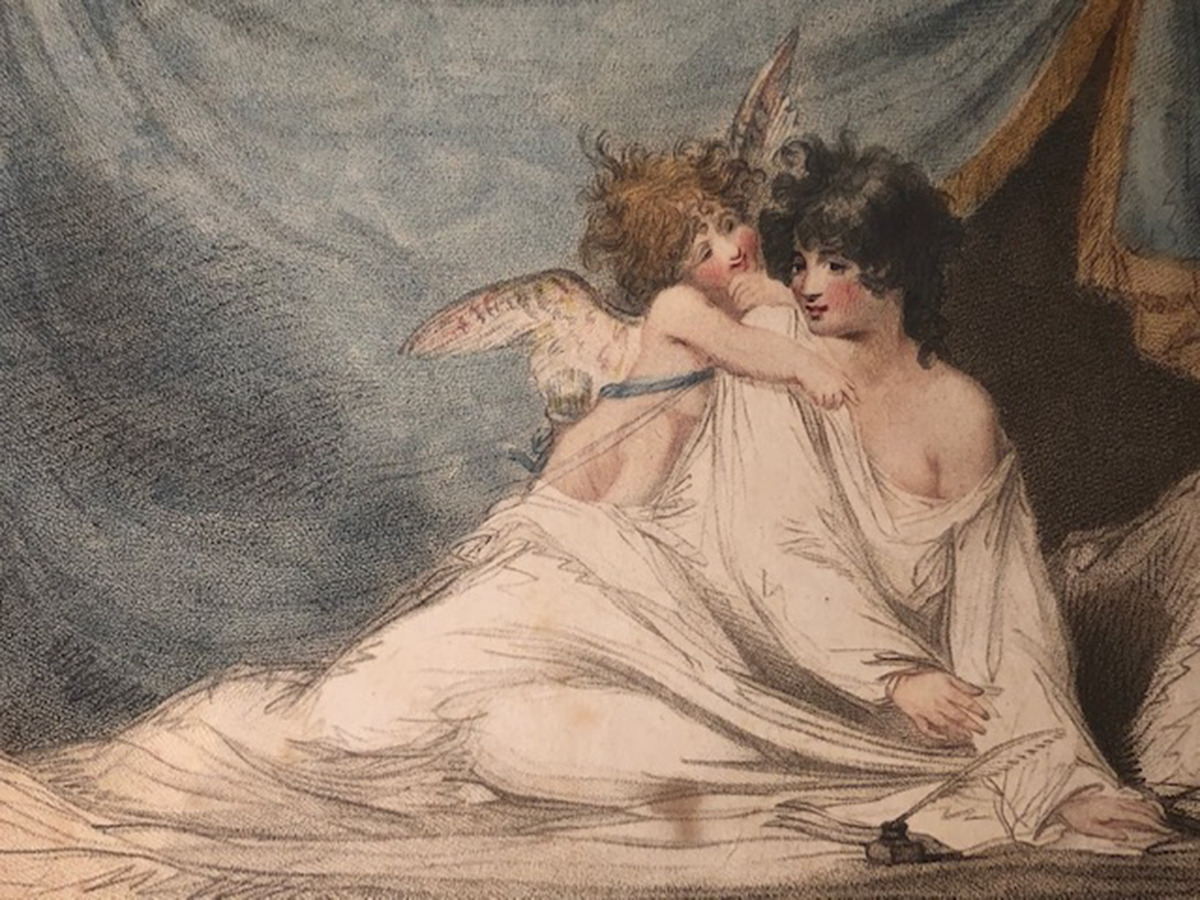
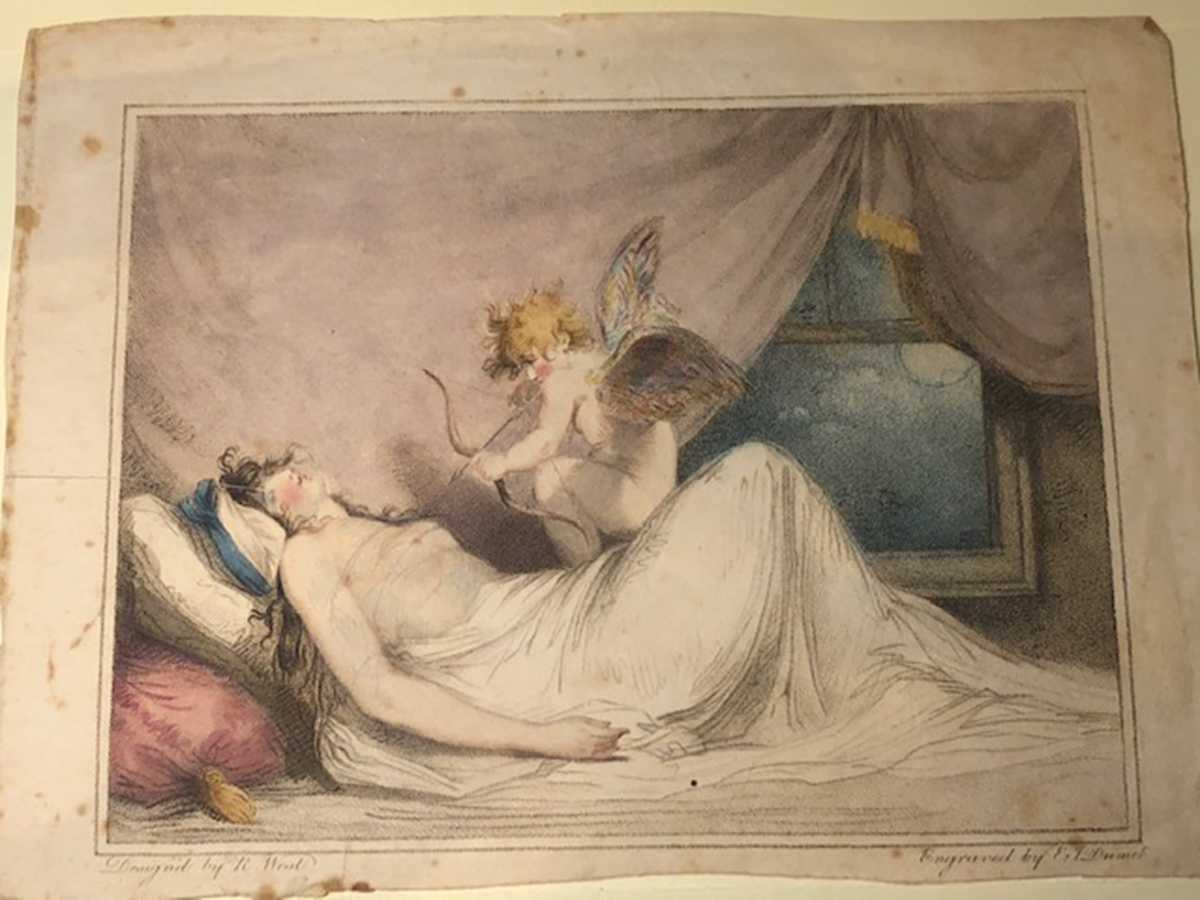
[The Love Letter] by E.J. Dumee. An infant cupid leaning laughingly over the shoulder of a youth reclining in a loose gown on a bed to right, pointing at the letter on which he rests one hand while reaching to take up the quill; after R West. 1822.Happy Valentine’s Day Beehive readers! I hope you’re all in the mood for some flirtatious frivolity. To celebrate this season of candy and cupids, I’ve curated a small selection of amorous displays from the MHS collections ranging from sincere, heartfelt loquaciousness to bawdy verses that will make you blush. So cuddle up and get ready for the dripping sentimentality, and if you’re feeling a little bitter this season, maybe just enjoy heckling the silly ways people express affection for one another.
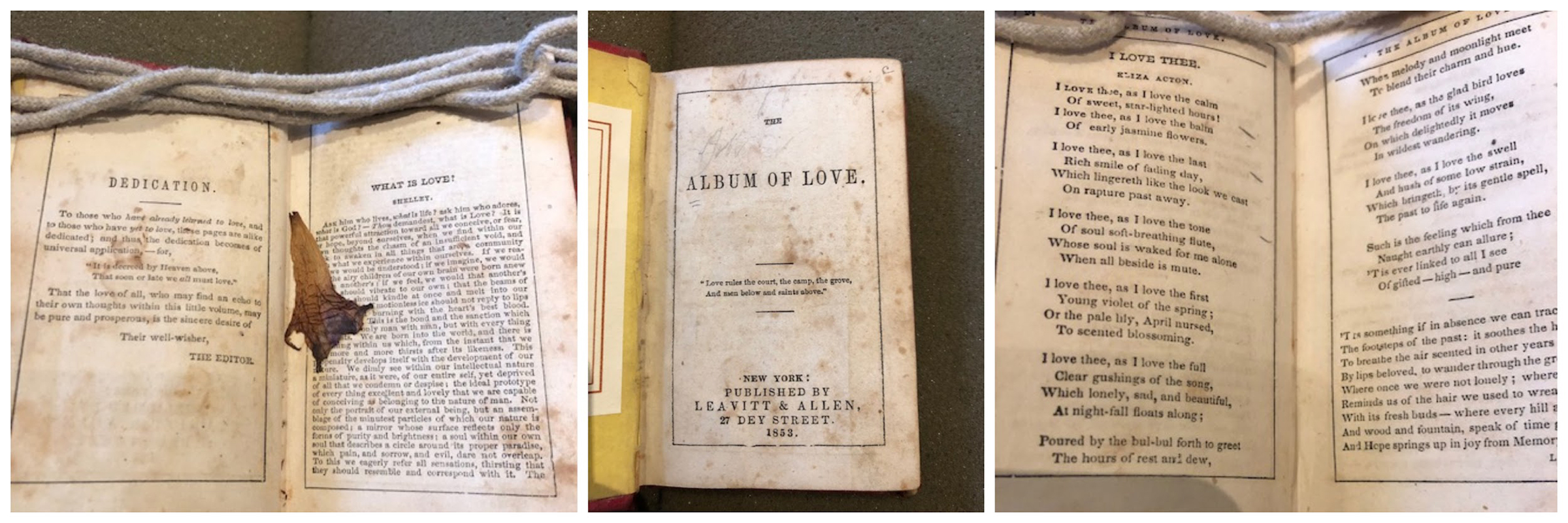
Album of Love removed from the Head Family papers
The first selection in the lineup is for the love poem enthusiasts in the crowd. This tiny volume published in 1853, measuring a mere 12 centimeters is titled The Album of Love. It begins with a dedication and an entire page defining, “What is Love?” where the previous owner saw fit to leave a pressed flower. And, though this book be but little, it is fiercely packed with the sonnets and verses of all your favorite love poets, Shakespeare, Lord Byron, Spenser, Eliza Acton, and John Clare.
Now, I know what you’re thinking. Though famous poets are great, you didn’t come to an archive’s blog to read about published works, did you? Where is the personal tea? Don’t worry. The following transcription comes from a letter from the John Lowell Letters, dated November 30, 1823. In this letter John Lowell Jr. carefully constructs a marriage proposal to his cousin and soon-to-be wife Georgina M.A. Lowell. It’s nice to know this worked out for him because the calculated tone of the request makes it seem that he was apprehensive at best about his chances. There’s even a part in which he instructs her to burn the letter if she doesn’t feel the same way.
Dear Georgina
I venture to address you in this formal manner on a subject nearly connected with my happiness, because I cannot devise any other mode of bringing it before you. It is the offer of myself & the request that you will permit me to ask Uncle Lowells consent to our union. I say nothing of my affection or the desire I have long had to obtain your approbation before that of any other person, because if I have not already persuaded you of these things, protestations would now be useless. This step may appear premature or presumptuous but I hope the near approach of the period when I shall cease to live here & the solitude I feel to settle a question of this sort previously to it’s arrival will excuse me it If it is not in your power to permit me the indulgence of those sentiments I feel towards you, I will thank you to burn this letter & not let it’s reception disturb the harmony of our acquaintance. I declare that no lady shall ever be voluntarily embarrassed by my attentions, when I know them to be unacceptable–
Believe me that whatever your determination may be though I earnestly desire a favorable one. I also wish that it may contribute to your happiness, for the continuance of which I would certainly sacrifice my personal feelings.
I am truly sincerely
Yours
John Lowell J.
This next excerpt is from the Henry W. Bellows Correspondence and is a letter from Henry to his fiancee, Anna Huidekoper Peabody, dated May 27, 1874. It’s particularly short, but may also be some of the sappiest collection of words I’ve ever seen written down. Imagine receiving good morning texts like the letter that Henry sends to Anna:
My dear & only love, your precious note of yesterday came in just after breakfast to feed me with new longings to see you, who are my breath & life! Don’t imagine I ask anything more lovely than every sentence you write. I see you through every loop in the letter & they all have sweet & tender meanings hanging onto their pot-hooks!
Hold on to your pot-hooks because things are about to take a turn. These next two items are not for the faint of heart. If you blush easily, you may want to skip past these.
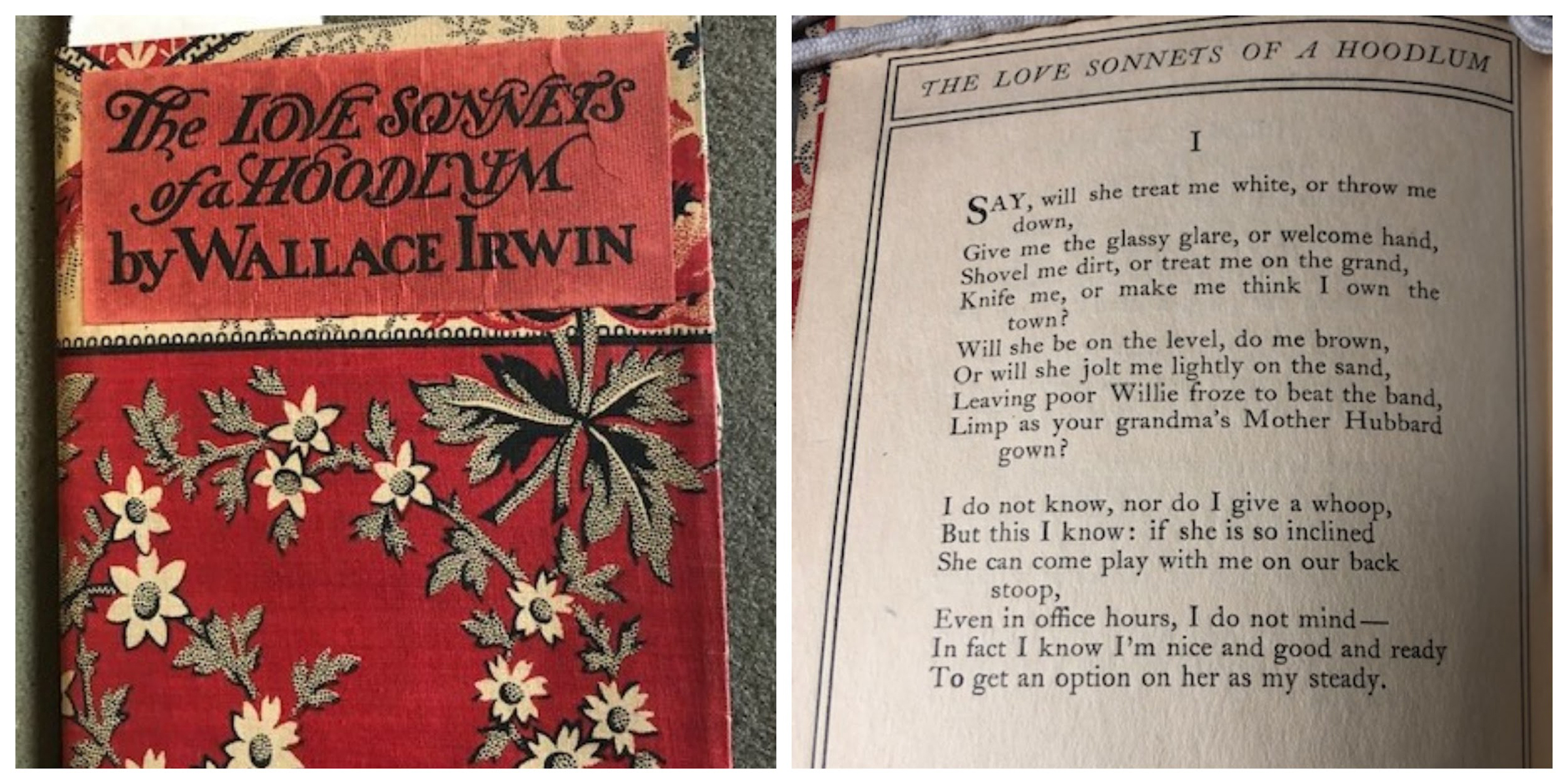
The Love Sonnets of a Hoodlum by Wallace Irwin
There is really no getting around the fact that the “love” sonnets in this book are just plain dirty. The love in question is definitely of a more physical nature, and many of the sonnets include references to a personified “Willie” who is usually being abused in some way or another. Crude nature aside, the sonnets do seem to follow the storyline of a relationship or series of relationships.
Did I hear someone in the audience ask about newspaper clippings?
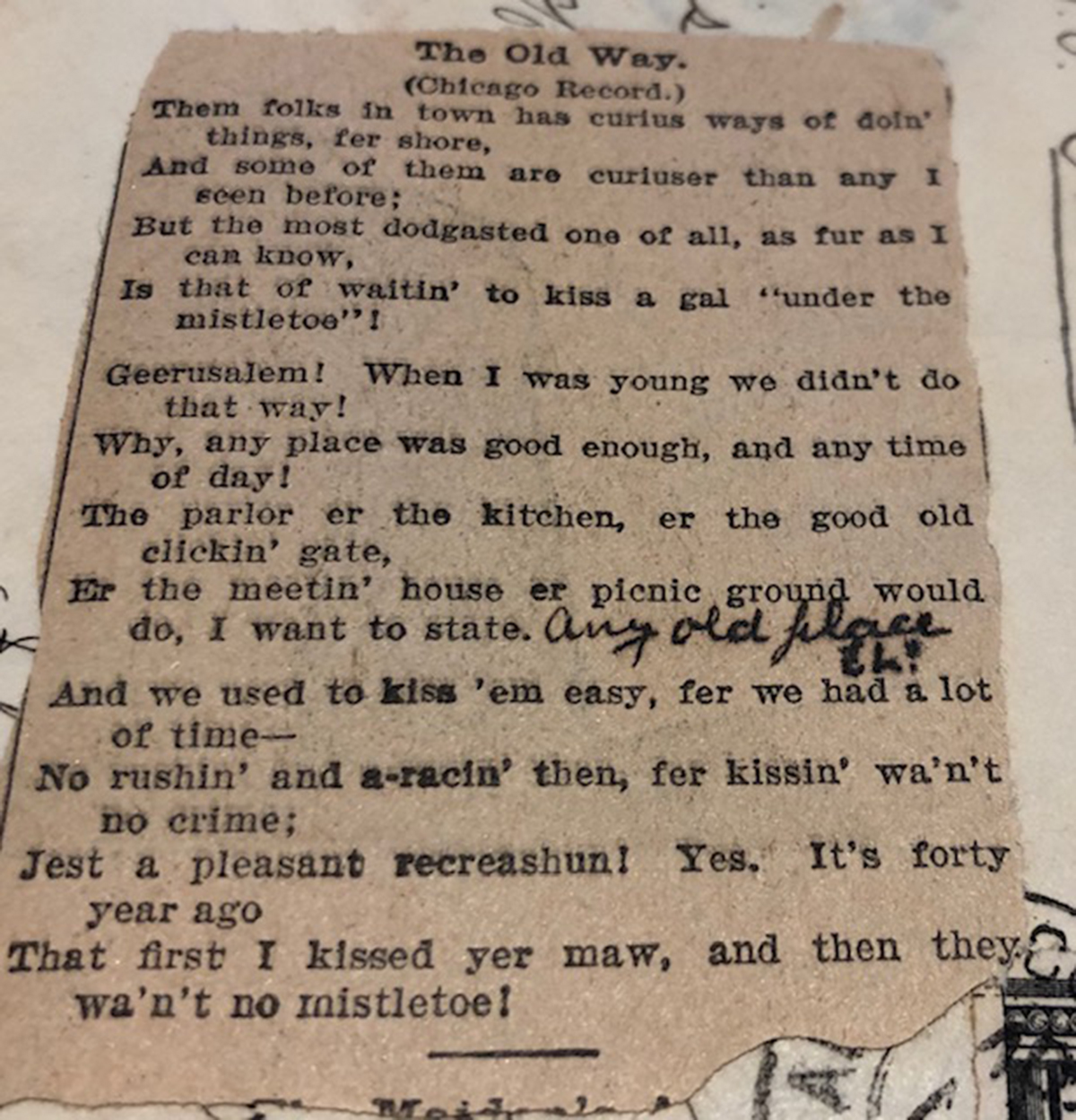
This next letter excerpt happens to be accompanied by just such an artifact! The excerpt comes from the Stone-Jackson Family papers in a letter from Arthur L. Jackson to his wife-to-be Pauline F. Stone dated February 9, 1889.
I enclose a little clipping that has a slight bearing on the subject and will merely say that I shall most certainly follow out its advice the very first time I see you. Shall I need mistletoe then sweetheart? If so I advise you to trim your hat with it and have all the ceilings in your house and veranda covered with it. If you do I shall kiss you under every single leaf of it. once for every day we have been separated, if only to make up for lost time. Just think how horribly in arrears we are that way now-a-days dearest. It will take just about a lifetime to ever get square again, won’t it dear.
Newspaper clipping from the Stone-Jackson Family papers in a letter from Arthur L. Jackson to his wife-to-be Pauline F. Stone dated February 9, 1889.
In comparison to The Love Sonnets of a Hoodlum, this letter could be construed as tame, but it was still one of the racier correspondences I came across when putting this together as Arthur playfully details his desire to kiss Pauline and under what circumstances.
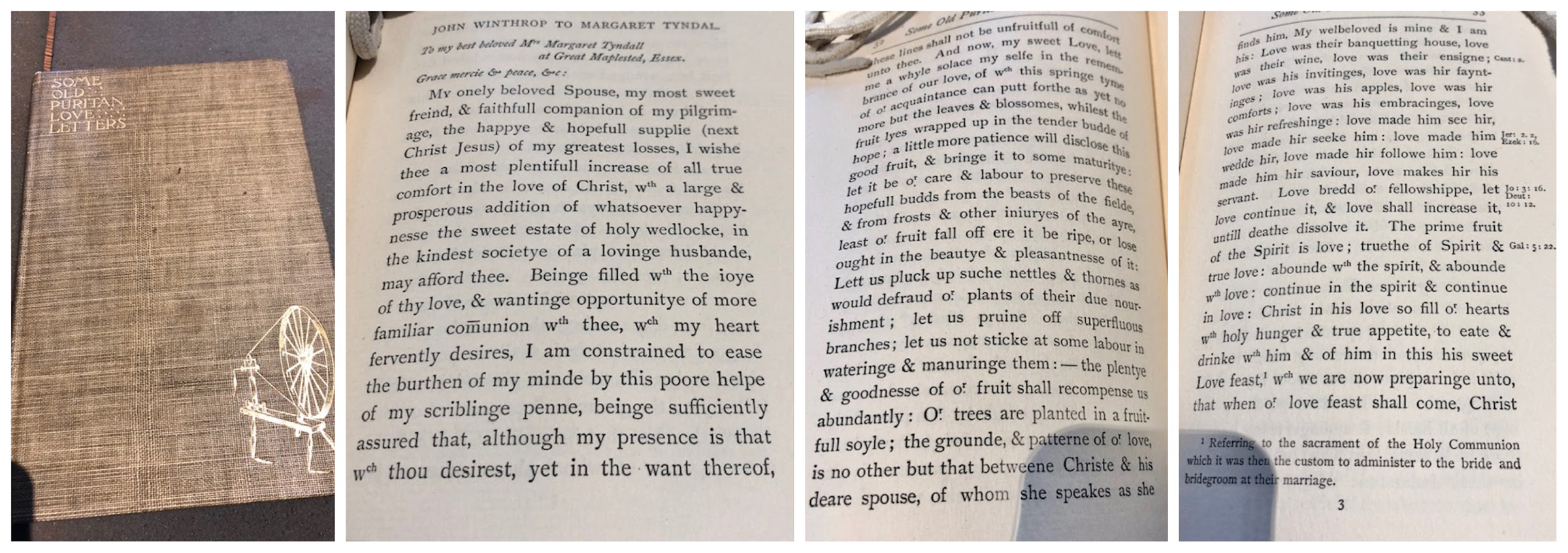
Now that we’re nearing the end of the post, I thought it would be a good idea to cool us down and cleanse our palates with Some Old Puritan Love Letters.
Some Old Puritan Love Letters, letter from John Winthrop to Margaret Tyndall.
The particular letter pictured is from John Winthrop to Margaret Tyndall. It opens, “My only beloved spouse, my most sweet friend, & faithful companion of my pilgrimage, the happy & hopeful supply (next Jesus Christ) of my greatest losses, I wish thee a most plentiful increase of all true comfort…” Even with its formal language and regular allusion to biblical verse, this letter still manages to feel poetically intimate and caring. Please note that I did not photograph the entire letter as it was incredibly long. If you would like to see the rest, please stop by the MHS and check it out (figuratively… we aren’t a lending library).
[The Love Dream]. A sleeping woman is about to be attacked by an armed cupid, who crouches next to her, bow drawn.I want to wish all of our readers a Happy Valentine’s Day and remind you to find joy in both the romantic and platonic loves in your life this February. In the words of John Winthrop, “I wish thee a most plentiful increase of all true comfort…” (i.e. candy and soft things).
by Susan Martin, Processing Archivist & EAD Coordinator
I’m very happy to add a brief postscript to last year’s seven-part series about Civil War soldier Dwight Emerson Armstrong. Last fall, following on the heels of that series, the MHS acquired the letters of his brother, Joel Mason Armstrong.
Mason (as he was called) was born in 1833 in Wendell, Mass. He worked as a carpenter in Sunderland before enlisting at the age of 28. He would serve for almost a year in the 52nd Massachusetts Infantry Regiment, Co. G., primarily in Louisiana. His collection is even smaller than his younger brother Dwight’s, but no less interesting. It consists of seven letters: six from Mason and one to Mason from none other than Dwight himself.
Dwight’s letter was written from Washington, D.C. on 15 September 1861, early in his service and before he’d seen any fighting. In it, Dwight described the building of batteries, the sound of nearby skirmishes, and a review of the troops by Gen. McClellan. I wrote about this period in Part II of the series.
All six of Mason’s letters were written to his sister Mary—the same sister, incidentally, to whom Dwight wrote his letters. Mason included some terrific details about life in the Union army, from the looting of nearby plantations for poultry, sweet potatoes, and sugar, to the days spent marching (“I find that I can tire out almost every one else & then march some ways further.”), to the thousands of formerly enslaved people who joined the Union caravan in the months after the Emancipation Proclamation. As for insight into Mason’s personality, I think this quotation sums it up: “I made up my mind long ago to make the best of everything and bear cheerfully whatever comes that cannot be helped.”
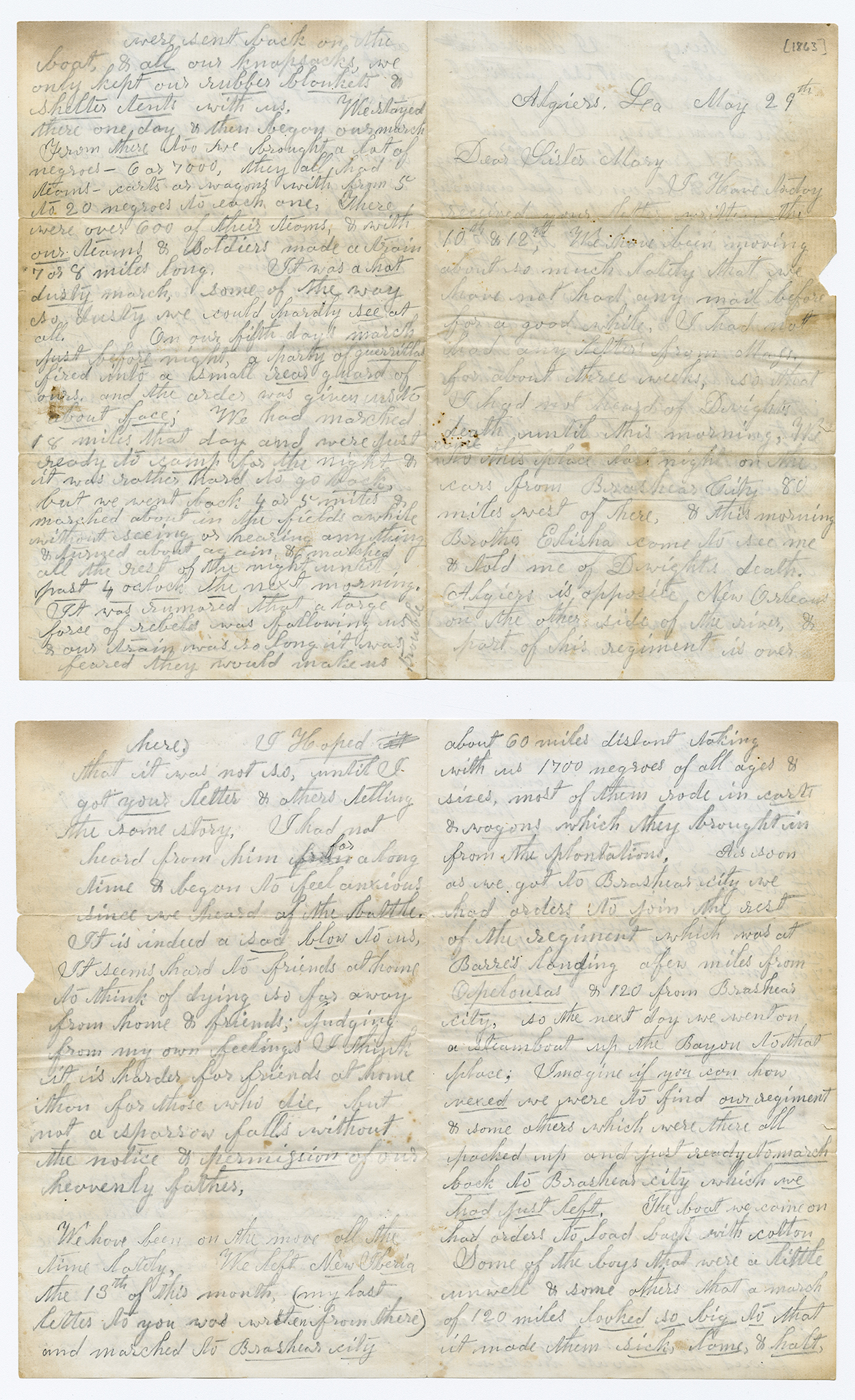
Letter from Joel Mason Armstrong to Mary (Armstrong) Needham, 29 May 1863
This collection also contains the letter Mason wrote to Mary on learning of Dwight’s death. Dwight was killed in battle on 3 May 1863, but Mason didn’t hear about it until nearly a month later, on the morning of the 29th. The news was confirmed by that day’s mail.
I Hoped that it was not so, until I got your letter & others telling the same story. I had not heard from him for a long time & began to feel anxious since we heard of the battle. It is indeed a sad blow to us. It seems hard to friends at home to think of dying so far away from home & friends; judging from my own feelings I think it is harder for friends at home than for those who die.
This patchwork of related collections is one of the advantages of a manuscript library like the MHS. Multi-generational papers, papers of different family branches, friends and neighbors running in the same social circles, letters from soldiers serving in the same military unit, travelers crossing each other’s paths—all of this overlapping and complementary material gives us a fuller picture of historical events and an opportunity to view those events from different perspectives. It’s not unusual to be working on a collection and run across the name of a person whose papers you recently processed.
Mason and his wife Helen had seven children, but one online source contained what I initially took to be a mistake. Listed among his children was Clara I. Sweetser, but she was born a year before their marriage. A child from a previous marriage perhaps? The name rang a bell, so I looked back at my genealogical research from last year.
Sure enough, Sweetser was the married name of Mason’s oldest sister Sarah. Sarah and her husband both died in November 1864, just six days apart from each other. They left five children, the oldest only 14. After a little more digging, I found that six-year-old Clara, their only daughter, was in fact raised by Mason and Helen. (I couldn’t confirm it, but I assume her brothers were raised by other family members.) Sources seem to conflict on whether she was formally adopted, but her name was legally changed to Armstrong in 1865. Clara would marry in 1883 and have four children of her own.
Joel Mason Armstrong died in 1905 in Sunderland, Mass.
As someone who is starting her career in the library field, and hoping to start library school in the coming year, I am very interested in how libraries organize information. Paradigms like the Library of Congress Classification not only make the information in our collection easy to navigate, these classification systems are information in-and-of themselves. They trace a lineage of scholars trying to determine the best ways to arrange collections in repositories such as libraries and archives, in accordance with the dominant ideologies of their time.
In the descriptively titled “Four letters to the mayor of Boston regarding waste and inefficiency in the cataloging department of the Boston Public Library” (s.n., 1880), Fredrick B. Perkins penned a series of letters to the mayor of Boston about what he considered to be the malpractice of the cataloging department at the Boston Public Library. His letters, direct and full of wit, call for the mayor to cut the library’s budget as an effort to force them to either decrease staff or decrease the salaries of staff in their cataloging department. He points out some specific examples of their negligence: a card in the card catalogue was labeled “Bomarsund (in India)”, though Bomarsund is in the Balkans (and also a village in the U.K.). Whether or these cataloguers deserved pay cuts and whether or not all Perkins’ claims are true, these series of letters bring up an interesting point: that the navigability of library catalogs is a public concern—even more so now, as public institutions have done more to live up to their mission of serving the public at its broadest.
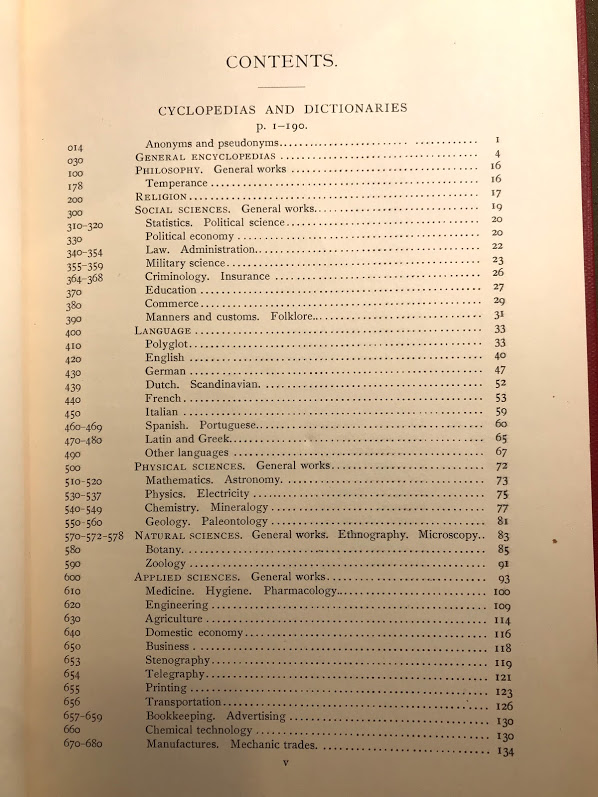
Example of a library’s catalogue in the early 20th century. This image is of A list of cyclopedias and dictionaries (John Crerar Library Board of Directors, 1904, a catalog of encyclopedias and dictionaries that the John Crerar library published.
In the pamphlet “On the construction of catalogues of libraries” (Smithsonian Institution, 1852) written in 1852, prominent librarian Charles C. Jewett—who in his lifetime was the Librarian of the Smithsonian Institution and the Superintendent of the Boston Public Library—proposed a method called stereotyping to effectively create library catalogs.[1] In his program all public libraries interested in adhering to this set of rules would send a formatted list of the titles all the books in their collection. This list would then be made into clay plates for printing. His ultimate hope for this was to create an aggregate catalog of all participating libraries, which would eventually include libraries in Europe, moving toward what he termed a “universal” catalog. Of course, this plan is ideologically limited, the scope of his universalism only extending to the North American and European continents. His vision did not come to fruition, though he remains a figure in the library field for his writing about cataloging methods.[2]
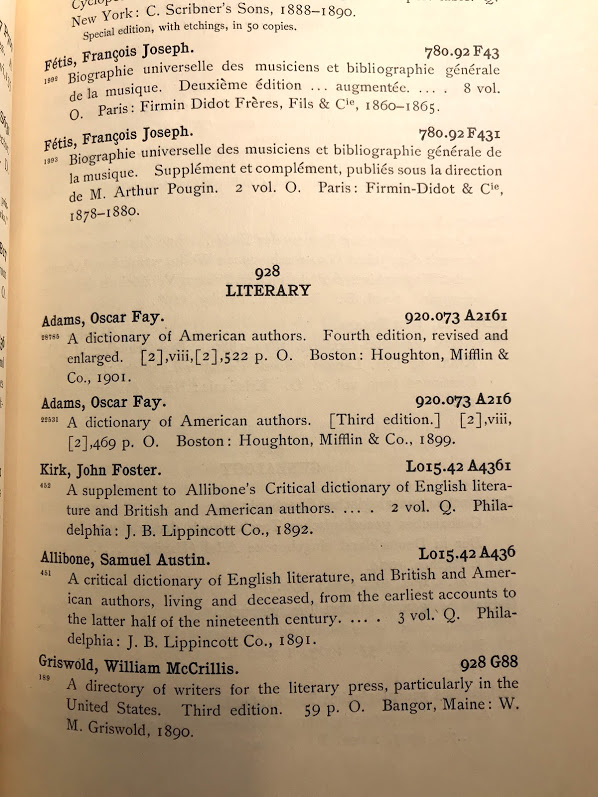
Another image of the John Crerar encyclopedia and dictionary catalog. This is of the literary subsection of the broader history section. Here you can see how the titles are formatted and what information they provide.
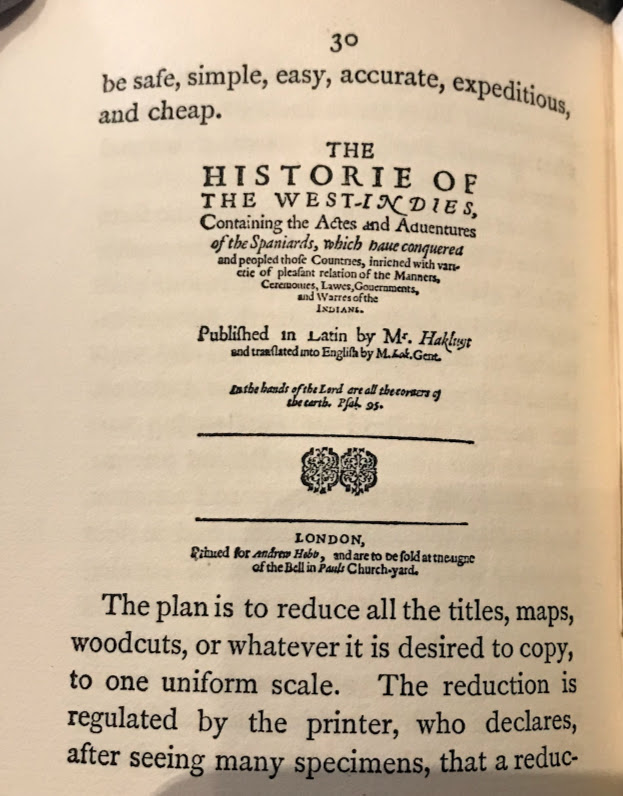
Photo-Bibliography (H. Stevens, 1878), written by bibliographer Henry Stevens in 1878, goes even deeper into the desire for an object that could, in-itself, act as a repository of knowledge. Stevens, an American expatriate living in the United Kingdom, calls for a full bibliography of all English books, and along with this bibliography, a “universal system” for cataloging.[3] To achieve this, he hopes for a “Central Bibliographical Bureau or Clearing House”. He even lays out the ideal dimensions for titles in such a bibliography. Ultimately, though, he does not imagine his vision coming to fruition, because of the ever expanding nature of libraries: “As there is little hope of any library ever even approaching completeness, there is no apparent progress whatever made towards that universal and harmonious catalogue raisonné which we have so long and so devoutly been praying for”. This hope will continue to permeate at least parts of librarianship and academia. Even a resource we have from 1952, “Indexes and Machines,” by the academic librarian Earl Gregg Swem, is intrigued by some way capturing “total-books”, or all the books published in English and European languages.
Stevens proposed formatting for titles in his imagined photo-bibliography.
Looking to create something all-encompassing, these sources point to the limiting viewpoints of their creators, and perhaps more generally, the time in which they were created. None of these sources point to any other epistemologies or consider any sort of relativism, such as forms of knowledge-making outside of the book. Rather, they hint at exceptionalism. Universality came to be a stand-in for all that is a part and product of European and American culture, specifically of the educated classes. The decisions made by those who envisioned a specific classificatory system come to be viewed as neutral and arbitrary. Librarians such as A. Brian Deer have realized the importance of creating classification systems that align with the beliefs of their communities and counter hegemonic classificatory schemes. Deer, a member of the Mohawk of Kahnawá:ke community, created the Brian Deer Classification System in the mid-seventies, which worked to prioritize an Indigenous perspective and an Indigenous audience. This system has been adapted and reinterpreted by various libraries in North America.[4]
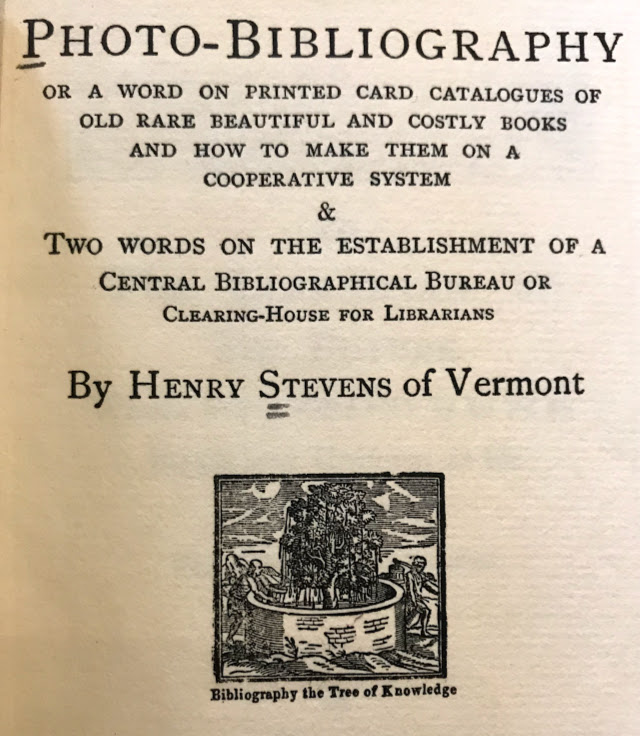
Detail of the title page of Photo-bibliography, referencing the “Tree of Knowledge”.
Classification systems will never be perfect. Knowing that a total system would at best be a reflection of ideologies of those that created it, the fact no library is “ever even approaching completeness” allows room for growth. As the discourses around knowledge shift to be less conclusive and more inclusive, the ever expanding nature of a collection can come to be less of a burden and more of an opportunity.
If you want to learn more about how we organize our resources, peruse our online catalog, Abigail. And if you are interested in viewing the MHS sources listed in this post, or many of our other resources, please visit our research library, which is free and open to the public!
[2] Jewett, C. C., & Harris, M. H. (1975). The age of Jewett: Charles Coffin Jewett and American librarianship, 1841-1868. Littleton, Colo: Libraries Unlimited.
[4] Doyle, A. M., Lawson, K., & Dupont, S. (2015). Indigenization of knowledge organization at the Xwi7xwa library. Journal of Library and Information Studies, 13(2), 107-134.
This is your official warning—Valentine’s Day is just over two weeks away. Maybe you’re in charge of planning festivities; maybe you’re looking for a subtle way to remind the person who is in charge. Either way, read on.
If there’s one thing my time with the Adams Papers editorial project has taught me, it’s that the answers to all of life’s questions can be found within the collection. Since the project contains three central power couples—John and Abigail, John Quincy and Louisa Catherine, and Charles Francis and Abigail Brooks—I knew the outline of a perfect Valentine’s Day date was scattered across those quarter of a million manuscript pages.
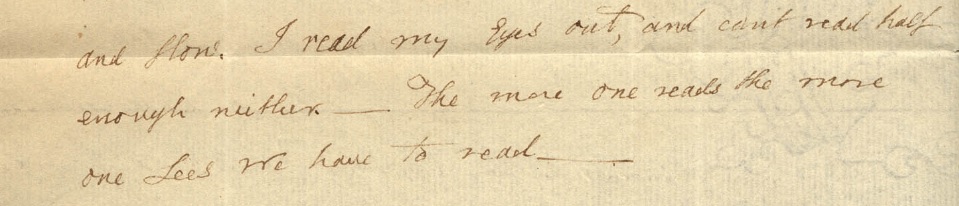
John and Abigail liked nothing more than to sit together by a crackling fire, languorously paging through the newest additions to their ever-growing private library. “I read my Eyes out, and cant read half enough neither,” John wrote to his like-minded wife on 28 Dec. 1794. “The more one reads the more one sees We have to read.” John and Abigail’s letters are full of quotes and beloved bon mots, and they would swap book recommendations, yearning to hear the other’s opinion. If you and your partner are all about that hygge lifestyle, swap books, get a fire roaring, put your feet up, and sink into a soft chair. Let others fight for those hard-to-get dinner reservations. (Bonus points if you indulge in another of John and Abigail’s favorite things: hot chocolate!)
John Adams to Abigail Adams, 28 Dec. 1794
John Quincy and Louisa Catherine shared an affection for music. Louisa was a harpist and singer, and John Quincy played the flute. John Quincy’s first impressions of Louisa were of her musical ability, as she always sang and played for him when he visited her family in London. “Memory often repeats to my Fancy, every strain which was once performed by you; it gives an Echo still returning to my ear, to every sound uttered by your voice, or called forth by your fingers,” John Quincy wrote to her on 6 March 1797. Valentine’s Day is the perfect excuse to get dolled up and take the music lover in your life to a symphony, choral concert, or opera.
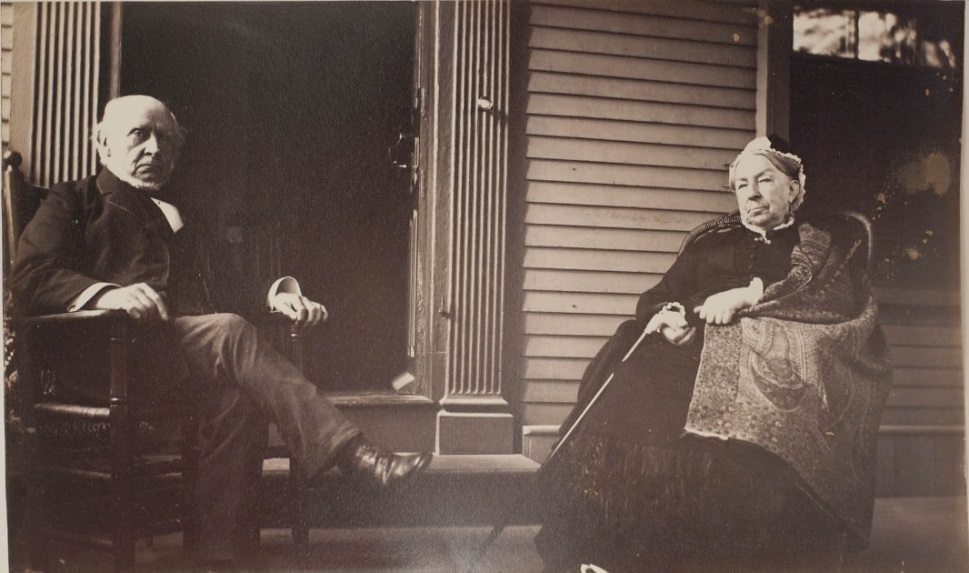
Charles Francis and Abigail Brooks Adams, 1883. Photograph by Marian Hooper Adams
Charles Francis and Abigail Brooks were collectors by nature. Their free time was filled with antiques shopping, and Charles was a regular at auctions. Charles collected rare coins, and Abby was delighted by knick-knacks of all kinds. They enjoyed traveling together, taking in landscapes, wandering through art galleries, and tasting local cuisine. “My Wife went in to make her purchases at the shop, the usual tax for curiosity in travelling,” Charles Francis recorded in his diary on 19 July 1836. If you and your date are always up for a daytrip, why not spend your Valentine’s Day as tourists, exploring boutiques and gift shops somewhere new?
It doesn’t matter how you celebrate this February 14th so long as you spend the day with your Dearest Friend.
John and Abigail Adams’s customary salutation.
The Adams Papers editorial project at the Massachusetts Historical Society gratefully acknowledges the generous support of our sponsors. Major funding is provided by the National Endowment for the Humanities, the National Historical Publications and Records Commission, and the Packard Humanities Institute. The Florence Gould Foundation and a number of private donors also contribute critical support. All Adams Papers volumes are published by Harvard University Press.
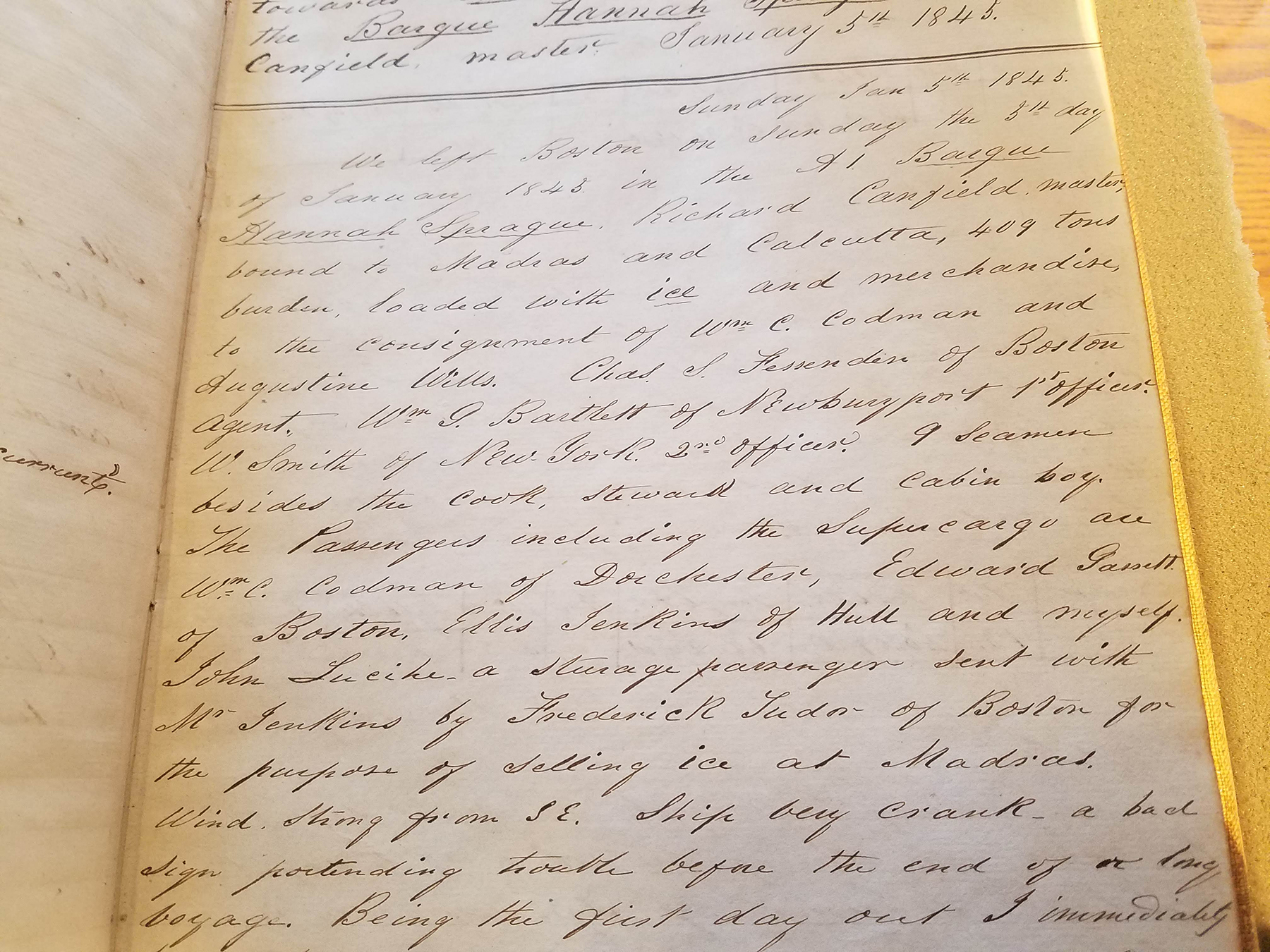
“We left Boston on Sunday the 5th day of January 1845 in the Barque Hannah Sprague, Richard Canfield master, bound to Madras and Calcutta, 409 tons burden, loaded with ice and merchandise, to the consignment of Wm. C. Codman and Augustine Wills. Chas S. Fessenden of Boston Agent. Wm G. Bartlett of Newburyport 1st Officer, W. Smith of New York 2nd Officer. 9 Seamen besides the cook, steward and cabin boy. The Passengers including the Supercargo are Wm. C. Codman of Dorchester. Edward Gassett of Boston, Elis Jenkins of Hull and myself. John Lucike a (strange) passenger sent with Mr. Jenkins by Frederick Tudor of Boston for the purpose of Selling ice at Madras. Wind Strong from SE. Ship very crank- a bad sign (portending trouble) before the end of our long voyage. Being the first day out I immediately began to oversee the preparation of my State-room &c. Find it pretty difficult to walk on the deck, not being accustomed to the motion of a ship. Did not sleep very well, but was not the least bit sick.”
Day 1, logbook of the barque Hannah Sprague kept by Horatio Stockton Rotch, 1845.
Thus begins Day 1 of Horatio Rotch’s 120 day journey towards Madras and Calcutta, India from Boston on a chilly January day. The log of the barque Hannah Sprague was kept by Horatio Stockton Rotch from 5 January 1845 through 25 December 1845, while on a trading voyage. Entries record longitude and latitude, course, winds, and distance traveled. One of many in the Society’s collection, I find this logbook to be simply remarkable. Indeed I am appreciative for his lovely legible handwriting (which I imagine is not easy aboard ship) but I am even more grateful for his detailed and honest descriptions throughout the journey. This must have been his first, as his narratives are rich in detail. The volume includes the logbooks of two subsequent journeys by Rotch: one aboard the barque Sylphide in 1846 and another on the brig Emily Bourne in 1849.
Rotch describes day to day happenings aboard the ship. It seems their journey was not in the least bit peaceful.
“ 2 Days Out
The gale kept continuing al day and increasing in violence towards night. Rained very hard and blew tremendously al night, so that the ship was in great danger of Capsizing. The ship bore up gallantly against the heavy sea, which at every plunge washed her decks, and almost overwhelmed her, and the next morning saw her safe.”
“3 Days Out
We got through the night safe, only to experience during the whole of today a constant succession of squalls, once in a while getting a peek at the sun. One of the sailors taken sick and put under my care by the Captain.”
“4 Days Out
Fair weather. Sun makes its first appearance to our great delight. First Observation taken. A Barque visible at the Southwest what name and where from we cannot find out, probably from some southern port. We are now in the South side of the gulf, and the change in climate is very manifest.”
And after two calmer days…
“7 Days Out
9 O’clock –The Storm still continues to rage, incessant squalls, very heavy sea. Blew a perfect hurricane all day and night. Thunder and lightning with most perfect squalls every five minutes. Scudding before the wind under a close-[suffered] foresail Great anxiety for the safety of the Ship and consequently of ourselves. Almost gave her up at one time during the night. The Captain said he had never experienced such a tremendous hurricane, although he has been eight voyages to the East Indies. The ship bore up gallantly (Just like a seagull) in spite of the roaring of the sea, which at every rise looked like a huge Mountain about to dash us to pieces. The scene in the Cabin was quite comical, some praying, some groaning, and most all frightened to Death, especially an Austrian name Lucike. Nobody can conceive the danger of our situation, save an eye-witness. Words cannot describe the scene.”
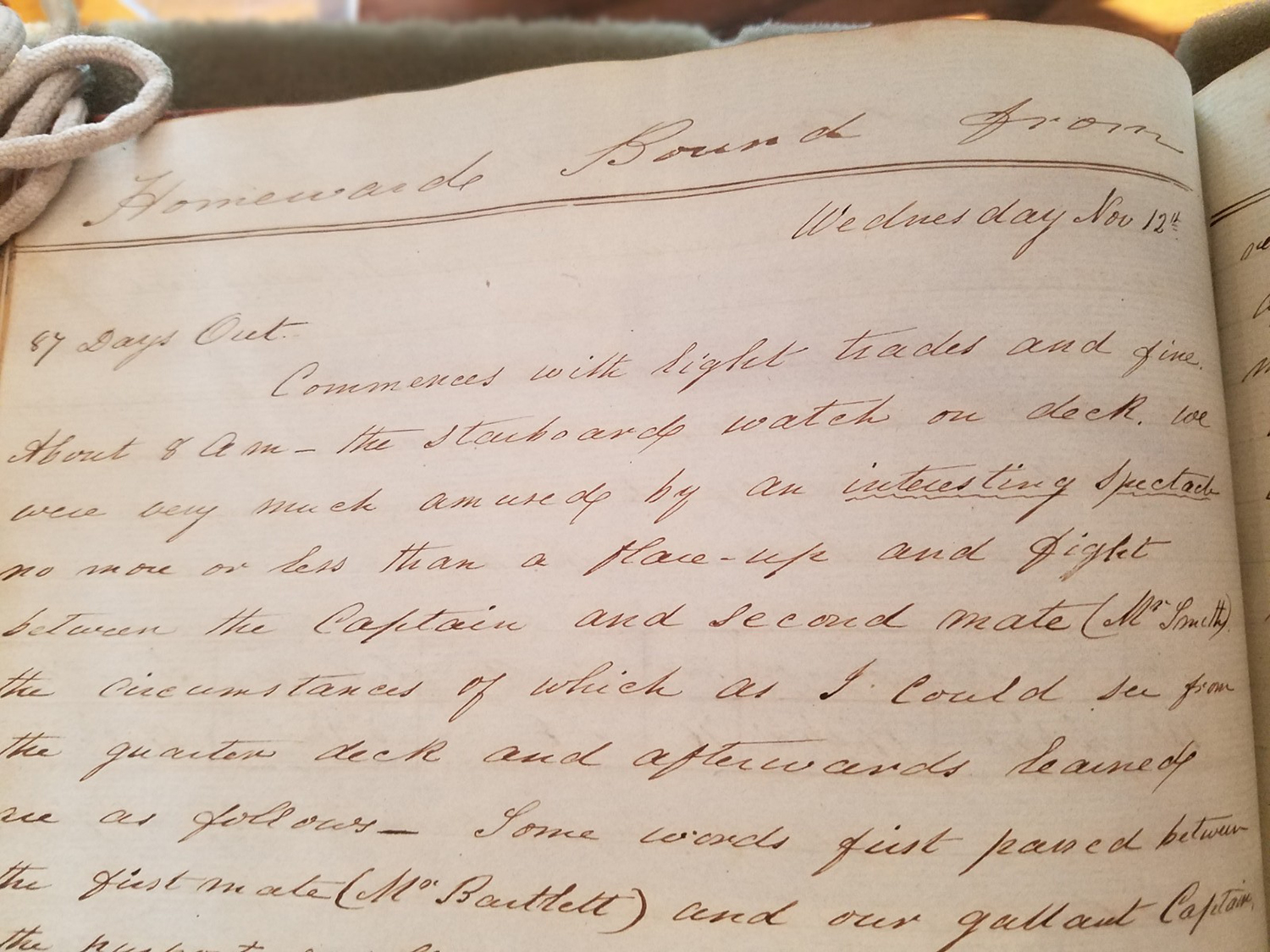
That was only 7 days out with another 111 to go before they would near their first destination. Personally, I would have never left land again, but as we already know, Horatio Rotch set out on the very next ship. For those who wonder what it was like to be out at sea on such a journey, this logbook is a magnificent resource. While there is simply not enough space in this post to include all the interesting details of the logbook, I will add that there is a fight scene 87 days out on the homeward bound journey. What would a sea voyage be without an “Interesting Spectacle” between the Captain and the 2nd Mate? Rotch describes the altercation in detail as “This Gentlemanly Affair took place on the starboard side of the forecastle in presence of the crew and every-body else aboard.”
Day 87, logbook of the barque Hannah Sprague kept by Horatio Stockton Rotch, 1845
Arriving in India three months later, Rotch gives a description of the Calcutta and an interesting recommendation:
“Calcutta
This is one of the largest cities in the east-indies and one to which it is well worth while to pay a visit, if only for once. It covers an immense space of ground and is three or four times the size of our largest American city (New York)…”
Turly, he must have succumbed to the lure and excitement of traveling the world, as is evident by the haste in which his next voyage begins. Horatio Stockton Rotch died in 1850 at the age of 28 and is buried in New Bedford, Mass. His thoughts and words live on through his wonderful logbook.
Interested in reading more? Visit the MHS library to view the log of the bark Hannah Sprague. Or, search our online catalog, Abigail, for logbooks. Everyone is welcome to do research in our Reading Room, so stop in the next time you are on Boylston Street, and take a journey back in time and across the Globe!
By Susan Martin, Processing Archivist & EAD Coordinator
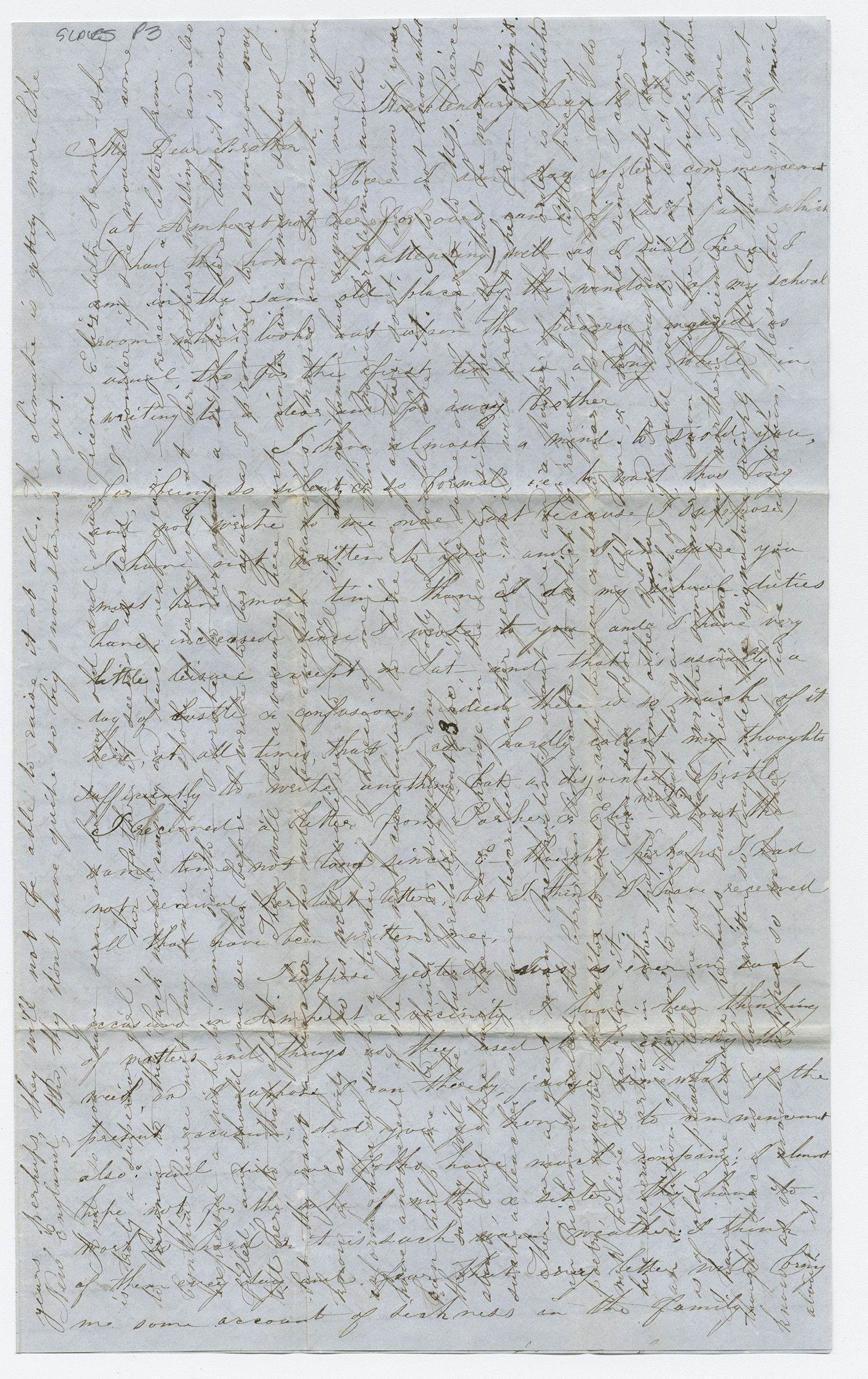
The MHS recently acquired a fascinating letter, dated 10 August 1849 from Mecklenburg County, Virginia. It was written by “Nannie,” a young white woman from New England, to her brother back home. Over four large, densely packed, cross-written pages, she discussed a variety of subjects, including chattel slavery on a plantation in the antebellum South.
Letter from “Nanny” to “My Dear Brother,” 10 Aug. 1849
It’s a disturbing letter to read. According to Nannie, enslaved people were not mistreated, they suffered more at each other’s hands than at those of enslavers, and Northern opposition to slavery was the real problem, because it made Southerners cling more tightly to their ways. She warned that the South “will see, and vote for, a dissolution of the union before they will give one inch to the north upon the subject.” She also revealed the whites’ widespread fear of revolt and defended the separation of families as necessary to preserve order.
The importance of manuscripts like this to our historical understanding can’t be overstated. Many white Northerners were not, of course, abolitionists, but were either complicit in or openly justified the South’s “peculiar institution.” This letter gives us a first-hand look at their self-serving rationalizations and willful ignorance.
Cataloging this new acquisition was also challenging for another reason: I had no idea who wrote it. Nannie was probably a nickname, but the letter came to the MHS as a single item, not as part of a family collection, so I had no context to help me. I didn’t even know the name of the brother she was writing to. So I began with a close reading of the text, gathering whatever piecemeal clues I could.
Nannie mentioned several other correspondents, including Elizabeth, Parker, and Caleb.
She asked about happenings at Amherst, Mass., possibly her hometown.
She worked as a teacher for a Mr. Pettus, who treated her well and wanted her to stay on.
She apparently lived and taught in the family home; she described writing the letter “by the windows of my school room which looks out upon the piazza” and going upstairs one night to visit the “boarders.”
Her brother, the recipient, worked for an abolitionist paper, of which Nannie disapproved.
She wrote poetry and had previously published her work in newspapers under the pseudonym “Viola.”
And that was it. Not much to go on. I thought my best clue was the name Pettus and started there. Searching online, I found Pettuses galore in Mecklenburg County, including three listed in an 1860 census of enslavers, but I could not pinpoint who employed Nannie. I needed to come at it from a different angle.
I searched using various combinations of keywords (Nannie, Pettus, Mecklenburg, plantation, Parker, Caleb, Amherst, Viola, 1849, etc.), hoping but not expecting to stumble on something helpful. To my surprise, I got a break in the case, so to speak. I found a transcription of an 1851 letter from Arlena Pettus to someone called Nancy “Nannie” Henderson Hubbard!
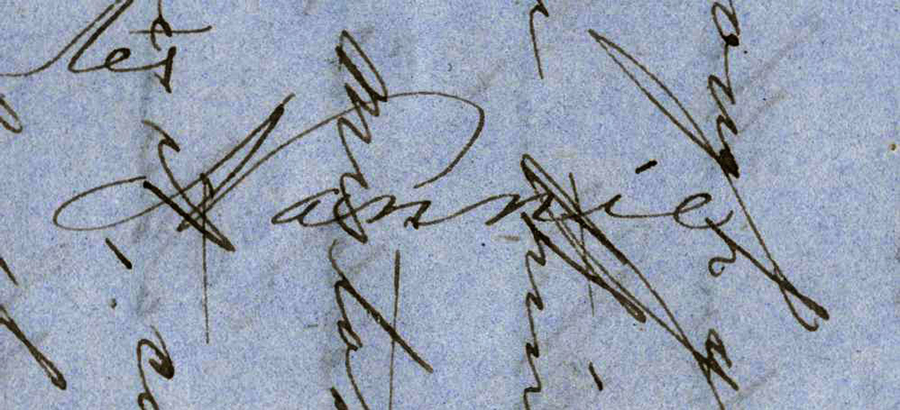
Arlena had apparently been one of Nancy Hubbard’s students, and the details in her letter matched what I knew—she even asked after her teacher’s birds, and our Nannie had written about keeping mockingbirds. Using this website as a jumping-off point, I set out to confirm the identification. I found Historic Homes of Amherst, a 1905 publication by Alice Morehouse Walker, which filled in most of the gaps: Nancy Henderson Hubbard, born in 1823, attended school in North Amherst, “went South as a teacher,” and published poetry under the pen name “Viola.” This was definitely Nannie.
Nannie’s signature
Researching Nancy Hubbard’s family tree, I found a brother Parker (who incidentally later served in the Union army), a sister Elizabeth, and a brother Caleb. The only living brother she didn’t mention in her 1849 letter—and therefore its recipient—was Stephen Ashley Hubbard (1827-1890), a journalist in Connecticut and later managing editor of the Hartford Courant.
Arlena’s letter not only linked the names Pettus and Hubbard, but also provided the specific Pettus for whom Nannie worked, the picturesquely named Musgrove Lamb Pettus (1808-1881). I verified this with the help of the Library of Virginia, which holds a few of Nancy’s letters discussing Musgrove’s family. My final and unexpected discovery was the 1850 Mecklenburg County census, where Nancy’s name is listed alongside Musgrove, Arlena, and other members of the Pettus household.
Nancy Henderson Hubbard returned to Massachusetts in 1851 and married Ansel Wales Kellogg, a banker in Oshkosh, Wisconsin. She died in Wisconsin in 1863, just thirteen days shy of her fortieth birthday. The Oshkosh Public Museum holds a carte-de-visite photograph of Nancy, a.k.a. Nannie, taken in 1855.
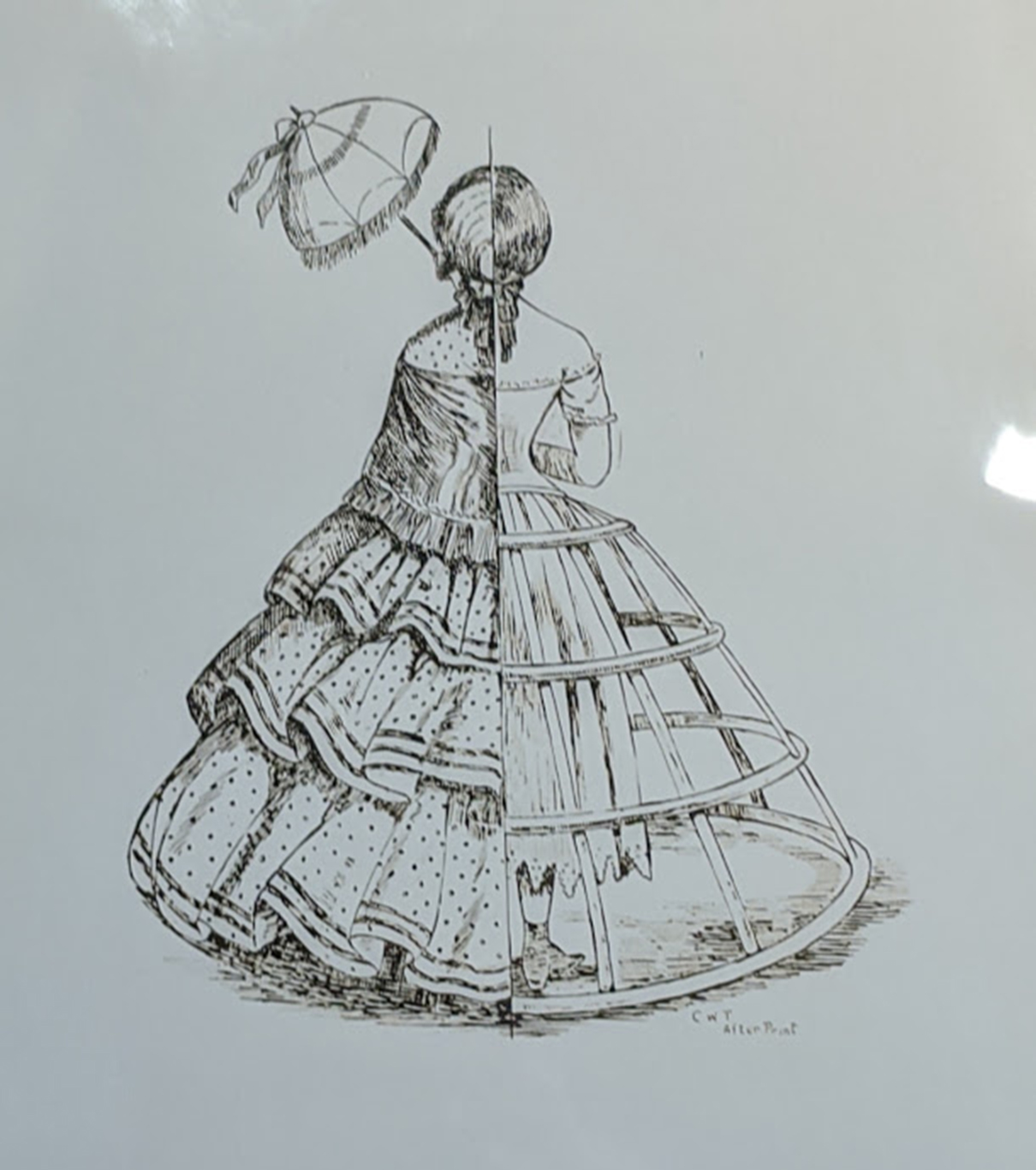
Woman’s costume circa 1865, [photograph] [1927]. Image from the collection of the Massachusetts Historical Society.Hooped petticoats arrived in the United States from England and France in the 18th century. Many women started to wear them as the hoops lifted heavy petticoats off the legs. The image above is a drawing of a woman in a dress from around 1865 with a full skirt and a view of her hoop skirt.
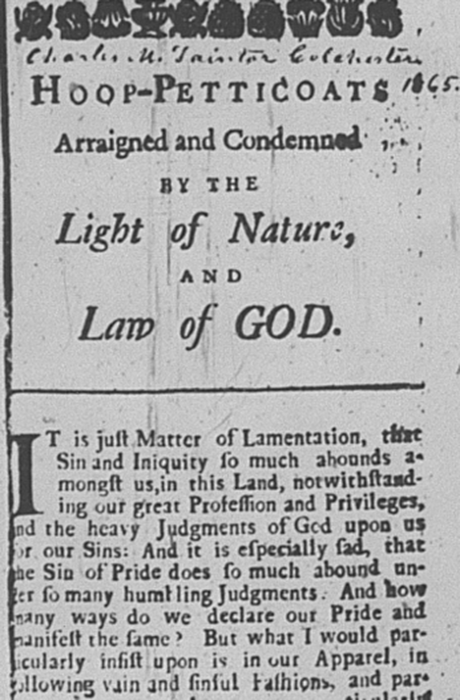
Satire of ministers who called hooped petticoats “contrary to the light of nature”. Printed and sold by James Franklin in Queen Street., 1722, microfilm edition. Image from the collection of the Massachusetts Historical Society.
However religious leaders of the church condemned the garments because the lightness of the hoop skirts often caused them to raise and expose undergarments or bare skin. Newspapers also published satirical cartoons and articles exaggerating how impractical wide skirts were, suggesting women got stuck in doorways or crushed men with their hoops. Despite the controversy, women continued to wear hooped undergarments until the silhouette fell out of fashion around the 1780s.
Full skirts became fashionable again only a few decades later in the United States. At first women used other means to achieve the desired full skirt by wearing crinolines, which were petticoats stiffened with baleen and horsehair. The heaviness of these crinoline made hoop skirts appealing once again. The trend of hooped petticoats really took hold after the invention of spring steel petticoats (also called crinolines) around 1850. These new undergarments eliminated the need for layers of stiffened garments, allowed the legs to move easily, and sit comfortably.[i] This type of undergarment is likely what is depicted on the young women in the image above.
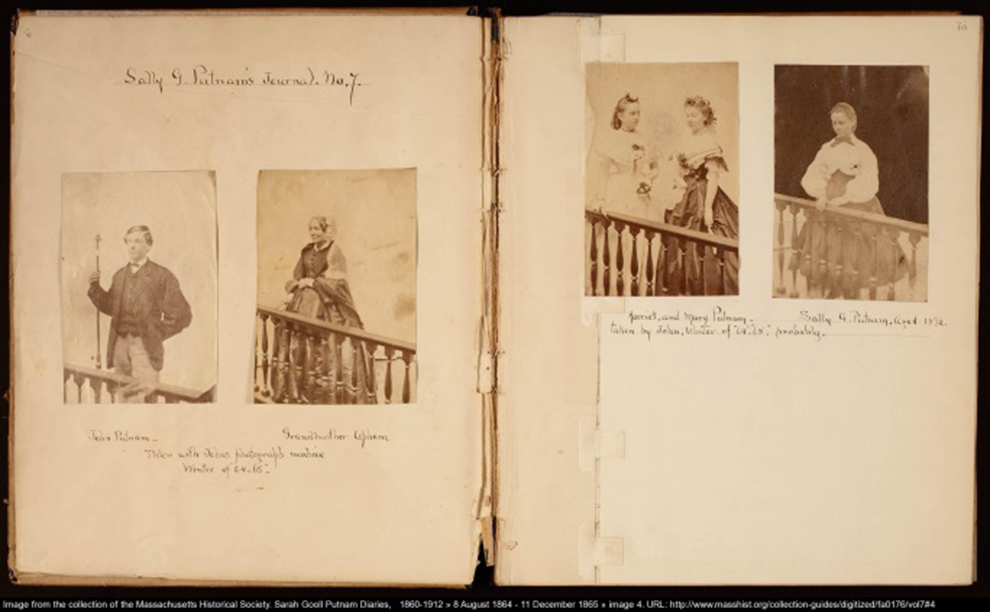
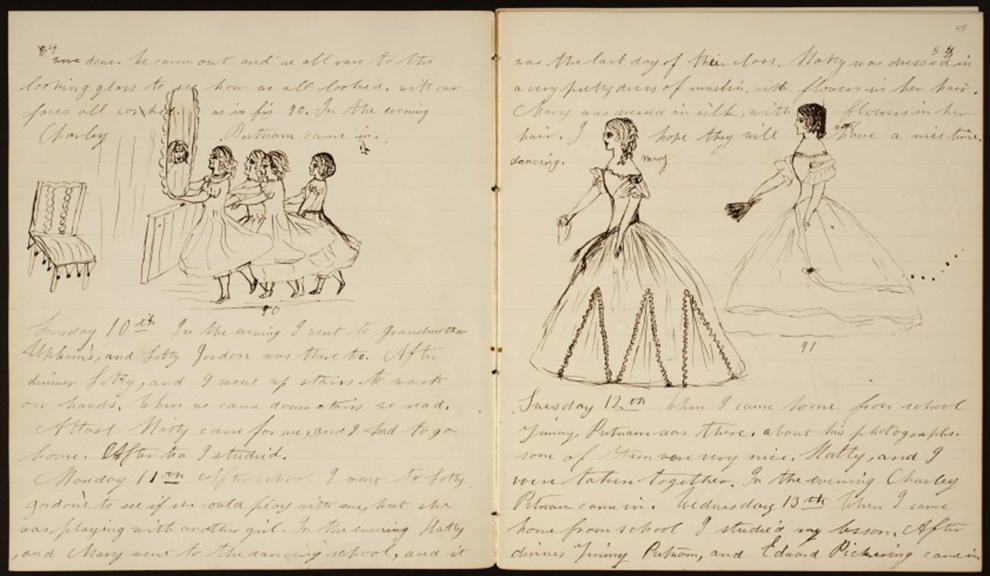
Sarah Gooll Putnam Diaries, 8 August 1864 – 11 December 1865. Image from the collection of the Massachusetts Historical Society.Sarah Gooll Putnam Diaries, 10 January 1861. Image from the collection of the Massachusetts Historical Society.
While the image of dresses with large hooped skirts are often associated with the antebellum period of the South the new spring steel hoop skirt became enormously popular, often dubbed “crinolinemania”. There were over 100 factories in New England making hooped petticoats and were even worn by women in rural areas of western Massachusetts.[ii] Sara Gooll Putnam of Boston often included photos and drawings of her friends and family wearing full skirted dresses in her diary entries.
The hoop skirt remained popular for many decades but eventually the style fell out of favor by the end of the 1860s. The condemnation of hooped skirts became stronger after the end of the Civil War, particularly by ministers.[iii] Additionally, the garments were impractical. While spring steel crinolines were an improvement wide skirts were still cumbersome, and in some cases even dangerous. In 1858 the New York Times reported that a woman in Boston died after standing too close to a fire in a crinoline, and that 19 women in England died due to crinoline related deaths.[iv] While the hoop skirt gave women a taste of freedom and mobility, eventually they wanted to have even more freedom of movement that a wide skirt cannot provide regardless of the undergarments holding it up.
[i] Erin Blakemore, “Why Hoop Petticoats Were Scandalous,” JSTOR Daily (JSTOR, January 28, 2018), https://daily.jstor.org/why-hoop-petticoats-were-scandalous/)
[ii] Lazaro, David E. “Supporting Role: The Hoop Skirt in 1860s Western Massachusetts Fashion.” In Dressing New England : Clothing, Fashion and Identity, 31. Deerfield, MA: Dublin Seminar for New England Folklife, 2010.
[iii]Abbott, Karen. “Death by Crinoline.” Wonders & Marvels. Accessed January 10, 2020. http://www.wondersandmarvels.com/2012/08/death-by-crinoline.html.
[iv] “The Perils of Crinoline.” The New York Times, March 16, 1858.
As the MHS’s resident medievalist, I’ve found it a joy to get up close and personal with the Society’s early American manuscripts. From Abigail Adams’s neat and regular hand to John Winthrop’s nearly indecipherable scrawl, each new manuscript that crosses my desk introduces a new scribe with all their individual idiosyncrasies. And every so often these American documents offer up clear links to their medieval European antecedents.
One such example came up recently during tandem collation work in the Publications department.[i] Since last July we in Pubs have been busy preparing a digital edition of the Wôpanâak-English word list compiled by John Cotton Jr. and his unnamed Native interlocutors late in the 17th century. Working from transcriptions prepared by Kathleen Bragdon and her team at William and Mary, we have nearly completed our first verification pass of the document.[ii] The vocabulary is arranged in phrase sets with Wôpanâak words on the left and English on the right, sometimes with more than one phrase set to a line, as in this section on colors and kitchen implements:
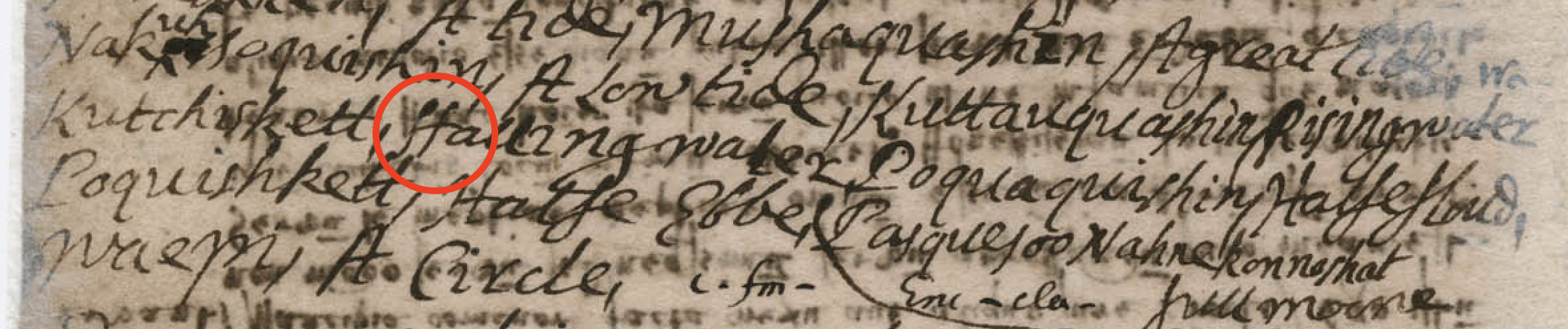
Another section, this one concerning tides and water, uses a rather curious spelling of a common English word:
Wôpanâak vocabulary, vocab p. 70, detail.
What looks like, “Kutchiskett, ffalling water,” is, in fact, “Kutchiskett, Falling water.” That double lowercase f represents a capital F.
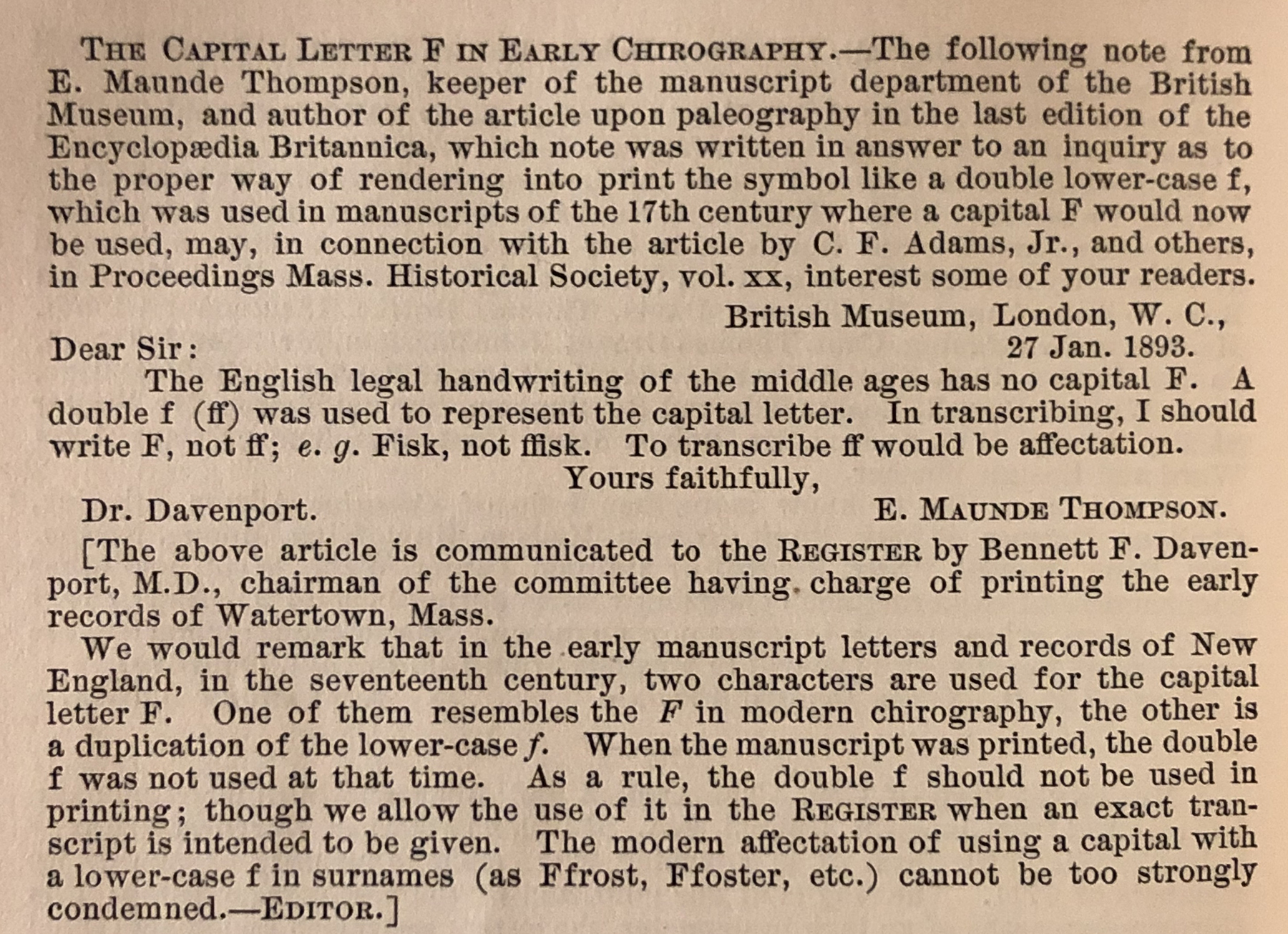
This practice of doubling fs for capitals dates back to the Middle Ages and has been vexing readers for centuries since then. The New England Historical and Genealogical Register addressed the issue in 1893 by publishing a note from E. Maunde Thompson of the British Library.[iii]
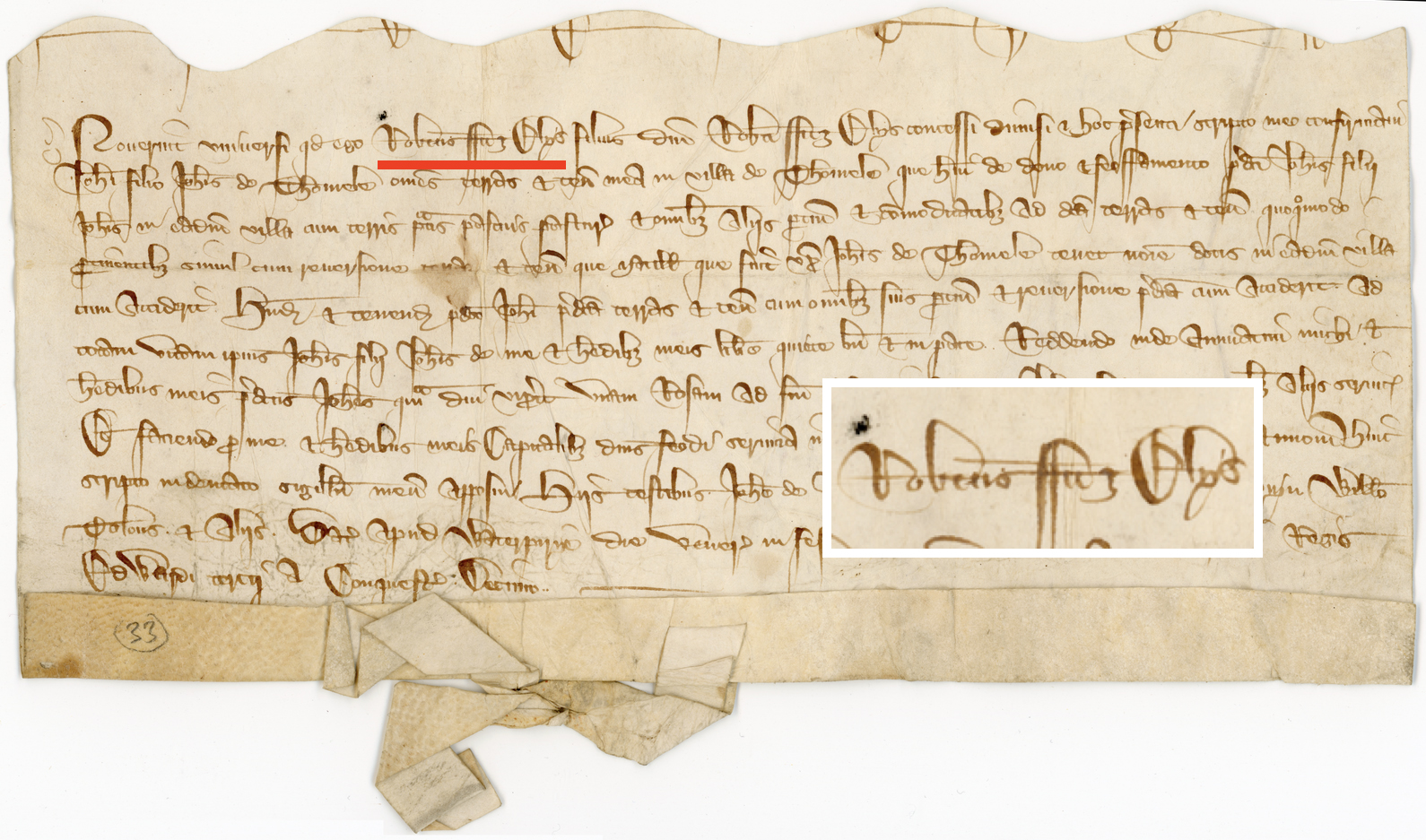
Certain English hands, particularly legal ones, did not use the usual capital F, so “ff” developed as an alternative to set off more important words. A chirograph—a kind of legal document, as opposed to chirography, used above, which is a synonym for handwriting—from 1337 written in an Anglicana script features the grantor’s name, Robert Fitz Elys, spelled with the double f in the first line.
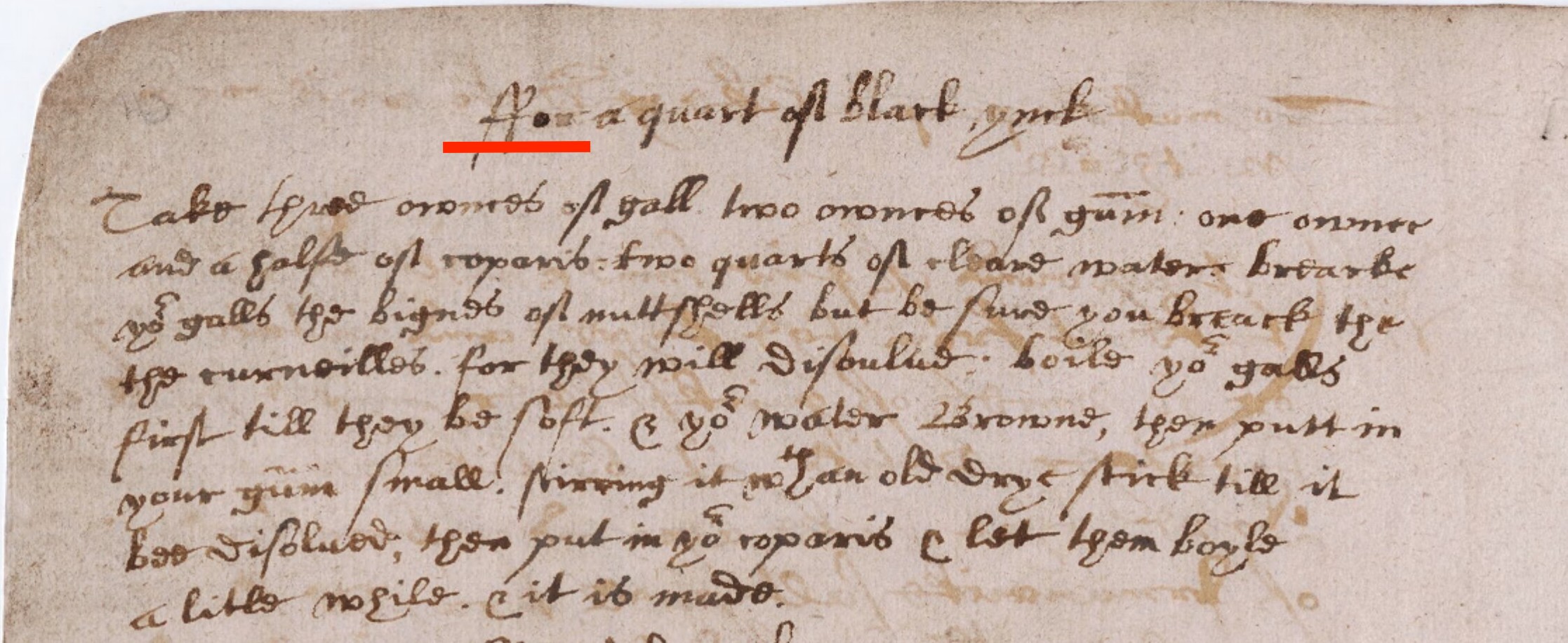
Hands varied over the time and by situation. A new style of writing called a secretary hand developed starting in the early sixteenth century. It also often used the double f form for a capital, as in this recipe “For a quart of black ynck” found in a commonplace book from 1595–1622:
New Haven, Beinecke Rare Book and Manuscript Library, MS Osborn a6, fol. 22v, detail.
As colonists sailed west from old England to New England, they brought with them their styles of handwriting. We saw John Cotton Jr.’s use of the double f above, and we can see it again in John Winthrop’s sermon notes, which were taken in England and brought over the Atlantic to the Massachusetts Bay Colony in its earliest years. In this note from Sept 2, 1627, Winthrop records, “Faith was now working by Love”:
John Winthrop, sermon notes for Sept 2, 1627, p. 356, Winthrop Family Papers, MHS
As the italic and later the round hand came to predominate over the secretary, the double f slowly disappeared from use in favor of the now familiar capital F. You can still see vestiges of it today, however, in last names like Ffoster.
Armed with this new knowledge, the next time you find yourself confronted by initial double fs don’t ffall into despair, sighing, “Oh, ffs.” Have Faith and, with a flash of recognition, think, “Oh! F!”
[ii] John Cotton Jr.’s notebook also contains sermon notes, a journal, and Latin exercises in another hand. The journal was previously published in Len Travers, “The Missionary Journal of John Cotton, Jr., 1666–1678,” Proceedings of the Massachusetts Historical Society 109 (1998): 52–101.
The Wôpanâak language fell into a century’s long dormancy beginning in the 19th century. It has recently been revived through the efforts of Jessie Little Doe Baird and the team at the Wôpanâak Language Reclamation Project.
[iii]The New England Historical and Genealogical Register 47 (April 1893): 212.
Several years ago, I launched an annual blog series transcribing a diary from exactly 100 years ago, month by month, for the Beehive. It’s been a fun way to get to know the everyday voices in our collection; since I began we’ve followed a year in the life of Boston matron Margaret Russell (1916), architect Lady Gertrude Codman Carter (1917), high school student Barbara Hillard Smith (1918), and George Hyland, a casual laborer living in southeastern Massachusetts (1919). This year, we are returning to the type of diary that inspired this project — the travel diary. In 2015, I published a series of posts featuring the travels of anonymous woman’s pleasure cruise down the Nile. As none of the diaries in our collection from the year 1920 stood out as particular candidates for a full year’s worth of transcription, I am going to offer up a bouquet of excerpts instead … one month for each diary, and each diary a different journey.
For the month of January, I have selected the diary of A.C. Woodworth, a businessman who was based in Chicopee, Mass. at the turn of the 20th century. The MHS holds two of his daily diaries covering the years 1894 and 1905 in which he kept records related to his travels and business dealings, expenses, family, and personal matters. The entries transcribed below recount his regional travels for work during the month of January 1894. At the beginning of January 1894 Woodworth accepted a position as traveling sales agent for the Field Life Guard Co., which sold “life guards,” or fenders, to be installed on the front of streetcars to prevent pedestrian fatalities. The below entries document his first few weeks in his new position.
* * *
Friday, January 5, 1894
Boston.
I had a long talk with Lawyer Nash, 19 Congress St. yesterday, and he told me he had brought Suit against Sam’l May to collect the notes amounting to $15,000 — which I hold against him. The suit is brought in Springfield though Mr. McClough may want to […] Nash and said he wanted a personal interview with me, and Nash made an appointment for me to meet May today at 11 o’clock but May did not turn up — Mr. Nash will push the suit to judgement but I hope May will offer to settle on some […] before that time. Had an interview with Lawyer Fowle — 53 State St. — about the […] Elevated R.R. Stock (yesterday) the stock is simply worthless. Fowle asked me to try to get Chicago people interested.
Saturday, January 6, 1894
Boston. Prov’c
I came to Providence this a.m. and took room 34 at the Hotel […]
I find Mr. Harris has not yet returned from Brooklyn where he went to have a trial […] but he is expected home today. Mr. Makepeace is sick in bed and […] me until tomorrow.
Met Mr. Wheeler on the […] went to the theater in the evening.
Sunday, January 7, 1894
Providence
I had a long talk with Mr. M […] today, at his home, where I took tea. M […] says he has cancelled […] $100-note I sent him, and will give me […] $200-note he holds on which I paid him $100 — I think he thought to do this because I have put as much money in working up […]
M […] told me all about […] in the Fender business & Harris Connection — also the chalk business.
Monday, January 8, 1894
Providence.
Harris has gone to Portland today to hold the annual stockholders meeting […] Field Life Guard Co. tomorrow (Wednesday) there will be a meeting after directors of that company held here in Providence when, if what Harris and Makepeace says comes true, an arrangement will be made with me to become their Western Agent on a salary of $2,500 per year and a commission of 10% on my sales — they to pay all my expenses.
Tuesday, January 9, 1894
Providence.
I had a long interview with Mr. Geo. H. Corliss and Miss. Corliss. I went to their house, cor. Angel & Prospect Sts. abt. 12 o’clock, by appointment made by Mr. Weeden (nephew) The interview was a very satisfactory one — but I am obliged to wait until the 20” of this month, before they will put a price on their property — at that time they will give me a price for the Geo. H. Corliss Engine Co. — Complete as it now stands, if the partners who are now negotiating for it have not closed the bargain.
I have this day engaged with the Field Life Guard Co. of this city, for six months at $200 per month salary and all my expenses — I am also to have 10% com on all the new business I bring the co. Salary to begin January 1/94.
Ames […] came to Chicopee this p.m. I have started my work for the Field Life Guard Co. Am going to Holyoke tomorrow morning & to Rochester in the afternoon.
Life Guard act.
R.R. to Chicopee $2.44
Genl exp. act.
Hotel bill $8.96
Meals $1.70
R.R. $2.44 $13.10
Friday, January 12, 1894
Chicopee, Holyoke & En Route.
Went to Holyoke this a.m. Saw Mayor Whitcomb & City Clerk. They have taken no action on the Fender business. Perkins out of city. Callahan dead. Am going to call Perkins Monday.
Life Guard act.
R.R. to Holyoke & return .24 c
Shirt […] .10
Dinner .75
Ink stand .50
Copy book 1.30
To Springfield .10 $2.99
R.R. to Rochester $6.94
Sleeper to “ 2.00
Supper on cars 1.00 9.94
Hotel .15
Cab to Hotel .50 65 13.58
Saturday, January 13, 1894
See […] in other book.
En Route, Rochester & Syracuse.
Arrived here this a.m. 3.20.
Went to Powers Hotel.
Lodging, Bkfst & Dinner 3.50
Other Exps. .45
Bus to depot .25
Telegram to Harris .35 .46 .81
Ticket to Syracuse 1.68
“ “ Sprg 5.30
Sleeper “ “ 1.50 13.49
Saw Prest & Secy of Rochester Railway Co. and arranged for trial of fender in about 10 days. Took measurements of car — gave price at $40 per car job at Worcester […] furnish man to supt putting fenders on cars — they have 150 cars to be fitted up. […] has been given the authority to fit up tr. cars — they have one very fine car that is to be fitted with nickel plated fender — they are going to have the Pittsburgh fender. […] $5,000,000–
John H. Beckley, Prest. F. P. Allen, Treas. C.A. Williams, Secy.
[gap in record]
Tuesday, January 16, 1894
M[…] Providence
Stayed at the Bay State House all night — Mr. F[…] came this AM and we went to the […] Co. together.
Telephone to Prov. .45
Car fares .20
Cigars .25
Bill at hotel 3.00
R.R. to Providence 1.10 5.00
Supper 45
F.L.G. Co. settled for Exp.
Chiropodist $5.00
Theatre 1.50
________________________
F. Co. Exp. to date $40.14
Wednesday, January 17, 1894
Providence & Brockton.
Field Life Guard Co. act.
Breakfast .65
Hotel 1.50
Dinner .50
R.R. to Taunton .60
Supper .35
R.R. to Brockton .80
Expenses .25 $4.65 4.82 9.47
Thursday, January 18, 1894
Worcester, Brockton & Providence.
I reached last [night] arriving at 9pm. Stopped at the B […] Hotel. Mr. C.B. Ragans Supt of this City .. will not put on fenders until he is obliged to.
Hotel 1.20
R.R. to Prov. 1.22
Papers .05
Dinner .60
R.R. to […] 1.10
Cigars .30
[…] .05
Telephoning .29 4.82
Received from the F.L.G. Co. p/c of Expenses $150
Friday, January 19, 1894
Mashpee & Boston.
Spent the day at Ames Plow Co. Field did not come as promised. Went to Boston at 4.22pm. Hotel 4– R.R. to Boston 1–
R[…] .35 Street Car .10
Messenger .28 Supper .90
_____________
F.L.G. Exps $6.60
Personal $5–
Mr. Field met me at Reynolds hotel this morning.
Saturday, January 20, 1894
Boston, Worcester, and Chicopee.
Took 7am train for Worcester, Field with me.
Hotel 2–
Breakfast […]
R.R. to Worcester 1–
Papers .10
R.R. to […] 1.24
R.R. to Chicopee .10 $2.89
[additional calculations]
Sunday, January 21, 1894
Chicopee & New York.
R.R. to New York 2.75
Street Car .05
Supper .75
Cigars .25 $3.80
I came to New York this evening and am stopping at the New Amsterdam Hotel cor. 21” and 4” Ave. Mr. Harris met me here at 11 o’clock.
Spent most of the day at the DeKalb […] shops with Harris and Field getting […] ready for […] Fender tomorrow. Saw […] a few moments.
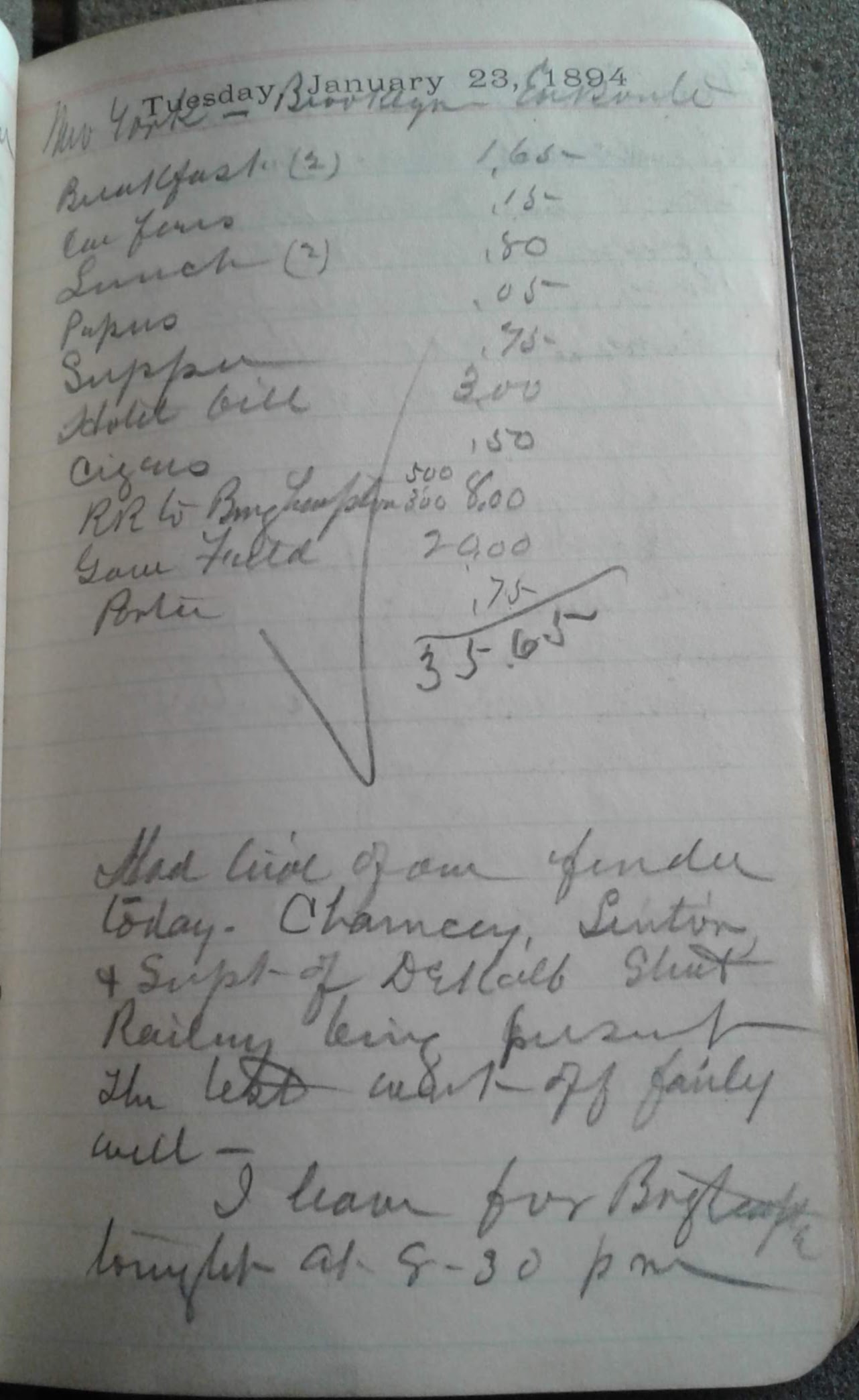
Page from diary of A.C. Woodworth, 23 January 1894
Tuesday, January 23, 1894
New York – Brooklyn – En Route.
Breakfast (2) 1.65
Cab fares .15
Lunch (2) .80
Papers .05
Supper .75
Hotel Bill 3.00
Cigars .50
R.R. to Binghampton 8.00
5.00
3.00
Gave Field 20.00
Porter .75 35.65
Had live [demonstration] of our fender today. Chauncy, Linton, and Supt. of DeKalb Short Railway being present. The test went off fairly well. I leave for Binghampton tonight at 8-30pm.
Wednesday, January 24, 1894
Binghampton & Rochester.
Arrived here this AM at 3-55 went to the […] Hotel. Saw Mr. G. Linny Pagus Prest. of the Binghampton Rd. Co.
Hotel Bill 1.25
R.R. to Rochester 3.65
Papers .05
Telegram .35
H[…] .50
Cigars .25 $6.05
Thursday, January 25, 1894
Rochester.
[illegible list of supplies and prices]
At work getting fenders on cars for trial.
[…] H. Moffett tonight that fender that would come off […].
Rec’d telegraph from Harris.
[gap in records]
Sunday, January 28, 1894
Rochester.
Sunday papers .75
Monday, January 29, 1894
Rochester – En Route.
Briefly went to New York yesterday — Had talk with Williams & Rasborough — Am to make a new fender & put on a car here. Packed up the 2 fenders and sent home by Express.
Helpers 1.25
Cigars .75
Car Fares .20
Papers .05 – 2.25
Hotel Bill (5 days) 17.50
Telegram from Moffitt .50
Buss [sic] .25
Supper .95
R.R. to Sp […] 6.92
Porter .25
Waiter .25
Sleeper to Sp […] 4.00
Cigars .25 Porter .50 33.12
Tuesday, January 30, 1894
En Route & Chicopee.
Porter .50
Breakfast .75
Dinner .50
Car fare .10 $1.45
Wednesday, January 31, 1894
Mashpee & […] & Prov.
R.R. to Prov. $2.44
“ “ .10
Exps .35
R.R. to […] 1.10
Papers .05
Dinner .65
Cigars .25
Telegram to Harris .55
Car Fares .10 5.59
Came back from Providence to Worcester this morning.
* * *
Please note that the diary transcription is a rough-and-ready version, not an authoritative transcript. Researchers wishing to use the diary in the course of their own work should verify the version found here with the manuscript original. The A.C. Woodworth diaries are unrestricted and may be consulted in our reading room. If you have questions about the collection, or about planning a visit to the library, please contact a member of the library staff for further assistance.