
Charles Cornish Pearson and the Great War, Part IV

By Susan Martin, Collection Services


This is the fourth post in a series about the wartime experience of Charles Cornish Pearson. Go back and read Part I, Part II, and Part III for the full story.

After a short hiatus, I’m happy to return to the story of Sgt. Charles Cornish Pearson of the 101st Machine Gun Battalion in World War I. We last heard from him in April 1918, so I’ll pick up now in May. I’ve been looking forward to this installment because it was during this month that Charles wrote some of my favorite letters in the collection.

Things were relatively quiet for Charles’ battalion after the terrible Battle of Seicheprey in northeastern France. Philip S. Wainwright says very little about the month of May 1918 in his History of the 101st Machine Gun Battalion, except that it “passed uneventfully.” But I imagine these calmer periods gave soldiers time to pause and reflect on their experiences, for better or worse. Certainly Charles wrote longer and more introspective letters this month, and in them he took a broader look at the war he’d been fighting for almost a year. He was housed in barracks somewhere near Seicheprey when he wrote to his parents on the 5th.

Please get the idea of the awfulness of this war out of your head […] We are not such a terribly afraid lot and as long as they keep us supplied with the necessary articles of food clothing & ammunition why we don’t kick a great deal. Money supplies & less politics are what we need over here and I hope the people in the U.S. will gradually awaken to these facts & the sooner they do so why the sooner the war will be over.


As for his recent “exciting experiences,” Charles showed remarkable composure (or at least put on a brave face for his family). His letters give us a fascinating look into the psychology of soldiers in the trenches.

Now that we have done our bit at the Front & had a taste of gas, shells air raids etc. why there isn’t much new to experience & one settles down to take it all as it comes. Do our bit & then try to forget about it as quickly as possible. […] We aren’t down hearted, but don’t think that we forget the serious side of this business and realize that the next day may be the time that we get our stomachful a plenty. Its all a matter of chance anyway & […] it makes little difference what you do, if its your turn, why you get it. 


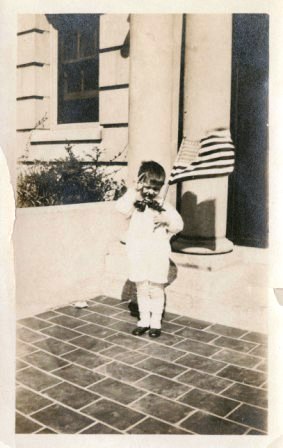
Fifteen days later, still enjoying the well-deserved rest and relaxation, he wrote at length to his younger sister Jean. The collection came with one photograph of her, taken ca. 1910-1915.


Jean—short for Jeannette—was about 26 years old in 1918 and lived in Masters, Colorado, with her husband Thomas B. McPherson and, I think, a young son and daughter. Unfortunately, the MHS doesn’t hold her letters to Charles, but she’d been a steadfast correspondent, often sending cigarettes and care packages. His letter, dated 20 May, reveals not only his affection for her, but also his sense of humor, compassion, and humility. After reassuring Jean that things were fairly quiet (“You don’t care for excitement these days after you have had a little of it”), he launched into a description of another soldier named Charlie. I particularly like his euphemism “over the weather,” which was a new one for me.

[He] was a little Sicilian in my old squad who when ever he got tight found the English language a little beyond him. […] He sure was a comical chap and furnished us with many a laugh. Used to always call me “Boss” and when he came in evenings a little bit over the weather would have to sit on the edge of my bunk and tell me all his troubles. Poor Charlie, he was not a success at the front. He developed a case of shell shock and was sent back to the Base and suppose we will never see him again.

Later he corrected a misunderstanding in his endearingly modest way.

Where do you get that “Hero” stuff in your last letter? Indifference to fear etc. Don’t you believe it for a minute. Yours truly is just as frightened as the next fellow and can duck and run for dug-out just as quick as the next fellow. Still this fear stuff doesn’t figure a great deal at that; you may be scared to death still if you have to do something why you have to, that is all.

And he explained in no uncertain terms who the real heroes were, downplaying his own hardships and betraying not even a trace of self-pity.

Besides as far as danger goes we don’t get it the way the doughboys do, he is the fellow that stands the brunt of this war and deserves the credit even more than any other line of service, aviators not excepted. Why? because he stands real hardship which many of us are lucky to get out of. He goes up to the trenches for six or seven days at a stretch, lives in mud and water, gets very little sleep and eats when he gets a chance […] To see those boys hiking back from the trenches makes one (who doesn’t get that part of the game) think that doughboy is the fellow to be pitied.

Stay tuned for Part V of Charles’ story.

“Across wide fields of melting snow / The winds of summer softly blow”: The Easter poems of Lucy Larcom

By Anna J. Clutterbuck-Cook, Reader Services

On March 20th we marked the spring equinox here in New England with the arrival of our fourth nor’easter of the month. After a warmer-than-average February we found ourselves bundling up for a colder-than-average March and spring has seemed further around the corner than it ought to be. In this week that marks both the Jewish Passover and Christian Easter holidays, I decided to share a poem for spring from New England poet Lucy Larcom.

A book of Easter poems
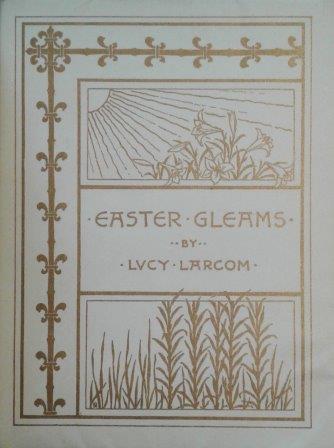
Easter Gleams, by Lucy Larcom, 1891

Many of you have likely encountered nineteenth-century writer Lucy Larcom through her autobiographical work A New England Girlhood (1889) which tells the story of her childhood in Beverly, Massachusetts and her experience working in the mills of Lowell before she traveled west to Illinois to become a teacher and later returned to Massachusetts to make her living as a writer and editor. In 1891, Larcom published a small collection of Easter poems, Easter Gleams with Riverside Press an imprint of Houghton, Mifflin & Company based in Cambridge, Massachusetts. Riverside had also published Larcom’s Girlhood three years before. Below are the poems “Ring! Happy Bells!” (5) poem “Sunrise” (13) from Easter Gleams.

Ring! Happy Bells!

Ring, happy bells of Easter time!

The world is glad to hear your chime;

Across wide field of melting snow

The winds of summer softly blow,

And birds and streams repeat the chime

Of Easter time.

Ring, happy bells of Easter time!

The world takes up your chant sublime,

The Lord has risen!” The night of fear

Has passed away, and heaven draws near:

We breathe the air of that blest clime,

At Easter time.

Ring, happy bells of Easter time!

Our happy hearts give back your chime!

The Lord has risen! We die no more:

He opens wide the heavenly door;

He meets us, while to Him we climb,

At Easter time.


Sunrise.

The Sunrise over the houses!

The beautiful rose of dawn

Reddening the eastern windows, —

The curtains of Night withdrawn!

More lovely than boughs in blossom

The spires and the roof-trees glow.

It is day; and, in God awaking,

Shall the spirit unfold and grow.

On the city, in chrismal splendor,

The blessing of morning falls: —

The Bride coming down out of heaven! —

The pearl-gates, the jasper walls!

The white light enters the casement

Like the wings of the Holy Dove;

And every house is a flower,

A blossom of peace and love.

The sunrise is fair on the gardens,

The groves and the forests afar;

But fairer the trees of manhood,

Of heavenly planting are.

And wide are the green savannahs

That under the dawn unroll;

But broader the landscape opens

In the sunrise of a soul!

The footsteps of morning hasten

Across yonder populous space,

And the dwellings of men are illumined

With the glory of God’s own face.

Who can guess the power of His coming?

He will banish doubt and despair;

The life of His Spirit will kindle

And stir the sleepers there.

Behold the Day Star ascending!

See the hour of His triumph begin!

The sunrise over the houses!

The Christ-light shining in!

In addition to holding a print copy of Easter Gleams and other published works by Larcom, the Massachusetts Historical Society holds Larcom’s diaries, correspondence, and other manuscript materials, principally in the Daniel Dulany Addison collection. We also hold issues of Our Young Folks (1865-1873) and the Lowell Offering (1840-1845), both of which Larcom was deeply involved in as a writer and editor. Researchers interested in accessing Larcom’s writings may visit the library or contact the reader services staff to learn about options for reproduction.

World Poetry Day, Porcine Edition

By Daniel T. Hinchen, Reader Services

Today, 21 March, is World Poetry Day as proclaimed by UNESCO in 1999. To recognize this designation we will look at a bit of newly-acquired poetry found here in the collections at the MHS. 

A few years ago here on the Beehive I published a post, “Porcineographs and Piggeries” about a man named William Emerson Baker and his vast estate, Ridge Hill Farms. In the original post I included references to a Guide to Ridge Hill Farms held here at the Society, as well as an invitation “to assist in laying the corner stone of a new piggery” on the estate, and my personal favorite, the Porcineograph.* 


The Society recently acquired several more items related to Ridge Hill Farms and Baker, generally, and some that specifically detail the lavish party held to lay the corner stone of his new piggery. In a printing titled Fete Champetre at the laying of the coner-stone for the new piggery…“, a contributor mourns the dearth of verse dedicated to pigs: 


The Pig and the Poets.

Almost every domestic animal has found his Homer among the poets. The horse, the dog, the cat, all have been celebrated in immortal verse. The pig, on the contrary, has been neglected by the brotherhood of bards; and the most persons would find it difficult to cite a single friendly reference to this despised creature in the writings of British poets. The pig seems to have been born under an evil star. He is never esteemed until he is dead. During his life, man gives him the cold shoulder: when he is dead, man takes it back.


What follows this brief lamentation is a series of responses to Baker’s invitations to join the festivities, including a handful of poems dedicated to his porcine pals. In honor of World Poetry Day, I present one such poem here. 


To the Ridge Hill Piggery.


Tall oaks from little acorns grow;

Great deeds from little causes flow.

The corner-stone of this new piggery

Is monument of past-time Whiggery,

When porkers, rooting for their dinner,

Cured old Great Britain, that great sinner,

And, making war upon strange gardens,

Set the old lady asking pardons;

And so she yielded up her knavery

That bound our seamen in her slavery.

All honor to the pigs immortal

Who brought the key to freedom’s portal!

They shall be praised with feast and song

As years roll on, and ages long, 

And voices chant the glorious bravery

Of those who broke our seamen’s slavery;

While grunting piggeries shall proclaim

From shore to shore each glorious name

Of porcine pilgrim, who began

The contest brave, that swiftly ran

Through House and Senate, and put down

The claim to search from Britain’s crown.

Let their bold choruses of grunts

Still meet all national affronts,

And stir the hearts of man and beast,

From North to South, from West to East.

All praise to all brave pigs forever!

Let piggeries multiply; and never

The glorious race, or noble donors,

Live but in health and wealth and honors!*

Mrs. G. L. Ford


Stay tuned to the Beehive for more recently-acquired items relating to the eccentric William Emerson Baker and Ridge Hill Farms. And if you just cannot wait until then, consider Visiting the Library. Who knows, there could be many a piggy punny you just might find funny.


*The Porcineograph provides a small tidbit of information that sheds some light on the topic of Mrs. Ford’s poem: “Litigation about the killing of two hogs found trespassing in a garden in Rhode Island in 1811, is said to have resulted in the election of the opposition candidate, Howell, to the United States Senate, and the Declaration of War in 1812.” 

From Absolute Monarchy to Absolute Demon: “Identity of Napoleon and Antichrist”

By Ashley Williams, Reader Services

As a newer library assistant in the MHS library, I occasionally peruse different subjects in ABIGAIL in the hopes of further familiarizing myself with topics our collections cover. Often, the search topics pertain to my own historical interests. A few months ago I was looking into our Napoleon-related materials when I came across this leviathan of a title: The Identity of Napoleon and Antichrist completely demonstrated, or, A commentary on the chapters of the Scripture which relate to Antichrist [microform] : where all the passages are shown to apply to Napoleon in the most striking manner : and where especially the prophetic number 666 is found in his name, with perfect exactness, in two different manners. 


This “observation,” as defined by the text, has no attributed author but was published by Ezra Sergeant in 1809, the same year the War of the Fifth Coalition was fought. It is no great secret that Napoleon had enemies, but to realize that he was despised enough to be compared as Antichrist was too thought-provoking a concept to let lie. As soon as time afforded, I pulled out the microfilm to take a peek.

Before diving into the topic of their reflection the author takes a few pages to chastise philosophers like Locke, Rousseau, and Voltaire for furthering the spread of deism and religious tolerance, seeing it as promotion for war against Christianity:

We never ought to use against any body the arms of satire and ridicule, which both reason and Religion disown. But to permit in this way the weakest boldly and openly to make war against the strongest, to tolerate it, and not to take care sometimes to set every one at his proper place, is what I consider as entirely abusive.


Throughout the work, the author notes what they consider to be several blatant parallels between passages from the Bible’s book of Revelations and Napoleon’s reign. They conclude that Napoleon and “the beast” share the same origins as the beast is prophesied to emerge from the sea and Napoleon, being Corsican, comes from an island.

The parallel of second beast is given to Charles Maurice de Talleyrand-Périgord, a French diplomat known for promoting the nationalization of church property in France during the beginnings of the French Revolution. The description of the second beast reads, “And he exerciseth all the power of the first beast before him, and causeth the earth and them which dwell therein to worship the first beast, whose deadly wound was healed.” (Revelation 13:12)

Tallyrand played a large role in foreign ministry under Napoleon and was eventually appointed grand chamberlain. He worked to keep peace with the British and encouraged the signing of the Concordat of 1801 which mended the alliance between France and the Papacy.² Unfortunately, he was also an accessory to the kidnapping and execution of a Bourbon prince and attempted to steal from the French National Archive to hide his involvement.¹ While this was a crime to the outside world, it helped to safeguard Napoleon’s rule. The author attributes a great deal of Napoleon’s success to the tireless work of Talleyrand which earns him the parallel.

After assigning the roles of Revelation to different people and countries, the author interprets the symbolism they perceive in the mark of the beast:

And he causeth all, both small and great, rich and poor, free and bond, to receive a mark in their right hand, or in their foreheads: And that no man might buy or sell, save he that had the mark, or the name of the beast, or the number of his name. (Revelation 13:16-17)

Given that Napoleon’s rule was arguably one of militant conquest the author argues that this mark in the hand or forehead is materialized by the French cockade, typically worn in hats, and the swords of the French military. To make applicable the hindrance of buying and selling in verse 17, the author alludes to Napoleon’s interference with European trade. In 1806, Napoleon issued the Berlin Decrees forbidding trade between his allies and England in the hopes of wounding England’s economy.³ This was not altogether unsuccessful, however, since England ruled the seas and moving goods over land was rather expensive, many of continental Europe’s economies suffered as well.

One of the final and farthest reaching pieces of evidence our author declares is mentioned in the title, “…where especially the prophetic number 666 is found in his name…” The author uses two different series of numbers aligned with letters of the English alphabet to spell out different versions of Napoleon’s name. In each case the numerical values assigned to the letters in his name equal 666. 


One can’t help but wonder just how many combinations of numbers and names the author calculated before getting the desired results.

These are just a few highlights of the connections drawn in this work. If you are interested in reading more parallels or perhaps viewing other Napoleon-related materials, check our online catalog, ABIGAIL, and consider stopping by the library for a Visit!

*****


1. “Charles-Maurice de Talleyrand, prince de Bénévent | French statesman and diplomat”. Encyclopedia Britannica, Accessed 2018-03-09 at https://www.britannica.com/biography/Charles-Maurice-de-Talleyrand-prince-de-Benevent.

2. “Concordat Of 1801 | French Religious History”. Encyclopedia Britannica, Accessed 2018-03-09 at https://www.britannica.com/event/Concordat-of-1801.

3. “Continental System | European History”. Encyclopedia Britannica, Accessed 2018-03-09 at https://www.britannica.com/event/Continental-System#ref71521.


“Too many things to do in the cause”

By Susan Martin, Collection Services

As I looked through the MHS collections for a Massachusetts woman to profile for Women’s History Month, I found myself faced with an embarrassment of riches. Our library holds the papers of female writers, doctors, teachers, artists, war volunteers, and mill workers, not to mention slaves and First Ladies. I decided to go back to a letter acquired by the MHS a few years ago. The letter was written by Lucy Stone on election day 1890, and I remembered her terrifically snarky opening sentence: “This is the day when our political superiors are electing rulers for Women!!”


Lucy Stone (1818-1893) was a suffragist and abolitionist from West Brookfield, Mass., famous for her oratory at a time when public speaking by women was considered scandalous and unfeminine. According to one account, before an appearance by Stone, a certain minister warned his congregation that “a hen will undertake to crow like a cock.” Opponents of her speeches shouted her down, threw hymn books at her, and even once dowsed her with water from a hose. As Sally G. McMillen wrote in her biography Lucy Stone: An Unapologetic Life (2015):

To say that most mid-nineteenth-century Americans deemed this occupation wholly inappropriate for women was a truism. Women were not supposed to have a public persona; they were supposed to marry and spend their lives in the quiet of home. And the two causes that Lucy espoused on which she intended to speak were radical ones. [p. 63]


Stone is also known for her refusal to take her husband’s name when she married—later advocates of this practice were often called “Lucy Stoners.”

This letter was written on the stationery of the Woman’s Journal, a paper founded in 1870 by Stone, her husband, and other like-minded reformers. The recipient, Mrs. Steele, had submitted an article, and Stone wrote back to explain that she couldn’t pay for contributions; the paper “had hard uphill work all the time and as hard now as ever was.” She offered Steele a one-year subscription instead and finished with: “I am sorry not to have said this sooner. But too many things to do in the cause.”

I had hoped to identify Mrs. Steele, but unfortunately came up empty. I did find three possible candidates: Lucy Page Steele of Washington, D.C., who wrote for the Young Woman’s Journal; Anna (Truax) Steele, wife of Colorado’s Chief Justice Robert W. Steele; or Carrie Steele, the “Mother of Orphans,” a former slave and founder of an African-American orphanage in Atlanta, Ga.

Lucy Stone did not live to see the battle for suffrage won for all American women, which wouldn’t happen for 27 more years with the passage of the Nineteenth Amendment. But less than three weeks after her death, on 7 November 1893, Colorado became the first state to enact women’s suffrage through popular vote.

Lucy Stone, Abigail Adams, and Phillis Wheatley are honored in the Boston Women’s Memorial on the Commonwealth Avenue Mall.

Book Review: “The Palatine Wreck: The Legend of the New England Ghost Ship”

By Erin Weinman, Reader Services


For nearly three centuries, stories of a burning ghost ship haunted the residents of Block Island, Rhode Island. Although it is unknown what it was witnesses have seen, the origin of “The Palatine Light” tells a different tale then the one passed down through popular culture. The Palatine Wreck: The Legend of the New England Ghost Ship by Jill Farinelli examines how the legend developed from the wreck of the Princess Augusta and explores how legends can emerge from public memory. By examining surviving letters of passengers, notarial records, and newspaper accounts of merchant ships, Farinelli was able to piece together a narrative of the Princess Augusta’s final journey in 1738 (xv-xvii). Further information on witnessed accounts of the ghost ship and surviving artifacts of the shipwreck was provided by Block Island’s historians. Jill Farinelli has worked as a freelance writer and editor for twenty-five years in Boston, Massachusetts. The Palatine Wreck is her first work of historical non-fiction.

In January 1867, the poet John Greenleaf Whittier published a poem titled “The Palatine” in the Atlantic Monthly. Based on a tale he heard from a friend, the poem was the first to launch the legend of “The Palatine Light” into mainstream society (158).

“The Palatine Light, from an illustration in the Providence Evening Bulletin, September 12, 1933. Image courtesy of the Boston Public Library.”


For still, on many a moonless night,

From Kingston Head and from Montauk light

The spectre kindles and burns in sight.


Now low and dim, now clear and higher,

Leaps up the terrible Ghost of Fire,

Then, slowly sinking, the flames expire.


And the wise Sound skippers, though skies be fine,

Reef their sails when they see the sign

Of the blazing wreck of the Palatine!


They burned the wreck of the Palatine.”


The origin of the Palatine Light legend began in 1738. Palatines, a name given to the people who resided in regions along the Rhine of modern-day Germany, began emigrating in vast numbers in the early 18th-century. As Farinelli examines, over 6,500 emigrants made their way to the British colonies in 1738 alone in hopes of a better economic opportunity in the Pennsylvania colony (169). Unfortunately, the 1738 sailing season would be one of the deadliest in history, with a death rate of 35 percent. Massive storms in the Atlantic and ill-preparation for numerous overcrowded ships were to blame. The Princess Augusta departed from Rotterdam in June 1738 with an estimated 340 passengers. While only 68 would survive the journey across the Atlantic, it was the ship’s destruction within the sandbanks of Block Island that brought wide-spread attention to the voyage.

Farinelli explores how such a common story captivated the public’s mind in final section of the book. Why was the Princess Augusta the event to be immortalized? One idea Farinelli explores is the rise of the Spiritualist Movement in the 19th century. People became interested in the paranormal and were simply captivated by stories believed to be started by the ship’s survivors, allowing them to remain popular amongst New Englanders (144-145). While Farinelli and other researchers are unsure what exactly caused the illusion of a burning ship, the legend has been embraced by many New Englanders.

“Map of Block Island.

Map: Patti Isaacs, 45th Parallel Maps and Infographics.”


Farinelli’s research on the works of 19th-century New England writers, interviews with local Block Island historians, and years of researching Palatine emigration allows The Palatine Wreck to work as a case study for how history can transform itself into legend. A mixture of human tragedy fueled by the national rise in Spiritualism sparked interest amongst artists, who used the legend within their own fictional works. Whittier may have been the most famous example, but a number of writers had interpreted the event in their own ways. The emergence of Spiritualism sparked interest in these types of tales, combined with increased tourism in Block Island. At the end, Farinelli points out that this isn’t necessarily a bad thing.

In the end it doesn’t matter whether the Palatine Light is a phantom, a figment, or a floating mass of dinoflagellates. Because the light has become an integral part of the legend, its reappearances has served a continual reminder of the tale. Without it, the Princess Augusta and its many passengers lost to the sea, would be lost to history as well. (152).

This book may be of particular interest to those who study transatlantic migration, German migration, and the development of public memory. Local New England residents who are familiar with the tale of “The Palatine Light” may also be interested, as the book provides a thorough background to the incident. The Massachusetts Historical Society holds a number of collections that complement the themes of this book including Palatine migration, transatlantic history, spiritualism, and maritime culture: 


Manuscripts

Depositions of officers of the Palatine ship Princess Augusta, 1939

The Palatine, or, German immigration to New York and Pennsylvania, 1897

John Erving logbooks, 1727-1730

Log of the Brigantine Dolphin, 1732-1734


Printed Material

Early eighteenth century Palatine emigration: a British Government Redempitioner Project to Manufacture Naval Stores by Walter Allen Knittle [Philadelphia: S.N., 1936]

Boston in the Golden Age of Spiritualism: Séances, Mediums, and Immortality by Dee Morris [Charleston, SC: History Press, 2014]


To work with these materials, or any other collections at the MHS, consider Visiting the Library!

*****

[Updated, 5 March 2018, to include images.]

“He has been the great landmark of my life”: CFA on JQA’s death and legacy.

By Gwen Fries, Adams Papers

On a drizzly February morning in 1848, Charles Francis Adams, son of John Quincy Adams, walked into his Boston office. As he reached his desk, Adams noticed a telegraph that communicated that his father “whilst in his seat at the House of Representatives at half past one o’clock was taken in another fit of paralysis and that it was not thought he could survive the day,” CFA wrote in his diary. Adams was on the next train south.

Charles Francis Adams, Photogravure, from “Portraits of American Abolitionists,” MHS.


Delays prevented Adams from making his connection to Philadelphia. As he waited for the next train, Adams began reading the book his wife had sent with him, Jane Eyre. That night, February 23rd, he anxiously read a newspaper that had reports from 11 p.m. on the 22nd that John Quincy “lingered.”

The next morning, while on the train to Baltimore, Charles Francis opened that day’s paper.

The first thing I saw was the announcement that at a quarter past seven last night my father had ceased to breathe. . . . Here then it is in all its reality— I have no longer a Father.

After another short layover in Baltimore, Charles Francis reached his parents’ home in Washington, D.C. He went straight upstairs to comfort his mother, Louisa Catherine. Charles Francis sat with her until it was time to go to bed.

She then told me she had no place to put me in but his room— And I went to it, just as he had left it on Monday morning: Yes there was his table and chair, his papers and writing materials, his bed and all his materials for his late sick life. And the animating spirit was not there and I was.

Charles Francis got little sleep.

The next day, his mother was “in a low, fainting state all day, and utterly unable to say any thing.” After a morning of greeting acquaintances and thanking them for their condolences, Charles Francis traveled to the House. He was ushered through crowds to the coffin, where he was left alone. “And here I was to take my last look upon one to whom for forty years I had been looking for support and aid and encouragement!” Charles Francis studied his father’s face through a glass pane and considered his future responsibilities. Poignantly, Adams reflected that he was “alone in the generation,” as his two older brothers and younger sister had all already passed away. He shed a few tears before returning to the committee room to discuss arrangements “until every nerve in me quivered.”

His mother being too unwell to attend, Charles Francis represented his family at the funeral. As he stood on the steps of the Capitol waiting for his carriage, he felt acutely the curious eyes of gawkers and resolutely stared ahead, reflecting on his father’s influence. “He has been the great landmark of my life,” Charles Francis wrote. “My stay and companion.” As he descended the stairs and climbed into the carriage, Adams prepared himself to become the Adams patriarch. “For the future I must walk alone and others must lean on me.”


When the Harlem Renaissance Meets Jim Crow

By Susan Martin, Collections Services

Your reference to the southerners regard, or rather, disregard of the Negro [–] I experienced a rather amusing incident a few weeks ago.


This passage comes from a letter written by African-American artist Meta Warrick Fuller on 5 January 1928 and recently acquired by the MHS. Fuller’s correspondent was Marion Colvin Deane, a white Canadian woman who worked at Virginia’s historically black Hampton Institute. Deane was an avid collector of autographs, particularly those of famous black writers, artists, educators, intellectuals, and activists. She wrote to Fuller, W.E.B. Du Bois, Marcus Garvey, Walter F. White, and many others soliciting autographs for her collection.

Meta Vaux Warrick Fuller (1877-1968) was an accomplished and acclaimed black sculptor associated with the Harlem Renaissance, though her work spanned the decades both before and after that era. Born in Philadelphia, her early artistic promise was nurtured by her family, and she studied art in Philadelphia before traveling to France in 1899 to attend the Académie Colarossi and the École des Beaux-Arts. In France, she met and was mentored by Auguste Rodin. Her work was exhibited alongside older and more established contemporaries like John Singer Sargent and Mary Cassatt, and she would go to win many commissions and awards over her lifetime.

In 1928, when Marion C. Deane wrote to her, Fuller was living in Framingham, Mass. with her husband Solomon Carter Fuller and their three sons. She worked in her own private studio behind the house.

Fuller began her reply to Deane by apologizing for her handwriting and thanking Deane for “the kind interest and regard – may I be worthy of them.” Then, in response to a comment by Deane on Southern racial animosity, she described a recent “amusing incident” on a Framingham bus. Returning from a shopping trip and finding the bus crowded, Fuller opted to sit in the back, although for her this was “contrary to custom.” From there, she overheard “a youngish sort of woman”—a white woman presumably visiting from the South—talking to a friend.

I could still hear the conversation – she spoke of how strange it seemed to see colored people mingling with white people – in schools – restaurants and the like – she would go out if one sat down at a table with her – it didn’t seem right.


And what was Fuller’s reaction? Maybe not what you’d expect.

It all impressed me as very funny – and mischief got the better of me – I wrote on a slip of paper ‘God made man of one flesh[.]’ I rolled it up, and as I passed on my way out dropped it in her lap. I was convulsed at the expression of surprise when she saw what I had done, but I left the car before she had time to read it. I have not since seen the woman with whom she was talking but I am curious to know what she did after reading it.


The MHS currently holds no other papers of Meta Warrick Fuller, so this letter is a very welcome addition to our collection. It’s also a fascinating record of racial attitudes in the years between the Plessy v. Ferguson “separate but equal” decision and the height of the civil rights movement in America.


Fetched from the Stacks : “Every breed of dog known”

By Daniel Tobias Hinchen

Well, maybe that title is a little bit ambitious. But, in recognition of the 142nd annual Westminster Kennel Club Dog Show – taking place this weekend – today we are looking at collections items featuring canines, particularly images of dogs that are in the stacks here at the MHS (the images, not the dogs). 

In 1845, Sir John Franklin, English rear admiral and explorer, led an expedition in search of the Northwest Passage. However, his journey met with disaster and, three years later, the remains of he and his crew were found in the Canadian Arctic.1 Of the several search and rescue missions put together to find Franklin and his men, one was carried out by the H.M.S. Enterprise and included some four-legged crew members.

“Daddy,” the Esquimaux dog of H. M. S. “Enterprise,” sent in search of Sir John Franklin.

According to a bit of text that is alongside the above image

The intelligence of the Esquimaux dogs, and their utility, is well known. The portrait of “Daddy” represents a faithful companion of Captain Collinson, who accompanied him 2000 miles, and of whom many anecdotes might be narrated; but one of the most interesting attaches to a dog of Capt. Penny, “Sultan,” who saved the life of one of Sir John Ross’ men who had indulged too freely on a visit to the Felix, when in winter quarters. The man alluded to was found by Sultan floundering in the snow at midnight, and, by his repeated intimations of something having occurred, induced some of the men to leave the ship and follow him to the spot. A few minutes more and life would have been extinct.


The following images have much less information to go along with them, but you can click on the links to see what we know.

Boxser. [graphic]


High life : from the picture in the Vernon Gallery [graphic] / E. Landseer, R. A. painter ; H. Beckwith engraver


Dog [graphic]


Fox-hunting, p. 1 / [graphic] Howitt in et f.


First aid / [graphic] Diana Thorne


Finally, we can connect all of this to another recent post published here on the Beehive. A few weeks ago we learned a bit about the famed showman P. T. Barnum, his lavish estate called Iranistan, and how he managed to attract the Swedish Nightingale, Jenny Lind, to perform in America. [See: “No Mere Adventurer…”]

Today, we probably associate Barnum most closely with the rise of the traveling circus, but did you know he also dabbled in dog shows? 


Small broadside advertising “A Great National Dog Show.”


As manager of Boston’s Aquarial Gardens, Barnum arranged for a six-day show, “including every breed of dog known,” with prize money going to the top two or three finishers in each category. Those who did not finish in the top tier were given “elegantly engraved Diplomas” as evidence of the quality of their canines. Among the various breeds and classes to be judged at this event were Newfoundlands, Pointers, Coach Dogs, and Esquimaux Dogs (just like “Daddy”). Below is an example of a prize diploma. 

An elegantly engraved Diploma, “Awarded by the judges to S. Hammond Esq. for his Blenheim Spaniel.”


Based on the information provided in the advertisement above, Mr. Hammond stood to win $10 for his best-specimen spaniel. However, the last page of the three-page ad also lays out some stipulations from Mr. Barnum. To wit: 

Should the Manager desire to retain the Cash Premium Dogs on exhibition from and including June 23rd until and including Saturday June 28th, he shall have the right to do so, he continuing to provide the proper care, food and water for the Dogs FREE, and continuing to admit exhibitors of said dogs free during the time above specified.

Ever the entrepreneur and showman, it makes sense that Barnum would retain the right to attract more viewers for these prize-winning dogs. Cash paid is cash earned, I suppose. 


These are just a few examples of animal illustrations available here at the MHS. Try searching our online catalog, ABIGAIL, to see what else you can find, then consider Visiting the Library to work with material in our reading room!

*****

1. “Sir John Franklin,” Encyclopaedia Britannica, Accessed 2018-02-10 at https://www/britannica.com/biography/John-Franklin


Barbara Hillard Smith’s Diary, January 1918

By Anna Clutterbuck-Cook, Reader Services, and Intern Lindsay Bina

A new year means a new serialized diary here at The Beehive, where for the past three years we have showcased a diary from the collections written one hundred years ago (you can read the 2015, 2016, and 2017 series in our archives!). This year’s diary was transcribed by intern Lindsay Bina.


The diary for 2018 is a tiny line-a-day diary kept by teenager Barbara Hillard Smith. Smith was born on 16 July 1903 and was fourteen in January of 1918 when she began keeping her diary. Before she began to record her daily activities, Barbara carefully completed the “Identification” page in the front of the diary, noting that her weight was 126, her height 5 feet, 6 ½ inches, her shoe size a 7, her hosiery 10 ½, and her gloves 6 ¼. Her telephone number was Newton West 193-M and her physician was an H.W. Godfrey. She was a student at Newton High School.

Image from The Newtonian (1920) yearbook. Barbara was captain of her basketball team senior year and is depicted in the center holding a basketball.


Without further ado, we bring you January 1918 through the eyes of a Newton teenager.

* * *

TUES. 1                      JAN., 1918 NEW YEAR’S DAY

Muriel’s. Skating at Bulloughs. Women Club Play


WED. 2

Went over to Aunt Mabels.


THUR. 3      

Mother went to New York. Aunt Mabels.


FRI. 4

Aunt Mabels


SAT. 5

Aunt Mabels


SUN. 6

Came home


MON. 7

School. Took care of the baby.


TUES. 8

School. Basket Ball.


WED. 9

Sick with cold. Peg hurt her back


THUR. 10

Sick with cold. Had Dr. Godfrey.


FRI. 11

Cold Better. Mother came home


SAT. 12

In the house. Down street.


SUN. 13

Church. Sunday School. Service flag unfurled. Skating in back yard. Sick


MON. 14

School. Stayed for algebra. Pegs skating


TUES. 15

School. Stayed for geometry. Pegs.


WED. 16

School. Stayed for French. Skating in front yard.


THUR. 17

School. Skating at Pegs. Concert at the Seminary


FRI. 18

School. Down to Rosa’s. Watched swimming class.


SAT. 19

Shampoo at Miss Mitchells. Sewed on my dress. Down town


SUN. 20

Sunday School. Hung around


MON. 21

School. Took care of the baby.


TUES. 22

School. Basketball. up to Mrs. Reed’s


WED. 23

School. Took care of baby.


THUR. 24

School. Basketball


FRI. 25

School. Camp Fire. Swimming.


SAT. 26

Skating with Mrs. Moody. Pegs. Mother Carey’s Chickens.


SUN. 27

Church. S.S. Skating at Pegs. [Havene] here. Fell down and hurt my back


MON. 28

Home with my back. Felt kind of weak


TUES. 29

Home with my back. Took care of sonny. Father died.


WED. 30

School. Took care of sonny.


THUR. 31

School. Basket Ball. Symphony and Mischa Elman.


* * *

If you are interested in viewing the diary in person in our library or have other questions about the collection, please visit the library or contact a member of the library staff for further assistance.


 *Please note that the diary transcription is a rough-and-ready version, not an authoritative transcript. Researchers wishing to use the diary in the course of their own work should verify the version found here with the manuscript original. The catalog record for the Barbara Hillard Smith collection may be found here.