
Fornication as Crime in 18th-Century Massachusetts

By Brendan Kieran, Reader Services

While the MHS is not home to a large collection of court records, I recently viewed two items we do hold relating to fornication in 18th-century Massachusetts. These materials concern judicial proceedings that were separated by nearly sixty years, but provide interesting glimpses into the criminalization of sex in colonial Massachusetts. Through further investigation, I learned more about the ways the judicial system addressed sexuality during this period, including the significance of race and gender within the system.


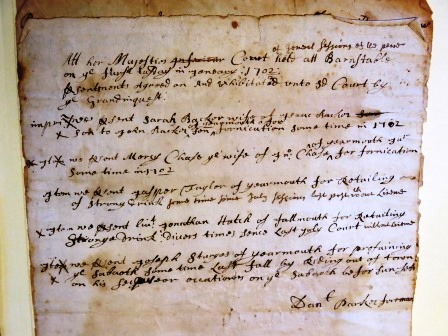
A small collection of Barnstable County (Mass.) legal documents includes one “memorandum of presentments to the Court of General Sessions of the Peace.” This January 1702 document, which bears the signature of foreman Daniel Parker, notes two cases of unlicensed sale of liquor, one case of profaning the Sabbath, and two cases of fornication. The people accused of fornication are Sarah [Backer?] and [Mercy Chase,] both of whom were married at the time; each supposedly engaged in “fornication some time in 1702.”


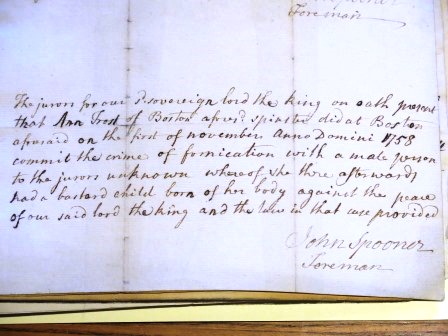
A Grand Jury presentment, 1 January 1760, located in our Miscellaneous Bound Manuscripts collection, notes an accusation against Ann Frost, a Boston resident who supposedly engaged in fornication on 1 November 1758. The man involved was “to the jurors unknown.” Frost had a child out of wedlock, “against the peace of our said lord the king and the laws in that case provided.” This presentment bears the signature of foreman John Spooner and was created for a Court of General Sessions of the Peace for Suffolk County-ordered grand jury.

In Regulating Passion: Sexuality and Patriarchal Rule in Massachusetts, 1700-1830 (Oxford: Oxford University Press, 2014), Kelly A. Ryan (a former Andrew W. Mellon fellow at the MHS) writes that, during the 18th century, white women became the main targets of fornication charges in the Massachusetts judicial system, while punishment of men for fornication dwindled beginning in the mid-17th century as sex outside of marriage came to be seen as a legal issue for women, not men (13-14, 21-23). Additionally, for much of the 17th-century colonial period, “premarital sex” was the main cause of fornication charges; however, in the late 1600s and early 1700s, men increasingly ceased to face judicial consequences for premarital sex (22-23). Also beginning in the late 1600s and extending through the 18th century, “nonmarital sex” became more common among fornication charges against women, as “the court and communities were especially concerned with remedying the problem of disorderly white women” (23-24). These charges were used to justify patriarchal control of white women; however, women accused of fornication did find ways to push back, including by resisting attempts of justices of the peace to elicit names of men involved (13-15, 30-32).

Engagement with the justice system for sex crimes did not look the same for men and women of color as it did for white people, though. According to Ryan, African Americans faced fornication charges in the 17th century, but African Americans and Indians experienced increasingly fewer such prosecutions during the 18th century (74-75, 77). This lack of prosecutions served to uphold white patriarchy by preventing white men from facing consequences for sexual contact with women who were enslaved while denying women of color agency and preventing African American men from being able to seek paternal rights (74, 78, 82). White women faced legal consequences for fornication with African American men, along with social disapproval for sex with Indian men; these actions were intended to enforce the notion that white women should be with white men (78-79, 82). Ultimately, according to Ryan, “[g]overnment prosecutions promoted white men’s sexual authority, partnerships between white women and white men, and the removal of paternal and sexual rights for men and women of color” (82).


Feel free to visit the MHS library if you would be interested in viewing materials in our collections. The library is open Monday through Saturday!


“The pretty little place was burnt to the ground”: The Destruction of Darien, Georgia

By Susan Martin, Collection Services


We feel very badly that you were compelled to take part, through your men, in the destruction of Darien, & fully sympathize in the sentiments you express. I sincerely hope that as Genl Hunter has been relieved, there may be a modification of the policy which caused the perpetration of such a deed, & that you may not be obliged again to participate in anything so repugnant to you.


This excerpt comes from a letter written by Francis G. Shaw to his son Robert Gould Shaw on 23 June 1863, part of the Shaw-Minturn family papers at the MHS. Twelve days earlier, the 54th Massachusetts Infantry, the African-American regiment Robert commanded, had participated with other troops in a raid on the town of Darien in southeast Georgia.

Unfortunately, our collection doesn’t include Robert’s original letter, but Francis was probably replying to the one Robert wrote to his wife Annie the day after the raid, which she sent on to his parents. Robert’s letter to Annie has been printed in Blue-Eyed Child of Fortune (1992) and other publications.

According to his account, when Union troops arrived at Darien, they found the place all but deserted. James Montgomery, colonel of the 2nd South Carolina Infantry (another black regiment) and post commander, had the furniture, livestock, and other movable property confiscated, then smiled “a sweet smile” at Shaw and said, “I shall burn this town.” Shaw explained:

I told him, “I did not want the responsibility of it,” and he was only too happy to take it all on his shoulders; so the pretty little place was burnt to the ground, and not a shed remains standing; Montgomery firing the last buildings with his own hand. One of my companies assisted in it, because he ordered them out, and I had to obey. You must bear in mind, that not a shot had been fired at us from this place, and that there were evidently very few men left in it. All the inhabitants (principally women and children) had fled on our approach, and were no doubt watching the scene from a distance. […]

The reasons he gave me for destroying Darien were, that the Southerners must be made to feel that this was a real war, and that they were to be swept away by the hand of God, like the Jews of old. In theory it may seem all right to some, but when it comes to being made the instrument of the Lord’s vengeance, I myself don’t like it. Then he says, “We are outlawed, and therefore not bound by the rules of regular warfare”; but that makes it none the less revolting to wreak our vengeance on the innocent and defenceless.


Shaw called it a “dirty piece of business” and “as abominable a job as I ever had a share in.” He hated “to degenerate into a plunderer and robber. […] There was not a deed performed, from beginning to end, which required any pluck or courage.” He also feared the raid would damage the reputation of black soldiers. Montgomery’s actions were “barbarous” and gratuitous, he thought, and made him no better than notorious Confederate raider Raphael Semmes. But disobeying orders would have meant a court-martial. Shaw lamented, “after going through the hard campaigning and hard fighting in Virginia, this makes me very much ashamed of myself.”

Luis F. Emilio, another officer of the 54th, wrote about the Darien raid 28 years later in his history of the regiment. Emilio also described the beauty of the town, as well as the looting and destruction carried out by Union troops. But while Shaw’s account was thoughtful and conflicted, Emilio’s was a little more clinical and didn’t address the ethical questions.

Robert Gould Shaw and many other men of the 54th Regiment were killed during the assault on Fort Wagner just a few weeks after the destruction of Darien. Another letter in the Shaw-Minturn collection, written by Rev. Phillips Brooks, summarizes Shaw’s legacy. Brooks wrote to Robert’s mother on 17 Nov. 1892: “Indeed, he belongs to all of us, & to the country, & to history.”


Gertrude Codman Carter’s Diary, October 1917

By Anna Clutterbuck-Cook, Reader Services

Today we return to the 1917 diary of Gertrude Codman Carter. You may read the previous entries here:


Introduction | January | February | March | April | May

June | July | August | September


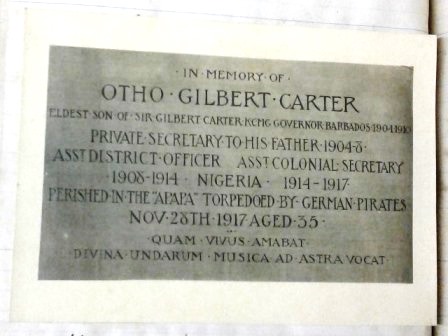
October 1917 is a lean month in Gertrude’s records, possibly because of Gilbert Carter’s return home from his long absence while Gertrude was relocating the family to Ilaro. After a final, hurried day of preparation on October 1st, Gilbert and Wickham — the household servant who had traveled with him — arrive and are greeted in fine style by a “grand gala festival.”

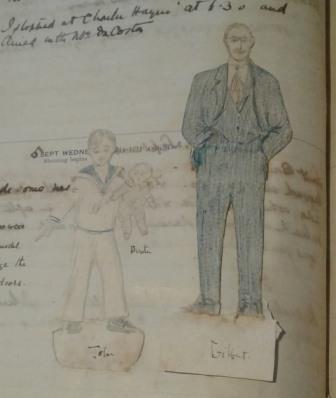
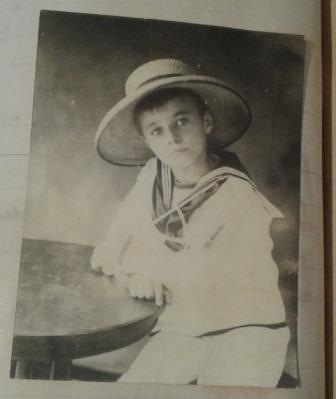
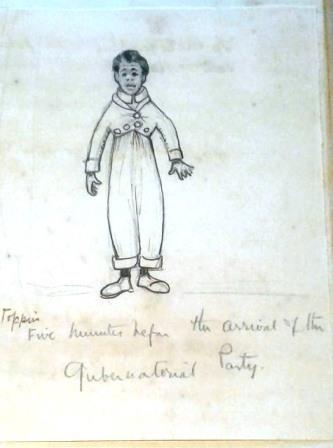
The sketch of her son, pasted over the entry for October 28th, has a faint inscription that seems to indicate that the drawing was made on the day of the visit to the photographer — an inference supported by the fact that John appears to be wearing the same outfit as he wore in the photograph pasted into the September pages of the diary.


* * *

Oct 1.

Paid servants & rushed on with G’s room. Mickey & I moved books, put up curtains, laid down mats.


Oct 2.

Gilbert (and Wickham) arrived.

Grand gala festival.

Mr. Soelyn came up & witnessed my will.


Oct 3.

Talked.


Sketch of John


Oct 28.

G & I dined with Sir F. & Lady Clarke at the Crane. Festive occasion.


Oct 29.

Tea at the Challums. Laddy drove Mrs Gregg out & me in. 9 the [illegible].

We went to Bleak House.


Oct 30.

4.15 Miss Burton stonework.


Oct 31.

All Hallow’e’en Fete at the MacClaren’s 

Fete in red [illegible.]


* * *

As always, if you are interested in viewing the diary or letters yourself, in our library, or have other questions about the collection please visit the library or contact a member of the library staff for further assistance.


“Mark, Traveler, this humble stone”: Quaint and Curious Epitaphs of Copp’s Hill Burying Ground

By Shelby Wolfe, Reader Services

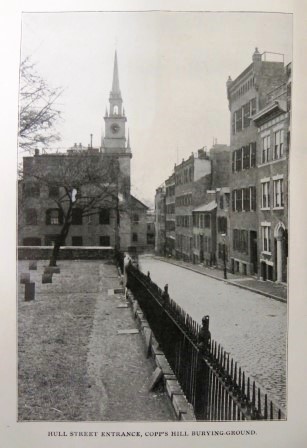
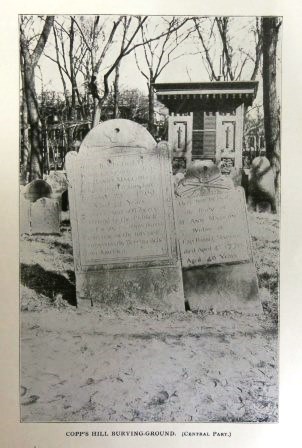
I find a visit to any of New England’s burying grounds fascinating year-round, but I consider treading among slate gravestones and timeworn monuments in October a quintessential New England experience. The leaves turn and fall, beautifully marking a transition from livelier months to the eventual stillness of winter. It’s a fitting setting to consider the lives and deaths of those memorialized on surrounding grave markers. In Historical Sketch of Copp’s Hill Burying-Ground with Descriptions and Quaint Epitaphs, published in 1909, John Norton provides an overview of Copp’s Hill in Boston and the burying ground’s gravestones. Norton begins with a history of Copp’s Hill, spanning its early days as “the North burying ground” through a time “when the well-to-do of Boston dwelt largely in the North End” to the end of the burying ground’s growth around 1832. The second half of this publication includes photographs and epitaphs of select gravestones and monuments.

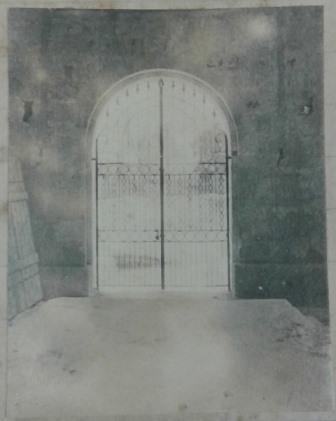
Hull Street Entrance, Copps Hill Burying Ground


As I read through this Historical Sketch, I realized I neglect to spend as much time as I should to pause and read headstones as I walk through a graveyard. It’s a shame, because whether you appreciate some blunt wisdom from the grave or simply enjoy an eerie epitaph, these gravestones have you covered. Thankfully, John Norton mitigates my neglect with this compilation of “old epitaphs, many of them, as is usual in old burying-grounds, quaint and curious, some incoherent and ungrammatical.” Reading these lines on paper might not have the same effect as seeing them inscribed on their intended medium, but I found this publication a handy tool for noticing themes and considering intentions of particular inscriptions.

Copps Hill Buyring Ground. (Central Part.)


Norton includes his own commentary on certain epitaphs. He remarks, “Doubtless the oddest and most puzzling is that over the grave of Mrs. Ammey Hunt, who died in 1769. We have no clue to the neighborhood gossip hinted at in these peculiar lines:

A sister of Sarah Lucas lieth here,

Whom I did Love most Dear;

And now her Soul hath took its Flight,

And bid her Spightful Foes good Night.


Norton continues, noting an “even more amusing…tradition connected with the following conventional stanza” on the stone of Mrs. Mary Huntley:

Stop here my friends & cast an eye,

As you are now, so once was I;

As I am now, so you must be,

Prepare for death and follow me.


This reminder is a common theme of Copp’s Hill epitaphs, some phrased more motivationally than others:

Susanna Gray, July 9, 1798,––42.

Stranger as this spot you tread,

And meditate upon the Dead;

Improve the moments as they fly,

For all that lives must shortly die.


Mrs. Mary Harvey, died May 2, 1782, aged 63:

Mark, Traveler, this humble stone

‘Tis death’s kind warning to prepare

Thou too must hasten to the tomb

And mingle with corruption there.


Mrs. Hariot Jacobus, died, May 27, 1812, aged 20:

Stop here my friends as you pass by,

As you are now, so once was I;

As I am now, so you must be,

Therefore prepare to follow me.


Others take a more resigned, if not foreboding, approach:

Mrs. Mary Hughes, d. in 1765, aged 46:

Time, What an empty vapour t’is,

            And days, how swift they flay:

Our life is ever on the Wing,

            And Death is ever nigh.

The Moment when our Lives begin,

            We all begin to die.


Mrs. Sarah Collins, died March 29, 1771, aged 62:

Be ye also Ready for you

Know not the Day nor hour.


Many epitaphs of younger women and children express themes of virtue and youth, imagery of fading flowers:

Miss Mary Fitzgerald, died Sept. 30, 1787, aged 19:

Virtue & youth just in the morning bloom

With the fair Mary finds an early Tomb.


John S. Johnson, died Sept. 9, 1829, aged 6:

See the lovely blooming flower,

Fades and withers in an hour

So our transient comforts fly,

Pleasure only bloom to die.


Others offer a sort of rational wisdom to console mourners:

Mrs. Deborah Blake, d. in 1791, aged 21 years:

Friends as you pass, suppress the falling tear;

You wish her out of heaven to wish her here.


Mrs. Abigail Cogswell, died Jan. 19. 1782, aged 42:

To those who for their loss are griev’d

This Consolation’s given,

They’re from a world of woe reliev’d

We trust they’re now in heaven.


If you have the opportunity, I encourage an autumn visit to Copp’s Hill and other historic New England burying grounds. While you take in the site and scenery, spend some time considering the lives and deaths of the individuals whose graves are marked. Read what they or their loved ones chose to be inscribed on their stones. For inspiration, historical sketches, and legible transcriptions of “ye ancient epitaphs,” as Norton writes, read more about visiting the library to work with Norton’s Historical Sketch of Copp’s Hill Burying-Ground and related material.


What did an Adams kid do for fun?

By Gwen Fries, Adams Papers

When John Quincy Adams was 59 years old, he wrote a nostalgic letter to his cousin William Cranch in which he pined for their shared childhood. This led me to wonder something—if you were an Adams kid, what did you do for fun?


John Adams’s absence from his family during this period provides a rich correspondence with their mother, Abigail, throughout which she describes the health and development of their “Little folks.” From Abigail’s letters, the children’s later reminiscences, and their skills evident as teenagers and adults, we can glean that Nabby, John Quincy, Charles, and Thomas passed most of their time with some combination of reading, shooting, chess, playing the flute, ice skating, keeping doves, and dancing.

When she wasn’t needed for household chores, Nabby could be found reading, playing cards, and gossiping with her cousins about their crushes. It is also probable that she accompanied her younger brothers when they went fishing, as she later describes fishing with John and Abigail while in England, or when they went on long walks, as her father believed in fresh air and exercise for young girls. Along the way, Nabby also must have become proficient in chess, as in 1786 her husband admitted to losing a game of chess to her. 

Like their elder sister, John Quincy and Charles loved to read. When John wrote home from Philadelphia and asked the children what presents they would like him to send home, Abigail replied, “I call[ed] them seperately and told them Pappa wanted to send them something and requested of them what they would have. A Book was the answer of them all only Tom wanted a picture Book and Charlss the History of king and Queen. It was natural for them to think of a Book as that is the only present Pappa has been used to make them.” As they grew older, John Quincy and Charles went for long walks and swims together, went shooting and ice skating, and took flute and dancing lessons.

Thomas, the youngest, enjoyed many of the same amusements of his older siblings, as evidenced by the necessity of abstaining from ice skating when he sustained a broken ankle. The “innocently playful” Thomas had an especially soft spot for animals. His aunt reported to Abigail, “Tom, a Rogue loves his Birds and his Doves, makes bad Lattin and says as he grows older he shall grow wiser.” When Thomas returned to live with Abigail, his aunt continued to send him reports of the animals. At fourteen, Thomas still appeared enamored with his pets, though John Quincy steered him towards more serious matters. His aunt wrote, “Thomas is A fine Lad, and does not run so often to look of his Doves in studying Hours, since Mr Adams has been here.”

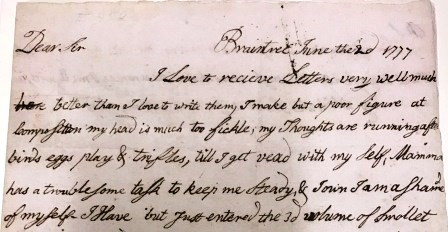
Though it appears inconceivable to have a normal childhood when the enemy army is a few miles up the road, ten-year-old John Quincy confessed to his father that his thoughts were “running after birds eggs play & trifles,” and five-year-old Thomas couldn’t wait until his father returned home so that they could get back to playing “jail.” It seems that even when the world is turning upside down and countries are being crafted, a kid is still a kid. Even an Adams kid.

Gertrude Codman Carter’s Diary, September 1917

By Anna Clutterbuck-Cook, Reader Services

Today we return to the 1917 diary of Gertrude Codman Carter. You may read the previous entries here:

Introduction | January | February | March | April | May

June | July | August

September’s entries are heavily illustrated with drawings and photographs. Having just moved into Ilaro, Gertrude supervises continued construction at the site while managing the household in her husband’s absence. Domestic drama includes the “letting go” of a servant who “couldn’t stand the stairs” of the new residence, and the hiring of a replacement — actions that do not endear Gertrude to her staff.

The war intrudes on the household once again as Gertrude receives a letter from the Colonial Secretary’s office with instruction for the conscription of her automobile in the event of an attack by the enemy. Amidst it all, Gertude continues to live a life of social obligation and voluntary labor as part of the Self-Help group and other island committees.

* * *

Sept 1.

Sent Barbara $50.

Moved into Ilaro. Toppin & Small, Edith & Norah & Ada, who couldn’t stand the stairs after all. We had our first dinner there on the marble verandah & it was quite lovely.


Sept 2.

Unpacked & tried to feel settled. John & I slept in the [illegible] room. Such fun.


Sept 3.

Rising bell at 7 a.m. & the house full up with very busy workmen,clanging & banging, sawing and jawing, [missing fragment], taping & scraping, patching & scratching, latching & detaching whatever was wrong, which happened after.

Our meal was rather full of coral dust but Topping was zealous & managed quite wonderfully for his age.


Sept 4.

Marked out servants quarters.

Mrs. Skeet came by to look at it.

I stopped at Charles Hayes at 6.30 and dined with Mrs. DaCosta.


Sept 5.

These little figures were made for a scale model of Ilaro, to gauge the height and width of doors.

Sept 6.

10.30 Civic Circle met at [illegible] Park.


Sept 7.

Called Chelston for washing. Gave up Ada & hired Rosina, a girl of the Cawfields. This, it appears, was considered by everyone below stairs as a fearful faux pas. I got no less than three anonymous letters on the subject, which outraged Bailey beyond measure.


Sept 8.

John began a letter & headed it “Ilaro Court limited.”

“What does it mean, John?” — “Oh – just what it means on the honey bottle!”


Sept 9.

Laddie to tea & a little [illegible] out. He is very appreciative of my powers as an architect.


Sept 10.

Miss Hatfield called about the Easter Féte for my advice. I became a sort of unofficial Chairman of the Committee & advised in a Sybelline manner.


Sept 11.

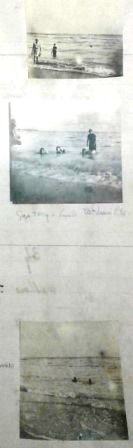
To photographer with John. [illegible] had sticks — both of them.


John Carter


4.30 to bathe at Mrs. Harold Whytes.


12 Sept.

Self-Help meeting

Miss [illegible] again.

Laddie later for a spin.


13 Sept.

[entry obscured by a typescript letter from the Colonial Secretary’s Office]


CONFIDENTIAL.

CIRCULAR.

No. 19.


Colonial Secretary’s Office, Barbados.

14th September 1917.


Madam,

I am directed by the Governor to inform you that the Defence Committee will require transport facilities for the Defence Force in case of enemy attack. On the “Alarm” being sounded you are requested to send your motor car No. M158 to [illegible] where it will be available for use in accordance with order issued by the officers of the Force.

2. A driver, and the necessary supply of Petrol, spare tyres, etc. should be available with the car.

3. The Government undertake to recommend to the Legislature that compensation be paid for damage caused by enemy action.

4. The “alarm” consists of the firing of five rockets from the Harbour Police Station, and the firing of powder charges from two 9 pounder guns, at the Garrison and the Reef respectively.

5. The Defence Committee’s recommendations are based on the assumption that you will readily co-operate with them in arranging transport facilities in case of attack. His Excellency has therefore asked me to obtain from you a statement to the effect that you have made arrangement of a kind to ensure prompt dispatch of the car whenever the “Alarm” is sounded.

I have the honor to be,

Madam,

Your most obedient servant,

T.E. Fell,

Colonial Secretary.


Sept 14.

Ditto.

“Toppin. Five minutes before the arrival of the Gubernatorial Party.”


Sept 15

The Probyns came to see the house.


Sept 16.

Mr & Mrs [illegible] to see house.

I dined at the Laurie Piles.


Sept 17.

Auction inspection.

I dined at the Harold Whytes’ – a most amusing evening. Harold Whyte & Laddy & Mr Fell played an uproarious game of bridge in which they were respectfully alluded to as the army, the vestry, and the government & every now and then a large land crab would come in & sport about the floor. I took Mr Fell & Colonel Humphreys home & my car began to wheeze just after that & I found that it was in for a long illness this time.


Sept 18.

Mrs [illegible] came & fetched up & took me back to Brittons for bitters.


Sept 19.

Hired a car & took Mrs. Carpenter to an auction in the country. We had a picnic lunch. Great fun.


Sept 27.

Mrs Humphreys & Doreen to tea. Rained heavily & we had no where to go but in & then it was only a courtyard.

I dined with the [illegible]. Jolly evening.


Sept 28.

Busy on the house.

Laddy telephoned.


Sept 29.

[illegible]. Laddy had a picnic & took me to Bleak House. Had [illegible] drove Mrs Carpenter. We had bitters & sandwiches & a great time.


Sept 30.

Laddie drove me out to the Charlie Haynes’. After dinner we worked all of us on the [illegible]. We saw Lady [illegible] toes out of the window!


* * *

As always, if you are interested in viewing the diary or letters yourself, in our library, or have other questions about the collection please visit the library or contact a member of the library staff for further assistance.


Who is J. Gibbs?

By Susan Martin, Collection Services

The Massachusetts Historical Society recently received a donation of William Gray Brooks family papers, primarily correspondence on genealogical subjects. It’s a terrific collection of letters from some of the leading lights of the 19th century, including Charles Francis Adams, Edward Everett, Henry Wadsworth Longfellow, Eliza Susan Quincy, and many others. This new acquisition complements other MHS collections related to Brooks and his family.

I was intrigued, however, by additional material that came to us as part of the collection, namely 22 issues of a family “newspaper” called “The One Hoss Shay.” The newspapers were handwritten by J. Gibbs of Brookline, Mass. and reproduced on a hectograph.


“The One Hoss Shay” contains light-hearted poems, stories, illustrations, jokes, announcements, reviews, etc., written by Gibbs and others, and it makes for some very fun reading. Here’s one of the better limericks:

There was a young man of Bombay

Excessively fond of croquet,

But when he got beat,

He would beat a retreat

And show himself no more that day.


Sandwiched between articles are editorial asides by Gibbs.

We wish to apologise for the condition of our hectograph, which absolutely refuses to print well. We are not responsible for it’s [sic] freaks.

If the “Shay” should chance to seem too local for general interest, we call attention to the fact that the more we heard from elsewhere, the more foreign news could be introduced. (Hint.)


Who was the mysterious J. Gibbs of Brookline? Unfortunately, the “Shay” provides very few clues. She was a “Miss,” and I eventually found her first name: Julia. The newspapers were written between 1886-1888, which probably meant she was born in the 1860s or early 1870s. Her family apparently summered in Marion, Mass. These were the only biographical details I could find or infer.

I guessed that because the newspapers accompanied the Brooks letters, and because some Brooks family members are mentioned in Julia’s articles, she may have been a relative. It was easy enough to find Brooks genealogies, given how famous the family is. (William Gray Brooks’ son Phillips, for example, was one of Boston’s most renowned clergymen.) But there was no sign of a Gibbs among William’s siblings or cousins or their children or grandchildren.

I went back to the collection for more information and noticed a reference to “Harriette Brooks Hawkins (Mrs. Hubert A.) […] (a granddaughter of W.G.B.).” Born in 1881, Harriette was the daughter of William’s youngest son John Cotton Brooks and his wife Harriette Hall (Lovett) Brooks. She owned the Brooks letters in 1935, but had she also owned the newspapers? Did she have a connection to Julia Gibbs?

Armed with a few more keywords, I took one last crack at an online search for Julia and finally found her: Julia de Wolf Gibbs (1866-1952), later Mrs. Addison. The name was right, the age was right, and the location was right—she is buried in Marion, Mass. So what was her connection to Harriette and/or William Gray Brooks? I got my answer when I identified her parents: Julia’s mother was Anne (or Anna) de Wolf (Lovett) Gibbs. Her mother and Harriette’s mother were sisters.

Out of curiosity, I searched our catalog for Julia and was excited to learn that she later became not only a published author


But also a designer of metalwork, ornamentation, etc. Some photographs of her work appear in one of our collections.


“The One Hoss Shay” was the brainchild of a creative young woman at the start of her career. Julia apparently took the title of her newspaper from Oliver Wendell Holmes’ 1858 poem “The Deacon’s Masterpiece, or the Wonderful ‘One-Hoss Shay’: A Logical Story.” In her third issue, she wrote that she and her aunt Harriette attended Holmes’ recitation of the poem at Harvard’s Sanders Theatre. This was her one-line review: “Our Patron Poet was quite at his best.”

(Incidentally, Julia’s future husband also earned a passing mention in one issue: “Rev. Daniel Dulany Addison is in Washington.”)

I’d be remiss if I didn’t say more about the newspaper’s impressive illustrations. Some were drawn by Julia herself, such as the seated girl on the right side of the first image above. Others were contributed by another of her cousins, “our popular artist, Mr. C. Dana Gibson.” If that name sounds familiar to you, it’s because Charles Dana Gibson went on to become one of the most popular illustrators in America and creator of the iconic turn-of-the-century Gibson Girl. He designed the letterhead for the “Shay” and provided drawings like this one:

Scene, a crowded horse-car. (Stout old man.) “Come, sonny, get up & give the lady your seat.” (Small Boy.) “Get up yourself, & give her two!”


For more about Gibson, I recommend the 1936 biography Portrait of an Era, which contains hundreds of his beautiful illustrations.


John Quincy Adams and the Education of a “Warrior Patriot”

By Rhonda Barlow, Adams Papers

When President John Quincy Adams delivered his first annual message to Congress on December 6, 1825, he noted that “the want of a naval school of instruction, corresponding with the Military Academy at West Point, for the formation of scientific and accomplished officers, is felt with daily increasing aggravation.” But Congress was not sufficiently aggravated to establish a school. Because young naval officers could learn to handle a ship only at sea, it seemed reasonable for all their education to be conducted aboard ship.

On December 4, 1827, Adams gave his third annual message to Congress, and for the third time, recommended the establishment of a naval academy similar to West Point, which Thomas Jefferson had established twenty-five years earlier. But this time, Adams explained his view of naval education in detail.

Adams held high standards for the “enquiring minds” of “the youths who devote their lives to the service of their country upon the ocean.” In his 1827 message, he explained that the academy he envisioned needed teachers, books, equipment, and a permanent location on shore. Subjects should include not only shipbuilding, math, and astronomy, but also literature, “which can place our officers on a level of polished education with the officers of other maritime nations,” and knowledge of foreign laws. As a former diplomat, and secretary of state from 1817 to 1825, Adams recognized that naval officers were a special class of American ambassadors.

But this combined scientific, technical, and liberal education was not enough. “Above all,” Adams continued, a young naval officer needed to learn “principles of honour and Justice” and “higher obligations of morals.” For John Quincy Adams, an American naval officer was a “Warrior Patriot,” equipped with a moral education that distinguished him from a mere pirate.

An entry in Adams’ Diary, made a few days after his 1827 speech, sheds light on his understanding of the role of morality in officer education. In his Diary, Adams reflected on the court martial of Master Commander William Carter for drunkenness.

Although he was reluctant to end Carter’s naval career, he wrote that “such enormous evils from intemperance demanded a signal example.” While intoxicated, the master commander twice was guilty of giving orders that almost caused the ship to founder, endangering both the valuable warship and her crew. On another occasion, he had been rude to a British officer. On another, he had engaged in disorderly conduct on shore, observed by, among others, a British officer. Adams’ Diary reveals that moral education was about self-control and responsibility, and the reputation of America’s fledgling navy abroad, especially among the British, whose Royal Navy was the envy of the world.

Adams failed to convince Congress to establish a naval academy. But eighteen years later, Adams, then a congressman, met with George Bancroft, the new secretary of the navy. In his Diary, Adams recorded that Bancroft “professes great zeal to make something of his Department.” A few months later, on October 10, 1845, Bancroft opened the Naval Academy in Annapolis, MD.

“An Amusing Journey”: John Quincy Adams Explores Silesia

By Hobson Woodward, Adams Papers

On 17 July 1800 John Quincy Adams and his wife Louisa Catherine embarked on an extended tour of Silesia, now southwest Poland. John Quincy chronicled their tour in a series of letters to his brother Thomas in the United States. The letters provide a rich description of a European excursion at the dawn of the nineteenth century. They also provide a rare look at a relaxed John Quincy Adams, unfettered by the demands of his diplomatic duties in Berlin.

John Quincy Adams to Thomas Boylston Adams, 20 July 1800, letterbook copy (Adams family papers, Massachusetts Historical Society)

John Quincy prefaced his first letter to Thomas by advising him to send his correspondence to their mother Abigail if his extended descriptions of the Silesian countryside and people proved a bore:

I cannot promise you an amusing journey, though I hope it will prove so to us; & if at the sight of this my first letter on this occasion, you think it looks too long, & appears likely to prove tiresome, seal it up, unread, & send it to Quincy, where a mother’s heart will fill it with all the interest of which it may be destitute in itself

Thomas Boylston Adams to John Quincy Adams, 15 January 1801 (Adams family papers, Massachusetts Historical Society)

Thomas found the letters anything but boring, however, and he was so entranced that he gave them to a newspaper editor friend for publication. John Quincy graciously accepted their printing for the public, even though he had not been told in advance. He was less happy when the articles were later published in an unauthorized 1801 London edition.

John Quincy’s travel accounts are indeed vivid. In a 3 August letter he described an ascent of a mountain near Schreiberhau (now Szklarska Poreba, Poland). The hike began easily enough, he reported, traversing a grade “about equal to the steepest part of Beacon hill in Boston.” The difficulty increased, however, and the party finally emerged to a dramatic sight:

Instantly a precipice nearly fifteen hundred feet deep opened its gastly jaws before us— A sort of isthmus, or tongue of land however allowed us to proceed about an hundred rods further, untill we could fix ourselves against the side of a rock, & look over into the tremendous depth— We had then the precipice on both sides of us, & it passes by the respective names of the great & the small snow-pit— They are so called because generally the snow at the bottom remains unmelted the whole round, although this has not been the case for the last two summers, & at present they contain no snow at all

Later John Quincy and Louisa visited the Zackenfall waterfall. One is almost brushed by the leafy mist when reading John Quincy’s description:

At this place you stand upon one side of the cleft & see the water dash down from the other; upon a level with yourself; between you & the stream is an abrupt precipice, which seems the more profound, for being so narrow; about an hundred yards— With the help of a ladder I descended to the bottom, & walked partly over the rocks, & partly over the billets of wood lying in the bed of the stream to the spot from which the water falls— We likewise went round by a winding foot path on the top, to the spot from which the streams launches itself

John Quincy also described a visit to a coal mine near Waldenburg (now Walbrzych, Poland). The mine was accessed by a small boat navigated over a subterranean stream.

You go down in a boat, flat bottom’d, about a yard wide, & ten feet long. The canal is not more than four wide, & equally deep, & over it is an arch about as high, hew’d in many places through the solid rock. It is nearly an english mile long, & strikes deeper & deeper under ground, untill the surface of the earth over head is more than 150 feet above you. The boat is pushed along through the canal, by two men, one standing at each end, who with a short stick in the hand press it against the sides of the arch that goes over the canal.

John Quincy further commented on churches, factories, and estates, and the peasants, craftsmen, and soldiers who occupied them. Thomas called his brother’s travel accounts a “rich feast of epistolary excellence.” The letters survive today in the Adams Papers collection of the Massachusetts Historical Society. In 2019 a selection of them will be annotated and published in volume 14 of Adams Family Correspondence, providing unprecedented access to a luminous portrait of an excursion through central Europe in an age gone by.

Holding Those in the Path of Hurricane Irma in Our Thoughts

By Anna J. Clutterbuck-Cook, Reader Services

As I write this post on Friday, September 8th, Hurricane Irma is working its destructive way through the Caribbean toward the southeast United States. While this blog post was scheduled to be the September 1917 diary entries of Gertrude Codman Carter it felt strange not to recognize the lives that are being turned upside down in the very islands that Lady Carter called home for much of her adult life. Carter’s diaries, chronicling her journey from Boston to Barbados in the early twentieth century, are far from the only or the earliest connections between Massachusetts and the Caribbean to be found in the MHS collections.


Today, I want to share some images from our copy of Thomas Jeffrey’s The West-India Atlas: or, A compendious description of the West-Indies: illustrated with forty correct charts and maps, taken from actual surveys. Together with an historical account of the several countries and islands which compose that part of the world (London: R. Sayer and J. Bennett, 1775). The MHS copy of this 18th century atlas was owned by Robert Haswell, whose Voyage round the world onboard the ship Columbia-Rediviva and sloop Washington, 1787-1789 also resides in our collections. A pastel portrait of Haswell by the English painter James Sharples may be viewed here.


The details in this atlas are both informational and whimsical. In addition to the flocks of birds pictured above, almost every chart includes tiny parades of detailed ships making their way safely past such landmarks as the Colorados Reef, sunken rocks, and false headlands.


The atlas also provides voyagers with information about fresh water, as in this detail of the tip of Cuba, an “old ruined castle.”


Earlier this week, Hurricane Irma devastated the islands of Barbuda and Antigua, pictured here. I encourage you, if you have the ability, to donate to a charity of your choosing that will support those who need to rebuild their lives.

Look for a return to Lady Gertrude’s diary at the end of September.