Winslow Homer’s Civil War reporting for Harper’s Weekly

By Alex Bush, Reader Services

While searching through the MHS’ library catalog, ABIGAIL, for records relating to Mr. Sidney Homer, an 1860s inventor, I stumbled upon a trove of graphics created by Winslow Homer. As a fan of Homer, I admonished myself for not being aware that we had any of his artworks here at the MHS. I did not, however, find any of Homer’s famous paintings in our stacks. Instead, I found evidence of an oft-overlooked part of Homer’s artistic career.

Known for his dramatic depictions of the ocean and idyllic images of country life, Homer’s career as a painter began to take off after his late-twenties. However, he showed artistic talent much earlier in his life in the form of sketches, prints, and other black-and-white media. This includes the MHS’ holdings, a selection of some of Homer’s lesser known work from this earlier period of his life, consisting in-part of prints he created for Harper’s Weekly as an artist-reporter during the Civil War.

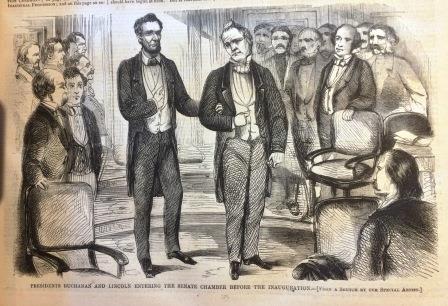
Following an arduous apprenticeship at the Boston lithographer J.H. Bufford, 21 year-old Winslow Homer was eager to begin his career as an artist free from the shackles of any sort of contracted work. He became a freelance illustrator, submitting pieces to magazines such as Harper’s or Ballou’s Pictorial. When he was offered a contract as a staff artist for Harper’s in 1860, he turned it down. “The slavery at Bufford’s was too fresh in my recollection to let me care to bind myself again,” he later stated. “From the time I took my nose off that lithographic stone, I have had no master; and never shall have any.” However, after completing a commission from Harper’s to cover the presidential inauguration of Abraham Lincoln at the dawn of the Civil War, Homer began a stint with Harper’s that would end up becoming a formative part of his early career as an artist.


 “Presidents Buchanan and Lincoln entering the senate chamber before the inauguration. – (From a sketch by our Special Artist.)” Harper’s Weekly, March 16, 1861, p. 165


With photography still in its developmental period, some of the public’s best sources for images of current events were publications such as Harper’s Weekly. Based in New York City, Harper’s was a political magazine featuring news, stories, illustrations, and more. It was especially active during the Civil War, during which it had nearly 200,000 subscribers, and it worked to provide the public with images, news, and accounts from the front. Part of this endeavor included the hiring of around 30 artist-reporters, tasked with shadowing troops to the warfront and attempting to depict what they saw there. In a short but vivid description from their June 3, 1865 issue, Harper’s explained the project as follows:

They have made the weary marches and dangerous voyages. They have shared the soldiers’ fare; they have ridden and waded, climbed and floundered… The pictorial history of the war which they have written with their pencils in the field, upon their knees, upon a knapsack, upon a bulwark, upon a drum-head, upon a block, upon a canteen, upon a wet deck, in the grey dawn, in the dusk twilight, with freezing or fevered fingers…–this is a history quivering with life, faithful, terrible, romantic.

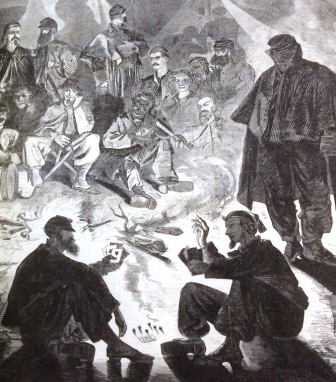
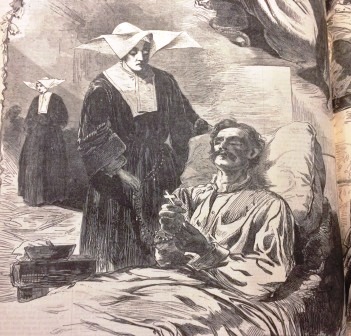
Winslow Homer was one such artist, although he was not assigned to a particular unit as were most of his colleagues. He made several trips to the front over the course of the war, but completed most of the actual depictions of what he saw there back at his studio in New York. His first trip to the front was likely around October of 1861, during which he focused on the Army of the Potomac. He did not witness any fighting as the army had recently returned from its defeat at Bull Run and was undergoing reorganization. The majority of Homer’s depictions of the war featured army life rather than actual fighting—soldiers setting up camp, eating, receiving medical care, or generally palling around. His images of camp are jovial and often humorous, highlighting the solders’ camaraderie and rowdiness. When compared with other artists’ depictions of soldiers from that time, Homer’s soldiers are distinctive in their quality of expressivity in contrast to other square-jawed, conventionally patriotic representations of “heroic” troops.  Though Homer did have a few pieces of a more patriotic nature, such as “Songs of the War” and “Our Women of the War.”


 Detail from “A Bivouac Fire on the Potomac,” Harper’s Weekly, Dec. 21, 1861, p. 808-809


Detail from “Our Women and the War,” Harper’s Weekly, Sept. 6, 1862, p. 568


In the spring of 1862 Homer visited the front again, and this time witnessed actual fighting. He was present in Washington to watch McClellan’s Army of the Potomac embark, and accompanied them on a transport ship to the York Peninsula in preparation for an advance on the Confederate capitol. Homer watched the month-long siege against Yorktown, but left not long after the siege ended. He completed most of his depictions of what he saw there after he returned to New York, and thus ended his stint as a “special artist” for Harper’s. He later complained to his friend John W. Beatty that Harper’s greatly reduced the size of his sketches upon printing them, sometimes squeezing 4 onto a single page and paying him only $25 for the entire page instead of $25 per artwork as was originally negotiated.

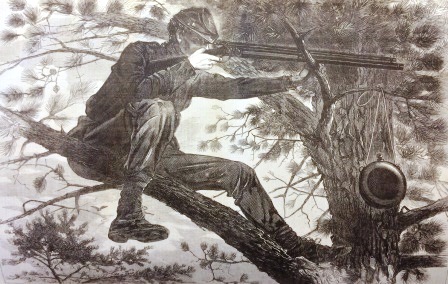
“The Army of the Potomac: a sharp-shooter on picket duty,” Harper’s Weekly, Nov. 15, 1862, p. 724


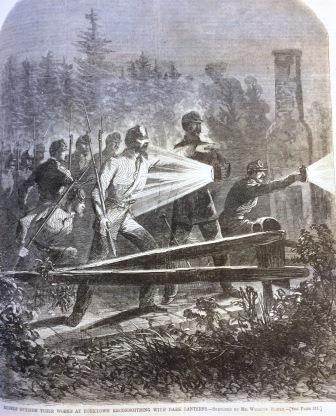
“Rebels outside their works at Yorktown reconnoitering with dark lanterns,” Harper’s Weekly, May 10, 1862, p. 305


Homer’s more famous images of the Civil War, “A Cavalry Charge” and “A Bayonet Charge,” were done after he returned to his home in New York and ended his work with Harper’s. Later drawings of army life suggest that he did make subsequent visits to the front later on in the war, but they were not part of Homer’s official work as a reporter. From here he shifted his focus to painting, although Harper’s did offer him another steady job at the end of his time at the front. Feeling intimidated by his obscurity as a painter, Homer heavily considered taking the job and vowed to his brother that he would accept the offer if his next two paintings did not sell. Unbeknownst to Homer, his brother purchased the paintings himself. Homer did not find out until years later, at which point he “swore roundly and refused to speak to his brother for weeks.” Still, this small encouragement helped to propel Homer into his career as a painter. In subsequent work he depicted scenes from war and soldiers, no doubt inspired by these early sketches.


All prints pictured in this post and more can be seen in their original forms in Harper’s Weekly at the MHS.

  1. Donald H. Karshan and Lloyd Goodrich, The Graphic Art of Winslow Homer, organized by the Museum of Graphic Art, New York, 1968
  2. Lloyd Goodrich, Winslow Homer, New York: Published for the Whitney Museum of American Art by Macmillan, 1944
  3. “Biography of Winslow Homer,” Winslow Homer, 2017, winslow-homer.com
  4. Amy Athey McDonald, “As embedded artist with the Union army, Winslow Homer captured life at the front,” Yale News, 20 April, 2015, http://news.yale.edu/2015/04/20/embedded-artist-union-army-winslow-homer-captured-life-front


“A stain of depravity”: John Quincy Adams on Lord Chesterfield

By Gwen Fries, Adams Papers

When Louisa Catherine Johnson wrote to her then-fiancé John Quincy Adams on March 20, 1797, she desired to impress him with her reading of Lord Chesterfield’s Letters to His Son. The reaction she received was not the reaction she expected.

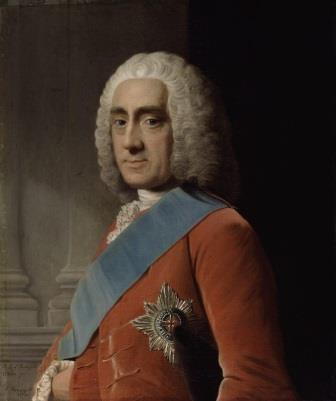
Philip Dormer Stanhope, 4th Earl of Chesterfield

(National Portrait Gallery, London)

Lord Chesterfield’s Letters to His Son is a compilation of 448 letters from Philip Dormer Stanhope, 4th Earl of Chesterfield (1694–1773), to his son, also named Philip (1732–1768), from the time the boy was five until his death. The letters contain lessons on subjects such as history and mythology in the boy’s youth, but the older he gets, the more the lessons relate to what Stanhope constantly refers to as, “the useful and necessary art of pleasing.” When the boy was eleven, Stanhope wrote that he desired he should be “as near perfection as possible” as “never were such pains taken for anybody’s education” and as his opportunities for knowledge and improvement were unparalleled. “The smallest inattention, or error in manners, the minutest inelegancy of diction, the least awkwardness in your dress and carriage, will not escape my observation,” Chesterfield wrote to his son. Understandably, Philip felt the need to keep secrets from his father. Upon his death from edema in 1768, Chesterfield discovered that Philip had been secretly married for ten years and had two sons. While Chesterfield provided for Philip’s two sons during what remained of his life and in his will, he neglected to leave Philip’s wife Eugenia anything, prompting her to publish over thirty years of his letters to his son. The collection of letters, published in 1774, attracted a great deal of notice in Britain and across the Atlantic.

Over twenty years after their original publication, Louisa wrote to her fiancé that she thought the letters “very good” but asked for John Quincy’s opinion on the book. John Quincy responded that he was never permitted to read the letters in his youth and harbored “too much contempt” for the principles within to have dedicated time to its perusal in his adulthood. Furthermore, he told her Chesterfield had a “stain of depravity which pervades all his ideas of morality” and that could only generate an “accomplished knave.” He advised her to read Samuel Johnson instead and leave Chesterfield’s “fraud” and “baseness” alone. (There is a 1779 copy of Stanhope’s work in the Stone Library at Peacefield with John Quincy’s bookplate attached.)

Undoubtedly, John Quincy’s fervent ideas about the book he claimed not to have read came, in part, from his parents. When his mother Abigail requested a copy in 1776, his father dissuaded her, telling her she wouldn’t want it as the letters were, “stained with libertine Morals and base Principles.” Abigail accepted her husband’s advice but got her hands on a copy four years later. After perusing the letters, she agreed that Chesterfield was filling his son’s mind with “the most immoral, pernicious and Libertine principals.”

Though John Quincy was no stranger to a father’s care, attention, and critiques, his relationship with his father little reflected the relationship of the Stanhopes. While John Adams urged his son to study the history of revolutions, Chesterfield outlined the proper way to bid farewell to mistresses. Chesterfield was, and urged his son to be, a chameleon in the world, a far cry from John Adams, the possibly uprooted but never swayed oak. In fact, Chesterfield’s instruction was so opposed to John Quincy’s lifestyle that he admitted to Louisa he felt as though Chesterfield were “personally satyrising” him.

John Quincy’s reaction to the text perhaps realizes his father’s April 15, 1776 wish that his children should “wear mean Cloaths, and work hard, with Chearfull Hearts and free Spirits” and that they would “scorn Injustice, Ingratitude, Cowardice, and Falshood. Let them revere nothing but Religion, Morality, and Liberty.” Nowhere did John Adams mention the useful and necessary art of pleasing.

A Treasure Rediscovered: The Civil War Sword of Robert Gould Shaw, 54th Regiment

By Daniel Tobias Hinchen, Reader Services

Today, the MHS is happy to unveil a recent acquisition to the collection. On 12 July the Society announced the acquisition of a significant collection of Shaw and Minturn family papers, photographs, art, and artifacts. The most remarkable item in the collection is the officer’s sword carried by Colonel Robert Gould Shaw, 54th Massachusetts Infantry Regiment – the first Northern regiment composed of free black volunteers. One hundred fifty-four years ago, Shaw carried the weapon during the failed assault on Fort Wagner, Morris Island, South Carolina. With sword in-hand, Shaw was shot in the chest while mounting the parapet and was killed. The sword and other personal effects were stolen from his body during the night and presumed lost.

However, the sword survives. Following acquisition of the sword from descendants of the Shaw family, the collections staff here at the MHS had the daunting task of tracing the provenance of this sword in order to ensure that it is the genuine article.

What follows is a brief chronology of Robert Gould Shaw and his sword, as laid out by Curator of Art & Artifacts Anne Bentley, and Senior Cataloger Mary Yacovone, who combed through various sources published, primary, and otherwise. [N.B. – These events are arranged chronologically but, as with much historical research, the pieces fell together in anything but clear order.]

*****

Nov. 1860 – Robert Gould Shaw (RGS) enlists in the 7th NY Militia.

28 May 1861 – RGS commissioned 2nd Lieutenant, Company H, 2nd Massachusetts Infantry.

8 July 1861 – RGS commissioned 1st Lt. in same.

10 Aug 1861 – RGS commissioned Capt. in same.

31 Mar 1863 – RGS commissioned Major, newly-formed 54th Massachusetts Regiment.

17 Apr 1863 – RGS commissioned Colonel, 54th Mass. Regt.

[mid-late April 1863?] – RGS’ uncle, George R. Russell, orders an officer’s sword for Shaw from master English swordsmith Henry Wilkinson.

11 May 1863 – Wilkinson sword no. 12506 proofed on this date, per Henry Wilkinson records.

23 May 1863 – Wilkinson sword no. 12506 etched and mounted on this date. Sold to C. F. Dennett, Esq., per Henry Wilkinson records.

28 June 1863 – RGS wrote to his mother: “Uncle George has sent me an English sword, & a flask, knife, fork, spoon &c. They have not yet come.”1

29 June [1863] – “June 29 – Monday. “Arago” in and mail from the North.”2

1 July 1863 – RGS wrote to his father that “A box of Uncle George’s containing a beautiful English sword came all right.”1

4 July 1863 – RGS wrote to his father that “All the troops, excepting the coloured Regiments, are ordered to Folly Island. … P.S. I sent you a box with some clothes & my old sword. Enclosed is receipt.”1

16 July 1863 – Mass. 54th participated in the Battle of Grimball’s Landing, James Island. RGS probably used his new Wilkinson sword in this action. First experience under fire for the 54th, which stood strong and proved its mettle covering the retreating Union forces.

18 July 1863 – Assault on Fort Wagner. RGS shot in the chest as he stood on the parapet of Ft. Wagner, sword in hand. Overnight his body was robbed of personal effects and arms and stripped to underwear. Sources differ as to the culprits.

19 July 1863 – RGS buried. According to Brig. Gen. George P. Harrison, C.S.A. writing to Luis F. Emilio much later, RGS was placed in the rifle pits below the parapet and 20 of his dead soldiers placed on top of him. Sources here differ also.

Friday 24 [July 1863] – John Ritchie diary: “Packed up Col. Shaw’s effects & expressed them North.” Ritchie later noted that he also sold the colonel’s horse.

3 June 1865 – Letter from Brigadier General Charles Jackson Paine, district commander at New Berne, N. C., to family:

Goldsboro June 3, 1865. I heard the other day of the sword of the late Robt. G. Shaw killed at Fort Wagner, in the possession of a rebel officer about sixty miles from here. I sent out and got it; the scabbard was not with it. I am going to send it on as soon as I have an opportunity.3

28 Jan 1876 – Letter from Lydia Maria Child to John Greenleaf Whittier:

I spent last winter with the parents of Colonel Shaw…The flag of the 54th Regiment was in their hall, and the sword of Colonel Shaw. There is a history about that sword. It is very handsome, being richly damascened with the United States coat-of-arms, and the letters R. G. S. beneath. It was a present from a wealthy uncle in England, and he received it a few days before the attack on Fort Wagner […] When his mother showed me the weapon she said: “This is the sword that Robert waved over his followers, as he urged them to the attack. I am so glad it was never used in battle! Not a drop of blood was ever on it. He had received it but a few days before he died.”4
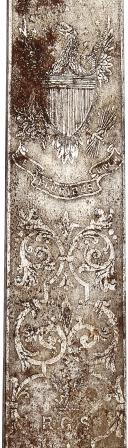
Detail of the sword, showing United States Coat-of-Arms and initials R.G.S.

(Photograph by Stuart E. Mowbray)


1900 – At a meeting of the Military Order of the Loyal Legion of the United States, Commandery of Massachusetts, Brev. Lt. Solon A. Carter, U.S.V., presented a paper titled “Fourteen Months’ Service with Colored Troops,” in which he stated:

In July [1865], upon leaving the service, the late Assistant Adjutant General* was charged by General Paine with the duty of restoring the sword to Colonel Shaw’s father, and upon arrival at this home, opened a correspondence with Mr. Francis George Shaw informing him of its recovery.

The sword in question proved to be the one carried by the gallant colonel and was identified by the initials R.G.S. delicately etched upon the blade. In a postscript to one of his letters, Mr. Shaw wrote, “The sword was a present to my son from his uncle, Mr. George R. Russell, who purchased it in England and caused the etchings to be made there.”

In a subsequent letter acknowledging its receipt he says “I thank you most heartily for all the care and trouble you have taken. So far as such words may be applied to an inanimate thing it is the weapon which has done most for our colored people in this war, and it is to me likewise as well as to you a source of great satisfaction that is was recovered and restored by officers of colored troops.”

*Captain Solon A. Carter, of Leominster, Mass., served as C.J. Paine’s Assistant Adjutant General. Appointed 15 July 1864 and resigned 3 July 1865.

Mar 2017 – The sword was found in the attic of the home of Mary (McCawley) Minturn Haskins.

6 Apr 2017 – In an e-mail to MHS Curator of Art & Artifacts Anne Bentley, one of the donors stated:

Susanna Shaw Minturn is my great-grandmother and apparently was very close to her brother, RGS. Her oldest son, Robert Shaw Minturn, had no children; there were four girls and my grandfather, Hugh Minturn (who died in 1915, before his mother). I can only guess, but presumably my great-grandmother passed the sword on to my father, Robert Bowne Minturn, not her oldest grandson, but the senior by male primogeniture. My father was 15 when his grandmother died in 1926. The sword may have hung on his childhood bedroom wall.

17 Apr 2017 – Shaw sword is given to the Massachusetts Historical Society as part of a larger gift including papers and portraits.

*****

1. Shaw, Robert Gould, Blue-eyed child of fortune: the Civil War letters of Colonel Robert Gould Shaw / edited by Russell Duncan, (Athens : University of Georgia Press, c1992.)

2. Lt. John Ritchie’s diary, Quartermaster of the Massachusetts 54th Volunteer Infantry Regiment, whose diary was used by Luis F. Emilio in A Brave Black Regiment.

3. Paine, Sarah Cushing, Paine ancestry : the family of Robert Treat Paine, signer of the Declaration of Independence, including maternal lines / compiled by Sarah Cushing Paine ; edited by Charles Henry Page, )Boston : Printed for the family [Press of D. Clapp & Son], 1912.

4. Child, Lydia Maria Francis, Letters of Lydia Maria Child / with a biogrpahical introduction by John G. Whittier and an appendix by Wendell Phillips, (Boston: Houghton, Mifflin and Company, 1883).


“Honest and Faithful” Emerson P. Dibble

By Susan Martin, Collections Services

That word Southwick brings a lot of happy memories to my mind. Can almost see the place now. The old mountain is just beginning to turn color. Chestnut burrs are about half formed and [I] can plainly see the tobacco field with the seed plants standing out like guards. 

This passage is from a letter written by Private Emerson Phelps Dibble on 25 August 1918, about one month after his enlistment in the U.S. Marine Corps. The MHS recently acquired a fascinating collection of Emerson’s papers, primarily letters written during his service in World War I.


Emerson Dibble was born on 24 March 1898, the son of Albert C. and Winifred E. (Phelps) Dibble. As far as I can determine, he was their only child. Emerson’s mother died when he was just three years old, and his father remarried a woman named Millie Holcomb. The Dibbles lived on a farm in Southwick, Mass., where they grew tobacco.

Emerson enlisted in the U.S. Marine Corps on 23 July 1918. Most of the letters in the collection were written to his stepmother Millie, his father Albert, and his girlfriend (later wife) Olive Madeline Jordan. Emerson’s letters are detailed, affectionate, funny, and often very moving. For example, when he wrote the words above, he was in training at Parris Island, S.C., and the pangs of homesickness had set in. Being away made him appreciate his home and family more. Millie wrote that she cared for him as if her were her own son, and he replied, “You can never know how my heart jumped when I read that.” He wrote to his father in the same vein:

When I saw and recognised your hand writing Gee, there was that same big lump came up in my throat and then when I read on and saw your feelings [I] couldn’t keep the tears from my eyes. They were tears of gladness tho’ and [I] can tell you this dad that when this big fight is over and I come back up in a decent country and back to Home there is going to be a closer, dearer feeling between us. I’ve made mistakes in the past that [I] never realized until now. You told me hundreds of times that [I] would see them some day but I in a foolish, boyish passion and anger could not see things the way you did. But [I] can assure you that I see them now, and, oh, so plainly, Dad. When I get back you and I are going to be father and son and not strangers as we have almost been.

Emerson seemed to flourish under the rigorous military discipline. He grew fitter and stronger every day, and even qualified as a sharpshooter. He was proud of the toughness of the Marines: “I wouldn’t want to be a Common Soldier. The U.S. Marine is the only real soldier of [the] United States and is good as any other in the world.” Emerson was also full of interesting anecdotes. He described meeting, in South Carolina, “one old fellow who said he was 92. Don’t know whether he was or not. He looked it tho’. He was a slave when the Civil War broke out and he told us he had seen the battle of Cold Springs and also the evacuation and capture of Richmond by the Yankees.”

In September 1918, the Spanish flu epidemic hit Parris Island, and the camp was temporarily quarantined. Emerson had “a slight attack” and recovered, but he was worried about the folks back home. The following month, he shipped out to Europe.

Letters took longer to reach him across the Atlantic, and when he didn’t hear from Millie, Albert, or Olive for three months, he worried even more. He wanted “to have everyone all O.K. when I come home.” But it was Emerson who would get the worst of it. After another bout with the flu and a fever of 103, he was hospitalized with sub-acute bronchitis. He complained of headaches, weakness in his legs, and a cough, but didn’t feel that bad, he said. It was the monotony he hated.

On 1 May 1919, an ecstatic Emerson wrote to Olive and Millie from the U.S. Naval Hospital in Brooklyn, N.Y. He’d been transferred back to the states and still hoped for a full recovery before leaving the service. One letter revealed a new detail: it was tuberculosis that had killed his mother Winifred eighteen years before, and the family was afraid Emerson would contract it, too. He reassured them that he’d had four sputum tests, and all four had come back negative.

Olive and Emerson were now engaged to be married. Olive was a schoolteacher in Springfield, Mass., and Emerson wrote to tell her how much he missed her:

Oh, Olive dear, if you had only known how I longed for you. Just to see you, to kiss you, to feel you cuddle up close to me as you used to. Gee, dearest girl, I lived over a hundred of those fine times we used to have to-gether. […] You understand, don’t you? Guess I have changed some since a year ago. Maybe in some ways for the worse but principally for the good. […] Oh, dearest girl, if you could only feel my feelings now, Olive, I love you, love you – God help me if I ever stop loving you. […] Hoping and praying to be with you and kiss you (again & again) sometime in the near future.

Emerson was honorably discharged from the U.S. Marine Corps on 29 July 1919 with marks of “excellent” for character, obedience, and sobriety. His service was described as “honest and faithful.” In the fall of 1919, before their marriage, Emerson worked at the General Electric plant in Pittsfield, Mass., and wrote often to Olive in Springfield. They were probably married in 1920.

The next letter, the final letter by Emerson in the collection, is heartbreaking. It’s dated 3 February 1921 and was written on stationery from a ladies’ clothing shop in Holyoke, Mass.—Emerson was apparently boarding there after receiving treatment at a sanatorium. His despair is palpable. At the same time, we learn that Emerson and Olive had become parents.

Today I started to “streak” again so I suppose may expect a hemorrhage any time. Hope this one finishes the bell for [I] am sick and tired of this separation and this recurrence of the trouble. Am afraid that I am going to be a misfit and a dependent for life and thats too much for me. […] Have thought of you often and pray for you and the little girl every night. Can’t go to sleep for hours sometimes just thinking of you dear. […] Maybe I am cowardly and all that but am ready to die tonight and would go happy knowing that [I] had taken a load from the world in general.

Emerson died in July 1922 and is buried at Pine Grove Cemetery in Lynn, Mass. According to his application for a driver’s license, filled out earlier that year, he had contracted pulmonary tuberculosis after all.

I’d love to know what happened to his daughter, Peggy Dibble. She was still alive in 1924, but I can’t find any record of her after that. The collection came to us with a small photograph album, but unfortunately the people in the photographs are unidentified. Another unsolved mystery is the  location of Emerson’s diary, which ended up in the hands of his friend Mike Cronin and was probably returned to Olive after Emerson’s death.

Amazingly, Olive lived to the age of 94 and died in October 1990. She never re-married and is buried in the Lynn cemetery plot with Emerson.


Gertrude Codman Carter’s Diary, July 1917

By Anna Clutterbuck-Cook, Reader Services

Today we return to the 1917 diary of Gertrude Codman Carter. You may read the previous entries here:

Introduction | January | February | March | April | May

June


Only two pages of Gertrude’s diary from June 1917 remain in her diary for that year, the rest having been sliced out at some point before the volume was donated to the Massachusetts Historical Society. Only July 26-31 remain. Still, in even these half-dozen entries we see Gertrude’s life contain everything from a party at the beach to a visit to a former cook who had served the family, now on a pension, to design commissions, to tea with a woman whose son has just enlisted and will soon ship out to war in Europe.

I turn it over Gertrude.

* * *

26 July.

To Lodge school to tea.


27 July.

Mrs South had a bathing party at the [illegible]. Rather fly [illegible] but amusing. Being a Friday & [illegible] day, a number of people [illegible]. So I planted my red sunshade in the sand & Clarence Hayden & I made ourselves into a “Vogue” cover for the amusement of the others. The children had a good time. John frisked about.


28 July.

Went in to see Mrs Plumer the old cook. Her cooking days are over. I am paying for [illegible] & [illegible] has a pension.


To Barton’s after tea


29 July.

John’s [illegible] lesson. “But Mummy, which were the nice people?”

Jacob & Esau

Took John to drive. Lovely sunset at C. Hayden’s.


30 July.

To Ilaro & town.
Called on the Majors.


31 July.

Savannah about green plots.
Inspection of auctions.

11. Dr Gooding dentist. He has invented [illegible] oval playing cards and has asked me to design a cover for them.


Tea at Mrs [illegible]. Her son has gone to enlist and she is very sad at his departure.


* * *

As always, if you are interested in viewing the diary or letters yourself, in our library, or have other questions about the collection please visit the library or contact a member of the library staff for further assistance.


A Swing through Lynn Woods around 1910

By Brendan Kieran, Reader Services

The Lynn Woods Reservation is a fun place to spend some time among trees and even take in views of the Boston skyline. It is also notable for various features and structures, such as Stone Tower, Dungeon Rock, and the Wolf Pits, as well as the stories behind them. My dad grew up in Lynn, and I’ve been to the woods myself, so I have some familiarity with these stories. However, I recently had an opportunity to “explore” the woods with two new guides.

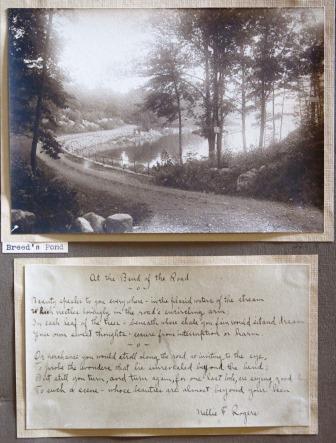
“Breed’s Pond,” photograph by Edward P. Nostrand; “At the Bend of the Road,” poem by Nellie F. Rogers.

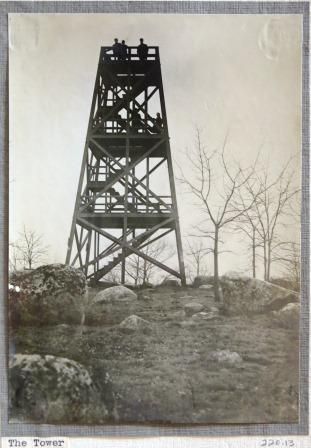
The MHS is home to a Lynn Woods photograph album, ca. 1910, consisting of various photographs of Lynn Woods along with explanatory text. The text by Edward P. Nostrand, which includes descriptions of various locations as well as short stories associated with the woods, reads like the transcript of a guided tour. The text interacts nicely with his photographs and Nellie F. Rogers’s poetry to provide an engaging sweep through the Lynn Woods of the early 20th century based on the perspectives of two people who experienced it.

Nostrand prefaces his narrative with a warning that “the legends have been handed down from generation to generation, and as to their truth, the reader must accept them as such.” He starts by briefly describing the early settlement of the Lynn area by Europeans in the seventeenth century. He writes about a supposed pirate encounter in 1656, in which a ship owned by Captain Kid [sic] came up the Saugus River and men from the ship got out and went into the woods. In response to a letter, the townspeople provided shackles and handcuffs to the pirates. According to the story, the men placed treasure in the woods, under Dungeon Rock.

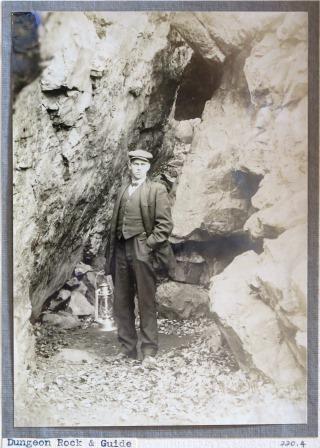
Nostrand also tells the story of Hiram Marble, a man who spent years blasting through the rock in the hopes of finding the treasure; while he never did find what Nostrand calls “treasure which never existed,” the effort has left behind a path in the rock, which is still open for exploration today. 

 “Dungeon Rock & Guide,” photograph by Edward P. Nostrand

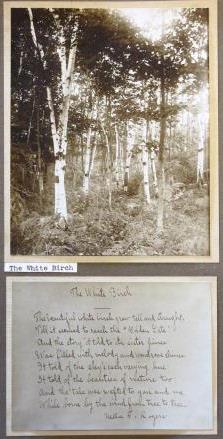
In addition to telling these fascinating stories, Nostrand describes various locations within the woods, as well as some of the flora and fauna there. Among the spots he mentions, and includes photographs of, are “Breed’s Pond,” “Fern Dell,” “Lovers Lane,” and “Forest Castle.” One particular feature that seems to be of particular significance to Nostrand is a group of white birch trees, about which he writes “Oh ye Gods what a sight! There they stand – are they not beautiful?” The previous page includes both a photograph of white birch trees and a poem by Rogers, titled “The White Birch,” which reads as follows:

The beautiful white birch grew tall and straight,

‘Till it seemed to reach the “Golden Gate.”

And the story it told to its sister pines

Was filled with melody and wondrous chimes.

It told of the sky’s each varying hue;

It told of the beauties of nature too;

And the tale was wafted to you and me,

While borne by the wind from tree to tree.


 “The White Birch,” photograph by Edward P. Nostrand; “The White Birch,” poem by Nellie F. Rogers

This Lynn Woods photograph album offers an exciting glimpse into the Lynn Woods of the 1910 period, as seen and documented by Nostrand and Rogers. Nostrand’s narrative should not serve as a transcript for a 2017 walking tour – he uses some language that is offensive today, and, based on my knowledge of the woods and my viewing of his photographs, the area does not look exactly the same now as did over a century ago. However, if you would like to engage with the woods as Nostrand and Rogers would have in the early 20th century, feel free to view the album here in the MHS library.

Additionally, if you are interested in the stories around Dungeon Rock, N. S. Emerson’s The History of Dungeon Rock: Completed Sept. 17th, 1856 (Boston: Adams, 1856) and Dungeon Rock; or The Pirate’s Cave at Lynn (Boston: C.M.A. Twitchell, 1885) are print items held by the MHS that may be of interest. Copies of an 1859 edition of The History of Dungeon Rock (Bela Marsh), which the MHS also holds, as well as the 1885 Dungeon Rock book are available electronically through Internet Archive.

“The Tower,” photograph by Edward P. Nostrand

Photographs at the MHS

By Susan Martin, Collections Services

Having spent the last few weeks immersed in a very interesting collection of 19th- and early 20th-century photographs (more on that in a later post), I thought I’d take this opportunity to write about processing photographs here at the MHS and what goes into making these terrific collections available to researchers. 

The MHS is primarily a manuscript repository, but most of our manuscript collections come to us with at least a few photographs mixed in. Because of their special storage and preservation needs, the photographs are removed and stored separately. Unfortunately we don’t have the resources to process all of our photograph collections, but we have cataloged many of them in our catalog ABIGAIL, and over fifty are described in more detailed online guides.

Describing a photograph collection is challenging, and not just because of the technical knowledge required. For one thing, unlike manuscript collections, which are arranged into groups of related material (correspondence, diaries, financial papers, etc.), photographs are described at the item level. Every photograph is listed individually, and each listing includes most of the following information: subject, date, photographer, location, type, size, and condition, as well as any label or caption.


Just the subject and date can be tricky! The collection I’m currently processing, for example, contains hundreds of photographs and came to us completely unorganized. Many of the photographs include no identifying information at all. Since the collection encompasses five generations of a very large family, as well as families related by marriage, I had to do a lot of genealogical research. As I sorted through the photographs, I started to recognize familiar faces (“Hey, it’s Frank!”). My colleague Sabina Beauchard described the fun of making these connections in an earlier Beehive post.

Dates of photographs can be determined—or at least estimated—based on various factors. Here it helps to know something about the history of photography, and fortunately for me (not even close to an expert) our library has some great resources on the subject. If I know when a particular photographic process was invented and when it was most popular, I can make an educated guess about a photograph’s date, even if I can’t identify the subject. I often use “circa” dates and date ranges to hedge my bets.

The earliest photographic processes were metal- or glass-based, and the types I’ve seen most are daguerreotypes, ambrotypes, and tintypes. Each has distinctive characteristics. Daguerreotypes and ambrotypes both come in cases or enclosures, but a daguerreotype has a mirrored surface, and you have to hold it at a slight angle to see the image. This isn’t true for ambrotypes. And the tintype is the only one of the three that’s magnetic.

Starting in the 1860s, these types of photographs were gradually replaced by paper-based cartes de visite and, later, cabinet cards. These come in standard sizes: cartes de visite are about the size of baseball cards (2.5” x 4”), and cabinet cards are larger (4.25” x 6.5”).

I may be able to use contextual clues to determine the date of a photograph—clothes, hairstyle, etc. If I have multiple photographs of the same person, I can try to guess their age, but this is more of an art than a science! Biographical details are useful: when did they take that trip to Philadelphia? When did they get married? If a photographer printed his or her name and address on a photograph, I can research when the studio was located there. There may even be something in the manuscript collection to help, like a letter the photograph was enclosed in.

Our digital team sometimes comes along behind us and digitizes part or all of a photograph collection, and we link to that content from the guide. Several of our Civil War photograph collections are accessible this way, as are our Portraits of American Abolitionists. Or to find photographs related to a particular person or subject, you can always just search our website. If you can identify anybody we missed, don’t hesitate to let us know!

Gertrude Codman Carter’s Diary, June 1917

By Anna Clutterbuck-Cook, Reader Services

Today we return to the 1917 diary of Gertrude Codman Carter. You may read the previous entries here:

Introduction | January | February | March | April | May

Unusual for this diary is a long unbroken series of entries from 1 June – 20 June without any missing pages (though we then skip to 26 July with a series of torn-out entries). The beginning of June documents a bustling social schedule punctuated by trips to Ilaro to view or supervise the ongoing construction. In the final June entry, for example, “sever rain” led to two separate trips to Ilaro in order to examine the damage done when gutters “behaved awfully.”


The distant war also enters back into the frame of English colonial life when Gertrude takes her son John to a church service held to send off the troops. “We both loved it!” she reports, with a rare exclamation point, describing the sermon as “splendid” and making note of two particular hymns that were played by the band.

We also see hints of relationship drama in the recurring figure of Harold Austin who is first mentioned on 9 June as the instigator of an outing in search of some wood flooring, presumably for Ilaro. He then turns the shopping excursion into a dinner party and, at some point during the evening “unburdens his soul” to Gertrude about “having a time of it with the fair Kitty.” He confided in her that “[he] has suddenly decided to go to England.” Four days later, Gertrude notes: “Harold Austin left suddenly today.” Whether to retreat from or in pursuit of the fair Kitty, we are left guessing.

Here is Gertrude’s June in her own words.

* * *

1 June.

Miss Barton to the house.


2 June.

Paid calls and to the Savannah.


3 June.

Ilaro with John. We have much fun in the [illegible] house planning & playing together. To the [illegible] & visited his coral caves.


4 June.

A luncheon party before the races. The Kings, the Clarence Haynes, Captain Hancock (Charlie Haynes could not come) who was so charming to me. I had a delightful afternoon. John and Mickey came too.

Gymkana at the Savannah.


5  June.

More home carving.

7.30 dined with Mrs. Carpenter.


6 June

Subcommittee on Savannah improvements

1. Improvement committee

Miss Burton at 4.30 carving.


7 June.

llaro.

Governor House at home.


8 June.

Another Savannah meeting.


9 June. Saturday.

Harold Austin about some nice wood he has for a floor. Such an amusing afternoon. We drove out to Blackman Plantation to a stone and garden [illegible] there. G. promptly disappeared into the woods with Mrs. H. H. Sealy so tripped off with Harold myself, who had just joined us and was looking so nice in his new uniform. Then had my fortune told! Harold Austin gave a dinner party to whoever he could find — Mr. Fell & Mrs. Frank [illegible] was coralled first & then Mrs. Carpenter who had a [illegible] & was quite ready to [illegible] …so Frank Austin & Mr. Carpenter very serious were produced & then Harold Austin sank exhausted next to me & unburdened his soul. He is evidently having a time of it with the fair Kitty & has suddenly decided to go to England. After supper we had a go at the theater. Harold Whyte came too & it was all fine hours later.


10 June. Sunday.

Mrs. Austin had a picnic for the kids only we had it in the house because it rained.


11 June.

Ilaro.

A [illegible] party with Mrs. Sean Evelyn. Laddie. Mrs. DaCosta.


12 June.

Swim

Ilaro.

Called Carpenters & Evelyns.

Took Miss Mary & Mrs. Sealy to house.


13 June.

10. [illegible] meeting

1. Theatre Co. meeting

To C.P. Clarkes at home

Charlie Haynes afterward

Harold Austin left suddenly today


14 June.

Savannah dull.


15 June.

Took John to a farewell to troops.

Service at the Cathedral. We both loved it! They had the band & sang “O God Our Help in Ages Past” and “Fight the Good Fight.” & Fr. Dallin preached a splendid sermon.


16 June.

Ilaro.

Took John to Bazaar.

¼ h8. Dinner party at Mrs. Charlie Sealey’s. Great fun. Talked politics afterward.


18 June.

Mrs. Austin & kids & we took our [illegible] to Maxwells. Afterward [illegible]. Victrola Magic Lantern.


19 June.

Tour with John.

Ilaro.

[illegible] tour at [illegible] Parks.

Miss Packer re her [illegible].

C Hayden for sunset.


20 June.

Severe rain.

Ilaro. Gutters behaved awfully.

Ilaro again to see the damage.


* * *

As always, if you are interested in viewing the diary or letters yourself, in our library, or have other questions about the collection please visit the library or contact a member of the library staff for further assistance.


Counting Votes and Campaigning: Aaron Burr’s “Intriguing” in the Election of 1800

By Grace Wagner, Reader Services

A letter addressed to Doctor William Eustis of Boston, MA.


In a box of letters addressed to Doctor William Eustis, a physician and politician who lived in Boston, some of the political and personal musings of Aaron Burr (Aaron Burr letters, 1777-1802) can be found at MHS. The bulk of letters were written between 1794-1802, right in the midst of Burr’s political campaigns (in 1796 and 1800) for the United States presidency and the height of his political ambition.

As might be expected, Burr references his political opponents and the forthcoming elections in his letters, but the focus of his letters is primarily concerned with counting votes. Burr marks the differences between himself, Thomas Jefferson, John Adams, and (Charles and Thomas) Pinckney through numbers rather than political views:

“If A. [Adams] has all the Eastern votes he has 69 north of Potomac If Jeffn [Jefferson] has all the Southern votes, he will has 70…” [December 16, 1796]

“It is now probable that N Jersey will not give a vote for A. [Adams]” [July 15, 1800]

“…both Hampton & Alston write positively that Jefferson will have the eight votes of that State both are however apprehensive that P. [Charles Pinckney] will also have them…” [December 5, 1800]

 Burr counts up the votes


In the 1796 election, Burr finished abysmally in comparison to his political opponents: Adams led with 71 votes, Jefferson a close second with 68, Thomas Pinckney in third with 59, and Burr in last place with only 30 votes. Alexander Hamilton wrote “the event will not a little mortify Burr.”[i] While this assessment may have been true, it was not the reaction Burr displayed publically or even in private letters to his friends. Burr’s letters following the election demonstrate that he remained committed to playing a numbers game as before. To Eustis, he writes: “I have no doubt however but he [Adams] will be the Pres’t — and I am very glad that your people had the discretion to throw away some votes rather than give them to P [Thomas Pinckney]” [December 18th, 1796].

As it turns out, Burr had good reason to concern himself with election numbers. In the election of 1800, this tactic, along with some clever political maneuvering, helped Burr come very close to winning the presidency. This was partly due to the way elections were run in the early days of the United States. At this time, presidents and vice presidents did not run on a single ticket. Rather, the man with the most votes became president and the runner-up became vice president. This meant that in addition to Burr running against candidates of the opposing party, Adams and Charles Pinckney (Federalist Party), he was also effectively running against a candidate of his own party, Jefferson (Democratic-Republican Party).

Burr’s campaigning became particularly rampant in the summer of 1800. Hamilton described Burr as “intriguing with all his might in New Jersey, Rhode Island, and Vermont,” and warned “there is a possibility of some success in his intrigues.”[ii] Judging by the cagey, secretive nature of Burr’s letters at this time, Hamilton may not have been far off base in his assessment. On July 1, 1800, Burr writes cryptically to Eustis: “The thing is preparing but not yet done — the labor exceeds what I had imagined — It will be finished & forwarded in the course of this week — I have nothing else now to say which I dare say in this way.”

When the votes had been cast, Burr and Jefferson were tied with 73 votes apiece, leading to a contentious run-off vote in the House of Representatives to determine which one would be president. James Cheetham, a newspaper editor of American Citizen, published a long, unfavorable pamphlet about Burr’s actions during the election, which included the following passage:

 Cheetham attacks Burr


“It is fearful to reflect upon what our condition would, in all probability be, were Mr. Burr at the head of our government….It cannot be concealed that he is a man of desperate fortune; bold, enterprizing, ambitious, and intriguing; thrifting for military glory and Bonapartian fame. A man of no fixed principle, no consistency of character, of contracted views as a politician, of boundless vanity, and listless of the public good…”[iii]

Although Burr lost to Jefferson in the House vote in February 1801, the way Burr ran his 1800 political campaign helped change the way that political elections were conducted in the future. In one of the last letters written to Eustis in our collection, Burr closes his letter with a typically cryptic remark: “My journey Southward is postponed and will I fear be abandoned for reasons which I cannot now detail — ” [August 1, 1801].

 Burr remains secretive


The above transcriptions are preliminary and are not meant to be authoritative. For more information about the election of 1800 and our “intriguing” Founding Fathers, check out the sources below or visit MHS to explore the collections!


[i] Van der Linden, Frank. “The turning point: Jefferson’s battle for the Presidency,” Golden, Colorado: Fulcrum Publishing, 2000.  32.

The Lion of the North, caged at the MHS [Updated]

By Daniel Tobias Hinchen, Reader Services

Many years ago as a college student enrolled in a Protestant Theology course, I was required to write a research paper on any topic related to the overall class. I chose to focus on Gustav II Adolf, or King Gustavus Adolphus of Sweden, the Lion of the North. During his reign, Gustavus and chancellor Axel Oxenstierna worked together to suspend the long-standing struggle between the monarch and the nobility which, in turn, allowed for some broad domestic political and social reforms. 

Under Gustav II, Sweden saw the formation of its Supreme Court and the setting of its Treasury and Chancery as permanent administrative boards. In the second decade of his reign, Gustavus professionalized local government in Sweden, placing it under direct control of the crown; he promoted education through the formation of the Gymnasia, an effective provision for secondary education in the country; and he gave generously to the University of Uppsala. Despite all these important political and social reforms, however, Gustavus Adolphus is perhaps best remembered, especially outside of Sweden, as one of the most brilliant military minds in European history.

Through much of his reign, which began in 1611 and ran to 1632, the Thirty Years War (1618-1648) raged in Europe. This long-lasting conflict pitted Catholic forces aligned with the Holy Roman Empire against anti-Imperialist Protestant governments and supporters. By 1630 – as our fair city of Boston was founded – the ordeal was going poorly for German Protestants and their allies. It was around this time that the entry of Lutheran Sweden into the fray helped to turn the tide against the Holy Roman Empire. This reversal of fortunes is directly attributed to Gustavus and the military innovations he brought to the table, such as the first effective iteration of light artillery and the successful combination of infantry and cavalry.**

And you might be thinking to yourself, “But Dan, what does this have to do with the MHS?” I’m glad you asked. 

I recently went to the stacks to retrieve a couple of documents from the Curtis Guild autograph collection. As I finger-walked through the folders, I saw one labeled with the name Gustavus Adolphus and was, of course, intrigued. In the folder is a document in fine, albeit small, handwriting. This item, headed with the phrase “In Memorial” and dated 1 November 1632, is signed and sealed by Gustavus Adolphus. Unfortunately, I am not able to make any sense of the text, aside from one or two names that stand out clearly (Oxenstierna being one). 

Accompanying the document is another, written much later, which reads:

Gustavus Adolphus

Fine signature & seal

Signed Nov 1 1632

Just 5 days before his death at

the battle of Lutzen –


Seal (detail) reading “Gustavus Adolphus D.G. Suecorum Gothorum Vandalorum Q Rex M.P. Finlan”

Regular readers of the Beehive may recall that last year around this time I published a post about a document from the Charles Edward French autograph collection which dates from the 12th century and which I could not make any sense of. Thanks to our readers, within 24 hours we had a transcription, a translation, and contextual information about the quitclaim deed. I am putting up this document in the hope that we can, once again, get help from you out there in the world and learn more about it. 

Are you familiar with 17th century Germanic languages? Can you provide any assistance in transcribing and translating this document? Maybe you know someone who does. If so, please leave a comment below!

_________

**While I wish my memory was so good as to remember all of this, I did use some outside help:

– Roberts, Michael, “Gustav II Adolf,” Encyclopedia Britannica online, https://www.britannica.com/biography/Gustav-II-Adolf (accessed 9 June 2017).