“He plants trees for the benefit of later generations”: John Quincy Adams’s Motto

By Rhonda Barlow, Adams Papers

In the summer of 1830, John Quincy Adams was preoccupied with two projects: planting trees on his properties in Quincy and reading the works of the Roman statesman and philosopher, Cicero, in the original Latin. Just two years earlier, in an 11 May letter to his son Charles Francis, John Quincy had lamented that he had not planted trees in his youth, for if he had, he could now enjoy their fruits and shade. He likewise wished he had read Cicero (106–43 B.C.) in Latin forty years earlier, when it would have been more profitable for his public service. He kept records of his planting and his reading in his Diary, which he had started in 1779, and by his death in 1848, filled 51 volumes.

On 14 August 1830, he started reading Cicero’s Tusculan Disputations, a philosophical treatise that began with “On the Contempt of Death.” In the midst of Cicero’s moralizing and speculation, a quote from the Roman poet Caecilius Statius leapt off the page:

Serit arbores quae alteri seculo prosint

John Quincy, writing in his Diary, made this translation from the Latin:

“He plants trees, says Statius… for the benefit of another century: for what purpose, if the next century were something to him? The diligent husbandman then shall plant trees, upon which his own eyes shall never see a berry? and shall not a great man plant laws, institutions, a Commonwealth?”

Cicero drew a comparison between the farmer and the statesman; but John Quincy was both. In his Diary, JQA followed his translation with this personal reflection:

“I have had my share in planting Laws and Institutions, according to the measure of my ability and opportunities— I would willingly have had more— My leisure is now imposed upon me by the will of higher powers, to which I cheerfully submit, and I plant trees for the benefit of the next age, and of which my own eyes will never behold a berry— To raise forest trees requires the concurrence of two Generations, and even of my lately planted nuts seeds and Stones, I may never taste the fruit— Sero arbores quae alteri seculo prosint.” Here John Quincy altered the Latin significantly, from Caecilius Statius’ “He plants” to “I plant.”

Having lost the 1828 presidential election to Andrew Jackson, John Quincy faced an early retirement from public life. He had passed from planting a republic to planting a garden. He could not forget the brief quote from Caecilius Statius. “Seculo prosint” kept appearing in his Diary as he cared for his trees. But within three months, he was elected to serve in the U. S. House of Representatives, and given a fresh chance to continue to plant laws for another century, another age, another generation.

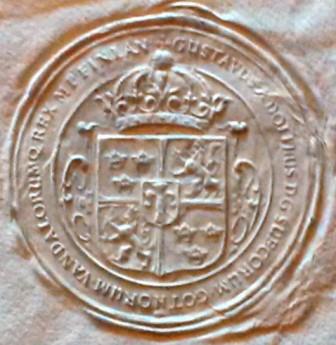
In June 1833, President Andrew Jackson, was in Boston inspecting the local troops. While listening to the roar of the cannons in the distance, John Quincy, alone with his seedlings, proclaimed alteri seculo as his motto. The Latin phrase was a shout of triumph in the midst of defeat. His grandson, Henry Adams, recorded that JQA designed a seal, featuring an acorn and two oak leaves, and began using it to seal his letters. He even made a fob for his watch, and carried it everywhere (Catalogue of the Books of John Quincy Adams, Boston, 1938, p. 144–145).

This seal now adorns every volume of The Adams Papers, and appears on the website for the digital edition.


The Significance of Strawberries

By Rakashi Chand, Reader Services

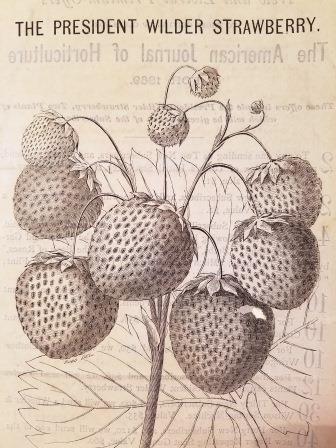
In New England, the arrival of summer is synonymous with strawberries. Strawberry plants (fields) can be found throughout the region, and the strawberry harvest in late May and early June goes hand-in-hand with the most beautiful part of the year. The lovely, fragrant evenings and the final sigh of relief as New Englanders pack their coats away for the summer inevitably lead to the sudden desire to celebrate the arrival of the long-awaited warm months of summer. So, naturally, spring fetes were often “Strawberry Festivals.” The delicious berry was a welcome addition to the kitchen after months of cooking and consuming dried fruit. Every dish on the table was augmented, filled, or garnished with the beautiful, vibrant, and sweet berry.

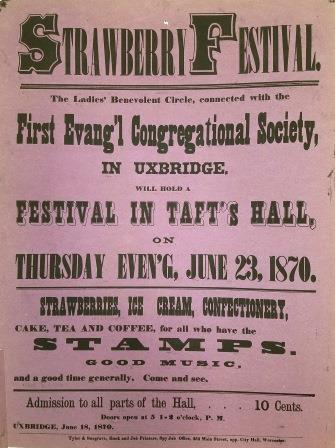
In the nineteenth century Strawberry Festivals or parties were very popular. The strawberry was the first crop of the summer, and the region was dotted with strawberry farms. Strawberry festivals were popular events celebrated in many New England towns. Here at the Historical Society we have a few examples of broadside advertisements for local strawberry festivals from the late nineteenth century.


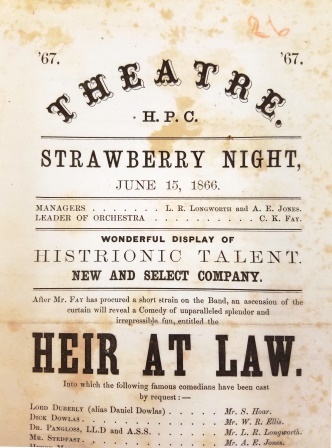
Harvard’s Hasty Pudding Club (yes, they were up to the same silliness all those years ago!) produced an annual show called “Strawberry Night” in June. 


But for us at the Massachusetts Historical Society, such festivals have a very special significance as our annual strawberry festival may have indeed led to the bequest of our biggest benefactor. According to Robert C. Winthrop, MHS President from 1855-1885, it was the invitation to the Massachusetts Historical Society’s Strawberry Festival that led Thomas Dowse to donate his prized library to the MHS, and to that end, Winthrop says, “the regeneration of our Society may thus be fairly dated.”

“SPECIAL MEETING, JUNE, 1886. A Social Meeting of the Society was held at the house of Mr. Charles Deane, in Cambridge, on Friday, the 18th instant, at five o’clock, P.M.

The Hon. Robert C. Winthrop then spoke as follows :

 “Passing from this topic, let me say how glad I am to find myself at another social meeting of our old society at Cambridge…

…But another of these Cambridge meetings was still more memorable, and can never be forgotten in the history of our Society. I refer, as I need hardly say, to the meeting at good George Livermore’s in 1856, just thirty years ago. From that meeting came the library and large endowment of our great benefactor, Thomas Dowse. Mr. Dowse was a neighbor and friend of Mr. Livermore, and had been specially invited by him to come over to our strawberry festival. Age and infirmities prevented his acceptance of the invitation; but the occasion induced him to inquire into the composition and character of our Society, and he forthwith resolved to place his precious books, the costly collections of a long life, under our guardianship, and to make them our property forever. From that meeting the regeneration of our Society may thus be fairly dated. Cambridge strawberries have ever since had a peculiar flavor for us, – not Hovey’s Seedling, though that too was a Cambridge product, but what I might almost call the Livermore Seedling or the Dowse Graft, which were the immediate fruits of our social meeting at Mr. Livermore’s.”*

Read more about Thomas Dowse and the Dowse Library here! (http://www.masshist.org/database/210)


Ten years ago, The Librarian of the Massachusetts Historical Society, Peter Drummey, suggested the library staff resurrect the age-old tradition; one hundred and fifty years later, a Strawberry Festival was once again held by the Massachusetts Historical Society.

The Library Staff of the Massachusetts Historical Society holds a Strawberry Festival every year in late May or early June for the staff, friends, volunteers, researchers and patrons of the Massachusetts Historical Society. We will be hosting our 2017 Strawberry Festival on Friday, June 2nd.


*Proceedings of the Massachusetts Historical Society, Second Series, Vol. 3, [Vol. 23 of continuous numbering] (1886 – 1887), pp. 53-54


Origins of Memorial Day, In Brief

By Anna Clutterbuck-Cook, Reader Services

The Massachusetts Historical Society will be closed on Saturday and Monday this weekend in observance of Memorial Day. The origins of Memorial Day are rooted in the Civil War, and the rituals of commemoration that sprung up extemporaneously and then in a more collective, organized fashion in the postwar period and during Reconstruction. Decoration Day, later Memorial Day, celebrations honored the dead, celebrated emancipation, and in the white South kept the memory of the Confederacy alive. It was not until the First World War, in the early twentieth century, that Memorial Day became a national day to remember those who had fallen in all violent conflicts in which the United States had been militarily involved. 


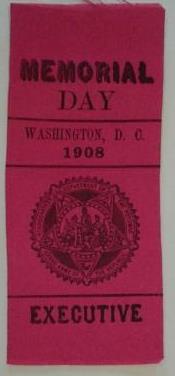
The ribbon above [http://balthazaar.masshist.org/cgi-bin/Pwebrecon.cgi?DB=local&BBID=201361], from 1908, was worn by a participant in the Grand Army of the Republic ceremonies in Washington, D.C. It is one of two ribbons from the day’s celebrations held in the collection of the Massachusetts Historical Society. 

We at the MHS wish you the best on this holiday weekend, and look forward to reopening the library on Tuesday for our summer research season.


Crooked and Narrow Streets: Annie Haven Thwing’s “Old Boston” Scrapbook

By Shelby Wolfe, Reader Services

I recently received a scrapbook from a friend moving away from Boston who needed to weed out her hefty book collection. She texted me a series of pictures of the books she was giving away, which included a Victorian volume with one word, “Scrapbook,” emblazoned in gold on the cover. The book was large (usually a deterrent for me, since I don’t have much room for books in my apartment either) and I didn’t entirely know what I would find inside, but of course I wanted it. I was happy to add this mysterious book to my collection and excited about flipping through its pages to find out what was tucked away between its covers.

I was similarly excited about looking through the Annie Haven Thwing Scrapbooks. It was the printed collection guide that first piqued my interest, the title list of the scrapbooks indicating volumes on ‘Old Boston,’ ‘Portraits,’ and ‘Friendly letters to A.H.T.’ I decided to pull the volume for ‘Old Boston’ and see what treasures it contained. Inside I found maps of Boston, reviews of Thwing’s book The Crooked and Narrow Streets of the Town of Boston, and a number of cut-out sketches and photographs of Boston.

What I found most interesting about these images, seemingly clipped from her own book as well as other publications, was the view they provide not just of Old Boston, but of lost Boston. A compilation of images depicting areas and buildings later demolished or destroyed, as well as maps of the city’s shifting boundaries satisfied some curiosities I had intended to research (What did Louisburg Square look like in the past?), some I didn’t realize I had (Who owned the pasture the State House was built on?), and raised others I have yet to thoroughly investigate: What’s the story behind Smokers’ Circle on Boston Common? The Water Celebration of 1848? The building replaced by the Boston Public Library? Thwing devotes several scrapbook pages to buildings and locations severely impacted by the Great Fire of 1872, highlighting the extent of destruction, damage, and change that such an event can precipitate. I certainly have enjoyed looking into these topics so far and will continue to do so. 


Map of Beacon Hill with preceding land ownership divisions.


Smoker’s Circle on Boston Common.


The Water Celebration of 1848 on Boston Common, commemorating the introduction of water from Lake Cochituate to Boston. 


The Samuel N. Brown House on the corner of Dartmouth and Blagden Streets, where the Boston Public Library now stands.


Artist’s rendering of Boston after the Great Fire of 1872.


 Annie Haven Thwing’s interest in Old Boston, every crooked and narrow street, is captured in her scrapbooks and writings. Other volumes in the scrapbook collection include personal correspondence, letters regarding the publication of her book, obituaries, and portraits of notable American figures, British political figures, Civil War regiments from New England, and newspaper clippings regarding the activities of Justice Oliver Wendell Holmes. Visit the library to view the Annie Haven Thwing Scrapbooks and other collections to see what answers you can find to the questions and curiosities her clippings inspire. For a more detailed history of Old Boston from Thwing herself, read The Crooked and Narrow Streets of the Town of Boston online via the Internet Archive.


The Final Journey of the Thomas P. Cope

By Susan Martin, Collection Services


A recent acquisition by the MHS details the harrowing trans-Atlantic voyage of the packet ship Thomas P. Cope in 1846 and, like so many other manuscripts in our collections, touches on several other fascinating subjects at the same time. The seven-page account was written by passenger Walter Cran on 10 January 1847, shortly after the events described. I wasn’t able to learn much about Cran, but he was apparently a Scottish immigrant living in St. Louis, Missouri. He, his wife, and their three young daughters were sailing to Scotland on the Thomas P. Cope, but they never arrived at their destination.

Our story begins a little earlier, though, on 5 October 1846, when the Cran family boarded the steamboat Colorado at St. Louis. As they made their way along the Ohio River, they saw what Cran called “novelties” and “Peculiar things,” including boats that carried sign-painting and glass-blowing establishments and even “a floating saw mill.” Cran also described this chilling sight: “We Passed a steamboat, that had on it a great number of Negros, 8 or ten being chained together like horses, going to Market.” It’s interesting to note that just five years earlier, Abraham Lincoln himself traveled on one of these boats. The MHS holds the letter Lincoln wrote to his friend Joshua Fry Speed on the subject:

In 1841 you and I had together a tedious low-water trip, on a Steam Boat from Louisville to St. Louis. You may remember, as I well do, that from Louisville to the mouth of the Ohio, there were, on board, ten or a dozen slaves, shackled together with irons. That sight was a continual torment to me; and I see something like it every time I touch the Ohio, or any other slave-border.

In Cincinnati, Ohio, on 11 October, Cran witnessed another notorious American cruelty: “Saw the soldiers, escorting above 200 of the Miama Indians, to the same boat, for transportation to the west.” What he was watching was the forced removal of members of the Myaamia (Miami) Nation from their ancestral home in Indiana, and by all accounts the number actually exceeded 300.

The Crans traveled on, met with some logistical and financial difficulties in Pennsylvania, then boarded the Thomas P. Cope at Philadelphia and sailed for Liverpool. Cran may have thought his hardships were behind him, but the worst was still to come. Late on 29 November, the ship was struck by lightning. Cran described a dramatic series of events:

In a sudden, a loud crack, or crash, was heard like that of a cannon, and a man runs down stairs, crying the ship’s on fire, when Immediately, the smoke rushed so on us, as it darkend the lamp light. I hurridly took hold of my two Eldest Children, & rushed them up stairs, & my Wife brought the baby, naked as they were, and we beheld the main mast and riggin, all in a blaze. A widow woman was halooing, my Child, my Child is below. I attempted to go down for her, but a sailor would not let me. The hatches was Imediately closed for to smother out the fire, for the Lightning had struck the main Mast, went down its centre, into the hold between Decks. […] O the confusion of Capt & sailors, hurring, of the boats over the ship, the women screaming; what a strange feeling I had Putting my family under the low deck of the forcastle, among ropes & blocks, chains &c., for to save them from being killed by Pieces falling from the riggen.

The ship’s main and mizzen masts were lost, and the Cope floated helplessly in the storm. The sea was so turbulent that the first rescue boat lowered over the side was immediately swallowed by the waves, so the frightened passengers and crew decided to stay onboard and try to contain the blaze until sighted by a passing ship. By morning, Cran wrote, some women “laying on the quarter Deck […] had their hair froze to the deck.” His own family huddled in the bow: “Hard times they had, for when the waves broke over, they were wet, and the sails of the fore mast, taring to ribbons, cracked over their heads, like thorns, a blazing, the snow & the hail attending.”

Amazingly, the passengers and crew managed to contain the fire and avoid sinking for almost a week. On 5 December, the Thomas P. Cope was spotted by a ship sailing from Liverpool—the Emigrant. Its crew effected a daring rescue, transferring passengers from ship to ship on small boats in the rough seas. Safe onboard the Emigrant, Cran and the others watched the Cope disappear in “a perfect cloud of smoke.” All but one of its passengers had survived—the widow’s six-year-old daughter trapped below deck in the initial chaos.

The Emigrant was sailing in the opposite direction, back to North America, and took their new passengers with them. With the help of that ship and another called the Washington Irving, the Cran family made it to Boston on 20 December 1846. Unfortunately, they had lost all their money and belongings. Walter Cran acquired some supplies from philanthropic individuals and societies, probably including the Scots’ Charitable Society (the MHS holds some material related to that organization). But the devastation of recent events caught up with him, and he wrote that he “could not help washing my face with my tears.”

Cran finally made contact with another Scottish immigrant, the wealthy merchant Robert Waterston. Waterston and his stepsisters, “the Misses Ruthven,” invited the penniless family to their home in Boston’s Fort Hill neighborhood. Cran described their hospitality with gratitude: “When we arrived, the first words the Ladies said to us, was; your welcome here. They set us by a large fire, and gave us breakfast, Plenty of water to wash with, and clean clothes to put on.” The Crans stayed there a week, until the Waterstons found Walter a job and put him “in a fare way, for to Provide for my Family again.”

Gertrude Codman Carter’s Diary, May 1917

By Anna Clutterbuck-Cook, Reader Services

Today we return to the 1917 diary of Gertrude Codman Carter. You may read the previous entries here:

Introduction | January | February | March | April

The entries for May 1917 are more extensive than the first few months of the year, beginning with May 3 and ending on May 31 with only one extensive gap in the middle of the month. In these brief entries we catch glimpses of Gertrude ever on the move between family, society, and artistic obligations — nursing her young son in bed with a cold, regular trips to Ilaro where building was still underway, the arrangement of a “very successful” dinner party followed by an evening at the theater to see a play about German spies in Southeast England during World War One (at this point still raging in Europe). 

Gertrude makes several reference in May to “Self Help” meetings. The Women’s Self-Help Association (or Society) was a charitable organization that she and a group of other Barbadian women founded in 1907 — and which, according to the Barbados Museum & Historical Society, only ceased operations in 2011. The organization arranged for what today we might consider a “fair trade” shop in Bridgetown, Barbados, where women could sell handicrafts and artwork to tourists as a means of adding to the family income. Edward Albes of the Pan-American Union wrote approvingly of the shop upon visiting Bridgetown in 1913:

In the salesroom of the association may be found picture postals, photographs, curios, Indian pottery, lace, embroidery and fancy needlework, homemade jellies, cakes, pies, light lunches, delicious ices, etc., and all at remarkably low prices. The association…is maintained by the ladies of Barbados, and is a splendid example of practical benevolence.

Not everyone saw “practical benevolence” of upper-class women as so splendid, of course. Writing shortly after the war, in 1920, women’s rights activist Maria Moravsky sniffed in The Suffragist:

The members of these organizations occupy their time mostly by reading sentimental ‘colonial’ novels, eating ice cream, selling their old jewelry and making crochet — in order to help their families. Hand-craft — sewing babies’ caps, making embroidery and laces — is considered less humiliating by the old-fashioned Barbadian gentlewomen than salesmanship or clerical work.

This passage hints at the tension that may have existed between Gertrude — an upper-class woman seeking to put her own professional skills and resources to work in support of women’s industry — and a new generation of activists critical of labor they deem “humiliating” and “old fashioned” compared to the twentieth-century pink collar opportunities opening up for (some, white) working class women in department stores and offices. As we have seen in already in the first quarter of the year, even Gertrudes spare records of her daily life can offer an opportunity to explore the complex — and not always easy — gender, class, and racial politics of her particular life, opportunities, and actions.

* * *

3 May.
Somerset House Team Tournament.
[illegible] went.


4 May.
Circus 2-10.

The Lewistons.

Also Brazilian ambassador & his [illegible] sent by the Perkins.


5 May.

Circus again. A great success particularly the [illegible] which [illegible].


6 May.

Headache from curtain lights of last night.


7 May.

More headache.

Carrolls to tea (?) [or (!)]

4.30 Mrs. Lew.


8 May.

House.

Made cement baskets under dreary room windows.

Swimming party at the Lewistons.


9 May.

Self Help meeting.

Jon had a cold & kept him in bed.


17 May.

Swim with John who [illegible] all right again.

12.45 Improvement Society which just asked me on its committee.

Pachu & Lew in P.M.


18 May.

Band Hall stone work.

Eve. I gave a dinner party for the Harold Leightons. I made special cards & had a short dinner – [illegible] theater. But excellent. The Whytes. Dr. Wm. Pilgrim, Mrs. South, Mrs. Fell, Mrs. Da Costa, Laddie [illegible], Miss [illegible] (who did not go to the theater), Mr. [illegible] Carpenter.

Went to “The Man Who Stayed at Home” (Clifton Whyte in the name part).
A very successful evening.


19 May.

11. Mrs. Collyum about Self Help difficulties. She was so nice.

Cook very ill had to be sent home.

4.30 Batting party.


20 May.

Walked to Illaro with Mrs. Fell.

Afternoon [illegible] with the Pils.

Eve wrote letters.


21 May.

Early to Ilaro

Auction in town.

Called Lewistons.


22 May

[illegible] auction


23 May

8 a.m. Public Buildings with Miss Packer.

10.30 Self Help.

1. [illegible] meeting.

P.M. Burtons tea party. Miss Burton sang “Buffalo Gals come out to play – come to play by the light of the moon.” John also sang charmingly.


31 May

Bathing party at Mrs. Harold Whytes. John had a find romp with Edna.

* * *

As always, if you are interested in viewing the diary or letters yourself, in our library, or have other questions about the collection please visit the library or contact a member of the library staff for further assistance.

Out West: Colorado Mines and the Labor Strikes of 1904

By Katherine Green, Reader Services

In March, Brendan Kieran from Reader Services wrote a blog post about industrial labor unions in Boston. This month, while browsing through ABIGAIL, I happened upon echoes of a very different kind of union history: that of the Western Federation of Miners and the Colorado Labor Wars of 1903-1904. The WFM, formed in 1893, sought to bargain for the rights of miners whom they felt were being exploited by rich mine owners.

The Massachusetts Historical Society collections, despite our East Coast location, is connected to the mines and miner strikes of Southwestern Colorado through the journals of Robert Livermore. His personal papers include a collection of neatly penned memories decorated with photographs and original pen-and-ink drawings.  

Robert Livermore surveying in Colorado


Livermore, who grew up in Jamaica Plain, Massachusetts and attended Boston Latin School, Harvard University, and MIT, journeyed out west in the early 1900s to travel and to work for the mines owned by his brother-in-law, Bulkeley Wells. Livermore arrived at Camp Bird Mine in Ouray, Colorado on 27th June 1903 to survey and sample the rock formations.

A sketch of Camp Bird drawn by Robert Livermore


In his journal, he describes the combination of “luxury and wilderness” Camp Bird Mine boasts:

We live in a great wooden building with baths, hot water, and electric lights, the best of wholesome food and fresh creamy milk, and all around us is the great wilderness of spruce forest and jagged peaks as it was since time immemorial.

Livermore’s brother-in-law Bulkeley Wells, whom he affectionately refers to in his diary as ‘Buck,’ was a businessman and manager/owner of Smuggler Mining Company in Telluride. Between his mine in Telluride and Camp Bird Mine in Ouray, there was much unrest among miners, mine labor unions, and mine owners. Wells himself was often at the forefront of anti-unionist attacks. According to a Daily Sentinel article, Wells led a mob of townspeople to ransack buildings to find and force out union members.

Meanwhile, Livermore seemed to enjoy his work in and around the mines, though he makes numerous observations of men who were killed or maimed in the harsh working conditions. “Yesterday Jessey, the shift boss was caught in a cave-in, in 327 stope but luckily escaped with only a broken leg.” (A stope, according to Merriam-Webster, is “a usually steplike excavation underground for the removal of ore that is formed as the ore is mined in successive layers.”)

Livermore himself suffered injuries from his work:

On Saturday the 18th, my eye became very much inflamed from a piece of steel or rock which had lodged in it while sampling. I went to Ouray and had it looked to by the local doctor. He could find nothing in it at first, but that day discovered the substance in the middle of the pupil and extracted it, supposedly.

In an entry dated 21st August 1904, Livermore describes an army of hundreds of anti-unionists descending upon Cripple Creek:

I never saw a more impressive sight than these hundreds of quiet, determined Americans, with their dinner buckets in hand, each with a revolver on his hip, making no display but resolved to suffer no more from the murderous gang who have tyrannized over them so long.


Livermore details the army’s actions of overpowering the union store and marching its members out of town. Later that evening, the union store was destroyed by a mob – an act which Livermore questions in his diary. Perhaps he did not share the sentiments of Buck, who seemed to relish the power and force he could exert over the unionists.

In his writings, Livermore appears fiercely attached to his sister and, by extension, his brother-in-law. Besides this loyalty to the anti-unionist Buck, and in spite of the fact that he uses a phrase like “murderous gang” to describe the union members, Livermore appears to be a passive observer in these conflicts.


“Today I was commissioned and sworn in as a ‘special deputy sherrif’ [sic] under Bell, which entitles me to carry a gun.”


This changed in September 1904. Under Adjutant General Sherman Bell, Livermore was appointed “special deputy sheriff” in Colorado’s government-backed anti-union forces. In one journal entry, he celebrates that he’ll be allowed to “carry a gun” and that he is “likely to see some fun if the unionists try to come back.” Perhaps his brother-in-law’s influence won out in the end.

A photograph of Livermore’s “Deputy Sheriff” insignia


After the strikes ended at the close of 1904, Livermore would go on to invest in and run numerous mining companies. He retired to Boxford, Massachusetts and died in Boston in 1959.

If you would like to learn more about Robert Livermore and his life, you can visit our library. You can also find related materials at the University of Wyoming American Heritage Center.

Reference Man in Catalog Land : Describing publications in the George Frisbie Hoar papers

By Daniel Tobias Hinchen, Reader Services

We here in the Library Reader Services department at the MHS concern ourselves with the user/researcher side of our collections. This job allows us to continually sharpen the skills of reference librarians: catalog searching, materials handling, patron interactions, and the like. Unfortunately, this being a full-time job, there is a chance that some of our other library skills can atrophy. Thankfully, we occasionally get the opportunity to flex those other muscles by taking on projects in other areas.


Recently, I started a cataloging project in which I create bibliographic records for entry in our online catalog, ABIGAIL. The print material that I am cataloging all comes from the George Frisbie Hoar papers, a voluminous collection that contains a heady mix of manuscript material, printed matter, and even some images. This is a valuable project for me because it allows me to get a much better sense about some of the topics on which the collection is informative. It also results in a great deal more description for a researcher about what is contained in the collection, at least as far as the printed matter is concerned.

Much of the project consists of copy-cataloging. That is, using catalog information already created by other institutions and made available via the Online Computer Library Center, or OCLC. This method of cataloging saves us from recreating the wheel for every single object, though we still need to add information about the specific copy in our holdings. For instance, in every catalog record I create for ABIGAIL, I need to note that it is stored offsite with the rest of the collection, a note not needed by other libraries.

When there is no record freely available through OCLC, then original cataloging is required. This entails adding into a form all of the bibliographic data necessary for making the item discoverable by researchers. So, we had the basic stuff like author, title, and publisher (when known), but also things like subject headings which provide another means of discovery. When the project is finished, a researcher working on a project about currency will now be able to find several publications in the Hoar papers about bimetallism, for example.

The project is also well-timed as we are seeing a very dramatic upswing in requests for material from this collection. In the last twelve months there were over 170 requests for the collection! Not only are people very interested in the large amount of manuscript material – over 100 record cartons simply of correspondence – but also in the wealth of print material that Hoar collected. Most of this related to various topics with which Hoar and his congressional colleagues wrestled during the latter-half of the 19th century, some of which are gaining renewed relevance today: immigration, American imperialism, election laws and controversies, bankruptcy and anti-trust legislation, and Supreme Court matters, to name a few.

In the end, this project is a classic Win-Win-Win scenario: I get some practice using my cataloging skills, our cataloger has one less project to worry about, and the researcher gets better information about what we hold in our collections.

Interested in learning more about this collection? You can find an online collection guide to the George Frisbie Hoar papers on our website, then, learn about Visiting the Library


“Legible only to myself”: John Quincy Adams’s Shorthand

By Gwen Fries, Adams Papers

A line in John Quincy Adams’s 1788 diary is the earliest example of his use of English poet John Byrom’s shorthand system. The system replaces words with symbols to make writing faster and, eventually, easier. Six years later, Adams recorded in his diary that his youngest brother, Thomas Boylston, was attempting to teach himself shorthand and noted that he had once endeavored to learn the system, “but soon gave over the pursuit; not having a very high opinion of the utility of the art.”

Later in life John Quincy changed his mind about shorthand’s usefulness, though he did not strictly adhere to the Byrom system. The symbols, some of which are his own variations, appear in his diary more frequently beginning in 1810. John Quincy penned an entire sonnet in shorthand on October 30, 1826. He wrote, “I record it thus that it may be legible only to myself, or to a reader who will take the trouble to pick it out of the short-hand— If it were better poetry I would have written it at full length.”

Though it at first appears to be a page of scribbles, by using a combination of Byrom’s original structure and the hints John Quincy scattered throughout his papers, it is indeed possible to “pick it out.” The linear symbols represent consonants and digraphs; vowels are represented by dots, if at all. If a symbol stands alone, it represents a commonly used word.


Directly translated, the first line of the sonnet (above) reads, “Da f/v m fthrs brth I hl th y.” Once the vowels and commonly used words are filled in, we get “Day of my father’s birth I hail thee yet.” Let’s examine some of the symbols used here. The first symbol in the line is a “d.” If it stood alone, it would mean “and;” however, it is modified by a dot. The placement of the dot reveals what vowel it represents. From top to bottom, the dots represent A E I O U. Because it sits at the top of the symbol, we can read the letters as “da.” The word is “day.” For longer words, several symbols are combined. You can see the green that represented f or v in the second word is repeated in the fourth; in this case, it represents f. The next symbol, in blue, is the digraph th. The orange dash is r, and the yellow line is s. What is written is “fthrs,” obviously, “father’s.” The r and th are repeated in the following word, with a b at the front, “brth,”—“birth.” Note that even though the th arch is flipped upside down, the meaning remains the same.

Using past examples of John Quincy’s shorthand as a guide, you simply need to write out what you know, use context clues, repeat the process fourteen times, and you’ve picked out the sonnet!

“All things are in common now”

By Susan Martin, Collections Services

Today is the 242nd anniversary of the battles of Lexington and Concord, the first battles of the American Revolution. The MHS holds some terrific letters and diaries containing first-hand accounts of that famous day, not to mention related books, pamphlets, maps, and artifacts. We’ve also digitized select items over the years, and they’re available on our website with full transcriptions. My favorites are the letters of two refugees, Sarah Winslow Deming and Hannah Winthrop.


Sarah Winslow Deming (1722-1788) wrote to her niece Sally Coverly, possibly sometime in June, two months after the battles. In her 12-page journal-style letter, she recounted her harrowing flight from Boston after that “fatal” and “dreadfull” day. Early the following morning, she was told that British troops had closed all roads to carriages and that she was essentially “Genl Gage’s prisoner.” Nevertheless she persisted.

I then determined to try if my feet would support me thro’, tho’ I trembled to such a degree, that I could scarce keep my feet in my own chamber, had taken no sustenance for the day, & very sick at my stomack. […] ah! can any one that has not felt it, know my sensation? Surely no.

Learning that some carriages had gotten out, she, her husband John, and others borrowed a chaise and managed to pass through the British checkpoints without incident, but with no idea of their final destination.

We had got out of the city of destruction; such I lookt upon Boston to be, yet I could not but lift up my desires to God that he would have mercy upon, & spare the many thousands of poor creatures I had left behind. […] I was far from being elated with my escape. I remember my sensations but cannot describe ‘em.

Along the way, the Demings encountered other refugees, including many women and children.

A lad who came out of Boston wth us […] run up to our chaise wth a most joyful countenance & cry’d, Sir, Sir; Ma’m, here are the cannon – Our cannon are coming […] The matter of his joy was terror to me […] We met little parties, old, young, & middle aged, some with fife & drum, perhaps not an hundred in the whole, a kind of pleasant sedateness on all their countenances. We met such parties all the way, which gave me the Idea of sheep going to the slaughter.

Drenched from a downpour of rain, they stopped at the house of Rev. William Gordon in Jamaica Plain, a man they barely knew but who immediately offered them accommodation. As Gordon told Sarah Deming, “all things are in common now.” Deming’s husband rode off to return the chaise, which was needed to rescue other stranded residents, and she was terrified she’d never seem him again.

Read about the rest of her narrow escape here.


The letter from Hannah Fayerweather Winthrop (1727?-1790) to her friend Mercy Otis Warren was written around May 1775 and forms part of our online exhibit of their correspondence. In this letter, Winthrop described her flight from Cambridge the day of the battle, first to a house a mile outside of town.

What a distressd house did we find there filld with women whose husbands were gone forth to meet the Assailiants, 70 or 80 of these with numbers of Infant Children, Crying and agonizing for the Fate of their husbands. In adition to this scene of distress we were for Some time in Sight of the Battle, the glistening instruments of death proclaiming by an incessant fire, that much blood must be shed, that many widowd & orphand ones be Left as monuments of that persecuting Barbarity of British Tyranny.

The next day, in the aftermath of the battles, Winthrop and others were forced to move again, which she compared to Eve’s expulsion from the Garden of Eden. But while Deming was making her way south, Winthrop fled north to the town of Andover, “alternately walking & riding.” The sights she saw along the way were gruesome.

What added greatly to the horror of the Scene was our passing thro the Bloody field at Menotomy which was strewd with the mangled Bodies, we met one Affectionate Father with a Cart looking for his murderd Son & picking up his Neighbours who had fallen in Battle, in order for their Burial.

Like Deming, Winthrop found asylum with a “very obliging” family. Her rural refuge in Andover was peaceful, a surreal juxtaposition with the historical moment in which she lived. Read the rest of her letter here.

For more information on the battles of Lexington and Concord and the people who experienced them, search our online catalog ABIGAIL or our website.