“We…Intend to Make Things Lively”: Boston’s Black Voters in 1884

By Susan Martin, Collection Services

The MHS just acquired a fascinating document related to political activism by Boston’s black voters during the 1884 presidential election. This election, only the fourth presidential contest in which black (male) voters could take part, pitted Democrats Grover Cleveland and Thomas A. Hendricks against Republicans James G. Blaine and John A. Logan. Most African Americans supported the Republican Party, and “Blaine and Logan Clubs” had sprung up in many American cities, including Boston.


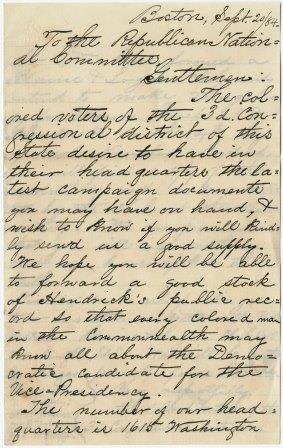
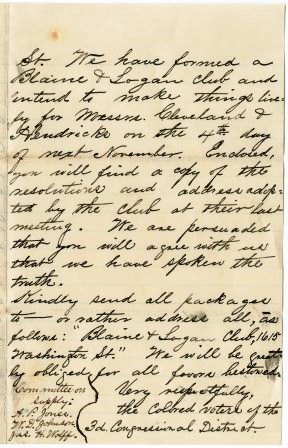
On 20 Sep. 1884, a committee consisting of three Boston men sent this letter to the Republican National Committee on behalf of the “colored voters of the 3d. Congressional district” of Massachusetts. They requested information on the candidates, particularly Democratic vice presidential nominee Hendricks. The letter reads, in part:

We hope you will be able to forward a good stock of Hendrick’s [sic] public record so that every colored man in the Commonwealth may know all about the Democratic candidate for the Vice-Presidency. […] We have formed a Blaine & Logan Club and intend to make things lively for Messrs. Cleveland & Hendricks on the 4th day of next November.

I was curious about this “opposition research” targeting Hendricks. Thomas Andrews Hendricks (1819-1885) of Indiana certainly had a substantial public record. By 1884, he’d served in multiple elected offices, including state congressman, U.S. representative, U.S. senator, and governor. He’d even run for vice president once before, on a ticket with Samuel Tilden in 1876, but they lost to Rutherford B. Hayes. So, what specific grievances did black voters have against Hendricks? To answer that question, I found two terrific resources in the MHS stacks, both printed in Boston in 1884.

The first is a book called The Life and Public Services of Grover Cleveland, by Frederick E.  Goodrich, which includes an appended biography of Hendricks. Goodrich was an enthusiastic Democrat, and his biography is unabashedly partisan. He describes the Democrats as the true heirs to the Founding Fathers and calls the Republicans “demoralized” and “thoroughly corrupt.” Hendricks himself sounds almost mythical: “His honesty was above suspicion, his integrity was never questioned, nor his motives impugned. He won the respect of all his colleagues and retained the confidence and support of his constituents.”

Goodrich wrote in generalities and didn’t have much to say about Hendricks’ specific votes related to slavery or African American civil rights. He did explain, in one passage, Hendricks’ support for the Fugitive Slave Act:

It has been objected to him lately, that he was in favor of the Fugitive Slave Law; but so was the majority of his party, which at that time recognized that slavery was a legal institution in the Southern States, and which upheld the right of the slave-owners to claim their property wherever they found it. It is too late in the day now to rake up the anti-slavery record of any man, because many of our foremost and most honored public men since the war were, prior to that event, defenders, or at least apologists of slavery.

The second resource I found at the MHS was a speech by W. R. Holloway delivered on 2 Aug. 1884 and published in pamphlet form as A Bad Record: Hendricks as a Public Man. William Robeson Holloway (1836-1911), a staunch Republican and brother-in-law of Gov. Oliver P. Morton, had held various political appointments in Indiana. He was a full-throated anti-Hendricks man and didn’t mince his words, characterizing Hendricks like this:

Shown to have been the Friend and Apologist of Slavery, a Copperhead of the worst type.—An Intense Negro Hater, as well as a Defender of Treason, a Constant Sympathizer with the Rebellion.—The Champion of Traitors, and always a Bogus Reformer, an Insincere Demagogue, and an Uncertain Leader.—Not a Redeeming Feature to be found in the Public Career of the Choice of the Democracy for Vice-President.

Hendricks did, in fact, oppose all three Reconstruction Amendments to the U.S. Constitution: the Thirteenth (abolishing slavery), Fourteenth (extending citizenship, due process, equal protection, etc.), and Fifteenth (granting suffrage to black men). In his speech, Holloway also described how the Democrat “sustained and defended the Dred-Scott decision,” “denounced the Emancipation Proclamation,” and opposed the military service of African Americans, arguing that black soldiers lacked the courage to serve alongside whites. He accused Hendricks of opportunism, hypocrisy, and cowardice. Here’s more:

He has been consistent in his opposition to the negroes, and while in the Senate, voted uniformly against the colored race, against emancipation in the District of Columbia, against their civil and political rights in that District, and against their right to ride on the street-cars in the city of Washington; opposed their employment as soldiers, and after they were enlisted and had gallantly perilled their lives on the field of battle, he voted on more than one occasion to deny them equal compensation with white soldiers in the same service.

It’s no wonder the “colored voters of the 3d. Congressional district” were determined to “make things lively”! Massachusetts’ 14 electoral votes went to the Republican nominee, James G. Blaine, but despite the party’s best efforts, Grover Cleveland won the election by a narrow margin. Thomas A. Hendricks died one year later on 25 Nov. 1885, and the vice presidency remained vacant for the rest of Cleveland’s term.

I hoped to find out more about the three men who sent the letter, A. P. Jones, W. D. Johnson, and Jas. H. Wolff, but could only definitively identify the third man. The remarkable story of James Harris Wolff (1847-1913) probably deserves a blog post of its own. He served in the Navy during the Civil War and became a prominent black attorney who argued civil rights cases for African Americans. In 1910, he was the first black person to deliver the official Fourth of July oration in Boston.


“A Remarkable Deception”: The Cardiff Giant Hoax

By Shelby Wolfe, Reader Services

In the autumn of 1869 the peaceful valley of Onondaga, in central New York, was in commotion from one end to the other. Strange reports echoed from farm to farm. It was noised abroad that a great stone statue or petrified giant had been dug up near the little hamlet of Cardiff, almost at the southern extremity of the valley; and soon, despite the fact that the crops were not yet gathered and the elections not yet over, men, women, and children were hurrying from Syracuse and from the farm-houses along the valley to the scene of the great discovery.

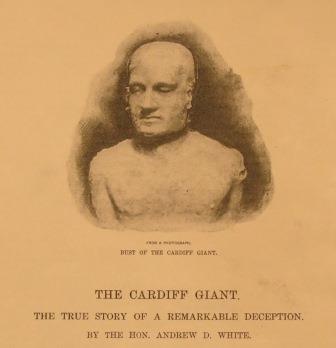
So begins Andrew D. White in a 1902 article for The Century titled “The Cardiff Giant: The True Story of a Remarkable Deception.” Thus, he sets the scene for his bizarre – yet true – story about a very fake giant.


I came across White’s article in a scrapbook of clippings in our collections, illuminating the events and deceptions surrounding the once-famed Cardiff Giant. While the compiler of clippings in this scrapbook is unknown, this person had enough interest to collect published material and neatly title the scrapbook in black ink, “The Cardiff Giant.” On the first page, a note from the November 1902 meeting of the Massachusetts Historical Society recognizes “one of our distinguished Corresponding Members,” Andrew D. White, for his “minute description of the attempt to cheat the public.”  

On 16 October 1869, workers who were hired to dig a well on the property of William C. “Stub” Newell in Cardiff, New York, unearthed what became known as the Cardiff Giant. The bewildered well diggers were hired by Newell, who knew the figure had been deliberately planted almost a year earlier by his cousin, George Hull. While in Iowa in 1866, Hull was reportedly inspired to create a stone giant and pass it off as a petrified man after he argued with a Methodist revivalist, Rev. Mr. Turk, and wondered why so many believed the remarkable stories in the Bible about giants. Two years later, Hull hired men to quarry out an eleven-foot block of gypsum near Fort Dodge, Iowa, which he shipped by train to Chicago to be sculpted into the giant. The finished 3,000-pound figure was shipped again to Cardiff and buried to await its debut. Once it was uncovered, Newell set up a tent to display the nearly ten-foot-five colossus, and hundreds flocked to his Cardiff hamlet for a twenty-five-cent viewing of what many believed to be a petrified man (Newell raised the price to fifty cents after two days). Following the discovery, Hull sold the giant to David Hannum for $23,000, who shipped it to Syracuse and began a road tour toward New York City. Noting the public’s remarkable interest in the giant, P.T. Barnum offered to purchase it for $50,000. Though his offer was declined, Barnum covertly made an exact copy of the giant and charged visitors to view it.

While much of the public and even some professionals were fooled, others saw through the deceit, partially or fully. An article in the 3 November 1869 edition of the Worcester Daily Spy includes a testimony from Professor James Hall, “the state geologist of New York, a scholar of a good American reputation.” Hall states, “It is certainly a great curiosity, and, as it now presents itself, the most remarkable archaological [sic] discovery ever made in this country, and entirely unlike any other relics of a past age yet known to us.” While Hall did not believe it to be a petrified human, he thought it a unique object related to “the race or people of the past formerly inhabiting that part of the country.” Another article includes a letter dated 24 November 1869, in which Professor O. C. Marsh concludes, “Altogether, the work is well calculated to impose upon the general public; but I am surprised that any scientific observers should not have at once detected the unmistakable evidence against its antiquity.” He posits evidence for the deliberate and relatively recent burial of the figure, namely an analysis of the gypsum from which it was cut and the estimated erosion timeline that both support the “humbug” conclusion.


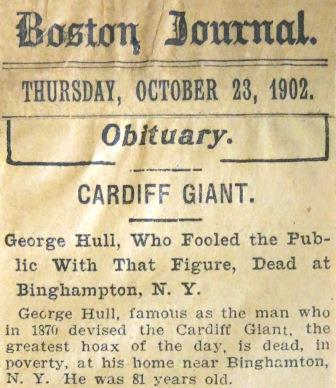
It struck me while reading George Hull’s obituary in the Boston Journal that the notice is hardly about Hull. Less of an obituary and more of a sensational article, the heading reads “Cardiff Giant” and within the article, “Hull Proud of It.” I presume it’s safe to say Hull wouldn’t have minded – the obituary notes, “Hull was very proud of the affair, and he never tired of talking about it.” According to the Boston Journal, Hull accumulated a fortune from his hoax but died in poverty. Whoever assembled this scrapbook of clippings also included an obituary next to Hull’s, printed just fifteen days later for “the last survivor of the famous ‘Cardiff Giant’ humbug,” sculptor John J. Sampson of Chicago.

The tale of the Cardiff Giant sparked the imaginations of authors Mark Twain and L. Frank Baum, and the giant even found his way into a Nancy Drew mystery. Today you can find him on display at the Farmers’ Museum in Cooperstown, New York.

If you would like to explore this topic further, visit the library to see what else you can uncover about the Cardiff Giant, its public reception and famed deception.

From the Case Notes of Robert Treat Paine: Taxes and Turmoil in Paxton

By Christina Carrick, Publications

In Paxton, Mass., on 3 February 1783, a riot broke out over a cow. More than a dozen “hearty fellows” from Paxton and nearby Worcester County towns stormed a “vendue” (an auction) and attempted to “rescue” a cow from the auction block. They broke through the bars penning the animal and, wielding “unusual” clubs, threatened the life and well-being of anyone who dared to place a bid. According to one witness, Paxton joiner and alleged rioter Asa Sterns said that “whosoever bids, bids at his peril” while Holden yeoman Jonathan Wheeler threatened “the first man that bid he’d knock his brain out.”

The rioters left a trail of bruises and sore heads behind them. No one was killed in the commotion, but 10 men were later arrested, charged with inciting a riot, and tried before the September Sessions of the Massachusetts Supreme Judicial Court in Worcester, prosecuted by Atty. Gen. Robert Treat Paine. The defendants were indicted for congregating in order to 

obstruct the due Execution of Law and to prevent the Collection of the public Taxes of this Commonwealth legally assessed on the Subjects thereof for the defence of their Liberty and happiness with force and Arms riotously routously and unlawfully did assemble and gather together for the destructive purposes aforsaid and to disturb the peace of the Commonwealth and being so assembled and gathered together, did then and there unlawfully riotously & routously remain and continue together in a tumultous manner for the space of one hour in evil Example to others to offend in like manner & against the peace & Dignity of the Commonwealth.*


In the small, makeshift notebooks that contain Paine’s hastily written trial notes, the cramped pages of witness and participant testimonies expose local, state, and class tensions. Witness after witness reported that the individuals in question, most prominently Asa and Reuben Sterns, had spoken against the state government in the weeks before the riot. Most of the Sterns brothers’ complaints addressed state taxes and more specifically the state resolve that allowed tax collectors to confiscate moveable property or livestock—the aforementioned cow—if an individual did not have specie (coin money).

Due to the shortage of hard money and the Revolutionary War’s interruptions of business-as-usual, many Paxton residents were cash-strapped and struggling to answer the intensifying state tax demands. Consequently, local officials confiscated cattle from the Sterns brothers and several other residents in lieu of unpaid taxes. Local residents saw this measure as grossly unjust. They argued that if their cattle—part of their means to a living—were confiscated, it would make it harder to earn the money to pay taxes, or even to eat. According to witness Thomas Pollard, “Asa Sterns sd. he wd. pay no more Taxes, if he did he shd. have no more money to pay Taxes.” The tax rioters complained that the coastal merchant elites were growing wealthy at their expense. David Pierce, one of the alleged rioters, swore at the trial that he was “fighting for liberty but it was become Tyranny & he wd. support it no longer” because the tax “money went to support great men.”

The resentment toward the state grew so high, witnesses reported, that after a few drinks the Sterns brothers proclaimed that Worcester County residents would be better off under the British government than the Massachusetts government. They had toasted the “brave Tories” and wished health to King George III. Other witnesses stripped the rioters of ideology and instead said that Asa Sterns “sd. if he pd. the 5 Doll for Taxes he shd. have no money to buy flip”—an alcoholic beverage popular in early New England.

On the February morning of the vendue, Reuben and Asa Sterns, David Pierce, and a number of other men arrived at the auction site with clubs, intending to stop the sale and prevent wealthier locals from purchasing their cows. Testifier Nathan Brigham Newton observed the buildup to the riot:

Vendue day, they sd. they had paid Taxes long enô.  Reuben Sterns sd. damn the Authority.  Asa Sterns sd. he’d keep his money to buy flip.  Jona. Wheeler told Silas Newton to hold his tongue or he’d split his head open.  this was before sale


Nathan Brigham Newton’s Testimony


The riot’s violence lasted less than an hour, with rioters targeting the state authorities and local tax collectors or trying to release the cattle from the auction pen and nearby barn. Some locals that were “freindly to Gov” drove the cattle back into the barn before the rioters could make off with them. The rioters were disbanded and indicted two months later.

The case was not as legally challenging as many that Paine faced. Levi Lincoln, attorney for the defense, presented thin arguments that fill barely half a page in Paine’s notebook, whereas the witness testimonies take up over a dozen. Paine noted when one defense witness stated that the rioters had not actually threatened murder, but his remaining defense notes are short and cryptic. Unlike many cases, he did not spend pages listing relevant legal texts, past case precedents, or rationalizing the charges—the case was straightforward. The 10 men were found guilty of inciting a riot and sentenced to each pay fines of £4 to £10 and sureties of £50 to £80 for a term of two years to guarantee their good behavior, while one man was sentenced to three months imprisonment. The cattle proceeded to auction; the proceeds from the sale went to the state government. Despite the relative legal simplicity, the case indicates broader tensions in Revolutionary Massachusetts.

Paine’s notes on Levi Lincoln’s arguments for the defense


Paine prosecuted several rioting cases in 1783. The same September court in Worcester County tried cases for riots in Sturbridge, Dudley, Douglass, and Petersham. These cases resemble the Paxton riot, with men resentful about taxation, confiscated livestock, and debt. The complaints underpinning these disturbances resurfaced in a larger protest movement later in the decade: Shays’s Rebellion. While the Revolutionary War drew to a close in 1783, Massachusetts residents continued to contest the shape and function of the new state government.

For the full trial story and Paine’s other legal endeavors, check out the Robert Treat Paine Papers collection at MHS and the published Papers of Robert Treat Paine. The Massachusetts State Judicial Archives also holds records on this case, including the above indictment. Paine’s notes for this case and the indictment will be printed in full in volume 4 of the Papers, forthcoming from the MHS Publications Department in 2017 thanks to a generous grant from the National Historical Publications and Records Commission (NHPRC).


*Quoted from the Massachusetts Judicial Archives, Suffolk Files 153487. All other quotations are from Paine’s trial notes at the MHS.


“A solid Judiciary”: John Adams and John Marshall

By Amanda M. Norton, Adams Papers

John Adams’s administration was in its waning days as January 1801 closed. While Thomas Jefferson had not yet been officially elected, Adams knew for certain that he was not going to continue in office and would soon head home. In the meantime, however, there was still plenty of work to be done.

The empty seat on the Supreme Court, the Chief Justice’s chair in fact, was one of his more pressing issues as the previous chief justice, Oliver Ellsworth, had resigned his seat in October. John Adams had no doubts about the importance of the high court in the young republic: “The firmest Security We can have against the Effects of visionary Schemes or fluctuating Theories, will be in a solid Judiciary,” however his first choice to replace Ellsworth, former chief justice John Jay, declined to serve in the position again. With only a few weeks left in his administration, Adams made one of the most significant and long-lasting decisions of his entire public career. On January 20, Adams formally submitted the nomination of his secretary of state, John Marshall, to serve as chief justice, to which the Senate consented one week later.

Adams sent Marshall his commission on the 31st, likely with a letter in which he requested that Marshall prepare letters of recall for John Quincy Adams to return home from his position as minister plenipotentiary to Prussia. Although Adams believed his son deserved to have his position upgraded with an appointment to Great Britain or France, he recognized that was not possible; “Besides it is my opinion that it is my duty to call him home,” Adams confessed.

Marshall accepted the role on February 4, writing to Adams, “I pray you to accept my grateful acknowledgements for the honor conferd on me in appointing me chief Justice of the United States. This additional & flattering mark of your good opinion has made an impression on my mind which time will not efface. I shall enter immediately on the duties of the office & hope never to give you occasion to regret having made this appointment.” Adams replied the same day, thanking Marshall for his acceptance but requesting that given the “Circumstances . . . of the times” he stay on as secretary of state for the remainder of Adams’s term. Chief Justice Marshall would serve for the next 34 years and profoundly influence and define the role and place of the Supreme Court in the nation in ways that endure to the present.


Benedict Arnold’s Heart

By Rakashi Chand, Reader Services

Unlike any other historical figure, Benedict Arnold’s contributions to the Patriotic Cause were so great that, had he not committed treason, history might have depicted him as a Founding Father. His accomplishments cannot be negated, his leadership and skill as a solider were unsurpassed, and his men loved him; had he been a less admired man, perhaps his treachery would have been less painful. The hero of the Battle of Saratoga, Arnold’s military success came at high costs, his war wounds leaving him lame and requiring the use of a cane throughout his life. Arnold fought courageously and boldly on the battlefield, the ‘Warrior’ of the Continental army, he was greatly admired and respected by his troops. So why would a man of such heroism resort to treason?

Well, perhaps it had to do with his passionate heart.

In late 1776, George Washington sent Arnold to Providence to take control of poorly defended Rhode Island following the British takeover of Newport. “His presence will be of infinite service,” Washington wrote, and indeed the 4,000-man Rhode Island militia was excited to hear of Arnold’s arrival. Arnold soon found they were not equipped for an attack on British forces and, with the lull of winter upon them, he went north to Boston in hopes of raising more troops. It was here in Boston that the middle-aged, widowed, weathered Arnold found himself embraced by Boston’s high society, including the remaining loyalists.

After the evacuation of Boston, some loyalist families returned to the city to look after property interests. One such family included Mrs. Gilbert DeBlois and her 16 year-old daughter, Elizabeth “Betsy” DeBlois. Arnold, who recently lost his wife, encountered the loquacious, flirtatious, and charming young Betsy through mutual acquaintances, namely, Lucy Flucker Knox, wife of General Henry Knox and daughter of Thomas Flucker, the royal secretary of the Province of Massachusetts Bay. Arnold promptly fell passionately in love with Betsy and tried desperately to court the girl, but her mother had already chosen another suitor, an apothecary’s apprentice. This did not stop Arnold from pursuing her; enlisting the help of Mrs. Knox, he secretly sent gifts and love letters. Arnold even sent a ring, said to be an engagement ring.

Here at the MHS is one such letter from Arnold to young Betsy. This gushing missive, meant to sweep the young belle off her feet, is the archetypal ‘love letter’. In fact, I would suggest that those who do not enjoy romance should perhaps abstain from reading any further…*

                                                                                                                                                                                       April 8th 1778

                Dear Madam,

                Twenty times have I taken up my pen to write to you, and as often has my trembling hand refused to obey the dictates of my heart, a heart which has often been calm, and serene amidst the clashing of Arms and all the din and horrors of War, trembles with diffidence and fear at giving offence when it attempts to address you on a subject so important to its happiness, long have I struggled in vain to errace your heavenly Image from it, neither time, absence, misfortunes, nor your cruel Indifference have been able to efface the deep impressions your Charms have made, and will you doom a heart so true, so faithful, to languish in despair; shall I expect no returns to the most sincere, ardent, and disinterested passion; Dear Betsy suffer that heavenly Bosom (which surely cannot know itself the cause of misfortune without a sympathetic pang) to expand with friendship at least; and let me know my Fate, if a happy one no Man will strive more to deserve it, if on the contrary I am doom’d to despair my latest breath will be to implore the blessing of Heaven on the Idol, [the] only wish of my soul.

                                                                                    Adieu

                                                                                                Dear Madam and believe

                                                                          me most sincerely          

                                                                                                             Your devoted

                                                                                                                         Humble Servant

                                                                                                                                  B A


In addition to this letter, the MHS also holds the ring that Arnold sent to young Betsy in the hope of attaining her hand. 


I had read of the romances of Benedict Arnold before, but I never realized how much passion coursed through his words (and his actions) until I saw the actual love letter. Sadly, “Heavenly Miss DeBlois” refused Arnold and his gifts.

This devastating blow to the heart was received with an equally devastating blow to his pride from Congress. At the time, Arnold was due to be promoted in the ranks. Instead, Congress promoted five Brigadier Generals to Major General, all inferior to Arnold. Many, including Washington, were outraged and assumed Arnold would certainly resign at such an insult. Perhaps this prompted Arnold to begin questioning himself and the world around him…

What a romantic Arnold must have been! It seems he was passionate in all aspects of life, but one who fell zealously and fervently in love, although, all too easily!

A year later Benedict Arnold met Peggy (Margaret) Shippen, and his heart was aflame once again. He also wrote Peggy love letters quite similar to the ones he had sent to Betsy. (Well, no point wasting good prose.)  Be still my heart, for Arnold strikes again!

…And then he turned out to be a traitor. 

An early Happy Valentine’s Day to all the romantics out there, especially those who love historical romance!


*Please note that the transcription is a rough-and-ready version, not an authoritative transcript. Researchers wishing to use the letter in the course of their own work should verify the version found here with the manuscript original.


“Free Soil, Free Speech, Free Labor, Free Men”: Charles Sumner and the Massachusetts Free Soil Party

By Susan Martin, Collection Services

It was the summer of 1850, and the Massachusetts Free Soil Party needed a standard-bearer. The party was just two years old and struggled to make headway against the two-party juggernaut of Democrats and Whigs. Free Soilers had seated only a handful of their candidates in Congress so far, but with the upcoming U.S. Senate election, they saw a chance to cement their influence on public policy.

Founded in 1848 by disillusioned anti-slavery Democrats and Whigs, the party’s primary issue was opposition to slavery in new territories acquired by the United States. Thus its slogan: “Free Soil, Free Speech, Free Labor, Free Men.” To be a Free Soiler was not necessarily to be an abolitionist; the party platform didn’t call for an end to slavery, merely opposed its extension into new American land.

The Free Soilers’ sense of urgency was warranted. On 2 February 1848, with the Treaty of Guadalupe Hidalgo that ended the Mexican-American War, the U.S. had annexed a massive amount of land, including Texas, California, and most of the American Southwest. The debate was raging: Would slavery be the law of the land in this new territory?

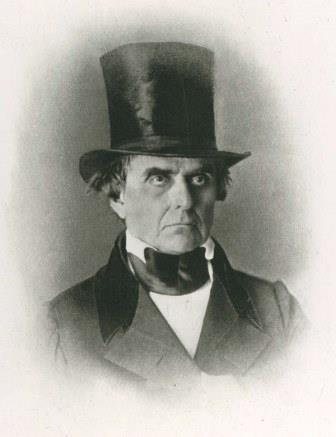
Daniel Webster

Then, on 7 March 1850, “the great Massachusetts Statesman” Daniel Webster gave a fateful speech. In his Seventh of March Speech, as it came to be known, Senator Webster argued in favor of the Compromise of 1850, including the abhorrent Fugitive Slave Law, as necessary to preserve the Union. Anti-slavery partisans in Massachusetts, where opposition to the compromise was strongest, were shocked and angry. Even more so when Webster was appointed Secretary of State by President Millard Fillmore in July.

To make matters worse, the nominee chosen by the Massachusetts Whig Party, Samuel A. Eliot, came out in support of Webster’s speech. The Whigs were the dominant party in the state, but Free Soilers could not, in good conscience, back Eliot’s candidacy. Tired of concessions to “the great Slave Power,” they met on 8 August to choose their own nominee.

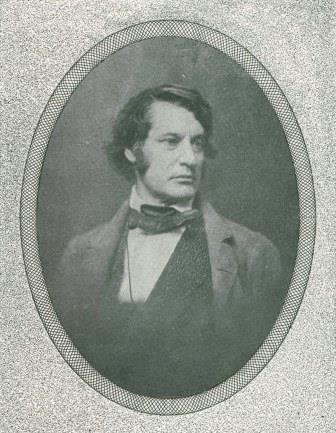
Charles Sumner


They settled on Boston lawyer Charles Sumner, a staunch “anti-extensionist” and former “Conscience” (anti-slavery) Whig. The 39-year-old Sumner was an impressive orator notorious for delivering a controversial anti-war speech at Boston’s official Independence Day celebration five years earlier. He’d also recently argued against racial segregation in public schools in the landmark case of Roberts v. Boston, alongside African-American lawyer Robert Morris. And although he’d run for a Congressional seat once before and lost, Sumner was a logical choice, and Free Soilers were hopeful.


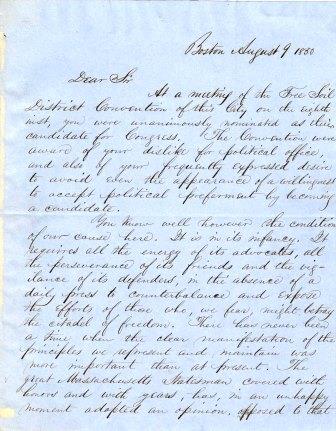
On 9 August 1850, Chairman William Bates and Secretary James W. Stone of the Massachusetts Free Soil Party wrote a letter to Sumner offering him the nomination. The letter, recently acquired by the MHS, reads in part:

You know well however the condition of our cause here. It is in its infancy. It requires all the energy of its advocates, all the perseverance of its friends and the vigilance of its defenders, in the absence of a daily press to counterbalance and expose the efforts of those who, we fear, might betray the citadel of freedom. There has never been a time when the clear manifestation of the principles we represent and maintain was more important than at present.

Sumner initially demurred. Then Congress passed the Compromise of 1850, and Sumner accepted the nomination.

He was a divisive candidate, to say the least. It took four months of repeated and contentious voting in Congress for Sumner to win the absolute majority necessary to take the seat, which he finally did in April 1851. It was the start of a long and illustrious career. Sumner would go on to serve in the Senate for almost 23 years, as a Free Soiler and then a Republican, until his death in 1874. Probably most famous as the victim of an assault by fellow Congressman Preston Brooks in 1856, Sumner is widely acknowledged as one of the most influential U.S. legislators during the Civil War and Reconstruction eras.


Sources:

Blue, Frederick J. Charles Sumner and the Conscience of the North. Arlington Heights, Ill.: Harlan Davidson, 1994.

Blue, Frederick J. The Free Soilers: Third Party Politics, 1848-54. Urbana, Ill.: University of Illinois Press, 1973.

Taylor, Anne-Marie. Young Charles Sumner and the Legacy of the American Enlightenment, 1811-1851. Amherst, Mass.: University of Massachusetts Press, 2001.

Gertrude Codman Carter’s Diary, January 1917

By Anna Clutterbuck-Cook, Reader Services

In late December, I introduced readers to Lady Gertrude Codman Carter, whose diary we will be exploring month-by-month through 2017. While a fairly regular diarist, Gertrude Carter’s journal skips from the end of December 1916 to February 8, 1917 without clear explanation. Thus, our January installment of this series will be slightly atypical as I introduce you to Carter’s diary through the look, feel, and format of the volume itself.


Unlike last year’s diary, which contained line-a-day entries with little or no elaboration, the Carter diary is a wealth of variation. While physically designed in a pre-printed format much like the line-a-day-diaries of Margaret Russell, Carter’s diary is a large format of 11.5 x 7 inches, three days per page. As you can see, Codman uses the design of the pages as only a loose guide; to begin with, she has repurposed a pre-printed volume meant for 1915 for her record of two years later. This thrift, perhaps caused by wartime shortages, requires her to correct the numerical date for each entry as well as the year printed next to the month on each page.


The page above, with which the diary opens, is preceded by the rough edge of several torn pages. Were the pages removed because they were unused, or was their information within them the diarist or descendent did not wish to be seen by future eyes? Impossible to tell from the volume itself.

It is also clear from Carter’s entries that, in some cases at least, the details were added in retrospect. “Another engagement,” she writes under February 10, a Saturday, “(doesn’t say what – so I imagine it was a life…)” … any suggestions for what that final word may be? To what other record is she referring, the record in which she failed to record her engagements? Another mystery.


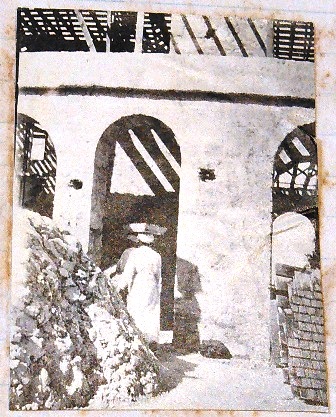
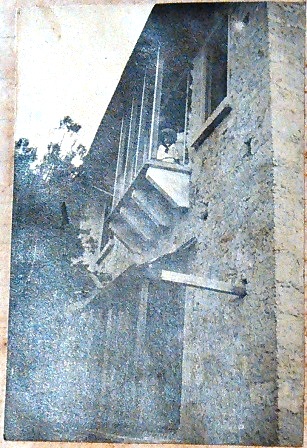
An artist, Carter’s record incorporates the visual. The photo affixed to the February page above is pasted on the date without remark, appearing to be an image of a construction site of some kind — perhaps work being done on Ilaro, the residence Carter was designing for her family. On other pages, we will encounter fanciful sketches and brilliant paintings, such as this tiny island sketched in an otherwise dense page of writing and the “Study of Captain Silver’’s Parrot,” both found in the volume for 1916.


In February, we will delve into the stories shared in the diary itself, including a long narrative recording about a what Carter deems a “real case of telepathy,” and the long, deathly shadow of the ongoing war.

Do you have specific questions about Codman’s life or diaries? Leave a comment below! Throughout the year, I will be exploring Codman’s biography and context, and will be happy to take requests.

If you are interested in viewing the diary yourself, in our library, or have other questions about the collection please visit the library or contact a member of the library staff for further assistance.

Book Review: “Not A Catholic Nation”

By Wesley Fiorentino, Reader Services alumnus


New England is perhaps not the first region in which twenty-first century readers place the Ku Klux Klan.  Yet, in Not A Catholic Nation: The Ku Klux Klan Confronts New England in the 1920s, Mark Paul Richard thoroughly dispels the notion that the infamous secret society had no substantial presence in New England or the northeast.  Richard, Professor of History and Canadian Studies at the State University of New York at Plattsburgh, focuses on the tensions between the KKK and Catholic immigrant populations throughout New England in the 1920s.  Of particular interest to Richard is the resistance to KKK influence by Franco-American populations in the northeast borderlands regions.  French-speaking Catholic groups in all six New England states were at the forefront of anti-Klan activity in the 1920s.

Richard closely examines the rise and fall of the 1920s Klan in New England using newspapers, state government records, and court proceedings as his source material.  Through this research Richard sheds considerable light on the sentiments both for and against the Klan during the 1920s.  Formally re-founded in 1915, the second iteration of the Ku Klux Klan spread well beyond the southern states where the original Klan had operated.  Building on a structured hierarchy, the Klan of the 1920s functioned as something like a fraternal and civic organization, espousing the need for Anglo-American Protestants to unite in the face of waves of Catholic immigrants in addition to Jews, African-Americans, and other minorities.  Espousing Nativist ideals, the Klan sought to disenfranchise entire groups of Catholic immigrants from politics and business.  While Klan-affiliated groups in New England remained in agreement with the national Klan with regards to their views on minorities including Jews and African-Americans, Catholic immigrants generally made up much larger portions of the population in New England states and were thus seen as a more immediate threat to be dealt with.  Among their biggest targets were the Franco-American populations in New England.  In the 1920s, Franco-Americans made up a huge portion of both the immigrant and the Catholic populations of New England states.  They would clash with the Klan in their newspapers, in the streets of New England cities and towns, and in the halls of state government.

Richard’s book showcases the efforts of ethnic Catholic groups to dispel the Klan’s exclusionary notions of Americanism.  Furthermore, Richard demonstrates that Franco-Americans in particular acted as their own agents in their ideological struggles with the Klan.  Although Irish-American politicians in New England such as James Michael Curley railed against the KKK, Franco-Americans resisted the influence of the KKK largely through their own efforts.  Richard examines the use of French-language newspapers in Massachusetts, Rhode Island, and elsewhere in exposing the contradictions and hypocrisy inherent in KKK ideology. 

In addition to earlier scholarship focusing on the struggles of Irish-American politicians against the Klan,  Richard shows that Franco-Americans were often a favorite target of Klan members and Nativist sympathizers and that they effectively discredited the Klan in New England through their own avenues including French-language newspapers and open protest.  Richard’s book is an excellent read for students of immigration issues in the early twentieth century, as well as of the struggles of Catholic populations against Nativist bigotry.  Scholars of the Franco-American experience in the northeast in the twentieth century will find Richard’s book to be an invaluable tool. 

Below are some materials relating to issues of immigration, race, religion, and civil liberties in Massachusetts from our collections:

– Ursuline Convent Trial Notes, 1834.  Call Number: Ms. N-1698.  Shaw, Lemuel, 1781-1861.  Massachusetts Historical Society.

– John E. Gilman Scrapbooks, 1885-1890.  Call Number: Scrapbooks 051.  Gilman, John E., 1844-1921.  Massachusetts Historical Society.

– Massachusetts Public Interests League records, 1919-1929.  Call Number: Ms. N-514.  Massachusetts Public Interests League.  Massachusetts Historical Society.

– American Civil Liberties Union of Massachusetts records, 1920-2005.  Call Number: Ms. N-2257.  American Civil Liberties Union of Massachusetts.  Massachusetts Historical Society.

Gertrude Carter’s Diary: An Introduction

By Anna Clutterbuck-Cook, Reader Services

Gertrude Carter with her husband Gilbert and son John, 1916

(Library of Congress, Public Domain)

Following the serialization of the 1915 travel diary of an anonymous Boston woman who journeyed down the Nile, and the 1916 line-a-day-diary kept by upper-class Bostonian Mrs. Margaret Pelham Russell, I am continuing to explore the personal narratives contained in the MHS collections in 2017 with the 1917 illustrated diary of Boston-born artist Gertrude Codman Carter.

Born in 1875 to Frank Parker and Mary Codman, Gertrude grew up in a comfortably upper-middle class family that had made its wealth in the textile industry before and during the Civil War [1]. Encouraged in artistic pursuits, young Gertrude was an accomplished artist and studied at the Boston Museum School of Fine Arts during the 1890s and traveled abroad to Italy and France to refine her work as a painter and illustrator [2]. In her late twenties she became the second wife of Sir Gilbert Thomas Carter, a British colonial officer who served as Governor in The Bahamas and Barbados and, briefly, in Trinidad and Tobago.

Gertrude and Gilbert began the year 1917 living in Barbados at Ilaro Court, a residence that Carter had designed herself, with their young son John (pictured above with his parents). Though an ocean away from Europe, the long shadow of WWI hangs over the household even as the activities of white British Colonial society carries on. Beginning in January 2017 we will be following Carter through her year to learn what her diaries can tell (and show) us about the life of a female artist, mother, and white British colonial was like one hundred years ago.

Do you have specific questions about Codman’s life or diaries? Leave a comment below! Throughout the year, I will be exploring Codman’s biography and context, and will be happy to take requests.

If you are interested in viewing the diary yourself, in our library, or have other questions about the collection please visit the library or contact a member of the library staff for further assistance.

The Bostonian and the Bard

By Dan Hinchen, Reader Services

The Shakespeare Birthplace Trust is an organization in Stratford-upon-Avon, Warwickshire, England which oversees the historic home in which the William Shakespeare was born. Through the centuries, millions have visited this 16th century abode in order to pay their respects to the Immortal Bard. 

A few weeks ago, I was greeted one morning with a reference question from the staff of the Shakespeare Birthplace Trust. The question focused on the oldest guestbook that the Trust holds in their archives. The item dates to the year 1812 and the first recorded visitors are a TH Perkins of Boston, and Joseph Curwen of Philadelphia.

DR185/1 Shakespeare’s Birthplace Visitors’ books, Stratford-upon-Avon, Shakespeare Birthplace Trust


The question coming from Stratford was whether this TH Perkins is Thomas Handasyd Perkins, a prominent Boston businessman and successful merchant of the China trade. Here at the MHS we hold the Thomas Handasyd Perkins papers, 1764-1854 and the folks at the Shakespeare Birthplace were looking for confirmation that these were the same person. So, I started digging to see what I could find about Mr. Perkins’ travels in the early 19th century.

Within the collection is a “Journal of Reminiscences of England and Wales, 1 July 1812,” which seemed promising for answering this question. I scrolled through the microfilm looking for keywords that would jump out at me and, sure enough, about thirty frames in I saw mention of Stratford, so I slowed down and started paying attention. As I read, more and more pieces slid into place.

Altho’ I had before visited Stratford, yet it gave me great pleasure to have an opportunity of passing a few more hours here…

When here before, I went to the house, and into the room where the Poet was born, but as Mr. Curwen had not visited this place before, I passed thro’ the town with him and visited, both the house and the church with him…

Perkins then goes into some detail about the people residing in the house

It is now occupied by a Butcher, who hangs up his mutton at the windows of the front room, and whose wife who is a very loquacious sort of a woman, shows you all the Relics which are said to have been the property of the bard.

He continues to describe some of the rooms in the house, making special mention of some walls which were whitewashed and then covered over in the penciled scrawling of visitors, signing their names and leaving messages to show their passage through.

When I was here before, I asked the woman why she did not keep a Book, in which persons who came to visit the house might subscribe their names, as the walls were full. She said she had frequently thought of getting one, and had been often asked if she had one, but that she had no one to prepare it for her; at that time I was much hurried, but determined that if I ever again passed thro’ Stratford I would purchase one and give it to the woman. I now put my resolution into execution by buying a quarto blank Book containing about four quires of paper, and giving to be applied to his purpose I ruled it, making a column for the date, another for the name and a third for the Residence__and having written in the beginning of it “Tribute of Repsect to the Memory of the Bard of Avon” and furnished the woman with an ink stand and some pens, I subscribed my name, and wished her to deliver the Book when filled to the Librarian of the town, who is to deposit it in the Library, and furnish another blank Book in its stead.


When taking on this reference question I was fairly confident that the “TH Perkins” in the guestbook would be the same as the man whose papers we hold. However, I was tickled when I read this passage and learned that our Perkins was actually the person who purchased and inscribed the guestbook, even going so far as to provide instructions for its preservation. Perhaps in another life this businessman will make a good librarian.