A Brief Look at 19th-Century Children’s Stories at the MHS

By Brendan Kieran, Reader Services

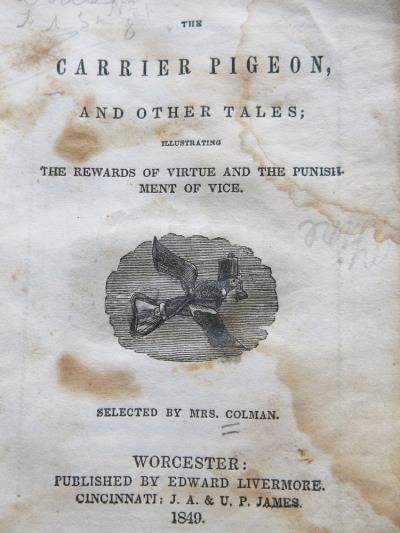
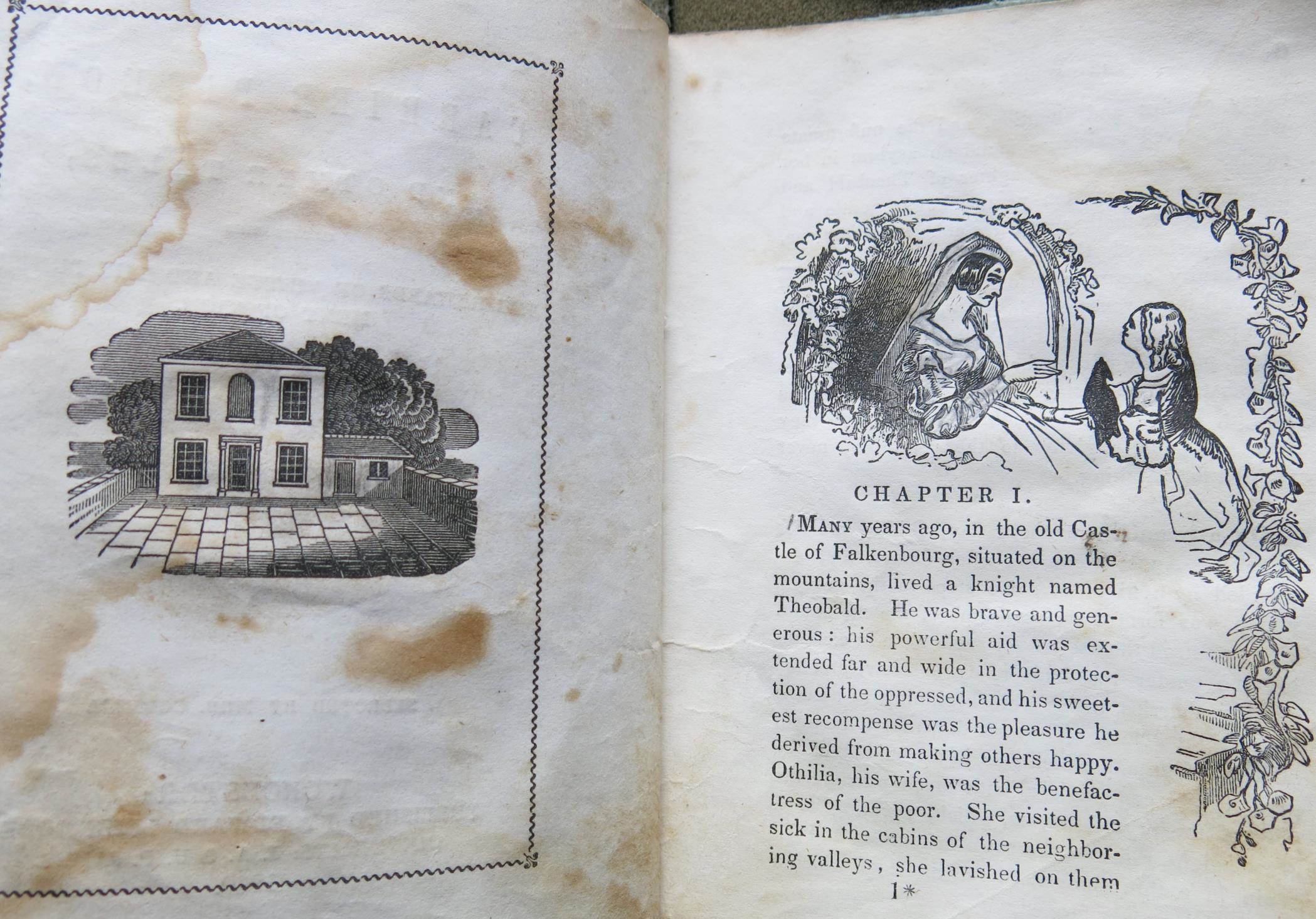
I initially came across The Carrier Pigeon and Other Tales: Illustrating the Rewards of Virtue and the Punishment of Vice, selected by Mrs. Pamela Chandler Colman (Worcester, 1849), in an effort to find materials relating to pigeons at the MHS. However, I ended up utilizing this collection of children’s stories as a jumping point into a look at children’s literature and children in the 19th-century United States. Through my reading, I began to gain some insight into the roles of children and themes represented in literature during this period.

The titular story of this book is set in the German countryside, seemingly in the medieval or early-modern period. A girl named Agnes comes into contact with a dove, which she decides to take in. Through the advisement of her mother, Othilia, Agnes turns the actions of the dove into lessons for her behavior, becoming a more obedient, hygienic, and organized girl in the process.

One day, a woman named Rosalind and her daughter, Emma, show up at the castle of Sir Theobald (Agnes’s father) looking for help; using her care for the dove as an example, Agnes encourages Theobald to take in the visitors. Later, once Rosalind and Emma have returned to their castle, two men show up at their house; unbeknownst to them, but later discovered by a servant named Leonardo, the men are robbers looking to steal from and murder Theobald and his family. Emma comes up with the idea of flying the dove with a note attached to it to warn Theobald and the family of the motivations of the robbers. Ultimately, it is successful, and the plan is thwarted.

The second story, “Ingratitude,” is about a young girl named Helen and Mrs. Everhold, a woman who takes care of Helen. When Helen’s mother dies, Mrs. Everhold is given responsibility for raising Helen. Everhold tries to teach her skills and a strong work ethic, but Helen decides to act out, eventually turning to working for a baroness and not being there for Everhold when she becomes ill and unable to work. Helen eventually marries a violent and abusive man, and when he dies in an accident, she goes to Mrs. Everhold for help. Helen apologizes for her past actions; going forward, she is good to Mrs. Everhold, who ends up living a long life.

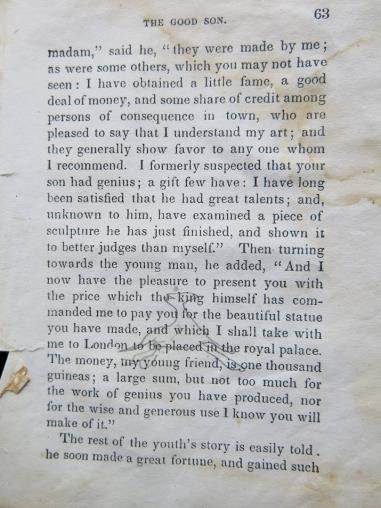
The final story is “The Good Son,” attributed to Rev. E. Mangin. After the death of her husband, a woman and son go to live with another family. The son, after displaying artistic ability, begins to train with a nearby mason. Ultimately, he receives awards for his work, providing new financial stability for himself and his mother. After becoming successful and notable as a sculptor, he continues to be good to his mother, the man who discovered him, and the family with whom he had lived.

All three of these stories have similarities that live up to the subtitle of the book. In “The Carrier Pigeon,” the dove serves as a symbol of virtue, imbued with overt religious connotations; to be like the dove is to be pure and respectful of God. The dove even serves as the means by which Rosalind and Emma are able to save lives. In “Ingratitude,” while Helen is disrespectful for much of the book, she ultimately turns to “proper” behavior toward a woman who took care of her, with suggested positive results for Everhold’s longevity. In “The Good Son,” the boy demonstrates hard work, creativity, and respect for the people who fostered his success. All of the children serve as lessons, indeed, on “the rewards of virtue and the punishment of vice.”

However, the stories do have some notable differences that raise questions regarding the audience of the book and the roles of class, gender, and race in 19th-century children’s literature. For example, the families in “The Carrier Pigeon” seem to be quite wealthy and of the nobility; however, the subjects of the other stories struggle with financial insecurity. There also seems to be an implication that girls are especially in need of lessons regarding proper morality. While the girls in “The Carrier Pigeon” learn lessons through the dove, and Helen in “Ingratitude” only learns good behavior after misfortune hits her, the boy in “The Good Son” seems to be good and respectful all along. It is men (the robbers) who exhibit most of the immorality in “The Carrier Pigeon,” and Helen’s abusive husband in “Ingratitude” is not a model of good behavior, but the process of learning lessons and correcting behavior seems to be more apparent in the women and girls in this book than in the men and boys. Racialized language seems to be a factor in “The Carrier Pigeon,” with the whiteness of both Agnes’s dresses and the dove deployed to represent good morality and cleanliness. This analysis is brief and tentative, but it hopefully notes the potential significance of this resource to scholars of race, class, and gender in 19th-century United States children’s literature. 

I consulted our copy of Karen Sánchez-Eppler’s Dependent States: The Child’s Part in Nineteenth-Century American Culture (University of Chicago Press, 2005) in the hopes of learning a bit more about children’s literature in the 19th-century. Sánchez-Eppler offers some conclusions about children and literature of the period. The author notes the role “of teaching morals and forming character” in primers of the period, and notes the “variation on the basis of class, region, gender, and race” in conceptions of childhood in the 19th century, including the connection between leisure and a middle-class living. Sánchez-Eppler also notes the desirability of “submissiveness” for girls in 19th-century temperance literature of the period; the literature suggested – often using references to incest – that these qualities in girls would help their fathers overcome alcoholism and become better people. This literature has class connotations, as well, with children representing middle-class norms in some temperance works. Later, the author draws connections between race and the proper, domesticated behavior of children in 19th-century Sunday School works; these themes served as components of imperialist and colonialist projects. There is much more to Dependent States than what I’ve included here, and Sánchez-Eppler’s scope of analysis is broader than strictly children’s literature, but these ideas offer some insight into the complex roles constructed for children in literature of the period.

The MHS library is open for anyone who would like to view any of our available print materials. In addition, an 1851 copy of this book is available electronically through Internet Archive.


Bringing Willa Home: A Child Displaced by Civil War

By Susan Martin, Collection Services

I’ve written a few times here at the Beehive about manuscripts from the Fay-Mixter family papers, and I’d like to dive into that collection again this week. I was intrigued by four letters from December 1861, so I dug a little deeper and uncovered the story of a family separated by war and a Southern child taken in by Northern friends.

The four letters were written by Edwin Parsons to Joseph Story Fay. Fay, originally from Cambridge, Mass., moved to Savannah, Ga. in 1838 and became a prosperous cotton merchant. He was an enslaver, but opposed secession, and before the Civil War broke out he returned to his home state of Massachusetts. When these letters were written he lived in Boston with his wife, their three children, and a child unrelated to them, the young daughter of a Mr. Sims.

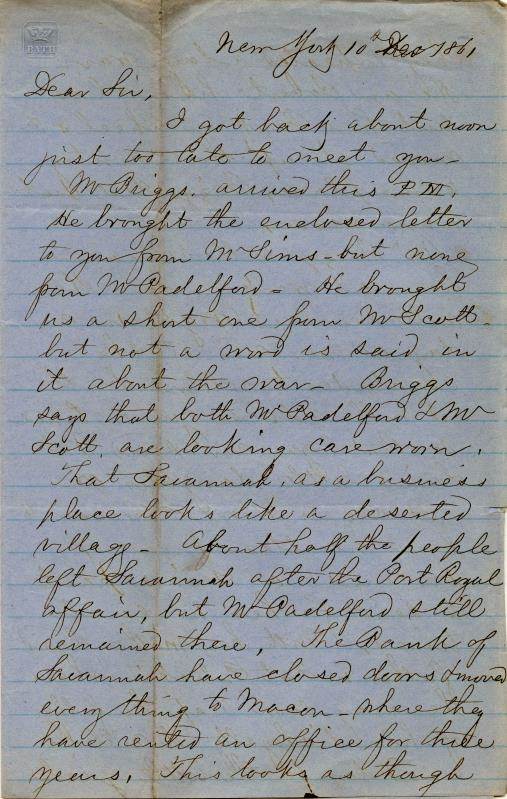
This passage in Parsons’ first letter to Fay, dated 10 December 1861, was the first thing that caught my eye: “I will advise you in time so that you can send Mr Sims little daughter on.” Parsons continued:

It seems to me however to be a heartless piece of business on Sims part to send for her in such times. With her mother dead & father in Fort Pulaski where he may soon reap the folly of his disloyalty, it will be a sad day for the little girl to exchange the kind care of Mrs Fay, for such a home as awaits her in Georgia.

Fort Pulaski was the vital clue. Among the soldiers stationed at this Savannah garrison in December 1861 was one Capt. (later Col.) Frederick William Sims of the 1st Georgia Infantry. Other details of his biography lined up: his wife Catherine (Sullivan) Sims had died in 1858, followed by one of their two children in 1859, leaving Sims and his nine-year-old daughter Willa. Willa must have been taken in by the Fays in Boston while her father fought for the Confederacy—the disloyalty Parsons alluded to.

Sims wanted his daughter brought back to the South, presumably to live with extended family while he finished out his military service. But Parsons, who apparently acted as a kind of agent for Sims, thought it was a terrible idea. Savannah was like a ghost town after the Battle of Port Royal, and many felt the war would continue for some time. And the possibility of “some hard fighting” in Kentucky after its admission to the Confederacy would make travel difficult, if not impossible. However, on 26 December 1861, when Parsons wrote his fourth and last letter on the subject, the matter was still unresolved.

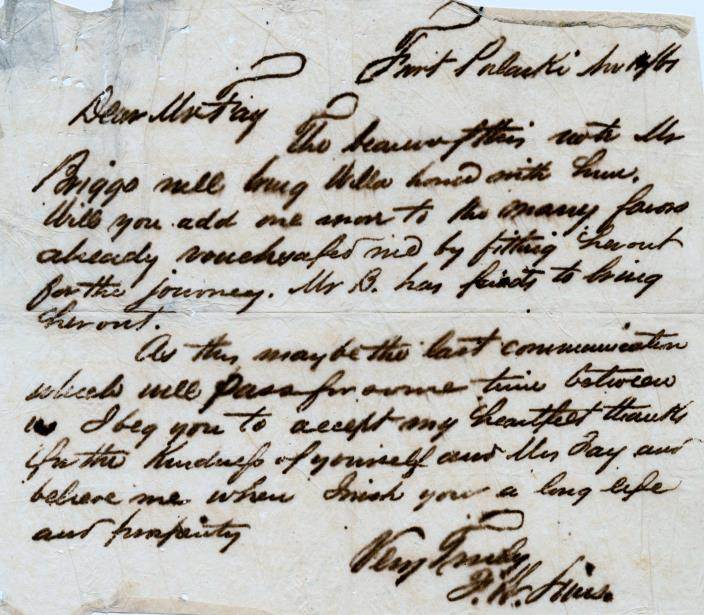
The last piece of the puzzle was a letter I’d originally passed over, not recognizing the signature. On 14 November 1861, Frederick W. Sims scrawled this short note to Joseph Story Fay on fragile onion-skin paper:

The bearer of this note Mr Briggs will bring Willa home with him. Will you add one more to the many favors already vouchsafed me by fitting her out for the journey. Mr B. has funds[?] to bring her out.

As this may be the last communication which will pass for some time between us I beg you to accept my heartfelt thanks for the Kindness of yourself and Mrs Fay and believe me when I wish you a long life and prosperity.

Fort Pulaski was captured by Union forces in April 1862, and Sims became a POW, later paroled. After the war, he worked as a merchant and insurance executive in Savannah and served as one of the city’s alderman from 1867-1869. He had at least six more children with his second wife, Sarah (Munroe) Sims, but most of them died young. According to newspapers, in 1875, suffering under severe financial difficulties, Sims died by suicide with a morphine overdose. The coroner’s report lists the belongings he left behind: $20.90 in coin, a gold watch and chain, clothing, and a revolver.

Unfortunately, I couldn’t find out what happened to Willa after 1861. No other papers in the Fay-Mixter collection refer to her. The obituary of Sarah (Munroe) Sims, who died in 1904, identifies only two surviving children, Emily and Elizabeth.

Happy Halloween, 1874: Sketches Here and There

By Rakashi Chand, Reader Services

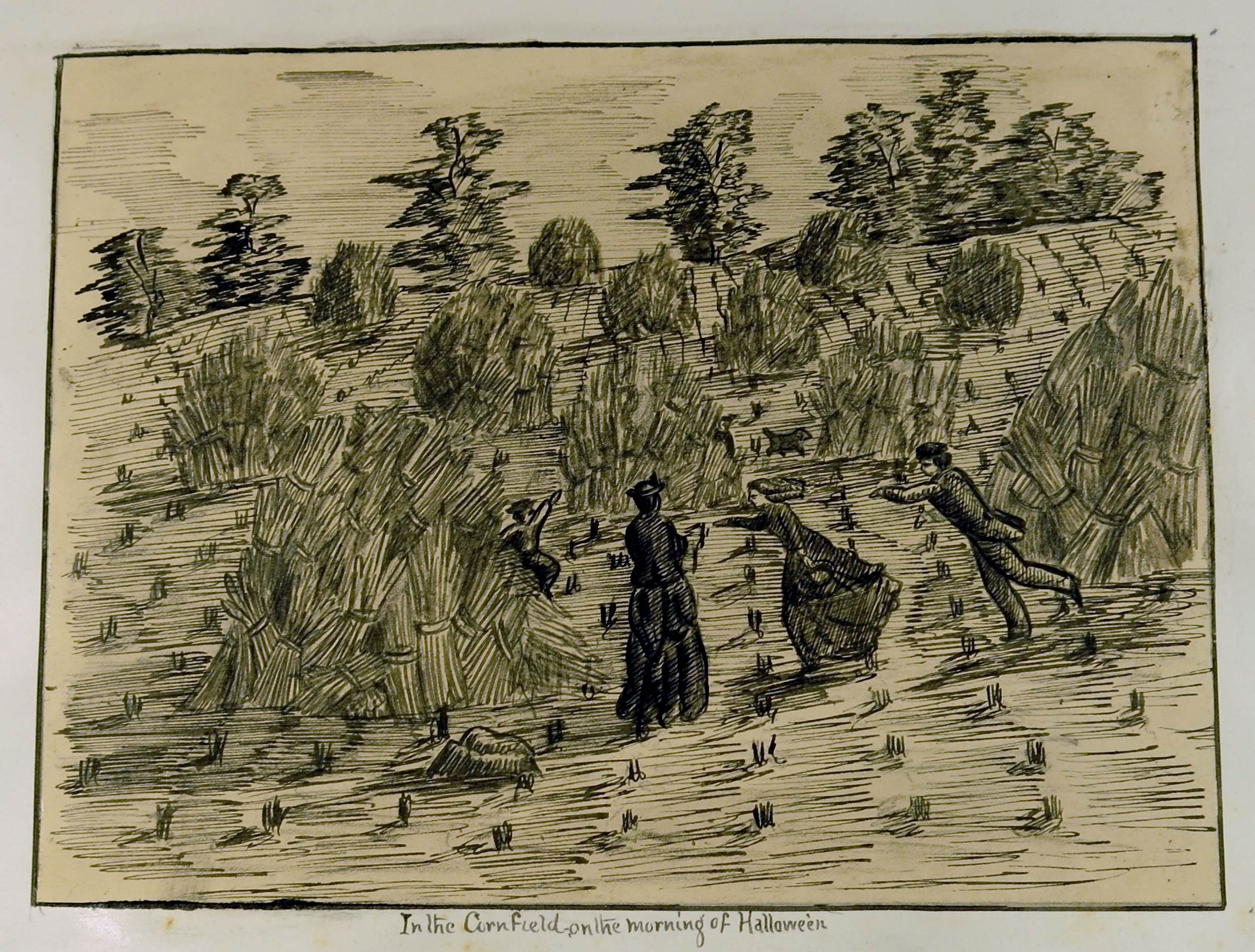
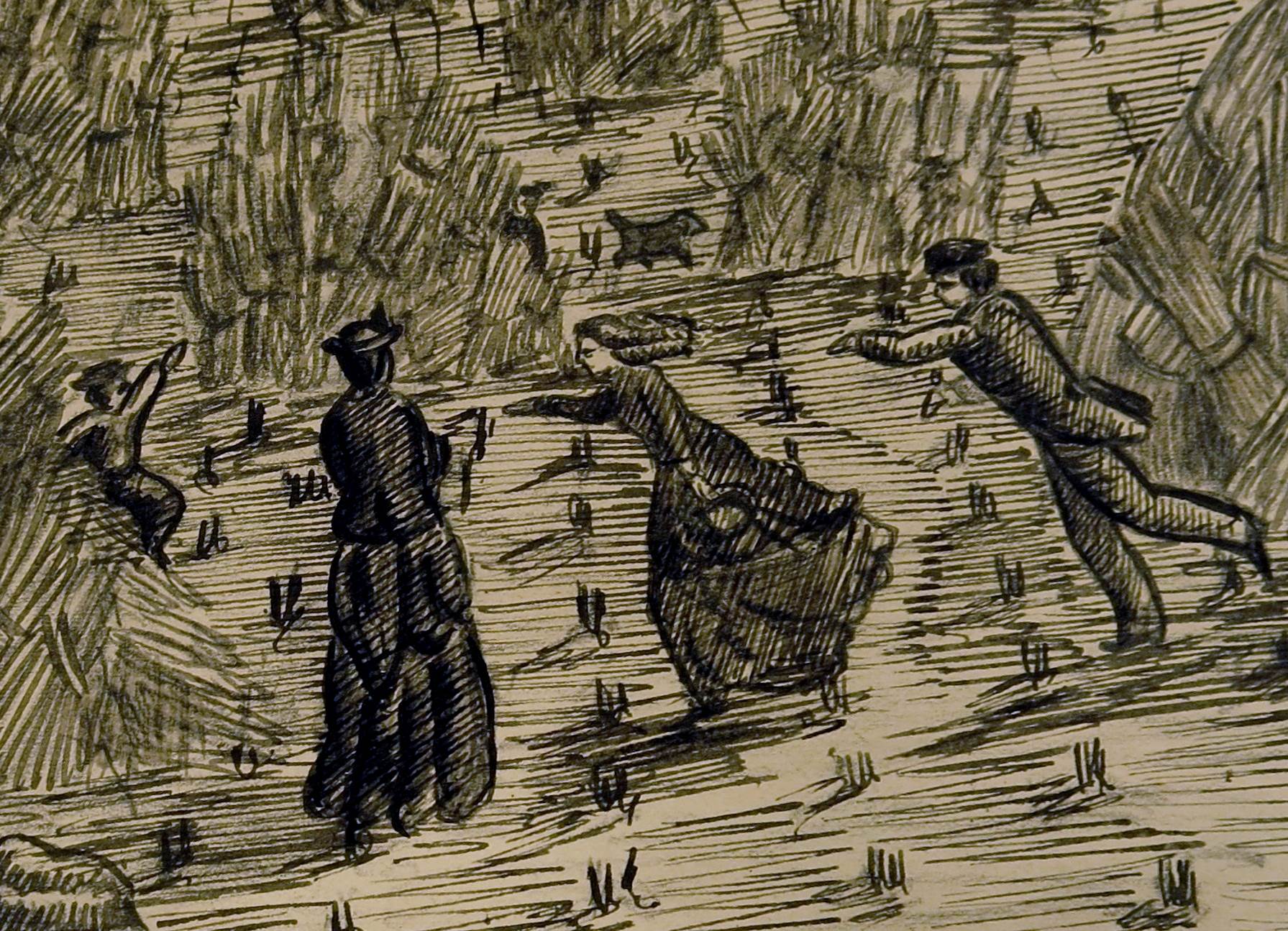
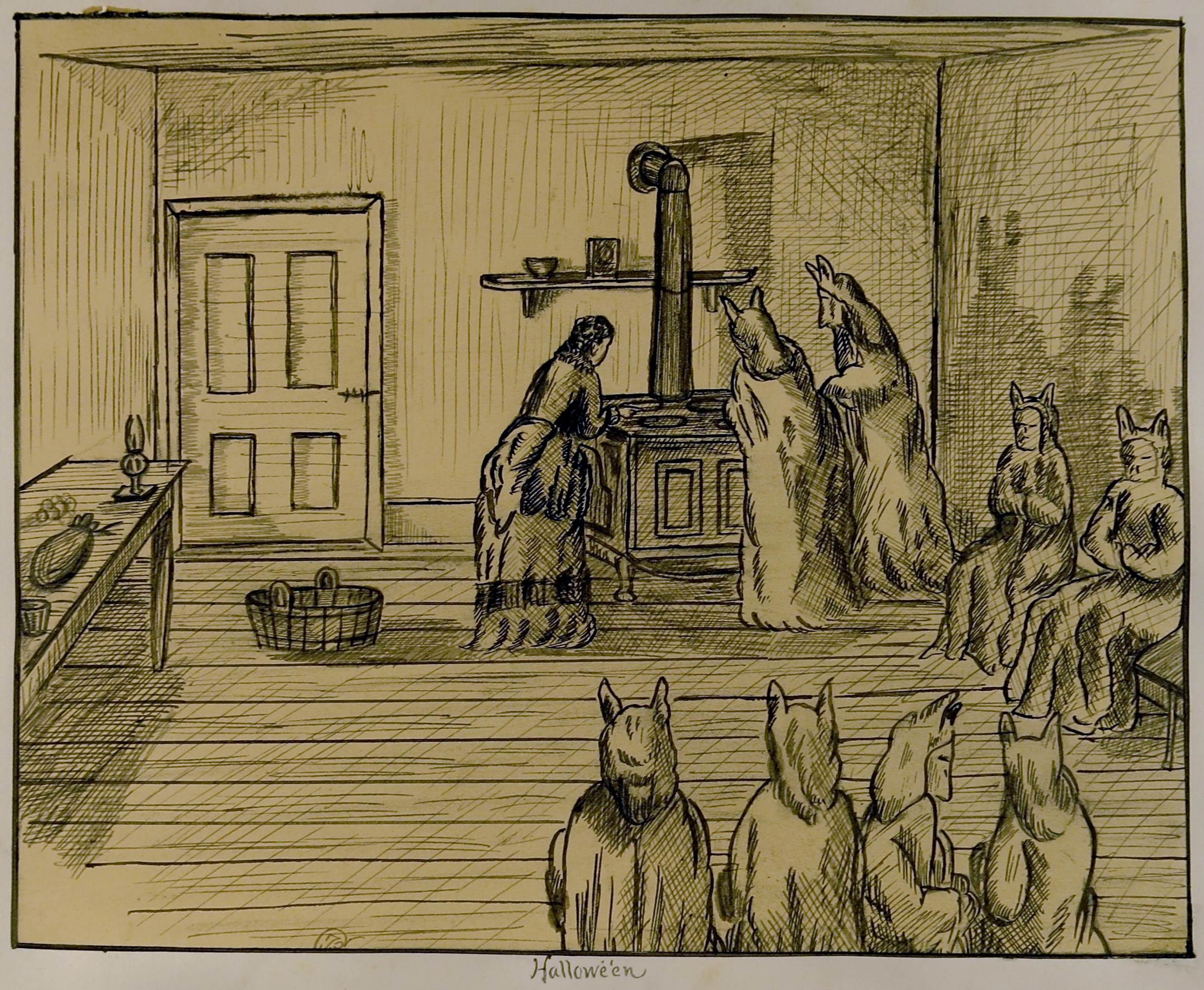
I love Halloween, so when I saw these lovely India ink sketches in our Graphics collection I was thrilled! Sketches Here and There by Franklin B. Gardner portray the fun and frolic of Halloween almost 150 years ago.  Amazingly, this is exactly what I had hoped and envisioned Halloween would have been like in the past; almost a ‘Dicken’s-like’ visual representation of what could be ‘A Halloween story’. Young people frolicking and enjoying a lovely morning in a cornfield followed by festive evening party, where guests clad in costumes have gathered to celebrate.

Although Halloween was celebrated elsewhere in various ways, modern Halloween is a distinctly American capstone holiday, whose traditions and celebration have permeated throughout the rest of the world. These images portray the holiday as a joyous occasion, celebrating autumn, the most beautiful season in New England. And what could be more idyllic than Halloween in the corn fields of New England in 1874?

In the Cornfield, on the Morning of Halloween


In the Cornfield, on the Morning of Halloween, detail.


As the Halloween season is upon us, these visions of Halloween past are a delight to examine. The food being laid out on the dining table during the gathering signifies that perhaps the celebration of Halloween involved a gathering or a feast among friends and family. The holiday has evolved over the years in such a way that we no longer enjoy the gathering and dinning that were once a part of Halloween celebrations. Modern Halloween celebrations puts much emphasis on ‘trick-o-treating’ and candy, so perhaps it is time to bring back the tradition of a gathering with friends and family. Let’s celebrate the season and enjoy the beauty of autumn days, and then feast on Halloween night! [Homemade costumes optional.]

Hallowe’en


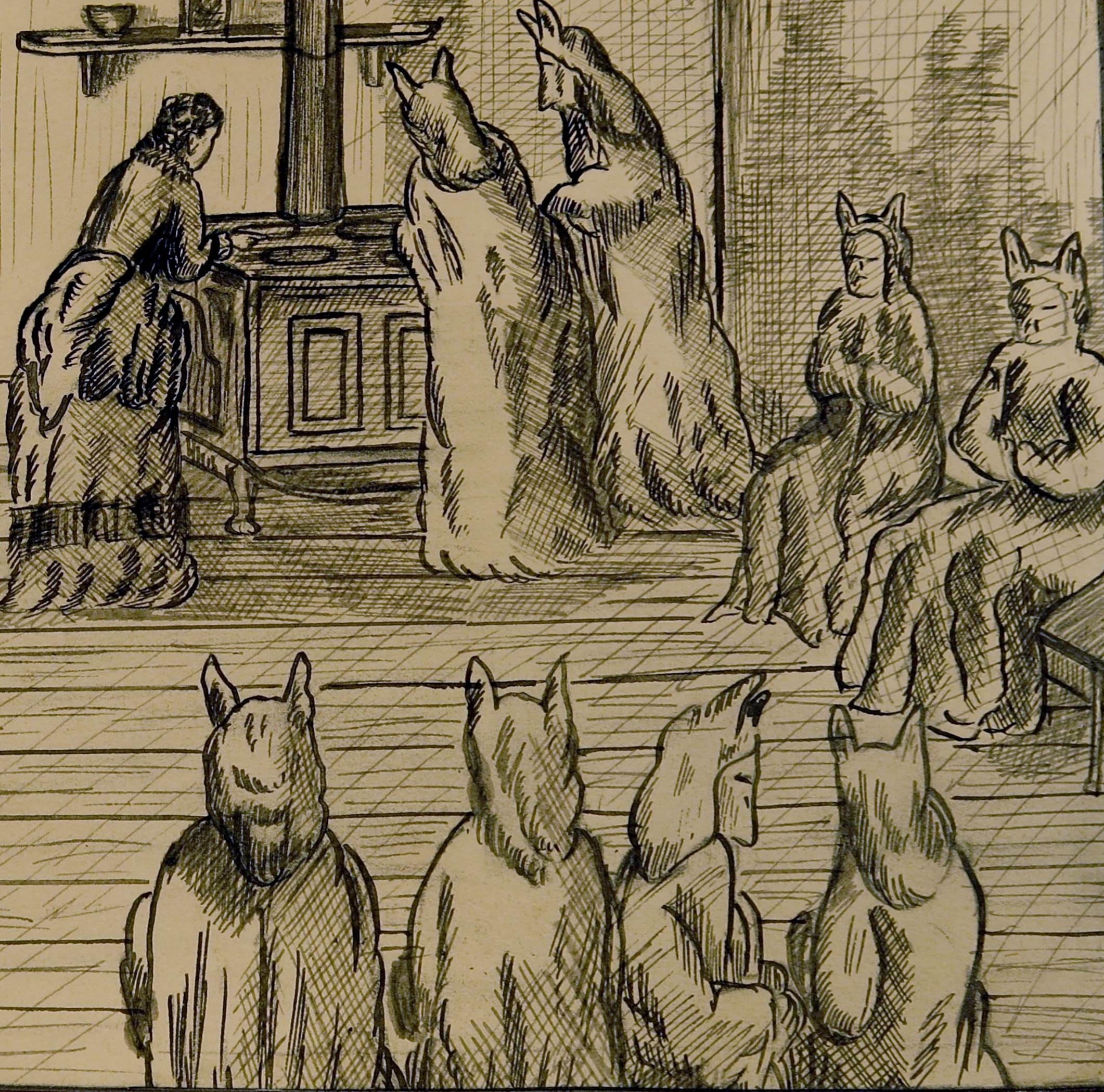
Hallowe’en, detail.


These beautiful sketches were done by amateur artist Franklin B. Gardner and given to the MHS in 1969 by Hermann Warner Williams, Jr. The collection consists of 16 pen and ink sketches and an illustrated title page. The subjects of the sketches are various social scenes, customs and activities and pastimes from the Boston area. We hope to be able to share each of these fabulous sketches with you in forthcoming blog posts.


Halloween in America

To quote Lisa Morton’s Trick or Treat: A History (Reaktion Books, 2012), how did Halloween go from being “An Autumnal party for adults” to “a costumed begging ritual for children”? The now heavily commercialized holiday has been exported from America to every part of the globe. Halloween has a very long and complex history, drawing on the traditions and customs of many cultures, a true amalgamation, which continues to evolve to this day.

Halloween is associated with death, although our relationship with and perception of death has changed along with the traditions of the holiday; thanks to advances in modern medicine, death is marginalized, which creates a fear of the unknown. Halloween has become a day when society indulges in fear.  Halloween was a holiday for mischief, especially for young boys, who enjoyed playing pranks through the night. Costumes were also a part of Halloween as exemplified by the ‘Hallowe’en’ sketch. But the biggest change in Halloween is the disappearance of the gathering and dinning, especially among adults. It was once a celebration of the season, when both the food and the theme of the party revolved around the bountiful fall harvest, with an emphasis on pumpkins and apples. It was not until after WWII that candy and Trick-or-Treating became a part of Halloween, indeed prior to that even candy manufacturers did not associate candy with Halloween. It was not long before Trick-or-Treating and the distribution of candy on Halloween night became mandatory customs.

More ‘spooky’ Halloween treats from the collection of the Massachusetts Historical Society:

– The Salem Witch Bureau: A beautiful piece of American joinery that was part of the Salem witchcraft trials, General William H. Sumner described this chest of drawers as “the Witch Bureau, from the middle drawer of which one of the Witches jumped out who was hung on Gallows Hill, in Salem.”

– Diary entry of Salem Witchcraft Trial judge Samuel Sewall,19 September 1692.

– Examination of Geo. Burroughs 1692 May 9-11.  By Samuel Parris: Proceedings of the examination of Geo[rge] Burroughs and the testimony of bewitched girls, 9-11 May 1692, during the Salem witchcraft trials. Burroughs was found guilty and executed for witchcraft.

A True Narration of the Strange and Grevous Vexation by the Devil of Seven Persons in Lancashire, and William Somers of Nottingham, by John Darrel: This is the only item in our catalog with the subject “Demoniac possession.”


Margaret Russell’s Diary, October 1916

By Anna J. Clutterbuck Cook, Reader Services

Today, we return to the line-a-day diary of Margaret Russell. You can read previous installments here:

January | February | March | April | May | June | July | August | September

October begins balmy, “really warm,” with lovely days on which to walk and drive. Margaret Russell takes several short motoring tours through Massachusetts, Vermont, and upstate New York, and also begins the relocation back to town for the winter. Columbus Day would not become a federal holiday until 1937, but was already celebrated in Boston for Margaret notes the day on October 12th. “Called at Endicotts & Appletons & Miss Rogers,” she observes. With the return to the city comes a more intense schedule of cultural events — in the last ten days of the month, following the family’s return to town, Margaret attends five concerts which she notes in her diary.

While domestic and social events continue to dominate the chronicle, two political items of note appear in the October entries. On October 9th she writes that a “German submarine off Nantucket sinks nine ships,” one of the first direct mentions of the war now raging in Europe. It was an event that made national news although the Sacramento Union’s account puts the number of ships at six rather than nine. On the 25th of the month, Margaret attends an anti-suffrage (“Anti-S”) meeting — a reminder that in the early decades of the twentieth century women as well as men were deeply invested on both sides of the fight over the “woman suffrage” question. Massachusetts was home to one of the most active anti-suffrage organizations, the Massachusetts Association Opposed to the Further Extension of Suffrage to Women, founded in 1895. While Margaret does not indicate what specific anti-suffrage meeting she attends it is likely that the meeting was an event organized by this group; their records have been recently digitized by the MHS and can be read online at the link above.

Without further ado, here is Margaret.

 * * *

October 1916*

1 Oct. Walked to church & home on State road. Family to dine. Lovely weather.

2 Oct. To town, errands, [illegible], lunch with Marian, to see aunt Emma at Cambridge. 

3 Oct. Started at 9.30 for Jaffrey arrived 1.10. The H.G. C’s not till 2. Started for Walpole at 3. Arrived at 4.45. Went to Cottage tea room. Walpole [illegible] full with people.

4 Oct. Started for Woodstock at 9.30. Got there 12.30. Lovely views. Took a short walk. Started at 2.15 via Rutland wonderful views. Arrived at 5.30 at Equinox.

5 Oct. Thursday – Took a walk with Miss A– to a lake [illegible] of dead [illegible] & 7 live ones. Really warm. Lovely drive to Cambridge N.Y. in P.M. 2 1/2 hours.

6 Oct. Started at 9. Stopped at Williamstown for lunch & walk. On at 1.30 over Mohawk to Greenfield & to Deerfield. Weldon hotel at 4.30. Lovely day.

7 Oct. Saturday. Started at 9.30. Lovely day. Got to Groton at 12.30 and lunched & home by Harvard & Concord. Home at 4.30. Perfect trip, no tire troubles & fine weather.

8 Oct. Sunday – Walked to church & back. Family to dine.

9 Oct. Monday – To town for errands, Mary & lunch with Marian. To see aunt Emma. German submarine off Nantucket sinks nine ships.

10 Oct. Tuesday – Walked over Nahant beach. [illegible] cold & windy. To town for an errand in the P.M.

11 Oct. Wednesday – Went to Rowley in the P.M. to get things at Fairview.

12 Oct. Columbus Day – Walked in A.M. Called at Endicotts & Appletons & Miss Rogers.

13 Oct. Friday – First concert. Perfectly delightful to hear the orchestra. Miss A– went. Lunched at Somerset with Edith.

14 Oct. Saturday – Met H.G.C. & A. at N. Andover. Cold but lovely.

15 Oct. [no entry made]

16 Oct. Monday – Took Miss A– to town & said good-by. Back early.

17 Oct. Tuesday – Packing. Bad gale so did not go out in motor.

18 Oct. Wednesday – Lovely clear & cold. Packing.

19 Oct. Thursday – Packing. To Nahant to see F. P. who had gone to town. Drove to Beverly in P.M.

20 Oct. Friday – Unpacking. Had Edith & Eleanor [illegible] & Mrs. Sears to lunch at Chilton & go to concert. Went to see F. Prince to hear about Norman’s death.

21 Oct. Saturday – Passed the day at Norfolk. E. Walcott & Susy B. – also there for lunch. Lovely weather. Concert in the evening.

22 Oct. Sunday – Went to Cathedral. Lunched at Walcotts’s & went to see Sara Jordan on the way home.

23 Oct. Monday – Dentist, Mary, lunch with Marian. Out to Gray Herbarium with specimens.

24 Oct. Tuesday – Walked all the morning for errands. Went to Milton to pay calls & found everybody in.

25 Oct. Wednesday – Anti S- meeting, lunched at Mayflower, dentist, & then to Swampscott to see Edith & the baby.

26 Oct. Thursday – to hospital & then to lunch at Parkman’s with Mrs. James Parker. Lovely warm day.

27 Oct. Friday. Mrs. Ruelkes lunched & went to concert with [sic]. Edith prevented by changes of [illegible].

28 Oct. Lovely warm day. Met the H.G.C’s at Groton for lunch. Home by Harvard. Splendid concert with Gadeski.

29 Oct. Errands & Mary. Lunched at Mrs. Bell’s with an attractive Mrs. Reed from Charleston. To see aunt Emma & the Greenoughs.

30 Oct. Monday – Lunched at Mrs. Bell’s with Mrs. F. Dexter & Mrs. Reed from the South.

31 Oct. Tuesday – Went to [illegible] concert with Mrs. Reed.

* * *

If you are interested in viewing the diary in person in our library or have other questions about the collection, please visit the library or contact a member of the library staff for further assistance.


*Please note that the diary transcription is a rough-and-ready version, not an authoritative transcript. Researchers wishing to use the diary in the course of their own work should verify the version found here with the manuscript original.


Mount Auburn: A Guide through the Nation’s First “Rural” Cemetery

By Shelby Wolfe, Reader Services

When friends and family ask me what they should do while visiting the Boston area in the fall, I generally get a strange look after my main recommendation. I tell them to visit Mount Auburn Cemetery, the first landscaped “rural” cemetery in the United States, located between Cambridge and Watertown. It’s a beautiful setting year-round, but there’s something about this season that brings out the best in Mount Auburn.

I’m tempted to list all of the reasons why I love Mount Auburn, but I’ll resist that urge here and tell you what I found out about it while searching our online catalog, ABIGAIL – mainly, that the MHS collections contain a lot more on Mount Auburn than I previously thought. Much of what we have are published materials, including catalogues of proprietors, maps, guides, pocket companions, and anthologies. Then, there are more personal items, such as poems written about Mount Auburn, speeches given at the cemetery, admission tickets, a broadside depicting Mount Auburn “on a delightful day in the Autumn of 1876,” and more. Mention of Mount Auburn arises in manuscript collections as well. Search for yourself in ABIGAIL to see what kinds of materials you can find at the MHS connected to this historic cemetery.

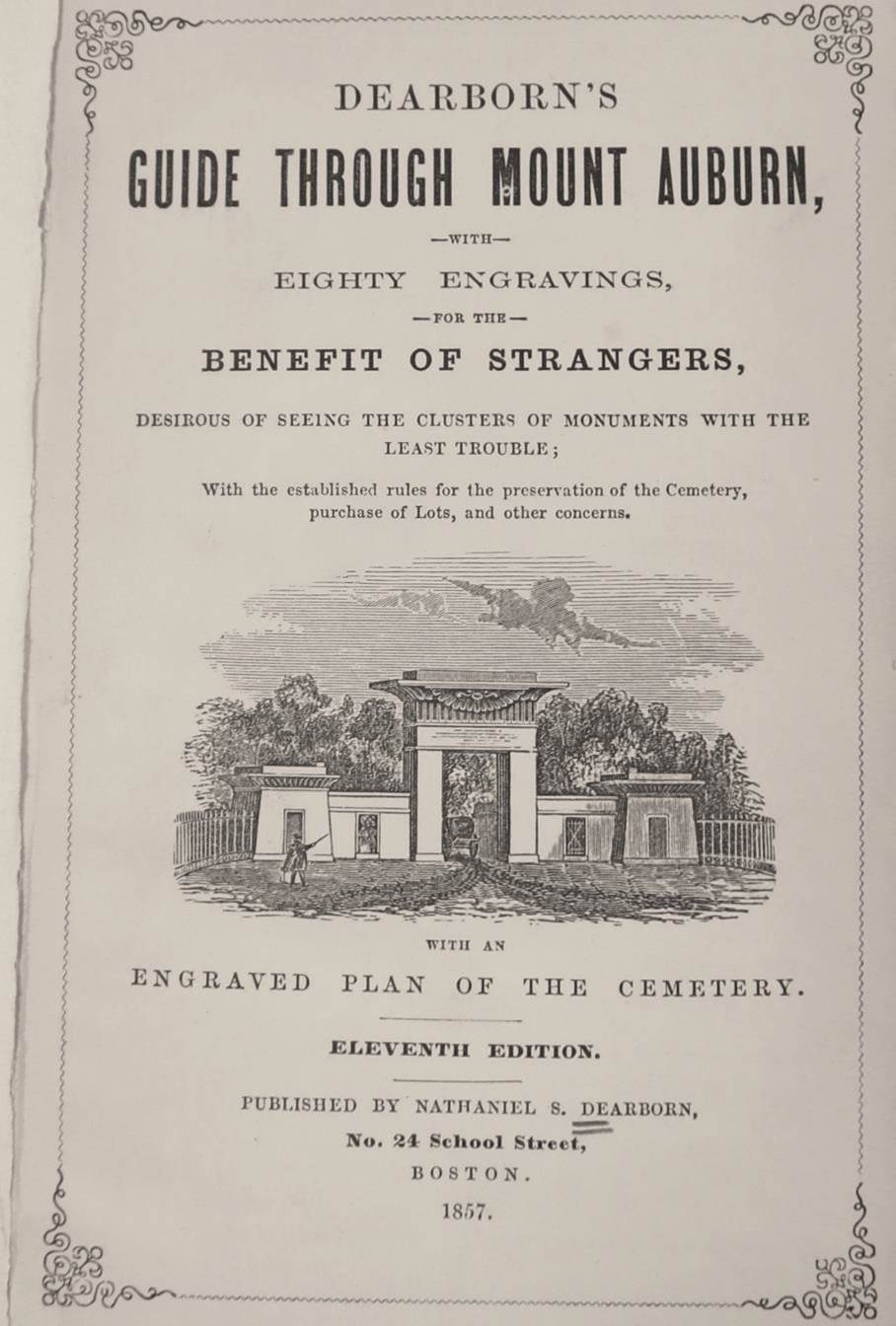
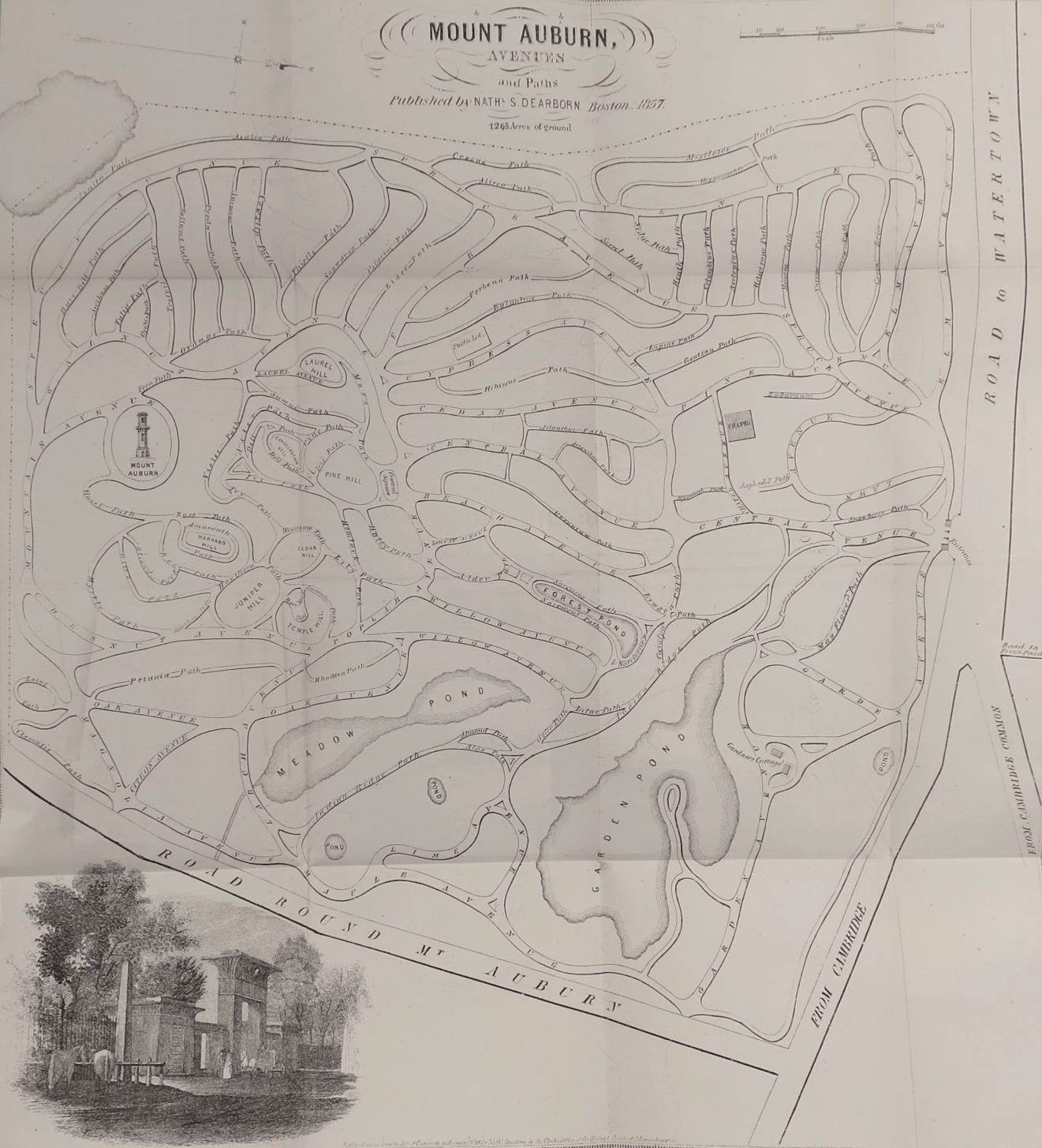
For someone whose interest in maps almost rivals her love of cemeteries, I found the fold-out maps in our copies of Dearborn’s Guide through Mount Auburn, published by Boston-based engraver Nathaniel S. Dearborn, most interesting. The map in the 1857 edition includes small engravings of the Egyptian Revival entrance and Washington Tower, an observation lookout providing panoramic views of Cambridge, Boston, and beyond. The guide in general is full of useful information about the cemetery as it functioned in 1857. Regulations include prohibition of “discharging firearms in the Cemetery,” and a warning of prosecution for anyone “found in possession of flowers or shrubs, within the grounds or before leaving them.” On that note, a poem titled “Touch Not the Flowers” by Mrs. C. W. Hunt adds a lyrical emphasis to the rule (and implores visitors with the ominous last line, “Touch not the flowers. They are the dead’s.”). After all, the cemetery was and remains as much a horticultural gem as a place of burial and memorial.

Among the conditions for proprietors, plot owners are informed that any monument, effigy, or inscription determined to be “offensive or improper” is subject to removal by the Trustees. Engraved illustrations present the cemetery-goer with a sampling of must-see monuments of notable men and women (and pets), including a memorial to Robert Gould Shaw, the impressive tomb of William P. Winchester on Narcissus Path, and a marble sculpture depicting the watchdog of Thomas H. Perkins, “an apparent guard to the remains of the family who were his friends.” Beautiful illustrations of the tower and chapel embellish the guide as well.


For the directionally gifted, the guide lists names of foot paths, avenues, and carriage roads, with rather complicated descriptions of how they are situated – “Willow, with two branches, the 1st branch from Poplar Av., northeasterly. to Narcissus Path, then curving easterly for the 2nd branch, to the south, to Larch Avenue.” I think you can see why Dearborn included a map.


Visitors can find up-to-date maps at the cemetery entrance today, so grab one for yourself and venture among the monuments and mausolea. Then, visit the library to see how the cemetery has changed over the years!


Mount Auburn Cemetery (Cambridge, Mass.)

Mount Auburn Cemetery (Cambridge, Mass.) Maps

Mount Auburn Cemetery (Cambridge, Mass.) Pictorial works.

Mount Auburn Cemetery (Cambridge, Mass.) Poetry.


Letters to Rosamond

By Grace Wagner, Reader Services


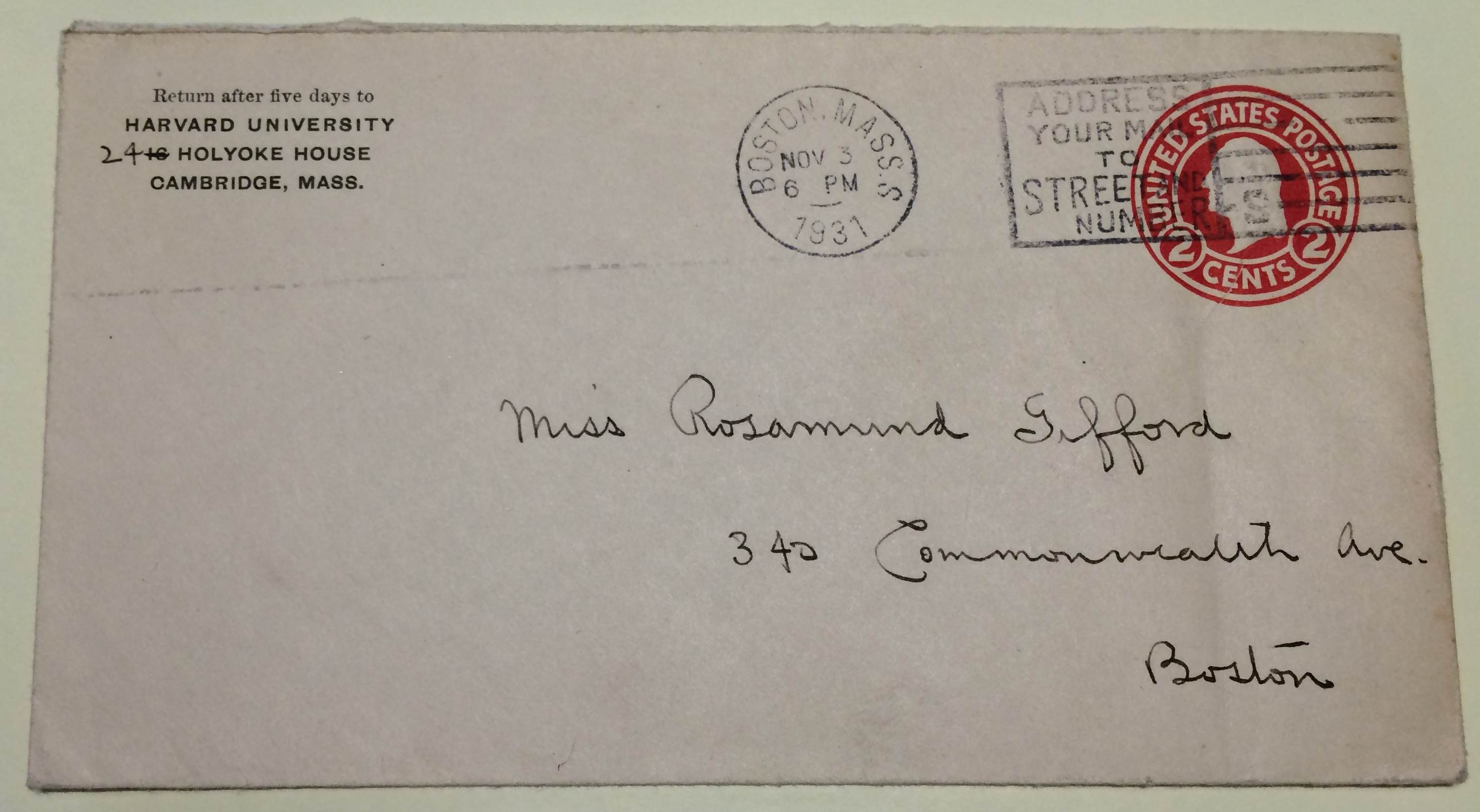
For most of her life, Rosamond Gifford was a resident of Boston’s Back Bay neighborhood. However, she was also received bachelor’s and master’s degrees from Radcliffe College, attended the Sorbonne in Paris, and was fluent in French.[i] Clearly, her residency in Boston never limited her worldview, or indeed, the array of individuals who corresponded with her. The Rosamond Gifford papers, 1930-1954, is composed of letters primarily dating from 1931-1946. During this time, Gifford received letters from a Harvard college professor advising her on thesis work for Radcliffe College, former classmates from the Waltham School for Girls, and friends who became soldiers and Red Cross nurses during World War II. Rosamond herself wrote to her family from France while touring abroad and studying at the Sorbonne in Paris. I have decided to highlight some of this correspondence for my blog post this week.


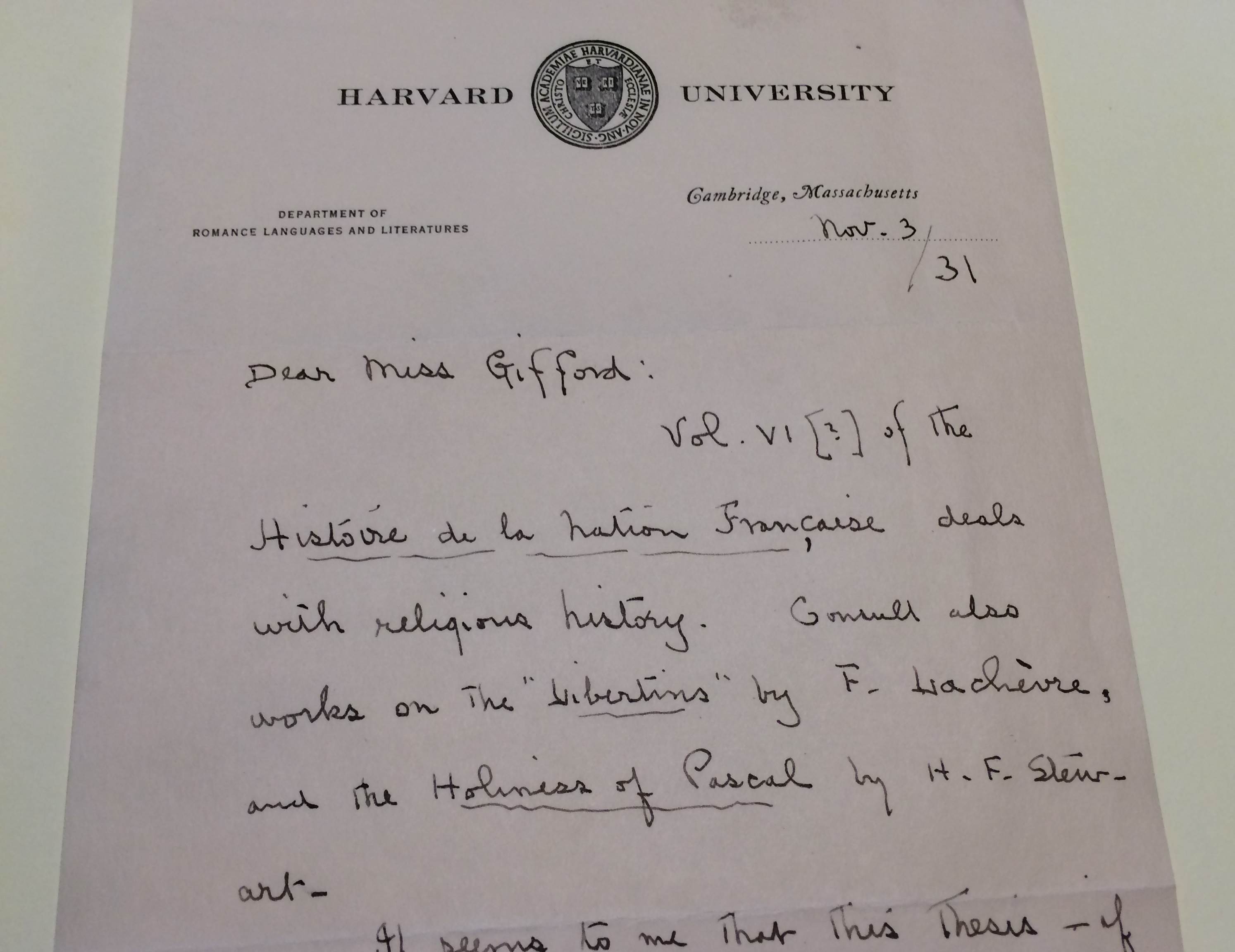
The first of these comes from George L. Lincoln, a professor who worked in the Department of Languages and Literature at Harvard. The letter is dated November 3, 1931, when Rosamond was an undergraduate in her junior year at Radcliffe College. The letter is brief, consisting primarily of several book recommendations for Rosamond’s thesis about French religious history, including The Holiness of Pascal by H.F. Stewart, but there is a note at the end that reads: “It seems to me that this thesis – if favorably commented upon by C.H.C.W. – might well be the basis for your HONOR Thesis next year.” This is an interesting comment, notable in that Lincoln later serves as an academic advisor for Gifford in letters sent between 1931 and 1933, before Radcliffe College and Harvard merged their classrooms, which would not happen until over ten years later.[ii] For Radcliffe women, interaction with Harvard faculty was often conducted through different channels, whether this was separate classes taught later at night, or corresponding with professors about their academic work through postal mail. Despite these interactions, female undergraduate and graduate students would receive degrees only through Radcliffe at this time.

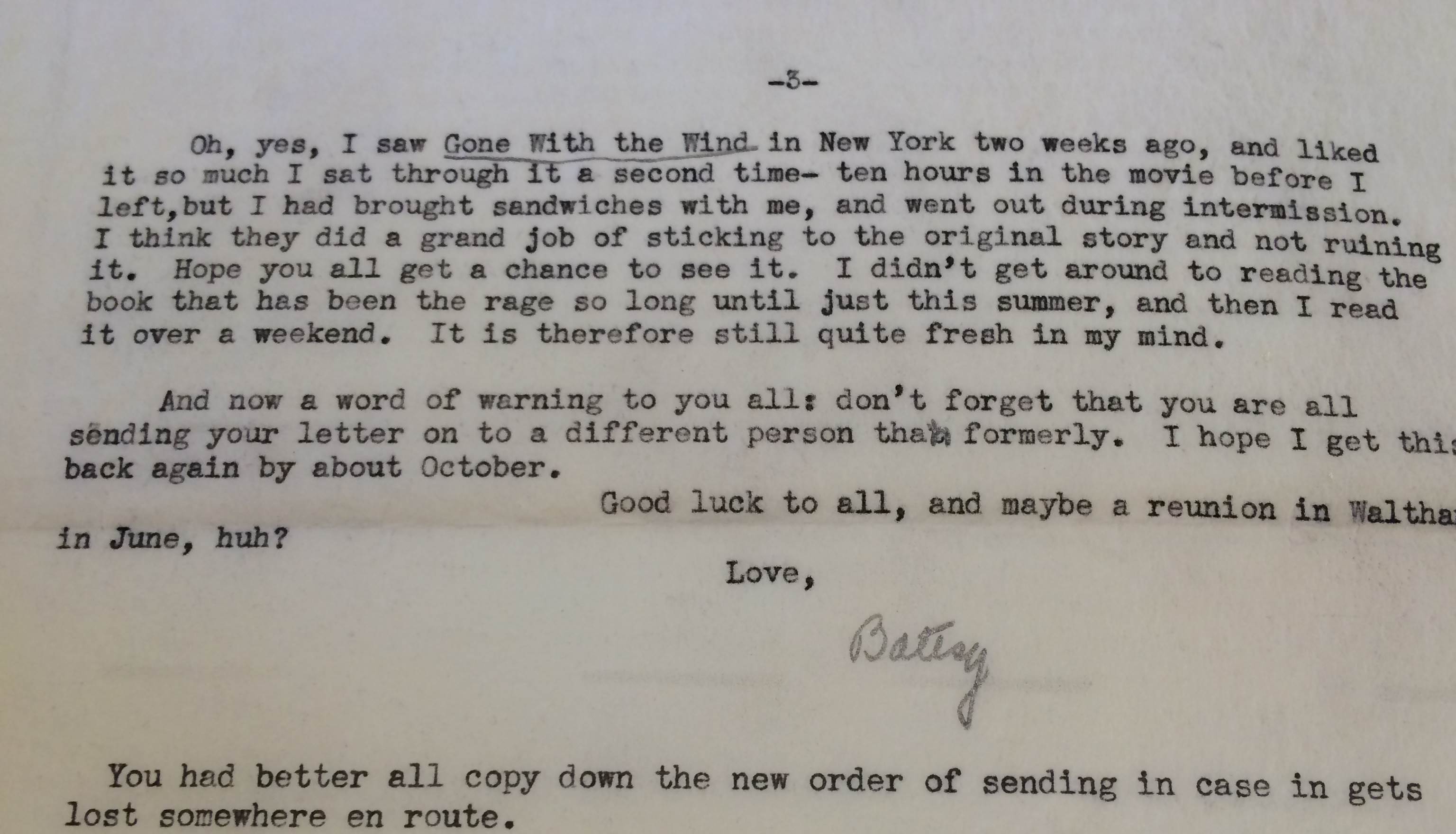
Radcliffe was not the only women’s school where Rosamond studied. The Gifford collection also includes a ‘Round Robin’ correspondence between Rosamond and former classmates from the Waltham School for Girls (the list of names includes Eleanor “Batesy” Bates, Vi Campbell, Rosalie Norris, Janet Lewis, and  Marion Chick). It began on January 22, 1940 with a letter from the organizer and ringleader of this endeavor, Eleanor “Batesy” Bates, who opens her letter with a cheery, ““Dear Round Robinites” and encloses her hopes that 1940 will bring forth a “new and rejuvenated Waltham Round Robin.” In this set of correspondence, Rosamond and her classmates discuss their lives with a refreshing degree of frankness. The letters include inexplicable nicknames and private jokes, slang, political talk, gossip about other classmates, and discussion of professional careers (writing, welfare work, teaching, and librarianship among them). I have included some favorite excerpts below:


“Oh, yes, I saw Gone With the Wind in New York two weeks ago, and liked it so much I sat through it a second time – ten hours in the movie before I left, but I had brought sandwiches with me, and went out during intermission.” – Eleanor “Batesy” Bates

“I do not get around much as my time is so taken up with writing and study, to say nothing of my son, husband and housework.” – Vi Campbell. 

“Will be awfully glad to see you all if we decide to visit Waltham this year en masse so do let me know the place. It would be fun to have a cigarette in North Hall, instead of behind the gym just once.” – Janet Lewis


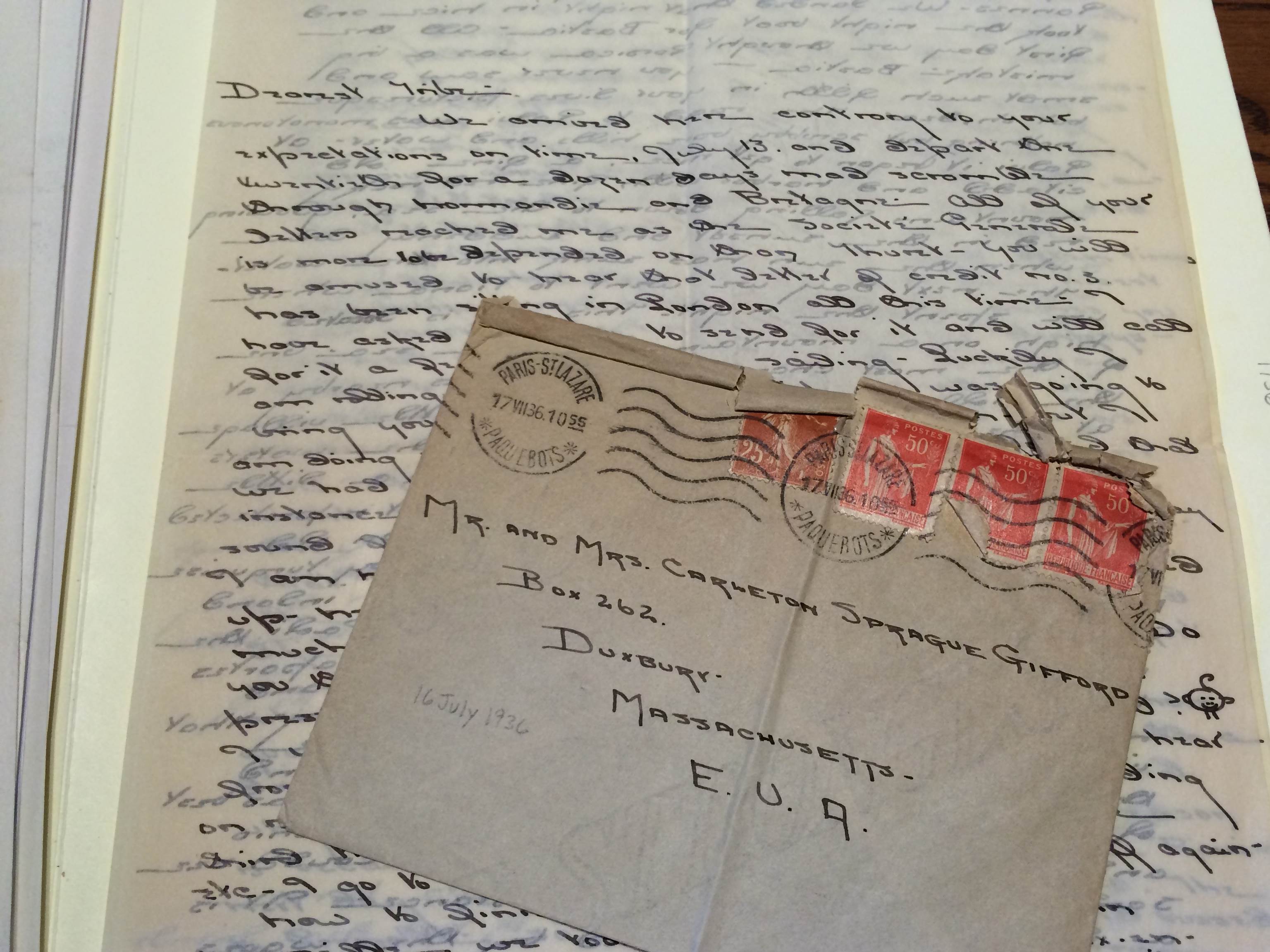
After World War II, there aren’t many more letters between Rosamond and her various correspondents, but Rosamond continued to live at 340 Commonwealth Ave. until her death in 1997. The Rosamond Gifford collection was a delight and a surprise to stumble across and have the opportunity to explore. Although I have shared words from Rosamond’s various correspondents, I would like to end this post with an excerpt from a letter written by Rosamond herself, dated July 16, 1936, while she was traveling abroad on an Anne Radcliffe fellowship for her graduate studies in France:[iii]


“Dearest Tribe,

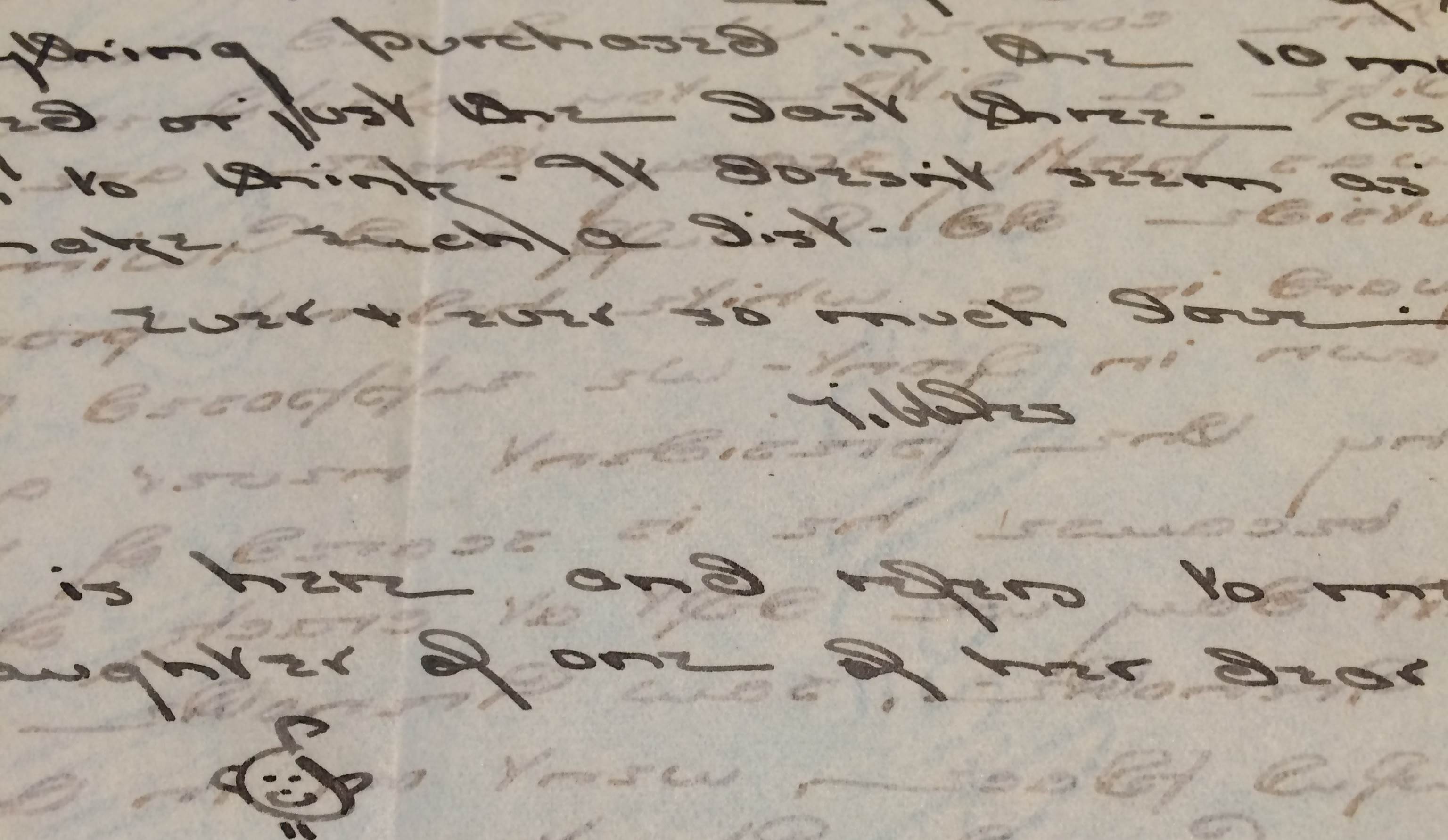
We arrived here contrary to your expectations on time, July 13, and depart the twentieth for a dozen days mad scramble through Normandie and Bretagne…From here we went to Ajaccio, one of the most charming cities I ever was in. The atmosphere exhales Napoleon and the house where he was born is most satisfactory. It is located on a little square with a garden, and the interior retains for the most part the original decoration of delicate eighteenth century designs. The main square is lined with palms and slopes down to the harbor which is surrounded by more red mountains – which were glowing in the evening light as we sailed away. I loved Corsica, best of the whole trip.”

She signs the letter, “Ever and ever so much love, Tibbles.”


[i] “Rosamond Gifford, 87, Philanthropist, taught French.” The Boston Sunday Globe, July 20, 1997.

[ii]  Ulrich, Laurel Thatcher. Yards and gates: Gender in Harvard and Radcliffe history. Palgrave Macmillan, 2004, 216. Radcliffe would not officially merge with Harvard until 1977.

[iii] “Radcliffe Gives 42 Fellowships.” Daily Boston Globe, May 12, 1935.


Reference Collection Book Review: Chinese in Boston

By Rakashi Chand, Reader Services

Chinese in Boston, 1870-1965 by Wing-Kai To and the Chinese Historical Society of New England (Charlestown, SC: Arcadia Publishing, 2008), part of the Images of America Series, tells the story of the Chinese experience in New England with a focus on Boston, MA through historic photographs with captions. The book is divided into seven chapters, which range from the first arrivals of Chinese immigrants in New England to the Settlement of Boston’s Chinatown, to various other topics until finally arriving at the modern experience of the Chinese in Boston. The text is brief as the photographs are the main source of history and context in this book.


The images come from a variety of sources ranging from the Bostonian Society to the Peabody Essex Museum to the Chinese Historical Society of New England, which was founded in 1992 to document the coherent and vibrant culture of Chinese Americans in New England. The book features the first Chinese owned business, notable members of the Chinese community, and photographic evidence of cultural assimilation as well as cultural preservation carried out in New England. The photographs are well presented and illustrative of the Chinese American experience in New England.

This book is useful for people trying to familiarize themselves with the Chinese history in New England and due to its length and format, can be read/viewed easily and quickly. It is hard to research the history of immigrant groups or minorities who were often not affluent and therefore not the subject of art, photography or historical records, making this book a rare source of an under-represented topic of New England History. This book begins circa 1870 with the first (known) photographic evidence of Chinese immigrants in New England and concludes with present day imagery.

Related Collections:

For more general history of Chinese immigrants in America the library of the Massachusetts Historical Society offers there secondary sources:

The Chinese in America: A Narrative History by Iris Chang (New York: Viking, 2003).

Asian America: Chinese and Japanese in the United States since 1850 by Roger Daniels  (Seattle: University of Washington Press, 1988).

Nothing Like It in the World: The Men Who Built the Transcontinental Railroad, 1863-1869 by Stephen E. Ambrose (New York: Simon & Schuster, 2000).

For the Chinese Exclusion Act we offer:

The Chinese Exclusion Act, Known as the Geary Law: Speech of Hon. Elijah A. Morse, M.C., of Massachusetts, in the House of Representatives, Friday, October 13, 1893 (Washington : [s.n.], 1893).

Amendment of the Chinese Exclusion Act. Speech of Hon. William Everett, of Massachusetts, in the House of Representatives, Saturday, October 14, 1893 (Washington: s.n., 1893).

Chiang Yee: The Silent Traveller from the East: A Cultural Biography by Da Zheng; foreword by Arthur C. Danto. New Brunswick (N.J. : Rutgers University Press, 2010).  

An Anglo-Chinese calendar for the year …: corresponding to the year for the Chinese cycle era (Canton : Office of the Chinese Repository).

Circular letter, signed C. L. Woodworth, regarding the Associations efforts with Chinese immigrants, Indians and African Americans. [Boston : s.n., 1880]

The library of the Massachusetts Historical Society houses a rich collection of China Trade papers and resources:

“Manuscripts on the American China trade at the Massachusetts Historical Society” by Katherine H. Griffin. Proceedings of the Massachusetts Historical Society, v. 100 (1988), p. 128-139.

Researchers on site also have access to the Adam Mathew database of primary source materials China, America and Pacific: Trade & Cultural Exchange.


An Adams Homecoming

By Amanda M. Norton, Adams Papers

On September 4, 1801, John Quincy Adams stepped ashore in Philadelphia, returning to the United States almost exactly seven years after he had left on his diplomatic mission to the Netherlands. He was not returning alone however; now his wife, Louisa Catherine Adams, and their first son, five-month-old George Washington Adams, accompanied him. Greeted by his brother Thomas Boylston Adams who was living in the city, the reunion was a happy but brief one. Both Louisa and John Quincy were anxious to see their parents once more but as the Johnsons lived in Washington, D.C., and the Adamses in Quincy, going together would mean a long wait for one of them. Neither wanted to put off greeting their families and so they went in opposite directions for the first time in their marriage. Louisa departed on the stage on September 12 with their son headed south, and John headed first to New York to see his sister, Nabby, before completing the journey to Massachusetts.

The decision to go independently was not without its concerns, however. Although her father was American, Louisa was “yet a forlorn stranger in the land of my Fathers” and ultimately in an unfamiliar country with an infant. John Quincy noted his distress over the separation in his Diary: “I parted from her and my child with pain and no small concern and anxiety.”

In her Autobiography, Louisa recalled reuniting with her parents for the first time in four years: “When I arrived after a tedious and dangerous journey, my Father was standing on the steps at the door of the house, expecting his Child, yet he did not know me— After he had recovered from the shock at first seeing me; he kept exclaiming that ‘he did not know his own Child,’ and it was sometime before he could calm his feelings, and talk with me.” John Quincy’s experience on the other had was quite different; on the 21st he recorded the event: “Here I had the inexpressible delight of finding once more my parents. After an absence of seven years— This pleasure would have been unalloyed but for the feeble and infirm state of my mother’s health. My parents received me with a welcome of the tenderest affection.”

As both John Quincy and Louisa settled in, they reunited with old friends and wrote to each other from afar. Although the plan was for Louisa to once again travel alone and meet John Quincy in Massachusetts, John Quincy agreed to meet Louisa and escort her and their son northward for one more significant homecoming—on November 25 John Quincy “had the pleasure of introducing my wife and child to my parents.” For her part, Louisa acknowledged that she had been received “very kindly,” but after London and Berlin, Quincy was quite an adjustment, and indeed Louisa declared, “Had I steped into Noah’s Ark I do-not think I could have been more utterly astonished.” It would take time for this homecoming to feel like home.


Autumn Dinner in the White Mountains, September 1875

By Rakashi Chand, Reader Services

It is ‘Leaf Peeping’ (fall foliage viewing) season in New England, so here are a few inspired leaves of thought…

Looking through our collections I came across an intriguing broadside, having read about the once opulent Hotels that dotted the New Hampshire Countryside in the mid nineteenth century. The [Dinner menu and wine list for Sunday September 12], no doubt, would serve as a glimpse into the grandeur of the majestic New Hampshire Resorts.

This unique Broadside attests to the lavish dinners served at the Crawford House, located in Crawford Notch New Hampshire. The most fascinating feature of this broadside is the material on which it is printed, a lovely piece of Birch bark. Birch trees are known for their beautiful lenticel marked white bark and can be seen throughout the forests of the White Mountains.


The single page pamphlet is printed on both sides and folded in half conveniently presenting the day’s fare and other pieces of information for hotel guests. For those intrigued by gastronomical history this is a fascinating specimen. Examining what was served on Sunday, September 12th 1875, one can truly note the changes in our collective palate and food culture over 150 years.


Finally, the last page features an extensive wine list, after all, how else would one be on a proper vacation? Modern coinsures will be intrigued by the Hock (German White wine) and Sauternes (French sweet wine) being such popular categories, but otherwise the list is quite familiar. Moet et Chandon champagne was a full $4.00 (The equivalent of $86.96 modern currency) proving that some things never change!


The first Crawford House was built in 1850. Described as having “a three and a half story central pavilion with a fine Greek Revival portico, identical five-bay, two and a half story wings, topped by pitched roofs with dormer windows.”  By 1852 there was such a high demand for rooms, that the owners of the Crawford House expanded, to create 200 sleeping rooms, by enlarging each wing by “eight bays”. Unfortunately the first Crawford House succumbed to fire, although within two days plans for the new Crawford House were already underway. Cyrus Eastman and his partners utilized a workforce of 175 men and 75 oxen and horses to complete the fastest hotel construction 1859 had ever seen.   Opening night was July 13th when 40 guests were received for dinner and 100 were entertained for the night, and the press noted that it was “the most spacious hotel about the mountain”.  In Eastman’s words “The Crawford House is a large and new edifice, very commodious and agreeable for a summer hotel. There are pleasant piazzas on the outside, and five halls, much used in the evening for promenading, run the entire length of the house within. The parlor is large and well furnished, the dining room ample in its proportion, and its tables always supplied with the delicacies of the metropolitan markets, as well as such substantial articles of mountain production, as delicious berries, and the richest milk and cream. The office is situated in the central part of the house… Here also is the post office of this wild region. Portraits of two of the Crawfords, patriarchs of these mountains, adorn the wall. The lodging rooms of the house are well furnished, and pleasant, especially those which have windows toward the Notch. Connected with the hotel are a bowling-alley for rainy-day and evening amusement, and extensive stables, furnished with a large number of horses… Last summer two tame bears afforded guests much amusement.” http://balthazaar.masshist.org/cgi-bin/Pwebrecon.cgi?DB=local&BBID=129906

Bostonians have always flocked to the White Mountain of New Hampshire to enjoy the striking natural beauty, although we in the modern era will never experience the grandeur met there by our predecessors.  A great transformation came to the region in the 1850s, the beginning of a huge tourist Industry, prompted by the laying of railroads, and later fueled by the Industrial Revolution which created a surplus of wealth in eastern cities. In the 1820s and 30s, the mountains and lakes were home to only a few highway taverns and Inns that provided rest for the weary stagecoach traveler on the harrowing passage north. After 1850, the region that had only been visited by a few hundred, started to see tens of thousands of tourists. This was the heyday of the White Mountain Resorts and Hotels. Rising up from scenic valleys, construction began on the grandest hotels in America in the mid-nineteenth century. These hotels were famous for their luxurious lodging, exquisite dinning, and state of the art facilities such as gas lighting. Travelers came from Europe to admire the grandeur of these Hotels, and to admire the beauty of the White Mountains, which, according to some European Newspapers, rivaled that of the Alps. Each of these hotels could accommodate 200-500 or more guests, offering extensive entertainment, numerous excursions, exquisite gardens, elegant parlors and dining halls serving the finest cuisine. Some of these Hotels had their very own railroad stations, conveniently bringing guests from Boston, Portland and New York directly to their doors and promising a scenic journey through the mountains before arriving at the their lavish lodgings. These hotels were The Crawford House, the Fabyan House, the Profile House, the Maplewood, and the Waumbek.

Unfortunately, the grand Hotels of New Hampshire were all built of wood, and almost all perished in fire. The Appalachian Mountain Club Highland Center sits on the site of the former Crawford House. The last of the majestic hotels built in the region was the Mount Washington Hotel, the grandest and largest, which still remains, a testament of the elegance and luxury of a bygone era and the largest wooden structure in New Hampshire.

The Massachusetts Historical Society lists 153 titles under the heading ‘Menu’ in our catalog. For this broadside, or to search for other broadsides in our collection, please use ABIGAIL, our online catalog. Visit the library of the Society to research more culinary history!

______________

Next up:

Nineteenth Century Travels through New Hampshire

(Burrage, Mary Greene Hunt. Letter to Margaret Howe (Cotton) Hunt [transcript] [1854} in Miscellaneous Manuscripts 1854)

Followed by:

The first map of the White Mountains done by none other than our very own Jeremy Belknap!


From the Bay State to the Free State: A Massachusetts Soldier in Maryland

By Susan Martin, Collection Services

The Civil War diary of Joseph Warren Phinney, a recent acquisition of the MHS, is a small unassuming leather volume. Probably fewer than half the pages are covered with smudged pencil entries dated 13 July 1864-22 April 1865, as well as miscellaneous memoranda. But even a cursory look into its contents reveals fascinating details.

Phinney hailed from Sandwich, Mass. and served with the 5th Massachusetts Infantry Regiment, Company A. His diary complements our other holdings related to this regiment, which include the papers of Charles Bowers, William Wallace Davis, Benjamin Newell Moore, and George L. Prescott. But it was Phinney’s entry of 8 October 1864 that piqued my interest. It begins: “To-day I was detailed to go with a squad to protect the Polls in a small town on the Eastern Shore of Maryland.” October was too early for the presidential election, but Phinney didn’t provide any context, so I consulted Alfred S. Roe’s 1911 history of the regiment to learn more.

Phinney was, in his small way, taking part in a momentous day in Maryland’s history. The Emancipation Proclamation had freed slaves in the Confederacy nearly two years before, but Maryland had never seceded and so was still a slave-holding state. In fact, its 1851 Constitution explicitly outlawed “any law abolishing the relation of master or slave.” October 1864 saw Marylanders voting to ratify a new constitution which would, among other things, abolish slavery in the state. (It ultimately squeaked by with a tiny majority of 375 votes.)

The 5th Massachusetts Infantry sent several squads from Baltimore’s Fort McHenry down the Chesapeake Bay to protect polling places along the Eastern Shore. Phinney’s squad was detailed to the small town of Trappe in Talbot County. They were quartered there for about a week, first in a schoolhouse and then a church.

But this 19-year-old bachelor wasn’t thinking about his place in history. He wrote: “We received many favors from the inhabitants and lived high on sweet potatoes and johnny cake brought in by them. The boys had plenty of liberty and improved it by seeing all they could and tasting all they saw.”

If you sense a certain tone to his words, you’re not imagining things. After his return to Baltimore, Phinney elaborated: “How much I enjoyed my visit at Trappe I can’t well express, but a long letter, containing three closely written sheets of good sensible sized note paper seems to tell me that I wan’t the only one who remembers with pleasure my visit to the ‘Eastern Shore.’” His correspondent was someone named either Emma or Erma—I can’t quite make out his handwriting. Whoever she was, he called her “darling” and “a good sweet little dear” and cherished her “token of love and friendship more than I shall dare to express here.”

I won’t keep you in suspense: as far as I can tell, Phinney and the young lady in question never saw each other again. But she wrote to him six months later, prompting him to reflect, in the only other entry he wrote about her: “Who would imagine that she would remember me enough to write such a letter after such a time since we met has elapsed. I am sure I didn’t when we enjoyed ourselves so pleasantly on the Eastern Shore of ‘Maryland, My Maryland,’ – as she used to sing so sweetly.” But she lived too far away, and he was a “wandering vagabond” and “scallawag” who couldn’t provide for a family. So he concluded: “I guess it will be best policy to let them all slide Nettie, Emma, and Lizzie, the whole boodle of them.”

Phinney didn’t let the whole boodle slide, however, at least not permanently. He married in 1869 to Susan Jane Turner, with whom he had two children before she died 13 years later. Phinney then married Priscilla Chase Morris and had four more children.

Other entries in Phinney’s diary are interesting, funny, or just plain cryptic. He had a tendency to scribble down random thoughts, financial memoranda, aphorisms, etc. He also sometimes vented his frustration. After his promotion to sergeant of the guard, he wrote: “Hullo, Sergeant Phinney? Your three stripes look better than two. How mad Walsh was that he didn’t get the warrant. I don’t give a damn!”


And here’s an excerpt from his description of the day Abraham Lincoln died, which stretches for several pages: “This has been a day of sorrow and mourning for the nation. […] On the opening of the telegraph office there was an immense crowd gathered in front of the entrance, awaiting, with intense anxiety, something definite in regard to the matter. Alas! The news was too true, for the wire confirmed what we had before hesi[ta]ted to believe. We cannot depict the horror and grief that seized our community.”

The MHS also holds a copy of Catch ’ems?, a beautiful two-volume compilation of the letters of Phinney’s daughter Ellis Phinney Taylor, published in 2004 by other members of the family. Although the letters date from the early 20th century, Catch ’ems? gave me my first glimpse of Joseph Warren Phinney and the Phinney family.


Phinney was born in 1845, the only son and youngest child of Warren and Henrietta J. (Smith) Phinney. His mother died just a few months after his birth, and his father a few years later, so young Phinney was raised by his maternal grandparents. After the Civil War, he became a printer and type founder and designed several typefaces. He died in 1934 at the age of 89.