
Autumn Dinner in the White Mountains, September 1875

By Rakashi Chand, Reader Services

It is ‘Leaf Peeping’ (fall foliage viewing) season in New England, so here are a few inspired leaves of thought…

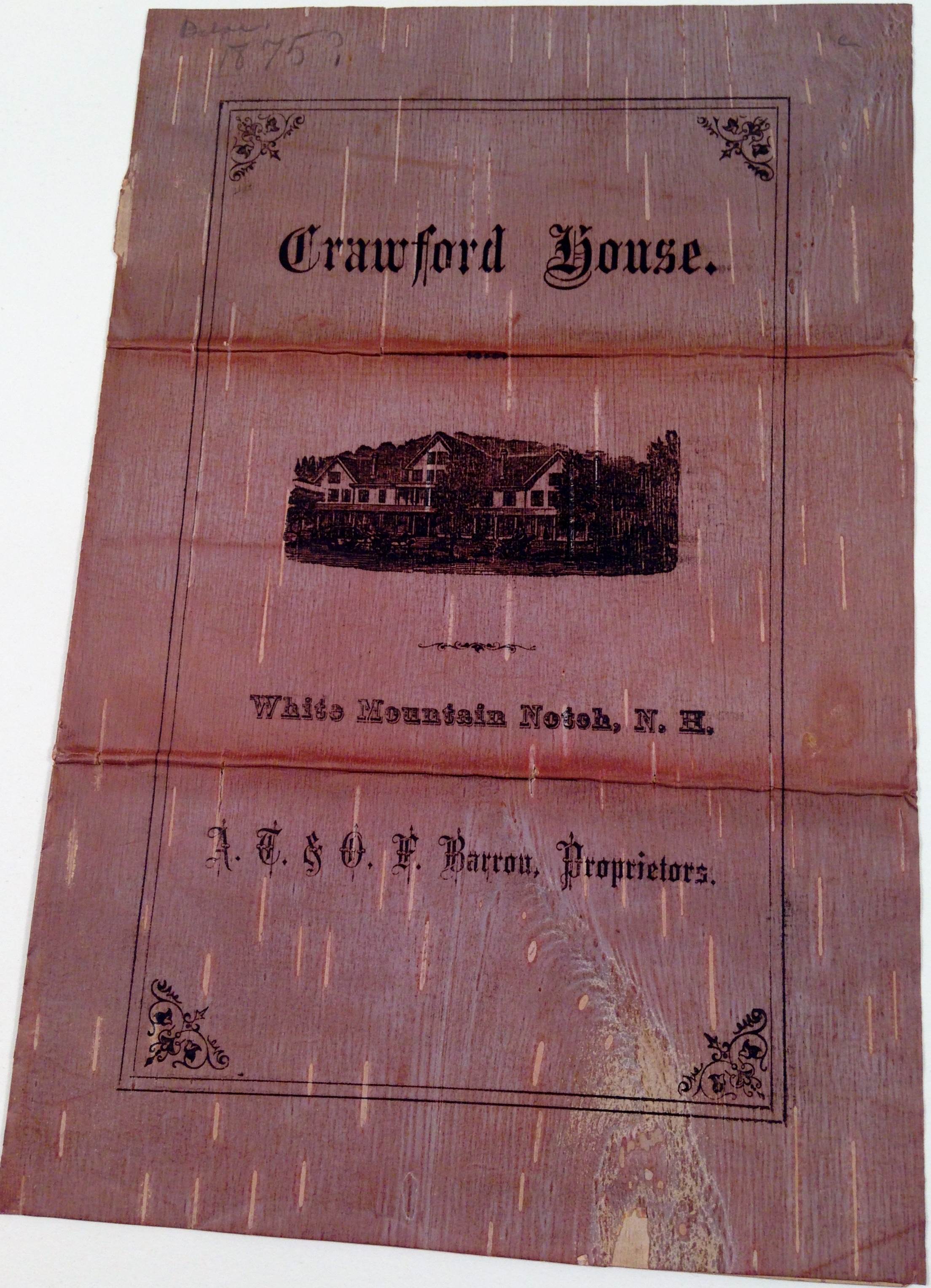
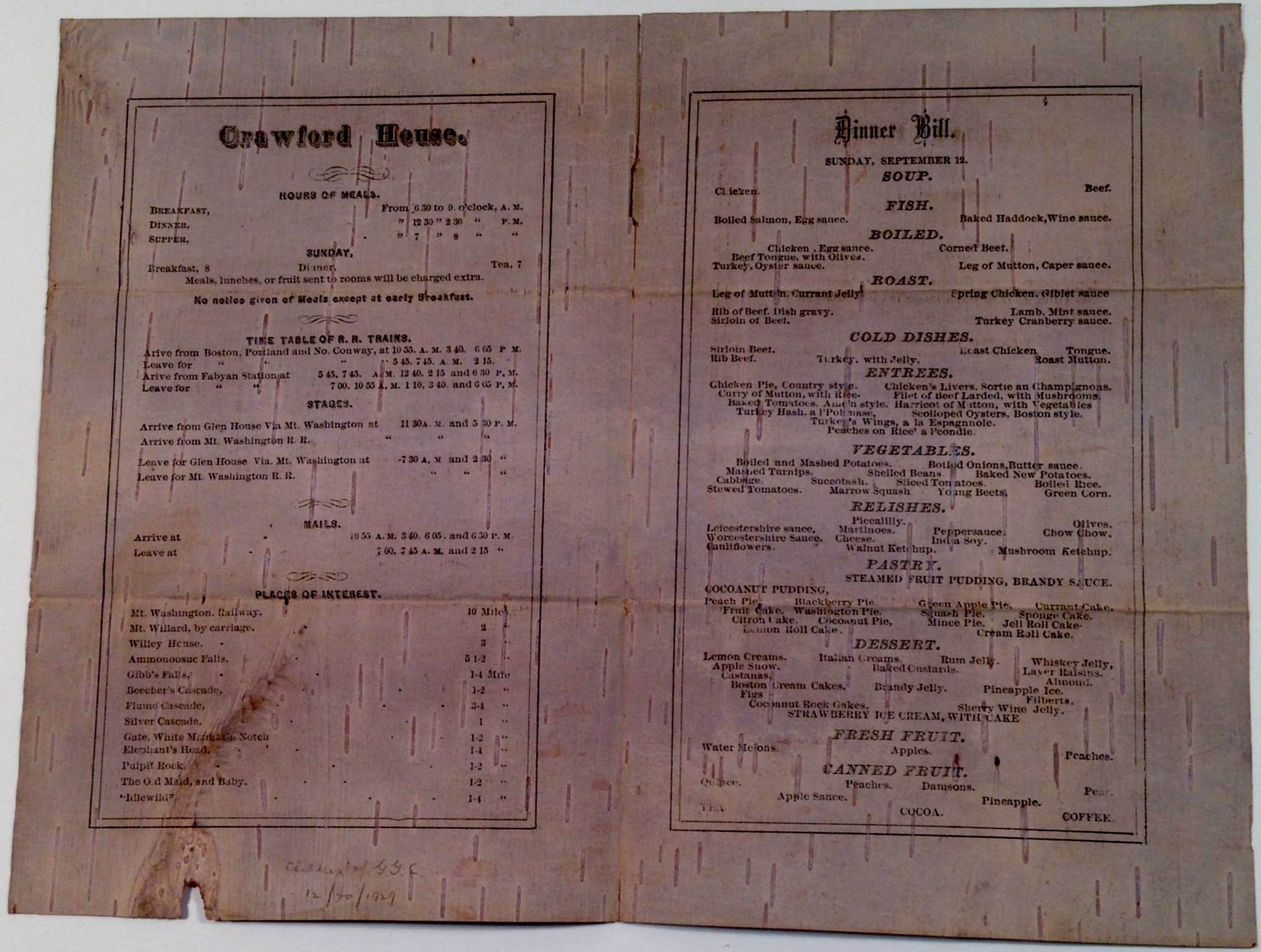
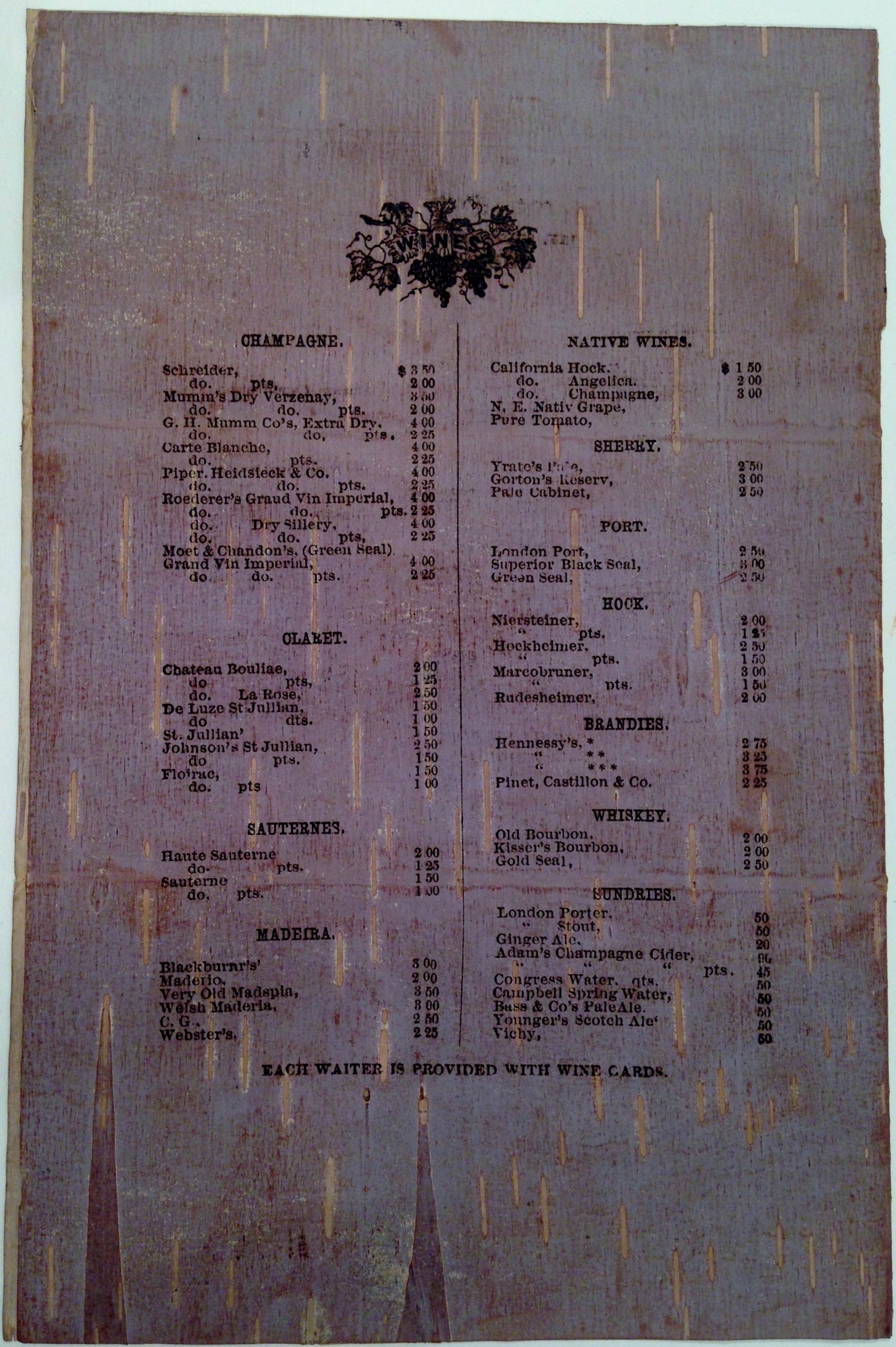
Looking through our collections I came across an intriguing broadside, having read about the once opulent Hotels that dotted the New Hampshire Countryside in the mid nineteenth century. The [Dinner menu and wine list for Sunday September 12], no doubt, would serve as a glimpse into the grandeur of the majestic New Hampshire Resorts.

This unique Broadside attests to the lavish dinners served at the Crawford House, located in Crawford Notch New Hampshire. The most fascinating feature of this broadside is the material on which it is printed, a lovely piece of Birch bark. Birch trees are known for their beautiful lenticel marked white bark and can be seen throughout the forests of the White Mountains.


The single page pamphlet is printed on both sides and folded in half conveniently presenting the day’s fare and other pieces of information for hotel guests. For those intrigued by gastronomical history this is a fascinating specimen. Examining what was served on Sunday, September 12th 1875, one can truly note the changes in our collective palate and food culture over 150 years.


Finally, the last page features an extensive wine list, after all, how else would one be on a proper vacation? Modern coinsures will be intrigued by the Hock (German White wine) and Sauternes (French sweet wine) being such popular categories, but otherwise the list is quite familiar. Moet et Chandon champagne was a full $4.00 (The equivalent of $86.96 modern currency) proving that some things never change!


The first Crawford House was built in 1850. Described as having “a three and a half story central pavilion with a fine Greek Revival portico, identical five-bay, two and a half story wings, topped by pitched roofs with dormer windows.”  By 1852 there was such a high demand for rooms, that the owners of the Crawford House expanded, to create 200 sleeping rooms, by enlarging each wing by “eight bays”. Unfortunately the first Crawford House succumbed to fire, although within two days plans for the new Crawford House were already underway. Cyrus Eastman and his partners utilized a workforce of 175 men and 75 oxen and horses to complete the fastest hotel construction 1859 had ever seen.   Opening night was July 13th when 40 guests were received for dinner and 100 were entertained for the night, and the press noted that it was “the most spacious hotel about the mountain”.  In Eastman’s words “The Crawford House is a large and new edifice, very commodious and agreeable for a summer hotel. There are pleasant piazzas on the outside, and five halls, much used in the evening for promenading, run the entire length of the house within. The parlor is large and well furnished, the dining room ample in its proportion, and its tables always supplied with the delicacies of the metropolitan markets, as well as such substantial articles of mountain production, as delicious berries, and the richest milk and cream. The office is situated in the central part of the house… Here also is the post office of this wild region. Portraits of two of the Crawfords, patriarchs of these mountains, adorn the wall. The lodging rooms of the house are well furnished, and pleasant, especially those which have windows toward the Notch. Connected with the hotel are a bowling-alley for rainy-day and evening amusement, and extensive stables, furnished with a large number of horses… Last summer two tame bears afforded guests much amusement.” http://balthazaar.masshist.org/cgi-bin/Pwebrecon.cgi?DB=local&BBID=129906

Bostonians have always flocked to the White Mountain of New Hampshire to enjoy the striking natural beauty, although we in the modern era will never experience the grandeur met there by our predecessors.  A great transformation came to the region in the 1850s, the beginning of a huge tourist Industry, prompted by the laying of railroads, and later fueled by the Industrial Revolution which created a surplus of wealth in eastern cities. In the 1820s and 30s, the mountains and lakes were home to only a few highway taverns and Inns that provided rest for the weary stagecoach traveler on the harrowing passage north. After 1850, the region that had only been visited by a few hundred, started to see tens of thousands of tourists. This was the heyday of the White Mountain Resorts and Hotels. Rising up from scenic valleys, construction began on the grandest hotels in America in the mid-nineteenth century. These hotels were famous for their luxurious lodging, exquisite dinning, and state of the art facilities such as gas lighting. Travelers came from Europe to admire the grandeur of these Hotels, and to admire the beauty of the White Mountains, which, according to some European Newspapers, rivaled that of the Alps. Each of these hotels could accommodate 200-500 or more guests, offering extensive entertainment, numerous excursions, exquisite gardens, elegant parlors and dining halls serving the finest cuisine. Some of these Hotels had their very own railroad stations, conveniently bringing guests from Boston, Portland and New York directly to their doors and promising a scenic journey through the mountains before arriving at the their lavish lodgings. These hotels were The Crawford House, the Fabyan House, the Profile House, the Maplewood, and the Waumbek.

Unfortunately, the grand Hotels of New Hampshire were all built of wood, and almost all perished in fire. The Appalachian Mountain Club Highland Center sits on the site of the former Crawford House. The last of the majestic hotels built in the region was the Mount Washington Hotel, the grandest and largest, which still remains, a testament of the elegance and luxury of a bygone era and the largest wooden structure in New Hampshire.

The Massachusetts Historical Society lists 153 titles under the heading ‘Menu’ in our catalog. For this broadside, or to search for other broadsides in our collection, please use ABIGAIL, our online catalog. Visit the library of the Society to research more culinary history!

______________

Next up:

Nineteenth Century Travels through New Hampshire

(Burrage, Mary Greene Hunt. Letter to Margaret Howe (Cotton) Hunt [transcript] [1854} in Miscellaneous Manuscripts 1854)

Followed by:

The first map of the White Mountains done by none other than our very own Jeremy Belknap!


From the Bay State to the Free State: A Massachusetts Soldier in Maryland

By Susan Martin, Collection Services

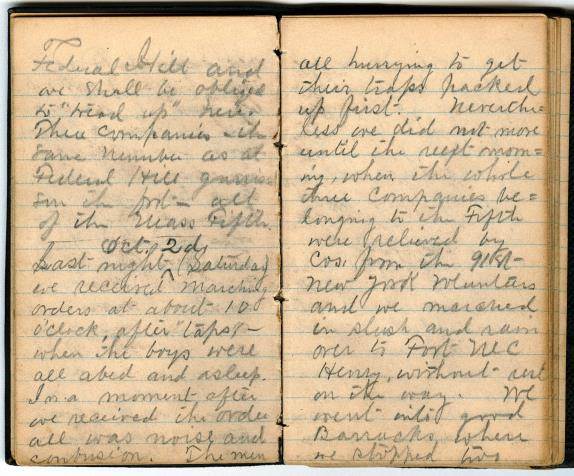
The Civil War diary of Joseph Warren Phinney, a recent acquisition of the MHS, is a small unassuming leather volume. Probably fewer than half the pages are covered with smudged pencil entries dated 13 July 1864-22 April 1865, as well as miscellaneous memoranda. But even a cursory look into its contents reveals fascinating details.

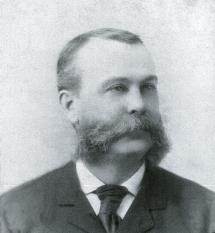
Phinney hailed from Sandwich, Mass. and served with the 5th Massachusetts Infantry Regiment, Company A. His diary complements our other holdings related to this regiment, which include the papers of Charles Bowers, William Wallace Davis, Benjamin Newell Moore, and George L. Prescott. But it was Phinney’s entry of 8 October 1864 that piqued my interest. It begins: “To-day I was detailed to go with a squad to protect the Polls in a small town on the Eastern Shore of Maryland.” October was too early for the presidential election, but Phinney didn’t provide any context, so I consulted Alfred S. Roe’s 1911 history of the regiment to learn more.

Phinney was, in his small way, taking part in a momentous day in Maryland’s history. The Emancipation Proclamation had freed slaves in the Confederacy nearly two years before, but Maryland had never seceded and so was still a slave-holding state. In fact, its 1851 Constitution explicitly outlawed “any law abolishing the relation of master or slave.” October 1864 saw Marylanders voting to ratify a new constitution which would, among other things, abolish slavery in the state. (It ultimately squeaked by with a tiny majority of 375 votes.)

The 5th Massachusetts Infantry sent several squads from Baltimore’s Fort McHenry down the Chesapeake Bay to protect polling places along the Eastern Shore. Phinney’s squad was detailed to the small town of Trappe in Talbot County. They were quartered there for about a week, first in a schoolhouse and then a church.

But this 19-year-old bachelor wasn’t thinking about his place in history. He wrote: “We received many favors from the inhabitants and lived high on sweet potatoes and johnny cake brought in by them. The boys had plenty of liberty and improved it by seeing all they could and tasting all they saw.”

If you sense a certain tone to his words, you’re not imagining things. After his return to Baltimore, Phinney elaborated: “How much I enjoyed my visit at Trappe I can’t well express, but a long letter, containing three closely written sheets of good sensible sized note paper seems to tell me that I wan’t the only one who remembers with pleasure my visit to the ‘Eastern Shore.’” His correspondent was someone named either Emma or Erma—I can’t quite make out his handwriting. Whoever she was, he called her “darling” and “a good sweet little dear” and cherished her “token of love and friendship more than I shall dare to express here.”

I won’t keep you in suspense: as far as I can tell, Phinney and the young lady in question never saw each other again. But she wrote to him six months later, prompting him to reflect, in the only other entry he wrote about her: “Who would imagine that she would remember me enough to write such a letter after such a time since we met has elapsed. I am sure I didn’t when we enjoyed ourselves so pleasantly on the Eastern Shore of ‘Maryland, My Maryland,’ – as she used to sing so sweetly.” But she lived too far away, and he was a “wandering vagabond” and “scallawag” who couldn’t provide for a family. So he concluded: “I guess it will be best policy to let them all slide Nettie, Emma, and Lizzie, the whole boodle of them.”

Phinney didn’t let the whole boodle slide, however, at least not permanently. He married in 1869 to Susan Jane Turner, with whom he had two children before she died 13 years later. Phinney then married Priscilla Chase Morris and had four more children.

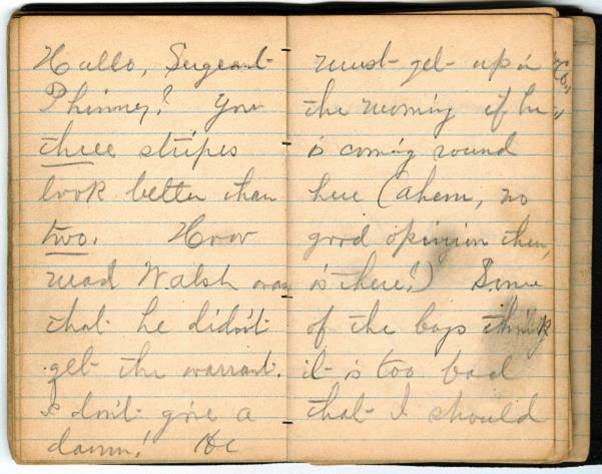
Other entries in Phinney’s diary are interesting, funny, or just plain cryptic. He had a tendency to scribble down random thoughts, financial memoranda, aphorisms, etc. He also sometimes vented his frustration. After his promotion to sergeant of the guard, he wrote: “Hullo, Sergeant Phinney? Your three stripes look better than two. How mad Walsh was that he didn’t get the warrant. I don’t give a damn!”


And here’s an excerpt from his description of the day Abraham Lincoln died, which stretches for several pages: “This has been a day of sorrow and mourning for the nation. […] On the opening of the telegraph office there was an immense crowd gathered in front of the entrance, awaiting, with intense anxiety, something definite in regard to the matter. Alas! The news was too true, for the wire confirmed what we had before hesi[ta]ted to believe. We cannot depict the horror and grief that seized our community.”

The MHS also holds a copy of Catch ’ems?, a beautiful two-volume compilation of the letters of Phinney’s daughter Ellis Phinney Taylor, published in 2004 by other members of the family. Although the letters date from the early 20th century, Catch ’ems? gave me my first glimpse of Joseph Warren Phinney and the Phinney family.


Phinney was born in 1845, the only son and youngest child of Warren and Henrietta J. (Smith) Phinney. His mother died just a few months after his birth, and his father a few years later, so young Phinney was raised by his maternal grandparents. After the Civil War, he became a printer and type founder and designed several typefaces. He died in 1934 at the age of 89.

Margaret Russell’s Diary, September 1916

By by Anna J. Clutterbuck Cook, Reader Services

Today, we return to the line-a-day diary of Margaret Russell. You can read previous installments here:

January | February | March | April | May | June | July | August

In August, Margaret Russell wrote about her ambivalence planning a trip to the American west due to the uncertainties created by the looming railroad strike. The strike was resolved, however, and as her diary reveals Margaret went ahead with her travel plans. On September 6th, the Wednesday after Labor Day (established as a federal holiday in 1894), she went to Boston to purchase tickets. Between September 7th and September 21st she traveled to Colorado and back by train. It is unclear whether Margaret Russell traveled alone or with other members of the family; her diary seldom reveals her daily companions. Her diary once again reveals her to be a lover of walks and drives, as she details the natural beauty of the landscape in the West. 

On the return journey she notes a tragedy: “Two men killed by our train but we did not know.” Were the men laborers? Were the deaths intentional suicide? An accident? She likely did not know and certainly does not say. It is a passing horror in an otherwise “splendid trip.” The final week of September sees Margaret return to her usual routine of errands, walking, and visiting on the North Shore and in Boston.

 * * *

September 1916*

1 Sept. Friday – Stayed at home in the morning. Drove to Newburyport for tea at Blue Elephant. Home by turnpike.

2 Sept. Saturday – First to Hosp. on to Natick Inn for lunch, on to see Mrs. Hodder home at 6. Dined at Marblehead to see Miss Reulker.

3 Sept. Walked to church & back. Family to dine.

4 Sept. Labor Day – Stayed at home in the A.M. Made calls at Nahant in the P.M.

5 Sept. Tuesday – Mrs. Ward’s last lecture, took tea with Jennie.

6 Sept. To town to make last plans & get tickets. Packing in the P.M.

7 Sept. Left home 8.30. Boston at 10 A.M.

8 Sept. Arrived at Chicago at 12.30. Bath & lunch at Blackstone. Drove through the Riverside Park. Left at 6pm for Denver.

9 Sept. Omaha when awakened at 7. Arrived Denver at 9.45. Brown Palace Hotel. Very noisy room.

10 Sept. Sunday. Fine service at cathedral & sermon from Dean on 10 Commandments. Took sight-seeing bus in P.M. Changed rooms.

11 Sept. Rainy – museum in the A.M. Movies in the P.M.

12 Sept. Left Denver at 8 A.M. Train to Loveland motor to Estes. Wonderful drive thru Thompson canyon. Stanley Hotel most comfortable.

13 Sept. Walked about in the A.M. I found flowers. Drove to Long Peak’s rim in the P.M. & on way home saw beaver dams.

14 Sept. Walked on the Prospect Trail & took Fall River drive up to 10,000 feet. Wonderful view.

15 Sept. Friday – Walked nearly to Glen Lake. Drive the High Drive & Moraine Park. Wonderful weather.

16 Sept. Saturday – Walked along river. Drive to Sprague’s in P.M. The most beautiful drive yet. Views superb.

17 Sept. Sunday Left Estes P- by motor at 2 in thunderstorm which was short. Reached Denver at 6. Road fine thru canyon very dusty on plains. Room Palace Hotel.

18 Sept. Went to museum. Very interesting, did errands. Left Denver at 2.45 for Chicago N. P. & C.M.St.P. Comfortable weather. Saw wind storm.

19 Sept. Travelling all day through corn fields & stock farms. Two men killed by our train but we did not know. Chicago at 9.

20 Sept. Left Chicago at 10.30. Went to Creighton’s first under Hotel Blackstone. Comfortable train & cool.

21 Sept. Arrived in Boston at 3. Had my hair washed & got home by 5.30. Mama very well. A splendid trip.

22 Sept. Writing & paying bills. Drove to Salem for errands & to N. Andover for tea in the P.M.

23 Sept. Saturday – Went to N. Andover with H.G.C.’s. Lovely day.

24 Sept. Walked to church. The two C’s & Ellen to dine only.

25 Sept. Monday – Town for errands. Lunched at Marian’s, went out to see Aunt E.

26 Sept. Tuesday – Walked from little Nahant. Drove to Lynnfield swamp & cut fringed gentian.

27 Sept. Wednesday – To town after lunch for Mayflower Soc. meeting.

28 Sept. Thursday – Walked from Marblehead across [illegible]. Quite warm. To Salem to see Ropes’ house in P.M. Dined at Beverly.

29 Sept. Friday – Church at ten. Looking [illegible] flowers to take to Gray. P.M. went to Herbarium & to Radcliffe tea.

30 Sept. Went to see Mrs. H. Then to Southboro to lunch with H.G.C. Much cooler. High wind.

* * *

If you are interested in viewing the diary in person in our library or have other questions about the collection, please visit the library or contact a member of the library staff for further assistance.


*Please note that the diary transcription is a rough-and-ready version, not an authoritative transcript. Researchers wishing to use the diary in the course of their own work should verify the version found here with the manuscript original.


“The Poor Wretched People Are Much Difficulted”

By Susan Martin, Collections Services

I’d like to take this opportunity to write about the topic that’s been dominating U.S. headlines and occupies countless hours of on-air and on-line punditry: the annual migration of the monarch butterfly.

Just kidding. Yes, I mean the U.S. presidential election. Bear with me.

Historical perspective is our bread and butter here at the MHS, of course. Studying the past is almost always both illuminating and sobering. So I thought I’d revisit the U.S. presidential election of 1788-1789, when 56-year-old George Washington became the first chief executive of the brand-new nation.

Looking for inspiration, I browsed through our collection of Miscellaneous Manuscripts, what we call an “artificial” collection. These documents were donated to the MHS at different times, and each is cataloged individually in our online catalog. They’re arranged chronologically, so I could zero in on a specific date range.

I came across a document I’d never seen before but loved immediately. It’s a letter from Baptist minister David Thomas (1732-1815) in Virginia to his nephew Griffith Evans (1760-1845) in Philadelphia. The letter is dated 3 March 1789. After complaining that he’d been “immers’d in the fatigues and troubles of a foolish perverse hairbraind world,” Thomas launched into a bitter diatribe about the sweeping Federalist victory in the presidential election two months before. His letter is dripping with sarcasm and contempt:

“How does Fedralism go on in your State? Does the people know the meaning of the word Fedralism, it is a very pretty word, it has a beautiful sound, it Charms all the learned the wise, the polite, the reputable, the Honorable, and virtuous, and all that are not Caught with the alurements of its melody, are poor ignorant asses, nasty dirty sons of bitches; reserved for future treatment agreeable to their demerrit. […] The whole American world is in an uproar.”


It’s hard to imagine the kind of sea change Thomas was living through. In fact, this letter was written just one day before the U.S. Constitution went into effect, superseding the Articles of Confederation. Thomas clearly resented the strong centralized government that was set to replace the looser confederation of independent states that he preferred.

George Washington belonged to no political party and was elected unanimously, a circumstance inconceivable today. But far from inconceivable is Thomas’s frustration at his state’s convoluted electoral process, which he described in detail:

“Perhaps you are a Stranger to the term hold the pole, of which I will inform you, viz: the Candidate stands upon an eminence close to the Avenue thro which the people pass to give in their votes, viva voce, or by outcry, there the candidates stand ready to beg, pray, and solicit the peoples votes in opposition to their Competitors, and the poor wretched people are much are much difficulted by the prayers and threats of those Competitors, exactly Similar to the Election of the Corrupt and infamous House of Commons in England.”

He’d narrowly escaped a seat in the Virginia Assembly himself:

“At the last Election I was drag’d from my Lodging when at dinner, and forced upon the Eminence purely against my will, but I soon disappeared and return’d to my repast, and as soon as they lost sight of me they quit voting for me. Such is the pitifull and lowliv’d manner all the Elected officers of Government come into posts of honour and profit in Virginia, by Stooping into the dirt that they may ride the poor people; and would you have your Uncle to divest himself of every principle of honour to obtain a disagreeable office[?] I hope not.”

So, if you get fed up with political shenanigans, chicanery, and tomfoolery this election season, what Thomas called “Rotated […] tricks” and “Reverberated flings,” remember that you’re not alone. And be sure to visit the MHS library to learn more about early American politics—or butterflies, if you prefer.

Death of a Party

By Dan Hinchen, Reader Services

“At seven minutes to three o’clock on the afternoon of Monday, Oct. 20, 1902, the National Club of Massachusetts committed suicide by voting itself out of existence. The scene of the tragedy was Room 12, Young’s Hotel, Boston. Twenty-one members, four less than a quorum, agreed with unanimity and composure to commit this act. A few minutes later, twenty-one gentlemen dispersed to their usual occupations so quietly that neither the elevator boy nor the waiters, nor the lynx-eyed clerks of the hotel, suspected what had been done. The newspapers took no notice of the suicide. The police did not exercise their ingenuity in inventing a theory as to its motive, or debate whether the weapon used were sharp or blunt. To this day, the coroner has ordered no ‘quest. And yet, for the historian, the National Club may be of interest, because of the great crisis out of which it sprang. That is why I have been so precise in specifying time and place and circumstance; and why it seems right to give the Society for safe keeping this collection, unfortunately incomplete, of papers refering to the Club and to is parent, the National Party of 1900. Antiquaries today spend their lives gathering similar material about political organizations long past; and in due season our time will be antiquity to a new age.”

From “The Suicide of a Political Infant” by William R. Thayer, found in the National Party records, 1900-1903.


If you want to learn more about the demise of this political movement, consider Visiting the Library!

“Have you look’d at this Universe, through the Telescopes of Herschell?”

By Rhonda Barlow, Adams Papers

The Juno space probe began orbiting Jupiter on July 4, 2016, and already has transmitted images of the planet’s moons and famous Great Red Spot. The study of the planets is not new, however, and when he was in England, John Adams had the opportunity to meet one of the most famous astronomers of his day.

In 1781, astronomer William Herschel discovered the planet Uranus, an accomplishment that earned him the patronage of King George III. Herschel set up his telescopes near Windsor, the summer home of the king.

John Adams seems to have been impressed. In 1786 he wrote, “Herschell indeed with his new Glass, has discovered the most magnificient Spectacle that ever was seen or imagined.” He tipped his hat to Herschel when writing his Defence of the American Constitutions: “A prospect into futurity in America, is like contemplating the heavens through the telescopes of Herschell: objects, stupendous in their magnitudes and motions, strike us from all quarters, and fill us with amazement!”

Adams had the opportunity to look through Herschel’s telescopes himself. He was supposed to accompany his friend Benjamin Vaughan to Windsor on the evening of April 1, 1787. A few days later, Vaughan wrote that although Adams had been unable to attend, “Dr. Herschell will always of course be happy to see his Excellency;—but the longer the visit is deferred, the more will be there to see. The most proper time is, the first quarter of the moon, whenever the visit is intended.”

What could have kept John Adams from an opportunity to look through Herschel’s telescopes? Adams explained in a brief note:

“I am very much mortified to loose the Pleasure and Advantage of an Excursion to Windsor, to see Mr Herschell in Such Company: but the State of my Family is Such that I cannot justify leaving it.— Mrs Smith is in Travel and the Anxiety occasioned by this Event has made Mrs Adams so much worse, that I should be very bad Company at Windsor, and what is more decisive, it becomes my Duty to Stay at home.”

Mrs. Smith—his only daughter, Nabby—was “in travel,” meaning she was in labor, and Abigail was understandably anxious about the birth of her first grandchild. As usual, John Adams knew where his duty lay—the volcanoes on the moon would have to wait.

Although we do not know when Adams finally looked through Herschel’s telescopes, we do know that he maintained his interest in astronomy. In 1813, Adams wrote to John Quincy, “Have you look’d at this Universe, through the Telescopes of Herschell? What am I and all my Posterity? What is this Globe of Earth? What is the Solar System?”

For more on the Adamses and astronomy see here


Margaret Russell’s Diary, August 1916

By by Anna J. Clutterbuck Cook, Reader Service

Today, we return to the line-a-day diary of Margaret Russell. You can read previous installments here:

January | February | March | April | May | June | July

During August, the Russell family continued daily life on the North Shore with numerous outings by train, motor, and sail. It appears, based on locations mentioned, that Russell spent at least part of her month on the coast of Maine, motoring and sailing in the area near Mt. Desert island (where Acadia National Park is now located). Her days are a mix of outdoor activities and socializing.

One social event Russell notes in passing is a performance of “Miss Draper’s monologues,” although she fails to comment on substance or quality. The following spring (April 1917) critique Agnes Repplier, quoted in the Cambridge (Mass.) Sentinel, had this to say about Ruth Draper’s work:

Miss Ruth Draper has proved to us once and for all the marvellous possibilities of monologue as a mimetic art. Her tiny dramas, differ materially from the earlier French models, which are always in the nature of a soliloquy, illustrating with light, deft touches a single situation and a single speaker. Miss Draper’s impersonations people the stage with characters unseen but distinctly vitalized. She converses with them, having no need of answers. They are invisible allies who throng at her beck and call. While most of Miss Draper’s monologues are humorous or satiric, they grow at times tense with emotion, betraying an exquisite and poignant pathos which proves her to be a pastmistress of her art. While most of them are simple in construction, there are others which may be said to condense a three-act play into ten breathless moments.

Politics, too, intrude upon the privileged and insulated idyll that was a Boston Brahmin summer. On the last Sunday in August, as is Russell’s usual routine, she walks to and from church in the morning, then hosts a family meal at which “C. thinks I better give up plans to go West on account of the strike.” A few days later she notes, “Strike looks so bad that I have given up my plans.” The threatened railroad workers’ strike Margaret Russell alludes to in fact never came to pass — but the threat of collective action did result in the Adamson Act (1916), a piece of federal legislation signed by president Woodrow Wilson, that established the eight-hour workday and overtime pay for railway employees. As the strike was called off by 3 September 1916, stay tuned next month to see if Margaret Russell’s travel plans are back on track!

* * *

August 1916*

1 August. Left on 8 o’k train & arrived at [illegible; likely a point in Maine given subsequent locations] at 4. Perfectly cool & comfortable journey & smooth on the water.

2 August. Wednesday – Drove to Jordan’s Pond to hear Miss Draper’s monologues. Saw lots of people. In the P.M. to see Mrs. Durham.

3 August. Thursday – Driving. Went to see Helen Cabot — Mrs. Lovett, Mrs. R[illegible] & Mrs. Gayley to tea.

4 August. Friday. Went in motor to Savin Hill – Hills Cove where we had tea. Bar Harbor [illegible] drive & home.

5 August. Saturday – Harry & Mrs. C. Parker arrived. Mr. & Mrs. Thompson & Miss Putterham came to tea.

6 August. Sunday – Bishop Brent preached a fine sermon. Went to see Miss Schulyer. In the P.M. drove to Jordan’s Pond for tea. Lovely clear day.

7 August. Monday – Foggy. Paid a call on Wheelwrights & Mrs. C. Parker. Stayed at home in P.M. & then went to see Vaughans.

8 August. Left at 9.30 in motor Ellsworth – Blue Hill – Penobscot – Castine. 3 ¼ hours. Sallie & I took a walk to the Point but it began to rain. Nice to be here.

9 August. Raining in [illegible]. Went to village for errands with Sallie. Lovely drive in P.M. with Rob & Dick & S– [crossed out] [illegible].

10 August. Breakfast at 6.15 & left Castine at 7.10 & train from Rockland at 10. Cool & Comfortable. The John Lawrences were on board. Miss. A– met me at Lynn 4.15.

11 August. Friday – Stayed at home to clear up my desk. Drove in the P.M. & stopped for tea at Salem.

12 August. Saturday. Miss A– & I to Rockport for lunch stopped at E. Gloucester & at Magnolia for errands. Bought [illegible] set. Dined at Beverly.

13 August. Sunday – Walked to church & back. Family to dine.

14 August. Monday – Town all day & to see Aunt Emma. Cool & lovely.

15 August. Tuesday – Errands & walked from [inkblot] woods. Mrs. Ward’s class – Miss A– came & we went for tea at Marblehead.

16 August. Wednesday – To Beverly & to see Marian. Went for [illegible] & she stayed for an hour. Then to Nahant for call.

17 August. Thursday – Heard of a burned out family & went to help. 8 boys in two families. Took drive & stopped for tea at Burnham House.

18 August. Friday – Went to Middlesex Fells at 10.30 & spent the day walking & [illegible] flowers. Lovely day but no results. Home by 4.30.

19 August. Saturday. Met the H.G.C’s at N. Andover. Miss Bramwell with them. Lovely day, long drive home.

20 August. Sunday. Walked to church & back. Nobody came to dine as most are away.

21 August. Monday. Town with Miss A–. Errands & went to see Aunt Emma. Very hot but did not feel it.

22 August. Tuesday. To Salem for errands. Miss Ward’s class & afterwards to tea at Marblehead.

23 August. Wednesday. Went up at 8.30 & met Clara & May T– at Chilton brought them down & took them back at [illegible] to Bar Harbor – boat.

24 August. Thursday – Went to church. Lunched at Nahant with Mrs. Amory Lawrence. Took drive with Miss A–.

25 August. Friday – at Home all the morning. Lunched at Beverly with Evie Curtis. Afterwards to Magnolia for errands.

26 August. Saturday – Met the H.G.C.’s at Bald Pate at lunch. Tried to find Pauline F– but failed.

27 August. Sunday – Walked to church & back. Family to dine. C. thinks I better give up plans to go West on account of the strike.

28 August. Monday – Rained hard. Town & then to see Aunt Emma. Went to see Dr. Smith.

29 August. Went to town to get Sevres groups from M.C. Cabot. Back to lunch. Mrs. Ward’s class & then to see F. Prince. 

30 August. Wednesday – Strike looks so bad that I have given up my plans. Walked back from Little Nahant. Baby came to see Mama.

31 August. Thursday. Lunched at Nahant at Mrs. F. Merriman’s. Went to Manchester to see Mrs. H[illegible] & Mrs. James H.

* * *

If you are interested in viewing the diary in person in our library or have other questions about the collection, please visit the library or contact a member of the library staff for further assistance.


*Please note that the diary transcription is a rough-and-ready version, not an authoritative transcript. Researchers wishing to use the diary in the course of their own work should verify the version found here with the manuscript original.


Abigail’s Window

By Sara Georgini, Adams Papers

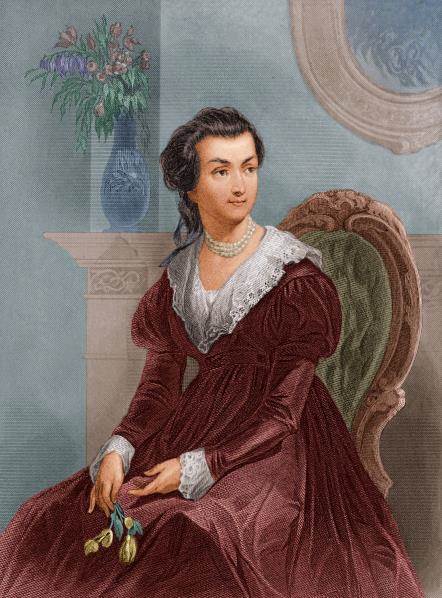
The First Lady was lost. Nine miles off the main road, Abigail Adams, 56, hacked her way through the thick woods bordering Baltimore and the “wilderness city” of Washington, D.C. Eager to join husband John in the new capital, Abigail had left Quincy in early November 1800 with two servants. By Saturday the 15th, they had fallen a few days off course. For two hours, a frustrated Abigail circled the same forest paths—a precious gulf of travel time gone, since they only rode in daylight, and local inns were scarce. Abigail (accurately) reckoned that 36 miles of rough and lonely land lay ahead. She forged on, “holding down & breaking bows of trees which we could not pass,” as she told sister Mary Smith Cranch, “untill we met a Solitary black fellow with a horse and cart. We inquired of him our way, and he kindly offered to conduct us.” Abigail hired him on the spot. Following his directions, by Sunday afternoon she reached her new home, “a Castle of a House…in a beautifull Situation” with a “romantic” view of the Potomac River.

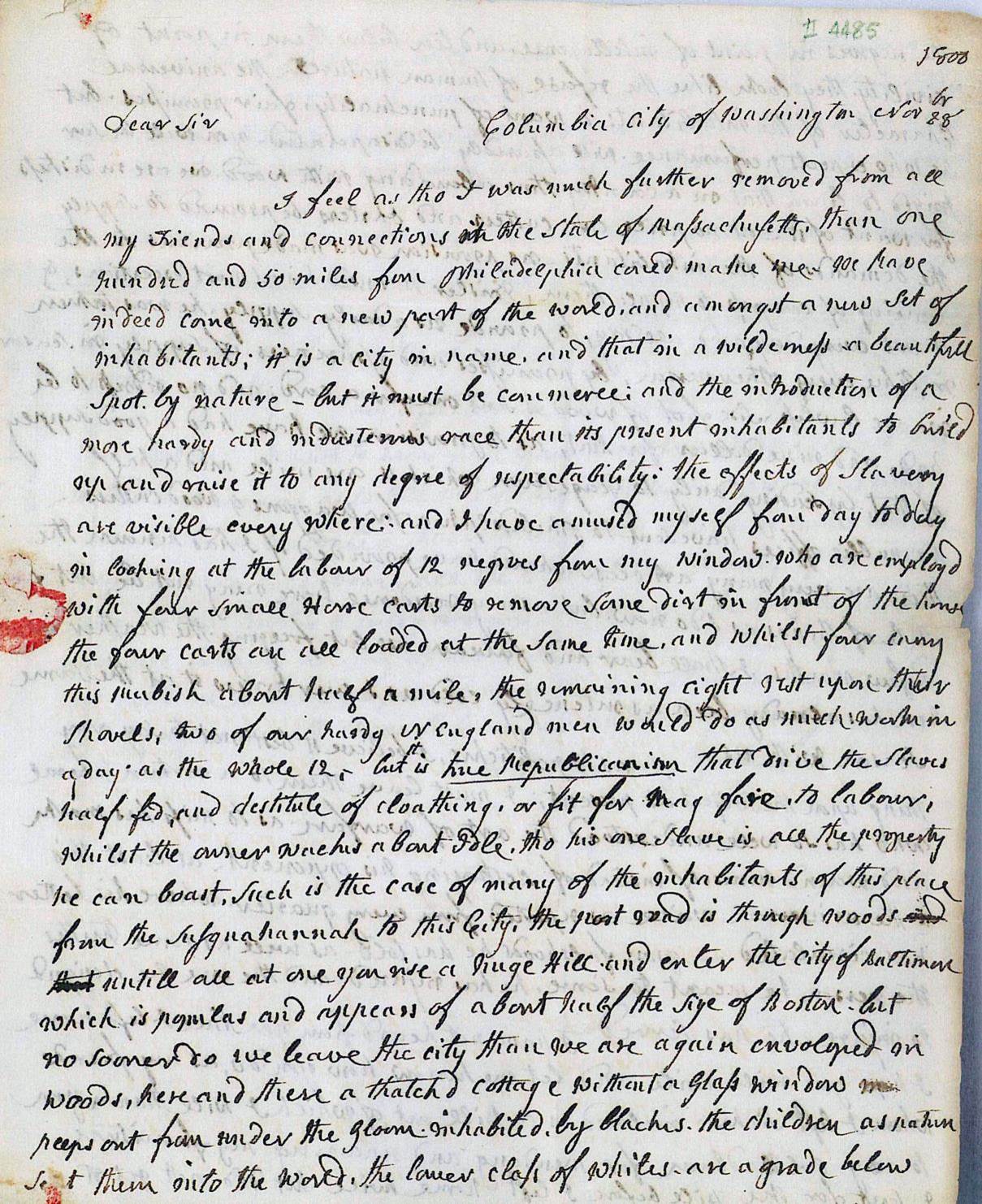
Abigail Adams’ trove of letters, as national convention-watchers have recently reminded us, supply a unique view of slavery and of the African-American experience in the new republic. When First Lady Michelle Obama reiterated on Monday that slave labor built the White House, many viewers turned to founding-era papers, including those of the Adams family, for details. Enter Abigail. One of the second First Lady’s D.C. dispatches, back in popular circulation again this week, lists her candid observation of slaves at work outside the President’s House window. Here’s an extract of the 28 Nov. 1800 letter to Cotton Tufts that got Abigail Adams trending on Facebook and lighting up Twitter:

“The effects of Slavery are visible every where; and I have amused myself from day to day in looking at the labour of 12 negroes from my window, who are employd with four small Horse carts to remove some dirt in front of the house. The four carts are all loaded at the Same time, and whilst four carry this rubish about half a mile, the remaining eight rest upon their Shovels, two of our hardy N England men would do as much work in a day, as the whole 12; but it is true Republicanism that drive the Slaves half fed, and destitute of cloathing, or fit for May faire, to labour, whilst the owner waches about Idle, tho his one Slave is all the property he can boast. Such is the case of many of the inhabitants of this place.”


Such a public display of slavery in the nation’s capital distressed Abigail Adams, although a New England upbringing had not shielded her from its misery. Her father William Smith, a Weymouth clergyman, owned several slaves who were freed upon his death in 1783.“I wish most sincerely there was not a Slave in the province,” Abigail wrote to her husband in 1774, as demands for American liberty grew. A staunch antislavery advocate, Abigail was furious when the Declaration of Independence’s “most Manly Sentiments,” denouncing the slave trade, were, after debate, heavily struck from the final draft. Plain-spoken about the need for African-American freedom on paper, Abigail’s actions also merit a quick review. She employed her father’s former slave, Phoebe Abdee, to run the family farm. She educated African-American servants in her Quincy parlor. When a neighbor balked at Abigail sending one of her staff, James, to school, she argued for him in a letter to John: “The Boy is a Freeman as much as any of the young Men, and merely because his Face is Black, is he to be denied instruction? How is he to be qualified to procure a livelihood? Is this the Christian principle of doing to others, as we would have others do to us?” Then Abigail pivoted to quash James’ toughest critic: “Tell them Mr. Faxon that I hope we shall all go to Heaven together. Upon which Faxon laugh’d, and thus ended the conversation. I have not heard any more upon the subject.” The question of James’ education was settled in 1797. Three busy years later, Abigail set out for the President’s House.

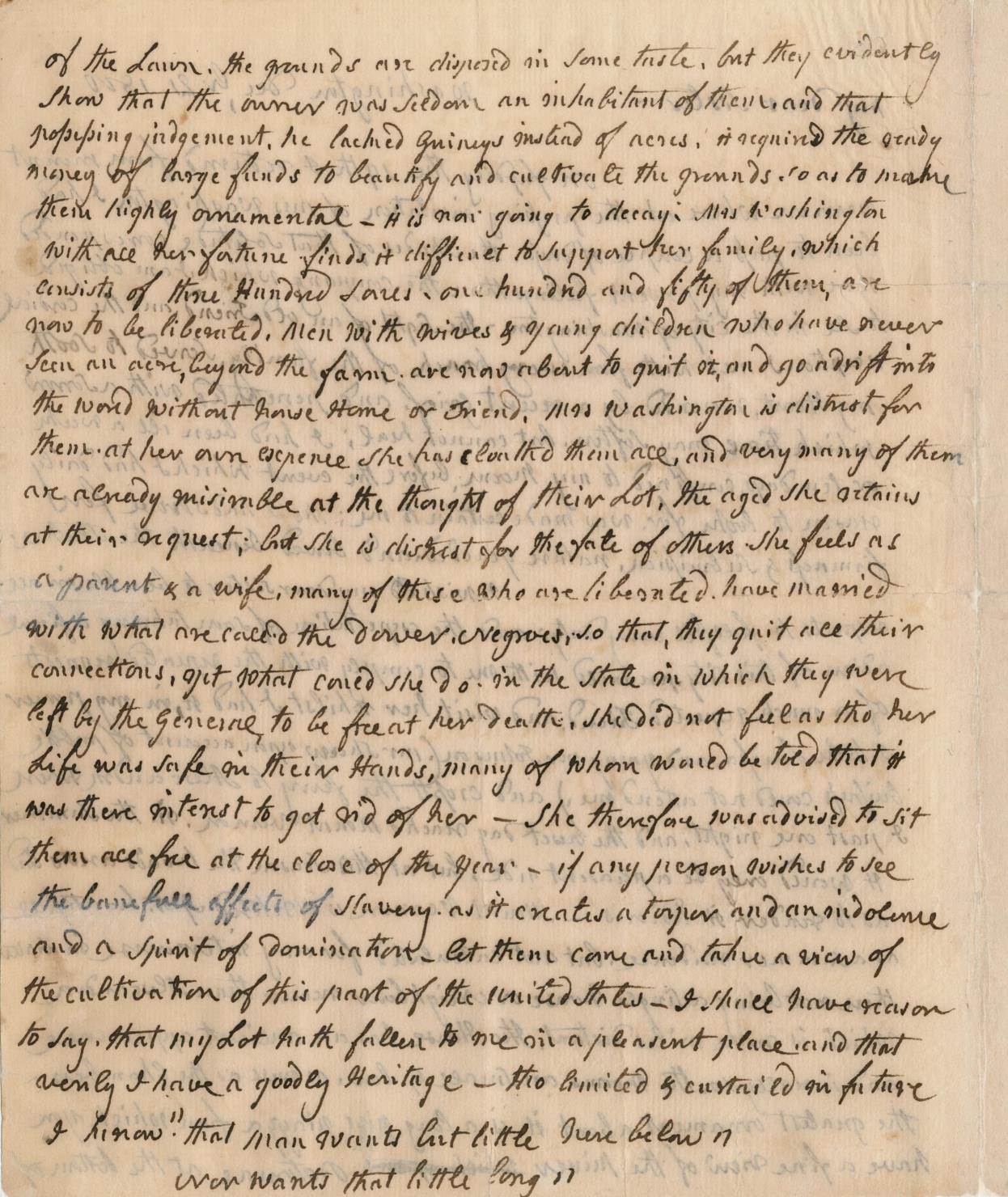
Abigail, a hardy traveler, took advantage of every panorama and every person she met. Given a new window on the world, Abigail used it. Barely a month into her D.C. stay, Abigail accepted an invitation to visit Martha Washington, now the General’s widow, at Mount Vernon. The rooms she found “small and low,” and the “greatest Ornament” to the visitor’s eye, Abigail decided, was a long piazza that knit together the Potomac’s gauzy blue-grey with lush green lawn. Signs of decay, the New Englander wrote, now threatened parts of the plantation’s beauty. Abigail’s unique summit with her old friend and colleague is worth a ponder. What did the two First Ladies discuss? We know one topic for certain: Slaves. Specifically, Abigail wrote to her sister Mary Smith Cranch on 21 December 1800, the deepening anxiety that Martha, “with all her fortune finds it difficult to support her family, which consists of three Hundred souls.” With 150 Mount Vernon slaves on the brink of emancipation, Abigail wrote that Martha was “distrest” for the fate of “Men with wives & young children who have never Seen an acre, beyond the farm. are now about to quit it, and go adrift into the world without house Home or Friend.”


This rich letter, held in the Adams-Cranch Papers here at the Massachusetts Historical Society, contains Abigail’s description of plantation life and underlines her antislavery creed. “If any person wishes to see the banefull effects of slavery. as it creates a torpor and an indolence and a Spirit of domination,” Abigail wrote, “let them come and take a view of the cultivation of this part of the United States. I shall have reason to Say. that my Lot hath fallen to me in a pleasant place. and that verily I have a goodly Heritage.” Mount Vernon gave Abigail another President’s House window from which to see America’s slaves, and the thorny road ahead. 

Society and Scenery: The Travel Diary of Elizabeth Perkins Lee Shattuck

By Shelby Wolfe, Reader Services

In May I traveled to Europe for the first time, keeping a travel diary throughout the trip. It was probably the longest run at journaling I’ve managed to keep, partly because I felt this experience was more noteworthy than my regular routine. More importantly, I didn’t want to forget the details of what I experienced. Travel diaries, and diaries in general, allow us to record our daily lives, passing thoughts, and observations on any given day. Years from now, we can look back on what we wrote and experience that pesky yet pleasant sense of nostalgia (or, in the case of many a teenage-years journal, embarrassment).

To see how other travelers had journaled about the places I visited, I searched our online library catalog, ABIGAIL, to find women’s travel diaries of different kinds. Some are introspective; others read more like a daily log of events and observations. Many are text-only while others include drawings, watercolors, and ephemera. The travel diary of Elizabeth Perkins Lee Shattuck, for example, is accompanied by a sketchbook with scenes captured throughout the writer’s journeys between 1868 and 1870. Elizabeth Perkins Lee, daughter of Henry and Elizabeth Perkins (Cabot) Lee kept this diary during her travels in Italy, France, and England between January and May 1869.


In her diary Lee records daily activities, sights toured, and social visits. She takes particular interest in describing the art and sculpture in Rome, frequenting the Villa Borghese and the Sistine Chapel. Lee notes after a trip to the Vatican, “Michel Angelos’ Pieta grows up me each time I see it.” While in Rome she celebrated Carnival from a balcony trimmed with bouquets, met friends for tea, and attended the Apollo Theatre, which she describes as “quite jolly and funny.” After her time in Rome, Lee traveled by rail to Florence, then through Geneva, Lyon, and Dijon toward her final European stop of this travel diary, England. She toured Eton and spent time admiring the art at the National Gallery and the Royal Academy of Arts in London.


Among the individuals mentioned in the diary are members of the Longfellow family, including Thomas Gold Appleton, Ernest Longfellow, and Hattie Longfellow; Lee’s uncle Francis L. Lee; her cousins Edward Perkins, Mary Perkins, and Charles Callahan Perkins; her future husband Frederick Cheever Shattuck; George Bemis; Frederic Crowninshield; and members of the Warren, Paine, Forbes, Curtis, Sewall, and many other families. A few entries discuss freedmen in America and the West Indies; American grievances against the British after the Civil War; and the Fifteenth Amendment.

While a large number of diaries in the MHS collections focus on Western European travels, others highlight trips to Cuba, New Zealand, Canada, and the Midwestern United States. If you’re interested in learning more about nineteenth-century travel and society – of if you’re simply in need of a vicarious vacation – visit the library for a closer look at Elizabeth Perkins Lee Shattuck’s travel diary and sketchbook, as well as others:

(For a more complete list, see Women travelers—Diaries in ABIGAIL.)


Mary Gardner Lowell diaries, 1823-1853. Diaries of Mary Gardner Lowell of Boston and Waltham, Massachusetts, 1823-1853. Travel diaries describe a voyage to Cuba with her husband Francis Cabot Lowell and infant son George, 18 December 1831- 3 June 1832, including time spent in Havana, on the slave plantations of the Matanzas province. Entries describe travel conditions of the voyages and coaching, sights seen, social and cultural observations, friends visited, the weather, and social engagements.

Lorenza Stevens Berbineau diaries, 1851-1869. Three personal diaries kept by Berbineau, servant to the Lowell family, kept while on a trip to Europe with members of the family (1851-1852).

Anna Peabody Bellows travel diary, 1864. Travel diary of Anna Huidekoper Peabody (later Bellows), kept on a trip to England, France, and Switzerland, 16 March-14 August 1864. Entries describe the voyage via steamer from Boston, as well as sightseeing, shopping, social calls, and other activities in Paris and other cities and towns. Includes pencil sketches and watercolors.

Aimee Rotch Sargent travel diaries, 1874-1875. Diaries kept by Aimee Rotch Sargent, 1874-1875, while traveling from New York to England and through Europe with her husband, Winthrop Sargent, describe the ocean voyage, her constant seasickness, social gatherings and engagements with acquaintances, parks, museums, and other cultural institutions visited.

Ann Eliza Perkins Adams travel diary, ca. 1883-1884. Travel diary kept while on a trip by train from Boston to St. Louis and a voyage on the Mississippi River. Entries consist of short descriptions of sites seen from the train window; coach and carriage rides in St. Louis; and traveling on the Mississippi River, including sites seen from the boat, towns visited, events attended, and steamboats observed.

Jane Cummings diaries, 1902-1949. June-September 1911 travel journal records her voyage to Spain, Algiers, Italy, Austria, Switzerland, France, and England, describing cities visited, architecture, gardens, museums, cultural institutions visited, works of art, stories about fellow travelers, and the weather.

Martha A. Rapp travel diary, 1920-1921. Diary kept by Martha A. Rapp of Brockton, Mass. while on a voyage from Boston to New Zealand, 4 November 1920-7 May 1921. Martha traveled with her parents by train to Vancouver, British Columbia, then on the passenger ship Niagara to New Zealand. Her diary describes daily life at sea including games played with other passengers, storms; and various places visited in New Zealand.


Madame Marie Depage in Boston

By Susan Martin, Collection Services

From 14-16 April 1915, Dr. Samuel J. and Wilhelmina (Galloupe) Mixter had a special guest at their home at 180 Marlborough Street, Boston. Madame Marie Depage was in town to drum up support for Belgian Red Cross field hospitals. She’d been traveling across America on a whirlwind fundraising tour, speaking about the suffering of the Belgian people after the outbreak of World War I. Dr. Mixter served as treasurer of Depage’s Boston fund, and the Fay-Mixter papers here at the MHS contain some fascinating papers related to the visit, including original correspondence from Depage.


Depage was a popular and high-profile guest. Her husband, Dr. Antoine Depage, was director of the Belgian Red Cross, past president of the International Congress of Surgery, and personal surgeon to King Albert I of Belgium. The king and queen had officially delegated Madame Depage, a Belgian nurse, to undertake this trip, and her comings and goings were covered extensively in American newspapers.

Americans had been generous in their aid to Belgian civilians living under German occupation, but medical care to soldiers in the field was sorely lacking. An article in the Rocky Mountain News quoted Depage as saying, “The conditions are so terrible you cannot imagine them. […] No men in the world can fight more bravely than the men of my country.” She wrote to the sympathetic Dr. Mixter, “You know what proper and urgent care means – one life saved, one limb saved means a family out of trouble after the war.”


I was particularly interested in Depage’s statements about wounded German soldiers. The Red Cross field hospitals she worked to establish treated injured allies and enemies alike. According to another newspaper article, she said, “When they were sick I never felt any different toward them than toward my own countrymen. They were simply poor, wounded men. It was only when they recovered and came to me in their gray German uniforms to say good-by that I felt it hard to treat them the same, but wounded men have no nationality.”

Depage used her personal charisma and professional connections to great advantage. She was unmistakably passionate, but pragmatic. She asked Dr. Mixter before her arrival, “Now can you tell me if a visit in Boston shall pay? I must put it in a very plain business way; you know this is not a pleasure trip and I may not think of what I should like or not like.” She thought smaller meetings in the private homes of wealthy Bostonians would be more lucrative than large gatherings. An individual visit, she knew from experience, would flatter her host into giving more: “I suppose Boston is a smart town where society leaders have a great deal to say. I have experienced that in Washington: if it was smart to go and listen to me the people came…and paid!”

Depage also had a personal stake in the cause. Her oldest son Pierre was a soldier in the Belgian army. When she heard that her second son, a teenager named Lucien, was going to the front, she decided to sail back to Europe to say goodbye. Unfortunately, the ship on which she booked passage was none other than the RMS Lusitania. She drowned when the ship was torpedoed by a German U-boat on 7 May 1915.


Depage had been euphoric about her fundraising success. On the morning of the Lusitania’s departure, she bragged in a letter to Wilhelmina Mixter, “I have altogether collected about $115,000.00 [in] contributions and about $50,000 in supplies. Are you not proud of America? I am! And specially of my Boston friends.” She was sorry that Mrs. Mixter hadn’t received an earlier telegram and protested “that you could believe for one minute that I forgot you! Please never do that, whatever happens for it can never be true.” In a previous letter, she’d called the Mixters “the best friends in the world.”


Wilhelmina Mixter was also very active in World War I work. She served on the general committee of the Special Aid Society for American Preparedness (SASAP), a women’s group that promoted military preparedness and national defense. The Fay-Mixter papers include meeting minutes and newspaper clippings documenting the activities of this group, which met just down the street from the MHS at 601 Boylston Street. In addition to the SASAP, Mrs. Mixter was involved with Emergency War Relief and sent care packages and supplies to soldiers. Some of my favorite items in the collection are these McCall sewing patterns for hospital clothing.


The MHS holdings include many papers related to World War I relief work, so we hope you’ll visit our library to learn more.