
Family and Mental Illness in Early 20th-Century Massachusetts

By Brendan Kieran, Reader Services

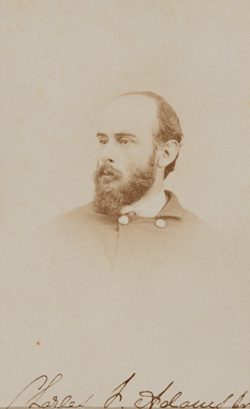
The MHS is home to a rich variety of family papers. These collections of diaries, correspondence, and other materials provide windows into the way people thought about each other and the world around them. I decided to utilize these resources to explore the ways New Englanders thought about mental illness a century ago. Searches in ABIGAIL led me to the David Richards Family Papers. David Richards (1850- ca. 1927) was a farmer and businessperson who lived in Sherborn, Massachusetts. His wife, Esther (Etta) Coffin Loring Richards struggled with mental illness for a number of years, and a good deal of correspondence among the family members relates to her condition. The personal nature of many of these papers leads to interesting accounts of the way one family understood and responded to mental illness, but the papers also offer insights regarding family dynamics and attitudes surrounding treatment in the early 20th-century.


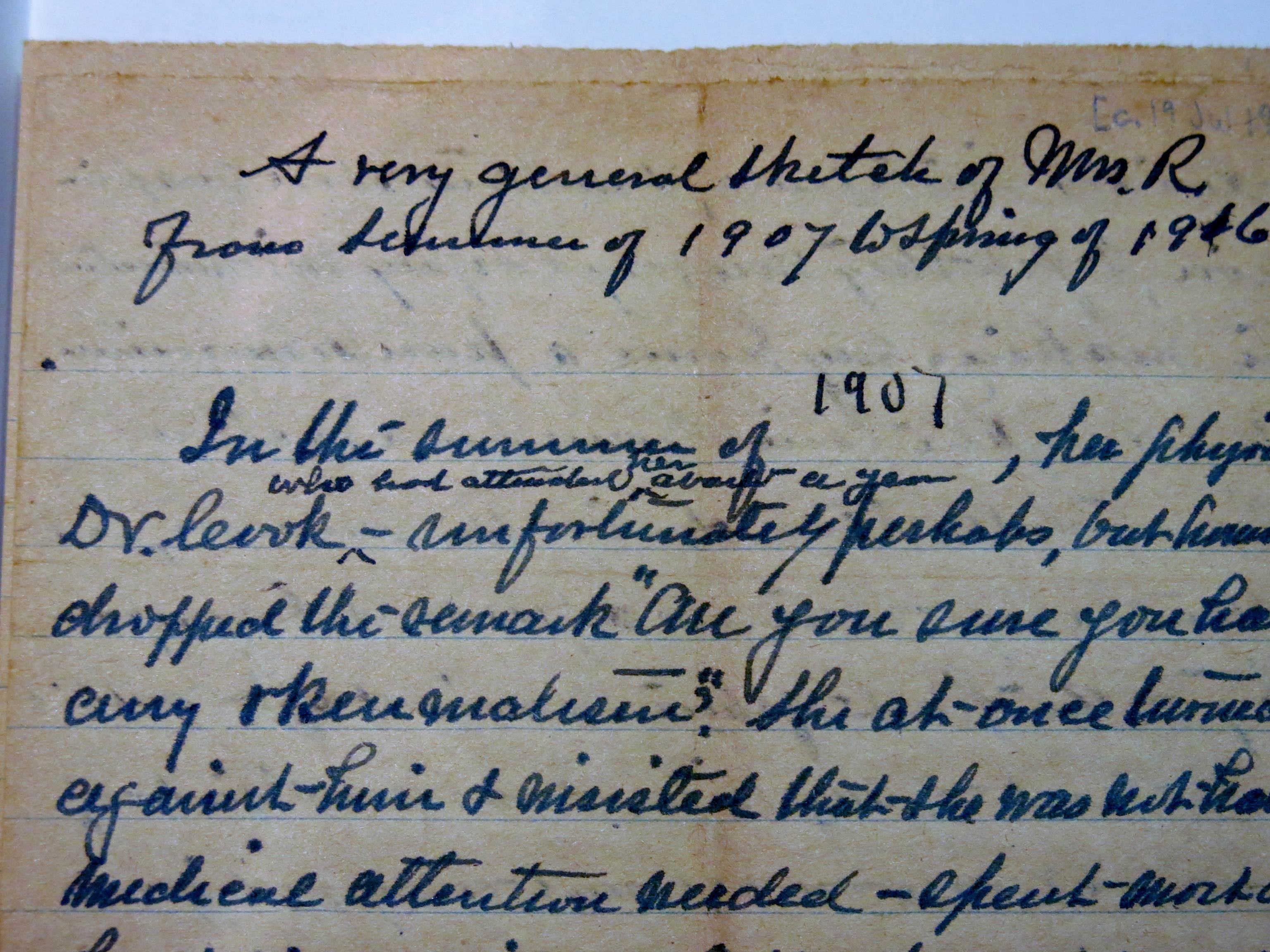
In The Mad Among Us: A History of the Care of America’s Mentally Ill, historian Gerald N. Grob writes that the late 19th– and early 20th-centuries constituted a period of challenges to and changes within the psychiatric profession. There were calls for an increasingly-scientific approach to psychiatric medicine, as well as a shift toward psychopathic hospitals rather than “traditional” mental hospitals. These new hospitals emphasized research and cared for a variety of so-called deviant individuals rather than simply long-term, chronically-ill people. However, according to John R. Sutton, rates of institutionalization remained high even with attempts at reform, in part due to new developments in the creation and management of deviance in the United States. Etta Loring Richards’ institutionalization takes place within this context. According to “A Very General Sketch of Mrs. R from the Summer of 1907 to Spring of 1916,” written by David Richards ca. 19 July 1916, Etta felt around the summer of 1907 that she could not trust anyone, and that she was not “having the medical attention she needed.” Etta was taken to Arlington Heights Sanatorium, then later to Adams Nervine. At Arlington Heights, she was diagnosed by a Dr. Ring (three Dr. Rings, two of whom are said to be affiliated with “Ring’s Sanatarium” in Arlington Heights, are mentioned on page 395 of this 1910 Medical Directory of Boston), who said of her condition: “There is nothing the matter with the woman physically, its simply Hypochondria.” After six months at Adams Nervine, Etta returned home. However, her mental health concerns reappeared in later years.

Throughout these papers, Etta and David reflect on Etta’s illness; these writings present possibilities for analysis of family and gender dynamics in their time and place. In a 2 December 1907 letter from David Richards to Mr. Batchelder, the family’s lawyer, David quotes Etta and her pleas for treatment, writing “‘If Mr. Batchelder were here he would say that you ought to take me [and] you say that you always do what Mr. Batchelder says,’” as well as “‘I did wrong in not going, but I am doing wrong all the time.’” Later, in an undated letter from about January 1908, Etta writes that she is sleeping well, but is having trouble eating, and often stays in bed feeling fatigued. She also notes that she is hurt and upset that David wanted to “keep money away from me,” as he thought she would “spend it all on Quack [doctors].” I certainly feel Etta’s pain when reading these letters.

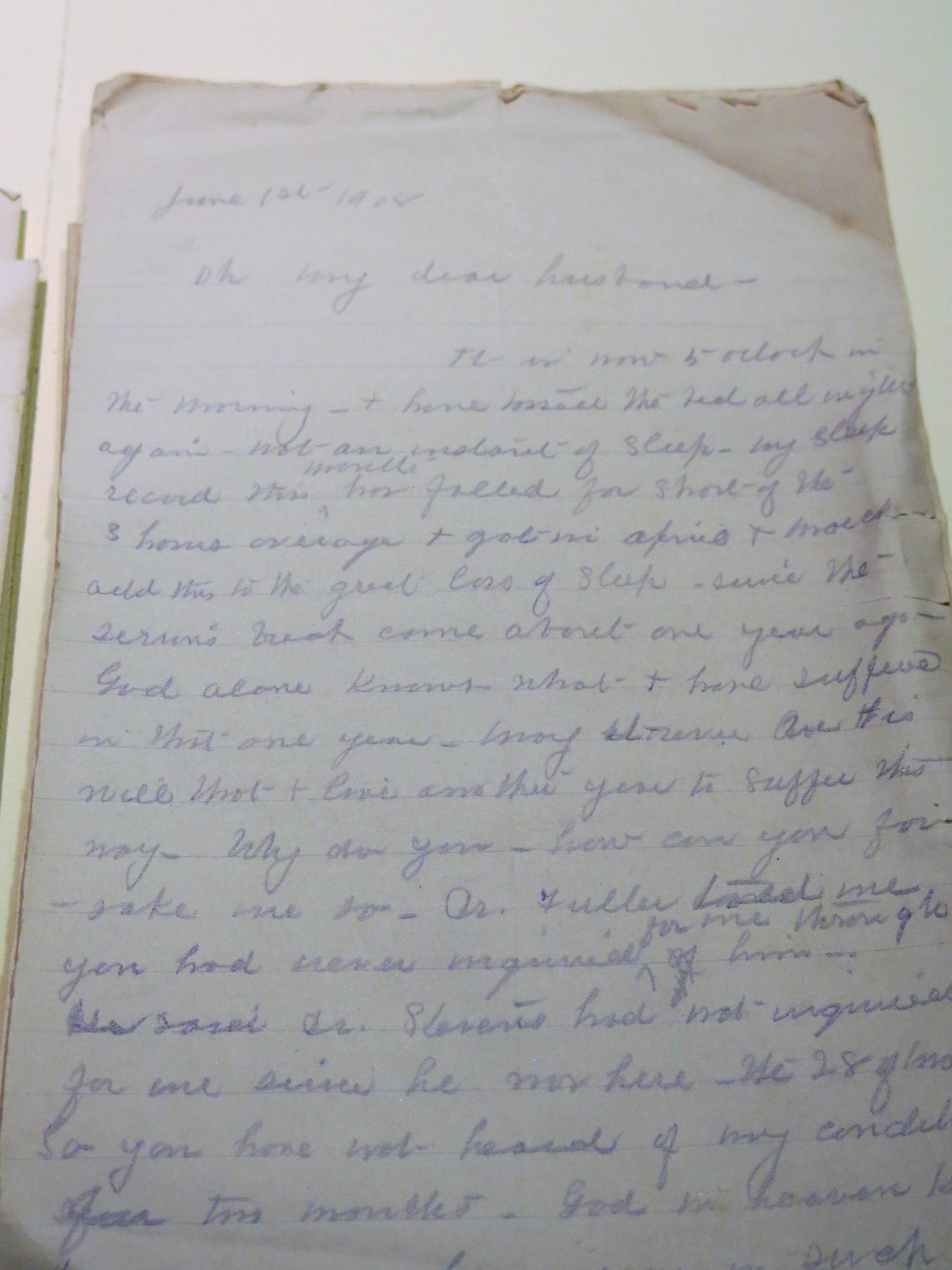
In addition to Etta’s frustration regarding David’s apparent indifference and skepticism toward her treatment, I got a sense of the loneliness Etta felt when her husband failed to give her the attention she sought while she was institutionalized. In a 1 June 1908 letter, Etta writes:

Why do you [–] how can you forsake me so [–] Dr. Fuller [told] me you had never inquired for me through him. He said Dr. Stevens had not inquired for me since he was here [–] the 28 of March so you have not heard of my condition for two months. God in heaven knows I could never leave you in such a suffering condition [-] and never inquire for you – directly or indirectly – for two long months[.] Oh how it hurt me[.]


Etta’s writings about her husband suggest that, in her mind, he was not there for her or interested in her well-being. This raises questions about the ways women were supposed to be taken care of by their husbands during this period. Was David’s behavior normal, with Etta expressing frustration at the roles of men during this period, or was David failing to fulfill a role that was expected of him? A closer look at David’s own writings may shed some light on these questions, as well as raise some additional ones.

David’s blend of indifference toward and control over Etta’s treatment and conditions are noticeable in his own writings, as well. In his “General Sketch,” he writes about his “indifference to my wife’s sufferings.” This supposed indifference is not just observable in hindsight; David writes that “some dear friends insisted Nervine plan my plan [sic], trying to make out my wife [insane?] to get control of her property.” This assertion may or may not have been entirely accurate, but the idea does seem to have some basis in his actions, as a similar fear seems to be on Etta’s mind when she laments his unwillingness to give her any money. David admits in his account that, when Etta wanted to go to an Asylum in 1914, he “laughed at her fears, would not listen to her story of desperation.” This apparent trivialization of Etta’s concerns regarding her health is frustrating to read; however, David’s attitudes present possibilities for analysis of patriarchy within early 20th-century families as well as gendered responses to mental illness within families of this period.

This brief exploration certainly does not tell the whole story of the Richards family, nor does it provide an authoritative account of mental illness and family in the early 20th-century. Numerous other correspondents and subjects exist in these papers, including other family members, as well as Etta’s friends and doctors. The David Richards Family Papers are available for viewing at the MHS, so feel free to stop in for a visit if you would like to explore them on your own.

Armistice Day, 11 November 1918

By Susan Martin, Collections Services

Today marks the 97th anniversary of the Armistice of Compiègne and the official end of World War I. You may be celebrating Armistice Day, Veterans Day, or Remembrance Day, depending on where you live.

The MHS holds the papers of many soldiers, aid workers, and other men and women caught up in the Great War. Among them is an entertaining collection of 43 letters from Alton Abraham Lawrence of New Bedford, Mass. to his friend Albert Stedman Murdy. Lawrence served in England and France as a private in the 658th Aero Squadron and 1108th Aero Replacement Squadron of the American Expeditionary Forces. In a letter dated 13 Nov. 1918, he described the armistice celebrations in Paris:


“In my letter of a week ago today I told you that the war would be over soon. It sure is and I’m not a bit sorry either. The terms embodied in the armistice were stiff enough to bury all the German Junkers. In a couple of weeks the Germans will be in the power of the armies who represent democracy.

“’Now let’s go,’ is the cry over here. All the boys in the A.E.F. are raving about going home. Can you blame us? I know you can’t. Unless they will send me to do guard duty in Germany I want to come home tout de suite. If they will send me there I’m game for another year overseas. I[t] sure would be fine for me to hike down the main drag in Berlin.[…]

“When the glad news in regard to signing the armistice was heralded I was in camp. The anti aircraft batteries in Paris put up a fake barrage in honor of the occasion. The noise could be heard for miles around.

“Yesterday I was in Paris and sure did have a great time. All the boys in the surrounding camps were on pass until reveille this morning. The people are wild and sure are celebrating. They are making no effort to conceal their elation.

“From the Louvre up the Concorde to the Arc de Triomphe the mobs command the roads and walks. The Tulleries [sic] is always filled with people whose cheeks are flushed with ardor. In some instances the men are carrying women on their shoulders. The gangs are apt to do most anything.

“I was near the Madeliene [sic] when I got cornered by a gang of larkers. The[y] formed a ring around the rose bush (some rose bush). Believe me they can yell viva l’America. The troops had a loud time. Honest to goodness I never celebrated so in my life before. I ate, drank and yelled until I was almost gag[g]ed. Oh what a head next morning. France has less wine and co[g]nac than she had a week ago.”


Lawrence had enlisted just over a year before, on 28 Oct. 1917. Now he was 22 years old and anxious to get back to the life he’d left behind. His return would be delayed for over five months, but he kept his spirits up and continued to write regular letters to Murdy, reminiscing about old times and speculating on his post-war plans. For one thing, he resolved to continue his interrupted education under Prof. Harry C. Bentley at the brand-new Bentley School of Accounting and Finance (now Bentley University in Waltham, Mass.).

I was particularly impressed by Lawrence’s appreciation for those personal relationships that had carried him through his wartime service. His friendship with Murdy had apparently been somewhat new or distant at the beginning of their separation, but their correspondence brought them closer. Lawrence anticipated a warmer friendship with him:

“When we get together again we will meet with a fondness that we have never felt before. One could hardly say that you and I have been together very much socially. The tone of your letters gives me the confidence to make this assertion. I guess that I am not far from being correct this time, am I Albert? I used to regard you as a damned good fellow and you know that old kid.”


Lawrence had also developed a new perspective on his father:

“He sure is a good old scout and I have often been very sorry that I did not chum around with him more when I was a little fellow. But the Dad was always a pretty tired man when he came home from work. My father has had to work for everything he has and this took up most of his time. There is another time coming to us and we should be able to get together then.”


Of course, it wasn’t just the high-minded things that Lawrence missed. He also looked forward to cruising in his car (“the old EMF”) around Boston and New Bedford, where he was sure he and Murdy would find “plenty of Janes.” Along the top of the 13 Nov. 1918 letter shown above, his first to Murdy after the armistice, Lawrence wrote excitedly: “Shine up the EMF.”

Lawrence’s cheerful and slangy letters are definitely worth a read. Unfortunately, I wasn’t able to learn much about his life after the war. Census records show that he returned to New Bedford and married a woman named Ruth, with whom he had two daughters, Lillian and Hannah. He died in 1942 at the age of 45.

Memorializing the Fallen, Inspiring the Living: “Death of the Immortal Dahlgren”

By Kittle Evenson, Reader Services

I was all set to do a spooky Halloween post for this installment of the Beehive, but while looking for a broadside advertising a Boston magician, my eye snagged on the word Immortal in the title on a proximal folder. With magic on the mind, who wouldn’t be intrigued?

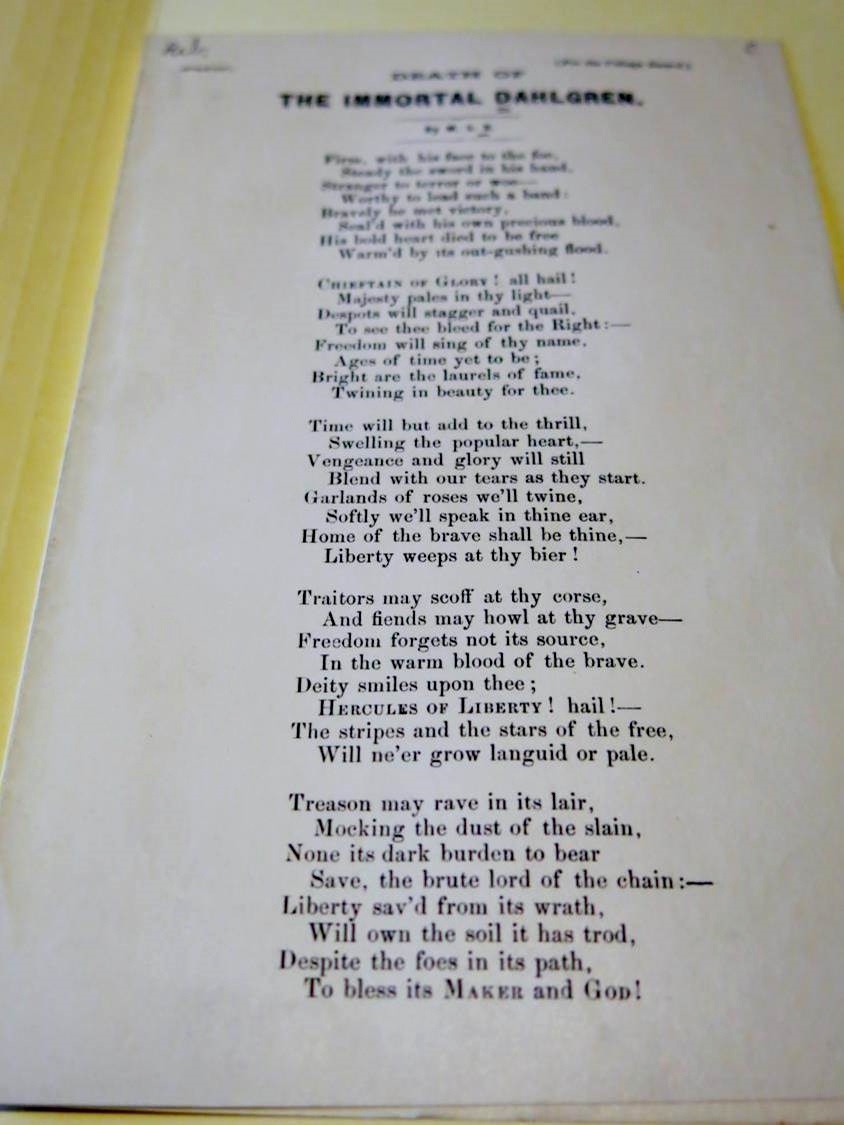
The document in the folder was “Death of the Immortal Dahlgren,” a poem by M.S.N. memorializing the death of a man described as a “Chieftain of Glory!” the “Hercules of Liberty!” whose “bold heart died to be free / Warm’d by its out-gushing flood.”

M.S.N.’s “Death of the Immortal Dahlgren”

Published in 1864 it seemed clear that this poem described a Civil War soldier, but who was The Immortal Dahlgren?

Halloween and magicians forgotten, I went on the hunt for this mysterious man.

Working backwards, I searched our online catalog ABIGAIL for the M.S.N. poem and found its item record (including Dahlgren’s first name – Ulric), and through that, two other poems and a memorial sermon of the same theme.

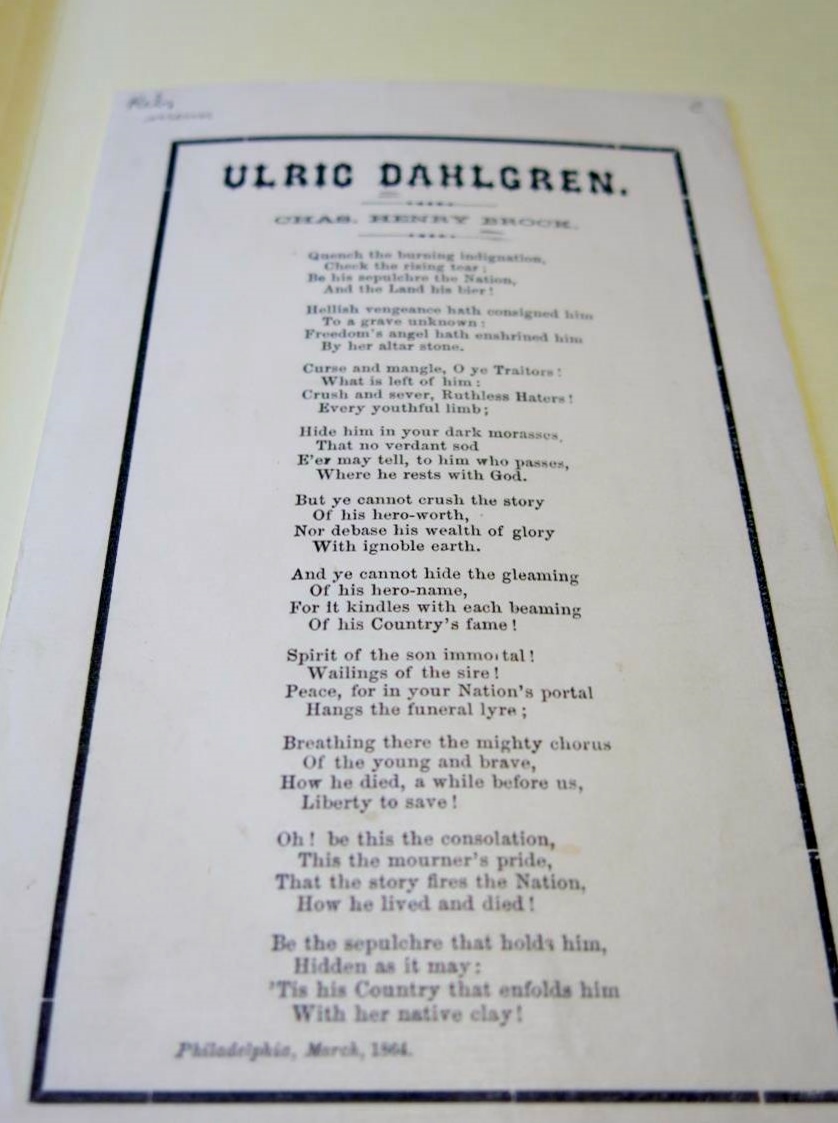
Chas. Henry Brock’s “Ulric Dahlgren”

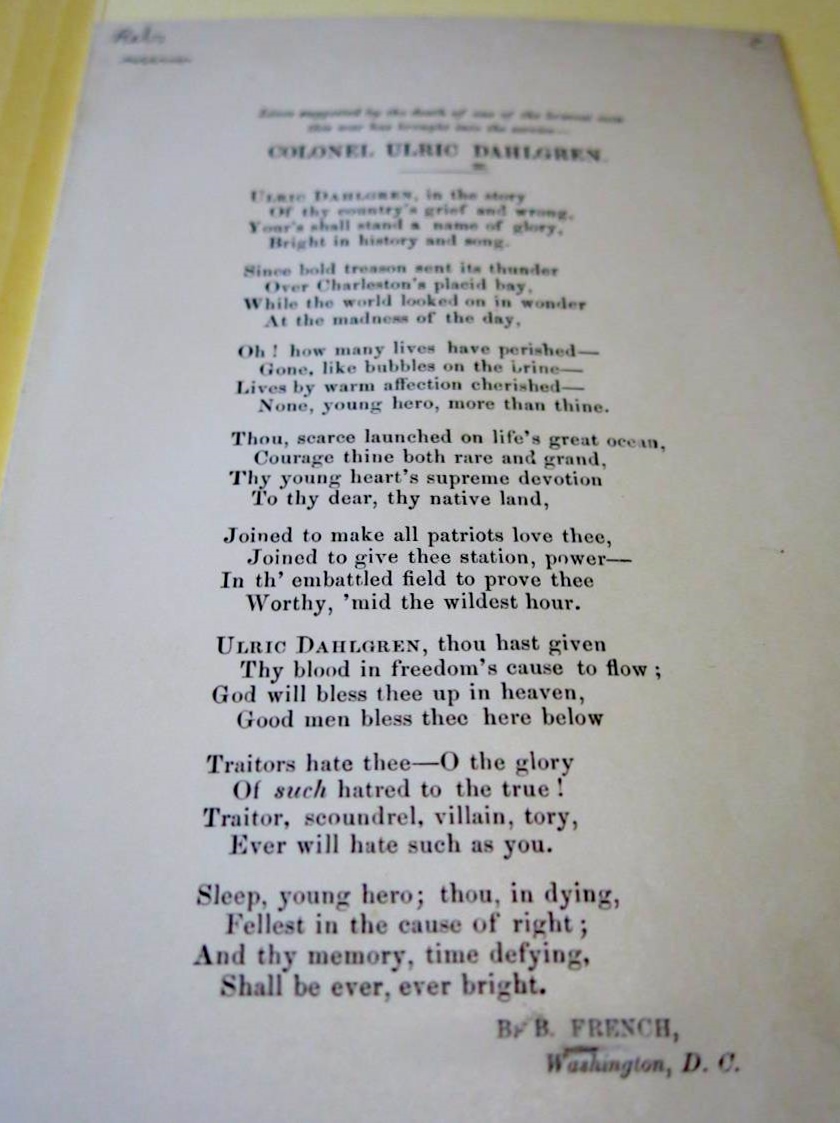
B.B. French’s “Lines suggested by the death of one of the bravest men this war has brought into the service — Colonel Ulric Dahlgren”

B. Sunderland’s “In memoriam: Colonel Ulric Dahlgren”

Sunderland’s memorial sermon includes copies  of the three poems I had already found, with the addition of one by H.T. Tuckerman. 

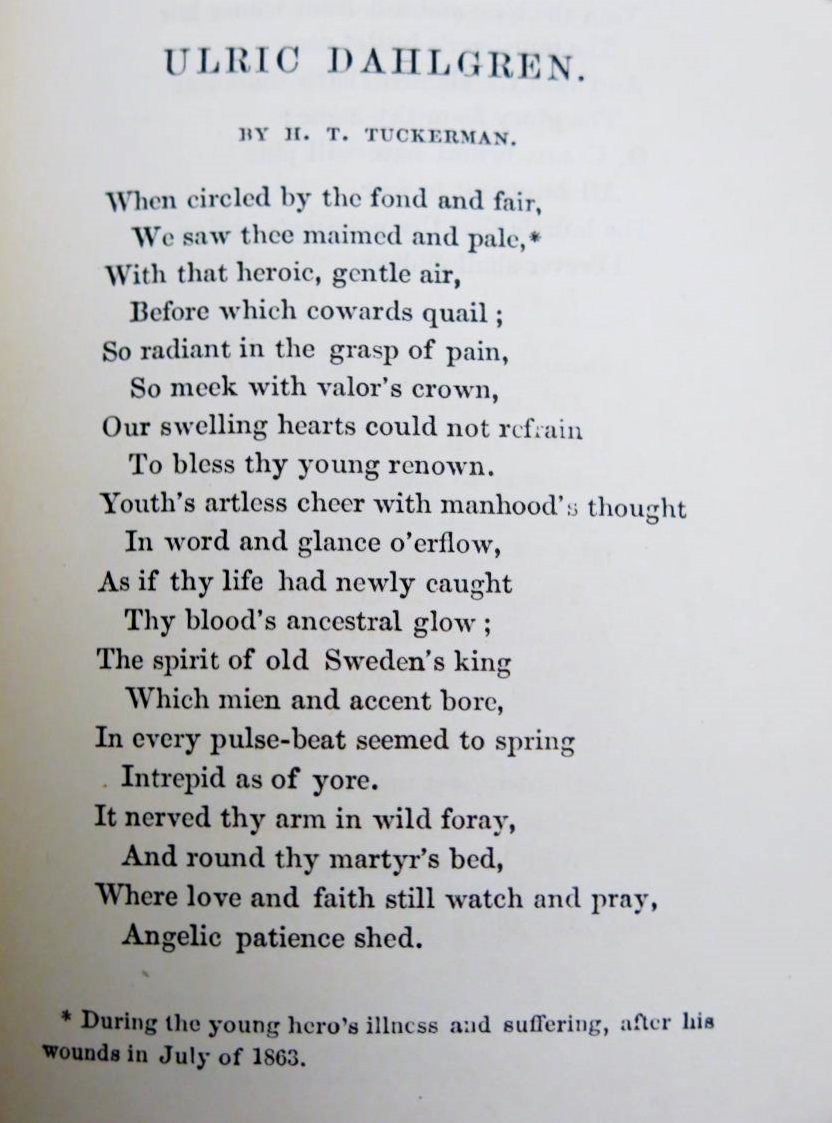
H.T. Tuckerman’s “Ulric Dahlgren”

All the poems describe, in florid prose, Dahlgren’s heroic battle actions, with Tuckerman’s also alluding to Dahlgren’s Swedish heritage and injuries he sustained earlier in his short career. 

The picture they paint is emotionally clear, if somewhat lacking in facts. Rev. Sunderland’s sermon helpfully fills in many of the gaps, beginning as it does at birth and expounding Dahlgren’s 22 years over 100 pages. Interestingly, the published copy also includes a letter from Congressman Schuyler Colfax and others requesting Sunderland to publish his oration. The letter reads, in part,

Dear [Rev. Byron Sunderland, D.D.]: We respectfully request that you will furnish for publication a copy of the eloquent and patriotic discourse on the life and death of Col. Dahlgren . . . We wish to see the noble daring and heroic devotion to the cause of his country, which characterized the brief but brilliant career of this young soldier, held up before the youth of our country that they may be stimulated to an honorable emulation of his virtues, and, if need be, to a similar sacrifice of their lives 

Not only is Colfax and company hoping to exemplify Dahlgren’s sacrifice for the Union army, but “to honor his memory” in hopes that it “will add to the reproach and shame of all [their] enemies and all who sympathize with them” 

The sermon itself draws the listener (or reader) through the life of a young man whose nature was shaped by “domestic, scholastic, and Christian influences,” and whose father’s military example inculcated in him the belief that “if [he dies], what death more glorious than the death of men fighting for their country?” 

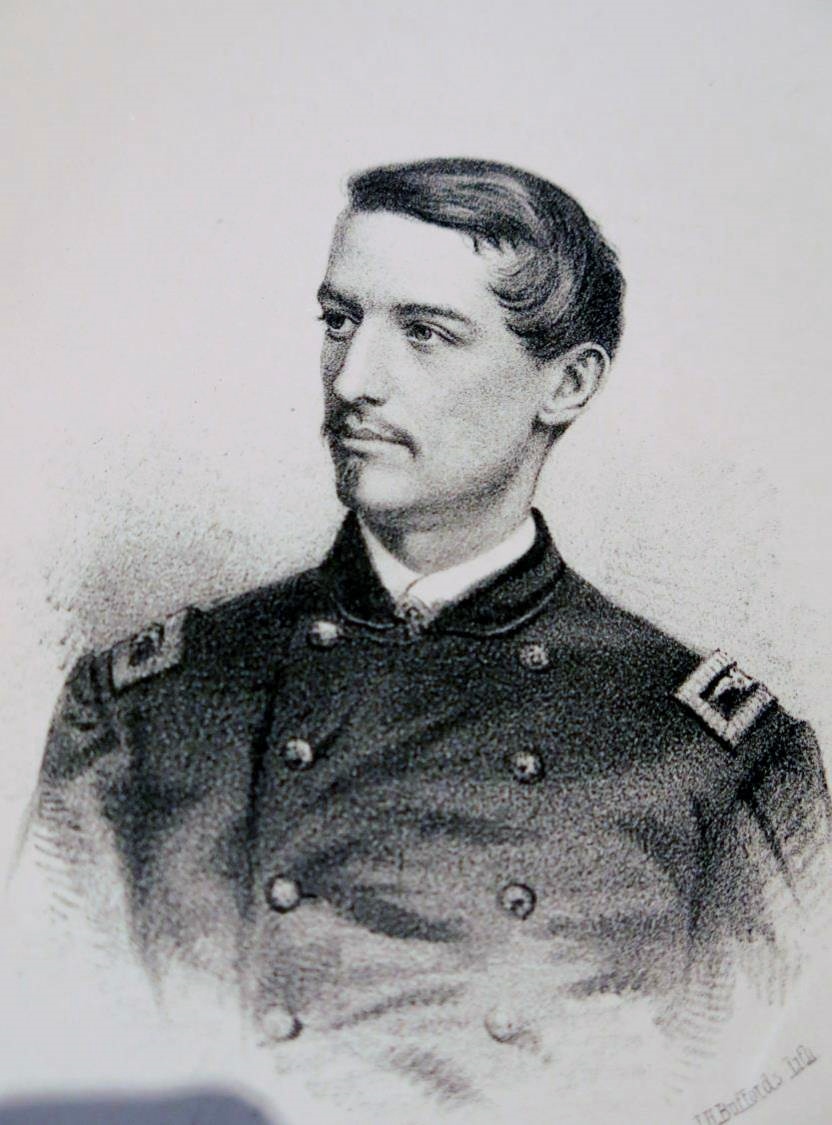
Colonel Ulrich Dahlgren

Highly educated, Dahlgren began his career as a lawyer in his uncle’s practice before following in his father’s military footsteps in 1862. Wounded in July of 1863, Dahlgren lost his right foot but returned to active duty, a newly promoted Colonel, in November of that same year. In late February of 1864, he joined General Kilpatrick’s offensive to free Union soldiers held at the Confederate prison Belle Isle near Richmond, VA. The mission was a failure, and in the early hours of March 2, 1864, just a few miles outside of Richmond, Col. Dahlgren and 500 of his men were ambushed by Confederate forces. Of the fated encounter Sunderland writes

Among the bodies that rolled down together in the dust and darkness, were Ulric Dahlgren and his high-mettled horse, all pierced and shattered with the leaden hail that made them both one heap of swift mortality.

This quiet death, indistinguishable from the thousands of others that occurred around it was publicly honored by the Union leaders as the exemplary sacrifice of a selfless officer. Military and political leaders alike had a vested interest in inspiring commitment and sacrifice in the nation’s youth, and a fierce support on the part of their families. They wove a narrative of Ulric Dahlgren that supported this conviction: a young man from a prominent military family who rose rapidly through the official ranks and gave for his county what Abraham Lincoln called in the Gettysburg Address, “the last full measure of devotion.”

The Massachusetts Historical Society holds a wealth of manuscript materials pertaining to the American Civil War, including firsthand accounts, military records, and photographs. Many collections and items have been digitized for projects associated with the 150th anniversary of the War, and still others are available for viewing on-site at the MHS library. Researchers interested in the Ulric Dahlgren memorials or any of our other collections are encouraged to stop by during any of our open hours.


“Three Generations Have Advanced in a Century” : From John Adams to Charles Francis Adams II

By Amanda Norton, Adams Papers

            On October 31, 1835, John Adams’ grandson Charles Francis Adams, along with his wife, Abigail Brooks Adams, had their second son, Charles Francis Adams 2d, baptized at their home in the presence of John Quincy and Louisa Catherine Adams and other close family members. Born in May, the day for the christening had been specially chosen—the centennial of John Adams’ birth. While John Adams’ birthday is recognized as October 30 in the new style Gregorian calendar, John Quincy Adams erroneously believed that the date should be recognized on the 31st and convinced Charles Francis to hold the baptism on that date.

            Charles Francis Adams, who often reflected on his place within his illustrious family, noted the occasion in his diary:

“It was a little singular that a child of mine should be christened just one hundred years from the birth of his great grandfather. Three generations have advanced in a century. May the last who is carrying the name of the family into the next be as honest, as determined and as a conscientious as the first. I trust in a power above us which has for reasons unknown thought fit to make among us instruments for advancing the power, the honor and the prosperity of this Nation, and whose decrees are always just and always wise. My feelings always overpower me when I reflect how unworthy I am. Prosperity has been showered upon me. May I learn to deserve it!”

            John Quincy Adams also linked the events in his diary: “This day is the centurial anniversary of my fathers birth. . . . He was born of Parents in humble life, and has left an illustrious name, for his descendants to sustain by virtues like his own. May it please the disposer of all Events that his great grandson this day devoted to the service of God and man may enjoy as long, as useful and as prosperous a life.”

            The prayers of the father and grandfather were indeed answered in Charles Francis Adams 2d (1835–1915), who was a distinguished Union Army officer, railroad executive, historian, and biographer. Along with these many achievements, Charles Francis served as president of the Massachusetts Historical Society and selected the spot on the Fens Park where the MHS now resides. He was also instrumental in the creation of the Adams Manuscript Trust and the deposit of the Adams Family Papers at the Society, thereby assuring the preservation and propagation of his great grandfather’s legacy and that of the entire family.

            For more on the collection, preservation, and dissemination of the family’s manuscripts and the origins of the Adams Papers Editorial Project, see the introduction to the Diary and Autobiography of John Adams.


How the Sausage Is Made: The Process of Processing

By Susan Martin, Collections Services

I’ve written many posts at the Beehive highlighting specific items, stories, and people from our collections that captured my attention, but it occurs to me that readers of our blog may be interested in a bigger picture of the work we do here. This week, I’d like to offer a behind-the-scenes look at how a collection is processed—or, as we say in Collections Services, how the sausage is made.

The responsibilities of the MHS Collections Services department include everything from the acquisition of new material to processing, preservation, and digitization. It’s the job of a manuscript processor like me to make collections both physically accessible and intellectually coherent to researchers, what archivists refer to as “arrangement and description.”

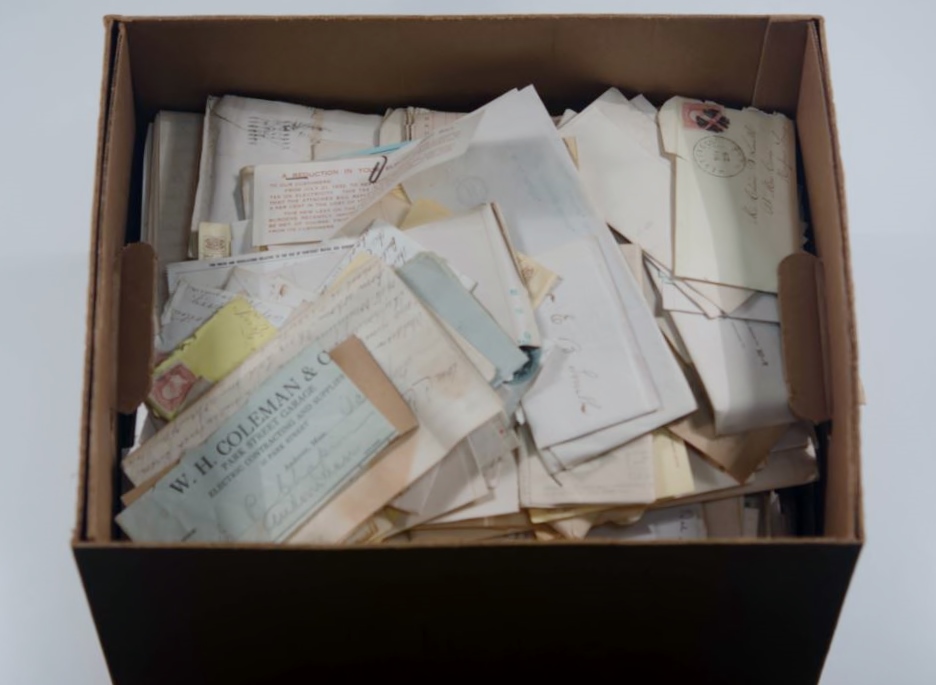
This can be challenging, to say the least. Collections come to us in all shapes, sizes, and conditions. Think of the way you keep your personal files at home or on your computer. You may know where things are, but would anyone else be able to figure it out? Are items arranged chronologically? Do folder labels really reflect the folders’ contents? How do the files relate to each other? When we’re talking about historical documents, often passed down through generations, potential problems multiply. Items may be in poor condition, undated, unidentified, basically a mess. For example:


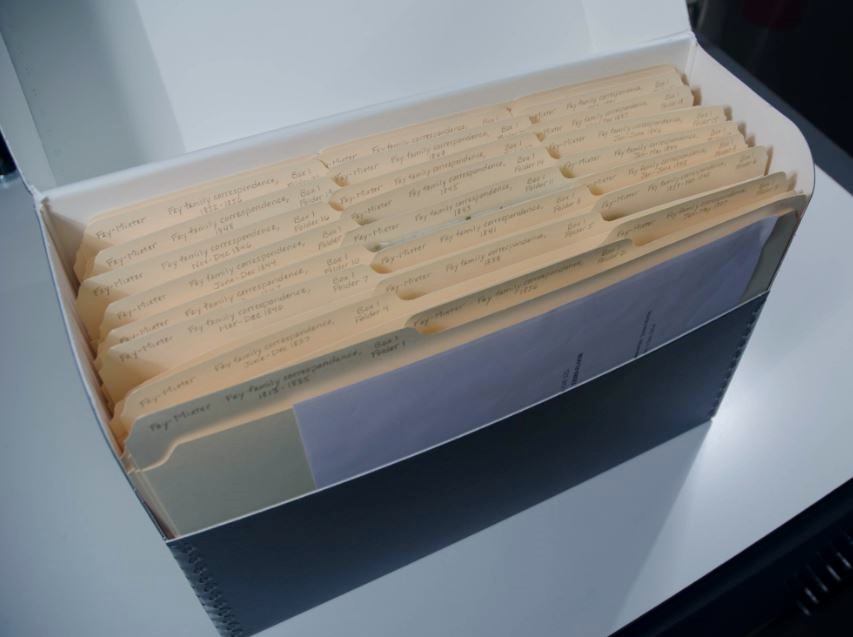
This carton contains hundreds of letters folded up in their original envelopes and in no discernible order, as well as rusty staples, paper clips, and who knows what else. (Hair, leaves, dead insects—we’ve found them all!) These papers can’t be used by researchers like this. Each letter will need to be unfolded and arranged chronologically in acid-free boxes and folders for access and long-term preservation. It’s a very time-consuming job. A finished collection ends up looking something like this:


At the same time this physical work is being done, the processor will also need to make some intellectual sense of the material, scanning the letters carefully but quickly to determine who the authors and recipients are and what topics they discuss. The collection will be described in ABIGAIL, our online catalog, with headings for people, places, organizations, events, subjects, etc.

Good cataloging is vital because it’s our description that directs researchers to a specific collection. Experienced archivists have developed both subject knowledge and professional instincts that help them make informed judgments about the context and importance of a collection. What makes the papers historically significant? What possible avenues of research might bring someone to see them?

When you look at one of our catalog records, you may notice many slightly different permutations of the same topic. For example, papers of the director of Boston’s Children’s Hospital during the peak of the U.S. polio epidemic might be described by any or all of the following subject headings (and then some):

Children’s Hospital (Boston, Mass.).

Children—Diseases.

Children—Health and hygiene.

Children—Hospitals—Massachusetts—Boston.

Hospital administrators.

Hospitals—Administration.

Hospitals—Massachusetts—Boston.

Poliomyelitis.

This may seem redundant, but there’s a method to the madness. What headings are useful depends on a researcher’s particular area of interest. Is he or she doing work on the specific hospital, children’s hospitals, Boston hospitals, hospital administration, polio, general childhood health?

Catalog records for manuscript collections have to be written from scratch because each collection is unique. No two archivists will describe the same papers the same way. Hundreds of our collections here at the MHS are also described more fully in online guides, which allow us to go into more detail about groups or “series” of papers and to indicate where specific material is located. Our guides are fully searchable, and more and more people are finding us through online search engines.

Manuscript processing is fundamental to all the work done at the MHS. Every other function of the library, from research to digitization, exhibit planning, even blogging, would not be possible without it. We’re constantly refining our catalog records and collection guides, and we’re still making discoveries in collections that have lived on our shelves for years. Our researchers are a great resource, bringing their subject knowledge to bear to fill gaps…and to catch our mistakes!


Boston by Broadside, part II: Fashionable Footwear

By Dan Hinchen

Welcome to my new series here on the Beehive: “Boston by Broadside.” Here I will use examples from the MHS’ collection of broadsides to show various views of our fair city as it used to be.


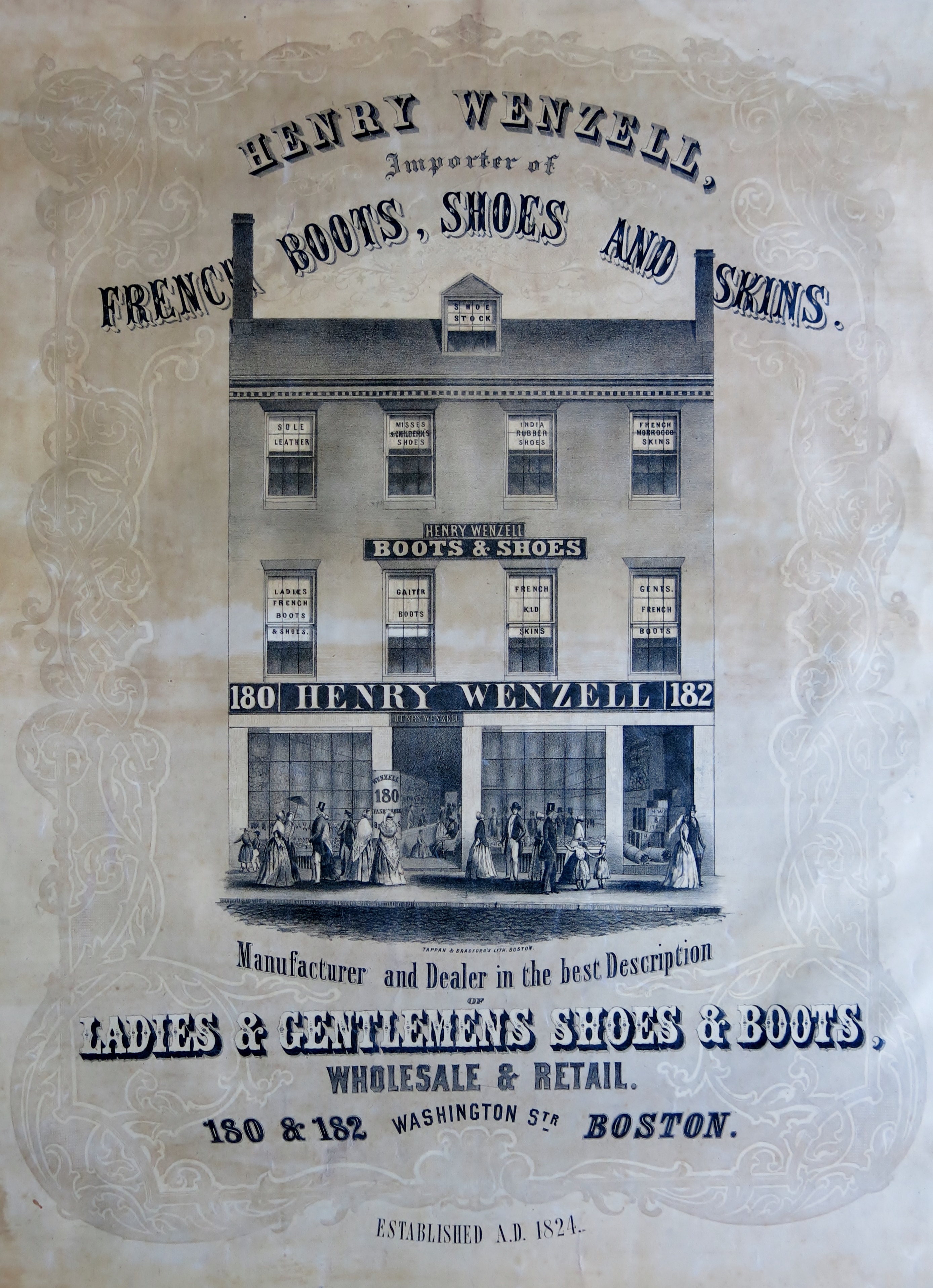
As we leave Prof. Boulet’s Gymansium behind after a bracing work-out, we are ready to start exploring the city a little bit more. Since we will probably be on our feet for a while we need to make sure that we have some trusty (and stylish) footwear to get us around. With that in mind, we’ll head into the city proper and proceed to 180-182 Washington St. to pay a visit to Mr. Henry Wenzell. 


As you can see from Messr. Wenzell’s handsome advert, he specializes in importing the finest and most fashionable French footwear, and has for some years now. I think that I will go with a sturdy pair of boots in case we are struck with a sudden downpour on our walk. 

And now, with our toes cozy, we can set off once again to see what sights Boston-that-was has to offer us. Check back soon to stay on the trail!

Prospect Hill Tower and the Grand Union Flag

By Bonnie McBride, Reader Services

One day when wandering through Somerville, my boyfriend, a recent transplant to Cambridge, noticed what looked like a castle tower in the distance. He asked me about it, and rather than just find the answer online, we decided to have an adventure and discover in person what this tower was all about. It turns out that there is not a secret castle in Somerville, rather it is the Prospect Hill Tower, built in 1903 to commemorate the first flying of the Grand Union Flag on that same hill 1 January 1776.


As someone who is a fan of early Massachusetts history, I was surprised that I did not know about this tower and even more surprised that the first flag representing the United States had looked as if it had a Union Jack quartered on it. The next day I decide to search our collections here at MHS to see what materials we held about the Prospect Hill Tower and the first flying of the Grand Union Flag.


We do hold a number of secondary sources about both Prospect Hill and the flag flying, ranging from published historic guides of Somerville to sheet music composed about the first flag flying. The sheet music, pictured below, was printed in 1862 and while it is about the first raising of the flag in 1776, you will notice that the soldier pictured on the cover is dressed in a Civil War uniform, with tents in the background. Prospect Hill was used during the Civil War as a training camp. Most of our materials regarding the flag and Prospect Hill are from the late 19th and very early 20th centuries, which was about the time the tower was erected.


One of these sources is a bound scrapbook, created by Alfred Morton Cutler in 1921. In it, he pasted clippings of articles he had written for newspapers, such as the Cambridge Tribune, between 1918 and 1921. A number of the clippings were Letters to the Editor, in response to articles on the location and flag, with Cutler writing in to correct errors. All the articles go into great detail about not only the location of the first flag on Prospect Hill but also the type of flag. Cutler describes the first American flag as having “thirteen stripes, and containing in the field the crosses of St. George and St. Andrew.” At the end of the scrapbook is a clipping from a letter to the editor from William E. Wall: “An attempt is being made by the Librarian of the Cambridge Public Library to rob our city of Somerville of the honor which it has held so long, viz., that on January 1, 1776, on Prospect Hill (then a part of Charlestown) the flag of the United Colonies ‘first flung defiance to an enemy.’” Mr. Wall goes on to encourage readers to read closely Mr. Cutler’s “answer to assertions of the Cambridge librarian.” Unfortunately the letter written by the Librarian of the Cambridge Public Library was not included in the scrapbook, though this was the apparent conflict which prompted Cutler to correct the narrative.


Perhaps realizing that a book would have a wider audience than a newspaper, Cutler re-works many of his articles and letters into a short book titled The Continental “Great Union” Flag which was published in 1929. Similar to his letters to the editor, which contained short citations, Cutler goes to great lengths to prove the validity of his claims by citing in detail his various sources, which I am sure would lead to more delightful discoveries if a researcher ever chose to track them down.


Stop by and visit the library to help answer your own early Massachusetts or local town history questions! Though you can find answers to many questions online, it is more interesting (and fun!) to see how scholars thought about those same questions many years ago. 


An American Woman in Egypt, 1914-1915: At the Cataract Hotel, Asswan

By Anna Clutterbuck-Cook, Reader Services

Today we rejoin our anonymous female diarist as she journeys down the Nile in the winter of 1914-1915. You can read previous installments of this series here (introduction), here (Cairo to Aysut), here (Aysut to Asswan), here (Asswan to Abu Simbel), and here (Wadi Halfa to Asswan).


Image from Cook’s Handbook for Egypt and Egyptian Sudan (1911), p. 723.


Having returned to Asswan and checked into the Cataract Hotel — a luxury hotel for foreign travelers — our anonymous diarist settles into a daily routine in the days before the Christian holidays. No longer constantly moving from location to location, our diarist’s daily routines still revolve around sightseeing, shopping, and socializing with fellow travelers.


Dec. 16. A.M. Went to bazar; bought [kimono?] & Miss. M. a blue stone. Also got post-cards. P.M. took a walk up on the hills of the desert beyond hotel & got fine view of the first cataract. Could see to the dam. Got back for sunset & watched it from terrace. Talking with the Brown’s [sic]. Wrote before dinner.

Dec. 17. A.M.Went to bazar again; bought some beads, cards, etc., & saw many pretty things in [illegible word] shop. P.M. had a shampoo, then went over to Hotel Lobby & had tea, but missed the sunset.

Dec. 18 A.M. Went to shops, I bought India scarf. P.M. took a boat and went over to the rock tombs first, then to Convent of St. Simeon & sailed about a little after-wards, getting back at 6.15.

Dec. 19. Took donkeys & rode out to granite quarries on the desert to see statue of Ramses laying in the sand. A 2 hour trip. P.M. Did some writing then at 4 we went out & walked up on the hill by the fort to see sunset. Wrote before dinner.

Dec. 20. Went to bazar for last time & bought some more charms & a few little things. P.M. tried to walk out along the road to Hotel [illegible] Palace but came to end of it & had to turn around. Sat on a seat in the Public Gardens & watched the sunset. In evening there was a small dance.


A contemporary description of the Monastery of St. Simeon, written for a tourist population, can be found in the 1911 Cook’s travel guide to Egypt:


On the western bank of the Nile, at about the same height as the southern point of the Island of Elephantine, begins the valley which leads to the monastery called after the name of Saint Simon, or Simeon. It is a large, strong building, half monastery, half fortress, and is said to have been abandoned by the monks in the thirteenth century, but the statement lacks confirmation; architecturally it is of very considerable interest. It was wholly surrounded by a wall from about 19 to 23 feet high, the lower part, which was sunk in the rock, being built of stone, and the upper part of mud brick; within this wall lay all the monastery buildings. (730)


You can read the full description in Cook’s Handbook for Egypt and the Egyptian Sudan (1911)   online at The Internet Archive.

In our next installment, we will get a glimpse of how our traveler celebrated Christmas far from home.


Making History: Boston’s Bicentennial

By Amanda M. Norton, Adams Papers

On September 17, 1830, Boston celebrated the bicentennial of its settlement. Such a noteworthy occasion would hardly be complete without the presence of one of the state’s leading families, particularly a former president. Thus, John Quincy Adams was invited to participate in the commemoration events held in Boston that day. Before meeting with the other members of the parade at the State House, John stopped by to see if his son Charles Francis Adams was in his Boston office and would join him. Charles, however, was not there but at his home in Medford. He reported in his diary entry for the day, “As this was the day destined for the Celebration of the Anniversary of the settlement of Boston, and about to produce a tremendous consequent fuss I thought it would be expedient for me to have nothing whatever to do with it. I have a great horror of Crowds, and if I make up my mind to attend public days always have cause to repent it.”

A grand procession of city and state officials as well as Boston residents marched through Boston Common and down Tremont and State Street to Old South Church. There the President of Harvard University and former Boston mayor, Josiah Quincy III, gave an oration that John Quincy Adams considered, “worthy of the subject and received with universal approbation” and a number of songs were sung in celebration of the city. The music included a rewrite of Great Britain’s “God Save the King” with new lyrics by Rev. John Pierpont and Handel’s “Hallelujah Chorus.” The group processed back to the State House. That evening, fireworks were set off over the common and John Quincy attended a party hosted by Lieutenant Governor Thomas Winthrop.

The momentous occasion also included the first hints of a historic event on the horizon—Adams’s election to the House of Representatives. Before returning to Quincy for the evening, a number of gentlemen at the party approached Adams to discuss an article which ran in the September 6, 1830 issue of the Boston Courier, which suggested that Adams be nominated for the Plymouth congressional district of which Quincy was a part. John Quincy was initially dismissive of the idea: “As the Editor of the Paper has been uniformly hostile to me, I supposed this nomination was made with the same Spirit, and did not imagine it was seriously thought of by any one.” Serious it was though, and two months later, President John Quincy Adams was representative-elect Adams—the first and only president to serve in Congress after his presidency.


Boston by Broadside, part I: Prof. G. H. Boulet’s Gymnasium

By Dan Hinchen

Welcome to my new series here on the Beehive: “Boston by Broadside.” Here I will use examples from the MHS’ collection of broadsides to show various views of our fair city as it used to be. 


For the first foray out into Boston-that-was, we begin in Charlestown. This first stop is just to make sure that everyone is physically up to the challenge of navigating the city by broadside. So, let us begin on Washington Street at Prof. G. H. Boulet’s Gymnasium, Fencing, Sparring, and Pistol Academy.

While your intrepid guide considers himself to be in passable physical condition, he realizes that his training thus far is lacking in many elements, most notably the swordplay and precision with firearms. There will need to be more work done here in the future.

But now, onto the next stop! Check back soon to see where we land!