
Major Samuel Selden’s Powder Horn: A Revolutionary Map of Boston

By Allison K. Lange, PhD

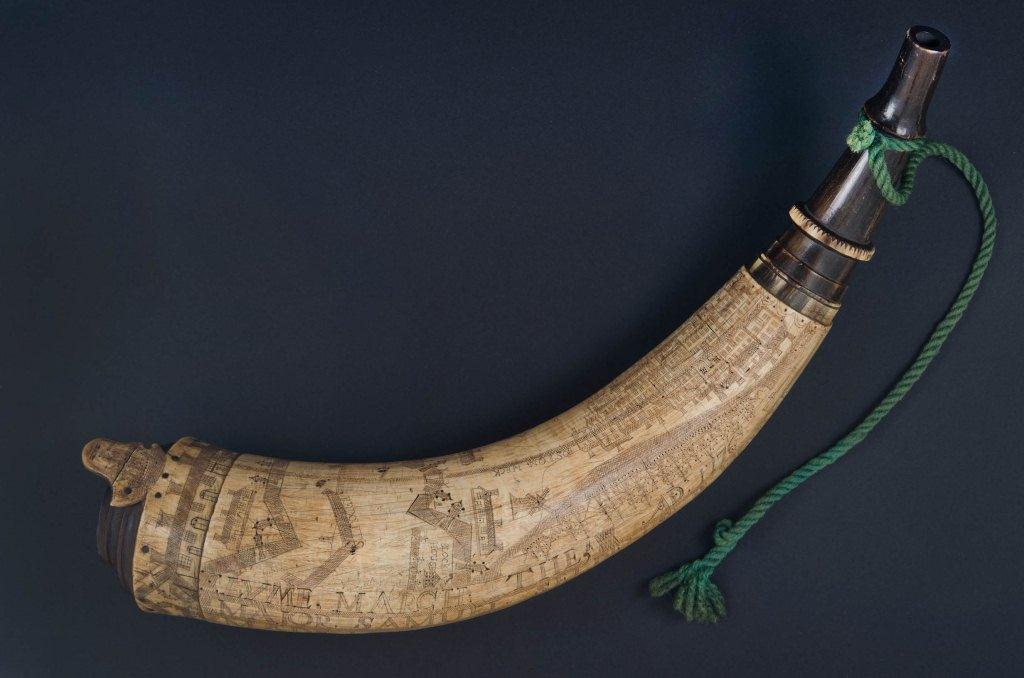
We expect to see maps on paper, not on animal horns. Maj. Samuel Selden might have thought this as he etched a map of Boston on his powder horn, which is dated 9 March 1776. During the Revolutionary War, soldiers used animal horns to hold their gunpowder. They filled them at the larger end and funneled the powder into their weapons. Not all militiamen had their own powder horns, so men like Selden carved unique designs on them in order to claim them as their own.

Selden was a member of Connecticut’s Provincial Assembly and became a major in the colony’s militia during the war. He served under George Washington’s direction during the siege of Boston. His powder horn depicts the sites of American fortifications as well as the positions of the Continental Army just before the British evacuated the city.

Even if we did not know Selden’s background, his carvings convey his allegiances. A ship labeled “Amaraca” displays a Continental Union flag. Another flag depicts the Liberty Tree, the tree near the Boston Common where locals met to protest British rule. Alongside his name, Selden also inscribed the words: “made for the defense of liberty.”

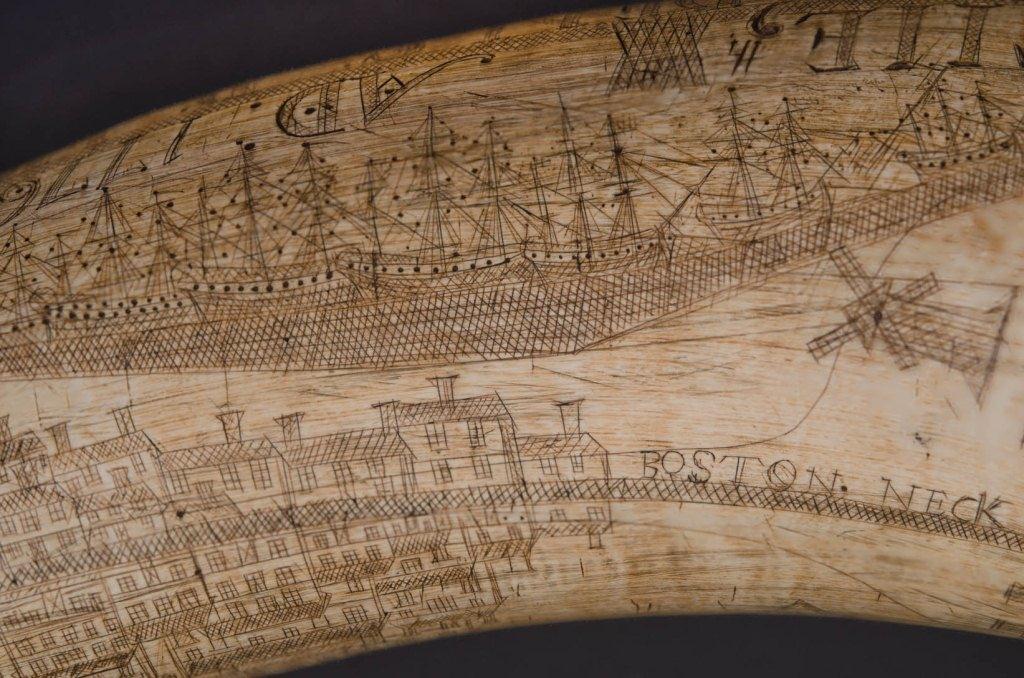
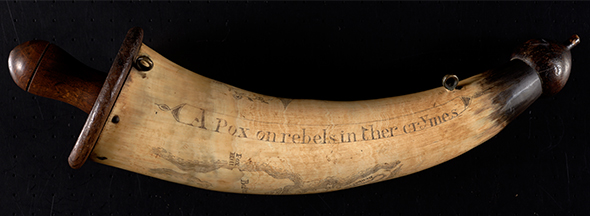
Selden’s map is a pictorial map rather than one focused on the area’s geography. His detailed carvings feature individual ships in the harbor and houses lining the Boston neck. Crosshatching adds depth to the water and makes his lettering stand out. In contrast, a 1775 powder horn housed at the Norman B. Leventhal Map Center features a more traditional map of Boston. Instead of pictures, this map traces shorelines. Unlike Selden’s, however, a British soldier carved this powder horn. He inscribed the words: “A Pox on rebels in ther crymes [their crimes].”

1775 powder horn

Photo courtesy of Norman B. Leventhal Map Center.

Just six months after Selden carved his horn, the British captured him at the Battle of Kip’s Bay during their campaign to take control of New York City. The prison’s conditions were poor. Less than a month later, Selden fell ill and died on 11 October 1776.

Selden’s powder horn, as well as that of his British counterpart, is currently on display in the Norman B. Leventhal Map Center’s exhibition at the Boston Public Library. The exhibition, We Are One: Mapping America’s Road from Revolution to Independence, uses maps to explore the events that led thirteen colonies to forge a new nation. We Are One demonstrates that maps, from Selden’s carving to early European maps of the new nation, were central to the revolutionary process. The exhibition features maps as well as prints, paintings, and objects from the Leventhal Map Center’s own collection and those of twenty partners, including the British Library and Library of Congress. Visit zoominginonhistory.com to explore geo-referenced maps from the exhibition.

The exhibition will be on display at the Boston Public Library through November 29, 2015. We Are One then travels to Colonial Williamsburg from February 2016 through January 2017 and to the New-York Historical Society from November 2017 through March 2018.

The Leventhal Map Center also hosts the NEH-funded American Revolution Portal database. Researchers can access maps from the Massachusetts Historical Society, British Library, Library of Congress, and other institutions in one search. Users can download images for research and classroom use. Access these resources and learn more about We Are One at maps.bpl.org/WeAreOne.

Find out more about the Society’s own map collection at their upcoming exhibition: Terra Firma: The Beginnings of the MHS Map Collection, which opens on 2 October. Through 4 September, visitors to the MHS can learn more about the American Revolution with exhibition: God Save the People! From the Stamp Act to Bunker Hill.

Image 1: Selden, Samuel, 1723-1776. [Powder horn scribed by Samuel Selden.] Lyme, Conn., 1776. 1 powder horn: ivory; 37 x 21 x 13.3 cm. Massachusetts Historical Society.

Image 2: Detail of above.

Image 3: E.B., [Powder Horn with Map of Boston and Charlestown]. [Boston], 1775. Scrimshaw horn, 14 x 3.5 x 3.5 inches. Norman B. Leventhal Map Center.

He Said, She Said (Redux)

By Susan Martin, Collection Services

Three weeks ago, I introduced you to John Egbert Jansen and Margaret A. Wisner of Pine Bush, N.Y. Their papers form part of the Hall-Baury-Jansen family papers and include overlapping diaries for the years 1858 and 1859. One of my colleagues here at the MHS asked me what happened to John and Margaret after 1859, so I did a little more digging. 

Unfortunately, none of the rest of the diaries in the collection overlap. We have one more diary kept by Margaret in 1862, but the ink has faded so much that many of the entries are illegible. John kept five more diaries, two before his marriage to Margaret (1860, 1861) and three after (1873, 1875, 1878). So we have to rely almost entirely on him for further details. 

John’s diary entries are short and cryptic. He visited Margaret and thought of her often, and it seems his feelings were reciprocated, but something was apparently delaying their marriage. The fact that we have only one side of the story heightens the mystery and the pathos. We see John pining for Margaret, “living in hopes,” wanting to say things to her but not daring, and parting from her in “affecting” scenes, but her voice is silent. Here are some excerpts from John’s 1861 diary: 

Many wishes I have, but must not express them now, and some inferences to make from former actions. (17 Mar. 1861)

Saw some one in want of sleep as well as myself. I have to think quite little of what I’ve heard lately. (28 Apr. 1861)

The last attempt. […] Not at all afraid. (26 May 1861)

Thinking considerable as to what I must do. (1 July 1861)

Saw one in Church looking sad and lonely. Sorry for that. (24 Nov. 1861)

What the conflict was, I can only guess. There was some discord during John’s visit to the Wisners on 14 Mar. 1861: “Some apparently disappointed in hearing my oppinions of Intemperance as applied to my case.” The day before, he had written: “At home in the evening on account of shame perhaps or the want of a place to go. I dont know what it will amount to. I’ll have to stop after while I guess.” John did take the occasional drink. Did Margaret’s family disapprove? Or was it something else? All we know for sure is that harsh words were spoken, and someone was “very much put out or disgusted.” John felt the sting of “people passing remarks on and about me,” but thought he was “not so bad as I might be.”

His love for Margaret is unmistakable. He referred to her tenderly as “Maggie” and even, in one entry, as his “duckee.” Sometimes he just used a plus (“+”) sign to indicate her, as on 18 Aug. 1861: “Retired early, but could not sleep thinking of the goodness and other qualities of +.” As the year neared its end, with the prospect of their marriage still dim, John was glum: “Dark and gloomy out. Myself dull and lonely. Wonder if any one is thinking of me? Doubts arising.” But on New Year’s Eve, he clung to hope: “As the clock strikes 12 I was happy and alone and may I next New Year’s eve be the same except the alone.”

As I looked through John’s 1861 diary more carefully, I realized that Margaret was not entirely silent after all. At some point, she also read the volume and couldn’t resist adding her own sly comments after some entries. For example, on 7 Oct. 1861, John described an outing with some friends: “Bad companie but hard spoiling me as I am so innocent??” Margaret added a playful: “Poor boy.” (The question marks were also probably written by her.)

We have no diary kept by John in 1862, so we switch to Margaret’s point of view. Her diary for that year, though faded, does contain some legible entries, but their meaning is just as elusive as John’s. The couple had frequent “discussions” and “consultations.” When John visited on 12 Nov. 1862, with nothing decided, the two of them just “sat & sat hoping things would be right.” The wedding was put off at least once, and the next day John was nearly at the end of his rope: “John E. here & to tea. Quite cross when he left. To bad. To bad.”

Finally, on 17 Dec. 1862, John and Margaret were married. Margaret’s entry for that date reads: “Memorable day. Promised much, before many witnesses. Left with My husband […]” John’s later diaries describe the life of a typical New York farm family. The couple had three children: Lewis Wisner Jansen (1864-1925), Elsie (Jansen) Vernooy (1866-1949), and Lt. Col. Thomas Egbert Jansen (1869-1959).

Margaret died in 1923, and John in 1929. They, their three children, and other Jansen and Wisner family members are buried in New Prospect Cemetery in Pine Bush, N.Y.


“A good house where we had a good bedroom…”: Edwin F. Atkin’s Travel Diary, 1872

By Bonnie McBride

While our mission statement here at the Massachusetts Historical Society proclaims that we hold materials dedicated to the study of the history of Massachusetts and the United States, we also hold materials that may be of interest to scholars researching other countries. As I am returning on a trip to Norway this summer, I decided one day to search and see what manuscripts (if any) we hold related to that country.

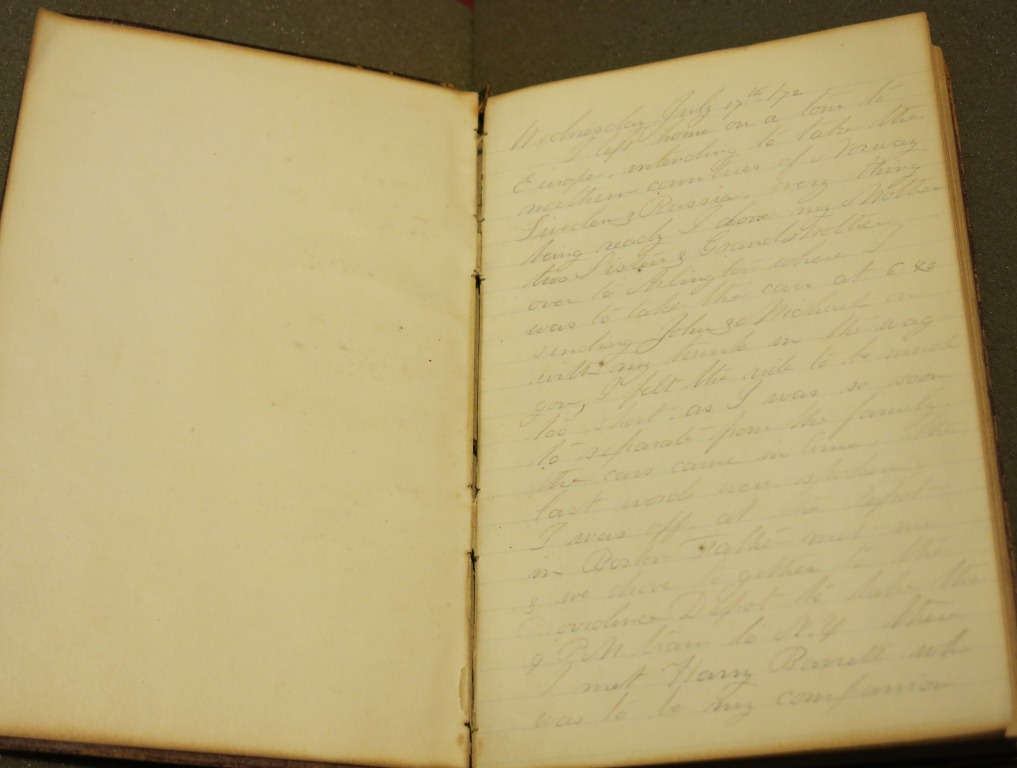
I was especially interested in reading about other travelers’ impressions and thoughts on the country, and so I chose to look through Edwin F. Atkins travel diary of what seems to be his first solo trip through Europe, at the age of 22 in 1872. He starts off with writing of how hard it was to say goodbye to his mother and sisters in Arlington as he left for Boston, first traveling by train to Providence and then onward to New York City, where he boarded a steamer bound for Plymouth in the United Kingdom. After a rough day at sea he writes “I think that I never again will travel by sea while anything remains to be seen in my own country.” Looking closer at the Atkins family papers, I did learn that Edwin did travel abroad again, many times to Cuba to visit his plantations there.  Apparently he either got used to sea travel, or decided that some discomfort was worth the rewards of travel. 

Reading through his diary, I started to make connections between a travel diary of the past and how we keep track of journeys today – often through a blog or social media. Similarities end there though, because travel journals in the 19th century were not intended to be shared in the same public way a travel blog is shared in the 21st century. A diary was kept mainly for yourself, to remind you of places you visited, how the food was, and to record interesting tidbits about your day. Reading each page of Edwin’s diary puts me in the mind of someone recording their thoughts so he could then recall what happened each day when choosing to share the trip with other people. For example, most of his daily entries are similar to this entry from 10 August 1872 “At Christiania [which is now Oslo, the capital of Norway] we went to Victoria House, a very good house we had a nice room and a good supper.” He was not one to speak in superlatives, often just noting the “fine scenery” and “clear weather.”

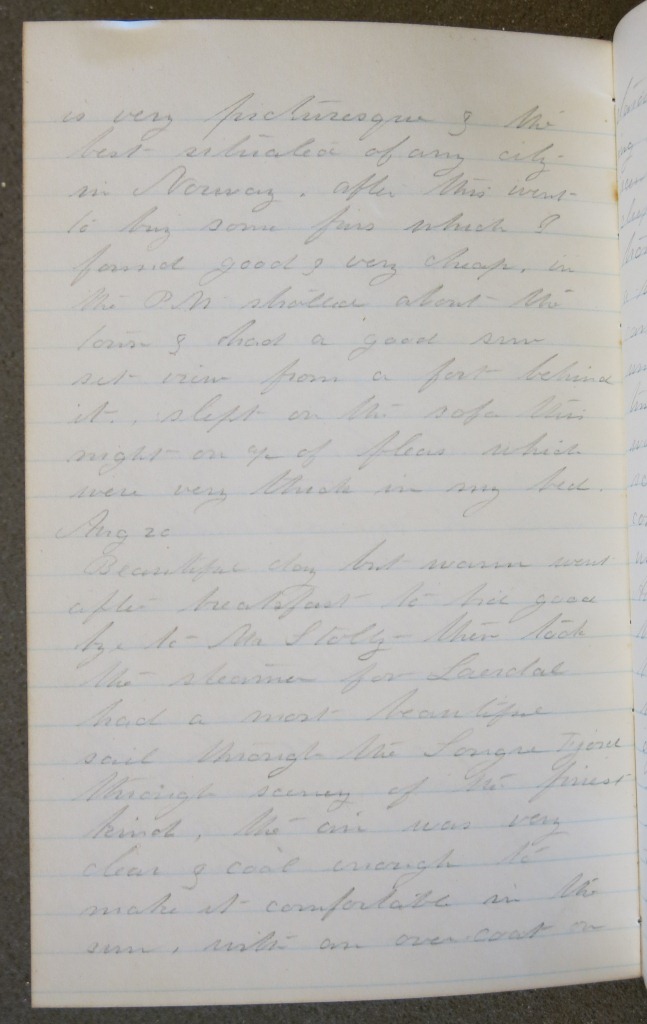
Because of his usually reserved writing, when he writes in great detail I knew he was writing of something special. On 20 August 1872, Edwin is on a steamer sailing through the Sognefjord, which he noted had “scenery of the finest kind.” He decided to spend the night sleeping on the deck: “We made a landing which woke me up; we were among scenery of the grandest – snow covered mountains just above us; from here we ran to Andal down a fjord where the rocks rose some two and three thousand feet right out of the water. Coming back through the same branch of the fjord, we entered another leading to Gudvangen more beautiful than the other with many beautiful waterfalls coming down from the rocks above more small villages…” Having been on a very similar ferry ride through the same fjord, I can completely understand his awe at the beauty surrounding him.

Edwin’s journal goes on to detail his travels around Norway and then into Sweden, and abruptly ends upon his entry into Germany. His last full entry is dated 2 September 1872 and while the next page holds the date 3 September, nothing else is written. I’d like to imagine that Edwin, like so many other travelers (myself included), was so caught up in his travels that he had no time to jot down his memories. If you are interested in reading travel diaries from faraway places, be sure to check out ABIGAIL to discover our collections here at MHS!


The Stamp Act and Liberating Knowledge

By Amanda M. Norton, Adams Papers

This August marks the 250th anniversary of the publication of the first part John Adams’s “A Dissertation on the Canon and Feudal Law.” This rather arcane title can obscure the profound message that his essay brought to that colonial resistance to the Stamp Act that had been imposed on the colonies in the spring of 1765 by the British Parliament. In this four-part series published in the Boston Gazette from August to October 1765 in the flush of opposition to this new tax, Adams attacked the Stamp Act from a different angle than simply opposition to “taxation without representation.” It was not merely the fact of a tax, but what Britain taxed: “it seems very manifest from the [Stamp Act] itself, that a design is form’d to strip us in a great measure of the means of knowledge, by loading the Press, the Colleges, and even an Almanack and a News-Paper, with restraints and duties.”

Adams, ever the lawyer, looked back over history and examined the two major legal systems that had ruled much of Europe up to the modern age—the canon law, the law of the Roman Catholic Church, and the feudal law, the law of medieval governments. In both of these legal systems, Adams saw a systematic attempt to keep knowledge from the people. In the first part of his essay, he explained how “the great” worked “to wrest from the populace, as they are contemptuously called, the knowledge of their rights and wrongs, and the power to assert the former or redress the latter. I say RIGHTS, for such they have, undoubtedly, antecedent to all earthly government—Rights that cannot be repealed or restrained by human laws—Rights derived from the great legislator of the universe.” In England, an alliance between these two systems had formed and it “was this great struggle, that peopled America. It was not religion alone, as is commonly supposed; but it was a love of universal Liberty, and an hatred, a dread, an horror of the infernal confederacy, before described, that projected, conducted, and accomplished the settlement of America.”

In the final installment of his essay, Adams’s rhetoric soars as he calls for Americans to look into and stand up for their rights. They should use this moment when the British attempted to subjugate America and oppose their efforts through education. “Let us tenderly and kindly cherish, therefore the means of knowledge. Let us dare to read, think, speak and write. Let every order and degree among the people rouse their attention and animate their resolution. Let them all become attentive to the grounds and principles of government, ecclesiastical and civil.” And Adams argued that just as the reigns of James I and Charles I produced some of the greatest British statesmen, “The prospect, now before us, in America, ought in the same manner to engage the attention of every man of learning to matters of power and of right, that we may be neither led nor driven blindfolded to irretrievable destruction.”

John Adams’s continued commitment to education as an essential component in a free society was evident in his draft of the Massachusetts Constitution of 1780, which included a chapter specifically calling for “The Encouragement of Literature” within the commonwealth.

If you want to learn more about the Stamp Act and the coming of the Revolution in Boston, a couple weeks are remaining to view the MHS exhibit, God Save the People! From the Stamp Act to Bunker Hill.


He Said, She Said

By Susan Martin, Collection Services

The Hall-Baury-Jansen family papers at the MHS include ten small diaries kept in Pine Bush, N.Y. between 1858 and 1878. Most of them belonged to a young farmer named John Egbert Jansen, but three were written in another, unidentified hand. By checking the diaries against each other, I was able to confirm that the second diarist was John’s wife, Margaret A. (Wisner) Jansen.

John and Margaret weren’t married until 1862, but both kept diaries in 1858 and 1859, during their courtship. A side-by-side comparison of these two years makes for some fun reading. Both John and Margaret wrote in their diaries every day, and while the entries are short, repetitive, and often dry, taken as a whole, they give us a glimpse into the couple’s relationship as it develops. And it’s hard to resist speculating on what some of the more elusive entries mean.

At the beginning of 1858, Margaret was a lonely young woman of 17. She disliked the days she spent at home alone and was disappointed when she received no letters or visits. Some of her early diary entries are forlorn: “I do wonder if any body likes me.” Her first reference to John comes on 21 January 1858: “To tea with J.E. Nice visit.” His entry for that date doesn’t mention her, but that was apparently the day he decided to “quit chewing tobacco.” (Coincidence? Hmm.) A week later, Margaret wrote that John “called for a singing book.” The corresponding entry in John’s diary discusses other matters before noting that he “made a call.” This circumspect little phrase was almost invariably the way he described his visits to Margaret.

The relationship of the young couple was moving along, and when he visited, she often had “a real funny time,” while he enjoyed himself “very much” or “finely.” He even helped with chores around her house. It’s possible that Margaret and John had known each other for years, if not their whole lives, considering how small the town of Pine Bush was. The Wisners and the Jansens ran in the same social circles and attended the same church and many of the same events. These included singing school, bible class, lectures, and parties. On 15 March 1858, Margaret attended a party at the home of John’s aunt and stayed until the wee hours of the morning. Her entry for that date reads: “Went to a party to Mrs. Jane Jansens. Had a splendid time. Saw ___. Came home about four A.M.” He wrote more succinctly that he “staid all night.”

John began calling at Margaret’s house more frequently, often multiple times a week. She now expected his visits and  made a note in her diary when he didn’t come. But of course their relationship, like all others, had its rocky patches. Margaret sometimes doubted that her feelings were reciprocated. Once she complained: “I think I may easily say I am thinking of those who think not of me & perhaps care not for me. I have one in my mind.” Other days, she was more dreamy and sanguine and “had some very pleasant thoughts.” One wistful entry just trails off: “Freligh Lyon called. I wish – ” And she still had those downcast days: “Did various little things. Took a little walk in the evening. Here on the rock I post this thinking, looking, all alone.”

If only she could have read John’s diaries! While he was more subdued in expression and less confessional in tone, he definitely thought she was “pleasant” and “agreeable.” He wrote happily about joining her and her friends on fishing trips and picnics. He still referred to her coyly as “a companion” or just by initials or a blank line, but we can use her diary to confirm that he did, in fact, mean her. And she might have been interested to know how disappointed he was the day she didn’t attend church and he felt “some what forgotten.” The end of the year made him philosophical: “Where will I be next year this time? I would like to know. I do not know! Do you?”

At the beginning of 1859, there was trouble in paradise, and the two different perspectives sometimes present a startling contrast. John thought his 1 Mar. 1859 visit to Margaret was “pleasant,” but she wrote: “J.E. called. Was much out of humor.” (I don’t know if she meant John or herself.) On another visit, she thought he was “very anxious to get away. Can’t say why.” He described some of the calls he made to her that spring as “miserable,” even “disgusting.” Neither wrote explicitly about their problems, but Margaret did confess that “one will get provoked occasionally.”

Whatever their differences, the couple rode them out, and their diaries contain many endearing, if terse, references to each other. She wished his visits lasted longer: “Johnie called, one minute. Always in a hurry.” For that matter, so did he: “Made a call. Sorry could not stay. Sorry to leave indeed.” He began to call her “Maggie” near the end of 1859, and her lonely days seemed to be a thing of the past. Her diary entry for 6 August 1859 reads, in part: “This is a good world but some mighty quear people in it.” Along the side of the page, she added, apparently later: “Some very nice good ones too.”

Reading John and Margaret’s diaries side-by-side also paints a picture of a typical man and woman of the time. While she spent days cleaning, sewing, and doing other housework, he was working on his farm, haying, logging, etc. It’s a rare treat to see two lives lined up so perfectly, each diary fleshing out and enriching the other to create a fuller picture…not to mention giving us a little peek at what these two young people really thought of each other!


An American Woman in Egypt, 1914-1915: Wadi Halfa to Asswan

By Anna J. Clutterbuck-Cook, Reader Services

Today we rejoin our anonymous female diarist as she journeys down the Nile in the winter of 1914-1915. You can read previous installments of this series here (introduction), here (Cairo to Aysut), here (Aysut to Asswan) and here (Asswan to Abu Simbel).

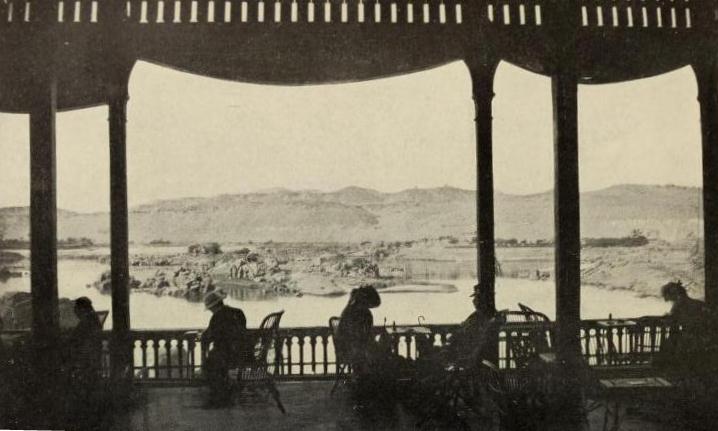
Image: “The Oriental Lounge of the Cataract Hotel at Assuan,” from Douglas Sladen, Queer Things About Egypt (1910)


In today’s entries, our diarist tours various sites on the border of Egypt and Sudan, in an area today bordering (and in some cases subsumed by) the Lake Nasser/Lake Nubia reservoir. In one case, visiting the Temple Kalabsha, she would have seen the temple in its original location nearly half a century before it was moved to accommodate the rising waters of the lake as the Aswan Dam was constructed (between 1958-1971).

On December 15th our narrator departs the steamer on which she has been traveling and takes the train north to Asswan once more, where she checks into the Cataract Hotel at which she will spend her Christmas holidays. These entries continue to illustrate how, as an American tourist, she experienced the country through which she traveled, and the people she encountered there.


Dec. 11. A.M. wrote post cards & at lunch we arrived at Wadi Halfa. Went on shore after lunch & walked around, then went up to train and saw people off for Khartoum. Went to P.O. for stamps. After tea went ashore again with dragoman & walked through [illegible phrase]. Saw Nubian village & then Sudanese on the desert.

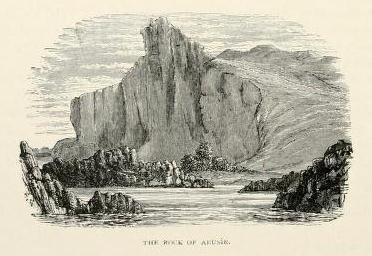
Dec. 12. Had early breakfast & left in small boat at 8:30. Miss M. did not go. Were rowed across first to shore & then towed along for about an hour’s ride. Then landed & got onto donkeys & rode over the desert to the rock of Abu Seer, 1 ½ hours. Went up on rocks & saw two [illegible word] shoot the rapids. Rode back to river bank & had lunch in a little hut there. Then visited Temple of [illegible phrase] took boats again & were rowed back to our steamer in time for tea. After it wrote a letter. Fine full moon.

Image: “The Rock of Abusir” from Amelia B. Edwards, A Thousand Miles Up the Nile (1890)


Dec. 13. Had early breakfast & at 8:30 went ashore in row boats to see rock temple of Sebel Addeli 4 papyrus columns with bud capitals — used as a Christian church. Soon after leaving this we passed Abu Simbel again. Wrote till noon time. Sailed along all the afternoon.

Dec. 14. Reached Kalabsha just at breakfast & immediately after went ashore — a large group of [visitors?] – went to rock temple of Beit-El Wali, a vestibule [illegible phrase]. Only side walls of vestibule standing, interesting historical reliefs. Some coloring in the hall & sanctuary. Then went back to river, took boats & rowed into temple of Kalabsha, which is partly submerged — never finished — has [illegible phrase] rooms — 1st vestibule has [illegible word] columns with floral capitals, the roof is gone. The other 3 rooms have walls, preserved reliefs with vivid coloring. Arrived at Shellal at noon. Most of people took 3pm train to Asswan. After they had gone Miss M., Miss Gillender & I had a boat & went around to Philae & back for tea & stayed on boat overnight.

Dec. 15. Left Prince Abbas* after an early breakfast at 7.30 & took 8.30 train to Asswan going to Cataract Hotel to get room. Then walked round to steamer “Arabia” and made a call on the Phelps’, stepping into Cook’s on the way. After lunch lay down & slept, then  sat on my balcony & watched sunset then went down & wrote till dinner. Talked with two English ladies in evening.

In our next installment, we’ll see how our diarist’s routines change (as well as stay the same) once she is no longer traveling daily from place to place but instead residing in a fixed location with a revolving cast of European guests.

*The first mention of it in this diary, I believe Prince Abbas may be the name of the boat our diarist had been staying on.

The July 4 Protest of “Half Mast” Fay

By Susan Martin, Collection Services

This July 4 marked the 151st anniversary of an interesting political protest by local businessman Joseph Story Fay. His protest provoked heated debate in the Boston newspapers and had professional ramifications for Fay, even months later.

Fay was apparently a Peace Democrat during the Civil War, or what some called a “Copperhead” (as in, the snake). This subset of Democrats supported the Union, but wanted an end to the war through negotiated peace with the Confederacy. At their National Convention in Chicago in Aug. 1864, the Democrats nominated General George B. McClellan to unseat President Lincoln. Their platform read, in part:

[…] after four years of failure to restore the Union by the experiment of war, during which, under the pretense of a military necessity of war-power higher than the Constitution, the Constitution itself has been disregarded in every part, and public liberty and private right alike trodden down, and the material prosperity of the country essentially impaired, justice, humanity, liberty, and the public welfare demand that immediate efforts be made for a cessation of hostilities […]

It’s not hard to imagine what the Republicans thought of that! The Boston Evening Transcript, a pro-Lincoln newspaper, tore into the Copperheads in every issue published that election season. If McClellan won the presidency, the paper editorialized, “compromise and concession to traitors will be the policy of the new administration.” The paper ran stories of rebels cheering McClellan’s nomination and routinely implied that the Copperheads celebrated Confederate victories.

The Peace Democrats argued that the war wasn’t just destructive to the Union, but to the Constitution. They railed against the violations of civil liberties perpetrated by Lincoln’s administration. The spur to Fay’s protest on 4 July 1864 was the suspension of habeas corpus in the case of a group of Illinois Copperheads who had been arrested and detained in a military prison without due process of law. Fay chose Independence Day to make his stand. He flew an American flag at half mast outside his home in Woods Hole, Mass., and attached a note:

The submission of Americans to this & other such cases, and to the suppression of free speech & of a free press without protest or complaint forms a strong & strange contrast with the Spirit of ’76. Our flag is no longer a protection & it droops its folds in sorrow.

There’s some dispute about what exactly happened next, but all accounts agree that a group of people objecting to Fay’s protest confronted him at his house. Fay warned them off, armed with a rifle. His youngest daughter Sarah, about 8 years old at the time, wrote later (her note is visible on the image above): “I remember my father going out on the piazza with his new .15 Shooter repeating rifle – a crowd of men around the flagpole, my father’s stern voice & then being bustled in & up to the nursery out of sight.”

Thankfully no one was hurt, but the incident would come back to bite Fay two months later. After he presided at a pro-McClellan rally at Faneuil Hall in Boston on 17 Sep. 1864, the Transcript printed a letter from an unnamed person reminding readers about Fay’s earlier “dishonor” and “insult” to the flag. The Democratic Boston Courier supported him, but the Transcript was unimpressed: 

The Courier defends and applauds Mr. Fay for putting the American flag at half mast on the Fourth of July, and for threatening to shoot anybody who interfered “to alter the position of the flag.” […] If the party to which they belong gets into power they may have the consolation of seeing the American flag permanently at half mast, with Jeff. Davis, pistol in hand, threatening to shoot anybody who “alters its position.”

Fay wrote to the Transcript to defend himself and his patriotism. His letter was published in full, but with unflattering commentary. The paper assumed the guilt of the Charleston “traitors” and the necessity of their detention, criticized Fay’s arrogance, and called him out for hypocrisy by rattling off a litany of abuses of power by his party, the Democrats. Fay’s protest was a “desecration,” the paper said, and not the act of a “true gentleman.” 

The flagpole issue would rear its ugly head again two months later, when Fay was denied a position on the Committee of Arrangements of the Boston Board of Trade, set up to honor the captain and crew of the U.S.S. Kearsarge. The Transcript (who else?) wrote, somewhat gleefully, on 11 Nov. 1864: “Mr. Fay’s friends make a great mistake in constantly crowding him before the public. He has damaged his political party and his family name, brought discredit upon the fair fame of our State, and should retire from the public view for the remainder of his days.” One of his detractors dubbed him “Half Mast Fay.”

 Fay resigned from the Board of Trade in a printed circular letter dated 14 Nov. 1864. But he was not without defenders among his fellow businessmen. George B. Carhart, president of the New York and New Haven Railroad Company, wrote to Fay that his critics were “fanatics,” and abolitionist Amos Adams Lawrence also sent him an optimistic letter of support.

Joseph Story Fay was no stranger to controversy. He had lived in Savanna, Georgia, during the antebellum years and often sparred with newspaper editors there. He’d once had to refute public accusations that he was an abolitionist. (Not only wasn’t he an abolitionist, he was a slave owner!) In the case of the Woods Hole flagpole, he never wavered or apologized. As he declared in his circular letter:

I trust I shall never live to be recreant to my opposition to wrong acts, for it is above party or politics. […] I feel that I have a right to mourn over any submission to such violations of personal liberty as brought on our war for Independence. What is our nationality, unless that is its spirit? For what are we fighting to-day?

Joseph Story Fay’s papers form part of the Fay-Mixter papers at the MHS.


Stills and Strikes: Policing in Early-Twentieth Century Boston

By Brendan Kieran, Reader Services

For my first blog post for the Beehive, I decided to look beyond the major political and social names to see what the collections here could tell me about life for “everyday” people in Massachusetts. In my search, I came across the Robert E. Grant Diaries. These diaries, kept, between 1901 and 1930 by a Boston police officer, provide opportunities for research into a variety of events and developments that took place in the city during those decades, such as the Sacco and Vanzetti trial and executions. While Grant’s entries are usually brief and direct, they chronicle the career of a person who spent three decades experiencing urban life at the ground level. As such, they could be of potential interest to a variety of researchers studying early-twentieth century urban history.

One interesting topic covered in the Grant diaries is Prohibition, including the police raids conducted during that period. For example, in an entry from Friday, 15 February 1924, he writes that “5000 lbs of sugar was seized,” following a mention of the “Largest Still Seized.” A newspaper clipping describing four raids that had recently occurred (and mentioning Grant’s name) is attached to this entry. This account captures the pride Grant must have felt on that day; it also serves as a snapshot of Prohibition-era Boston and the actions taken by law enforcement to enforce bans on alcohol. This story is not the only one of its kind described in Grant’s diaries, so there are certainly opportunities for further research into this topic contained in these pages.

Grant also writes briefly about the Boston Police Strike of 1919. On Tuesday, 9 September 1919, he writes:

After rollcall at 5:45 PM, Patrolman Buckley informed the Captain that they refused to go on duty & twelve of them said the same they were told to leave all property belonging to the Department at the desk which they did & walked out. At 11:15 PM patrol Downey who did not join the union reported to this station that he refused to go on duty on morning watch & he turned in his property & walked out.

While Grant’s coverage of the police strike is brief, the MHS does hold other materials that offer some more details about the strike and the climate of the city during the strike. For instance, Dates, Data and Ditties: Tour of Duty, A Company, 11th Regiment Infantry, Massachusetts State Guard, During the Strike of the Boston Police, Nineteen Hundred and Nineteen, printed for members of the A Company in the aftermath of the strike, provides insight into the activities of the soldiers deployed to patrol the city during the strike. The book details incidents ranging from the violent, such as attempted assaults against women, to the mundane, such as giving directions to pedestrians at South Station.

In-depth studies of the strike help provide context for these materials. In A City in Terror, Francis Russell analyzes the context for the strike, the major players and events, and the aftermath of the strike.

The Grant diaries are an excellent example of the wide variety of research possibilities contained within the collections at the MHS. Researchers are welcome to visit the library and explore these opportunities.


Incendiary Fun: 19th Century Toys for Boston Youth

By Kittle Evenson, Reader Services

As the school year draws to a close and students across Boston slip leisurely into the summer heat, I was inspired to look at the MHS collections through a more playful lens. As difficult as it can be to piece together a historical narrative of adolescence, I wanted to see what we might have on the most playful of subjects: toys. 

I found disappointingly few children’s artifacts or toys in the MHS collection. I did, however, find two items from the 19th century that brought a smile to my lips, and one or two questions to my mind. 

The first is a fascinating tease. An encasement for a toy dramatically named “Torpedo Balloons!”. If the name itself fails to ignite your excitement, the picture on the cover surely will. Dating to 1897, the envelop features four adolescents excitedly, yet purportedly harmlessly igniting bits of paper with a well-timed flame. Similar to fireworks, the “Balloons” are advertised to attract the budding pyrotechnic, with safety-conscious parents.


 Directions: Distend the paper cone, placing it on a smooth surface (table or desk), and light the upper edge. It will burn down and the ashes will ascend and explode in the air.

 As the boy in the foreground lights a “Balloon” with a match, ashes explode over his head. His unsupervised peers appear to be playing in a well-decorated formal dining room, with delicate furniture, portraits hanging in the background, and gas light fixtures on the walls. While the flying embers may enrapture the children, the advertisement reassures parents that no harm will befall their expensive possession (if not their children).

Absolutely harmless [it reads]. Will not ignite or injure table cloth, bank note, or any similar article upon which it may be placed for sport.

Though the envelope has been preserved in almost pristine condition, I was disappointed to discover that it no longer contains even a single “Balloon”.

The second item I found is directed towards the girl we seen in the background of the “Torpedo Balloons!” cover image. The American Toilet, a small “conduct book” for young woman, uses emblematic illustrations to teach the reader moral precepts with regard to socially appropriate comportment and expectations.

Hannah and Mary Murry’s The American Toilet was adapted from Stacey Grimaldi’s “The Toilet,” first published in London in 1822, and includes delicate illustrations of the materials often found on a woman’s dressing table. The book is an example of a flap book, referring to the bits of paper that can be lifted to reveal hidden messages throughout the pages.


caption: With this choice liquid gently touch the mouth. It spreads o’er all the face the charm of youth

The Toilet juxtaposes shallow desires for opulent jewelry and alluring, made-up lips, with attitudes of meekness and good charm. Girls were instructed at a young age that to be socially accepted and respected they must counter desires for beauty and glamour with overt modesty and unwavering deference. The work constantly reinforcing that girls should be seen and admired as implacably pleasant creatures, not engaged with as substantive individuals.

       and

caption: This ornament embellishes the fair, And leaches all the ills of life to bear

As engaging as the “Torpedo Balloons!” and The American Toilet are, it is important to note that they represent a very narrow experience of well cared for, educated childhood within Boston’s more affluent families. Just as adult narratives cannot be blindly generalized beyond class lines or economic boundaries; neither can children’s experiences be taken as monochrome. It is doubtful that the idyllic image of children in well-tailored clothes that adorns the “Torpedo Balloons!” packet would be mirrored in homes of less-wealthy children.

These are just a selection of our items at MHS pertaining to childhood; others include diaries and photographs that can expand our snapshot of youthful realities through personal writings, drawings, and images. If you are interested in viewing the “Torpedo Balloons,” The American Toilet, or any of our other collections in person, please contact the library or stop by for a visit.


A Life in Bondage: The Narrative of Moses Grandy

By Wesley Fiorentino, Reader Services

Fielding reference questions at the MHS often means I come across fascinating material that I might not have the opportunity to discover for myself.  One particular inquiry introduced me to Moses Grandy, an African-American born into slavery in about 1786 whose experiences during and after his bondage have fortunately been recorded for posterity.  The Narrative of the Life of Moses Grandy: formerly a slave in the United States of America is a disturbing but truthful account of one man’s suffering under forced servitude. Grandy’s narrative provides a firsthand insight into the lives of the men and women who lived in captivity.

The story of Grandy’s life, written down by noted abolitionist George Thompson and first published in 1843, became popular with the abolitionist movement both in the United States and abroad.  Grandy’s story, like a number of other slave narratives including those of Frederick Douglass and Solomon Northrup, served to illustrate for a wide audience the cruelties of slavery and the outrages endured by those kept in bondage.  Stories of this kind helped to spread the message of abolitionism far and wide in the decades prior to the American Civil War. 

Like many enslaved men and women, Grandy witnesses the break-up of his family when his siblings and father are sold away.  He recounts how his mother at times would hide some of her children to prevent them from being sold, but several of his brothers and sisters would be sold away never to see him again.  Grandy later witnesses the sale of his first wife.  When he protests her sale to the man who has purchased her, he is threatened at gunpoint and forced to watch her go.  As she is taken away, Grandy beseeches her new master to let him see her one last time.  “I asked for leave to shake hands with her, which he refused, but said I might stand at a distance and talk with her.  My heart was so full, that I could say very little.”  In addition to this heart-wrenching instance, Grandy describes in detail the atrocities endured by his fellow enslaved Americans, including beatings and malnourishment.  Grandy himself states that he was often half-starved for lack of proper meals. 

Grandy’s account also offers detail into some of the common practices of slaveholders and into the variety of responsibilities with which an enslaved individual may have been entrusted.  The narrative is an important historical source for studying the practice of “hiring out” slaves to work temporarily for different masters.  Moses is hired out by his master James Grandy at the age of ten.  He describes in detail some of the horrific incidents he experienced in the employ of various individuals, ranging from brutal beatings to being fed so little that he was forced to eat ground cornhusks.  One particular master who hires Grandy multiple times is described as a great gambler who would keep Grandy up for several nights in a row without sleep to wait on his gambling table.  In one case, Grandy writes that he “was standing in the corner of the room, nodding for want of sleep, when he took up the shovel, and beat me with it: he dislocated my shoulder, and sprained my wrist, and broke the shovel over me.”  A number of frightful incidents like this are described or referred to in the narrative, sometimes with Grandy as the victim and other times with him as a witness to similar instances of brutality.

However, Grandy also provides a valuable account of many of the tasks he performed at one time or another.  Grandy’s narrative provides a unique example of how enslaved men and women often became highly skilled laborers and artisans.  Grandy himself is managing ferry crossings at Sawyer’s Ferry in Camden, North Carolina by the age of fifteen.  He is eventually hired as a freightboat captain for several boats which navigate and transport goods on the Great Dismal Swamp Canal and the Pasquatonk River.  Grandy explains that he “took some boats on shares…I gave [the owner] one-half of all I received for freight: out of the other half, I had to victual and man the boats, and all over that expense was my own profit.” 

Grandy works a wide variety of other jobs as well, including the cutting of timber for the canal and working as a field hand.  Through these different tasks, Grandy is able to save up enough of his earnings to purchase his freedom.  However, he twice gives the money for his freedom to his respective masters and twice they keep his money and refuse to free him.  Ironically, it is one of the most brutal overseers described in his narrative who apparently expresses outrage over Grandy’s treatment and who connects him with a man who is willing to buy Grandy and help him earn his freedom.

The Narrative of the Life of Moses Grandy can be read in its first American edition, published in Boston by Oliver Johnson in 1844, here in the MHS reading room.  For those researchers who are unable to come to the MHS in person, Grandy’s narrative can be read through Project Gutenberg, as well as through the Internet Archive.