
Voices of the Exhibition: Bostonians at the Centennial

By Hope Hancock, Hope College

One year ago, I embarked on my first major archival research project outside of the comfort of Hope College in Holland, Michigan, where I am an undergraduate student studying English literature, communication, and music.  The first stop on my journey was at the Massachusetts Historical Society (MHS) to connect with my research advisor, Professor Natalie Dykstra, and an MHS archivist, Anna Clutterbuck-Cook, who is a Hope alumna.

My research project, titled “Voices of the Exhibition,” is a series of four podcasts intended to bring the stories of different people who visited the Centennial Exhibition to life.  The Centennial Exhibition of 1876 was a world’s fair held in Philadelphia to commemorate the 100-year anniversary of the signing of the Declaration of Independence and was attended by 10 million people from around the globe, making it the highest attended world’s fair at that time.

Many diaries and letters of Exhibition-goers have been catalogued at the MHS and other Boston archives.  In searching through these archives, I found many interesting sources, but my favorite is the diary of Frank Dudley Chase, which currently resides in the collections at the MHS. 

Frank Dudley Chase was 16 years old when he visited the Exhibition, and in elegant penmanship he dutifully recorded everything he encountered while at the fair.  From the cost of his train ticket to elaborate descriptions of the exhibits, Chase left little about his journey out of his diary. 

Chase was a typical teenage boy who loved being outdoors and did not always like to do his chores.  He travelled from Dedham, Massachusetts to Philadelphia for the Exhibition and was at the Exhibition for five days from October 23 to October 28.  From descriptions of ammunition to meticulously painted foreign vases, Chase’s diary is a vivid record that provides a glimpse of what  exhibits and oddities attracted youthful Exhibition visitors.

On Tuesday, October 24, Chase wrote:

Had a heavy rain last night in the night.  Pleasant.  Visited Main building.  First went through U.S. dept.  Near So. Entrance of building were a number of large fancy mirrors.  Among these was a couple one concave; the other convex one showing an object unnaturally broad; the other unnaturally slim … Also saw an immense crystal of alum, weighing 9 tons, a 365 bladed pocket knife, a table knife 9 ft 6 in costing $1500 … the silk exhibit showing the eggs, butterflies, cocoons and raw silks … In the Brazilian department saw precious stones among them white topaz, amethyst and agate; collections of beetles and butterflies; a leather exhibit and a porcupine fish…

He and the rest of his group were undoubtedly eager to take in every facet of the Exhibition.  However, his diary provides more than a meticulous record of daily weather and exhibits: it is a window into Chase’s experience and the experiences of other teenagers who visited the Exhibition.

The Centennial Exhibition was a fair for the people.  It was designed to bring together Americans to celebrate independence and express their patriotism.  Furthermore, it provided an education tool that introduced Americans, like Chase, to cultures, inventions, and ideas that were brand new to them.

Before researching at the MHS, I was already able to recite many facts about the Exhibition.  I would not call myself an expert in every detail, but I knew a lot.  However, it was not until I read Chase’s diary that I fully understood the impact of the Exhibition on the American people.  On December 31, two months after visiting Philadelphia, Chase said it best when he wrote: “One great event distinguishes this year in my life, and that is my journey to the Centennial where I learnt more than I should have in many years of quiet life.”

As I look back on the past year, I am still so thankful for the experience I had at the MHS.  Not only did I find wonderful information in Chase’s diary, but I read the diary of George W. Ely, a young man who visited the fair, official addresses to the Centennial committee, and letters from prominent Boston citizens, such as members of the Saltonstall family and their friends. 

As an undergraduate student, I never thought that I would have the opportunity to do research at such a prestigious institution.  I cannot express enough the importance of the MHS to my education and professional development.

Listen to a podcast that features Chase’s diary, titled “Children at the Exhibition.” It is the second podcast in the four-podcast series, all of which can be found on my website at hopehancock94.wordpress.com.


Fathers’ Day: Louisa Catherine Adams and Joshua Johnson

By Amanda Mathews Norton, Adams Papers

Fathers have a tremendous impact on the lives of their children; and this is quite evident in the case of the Adams family. While John Adams and John Quincy Adams clearly and significantly influenced their children, I want to highlight the relationship of Louisa Catherine Adams with her father, Joshua Johnson. This relationship not only shaped Louisa’s upbringing, but indeed colored her entire life, and her relationship with the Adamses.

Joshua had moved to London before the Revolutionary War to forward his business interests, and during the 1790s served as the U.S. consul at London. Marrying an English woman, and raising his children in France and England, led some to question his patriotism and Louisa’s need to protect and defend her father’s honor and reputation is evident throughout her writings. This need not only grew out of Joshua Johnson’s long foreign residence but more especially because of her father’s financial circumstances at the period when she married John Quincy Adams. Just as she and John Quincy were married, her father’s business failed. Unable to provide the dowry he had promised and in debt, Joshua Johnson quickly took his family from London back to the United States to attempt to recover his losses. Louisa entered her marriage with the anxiety and shame that her husband and others would think that she and her father had conned John Quincy into marrying her with false promises; it was a sensitivity that never went away.

But for Louisa, her father had been entirely blameless, and this belief she also carried throughout her life. Fortune was unkind. His partners had cheated him. In her Autobiography, “Adventures of a Nobody,” Louisa reminisced:

The qualities of the heart and of the mind, excited a higher aim; and a romantic idea of excellence, the model of which seemed practically to exist before my eyes, in the hourly exhibition of every virtue in my almost idolized Father; had produced an almost mad ambition to be like him; and though fortune has blasted his fair fame; and evil report has assailed his reputation; still while I live I will do honour to his name, and speak of his merit with the honoured love and respect which it deserved— As long as he lived to protect them, his Children were virtuous and happy—amidst poverty and persecution.

Like many adults in times of sorrow or hardship, even at the age of 64, in her Diary in July 1839, she looked back with fondness and nostalgia for her childhood:

My Father! my Dear my honoured my revered Father! In the hour of sickness, of sorrow, of disappointment; memory carries me back to the days of my youth; when on the slightest complaint, I met thy sympathising tenderness, anxious solicitude, and affectionate indulgence to suffering and weakness; and the soothing encouragement which braced the nerves to fortitude, and the spirit to courage! Where in this world is thy likeness to be found! Thou wert not great, but thou wert good!!!

As we celebrate Fathers’ Day, this is yet another reminder that the emotions and relationships, particularly those of parent and child, remain familiar across the centuries.


The More Things Change….

By Susan Martin, Collection Services

Today’s media commentators like to decry political polarization and incivility in the United States. It’s become a well-worn cliché: Why can’t we all just get along? Some will even claim that this polarization is worse now than ever before. (Of course, we only have to go back 150 years to find Americans literally at war with other Americans, but let’s put that aside for the moment.) I’d like to present, as evidence for the defense, a letter written in 1813, when this nation was still in its infancy. The letter forms part of the Henry P. Binney family papers at the MHS.

In mid-1813, Benjamin Homans (1765-1823) worked as chief clerk of the Navy Department in Washington, D.C. His friend and colleague Amos Binney (1778-1833) was the Navy Agent at Boston. The United States was a year into the War of 1812, and Boston was a hotbed of dissent. New England Federalists and merchants vehemently opposed “Mr. Madison’s War, largely because of their reliance on trade with England. Binney lived and worked in the belly of the beast as an agent for the federal government, and Homans sympathized. He wrote to Binney on 23 June 1813:

You may be very sure, that I am no stranger to the active operation of evil spirits in Boston, party spirit, selfish spirit, envious spirit, proud spirit, family spirit, mean dirty spirit, assassin spirit, infernal spirit, tory spirit, royal english spirit, pseudo patriot spirit, hypocritical sanctity spirit, professional spirit, Jew spirit & Turk spirit. […] I conceive that every good quality, every moral virtue, and every social principle to be rapidly depreciating in Boston, and that it is at this day the vilest and most profligate spot on Earth, and for myself, my heirs & successors, I would prefer a residence in Algiers, Siberia or Botany Bay, than to live within one hundred miles of the atmosphere tainted by the noxious breath of Ben Russell and the Junto and their satellites.

Wow! Homans certainly didn’t mince words. A little bit of context: Benjamin Russell (1761-1845) was the editor of Boston’s hugely popular and staunchly Federalist Columbian Centinel. He had editorialized against Thomas Jefferson and now regularly attacked his successor James Madison. The “Essex Junto” was a group of hardline New England Federalists, so-called because many of its original members hailed from Essex County, Mass.

It would be difficult to overstate the Junto’s opposition to the Madison administration and the Democratic-Republicans. Governors of Federalist states refused to send their militias to join the war effort. There was even talk of secession. Just before Homans wrote this letter, John Lowell (1769-1840), a prominent member of the movement, published a pamphlet entitled Thoughts in a Series of Letters, in Answer to a Question Respecting the Division of the States. In this pamphlet, Lowell argued that the Louisiana Purchase had been an unconstitutional overreach by Jefferson and a violation of the original compact of the thirteen colonies. In truth, the annexation of all that new territory meant a shift in the balance of power and a dilution of the political and economic influence of the North. Lowell thought the original colonies should expel the western territories from the Union. Russell at the Columbian Centinel agreed.

In his letter, Homans advised Binney to stay strong and ignore the haters:

There is but one course a man can take, and that is to fix the pole star in his mind and steer by his own Compass, without attraction deviation or variation; the privilege of finding fault gives employment to the idle and food to the envious and vicious, and Saint John or Angel Gabriel could not go from the Town House to the head of Long Wharf without having some fault found with them, and even some would be self-righteous enough to cast a stone; in my opinion, no event in the progress of human affairs will ever restore Boston, to a state of social happiness civil liberty & personal independence. Since the Essex Junto took possession of it, every unclean Beast has found an asylum there. 

Homans also referred to the capture of the U.S.S. Chesapeake just three weeks before and took one more swipe at Madison’s domestic adversaries: “We have a desperate, enraged and brutal Enemy to deal with. And their friends & advocates are ten times worse and deserve ten times greater damnation.” Though he didn’t use the word, there’s little doubt that he considered these men traitors. In fact, some people called them “Blue Light Federalists” because they were alleged to use blue signal lights to communicate with British ships from the harbor.

 For better or worse, bitter partisanship and vitriolic attacks have been a part of our political landscape from the beginning. When Homans’ letter was written, the United States was just 37 years old, and acrimonious debates were already raging about vital issues: territorial expansion, states’ rights, international alliances, and regional conflicts between the mercantile North and the agrarian South.

 With only superficial changes, Homans’ words might have been spoken by any number of today’s political commentators. And if Benjamin Russell’s Columbian Centinel were an online publication, it’s easy to imagine what the comments sections would look like!


“Covered with Egyptian Darkness”: New England’s Dark Day of 1780

By Amanda A. Mathews

While the weather in Massachusetts was sunny and beautiful over Mothers’ Day weekend, many other places in the country experienced extreme and severe weather ranging from hail and tornadoes to flooding and blizzards. On 19 May 1780, Massachusetts, along with the rest of New England, experienced a different type of extreme weather event in what became known as the “dark day.”

Abigail Adams, home in Braintree while John continued his diplomatic mission in Europe, recorded her impressions of “a strange Phenomena”:

“On fryday the 19 of May the Sun rose with a thick smoaky atmosphere indicating dry weather which we had for ten days before. Soon after 8 oclock in morning the sun shut in and it rained half an hour, after that there arose Light Luminous clouds from the north west, the wind at south west. They gradually spread over the hemisphere till such a darkness took place as appears in a total Eclipse. By Eleven oclock candles were light up in every House, the cattle retired to the Barns, the fouls to roost and the frogs croaked. The greatest darkness was about one oclock. It was 3 before the Sky assumed its usual look. . . . About 8 oclock in the Evening almost Instantainously the Heavens were covered with Egyptian Darkness, objects the nearest to you could not be discerned tho the Moon was at her full. . . . I hope some of our Philosophical Geniousess will endeavour to investigate so unusual an appearence. It is matter of great consternation to many. It was the most solemn appearence my Eyes ever beheld but the Philosophical Eye can look through and trust the Ruler of the Sky.”

In a letter to John Adams, Abigail’s uncle Cotton Tufts included his own account and noted the various explanations local people were giving for the strange occurrence:

“This uncommon Darkness, greater in Degree and longer in Duration than had ever been before amongst us occasioned much Speculation, some attributed it to the Influence of the Planets, some to the Effects of a Comet and some to an Eruption of a Vulcano. The Vulgar considered it some as portending great Calamities, others as a Prelude to the general Dissolution of all Things. A close Attention to what appeared before and during this Event will help us to (at least) a probable Solution of this Matter, without having Recourse to the Planets &c. for a Cause. Prior to this, The Woods from Ticonderoga for Thirty Miles downwards had been for some Time on Fire. No Rain for many Days, Winds chiefly at West and N. West. By these the Smoak and Vapours were carried to a great Distance, insomuch that in our Vicinity, the Sky was at Times obscurd, the Air crowded with Smoak and Vapours, a disagreable Smell like what proceeds from Swamps on Fire.”

Indeed, Tufts’ explanation of forest fires proved correct; however, it was only recently that examination of tree rings in the forests of Ontario, Canada, indeed confirmed a widespread fire sending smoke far into New England, coupled with fog and cloud cover combined to produce a weather event that was remembered for generations.

“A Second Mother”

By Susan Martin, Collection Services

In this post, I’d like to introduce you to a remarkable person from one of our manuscript collections: Frances Elizabeth Gray. Elizabeth, as she was called, was born on 2 July 1811, the oldest child of Henry and Frances (Pierce) Gray, and spent most of her life in Roxbury, Mass.

What makes Elizabeth so remarkable? Her story begins with the tragic and premature death of her mother. Frances Pierce had been just 16 years old when she married Elizabeth’s father Henry in 1810. Twenty years later, just three days after giving birth to a daughter Anna Ellen, she died. She had delivered sixteen children, three of whom died in infancy. With Frances gone and Henry working as a merchant far away in New York, their daughter Elizabeth found herself with twelve—that’s right, twelve—younger siblings to raise. She was 18 years old.

Her siblings were: William (17 years old), John (16), Henry, Jr. (14), Caroline (12), Charles (11), Lydia (10), Mary (8), Frederick (6), Arthur (5), Frances (4), Horatio (15 months), and Anna Ellen (3 days). The Grays received some support from uncles, but the day-to-day care of the family fell on young Elizabeth’s shoulders.

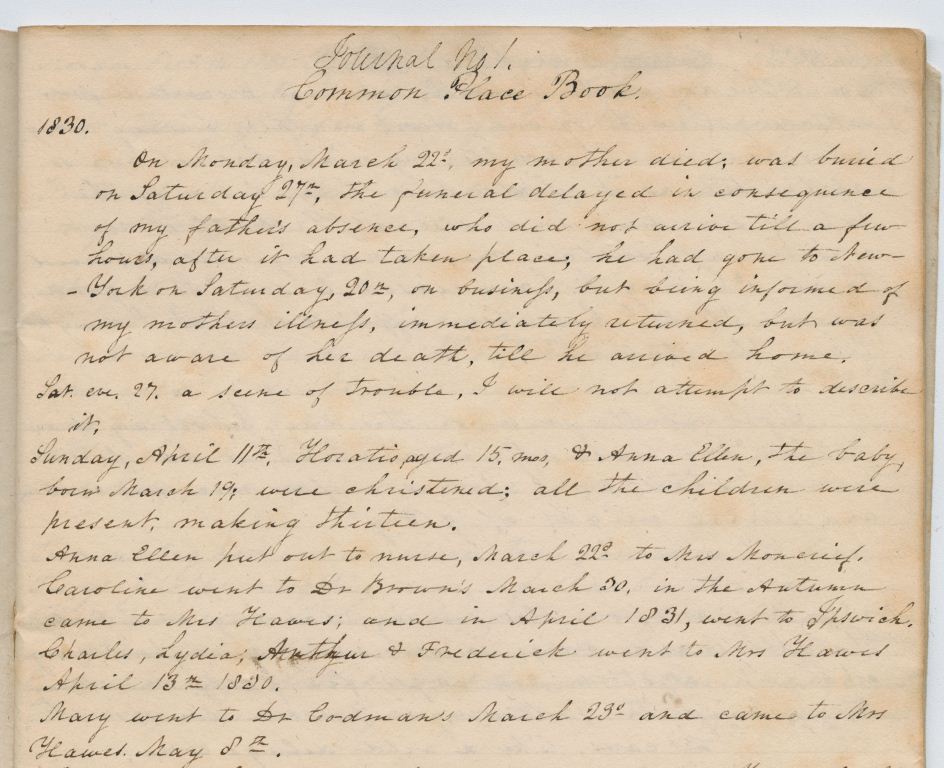
Her diaries begin with entries describing her mother’s death and the events that followed:

1830. On Monday, March 22d, my mother died; was buried on Saturday 27th, the funeral delayed in consequence of my father’s absence, who did not arrive till a few hours, after it had taken place; he had gone to New-York on Saturday, 20th, on business, but being informed of my mothers illness, immediately returned, but was not aware of her death, till he arrived home.

Sat. eve. 27. A scene of trouble. I will not attempt to describe it.

Sunday, April 11th. Horatio, aged 15. mos, & Anna Ellen, the baby, born March 19; were christened; all the children were present, making thirteen.

Anna Ellen put out to nurse, March 22d to Mrs Moncrief.

Henry Gray returned to business in New York and frequently wrote to Elizabeth with news and advice. I was prepared to dislike Henry for his absenteeism, but his letters demonstrate a respect for his daughter that impressed me. He almost always deferred to her in matters related to the children. He wrote with genuine affection and regard for her happiness, as well as confidence in her judgment. For example: “I approve your measures, not only what you have done, but what you may do.”

The rest of the correspondence consists primarily of letters to Elizabeth from her brothers William, John, and Henry, Jr. In the 1830s, the boys were living in various Massachusetts towns, where they were educated and trained for professions. My favorite correspondent, by far, is John. He often wrote to Elizabeth with desperate pleas for money, clothing, and other items, and when she sent them, he was effusive in his gratitude. Here’s part of letter dated 25 Oct. 1831:

I shall simply say I have received what you promised: viz bundle and moneys. A thousand thanks—best feelings—memorys of you—none wrecked. Indeed you have been a second mother. May the Father of Mercies, direct the early beginning of such charity, to terminate in your own personal happiness! I address him for you; for you especially, peculiarly, emphatically for you.

John’s life also ended prematurely, which adds to the pathos of his letters. He was studying law, but struggled with financial and emotional problems. After a failed effort to establish himself in the west, the 23-year-old John was found dead in a hotel in Wheeling, Virginia (now West Virginia) on the morning of 21 Mar. 1837, almost seven years to the day after his mother’s death. He’d taken a fatal dose of opium.

Caption: The last letter in the collection from John Gray, written in Wheeling.

The collection includes many letters related to John’s death, as the family struggled to come to terms with it. Henry felt that John had been the most gifted of his children, and his death was an “irreparable loss.” An inquest established that John had not died by suicide, and Dr. Eoff of Wheeling provided more details on his state of mind in the last days. In a letter to Elizabeth, he explained that John had suffered from delusions and took the opium as a curative:

He believed that one or more living animals were within him & consuming his heart, liver, &c &c & imagined that he could hear them singing &c. These impressions produced great depression of spirits & kept him continually anxious to take some medicine to remove them.

As for the other Gray siblings, my research turned up only the barest outlines of their lives. Elizabeth herself lived to be 82, but never married, though she received offers. In later life, she lived with her youngest sister Anna Ellen and helped care for her nephew, William Gray Brooks. He remembered his aunt Elizabeth fondly, writing: “I owe to her unselfish devotion and love whatever I am or know.”

Another moving tribute appears in a letter to Elizabeth from her troubled brother John, written on 16 Sep. 1834:

You say little to me of Futurity; perhaps you speak the less, because you feel the more. You have acquired fame enough. To illustrate your virtues and tenderness I point to twelve brothers and sisters. Let me partake of your advice often, that my gratitude may be strengthened, if it be capable of it.

An American Woman in Egypt, 1914-1915: Asswan to Abu Simbel

By by Anna Clutterbuck-Cook, Reader Services

Today we rejoin our anonymous female diarist as she journeys down the Nile in the winter of 1914-1915. You can read previous installments of this series here (introduction) here (Cairo to Aysut) and here (Aysut to Asswan).

What strikes me about the diary entries for 6-10 December 1914 is that while our American traveler is describing mural reliefs, shopping at outdoor markets, and visiting luxury resorts, Europe is settling in for the first winter of the Great War. During the first week of December, the Austrian army captured Belgrade and the British-Indian army was moving across Mesopotamia toward the Ottoman empire. The Great War YouTube series provides a nine-minute synopsis of the week’s events in newscast form.

Meanwhile, on the Nile:

Dec. 6. Arrived at Komumbu about 10  & walked to temple a few steps away. Temple dedicated to 2 deities, each deity had his own special worship & festivals so there are really 2 temples; the temple was divided & each side had its own gateways, doors & chapels. Crocodiles were worshipped here. Mural reliefs especially beautiful. Fine view of Nile country from temple. After lunch reached Asswan about 3. Took boats from ship & went first to Elephantine island to see the Nilometer & some ancient ruins; then sailed round island by Cataract Hotel to mainland & went through the Bazar with the [illegible word]. Got back to ship for late tea & had fine sunset coming back.

Dec 7. At 9.30 took boat to ships – visited shops & bought [illegible word], then went up to Cataract Hotel & looked at views. Got back just for lunch. Saw Eatons at hotel, who asked us to lunch P.M. At 2.30 went ashore with Miss Phelps took carriages & road out on desert to granite quarries & Bisharin camp where the natives danced for us on the sand. Saw horses raced [illegible] we had to get out and go in other carriages. Lunch in the [illegible word] . Got back for tea after 5. Then packed.

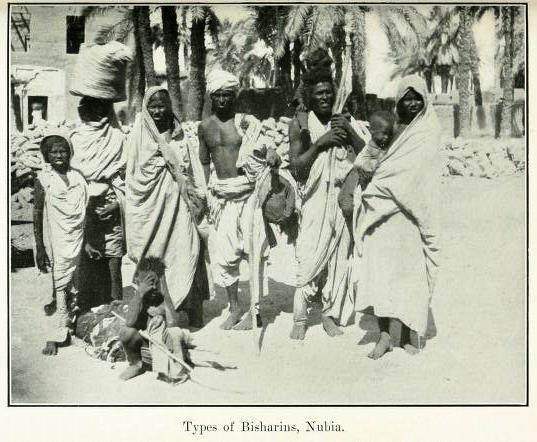
The entry of 7 December 1914 is the first time that local Egyptians, in this case the Beja people of southern Egypt and northern Sudan, have appeared in our narrator’s diary. The portrait of a group of anonymous Bisharin (a subgroup of the Beja people) which appears above, comes from the contemporaneous travel narrative Along the Nile with General Grant by Elbert E. Farman (1904). Farman’s description of the community which he and General Grant visited, like that of our diarist, situates the Bisharin as local color: “It is here that they are best seen in their real native character, habits and dress … Here was the simplicity of nature” (220-221). The brief appearance of the Bisharin in our diarist’s narrative underscores the overall absence of interaction with local Egyptians. Like many tourists today, our diarist’s focus on the ancient history and landscape of the places she passes through renders the inhabitants an often indistinguishable part of the backdrop.

Dec 8. Had early breakfast & left boat at 8.30. Took boat to train & then trains  to [illegible phrase] & there we left our party & went on board the Prince Albert sailing at 9.30 After lunch visited temple of Dendur a very small temple built by Augustus. Later, almost at sunset, landed in boats & visited temple of Gerf-Hosein. Had magnesium light to see inside. In the center some pillars [illegible phrase] burial figures of Ramses II. [illegible phrase] statues of King there [illegible phrase]. Quite dark going back to boat.

Dec. 9. Arrived soon after breakfast at Wadi Sabou & went ashore to visit temple. An [illegible word] of sphinxes leading to the temple. Soon after lunch went ashore again to see temple of Amadu – then at sunset reached Kaer-[illegible word] & climbed to top of ruined fort or castle for the view. Stopped here for the night.

Dec. 10. Reached Abu Simbel just before lunch & after it went ashore & saw the temple – with 4 statues of Ramses II outside 66 ft high – then at the right temple dedicated to his wife. Hathor & his wife. The front ornamented with statues of the king, his wife & some of his children. After dinner went back to see it by moonlight.  Were called at 4.30 A.M. to see [illegible phrase] temple hewn in rocks, to 185 ft deep.

Stay tuned for the next chapter in our diarist’s travels, to be posted mid-June. And, as always, you are welcome to access the diaries for yourself here in the Massachusetts Historical Society’s library reading room


Extinction and Discovery, Denial and Redemption: The Brontosaurus Roller Coaster

By Dan Hinchen

The Brontosaurus is one of the most easily identified dinosaurs in popular culture. Just think about Little Foot, the main character in the animated movie, The Land Before Time, or about Fred Flintstone chowing down on a brontosaurus burger.

Despite this popularity, since 1903 this animal has officially been considered a non-entity. Rather than representing a singular genus of dinosaur, it was believed that the available fossils were actually those of a species of Apatosaurus, that archaeologists misidentified the bones. Thus, the lone species of the genus, Brontosaurus excelsus, was reassigned as A. excelsus.

Earlier this month, though, some members of the scientific community turned an about-face and accepted that the two genera of dinosaur, Apatosaurus and Brontosaurus, are distinct enough from one another to receive individual classification. Once again, Brontosaurus is a valid term. You can read more about the debate in nomenclature and cladistics in the articles listed at the end of this post.

So what does this have to do with the MHS?

Within our holdings is a publication created by Othniel Charles Marsh, the man credited with original identification and description of both the Brontosaurus and Apatosaurus, among many others. The Dinosaurs of North America (1896) is an extract from the 16th annual report of the U.S. Geological Survey.

In this report, Marsh looks at three main time periods in turn, beginning with the Triassic period, then Jurassic, then Cretaceous. In each period he splits his descriptions among three distinct orders of dinosaurs: theropods, sauropods, and predentata. The first part of the book is devoted to narrative description. As he begins a new order of animal he gives brief and broad descriptions of typical characteristics and geographic dispersal. Then he gets more specific, identifying major families and genera within each order.

Theropods were typically bipedal and carnivorous. The most famous of all the theropod dinosaurs must be Tyrannosaurus rex. Marsh, however, looks at some of its smaller cousins that were located in North America, like the Allosaurs and Ceratosaurs.


Sauropods were large four-legged herbivores (mostly), characterized very generally by huge, barrel-shaped bodies with long slender tails and necks, and relatively small heads. It is into this order that the genera Brontosaurus and Apatosaurus fall. Other fairly well-known names in this type are the brachiosaurs and diplodocidae.


The third and most varied order handled by Marsh in this book are the predentata, now known more widely as ornithischia. This order contains the armored stegosaurs and ankylosaurs, the horned ceratopsians, and the duck-billed hadrosaurs.


Following all of this narrative information are dozens of plates featuring detailed drawings of skeletons and individual bones. All of the images in this post come from this volume and are a small sampling of those present.

Unfortunately, when searching our online catalog, ABIGAIL, this item is the only one that comes up under the subject Dinosaurs. Still this volume is wonderful look at the work which laid the foundation for our modern understanding of these long-extinct creatures. Do you have any favorites that appear here? What do you think of the potential resurrection of the Brontosaurus?


For further reading

Choi, Charles. “The Brontosaurus is Back.” Scientific American (2015). Accessed April 25, 2015. http://www.scientificamerican.com/article/the-brontosaurus-is-back1/

– Naish, Darren. “That Brontosaurus Thing.” Scientific American (2015). Accessed April 25, 2015. http://blogs.scientificamerican.com/tetrapod-zoology/2015/04/24/that-brontosaurus-thing/

– Switek, Brian. “Back to Brontosaurus? The Dinosaur Might Deserve Its Own Genus After All.” Smithsonian (2015). Accessed April 25, 2015.  http://www.smithsonianmag.com/science-nature/back-brontosaurus-dinosaur-just-might-deserve-its-own-genus-species-science-180954892/?no-ist

An American Woman in Egypt, 1914-1915: Aysut to Asswan

By Anna J. Clutterbuck-Cook, Reader Services

Image: Watercolor from A Nile Journal by Emily Horby (1908)


In the previous installment of An American Woman in Egypt, we left our narrator journeying south from Aysut by steamer. During the first week of December, the travelers continue down the Nile stopping at a number of archeological sites and luxury tourist resorts along the way. In this post, I have interleaved our anonymous diarist’s narrative with excerpts from a contemporary travel guide and published memoir describing the same locations.

Dec. 1. Had early breakfast, reached Denderah & went ashore there at 8.30. Took donkies [sic] & rode to Denderah Temple in 2 hours. Temple of Hathor.  Great vestibule of Pharaohs 24 columns with heads of Hathor. Went up on the roof for view. Got back for lunch. Just at tea time reached Luxor. Miss Goeller & we two went ashore with Dr. Hodson who took us over the Winter Palace Hotel & gardens. Then we walked out to Luxor temple & looked at ships.

Dec. 2. Started on donkies at 9.30 & rode to Karnak. Very hot day. Saw temple of Kurnah then rode dromedaries little way to temple of Ammon. Finally went on top for view and got home just before one p.m. Very warm & slept after lunch; had tea at 4 & then went out to see Luxor temple. A beautiful sunset & we stayed behind to see the color on the water then went to Winter Palace & P.O.

 A short distance from the river, on the west bank, a little to the north of the village of Denderah, stands the Temple of Denderah, which marks the site of the classical Tentyra or Tentyris … where the goddess Hathor was worshipped. … The wonderfully preserved Temple now standing there is probably not older than the beginning of our era; …hence it must be considered as the architectural product of a time when the ancient Egyptian traditions of sculpture were already dead and nearly forgotten. It is, however, a majestic monument worthy of careful examination.
The Nile: Notes for Travellers in Egypt, 9th edition (London: Thos. Cook & Son, 1905).

Dec. 3. Breakfast at 7.30, left at 8.30 & sailed across to W. bank where we took donkies & road to mortuary chapel of Sethos I. Then rode on to tombs of Kings & reached 4 — Ramses IX – Ramses VI – Sethor I – Amenophis II – then walked up over hill for view & down to rest-house for lunch. At 2 walked to temple of Darr El-Bahre of Queen Hatsh[epsut]. Then rode back to river & took boats home in time for tea. After it went to buy cards.

Dec. 4 – Early breakfast at 7.30. Left at 8 & rode first to ruins of Rames great temple of Ramses Srenk II, then road to temples of Derr-El-Medenah, judgement halls of Osiris, & temple of Ramses III. … finest in Egypt. Passed Colosses of Memmon (Amenophsis III) on way back to boat. Got back to steamer just for lunch. P.M. took pad[dle] on Nile for 1 hr with Miss Phelps & Miss Marell, mailed my Christmas cards after tea went to Hotel [illegible phrase] walked along shore to see sunset, then went into shops.

Came to a lovely grove of palm trees, where we lunched. Donkeys arrived…and we had a very pleasant ride on to Karnak, a good way further. Pigeons flying in clouds over fields. Must be very destructive, but picturesque. Soon the obelisk was seen in the distance, and at last we came to the avenue of the sphinxes, which has only been lately thoroughly uncovered. Enormous creatures, each with a little figure on their knees.
A Nile Journal by E. H. [Emily Hornby] (Liverpool: J.A. Thompson, 1908)

Dec. 5. Sailed very early from Luxor & about 10 arrived at Esna after going thro’ a lock. Walked to the temple, as it was very near. Temple of Khnum goat-headed local deity. Pronave 24 columns in 6 rows with different floral capitals – similar to  of temple Hathor at Denderah. From there sailed on & reached Edfou about 3, took donkeys & some walked to the temple of Horus, best preserved ancient temple in the world. A great [?] & we went to top up a dark stairway for view 242 steps. Crest surrounded on 3 sides by colonnade of 32 columns in the different floral (^ & palm) capitals [illegible phrase] wall also decorated. In evening we had a lecture on the Nile by the doctor. Got back from temple for tea.

Side-by-side it is possible to see how the genre of travel writing, published and unpublished, often contains strikingly similar observations, despite differences in tone (the Cook’s authoritative, the Hornby self-consciously poetic in her descriptions). It is likely that our diarist would have read one or more commercially-published travel guide before or during her tour, and it is clear that Dr. Hodson, mentioned in the December 5 entry above, mediates her interpretation of the archeological sites the group encounters. 

In two weeks we will continue our journey down the Nile. In the meantime, I encourage you to explore the lavish watercolor illustrations and personable narration of Emily Hornby’s Nile Journal at Internet Archive.

“The Long Agony Is Over”: The Trial of John White Webster

By Susan Martin, Collection Services

With all the coverage of the Tsarnaev trial here in Boston, I’m reminded of another case that rocked the city 165 years ago: the murder of George Parkman in Nov. 1849. Harvard Medical College lecturer John White Webster, who owed Parkman a significant sum of money, was accused of killing him and attempting to destroy his body by burning it in a furnace. Webster was convicted on 30 Mar. 1850 and sentenced to execution by hanging. The gruesome nature of the crime and the high social standing of both men meant that not just all of Boston, but the entire country, was riveted.

The story has been covered so well and so thoroughly by others that I won’t go into the details of the case, but I was curious about contemporary reactions to the crime and the trial. Manuscript collections at the MHS give us a nice cross-section of opinions. For example, the day after the verdict came down, a young woman named Harriet Hayward wrote in her diary:

Has been a dismal day. Poor Dr Webster is pronounced guilty; the verdict was brought in last night, and we heard of it this morning. I have felt fairly sick today, and totally unfit to take charge of a class at Sunday school. What a barbarous and wicked law! A man taken from his wife and children to be put in prison for a short time, and afterwards hung [sic], while the family is made wretched. When a poor man is once fairly shut up in prison, and not able to say a word for himself, all kinds of stories are circulated about him, that have no foundation. If I were a person of some importance and could say or do any thing to save his life I would do it, but I feel my own insignificance now more than ever. I hope mercy will be shown him in another world.

It’s unclear to me what Hayward thought of Webster’s guilt or innocence, but she certainly objected to the sentence of death, and her reaction was not atypical. Letters started pouring into Massachusetts Governor George N. Briggs’ office from all over the country petitioning for clemency for Webster. Some argued he was innocent, that he had not received a fair trial, or that the evidence against him was circumstantial. (One anonymous letter claims Webster couldn’t possibly have committed the crime because the writer did it himself!) Others accepted his guilt but opposed capital punishment on religious or moral grounds. Many called the murder unpremeditated and believed Webster was sincerely penitent.

The prosecutor in the case, John H. Clifford, was exhausted after the trial. He wrote in a letter on 2 Apr. 1850, “The long agony is over, and I am once more by my own hearth stone, trying to restore the equilibrium which two weeks straining of my entire being has deranged & disturbed. […] I cannot help feeling this trial to have been a great crisis in my life.” He called Webster “almost soulless” and was satisfied with the outcome, but pitied the man’s family.

Webster’s wife Harriet and their four daughters steadfastly maintained his innocence and banished any who doubted it from their Cambridge home, but some extended family members were unconvinced. Harriet’s sister Amelia (Hickling) Chambers Nye had no trouble believing Webster guilty. In letters written between June 1850 and Feb. 1851, Nye made her case against her brother-in-law. In fact, she had suspected him all along:

Is it not strange that when Eliza and I saw the first advertisement about Dr. P’s disappearance and Dr. Webster being the last person who saw him the thought struck us both that he knew more of his disappearance. The same thing struck both sister Prescott and Susan and Emma so that every one who knew him best, suspected him first. On the Wednesday before Thanksgiving he went to Mrs. Cunningham’s to a party, a lady said to him so Dr. you were the last person who saw Dr. Parkman what if you should be suspected. He immediately replied, “what do you think I look like a murderer?” and went on talking about something else.

In her long, somewhat rambling letters, Nye described the Websters’ financial problems, her brother-in-law’s “bad qualities,” and other heinous crimes she believed he’d committed years before. She thought Harriet and the children were deluded. Since they refused to read the papers, they were unaware that “one half the people in Boston believe it was a premeditated act.” Much of what Nye wrote was hearsay and rumor, but her animosity toward Webster is unmistakable. His penitence was feigned, she claimed. His family would be better off without him, and even execution would be preferable to the shame of life imprisonment, a fate she described as “a living death to all of them.”

After his conviction, John White Webster confessed to killing George Parkman in a fit of rage over the debt. He also wrote to Francis Parkman, George’s brother, asking for forgiveness. Gov. Briggs, however, did not commute his sentence, and Webster was hanged on 30 Aug. 1850. Boston merchant Frederic Cunningham read a description of the execution in the newspaper and wrote about it in his diary, commending Webster’s self-possession: “He walked firmly to the scaffold & fell 8 feet.” According to Cunningham, the people of Boston were “better disposed towards him” after his death.

Though opinions were sharply divided, the case held an undeniable fascination. Three weeks after the trial, in spite of her horror at the verdict, young Harriet Hayward and some friends visited the Harvard Medical College laboratory where the crime had taken place. Amelia Nye’s friend Miss Jennison told her that “she never saw so many carriages in Cambridge before. They rode round the square purposely to look at the [Websters’] house.” As for Nye, she wrote of John White Webster, “I cannot help shuddering when I think of him.”


Selections from MHS in the New “Remembering Lincoln” Digital Collection

By Nancy Heywood, Collection Services

On 14 April 1865, while attending a play at Ford’s Theatre in Washington, D.C., President Abraham Lincoln was shot by John Wilkes Booth.  The event was tragic and shocking. Lincoln died the next morning, 15 April, and people all over the country struggled to comprehend what had happened.

Ford’s Theatre, a National Historic Site and a working theatre, has recently launched a new digital collection, Remembering Lincoln.  Two dozen institutions, including the Massachusetts Historical Society, have contributed digital images, metadata, and transcriptions of materials about the assassination of President Lincoln to this online collection. Researchers can read first-person accounts of the startling event, examine newspaper articles, explore printed documents and broadsides, and look at artifacts.

Several remarkable manuscripts from the collections of the MHS are included in the Remembering Lincoln collection.  Two letters were written by Augustus Clark, a War Department employee, who was one of the men who moved Lincoln after he was shot from Ford’s Theatre to Petersen’s boarding house.  One of Clark’s letters (addressed to S. M. Allen) fully describes his impressions of the evening and the tragic event.  In the other letter, written to Massachusetts Governor John A.  Andrew, Clark mentions enclosing a piece of cloth with Lincoln’s blood with the correspondence.  Both letters (letter to S. M. Allen and letter to Gov. Andrew) and also the towel fragment are viewable on the website. 

Another item featured in the digital collection is an excerpt from the young Boston diarist, Sarah Gooll Putnam.  Only 14 years old in April of 1865, her reaction was poignant.  She drew a shocked face on her diary page along with the following words:   

Now guess my feelings, when coming down to breakfast, at mother’s saying “The president is killed!” I stared so [handwritten mark pointing to illustration] for a few minutes without speaking. I cannot realize it yet.  Poor, dear, old, Abe.

Please explore the whole Remembering Lincoln website:  http://rememberinglincoln.fords.org/


A browse display of the items that MHS contributed to Remembering Lincoln is also available:  http://rememberinglincoln.fords.org/contributor?uid=40