“The Long Agony Is Over”: The Trial of John White Webster

By Susan Martin, Collection Services

With all the coverage of the Tsarnaev trial here in Boston, I’m reminded of another case that rocked the city 165 years ago: the murder of George Parkman in Nov. 1849. Harvard Medical College lecturer John White Webster, who owed Parkman a significant sum of money, was accused of killing him and attempting to destroy his body by burning it in a furnace. Webster was convicted on 30 Mar. 1850 and sentenced to execution by hanging. The gruesome nature of the crime and the high social standing of both men meant that not just all of Boston, but the entire country, was riveted.

The story has been covered so well and so thoroughly by others that I won’t go into the details of the case, but I was curious about contemporary reactions to the crime and the trial. Manuscript collections at the MHS give us a nice cross-section of opinions. For example, the day after the verdict came down, a young woman named Harriet Hayward wrote in her diary:

Has been a dismal day. Poor Dr Webster is pronounced guilty; the verdict was brought in last night, and we heard of it this morning. I have felt fairly sick today, and totally unfit to take charge of a class at Sunday school. What a barbarous and wicked law! A man taken from his wife and children to be put in prison for a short time, and afterwards hung [sic], while the family is made wretched. When a poor man is once fairly shut up in prison, and not able to say a word for himself, all kinds of stories are circulated about him, that have no foundation. If I were a person of some importance and could say or do any thing to save his life I would do it, but I feel my own insignificance now more than ever. I hope mercy will be shown him in another world.

It’s unclear to me what Hayward thought of Webster’s guilt or innocence, but she certainly objected to the sentence of death, and her reaction was not atypical. Letters started pouring into Massachusetts Governor George N. Briggs’ office from all over the country petitioning for clemency for Webster. Some argued he was innocent, that he had not received a fair trial, or that the evidence against him was circumstantial. (One anonymous letter claims Webster couldn’t possibly have committed the crime because the writer did it himself!) Others accepted his guilt but opposed capital punishment on religious or moral grounds. Many called the murder unpremeditated and believed Webster was sincerely penitent.

The prosecutor in the case, John H. Clifford, was exhausted after the trial. He wrote in a letter on 2 Apr. 1850, “The long agony is over, and I am once more by my own hearth stone, trying to restore the equilibrium which two weeks straining of my entire being has deranged & disturbed. […] I cannot help feeling this trial to have been a great crisis in my life.” He called Webster “almost soulless” and was satisfied with the outcome, but pitied the man’s family.

Webster’s wife Harriet and their four daughters steadfastly maintained his innocence and banished any who doubted it from their Cambridge home, but some extended family members were unconvinced. Harriet’s sister Amelia (Hickling) Chambers Nye had no trouble believing Webster guilty. In letters written between June 1850 and Feb. 1851, Nye made her case against her brother-in-law. In fact, she had suspected him all along:

Is it not strange that when Eliza and I saw the first advertisement about Dr. P’s disappearance and Dr. Webster being the last person who saw him the thought struck us both that he knew more of his disappearance. The same thing struck both sister Prescott and Susan and Emma so that every one who knew him best, suspected him first. On the Wednesday before Thanksgiving he went to Mrs. Cunningham’s to a party, a lady said to him so Dr. you were the last person who saw Dr. Parkman what if you should be suspected. He immediately replied, “what do you think I look like a murderer?” and went on talking about something else.

In her long, somewhat rambling letters, Nye described the Websters’ financial problems, her brother-in-law’s “bad qualities,” and other heinous crimes she believed he’d committed years before. She thought Harriet and the children were deluded. Since they refused to read the papers, they were unaware that “one half the people in Boston believe it was a premeditated act.” Much of what Nye wrote was hearsay and rumor, but her animosity toward Webster is unmistakable. His penitence was feigned, she claimed. His family would be better off without him, and even execution would be preferable to the shame of life imprisonment, a fate she described as “a living death to all of them.”

After his conviction, John White Webster confessed to killing George Parkman in a fit of rage over the debt. He also wrote to Francis Parkman, George’s brother, asking for forgiveness. Gov. Briggs, however, did not commute his sentence, and Webster was hanged on 30 Aug. 1850. Boston merchant Frederic Cunningham read a description of the execution in the newspaper and wrote about it in his diary, commending Webster’s self-possession: “He walked firmly to the scaffold & fell 8 feet.” According to Cunningham, the people of Boston were “better disposed towards him” after his death.

Though opinions were sharply divided, the case held an undeniable fascination. Three weeks after the trial, in spite of her horror at the verdict, young Harriet Hayward and some friends visited the Harvard Medical College laboratory where the crime had taken place. Amelia Nye’s friend Miss Jennison told her that “she never saw so many carriages in Cambridge before. They rode round the square purposely to look at the [Websters’] house.” As for Nye, she wrote of John White Webster, “I cannot help shuddering when I think of him.”


Selections from MHS in the New “Remembering Lincoln” Digital Collection

By Nancy Heywood, Collection Services

On 14 April 1865, while attending a play at Ford’s Theatre in Washington, D.C., President Abraham Lincoln was shot by John Wilkes Booth.  The event was tragic and shocking. Lincoln died the next morning, 15 April, and people all over the country struggled to comprehend what had happened.

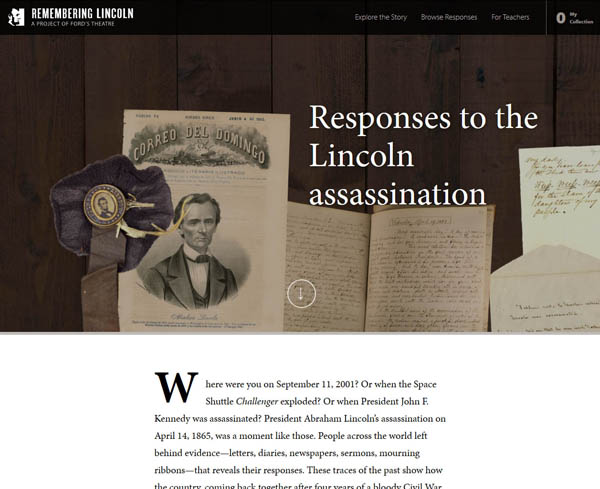
Ford’s Theatre, a National Historic Site and a working theatre, has recently launched a new digital collection, Remembering Lincoln.  Two dozen institutions, including the Massachusetts Historical Society, have contributed digital images, metadata, and transcriptions of materials about the assassination of President Lincoln to this online collection. Researchers can read first-person accounts of the startling event, examine newspaper articles, explore printed documents and broadsides, and look at artifacts.

Several remarkable manuscripts from the collections of the MHS are included in the Remembering Lincoln collection.  Two letters were written by Augustus Clark, a War Department employee, who was one of the men who moved Lincoln after he was shot from Ford’s Theatre to Petersen’s boarding house.  One of Clark’s letters (addressed to S. M. Allen) fully describes his impressions of the evening and the tragic event.  In the other letter, written to Massachusetts Governor John A.  Andrew, Clark mentions enclosing a piece of cloth with Lincoln’s blood with the correspondence.  Both letters (letter to S. M. Allen and letter to Gov. Andrew) and also the towel fragment are viewable on the website. 

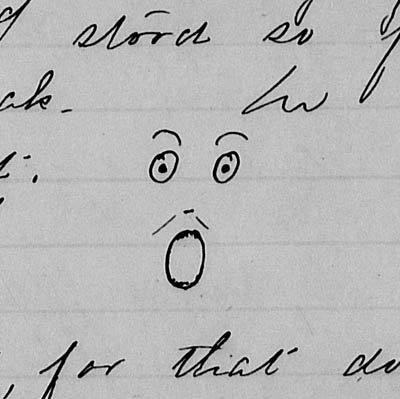
Another item featured in the digital collection is an excerpt from the young Boston diarist, Sarah Gooll Putnam.  Only 14 years old in April of 1865, her reaction was poignant.  She drew a shocked face on her diary page along with the following words:   

Now guess my feelings, when coming down to breakfast, at mother’s saying “The president is killed!” I stared so [handwritten mark pointing to illustration] for a few minutes without speaking. I cannot realize it yet.  Poor, dear, old, Abe.

Please explore the whole Remembering Lincoln website:  http://rememberinglincoln.fords.org/


A browse display of the items that MHS contributed to Remembering Lincoln is also available:  http://rememberinglincoln.fords.org/contributor?uid=40


Military Manuscripts at the MHS and Beyond

By Dan Hinchen

It is not uncommon for the MHS library to receive copies of new publications from authors that did research here. In fact, we have an entire set of shelves devoted to displaying this type of new publication. After some time on display, these volumes are typically moved to our closed stacks and then available by request. Less often, we receive a new publication from a researcher that we deem appropriate to move immediately into our reference collection.

We recently received a newly published book called Military Manuscripts at the State Historical Societies in New England (2014). This volume, put together by Paul Friday, provides extensive documentation of manuscript collections relevant to military history in New England. Each chapter shines a spotlight on one individual institution and provides detailed lists of manuscript collections that contain materials related to military matters.

Since I started working at the MHS in 2011, Mr. Friday’s face has been one of the more familiar ones in the reading room. Over the years he placed scores of requests to consult manuscript materials from myriad collections in our holdings. The result is a box-level, sometimes folder-level inventory of military-related papers that the Society preserves. The sources include a large variety of material types, from maps and charts to correspondence and orderly books to printed materials like broadsides. The materials he worked with encompass a large chronology, going back as far as the Pequot War of the 1630s all the way up to the Vietnam War.

The countless hours of work that Mr. Friday did result in extremely valuable identifications of military papers held here. From documenting a single letter by Gen. John Burgoyne in the Bromfield family papers, to identifying thirty-five boxes, seven volumes, and three oversize items in the Clarence Ransom Edwards papers.

In addition to identifying such relevant collections, Mr. Friday also provides explanations in each chapter about the various organization schemes used by the different institutions, catalogs available for researchers (online and physical), procedures for requesting materials, hours of operation, and so forth.

At the back of the volume there are four appendices made up of several glossaries and complementary information. Also, there are five separate indices and a section introducing them.

Because he used available finding aids and collection guides to locate collections with military papers, Mr. Friday acknowledges that each historical society holds additional relevant collections that did not have companion finding aids and so did not show up in the volume. Despite this limitation, the volume as a whole will surely prove a tremendous help for researchers performing primary source research into the military history of New England and the United States. 


“More fool than Knave”: Dr. George Logan and the Logan Act

By Amanda A. Mathews, Adams Papers

Over the last few weeks the Logan Act, a bill passed by Congress and signed by President John Adams in late January 1799 has been widely discussed in the national news. Here at the Adams Papers, work has just begun on Adams Family Correspondence, volume 13, in which Dr. George Logan, whose actions provoked this legislation, is a major topic of conversation for the Adamses on both sides of the Atlantic.

In September 1798, tensions between France and the United States were running high. The specter of war loomed large as the revelation of France’s bribery attempt in the XYZ Affair and continued attacks on American vessels led to a buildup of American armed and naval forces with growing chants of “millions for defense, but not a sixpence for tribute.” It was in this climate that from their place in Berlin, John Quincy and Thomas Boylston Adams reported on the arrival of Logan in Europe. John Quincy detailed that Logan was claiming to be an envoy representing the Democratic-Republican Party, which opposed John Adams’s administration. At first refused a passport into France, Logan continued to represent himself as officially representing the United States while waiting in the Netherlands, and was eventually granted permission to enter France and given audiences with members of the French government to discuss the differences between the two nations. Thomas summarized his views on Logan—“a villain & a traitor to his Country.”

After Logan returned to the United States in November, he met with President Adams to discuss what he had learned from his meetings with the French government and to convince Adams that the French had peaceful intentions. Abigail’s nephew, William Smith Shaw, serving as John’s secretary, reported to the First Lady, who had remained in Quincy: “[Logan] then said, that he had just come from France and that he had the pleasure to inform the president that the directory had altered their conduct respecting America and had become more pacifick. Why then, said the president, have they not repealed their decrees against our commerce? here Logan stammered and said they were making preparations to do it.” John next asked if Logan believed that France would faithfully maintain a new treaty with the US, and he answered affirmatively claiming “the firm and united conduct of the Americans had proved to the directory the impolicy of their conduct.” Shaw reported that this response made John “burst into a broad laugh.” Adams continued his questioning, as Logan became increasingly uncomfortable until he “seemed to want some lurking place like the Turtle to draw in his head and to hide his face.” From this report, Abigail ultimately concluded in a letter to her husband that Logan was “more fool than Knave.”

Whether fool or knave, hero or villain, the Federalist controlled Congress had no patience with his meddling and passed the act prohibiting unauthorized private citizens from negotiating with foreign governments on behalf of the United States. The law has been in force ever since.


The Unstoppable Anna Maria Mead Chalmers

By Susan Martin, Collection Services

As a manuscript processor here at the MHS, I have the opportunity to meet new people every day. Well, okay, most of them died a long time ago, but that doesn’t make them any less interesting! One of the best parts of processing and cataloging a new collection is getting to know the personal stories behind the letters, diaries, and other papers. I almost always uncover something unexpected.

Case in point: a small collection recently donated to the MHS consists primarily of letters written by Sarah Louisa “Louly” (Hickman) Smith to her sister Anna Maria. Now, I knew that Louly had become a published poet in her teens before her untimely death at the age of 20, and her letters reveal a remarkable young woman. But I was also curious about Anna Maria. The collection contains letters written to her, but none by her, so she seemed more elusive.

The first clue I had about her life was her name. She was born Anna Maria Campbell Hickman on 23 July 1809. Simple enough so far, but it gets trickier. She married three times (and outlived all her husbands): first a Mr. Otis, then Mr. Mead, and finally Mr. Chalmers. For those of you at home keeping score, that would make her Anna Maria Campbell Hickman Otis Mead Chalmers. (She’s generally referred to as Anna Maria Mead Chalmers.)

The more I learned about Anna Maria’s life, the more interesting it became. Originally from Newton, Mass., she studied under some of the best teachers in the Boston area and spent a year with an aunt and uncle in Savannah, Ga. before marrying a young Boston lawyer named George Alexander Otis, Jr. in Feb. 1830. Unfortunately her husband died of consumption the following year when their son was only seven months old. George’s death was followed closely by that of her beloved sister Louly on 12 Feb. 1832.

In the mid-1830s, Anna Maria lived in Newton with her mother and young son (her father had died in 1824) and wrote several children’s books for the American Sunday-School Union. She met and married the Rev. Zachariah Mead, a Virginian, moving with him to Richmond in 1837. The couple had two sons and a daughter: Edward C., William Z., and Anna Louisa Mead. Zachariah died (also of consumption) on 27 Nov. 1840, and Anna Maria, still just 31 years old, was now twice widowed and the mother of four young children.

For about a year, she took over Zachariah’s editorship of the Southern Churchman, to which she had often contributed, before selling the paper and embarking on arguably the most significant chapter of her life. On 4 Oct. 1841, she opened a boarding school for girls in Richmond, which she would run for 12 years to great acclaim. During her tenure, hundreds of girls were educated in subjects as wide-ranging as history, literature, theology, the sciences, mathematics, languages, music, art, etc., all in accordance with Christian principles. An 1842 advertisement in the Southern Literary Messenger described the school’s mission this way: “to form the female character for its high duties here and its still higher destination hereafter.” Anna Maria also continued to write devotional fiction and articles.

Tragedy struck again when her youngest child and only daughter, three-year-old Anna Louisa Mead, died on 4 Dec. 1843. Her mother followed four years later. So, by the 1850s, Anna Maria had buried her parents, her sister, two husbands, and a daughter. She retired as schoolmistress of “Mrs. Mead’s School” and, on 3 Jan. 1856, at the age of 46, married her third husband, David Chalmers. He was a widower and a member of the Virginia House of Delegates, and he owned a large Halifax County plantation.

As a wealthy planter, David Chalmers was, unsurprisingly, an enslaver, and Anna Maria became “a true Virginia matron.” How did she feel about the South’s so-called “peculiar institution”? According to her son Edward in his comprehensive 1893 biography, she opposed slavery and often spoke out against it, but took no active part in the fight for abolition. She preferred to leave the matter to God. And while her husband advocated secession, she dreaded the coming war between the states. With very good reason, it turned out: the Civil War would find her with one son serving in the Union army, another in the Confederate army, and all of her northern property under threat of confiscation.

Her oldest son, George Alexander Otis (1830-1881), was a surgeon with the 27th Massachusetts Volunteers and the U.S. Volunteers. Her third and youngest son, William Zachariah Mead (1838-1864), fought for the Confederacy and was killed on 14 May 1864 in the Battle of Resaca, Ga.

Anna Maria traveled north in 1863 to protect her property there and stayed in New York until the end of the war. In 1865, she returned to Virginia, where she would spend years helping the poor, educating formerly enslaved people, and writing. She died on 8 Dec. 1891, outliving her third husband by 16 years and her oldest son George by ten, and survived by only one of her children, Edward Campbell Mead (1837-1908).

In her 82 years of life, Anna Maria Mead Chalmers was many things: a writer, an editor, a teacher, a philanthropist; a sister, a mother, and the wife (and widow) of a lawyer, a minister, and a farmer; a Northerner and a Southerner. It’s remarkable to find so much of American history all rolled up into one person!

Newly Digitized Photograph Collection

By Peter K. Steinberg, Collection Services

Collection Services at the Massachusetts Historical Society has recently created a collection guide for, and fully digitized, the 5th Massachusetts Cavalry Regiment carte de visite album, ca. 1864-1865 (Photograph Collection 228).

The 5th Massachusetts Cavalry Regiment was a “colored volunteer” regiment active from 9 January 1864-31 October 1965. Formed at Camp Meigs, Readville, Massachusetts, was commanded by some notable sons of Massachusetts including Charles Francis Adams Jr., Henry S. Russell, Charles Pickering Bowditch, and Henry Pickering Bowditch. The regiment saw some action in the war, notably in a battles which took place at Baylor’s Farm and the Siege of Petersburg in Virginia.

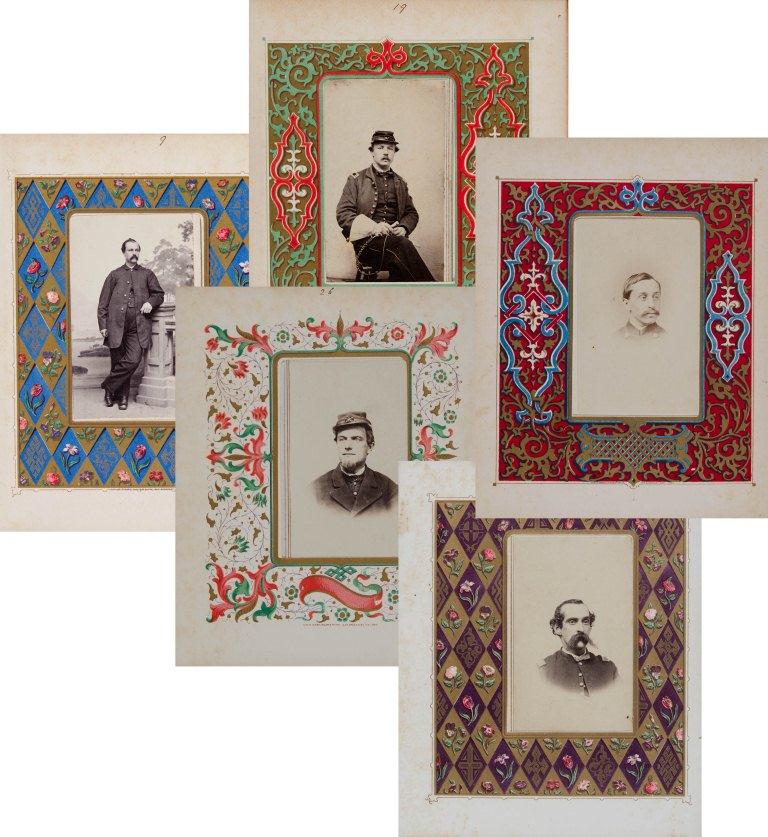
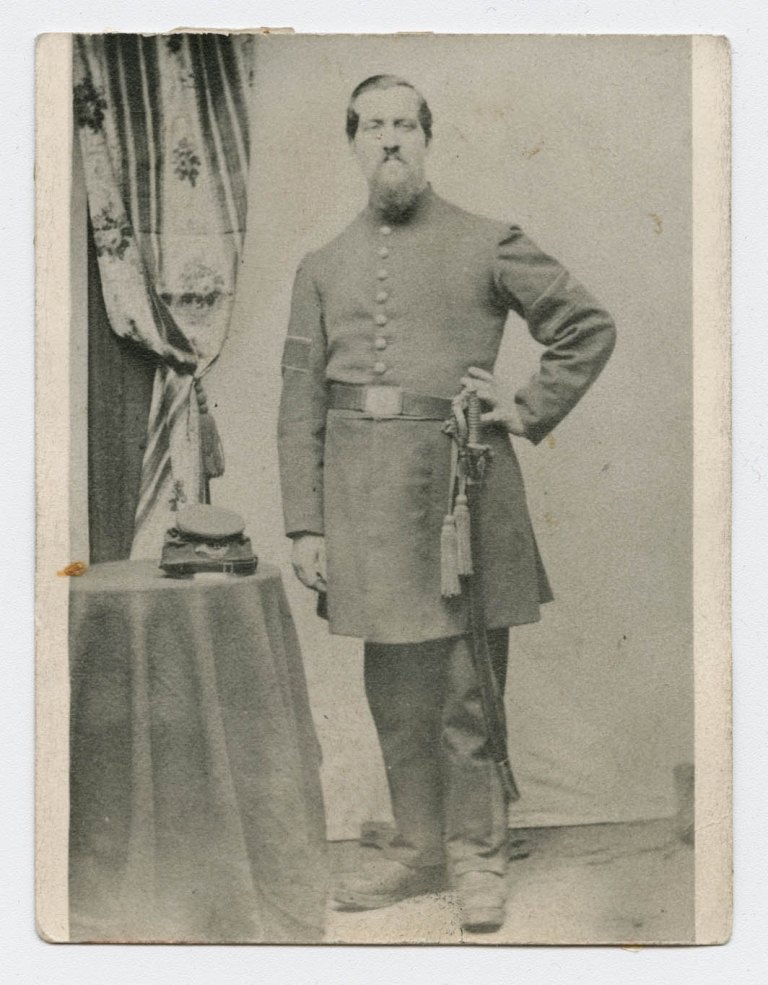
This collection consists of a photograph album containing 46 carte de visite photographs of officers from the regiment. In addition to those named above, the regiment included Edward Jarvis Bartlett, Daniel Henry Chamberlain, Patrick Tracy Jackson, and others. The album includes a two-page handwritten index which identifies all but one of the photographs. Each image appears on a page beautifully bordered, as can be seen in the examples presented here.

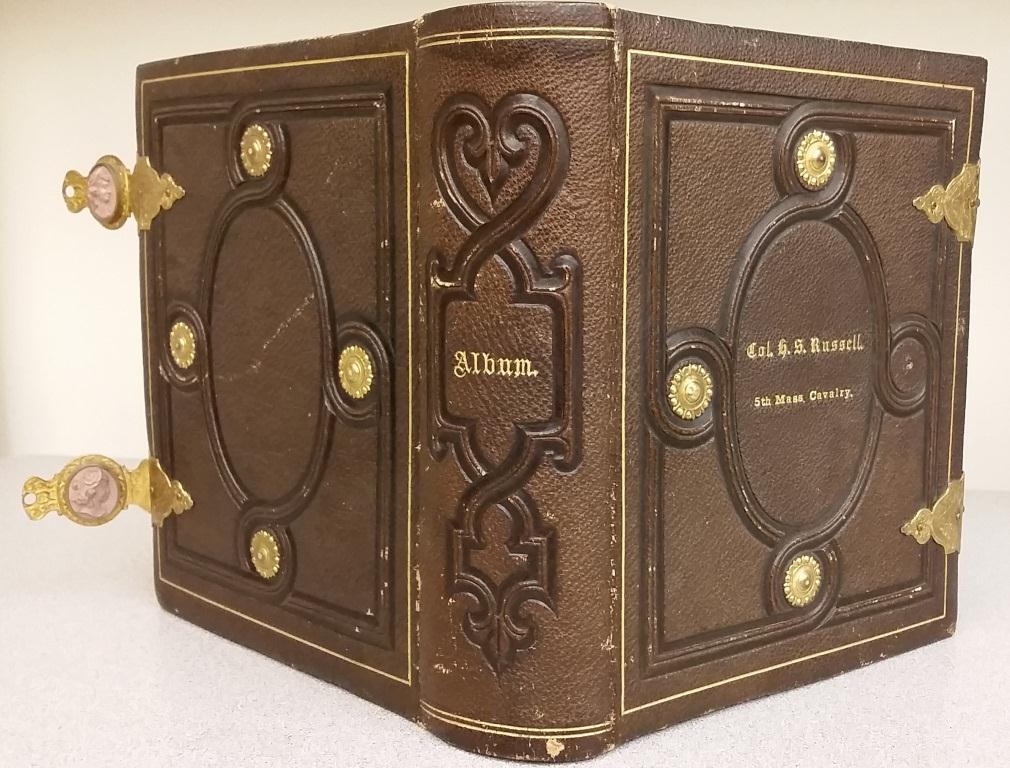
The cover of the album, also stunning, is embossed: “Col. H. S. Russell. 5th Mass Cavalry” and features the original, still-functioning brass clasps to keep the album closed. Henry S. Russell (1838-1905), an 1860 graduate of Harvard University, served several ranked positions in the Union Army reaching Lieutenant-Colonel of the 2nd Massachusetts Infantry and Brigadier-General of the 5th Massachusetts Cavalry. In 1864, Russell married Mary Hathaway Forbes, the daughter of the influential Boston businesman, railroad magnate, and abolitionist John Murray Forbes, and was a cousin of Robert Gould Shaw, Colonel of the 54th Massachusetts Volunteer Infantry Regiment.

Another family connection, but this time within the 5th Massachusetts Cavalry Regiment, were the brothers Henry Pickering Bowditch (1840-1911) and his younger brother Charles Pickering Bowditch (1842-1921). Both were Harvard educated; Henry being a physician and physiologist as well as dean of Harvard Medical School, and Charles becoming a financier, archaeologist and linguistics scholar.

This is the seventh fully digitized Civil War photograph album at the Massachusetts Historical Society. The MHS has additional fully digitized Civil War materials available, as well. Further Reading: Morse, John T., Jr. “Henry Sturgis Russell.” In Sons of the Puritans: A Group of Brief Biographies. Boston: American Unitarian Association, 1908:153-162.

Memories of the Civil War

By Susan Martin, Collection Services

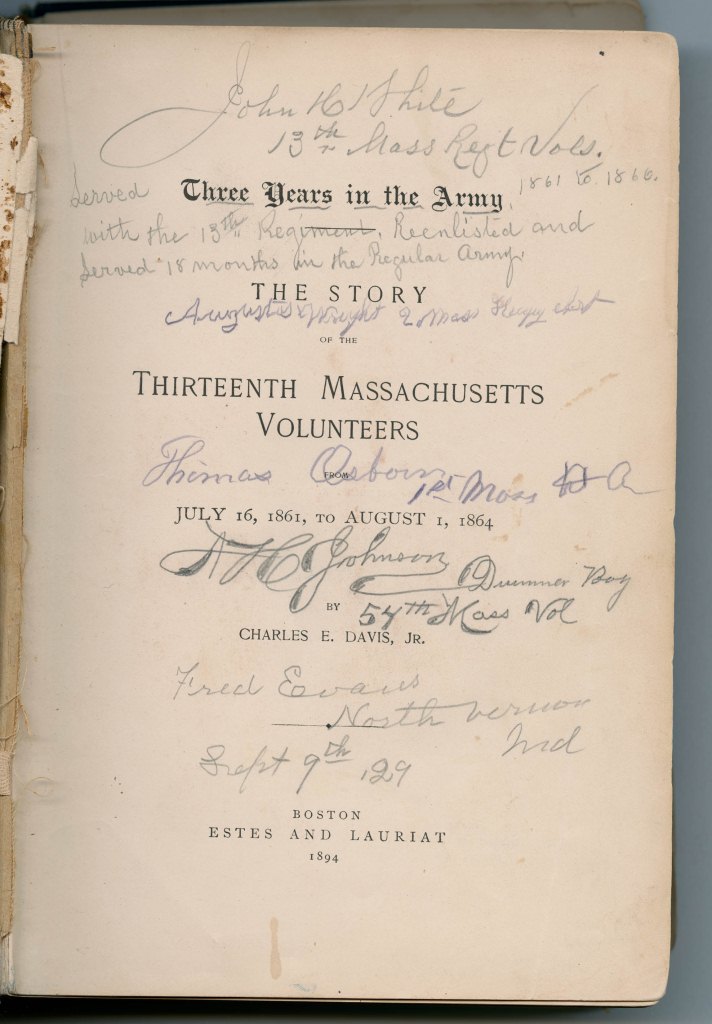
John Hill White (1835-1920) served as a hospital steward in the 13th Massachusetts Infantry during the Civil War. His collection at the MHS  contains a lot of fascinating material, including four diaries he kept from 1862 to 1865. But I was particularly interested in his personal copy of the book Three Years in the Army: The Story of the Thirteenth Massachusetts Volunteers by Charles E. Davis, Jr. When White’s collection was acquired, the MHS already held a copy of this regimental history as part of its reference collection. But White’s copy is unique because he annotated many of the pages, adding valuable and sometimes hilarious running commentary in the margins.

Title page autographed by veterans of other regiments

Many of White’s notes, probably written about 1903, identify individuals Davis had left anonymous. White also underlined and bracketed passages and added some specific dates, presumably by consulting his own diaries. But it’s his longer annotations that make for the most entertaining reading. Take, for example, this anecdote he scribbled at the bottom of page 40:

Capt Joe Coburn [Colburn], Ned Frost, John Saxton, & myself went to the hotel in town. The landlady asked Coburn if he was General Abercrombie & staff. Joe said yes, and she informed him that supper was all ready. The General had ordered the supper. We ate it, you bet, and as the general appeared at the front door we made a masterly retreat out the back door, & the general never found out who ate his supper, and did not pay for it.

And another a few pages later:

It was at Middleburg that Bryer, John King, & “Polly” Waitt got 24 good fat chickens for me. I had to present a revolver at the head of the man who owned them who politely informed me he would smash the head of the first man who took one, but the cocked revolver that he was looking into quieted him and he dropped his axe.

White had often been present at the events described in the book and used his notes to elaborate or add context. For example, a story on page 57 involves Gen. George L. Hartsuff, a kettle of beans, an irascible cook, and a case of mistaken identity. Here’s White’s version:

I saw the whole transaction. When Henry [the cook] turned around & saw the Gen’l, he straightened himself up, & saluting the Genl with the long iron spoon he held, said to him, “was that you general who wanted some of those beans?” I was the man said the general, & you can bet he got enough for a feast. The general married a Mass’t lady and there learned to love his beans.

These nostalgic “Humor in Uniform” style accounts are interspersed with others of the more heartbreaking variety. On page 78, next to the description of a particularly grueling march (at times through knee-deep water), White added:

I lost 20 lbs on this march, and was nearly starved during our 10 days marching. I was wet to the hide, for I did not have a blanket or my overcoat and the nights were cold as the devil.[…] Not a bit of fun being hungry & wet.

White’s notes reveal a lot about him and transform this printed volume into a kind of personalized history or mini-memoir. For example, he proudly starred and underlined a reference to the regimental glee club, of which he was a member. He also marked his birthday and commented on fellow soldiers. George M. Cuthbert was apparently a “great cribbage player” (p. 410), and the young drummers Ike and Sam Webster were “2 brothers who lived in Martinsburg Va. Little freckeled face boys, but good soldiers, true to the old Flag” (p. 465). Col. Richard Coulter of the 11th Pennsylvania is praised fulsomely in Davis’s text: “a better fighting man never lived” (p. 63). White agreed in the margin: “That is so.”

Unsurprisingly, White was not a fan of Gen. Jeb Stuart, who captured him with nearly 100 others on 30 Aug. 1862. According to White (p. 119), Stuart “was a damn coward, for the first shell that came from our side sent him down the hill as if the devil was after him.” But another Confederate general, Roger A. Pryor, “was a perfect gentleman and did all he could to make our wounded as comfortable as possible, under the circumstances.”

When I compared White’s annotations to the corresponding entries in his diaries, I appreciated this volume even more. In most cases, what he wrote here is much richer in detail. However, one fascinating fact is revealed in his diaries: he was present at Ford’s Theatre in Washington, D.C. on 14 Apr. 1865 and witnessed the assassination of Abraham Lincoln! Here’s his description of that event:

Went to Fords Theatre. Miss Laura Keenes Benefit. Mary C. with me. At 25 minutes past 10, heard a pistol shot and immediately J Wilkes Booth jumped from the box in which the President and wife were, exclaiming, “Sic Semper Tyrannus, Virginia is avenged.[”] He had shot the President in the head, and stab[b]ed Major Rathborn [Rathbone] with a dirk. He escaped by the stage door. All was excited. Men & women shed tears. Got home at 11 p.m. No sleep all night. Secretary Seward and sons stab[b]ed by an accomplice of Booth. A general slaughter of the whole Cabinet attempted.

 The next day, he wrote:

The President died at 20 past 7 am. Went to town saw the body of the President being conveyed to the White House. Went to town in the afternoon. All business suspended and all the public buildings stores and houses dressed in mourning. Sad, sad day, for our Country.[…] Report of Booth having been captured. Andrew Johnson took the oath of office as President at 11 am this day at the Kirkwood House.

The King of the Filibusters

By Dan Hinchen

Filibuster, n. 1. An irregular military adventurer, esp. one in quest of plunder; a freebooter; — orig. applied to buccaneers infesting the Spanish American coasts; later, an organizer or member of a hostile expedition to some country or countries with which his own is at peace, in contravention of international law.

On September 12, 1860, an American lawyer and journalist, an adventurer and filibuster, was executed by firing squad in Trujillo, Honduras. This is his story in brief.

William Walker was born in Nashville, Tennessee, in 1824. Pushed by his parents to a good education, he graduated from the University of Nashville at the age of 14. By 1843, at 19, Walker received his medical degree from the University of Pennsylvania. He continued his medical education in Paris and toured several cities in Europe before returning to Nashville to practice.

Dissatisfied with his career in medicine, Walker changed his focus to law and, shortly after taking up studies, moved to New Orleans. While he attained the bar in Louisiana, his practice there was even briefer than his medical practice and he soon moved into the field of journalism. In the winter of 1848, Walker became an editor and proprietor of the conservative New Orleans Crescent.

The following year, like so many other intrepid young men, Walker responded to the lure of the West and settled in San Francisco, arriving in June, 1850. He continued his work as a journalist, speaking loudly against the judicial authorities in San Francisco for failure to roll back a tide of lawlessness and crime. His vocal stance raised the ire of district judge Levi Parsons who declared the press a nuisance and, after much wrangling, judged Walker guilty of contempt and set a fine on him. Now, Walker’s legal experience came to the fore as he defended himself in open court against the charges, with much popular support, and was ultimately vindicated.

Shortly after, Walker moved to the nearby and quickly growing town of Marysville where he practiced law with Henry Watkins. By this time, many men of California were already engaging in filibustering in Latin America. This practice, prominent during the 1850s, was an aggressive and idealized effort to expand the influence of the United States in fulfillment of manifest destiny.

Over the next several years, Walker pursued this activity with fervor. In 1853 he attempted an invasion of Mexico with a small band of men, barely escaping alive. The United States tried him in violation of the neutrality act but he was quickly exonerated. In 1855, he set his sights on Nicaragua. This locale was coveted by many as the key to linking the Atlantic and Pacific Oceans. No less a man than Cornelius Vanderbilt invested heavily in transporting goods across the narrow country. 

Landing with a small force of Americans, Walker supplemented his force with sympathetic liberal Nicaraguans and demanded independent command. With a lot of luck and small amount of daring, Walker and his men took the city of Granada and made hostages of its conservative leaders. 

Over the next several months, Walker used various schemes and local proxies to consolidate power in his own hands, eventually raising the alarm in neighboring Central American countries. In April 1856, Costa Rica occupied the Nicaraguan city of Rivas in order to drive Walker out but, with the aid of an outbreak of cholera, he forced them into retreat.

Throughout the next year, Walker’s course of action greatly alienated him from his supporters in American business. So it was with the financial backing of Vanderbilt that, in spring of 1857, an alliance of Central American countries besieged him at Rivas, forcing him to surrender to an American naval officer, at which time he and his men were delivered out of the country.

Still, he was not finished. By this time, Walker was something of a folk hero in the United States, meeting acclaim wherever he went. In November 1857, he tried to invade and was met by the US Navy which forced a quick surrender. In 1860 he made one last effort. This time, the Royal Navy captured him and delivered him to the nearest authorities, the Hondurans. In September of that year, William Walker finally met his end. 

The story of William Walker was unknown to me until I recently watched a film from 1987 called simply Walker, with Ed Harris in the title role and directed by Alex Cox. Though a fictional take on the actions of the man, it raised my awareness and piqued my curiosity. If you are interested in learning more about Walker and other 19th century filibusters, see below for some resources 


Sources at the MHS

–        The destiny of Nicaragua: Central America as it was, is, and may be, Boston: S.A. Bent & Co., 1856.

–        Scroggs, William O., Filibusters and financiers: the story of William Walker and his associates. New York: Macmillan, c1916.

–        Wells, William V., Walker’s expedition to Nicaragua…, New York: Stringer and Townsend, 1856.


Useful online resources

–        Stiles, T.J., “The Filibuster King: The Strange Career of William Walker, the Most Dangerous International Criminal of the Nineteenth Century,” History Now 20 (Summer 2009). The Gilder Lehrman Institute of American History. Accessed March 12, 2015. http://www.gilerlehrman.org/history-by-era/jackson-lincoln/essays/filibuster-king-strange-career-william-walker-most-danerous-i  

–        Tirmenstein, Lisa, “Costa Rica in 1856: Defeating William Walker While Creating a National Identity,” Accessed March 12, 2015. http://jrscience.wcp.muohio.edu/FieldCourses00/PapersCostaRicaArticles/CostaRicain1856.Defeating.html  

–        Judy, Fanna, “William Walker,” The Virtual Museum of the City of San Francisco, Accessed March 12, 2015. http://www.sfmuseum.org/hist1/walker.html  


Untangling North Atlantic Fishing, 1764-1910, Part 1: British Claim to the North Atlantic Fishery

By Andrea Cronin, Reader Services

Boundaries on land are largely man-made. These lines scribbled on paper or enclosed by transient fences signify what is claimed. Borders change over time. Geography shifts with natural disaster into or out of the ocean. Land boundaries are surprisingly fluid but not as immaterial as the open ocean, which poses the indeterminate question:  Who owns the sea? Who has the right to fish the ocean?

In a four-post blog series, I aim to examine the claims over the North Atlantic fishery from 1764 to 1910. I cannot identify who owns the ocean. You may want to ask Poseidon or Neptune. My goal is to tell the story of claims and contestation of this “American fishery” between Great Britain, Canada, and the United States through our collections at the Massachusetts Historical Society. The contestation truly begins with the coming of the American Revolution.

In the North Atlantic, various claims to the plentiful fishing waters off the Newfoundland coast to the tip of Cape Cod in Massachusetts Bay caused great strife between Great Britain and its colonies. Great Britain’s economy relied heavily on Atlantic fish trade especially that of dried, salted cod. The growth in population and life expectancy in New England throughout the 18th century also increased the numbers of New England fishermen and their fishing vessels, and thus increased Atlantic fishing. In response to this additional competition in the Atlantic, British fish merchants cornered the market by prevailing upon Parliament to protect their interests in the “American” fishery. To this end, Sir Hugh Palliser became Governor and Commander-in-Chief at Newfoundland in 1764 and intensified the removal of New England fishing vessels from the coastal waters in support of a British fishery in the North Atlantic.

Massachusetts resident William Bollan published a treatise entitled The Ancient Right of the English Nation to the American Fishery in the same year as Palliser’s appointment. This publication summarizes a history of naval conflict in the North Atlantic in an effort to persuade his London audience of their might over the pitiable French. In establishing the English right to this fishery, he then asks to share these waters with the enemy:

“…I cannot forbear recolleƈting that the eagles grief was encreased on her finding that she was shot with an arrow feathered from her own wing; and that my cordial wishes for the future happy fortunes of my prince and country are accompanied with concern that after obtaining so many important victories, whereby the enemy was so far enfeebled and disarmed, and the sources of her commence and naval strength brought into our possession, there should be prevailing reasons for putting into her hands so large a portion of this great fountain of maritime power.”

Bollan’s use of the eagle shot with an arrow feathered from her own wing in hindsight unintentionally reflects the growing revolutionary sentiments in the British North American colonies during the 1760s.

With tensions rising over the Sugar Act in 1764 and the Stamp Act in 1765, British seizures of American fishing vessels in Newfoundland waters increased the building momentum of riotous debate over colonial rights.  In the summer of 1766, Captain Hamilton of HMS Merlin boarded the colonial schooner Hawke and demanded to know what business skipper Jonathan Millet had in the Newfoundland waters. The New England fishermen were there for cod fishing. Upon the response, the captain promptly seized the vessel and fish, according to Jonathan Millet’s deposition from 13 September 1766, “…[Captain Hamilton] threatn’d that if he ever Catch’d any New England Men Fishing there again that he wou’d seize their Vefsells & Fish and Keep all the Men, beside inflicting severe Corporal Punishment on every man he took,….” Spurred by his foul treatment at the hand of the captain, skipper Millet recounted his impressment grievances to the Justices of the Peace Benjamin Pickman and Joseph Bowditch in Salem for this deposition. 

A plethora of impressment grievances appear in the 1760s in the MHS collections. In fact, William Bollan personally knew of impressment as a major issue of contention. Massachusetts Governor Thomas Hutchinson wrote to Bollan in the latter’s capacity as colonial agent in London on the issue of impressment in 1756. This letter was written a decade prior to the Hawke impressment.  British inattention to colonial rights and the impressment of colonial fishermen certainly led to rebellion. But the contestation over Newfoundland fishing rights continued well into the 19th century.

In the next blog post, I will examine the fishing in the Early Republic as New England fishermen become citizens of the United States, and Britain’s continued impressment until the Treaty of Ghent in 1814.