Bragging Rights

By Andrea Cronin, Reader Services

The practice of attaching additional items (newspaper articles, photographs, etc.) to correspondence obviously is not a new custom. Attachments generally provide more detail about the subject matter discussed in the associated correspondence. However, I found an interesting letter in the S. Lothrop Thorndike papers in which the letter is meant for one individual and the attachments are intended for others.

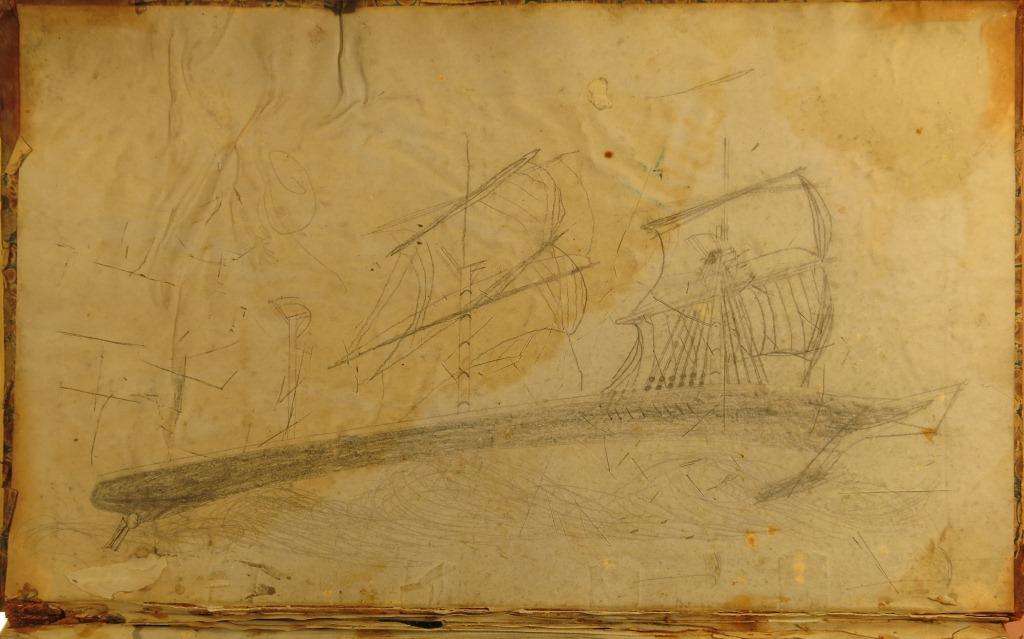
The two articles enclosed with a letter from the Canton, China bound Samuel Lothrop Thorndike on 27 May 1852 tell fascinating stories about a wager on a ship race to Hong Kong and cyclonic gales encountered along the way in the Philippine Sea. The younger Thorndike clearly leaves mention of these events out of the letter, addressed to his father Albert Thorndike. He includes these grand adventure stories as attachments, intended for his college friends.

At 22 years of age, Samuel Lothrop Thorndike left Harvard College in the middle of his senior year to accompany fellow Harvard student William Sturgis Hooper on a voyage to China. These two young scholars obtained a faculty leave of absence to make the voyage, and traveled on the new ship Courser. Sturgis’s father, shipping merchant Samuel Hooper, dispatched the Courser from Boston to California then to China in January 1852.

The letter to Albert Thorndike contains little more than a greeting, a note that the son has not yet received mail, and reassurance of good health and love. Postscript directions from son to father request that the two enclosed attachments be given to young brother William “Bill” Thorndike, who will see that “the fellows in Cambridge” – Harvard classmates Joseph Hodges Choate and Peter Chardon Brooks – receive the articles.

The first newspaper article recounts a ship race from San Francisco to Hong Kong between the Courser and the Witchcraft. Seemingly unaware of the race, the clipper ship Invincible simply loses by nearly two weeks.

PASSAGES FROM SAN FRANCISCO TO CAN-
TON. – The ship Courser, Capt. Cole, of Boston,
sailed from San Francisco May 29 for Canton, where
she arrived July 11. The clipper ship Invincible,
Capt. Johnson, of New York, sailed from San Fran-
cisco May 16, and arrived at Canton July 11. The
clip ship Witchcraft, Capt. Rogers, of Salem,
sailed from San Francisco May 30, and arrived at
Canton July 19. We understand that bets were
made in San Francisco that the Witchcraft would
reach Hong Kong ten days before the Courser, but
the event proved that the C. which is not a clipper,
beat the Witchcraft full six days, and beat the In-
viscible thirteen days.

The second article briefly describes the cyclonic gales in the Philippine Sea that Thorndike and Hooper weathered during the Courser’s voyage.  

Very heavy cyclonic gales were experienced in the China
seas, from the 3d to the 7th of July. The Am ship Courser
encountered one on the 5th, in about lat 18 N, lon 128 E.
The Invincible on the 6th in lat 20 N, lon 119 E.

Thorndike does write to his father in reassurance, “I never was in better health and spirits in my life.” However, he does not mention the betting, race, or the gales. He essentially left all the fun and danger out of his letter to his father. But he dispatched the articles to his Harvard classmates as bragging rights.


“For your mutual Happiness and…dedicated to the Public”: The Marriage of John Quincy and Louisa Catherine Adams

By Amanda A. Mathews, Adams Papers

In the upcoming volume of Adams Family Correspondence we reach a pivotal moment in Adams family history—the marriage of Louisa Catherine Johnson to John Quincy Adams.

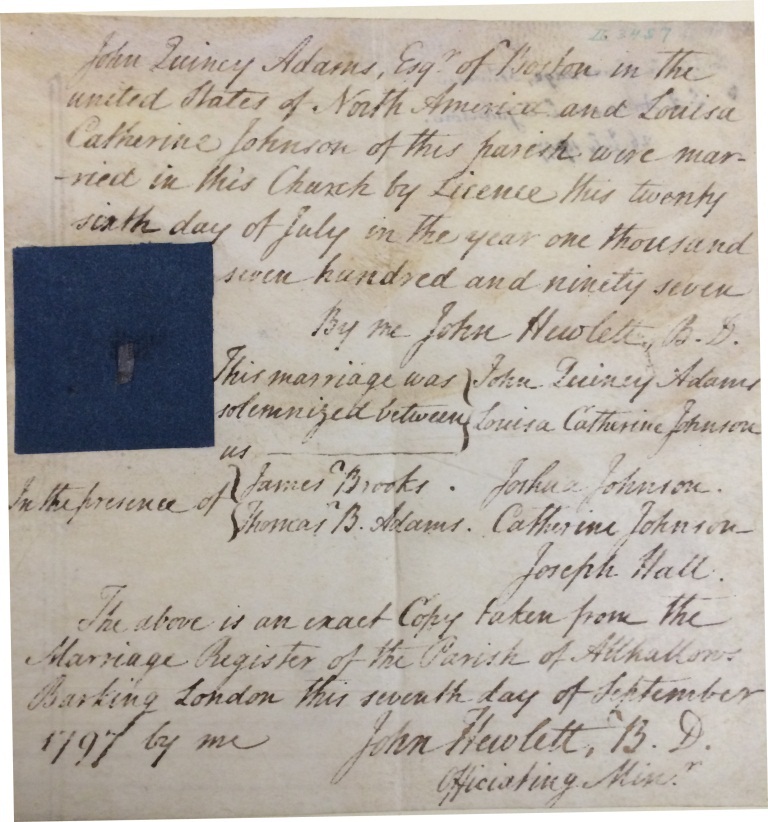
This partnership began quite simply on July 26, 1797. They were married before eleven o’clock in the morning at the Church of All Hallows, Barking, right by the Tower of London and immediately took a tour of country house near London, as JQA reported in his diary entry for the day. Louisa, who kept no diary at the time, wrote in her memoirs nearly thirty years later, and with the knowledge of what was coming quickly around the corner for the newlyweds—the embarrassment of her father’s financial failure—noted it simply, “On the Wednesday 26 of July 1797 I became a bride under as every body thought the happiest auspices—”

Two days after the wedding, the newlyweds sat down to compose a joint letter announcing their marriage to the distant John and Abigail Adams.

John Quincy opened the letter:

I have now the happiness of presenting to you another daughter…. My recommendation of her to your kindness and affection I know will be unnecessary. My sentiment of her merit, will not at this moment especially boast its impartiality, but if there be as I believe an inseparable chain of connection which binds together all the domestic virtues, I have the strongest pledge that she, who has in an amiable and respectable family, adorned the characters of a daughter and Sister, will prove an equal ornament to that of a wife.

Louisa, promising to always act worthily of their “esteem and tenderness,” concluded: “fulfillment of my duties either as wife or daughter, to be respected in these characters, and to meet the approbation of my Husband, and family, is the greatest wish of my heart— Stimulated by these motives (your affection the reward) will prove a sufficient incitement, never to sully the title of subscribing myself your, Dutiful Daughter.”

John Adams replied to the news of his eldest son’s marriage with his blessing: “I congratulate you and your Lady on this Event, which I hope will be for your mutual Happiness and…, for a long Course of years, dedicated to the Public— And may the Blessing of God Almighty be bestowed on this Marriage and all its Connections and Effects.” His blessing on this marriage, one that lasted over fifty years and combined the charm and sociability of Louisa to John Quincy’s dedicated and driven, if sometimes brusque demeanor, was more than fulfilled in the couple serving the public until John Quincy’s death in 1848.


**Image: JQA and LCA’s Marriage Certificate,  26 June 1797, Adams Family Papers.


Stephen Greenleaf Bulfinch Diary, Post 34

By Elaine Grublin

The following excerpt is from the diary of Stephen Greenleaf Bulfinch.

Sunday, July 24th, 1864


As to public affairs, – we appear to gain little near Richmond, – Sherman advances successfully in Georgia. Gold has been up to 270 or above it. The president calls for half a million more men, – for one year. The first abortive attempts at negotiation are symptoms which may be followed by something better. The awful sacrifices of the war go on meantime; & among the late losses is that of my friend Hall’s son, of Dorchester, assistant Henry Ware Hall, killed near Atlanta, Georgia. His father bears it heroically.

 Sunday, July 31st


This dreadful war continues its ravages, & the good & the brave fall on both sides. Maria writes me of the death of her cousin Cyprus, – my namesake & godson, – in battle near Marrietta, – fighting in the rebel cause; – & of the Christian firmness & submission with which he met death. ‘How long, O Lord!’

Guest Post: Searching for the Federalist Party in Massachusetts

By Kyran Schnur, Hopkinton High School

I plan to be a professional historian, but I had this nagging worry that sifting through a bunch of historical documents could be a mind-numbing slog that would turn me off of the subject I love so much. Thanks to the Massachusetts Historical Society, I now know I’m in this for the long haul. I had so much fun looking through old letters, speeches, and newspaper publications. Every text seemed to be an appeal from the long-dead author, saying, “Hear me! Know my story!” It was a thrilling experience to hear the perspective of contemporaries and draw my own conclusions.

Once I was shown around the building and told how to navigate the collection, I felt right at home. There is such a welcoming atmosphere, and I really felt the satisfaction of learning from the material, rather than simply completing an assigned project. I could assign real value to my work, and I wasn’t treated like a child. I really enjoyed working on my own investigation, alongside like-minded people, in an environment in which I felt completely at ease. During my visits I was delighted to see other young people doing the same kind of thing. The staff always took me seriously, and was always ready to help if I had a question. Until now I had never used microfiche, but within two minutes the reference librarian had me set up and I knew all I needed to know to use it. I could even take pictures of the old documents and email them to myself so I could do work at home.

My project was an investigation of just what happened to the Federalist party after the Revolution of 1800, the first major turnover of power in our government’s history. Usually we are taught that this defeated party, woefully out of touch with public opinion, faded into obscurity quickly after being defeated by Thomas Jefferson, apparently the dashing savior of the republic. The sources I looked over showed a very different story of a party that raised its standard against what they saw as misgovernment and staged a strong, if brief, political comeback.

My most invaluable resource was a collection of the letters by the arch-Federalist Harrison Gray Otis in the aftermath of the disastrous Hartford Convention. I actually came upon it by accident while looking through a collection of Massachusetts letters for a specific speech. The letters form a plea by Otis to posterity, people like us, to not let the name of Massachusetts be blackened by the misrepresentation of its conduct by the rest of the country. After watching a rival get elected governor and listening to that man’s denouncement of his own state during the War of 1812, he laments:

Hereafter it will be too late to blot out the blot made by His Excellency upon the historic page, by alleging that his speech was intended merely to chime with the slang of the day. It will be answered … that the accused party in the Legislature quailed under the pungent rebuke from the chair, and that members of the Convention continued to be dumb as sheep before their shearer … will not the rising generations of this State burn with shame and indignation when it shall constantly be thrown in their teeth by the rising generations of other States, that their base blood has crept to them through ancestors who silently admitted themselves to be stigmatized as outlaws from the “American Family!”

It was the discovery of documents such as this that helped me to develop a real connection to the project, unearthing old misconceptions and hearing age-old voices as directly as I possibly could. The MHS archives gave me a wonderful opportunity to experience historical research first hand. Even now that my fellowship is over I intend to go back and continue my research. We are so lucky to have access to these documents in Massachusetts and this organization, and I hope other people will take advantage of them as I did.


**The MHS has awarded the John Winthrop Student Fellowship since 2013. This fellowship encourages high school students to make use of the nationally significant documents of the Society in a research project of their choosing.

“Use the Elevated!”: The Boston Elevated Railway Promotes its Services in 1926

By Anna J. Clutterbuck-Cook, Reader Services

On July 1st, riders on the Massachusetts Bay Transit Authority (MBTA) rail and bus system saw fare increases that brought the cost of a single local bus ride to $1.60 and a single rapid transit (“T”) ride to $2.10. In light of this change, and the ongoing discussion within the Boston metropolitan area — as well as across the country — about the place of mass transit in the fabric of our lives, I thought it would be timely to look back at the history of Bostonians transit options.

The history of “mass” transportation in the Boston area actually begins much earlier than one might assume, with the commencement of stagecoach service between Boston and Cambridge in 1793. The nineteenth century saw an expansion of horse-drawn omnibuses and railcars, then a conversion to electric trolley lines in the late 1800s. This shift came about in part due to organized opposition to the harsh treatment of the working horses. The 1890s also saw the construction of the first subway tunnel in the United States, Boston’s Tremont Street Subway completed in 1897. By the 1920s there were hundreds of miles of streetcar, elevated, and subway tracks wending their way through Boston, many of them run by the Boston Elevated Railway Company. In 1926, the Elevated issued a Guide and Information Book for riders which offers us a glimpse at what public transit was like almost a century ago.

In 1926 the fare for a single ride on the local rail and bus lines in Boston was ten cents, or $1.30 in today’s currency (adjusted for inflation). As today, the company struggled to make needed improvements in service on the income these fares produced. In a section of the pamphlet titled, “USE THE ELEVATED,” the company exhorted Bostonians to use the railway “operated by the public and for the public.” According to the company’s 1925 ridership statistics, the average resident rode the railway less than once per day. Their faith in the public’s civic engagement is admirable as they proceed to provide a line-item budget for needed improvements and suggest that “If the population served had traveled an average of once a day per capita … revenue would have increased by $7,800,000”! Would that Bostonians of today responded to such fiscally-minded challenges to “use it more”!

With a network of railways and bus routes that trace similar routes to modern-day transit lines, then, as now, “the railway [offered] a solution for traffic congestion.” Even before the highway and automobile boom following World War Two, Bostonians wrestled with the problem of congested streets and long commutes. “At Governor Square and Kenmore Station in the … period between 5.30 to 5.45 P. M.,” the Guide reports, “there were 30 elevated units comprising 78 cars transporting 4178 passengers [while] 1204 automobiles [carried] 2057 passengers.” One pictures earnest civil engineers standing on each corner, pencil and notebook in hand, scribbling away.

The Guide also offers visitors to Boston a useful list of cultural and historical sites of interest, including our very own Massachusetts Historical Society (“Subway–Ipswitch Street car”). “To the resident or visitor,” the Guide concludes on the final page, “Boston offers an inexhaustible variety, whatever his [sic] inclination may be”:

If it be historical, here he may find the scenes of the events which shaped the early development of our country. If literary and education, its churches, libraries, schools and colleges; if artistic, in its galleries, museums and concerts halls where the world’s best of art and music may be seen and heard. … for amusement there are its theatres, skating rinks, baseball parks, boating and canoeing, trolley rides, automobile rides, and nearby all the delights of the seashore, salt water bathing, and excursion trips.

Such boosterism would definitely make modern-day Boston’s promoters proud.

Interested in exploring the history of Boston’s transportation network further? For a live-action tour through the history of Boston street cars, check out Civil Engineering student Gil Propp’s twenty-minute documentary film “Streetcar Tracks” available to stream at his website Boston Streetcars. And of course, researchers are always welcome to stop by the Massachusetts Historical Society (Green line T–Hynes Convention Center) to explore our holdings!


Eight Is Enough: The Worcester Family in the Civil War

By Susan Martin, Collection Services

It can sometimes be difficult to comprehend the scale of the Civil War and to realize how deep an impact it had on the lives of families far and wide. Then something comes along that really drives the point home.

The MHS recently acquired a collection of the papers of Joseph E. Worcester, publisher of dictionaries, almanacs, gazetteers, atlases, and other reference works. While most of the collection relates to his lexicographical career, one letter, written in the midst of the Civil War, caught my eye. On 20 Apr. 1863, Joseph wrote to his sister Deborah (Worcester) Loomis from his home in Cambridge, Mass. The letter starts out simply enough: Joseph discusses some family business related to the death of their brother-in-law Daniel French and the disposition of French’s property. Then he changes the subject:

You know, I suppose, that we have eight nephews in the army, but how recent information you may have had respecting them, I know not. Henry P.’s wounded ancle [sic] is healed, and he has joined his regiment, and is now, or was recently, at Falmouth, in Gen. Hooker’s army. Charles, John, and William, who have passed most of the winter at St. Augustine, Florida, are now in South Carolina – were well early this month. Henry, br. G.’s son, has seen hard service in N.C. – has been very ill, and is now, I suppose, in the hospital at Port Royal. He will be, as I hope, soon discharged, if he is not already. I have seen a letter from Leonard’s son Edward, dated the 24 of March at Camp Farr, near New Orleans. He was in good health. Brother David’s sons Frank and Edward, who enlisted and left Bangor in February are now, I suppose, at Fort Alexandria, near Washington. It is to be hoped, though hardly to be expected, that all these young men will return in due time to their friends.

I was intrigued, so I set out to identify the (mind-boggling!) eight soldier nephews and learn their fates—no mean feat considering the size of the family. Joseph was one of fifteen children of Jesse and Sarah (Parker) Worcester of Hollis, N.H. Those fifteen siblings had, according to The Worcester Family: The Descendants of Rev. William Worcester, a total of nearly fifty children. Many of that generation’s young men died on the battlefields of the Civil War, and Joseph was right to be guarded in his optimism.

So how did the Worcesters fare? Amazingly, it turns out that seven of Joseph’s eight nephews survived the war—all except 24-year-old John Howard Worcester (1839-1863). In fact, John died on 26 July 1863, just three months after this letter was written, from wounds received during the infamous assault on Fort Wagner, S.C. The rest of the nephews did, in fact, “return in due time to their friends.” Taking them in order…

Henry Parker Worcester (1839-1882) was a member of the 3rd Maine Infantry and saw action at Fair Oaks, Wilderness, and Bull Run. Wounded twice and promoted multiple times, he finished his service as a captain. After the war, he settled in Norfolk, Va.

Charles Henry Worcester (1837-1919), the aforementioned John, and William Worcester (1840-1895)—Charles and John were brothers, and William their cousin—served together in the 7th New Hampshire Infantry. After the war, Charles went into business with his three other brothers and, as far as I can tell, lived the longest of the eight nephews. William died of heart trouble at the age of 55.

Henry (1842-1911), William’s younger brother and a member of the 24th Mass. Infantry, was, as his uncle Joseph hoped, discharged due to illness. Henry became a leather manufacturer, post commander of his local G.A.R. #40 in Malden, Mass., and a Civil War historian.

Edward Joseph Worcester (1831-1893) of the 42nd Mass. Infantry was the only one of the eight with a wife and children at home when he enlisted as a “hundred days man.” Happily he returned to his family and had two more children with his wife Maria.

Francis D. Worcester (1843-) was a member of the 1st Maine Heavy Artillery. He survived the war but may have suffered from mental illness later in life. His brother Edward Lewis Worcester (1845-1897), the youngest of the eight, also served in this regiment and went from private to first lieutenant over the course of the war. He later settled down as a farmer in Iowa.

After updating his sister Deborah on the status of their soldier nephews, Joseph wrote more broadly about the conflict itself:

This most iniquitous war, after two years of most destructive prosecution, seems now no nearer a successful termination than it did one or two years ago. I have all along had a hope that the war would lead to the extermination of the cause of it, that is slavery, but whether this will be effected seems doubtful. I think slavery is a much greater evil than the people of the Free States have considered it, but it is an evil that is very difficult to get rid of without the concurrence of the slaveholders. We know not what the designs of Providence may be, but we may hope good will come in some way.

Stephen Greenleaf Bulfinch Diary, Post 33

By Elaine Grublin

The following excerpt is from the diary of Stephen Greenleaf Bulfinch.

Wednesday, June 1st, 1864

The Convention of Ultra-Republicans has met at Cleveland, & nominated Fremont for president. While thinking him the most brilliant man we have, I have not that confidence in his sound discretion, & what the Romans would have styled his fortunes, to think him the right man for the office. Mr. Lincoln is my choice, & will, I think, be that of the nation, unless possibly a brilliant victory gives Grant the preference.

Monday, June 13th

Our good president Lincoln has been re-nominated, by the Union Convention, with Johnson of Tennessee for Vice; – a good choice, as a tribute to the union men of the South, & I trust in other respects. 

Sarah Checkley’s Spirituous Liquor License, 18 July 1764

By Andrea Cronin, Reader Services

It is the season of graduations, celebrations, and toasts. My personal social network bubbled this past weekend with images of familial celebrations, beach weekends, and – of course – spirituous liquors. Many a photo popped up of friends in drinking establishments, and I became curious about the history of taverns as a result. I browsed our online catalog ABIGAIL and discovered a liquor license issued to Sarah Checkley of Boston on 18 July 1764. Naturally it piqued my interest for several reasons. The license states:

We the Subscribers Selectmen of the Town of Boston do approve of Mrs. Sarah Checkley’s being a Retailer of Spirituous Liquor, at the House where into she has lately removed and now dwells, in Hanover Street near the Mill Bridge Boston, and recommend her a Person of sober Life and Conversation, and suitably qualified and provided for the Exercise of such an Employment she having for many years past been a Retailer in this Town and behaved to good acceptance.

This document is peculiar for what it is not. The license is not the oldest item pertaining to liquor petitions in the Society’s collections. The honor of oldest liquor petition goes to Samuel Walton of Woburn, Mass. who petitioned the Massachusetts General Court on 30 March 1665 to sell “strong waters.” How strong, the document does not specify. Checkley’s 1764 petition is not even the only liquor license in the MHS collections granted to a woman! A quick glance among retailer’s licenses, tavern licenses, and innkeeper’s licenses shows the custom to issue such documents to women not unusual for the late 18th century.

The Suffolk County Court and Boston Selectmen approved retailer and liquor petitions from widow Elizabeth Pittson on 7 June 1767, widow Rachel Masters on 21 July 1767, and widow Mary Rose on 8 July 1773. The court also approved a petition from Mary Vinal to sell liquor on 30 July 1771. The petition did not designate Mary Vinal a widow unlike the aforementioned ladies. Her father suffered from palsy and could not provide for his family. Thus, Mary Vinal required a means to make an income as did the widows. In their petitions to the selectmen, the women granted these licenses all clearly stated a similar problem in their personal situations: a lack of income from male earners. Sarah Checkley’s petition lacks detailed information about her familial or marital status. This lack of information does not imply that she was not a widow or did not care for aging or sick male members of her family, but the petition is more interesting to me without these details. This absence lets me rosily imagine Sarah Checkley as a robust purveyor of spirituous liquors of her own accord.

For those of us celebrating graduations, petitioning for prospective employment, or just enjoying summer fun, we all know the important role income plays in our lives. May your summer be fruitful in your endeavors, but spirituous in fun! And remember to tip your bartenders.


Discovering Georgiana Appleton and the Fort McHenry Flag

By Elaine Heavey, Reader Services

A few weeks ago a writer contacted me looking for material located in the Appleton Family Papers.  The writer, Ariel Sabar, was working on a piece for the June issue of Smithsonian Magazine.  The focus of the article was the act of taking souvenir clippings from the original Star-Spangled Banner, the flag that flew over Fort McHenry when the British attacked on the evening of  13 September 1814 and inspired Francis Scott Key to compose our national anthem.

Sabar hoped I could locate and provide him with a copy of a letter written to a Georgiana Appleton from a Stephen Salisbury in 1874. The letter, Sabar knew, contained Salisbury’s request for a clipping from the old Star-Spangled Banner. I was dubious, until realized that Georgiana Appleton was formerly Georgiana Armistead, the daughter of Major George Armistead. Major (later Colonel) Armistead, upon taking command of Fort McHenry in 1813, saw to it that an enormous flag was made to be flown over the fort, which he assumed would be a likely British target in the ongoing War of 1812. Sometime in the three years between the inspirational battle at Fort McHenry and Armistead’s death, Armistead came to possess the flag. His daughter Georgiana, who had married into the Appleton family, inherited the flag upon her mother’s death in 1861. 

So I spent a bit of time browsing the Appleton Family Papers (our very detailed collection guide helped me narrow my search to 5 folders contained in box 10 of the collection) and my interest was piqued! Even after I located the letter Sabar had requested, I kept reading. I needed to learn more about Georgiana and the flag.

At first glance, what I read both thrilled and slightly horrified the trained archivist in me. I kept reminding myself that the best practice guidelines for preservation of historical treasures we follow today simply did not exist in the mid-1870s. But it seemed that each letter uncovered tales about snipping souvenirs from the flag to give to different parties, shipping the flag off by mail, and schlepping it around from exhibition site to exhibition site. I thought about the stringent guidelines we impose on borrowing institutions when we loan items from our own collection, not to mention the time we invest in doing condition photographs and reports, having insurance appraisals done, hiring professional art movers to transport artifacts, etc., etc. I marveled that the flag survived into the early 20th century, when Appleton’s son, Eben Appleton, gifted it to the Smithsonian, who has worked to preserve the flag ever since.

Starting with a letter written in February 1873 there is a rich correspondence between Georgiana Armistead Appleton and Commodore George Henry Preble. Preble authored a history of the American flag, first published in 1872, and I gleaned from his first letter that Appleton had sent him a list of corrections to his text regarding the Star-Spangled-Banner. Preble promised to correct those errors in the next edition, and then asked that Appleton facilitate his photographing the flag so that he could include an engraving of the original flag in his next edition as well.

Here is where the feeling of horror began to sink in. Appleton agreed to loan the flag so that it could be photographed, and in letter dated 15 May 1873 Preble advised Appleton to “express ‘the flag’ to the address on this letter [the Boston Navy Yard] any time after or about the 1st of June” so that he could have it “hoisted on the Navy Yard Flag Staff & be so photographed.” It was so casual, as if she were lending him a table cloth, not a national treasure.  

But when I read a bit deeper, I discovered the horror was a bit unwarranted.  In his first letter in February 1873, Preble expressed concern for the flag, stating that such treasures should not remain in private hands and recommending that Appleton deposit her flag at the Military Academy at West Point for long-term safe keeping. And in writing on 9 June 1873 Preble assured Appleton that once he received the flag at the Navy Yard he would see to it that “the banner is carefully preserved,” noting that he will only attempt to have it hoisted at the Navy Yard if its current condition merits it. 

Alas, when the flag arrived by express on 11 June, Preble disappointedly found it “too frail & tender” to be hoisted. The next day he informed Appleton that he was having some of the ripped seams restitched, and that he planned to have the flag “hung (out of the wind) against the wall of some one of the Navy Yard buildings” so that the photograph could be taken.  Preble was clearly more preservation minded than I had at first given him credit for.

For a period of about three years Preble acted as caretaker to the flag. He arranged to have the Banner, along with two other historical flags he wrote about in his history (the flag of the Revolutionary era USS Bon Homme Richard, and a flag from the USS Enterprise, famous for its involvement in the Tripolitan Wars of the early 19th century) exhibited at the New England Historical Genealogical Society (NEGHS).  A one-day exhibition of the relics took place on 9 July 1873. Appleton’s flag remained on display for several weeks after, until, under Preble’s supervision, it was carefully rolled up, placed in a canvas bag, and deposited in the fire proof safe at the NEHGS for safe keeping. 

Immediately after the NEHGS exhibition, Preble and Appleton began corresponding about another opportunity to publically exhibit the flag.  As early as March 1873 representatives of the Centennial Committee, based in Philadelphia, began contacting Appleton about borrowing the flag for display during the celebration of the centennial in that city.  What again seemed a risky venture on the surface, proved that Preble was concerned about the long-term preservation of the flag, as he advised Appleton (on both 12 July and 21 Aug 1873) that if she chose to lend the flag, she should require that it be insured for “$5 or $10,000 dollars” and request a guarantee from the committee that none of it will be sold for relics. He also stressed the importance of ensuring that the flag would be displayed in a manner that prevented relics from being taken by enterprising attendees.  Reading through to the letters of 1876, I discovered that Appleton did choose to loan the flag, and that Preble ensured that proper case was taken.

Of course I could not overlook that Preble also wrote of taking snips of the flag, with Appleton’s authorization, to give to this person and that.  In fact, there is a receipt in one of the folders, dated August 1873, indicating that a snip of the flag was given as a gift to the NEHGS. But as Sabar points out in his article, the act of flag snipping was common in the 19th century, and Preble does stress in his letters that he takes great pains to take his snippings from areas where they will not be missed. So I can try to forgive this preservation transgression. [Side note: The MHS has its own snippet of the Fort McHenry flag, but it was not gifted to the MHS by Appleton.  It was received in 1917, inserted an extra-illustrated edition of Preble’s History of the Flag of the United States of America, that was donated by a Nathan Paine.]

I discovered a number of other interesting letters in the Appleton Family Papers, all of which I am sure could lead to hours of research and future blog fodder.  There were multiple letters from individuals seeking clipping from the flag (unfortunately, Appleton did not keep copies of her replies to those requests) and letters from individuals that had written poems and songs about the flag.  There was even a letter from the granddaughter of Mary Pickersgill, the woman credited with making the flag, revealing her own poverty, and asking that a sign be displayed with the flag at the centennial to generate donations to support her.  But, I must say, the letters from Preble, that not only tell the story of the flag, but offer insight into thinking about preservation issues in the mid-19th century, are the real gem for me.   

“Time will bring forth…a fine Child”: The Labor of Declaring Independence

By Amanda A. Mathews, Adams Papers

Sometimes the waiting is the hardest part. In June 1776, John Adams likened the struggle in the Continental Congress to declare independence to giving birth. For Adams, the fact of independence already existed; it was only a matter of recognizing what was already there. In a letter of June 12, Adams alluded to the momentous occasion finally on the horizon: “We have greater Things, in Contemplation, than ever. The greatest of all, which We ever shall have. Be silent and patient and time will bring forth, after the usual Groans, throws and Pains upon such occasions a fine Child—a fine, vigorous, healthy Boy, I presume. God bless him, and make him a great, wise, virtuous, pious, rich and powerfull Man.”

Those final throws and pains began in earnest on June 7, when Richard Henry Lee put forward a simple but powerful resolution: “Resolved, That these United Colonies are, and of right ought to be, free and independent States, that they are absolved from all allegiance to the British Crown, and that all political connection between them and the State of Great Britain is, and ought to be, totally dissolved.” John Adams seconded the motion, but patience was yet required. Some delegates were unwilling to take such a step without explicit instructions from their constituents moved for a delay of consideration of the Lee Resolution. So that there would be no further loss of time, however, it was proposed to form a committee that would draft a declaration to serve as a justification for the resolution should it pass. On June 11, the Continental Congress appointed a Committee of Five—Robert R. Livingston of New York, Roger Sherman of Connecticut, Benjamin Franklin of Pennsylvania, Thomas Jefferson of Virginia, and John Adams of Massachusetts.

Leaving no contemporary minutes, the details of the committee’s proceedings to create the draft of this declaration have been lost to history, although Adams gave a brief, though contested, overview in his Autobiography based on his recollections thirty years later. The draft that came out of the committee on June 28 was closely debated in Congress from July 2d to 4th, and the final product—the Declaration of Independence (to Adams’s surprise)—would go on to surpass the Lee Resolution in national importance and symbolism.

Nevertheless, on July 3, 1776, the day after the Continental Congress unanimously declared “that these United Colonies, are of right ought to be, free and independent States,” Adams wrote triumphantly to his wife Abigail that the “Day of Deliverance” had arrived—the child safe delivered: “Yesterday the greatest Question was decided, which ever was debated in America, and a greater perhaps, never was or will be decided among Men…. You will see in a few days a Declaration setting forth the Causes, which have impell’d Us to this mighty Revolution, and the Reasons which will justify it, in the Sight of God and Man.” The child born, the day past, the real work could now begin.