
Guest Post: Unlocking the Story of a Real-life Robinson Crusoe

By Gregory N. Flemming, Guest Author

Tucked away in the archives of the Massachusetts Historical Society Library are two small, leather-bound volumes printed nearly 300 years ago. These small tracts, titled Ashton’s Memorial, reveal an incredible story — the first-hand account of a Massachusetts fisherman named Philip Ashton who was captured by pirates in 1722 and then escaped and lived as a castaway on an uninhabited Caribbean island for nearly two years. Ashton’s Memorial is a rare description of a voyage aboard a pirate ship during the peak of Atlantic piracy and it reveals rich new details about the crew, captures, and nearly-fatal mishaps.

The Society may hold the only surviving copy of the original 1725 printing of Ashton’s Memorial in Boston. There are original editions from a second printing of Ashton’s Memorial, published in London in 1726, at both the Massachusetts Historical Society and the British Library. The second printing is nearly identical to the first, except the title page uses the descriptor “An Authentick Account” instead of “An History” and includes three lines of text that were omitted from the Boston printing, apparently due to a typesetting error.

Ashton’s narrative was compiled by his minister, John Barnard of the First Church in Marblehead, Massachusetts. The fact that the book was published in London a year after it was printed in Boston speaks to the popularity of the story at the time. In fact, Ashton’s Memorial may have been read in London by Daniel Defoe, who had a lifelong interest in piracy, castaways, and the maritime world. A leading scholar of Defoe’s work, Manual Schonhorn, has compared Defoe’s writings before and after Ashton’s Memorial was published and concludes that Defoe incorporated new details from Ashton’s story — never published anywhere else — in his next novel.

Barnard compiled Ashton’s Memorial shortly after Ashton returned home to Massachusetts from his three-year odyssey, but the book is written in the first person and reads as though Ashton wrote it. Barnard notes in a short introduction that he met with Ashton on several occasions to record the narrative and subsequently verified its accuracy: “I have taken the minutes of all from his own mouth, and after I had put them together, I have improved the first vacant hour I could to read it over distinctly to him that he might correct the errors that might arise from my misunderstanding his report. Thus corrected, he has set his hand to it as his own history.” In researching Ashton’s story, I found that a number of significant events recounted in Ashton’s text were supported by other sources.

The Massachusetts Historical Society also holds the papers of John Barnard, including his Autobiography and three other volumes of his sermon notes. These papers provide additional insights into the adventurous life of one of New England’s more prominent Puritan ministers during the early eighteenth century — but they reveal nothing more about Philip Ashton or Ashton’s Memorial. It is striking, in fact, that Barnard was compelled to record Ashton’s story not for the sake of history, but because he believed it conveyed important religious themes to an audience that was, in his mind, lacking in faith. This was quite common, in fact. Religious leaders during this era — including Barnard’s former teacher, Cotton Mather — frequently exploited pirate captures, executions, and other dramatic events to issue dire warnings against what they saw as a rising tide of drunkenness, adultery, blasphemy, church skilling, and other transgressions in Boston and throughout colonial New England. As interesting as Ashton’s voyage was, for Barnard the true message in the story was “God’s ability to save” an ordinary fisherman from death and disaster.


Gregory N. Flemming is the author of At the Point of a Cutlass: The Pirate Capture, Bold Escape, and Lonely Exile of Philip Ashton, published in June. He will speak at the Massachusetts Historical Society at 12 noon on Thursday, June 19, 2014. The event is free and open to the public.


Oliver Lofts: Mapping the Traces of a Music Publishing Empire

By Anna J. Clutterbuck-Cook, Reader Services

A couple of weeks ago, my wife and I moved across town from one former streetcar suburb-turned-neighborhood of Boston (Allston/Brighton) to another (Jamaica Plain). A paltry three mile journey as the crow flies, since we live without a car and get around on foot, public transit, or bicycle, this has meant learning new pathways to all of our usual destinations — including the Massachusetts Historical Society. Along these new routes stand traces of Boston’s past, if only you keep your eyes open and know where to look for them.

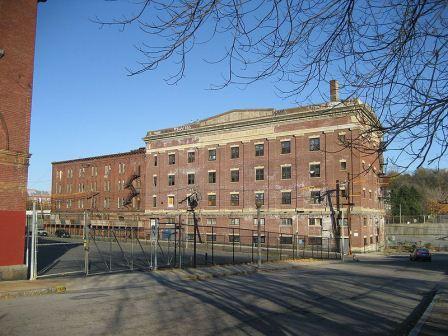
Bicycling home from work along the Southwest Corridor Park, from Symphony Hall to Jackson Square, last week I happened to notice the brick facade of an old factory building turned residential lofts that announced in the stonework “Oliver Ditson Co.”

Who, I wondered, was Oliver Ditson, and what had his factory once produced? Fresh from reading Alexander von Hoffman’s history of Jamaica Plain, Local Attachments: The Making of an American Urban Neighborhood, 1850 to 1920 (Johns Hopkins University Press, 1994), I knew the Heath Street area had been known for its breweries. Perhaps, I thought, our Mr. Ditson was a brewer. Happily, I work at a place where such questions can often be answered by searching our catalog and going on a historical treasure hunt! A few keystrokes and call slips later, I had discovered that Oliver Ditson and his company were not brewers but, instead, music publishers and retailers here in Boston. Ditson, born in Boston in 1811, began his career working at a bookshop on Washington Street, under the employ of Samuel H. Parker, before launching into the music publishing business in 1835. In 1858 Oliver Ditson & Co. began publishing Dwight’s Journal of Music, one of the most highly respected music journals of the nineteenth century, and was soon expanding into the Cincinnati, Chicago, Philadelphia, and New York markets.

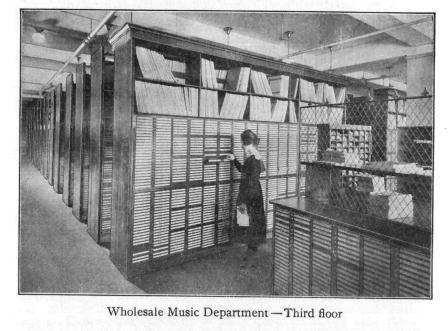
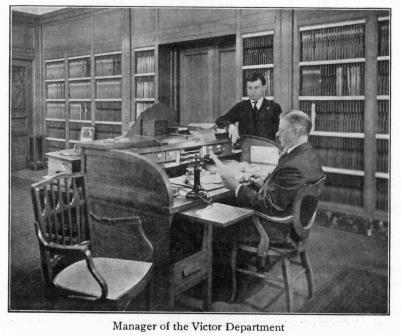
In 1918 a history of the music scene in Boston, published by the Oliver Ditson Company, foregrounded the company’s sparkling new ten-story retail building that still stands today on the corner of Tremont and Boylston Streets, overlooking the Boston Common. “The focus on modern Boston’s shopping activity is at the corner of Tremont and Boylston Streets, where converge the currents of vivid life from hotels, theatres, and subways,” writes William Fisher in Notes on Music in Old Boston. “Within a stone’s throw of this teeming corner … is the splendid new home of the Oliver Ditson Company” (79). From its state-of-the-art heating plant in the sub-basement to its Tiffany show windows, “Victor Talking Machines” department,” and opulent meeting rooms, the Tremont Street headquarters was the company’s public face.


The building that would become Oliver Lofts in 2011 meanwhile, was a late arrival into the company’s holdings. The property did, indeed, begin life as a brewery — though unassociated with Ditson. According to Historic Boston, the Highland Spring Brewery occupied the site until Prohibition brought the American beer industry to its knees. The Oliver Ditson Company then purchased the storehouse, built in 1912 and once used to house casks of ale and porter, and used the building as a print shop and warehouse into the mid-twentieth century.

Thus, one single rehabilitated industrial building I pass by on my evening commute holds within its walls traces of two centuries worth of Boston development.

Travel Woes in 1814: JQA and Zandelin’s Not-So-Excellent Adventure

By Nancy Heywood, Collection Services

Do you remember some of the people you’ve met while traveling?  Maybe your flight got delayed (a real possibility these days!) or you had a long layover during one stage of your trip and you struck up a conversation with someone in a waiting room.  Years later will you remember anything about them or your conversation?

Thanks to John Quincy Adams’ (JQA’s) diary entries from May 1814, a man named Zandelin comes vibrantly to life. This is a man JQA met while traveling between Reval, Russia (present-day Tallinn, Estonia) and Sweden.  JQA had previously been serving as minister plenipotentiary to Russia and living in St. Petersburg, but in early 1814 he was appointed head of a commission to negotiate an Anglo-American peace treaty (and end the War of 1812). JQA was told the negotiations would take place in Gothenburg (although later he learned that the location was changed to Ghent, Belgium), but as of the spring of 1814 his destination was Sweden.

By May 1814, JQA had reached Reval, a port on the Gulf of Finland, and he arranged passage across the Baltic Sea on the ship Ulysses.  Mr. Zandelin, a Swedish merchant, was another passenger on the vessel.  Although Zandelin could be seen as an unimportant figure in history, his presence on the same ship as JQA and on the pages of JQA’s diaries, means that we have a more detailed and colorful picture of an 11-day stretch within JQA’s much longer journey to the site of the peace negotiations.

When JQA made arrangements with Captain Brinkmann (of the Ulysses) on May 3, he was told that the ship would leave a few days later.  However, several factors including tricky sailing conditions (unfavorable winds and the fact that there was still a significant amount of ice in the harbor) delayed the departure of the ship.  It wasn’t until the evening of May 15 that JQA was asked to board the ship.

When JQA arrived on board the Ulysses he found Mr. Zandelin surrounded by about a dozen men wishing him (Zandelin) farewell.  These men departed the Ulysses via the same boat that shuttled JQA from shore out to the ship. 

I immediately finished the packing of my Clothes, books and Papers, and came on board the Vessel– The Ulysses, Captain Brinkman– It was between 9 and 10 in the Evening. Mr Ross with ten or twelve other Gentlemen were on board; to take leave of Mr Sandolin, a Swedish Merchant, who freights the Vessel, and is also going in her as a Passenger– They returned on shore in the Boat, in which I had come on Board–

Despite favorable winds at 4 AM on the morning of May 16, 1814, the ship couldn’t depart because the officer of the guard ship didn’t arrive with the vessel’s pass and JQA’s passport until around 8:00 AM. The interactions with the guard took some time, and by the middle of the day, when the ship was cleared for departure, the winds had died down.  A light breeze started in the evening, and despite the captain’s apprehension regarding the “floating masses of ice” he did attempt to set sail partly in response to the urgings of JQA and Mr. Zandelin. However, the unfavorable winds and ice prompted the captain to turn the ship around early on the following morning (May 17) and return to Reval.

Once the ship, crew and passengers were back where they started from—Reval’s harbor—a couple of Mr. Zandelin’s friends returned to the ship to visit with him, “In the afternoon, two Gentlemen of Mr Zandelin’s friends came on board, and spent an hour with him–“.

The temperatures were so cold that JQA had trouble holding his pen.  However he continued to write diary entries every day of his journey, and they indicate that he spent a great deal of time reading.  He was travelling with many books including a multi-volume memoir of the Duke of Sully entitled Memoirs of Maximilian de Bethune: Duke of Sully, Prime Minister to Henry the Great.  Each published volume was divided into numerous “books,” and when he boarded the Ulysses JQA was reading book 12, and by the time he departed the ship he was reading book 30.

JQA’s diary notes that the wind conditions on the morning of May 18, 1814 were favorable, but the ship remained in the harbor.  The captain had gone onshore for the day and didn’t return until the evening.  Then on May 19 the ship couldn’t depart because the winds were once again unfavorable.  JQA didn’t mention the level of his own frustration, but he wrote about Mr. Zandelin’s dwindling patience:

After a Night totally calm, there was again a light breeze this Morning. West by North– It was impossible to move. The breeze continued freshening all day long; and by 5 in the afternoon, the time of the New-Moon, had risen to a brisk Gale. It blew hard, the whole Evening; with some Rain. My fellow passenger Zandelin, for fear of losing his good humour, took to his bed, and slept, the greatest part of the day– 

Despite Zandelin’s preemptive measures not to lose his good humor, it was all gone by May 20.  JQA’s brief words clearly describes the situation:

At 6 this Morning the Wind was at North-North-East; and Mr Zandelin was in a flame to get immediately under weigh– The Captain was reluctant, and fearful; because none of the other vessels laying in the harbour shewed any signals of sailing– 

Captain Brinkman overcame his reluctance, and the Ulysses did indeed set sail (again) on May 20.  Difficult wind conditions and “ice islands” prevented it from making significant progress during the next two days (May 21-22, 1814), but the vessel did slowly move along the shore of Finland.  On May 23 Mr. Zandelin had reached his limit, but was thrilled to find more favorable traveling conditions the next day.  Zandelin’s low and high are both described by JQA: 

The Night was nearly calm. My fellow passenger Zandelin had exhausted his Patience, and told me last Evening that if the wind continued as it was it would kill him– About 5 this Morning he came down from deck, in an extasy of joy, and said, Sir, I do not know whether I dare to tell you…We have the fairest wind in the world–just this moment sprung up– I answered that he needed not to have told me: for I had seen it in his face, the moment he opened the cabin door– This wind continued fair, the whole day; a light breeze, and scarcely a cloud to be seen–

The Ulysses reached Sweden on the following morning (May 25, 1814) and by the end of the day had navigated through the tricky channels and anchored in the harbor of Stockholm.  During this final part of their journey on the Ulysses, Mr. Zandelin gave JQA information about why some of the channels were almost impassable.  This is the last time JQA mentioned Zandelin in his diary.  In the evening, JQA disembarked and found lodging at the English Tavern.

JQA’s diaries contain a lot of information, but the diaries don’t (and can’t) include everything.  Although it would be interesting to know how frustrated JQA was with the slow pace of the journey from Reval to Sweden, we don’t know.  Although it would be interesting to know if JQA was bemused or irked by Mr. Zandelin, we don’t know. We don’t really know what JQA’s and Mr. Zandelin’s interactions were like during the long voyage, although it is tempting to picture every interaction as a stark juxtaposition of a gregarious and emotive fellow with a composed and non-flappable man.

However, we do get to see references to Mr. Zandelin on the pages of JQA’s diaries, written by JQA in his steady and readable handwriting.  Thanks to JQA, we do have glimpses of Mr. Zandelin from 200 years ago.


The quotes above are from pages 104-107 of John Quincy Adams diary 29, 1813-1816, from the Adams Family Papers.  These pages, as well as all of JQA’s diaries (51 volumes comprised of more than 14,000 pages), are available online at the Massachusetts Historical Society’s website.


MHS has been tweeting JQA‘s line-a-day diary entries 200 years after the day he describes.

Love Birds: Ducks, Doves, and Darlings

By Elaine Grublin

Each month I have the pleasure of delving into our rich Civil War era collections seeking just one document to showcase in our “Massachusetts Finds Her Voice” web feature.  It is one of my great pleasures, sitting in the reading room working through page after page of correspondence and diaries, written exactly 150 years ago, that capture the essence of how people from Massachusetts experienced the war.  Each time I sit down I hope to find a document that represents the particular aspect of the war experience I hope to highlight in a coming month. 

Typically, I limit myself to searching the collections of persons from Massachusetts, as the scope of the project only allows for featuring documents authored by men and women from Massachusetts. But earlier this spring, I found myself reading the Lafayette S. Foster Papers. Foster was a lifelong resident of Connecticut. He represented that state in the US Senate from 1855-1867. I turned to this collection hoping Foster may have received letters from members of the Massachusetts congressional delegation. I dreamed of finding something referencing the ongoing debate surrounding the 13th Amendment. I struck out along that line, but a letter Foster had written to his wife grabbed my attention.

I knew that this letter could not be used in the Civil War feature, but as my eyes fell on the final line of the first page, where Foster states “you are a bird, and a duck, and a dove, and a darling,” I simply could not resist reading the letter in its entirety. 

Writing to his “dearest Wife” from the Senate Chamber on Tuesday, 31 May 1864, Foster opens the letter with the lament:

I generally fail to get any letter from you on Tuesday morning – it sometimes reaches me on Tuesday night – It shows me how great is the loss – for it so falls out, that what we have we prize not to the worth, while we enjoy it – but being lost, why then we rack the value – You are a bird, and a duck, and a dove, and a darling, and when your letters fail to come I find how much I lose.

The letter continues on to discuss the progress on a tax bill (slow), the progress of the war (unpredictable), and the prospects for the Republican nominating convention in Baltimore the following month (Lincoln all the way!). 

Being a true reference librarian, I simply had to see what I could discover about the woman who inspired such Audubonian comparison.  Referred to as both Mittie and Mattie in Foster’s letters, Martha Lyman was Foster’s second wife.  His first wife, Joanna, died in 1859 after 22 years of marriage.  Foster and Lyman wed in October 1860, and made their home in Norwich, Connecticut. But it thrilled me to learn that there was a genuine Massachusetts connection in the letters.  Martha Lyman – the bird, duck, and dove, of Foster’s musings – had been born in Northampton, Massachusetts in 1823.  Perhaps I shall go back to the Foster collection and examine Martha’s letters, to determine if any of those missives, written by a Massachusetts native, make a likely candidate to be featured in Massachusetts Finds Her Voice in a future month.   


“A disposition to do my duty”: Three Generations of Ministers to Great Britain

By Amanda A. Mathews, Adams Papers

Charles Francis Adams recorded Tuesday, April 30, 1861 as a “soft, springlike day” in Boston in his diary. Nevertheless, as serene as the weather may have been, the political world was far less so. Not yet had three full weeks gone by since the Battle at Fort Sumter—the opening salvos of what would be a long and painfully bloody Civil War. The turbulent present and still unknown future did not solely occupy his thoughts on this day however. Rather, it was to the past that he looked. He could not help but be acutely aware of the knowledge that he was following in the footsteps of both his father, John Quincy Adams in 1815, and grandfather, John Adams in 1785; as he prepared to embark as the third generation of his family to serve as the United States Minister to Great Britain.

As he was to depart Boston the next day, Charles went to take his leave from the Governor of Massachusetts, John Albion Andrew, who surprised him by making a speech before the state’s public officials. Charles recorded the meeting in his Diary:

Soon after ten o’clock Governor Andrew was announced but instead of coming as I supposed with only his immediate Aids and Secretary, there filed in all the heads of bureaus of the Commonwealth…. The Governor rose and made me an address, alluding to the peculiar position which I occupied, to the departure of John Adams eighty four years ago, to the responsibility of my present mission, and closing with the expression of the entire confidence of the State in whose name he spoke as well as his own in my capacity and fidelity in the performance of my duty. For such a speech I was entirely unprepared and yet I saw that a reply was demanded…. I expressed my thanks for this most distinguished honor, my regard for him as the head of the Commonwealth not less than as a man, alluded to the painful circumstance in which I should leave the Country, but took consolation from the fact that as my father and grandfather had both of them left in moments of the greatest national distress, so I might like them return to the hour of restoration of its prosperity.

Nearly 44 years before, a ten-year-old Charles had crossed the Atlantic travelling home with his parents and siblings at the conclusion of his father’s mission to England—now he would be returning to that country with his own wife and children and a very different mission. For his father and grandfather, the threat to the survival of the United States had come from across that ocean; now, the threat lay at home. But like the generations before him, he would ably perform his duty as his country’s minister and would return home in 1868 to a booming and prosperous but still deeply scarred nation.

Harry Adams Hersey’s Bike Ride: Creating a Digital Map from a Nineteenth-Century Travel Diary

By Anna J. Clutterbuck-Cook, Reader Services

When spring arrives in Boston, bicycles return to the streets. No longer are two-wheelers limited to intrepid all-weather cyclists bundled up in scarves, hats, and gloves, navigating their way around ice, snow and potholes — now riders young and old can strap on a helmet, jump on a bike (perhaps borrowed from Hubway?) and set off across the city — or further! — in search of adventure.

As I have written previously here at the Beehive, we modern-day cyclists follow in the path of a trailblazing generation of “wheelmen” (and women) who popularized bicycle riding in America during the late nineteenth century. Many Bostonians were enthusiastic early adopters of the bicycle, including a young Dorchester piano tuner named Harry Adams Hersey (1870-1950). In July 1892, the twenty-two year old set off to ride from Dorchester, Massachusetts, to Boothbay, Maine. He was accompanied to York, Maine, by his cousin Fred Howard and two friends, Arthur Newhall and Fred Ducette. He chronicled the adventure in a diary that he later circulated to friends and family as a “descriptive letter” of his travels. He writes about the weather and the state of the roads, the tourist sights visited, and where the friends found food and shelter.

Consulting this diary in our reading room recently, I was struck by the number of geographic locations Hershey mentions in his brief account. Using the free online tool Mapbox, I created an interactive map sharing quotations from the diary, as transcribed by his daughter, Helen, in the 1990s, mapped onto the locations which the diary describes. Thus, readers can follow Hersey’s journey, geographically as well as narratively, as he moves northward from his Dorchester home to the wilds of coastal Maine.


Seven years after his cycling vacation, Harry Hersey became engaged to a schoolteacher named Lottie May Champlain, shortly after his ordination to the ministry. The couple married in 1906, and raised four children while Hersey served Universalist congregations in Massachusetts, Connecticut, Maine, New York, and Indiana.

According to his daughter Helen, Hersey rode over 100,000 miles over the course of his lifetime, “without a major accident,” riding his bicycle both for pleasure and parish business. Hersey died in 1950 in Somerville, Massachusetts, only three years after completing an ambitious bicycle trip on the coast of California. Helen Hersey Dick donated her father’s memoirs and accompanying photographs to the MHS in the 1990s, where they and her transcripts can be accessed in the Society’s reading room.

Answers to Questions of Chinese Script, 1801

By Andrea Cronin, Reader Services

In a prior blog post, “Chinese Hanzi Characters in 1801,” I wondered what message the Chinese script on the verso of the 30 July 1801 letter from Captain Samuel Barrett Edes of the snow Pacific Trader to American merchant Sullivan Dorr expressed. Last month, to my great surprise, I received two separate e-mails regarding the script.

The first correspondent, professional Chinese translator Ye Aiyun, graciously gave me a direct translation of the Chinese characters:

带到省十三行凿石街交泗兴办馆收,即交花旗“哆”开拆,立取回头信带回。二十二日澳付,准廿三到省,如无番信回音,办馆X回书。信X二元,澳已交一元。

[This letter] is to the Sixin Grocery Store at Stoning Street in Canton, and the store will send it to Dorr of the flower flag country (United States of America). If Dorr writes back, his letter will be sent to Canton in the same way. This letter should arrive at Macao on [September] 22nd and back to Canton on the 23rd.  If the foreigner [does not have a letter to send back in return], the store will just leave it [alone]. The postage is two dollars, and [the people in] Macao have paid one dollar.

Ye’s translation confirmed my first assumption about the script.  It definitely gives directions for delivery of the letter to Sullivan Dorr.

Paul A. Van Dyke, professor at Sun Yat-sen University in Canton, China, and former Benjamin F. Stevens fellow at the MHS, also wrote concerning the Chinese script. Van Dyke gave me further context for the letter:

“The address on this envelope is to Sullivan Dorr’s residence in Canton, which was in the Thirteen Factories area. It is clear from the Chinese inscription that this [letter] was sent to the Thirteen hong district 十三行。 The confusion comes in the name of the street Zao Shi Street (鑿石街) which does not exist on any maps [of which] I am aware. And the name of the building Si Xing Ban Guan (泗興办館) is also very strange and appears in [none of the] listings of the buildings in this district. In short, we know all of the Chinese names of the streets and buildings in this district at this time and these names do not appear.”

Yet another mystery arises from this letter! Van Dyke explained that perhaps this address is a small undocumented alley within the American Factory, a trading post that American Consul Samuel Shaw constructed and Sullivan Dorr, at one time, managed. Responding to my previous post, Van Dyke also addressed my final query concerning who might have written this note. He stated that Chinese compradors (provision purveyors), pilots, linguists, and merchants were generally literate, so any one of them could have written the instructions for delivery.

Thank you to my generous correspondents Ye Aiyun and Paul A. Van Dyke for their answers to my questions. Do you have any additional information to contribute to this conversation? Please leave a comment on the blog or feel free to e-mail me.

Perry-Clarke Collection Guide Online

By Susan Martin

The guide to the Perry-Clarke collection is now online! Originally acquired by the MHS back in 1968, this collection has been available for research since then, but the old unwieldy paper guide needed a major overhaul. We hope this streamlined, fully searchable online guide will bring even more researchers to these wide-ranging and important materials.

Primarily the papers of Unitarian minister, transcendentalist, author, and reformer James Freeman Clarke (1810-1888) and his family, the collection consists of 64 boxes of correspondence, sermons, lectures, journals, notebooks, and other papers and volumes. Included are papers of Clarke’s wife Anna (Huidekoper) Clarke and members of the Huidekoper family, who were involved in the establishment of Meadville Theological School in Meadville, Pennsylvania, as well as papers of James and Anna’s children, Lilian, Eliot, and Cora. Much of the collection documents the family’s interest in social reform movements.

The Perry-Clarke collection may be best known to our researchers as the home of the 1844 journal and commonplace-book of Margaret Fuller, a close friend of the family. But I found many other items equally interesting. For example, one small manuscript diary entitled “Notes of a Nile voyage by S. A. Clarke, 1873.” S. A. Clarke was James’s older sister Sarah Anne, better known, it turns out, by the name she adopted later, Sarah Freeman Clarke (1808-1896). She was an accomplished artist, teacher, and philanthropist, and her Nile diary is that of a well-educated, well-traveled, late-Victorian American woman in an unfamiliar country.

Here’s an excerpt from 22 Dec. 1873:

We left Alexandria at ten o’clock A.M. The way was of perpetual interest. The camels pleased us particularly, walking along the embankment. They walk with their long necks stretched out, and their heads well up. They are ugly, but most picturesque, and one never tires of watching their solemn stride. They carry wonderful burdens. Four or five large building stories bound together with ropes, on each side, and which must bruise them at every step, is a common burden. They are the most patient of laborers, and with their backs piled with burdens, and an Arab on the top of all they make a most sketchable mass.

And about two months later inside one of the temples at Karnak:

In the room next to that where is a portrait of Cleopatra, I unfold my easel to make a sketch of some Sphinx heads which lie there. The sun glares in at the door and the noise of the Arabs without is distracting. I close the door and the place is now lighted only from some holes in the roof. There is light enough for me, but if I move the dust rises in clouds. Is this the dust of the Ptolemaic or the Pharaonic dynasty? It is very choky. The flies are also tormenting. They are the direct descendants of the flies that Moses procured to plague Egypt. […] As I sit there working alone the spirit of the past comes over me with much power. I have never been so near the old Egyptians as at this moment. […] I get a Sepia sketch of this suggestive corner. There is no time for more. The door opens, the Arabs scream, my friends come to look me up and we must go on. But I have added something important to my gallery of memories, and also to my portfolio of sketches.

Cleopatra

Sarah Freeman Clarke sailed the Nile in a dahabeah like this one (from the Perry-Clarke collection)

To learn more about James Freeman Clarke, Margaret Fuller, and the Clarke and Huidekoper families, see ABIGAIL, the online catalog of the MHS.

“He cannot degrade her”: Louisa Catherine Adams on Women’s Natural Equality

By Amanda A. Mathews

While Abigail Adams is often cast into the role of proto-feminist based on her famous “Remember the Ladies” letter to John Adams in March 1776, Louisa Catherine Adams also expressed strong feelings about the natural equality of women, particularly in regards to their intellectual capacity, which were grounded in her understanding of Scripture and Christianity.

In a letter to the abolitionist and women’s rights advocate Sarah Grimké in 1838, Louisa wrote:

When God breathed the breath of life into the nostrils of the creatures of his hand, that breath was an emanation of his own nature! I would modestly enquire how in the simple act of inspiring this vitality into the body of Eve, that unchanging and immutable principle, should take a different form in the spiritual existence of the two human beings, who we are told inhabited Paradise!!!

Ere these bodies received the vital inspiration, they were a mere transcript of death; and liable to corruption, but on the instant the divine inspiration was inhaled, these clods became animated in the perfection of human loveliness, so equal in mind, and in the joys of immortality, but the woman so exquisite in her beauty, that Man next to his God even then worshipped at her shrine! and we no where see an evidence of inferiority in the female; but only the sensitive tenderness of Adam, who in the excess of his love spared her from those toils to which he would not expose her beauty. . . .

The Bible repeatedly asserts, “that a virtuous Woman is above all price”; and this was the result of Solomons wisdom— and it was through the Medium of a Woman, in the emblematic purity of her innocence and loveliness, as this being above all price; that the Messiah came into the world to call Sinners to repentance, and to redeem our degenerate race from Sin and death—

Man may subvert woman for his own purposes. He cannot degrade her in the sight of God, so long as she acts up to those great duties, which her Nature and her Constitution enforce; and which enjoins the highest virtues that combine society, in the relations of daughter, Wife, and Mother: from whence originate all the great characteristics which enoble man from the Cradle to the tomb—

This topic would be a recurring one in Louisa’s writings, both in her diaries and letters, in the last twenty-years of her life, and perhaps inspired her to record her “Narrative of a Journey from Russia to France,” which she prefaced:

It may perhaps at some future day serve to recal the memory of one, who was—and show that many undertakings which appear very difficult and arduous to my Sex, are by no means so trying as imagination forever depicts them— And that energy and discretion, follow the necessity of their exertion, to protect the fancied weakness of feminine imbecility.

Louisa Catherine Adams diary

Memoirs of an Adams Transcriber

By Jim Connolly

For three years I worked as a transcriber for the Adams Papers. Future editors, responsible for checking and publishing my transcriptions of the Adams family’s letters, will rue this fact—as my colleagues at the time must have, I’m sure. Oh, those carefree days poring over priceless manuscripts!

One of the best parts of being a transcriber is coming across surprising passages. Novel turns of phrase, hilarious absurdities, powerful expressions of grief—that kind of thing. Occasionally I would find something so weird I needed to share it with the rest of the Adams Papers editors in a group email. Here is one such email—published in full for the first time!—about a poetic outburst I found in a John Adams letterbook.

___
Subject: JA, existentialist

This John Adams fragment from a 9 April 1813 letter to Benjamin Waterhouse is like a freight train barreling over the epistolary countryside bearing a cargo of bad attitude.

“Since there is Nothing in human Life but Brimborions, that is magnificent Nothings, pompous Bubbles, Sounding Brass tinkling Cymballs, phantastic Non Entities, airy Gossamours, idle dreams delirious Visions &c &c &c…”
JTC
___

About the subject line: I realize now that the sentiment Adams expresses is as much in line with any number of religions as it is with existentialism—maybe more so. Never mind that, though.

Brimborions.

Brimborion, of French origin and meaning “a thing of no value,” is a word I had never seen until that day and that I haven’t seen since unless I’ve Googled it. Its printed use in English dates back to at least the 1650s. The word, in its look, sound, and sense, sets the stage for the torrent that follows it. From the energy and raucousness of the passage you might get the sense that John Adams was the original Allen Ginsberg. I wouldn’t be so bold as to make an assertion one way or the other.

You, too, can engage with the writings of the Adamses, and you can start by visiting the Society’s landing page for all things Adams.