
Helen Keller in Boston

By Susan Martin, Collection Services

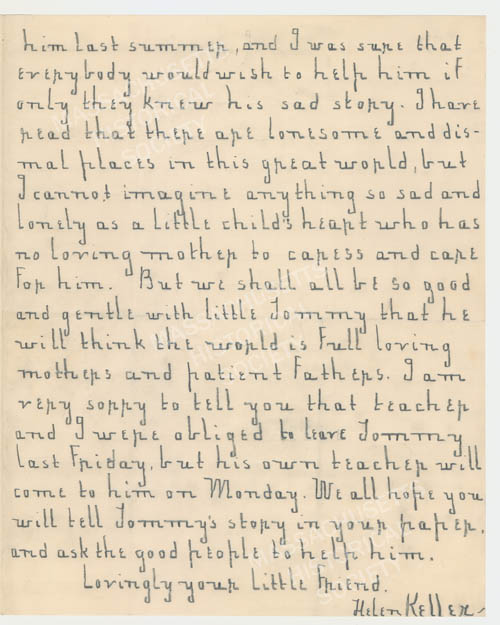
Those of us who process manuscript collections are always stumbling on interesting and unexpected finds. I was recently working with the MHS’s George E. Ellis papers to improve the arrangement and description of the collection, and one letter immediately caught my eye. It was written by 10-year-old Helen Keller.

Between 1888 and 1892, Keller was a student at Perkins School for the Blind in South Boston. (The school moved to Watertown, Mass. in 1912.) She found a happy home at Perkins, which she described in her 1902 autobiography The Story of My Life: “Until then I had been like a foreigner speaking through an interpreter. In the school where Laura Bridgman was taught I was in my own country.”

The subject of this letter, written to Dr. Ellis on 27 April 1891, is four-year-old Tommy Stringer, another Perkins student who was both blind and deaf. Stringer’s family was unable to support him, so he had been brought up from an almshouse in Pennsylvania to the Perkins kindergarten. Keller became his energetic advocate and wrote to friends and strangers alike, as well as newspapers, to solicit donations for his education. Ellis was one of the many who contributed. Keller wrote to him gratefully:

Mr [Phillips] Brooks once told me that love was the most beautiful thing in the world, and now I am sure it is, for nothing but love could brighten Tommy’s whole life. I think we ought to love those who are weak and helpless even more tenderly than we do others who are strong and beautiful….I have read that there are lonesome and dismal places in this great world, but I cannot imagine anything so sad and lonely as a little child’s heart who has no loving mother to caress and care for him. But we shall all be so good and gentle with little Tommy that he will think the world is full [of] loving mothers and patient fathers.

It just so happens that Ellis was the president of our very own MHS at the time, an historian, and a former minister of the Harvard Church in Charlestown, Mass. He corresponded with many notable people, but this letter, written in large, neat, blocky handwriting, stands out from the rest. It’s amazing to realize that it was written just four years after Keller met Annie Sullivan, at which time Keller could barely communicate at all, let alone read and write. (About a year later, she explained to the readers of the children’s magazine St. Nicholas how she wrote by placing a “grooved board” between the pages, probably some version of a noctograph.)

George E. Ellis died in 1894. In his will, he bequeathed $30,000, as well as his home and all its contents, to the MHS. Funds from the sale of his property were used to help build and relocate to our current home at 1154 Boylston Street. Our very own research room, Ellis Hall, is named after him. We hope to see you there sometime!

Thomas Stringer graduated from Perkins in 1913 and became a woodworker in Pennsylvania, dying in 1945.

Volunteer, the America’s Cup victor—of 1887

By Peter Drummey, Librarian

The extraordinary come-from-behind victory of Oracle Team USA in the recent America’s Cup competition calls to mind a time when Boston was the center of American yacht racing design and development.  Between 1885 and 1887, the local team of Charles Jackson Paine (owner) and Edward Burgess (designer), first as part of a syndicate and then twice on their own, defended the Cup in three successive campaigns.  The triumph of their center-board sloop, Volunteer, over the British challenger, Thistle, in September 1887, was the cause of an enormous victory celebration that took place, on October 7, 1887, 126 years ago , at Faneuil Hall in Boston.  While photographs of elegant Volunteer evoke a romantic, now long-lost age of sail, she was, in her own day, as innovative as the wing-sailed catamarans that vie for the Cup today.  Designed and built in great secrecy with steel frames and plating, Volunteer could carry ballast lower in her hull than her wooden-hulled predecessors.

Although 19th–century Boston was increasingly divided along ethnic and political lines, in 1887 the entire city came together in a joyous outpouring of patriotism at a monumental reception for their local heroes. So many ardent supporters attended the event—which included the reading of a poem written for the occasion, “Bostonia Victrix”— that the program was interrupted at several points “to allow the assembled multitude to greet the guests of the evening with a hand-shake.”  Newspaper reporters estimated that 7,000 people queued up for the opportunity to personally thank “enterprising” Charles J. Paine and equally “inventive” Edward Burgess, the “guardians of the Cup.”    

Chinese Hanzi Characters in 1801

By Andrea Cronin, Reader Services


On 30 July 1801 the snow Pacific Trader bound for Canton floundered in the Pacific Ocean when the vessel took on water in the midst of a violent two-day gale. The winds tore the sails and mangled the rigging so terribly that the ship and its small crew limped into safe harbor at Macao on 23 August 1801. Proprietors William and Sullivan Dorr in Canton received more than ten letters from Captain Samuel Edes aboard the Pacific Trade in the subsequent month while the ship sheltered and was repaired in Macao. These letters are contained in the Samuel Barrett Edes papers held at the MHS.

On 27 September 1801 Captain Edes writes to inform the Dorrs of the progress of ship repairs and the condition of the cargo. However, it is the verso page of the letter that truly captures my imagination. The verso functioned as the envelope, containing the address information of the intended recipient, Sullivan Dorr. Far more interesting than the address is the beautiful example of Chinese Hanzi characters composed on the verso.

I imagine that the Hanzi message reveals directions due to its location close to the address, just near the seal. However, a larger question looms in my mind. Who wrote this inscription? The small crew of the Pacific Trader hailed from Massachusetts, New York, Virginia, Ireland, St. Croix, Guadeloupe, and Bengal according to a crew list in the Samuel Barrett Edes papers. None of these men were native to China or surrounding countries that utilized Hanzi script. Although some crewmen may have learned the spoken language, the beautiful and careful script of the Hanzi suggests to me that a native writer composed the message.

Are you familiar with 19th century Chinese Hanzi script? Can you read this inscription? We would love to hear from you!

John Adams and the Bill of Rights

By Amanda A. Mathews, Adams Papers

On this day in 1789, President George Washington wrote a short letter to each state’s governor, enclosing a copy of twelve proposed amendments to the new United States Constitution for consideration, which Congress had passed on September 25 with the signatures of the Speaker of the House and the President of the Senate, Vice President John Adams. Of the twelve, ten received the necessary ratification and collectively became known as the Bill of Rights.

These amendments corresponded with many of the changes for which John Adams had expressed a desire when he first read the proposed Constitution. “A Declaration of Rights I wish to see with all my Heart,” he confided in early 1788, “though I am sensible of the Difficulty of framing one, in which all the States can agree.— a more compleat Seperation of the Executive from the Legislative too, would be more Safe for all. The Press, Conscience & Juries I wish better Secured.— But is it not better to accept this Plan and amend it hereafter?”

Adams certainly was “sensible of the Difficulty” of writing a constitution. A decade earlier, in the fall of 1779, he toiled over his draft of the Massachusetts constitution, drawing upon the other states’ constitutions as well as his own extensive study and consideration of law and government. Not only did he include protections for the press, religious belief, and juries, but reflecting the importance the Declaration of Rights held for Adams, he had placed it ahead of the frame of government itself.

While the proposed amendments did not repair all the defects that Adams perceived in the federal Constitution (he particularly opposed the limited presidential veto and the need for Senate approval of nominations), he understood that the Constitutional Convention’s achievements could not be diminished, even if the final product remained flawed. “A result of accommodation cannot be supposed to reach the ideas of perfection of any one,” Adams admitted in the conclusion of his Defence of the Constitutions of Government of the United States, “but the conception of such an idea, and the deliberate union of so great and various a people in such a plan, is, without all partiality or prejudice, if not the greatest exertion of human understanding, the greatest single effort of national deliberation that the world has ever seen.” The new Bill of Rights moved the nation another step toward a “more perfect union.”

“[Otters] Are Your Principall Object”: Fur Trade in the Dorr Family Papers, Part I

By Andrea Cronin, Reader Services

“…perhaps you will find that you are to far up the Country for otters,” Boston merchant Ebenezer Dorr advises his son Ebenezer Dorr, Jr. who served as the supercargo onboard the schooner Amelia in a 10 December 1787 letter contained in the Dorr Family Papers. The elder Dorr continues, “if so one of you can scower the Seashore for them, they are your principall object, we are now making our first shipment on the new plan & making preparation for the second, the third expect you will proceed with if business turns out as I expect.”

The fur trade between the United States and China boomed in the late 18th century after the gates of Canton’s markets opened to United States merchant shipping in 1784. The Dorr family invested heavily in the fur trade expeditions of the schooner Amelia (1787), the sloop Lucretia (1792), and the snow Pacific Trader (1799-1801). In this letter Ebenezer Dorr instructs his son to collect otter pelts from the Pacific Northwest for trade in Canton where such furs commanded substantial returns. The Chinese merchants sought American furs, paying premium prices for luxurious otter pelts. The crew of the schooner Amelia engaged in sealing and trapping in the Pacific Northwest in efforts to bolster their wares before continuing passage to Canton.

The market of pelts employed not only the efforts of Chinese and American merchants, but Russians too. While otter fur exacted better prices, other furs sold in this market included seal, beaver, buffalo, wild cat, and even raccoon. In the very same letter the elder Dorr writes to his son that he should seek out, “rackoon if blackhaired & well furr’d … & wild cat they being furrs fashionable in Russia.” Those savvy Dorrs in Boston understood the unique demands of the participating powers in the fur trade and aimed to capitalize on their fur trading endeavors in the Pacific Northwest and Canton.

Stephen Greenleaf Bulfinch, Post 25

By Elaine Grublin

The following excerpt is from the diary of Stephen Greenleaf Bulfinch.

Bridgewater, Tuesday, Sept 1. 1863

I have received to-day a very pleasant letter from Maria….She writes pleasant intelligence also, of my brother-in-law and former assistant, George A. Howard. He is now in beleaguered Charleston, but the seriousness of the time, or some other cause, seems to have made a very happy change in him. His nephew and mine, my godson, Cyrus Bulfinch Carter, is in the Confed service, & has been stationed at Fort Wagner, at Charleston.

With a sigh for all the miseries of this time, – of which, as of its crimes, a most awful example is given by the recent massacre of Lawrence, Kansas, – I yet rejoice at the increasing success of the Union Arms – God grant his keeping for the restoration of peace, & the progress of freedom!

Sunday, Sept. 6th

Today I went in to preach at King’s Chapel but did not, owing to some mistake. Heard a good sermon from Mr. Foote, referring touchingly to the losses by the war, – particularly the cares of Major Paul Revere and Mr. Perkins, the death of the latter having been only learned of yesterday.

Sunday, Sept. 20 1863

The war continues with varied success in individual encounters, but important gain on the whole, to the cause of Union and Freedom. The eyes of public expectation are now fixed on Charleston, – Northwestern Georgia, – the Texas expedition, – and the Rappahannock. There is anxiety about our foreign relations, but we can hardly think English statesmen will be guilty of so great a crime and folly as to force us into a war. God grant that way be spared us! Mr. Sumner’s speech, recently delivered, must, one would think, make them feel the unworthiness of their position. The danger from France seems to be passing away.

Return from RBS

By Dan Hinchen

During the last week of July I attended a course at Rare Book School, housed at the University of Virginia, Charlottesville. The class was an introduction to bibliographic description or, basically, the physical description of books created during the hand-press period, or, up to about the mid-19th century. The course focused mainly on the printing process that occurred in between the functions of the author and the binder.

The course concentrated on just a few elements of bibliographic description, namely format, collation formulae, signing statements, and pagination. This information seems a bit esoteric at first but it can be valuable for researchers who study printing processes or who examine all editions of a given title in order to identify printing errors and corrections and discrepancies among various printings.

As I walk through the stacks here at the Society now, I keep my eyes peeled for interesting-looking volumes that I can practice with. Trebly-beneficial, this will allow me to 1) keep my newly-acquired skills sharp, 2) familiarize myself more with the MHS’ rare book collection, and 3) potentially aid our cataloging department in the cases where these descriptions are not already present.

And with that said, I will share one such example of a collation formula to illustrate the practice. The volume I chose has a long title so I will only give part: “Pansebeia: or, A view of all the religions in the world…” (London, 1664). The MHS has three different copies of this title from three different dates. This 1664 version is the fourth edition. When I checked in our online catalog, ABIGAIL, I noticed that this copy did not have a collation formula attached while the other two did.

I start by measuring the size of the leaves and examining the paper for evidence of chain lines and watermarks. These will give clues as to the format of the book (folio, octavo, duodecimo, etc.). Then I perform a leaf count which is just as it sounds, counting all the leaves in the book that would have been involved in the printing process (this excludes things like blank leaves at the front and back, and illustrations that would have been inserted after printing).  Next is the collation formula. This step involves identifying signature marks that appear throughout the text and then, using the pattern in which they appear, forming a signing statement. The signatures consist of letters and numbers at the bottom of the page that, along with other clues, informed the binder of the order in which pages should be arranged before binding. The last step is to identify the pagination, or, how the pages are numbered and where mistakes are made. All of this description is put into a formula that looks much like an algebraic statement:

8°: A8 a8 B-I8 L-R8 T-2M8 2N4 3A8 3a4 3B-3F8 (K8 S8  3F8 missing; 2D6 missing, removed); [$4 (-3A2, 3a4) signed; missigning V4 as U4]; 345 leaves; [32] 1-544 [545-552]; 2[24] 1-78 [79] [misnumbering 68 as 63, 78 as 73, 206 as 106, 479 as 463, and 266 as 96].

Look confusing? In my next post I will explain the formula and some of the terminology associated with bibliographic description. Stay tuned!


“There is not moments in a day but I think of home:” The Letters of Civil War Sharpshooter Moses Hill, Part 5

By Susan Martin, Collection Services

Unfortunately we’ve come to our last installment on the letters of Moses Hill here at the MHS. After the devastating fighting around Richmond that I described in my previous post, Robert E. Lee drove the Union army south to Berkeley Plantation on the shores of the James River. This estate served as George B. McClellan’s headquarters in July and August 1862, and here Moses and the other Andrew Sharpshooters got a short respite, a chance to regroup while the Union forces were replenished with new recruits.

Over the last two weeks, Moses had fought in multiple battles, including Savage’s Station on June 29, Glendale on June 30, and Malvern Hill on July 1. He wrote to his wife Eliza about the grueling retreat:

I think there must of been a great meny sick & wonded left behind. After I gave out I saw hundreds of wonded & sick limping and working themselvs along the best way they could. It was a horable sight to see them exert every nurve and strife for life. I am glad you did not see them. Horses would run over them and nock them down. They had to creep crall any way to get along.

Union morale was low after the failure to take Richmond, but Moses still hoped to be back home in Medway, Mass. soon. He treasured a photograph Eliza had sent him:

I received your Picture and I think it looks very naturel or as you looked when I left home. I think I shold remember how you all looked if I was off for a long while. I like to take your picture out and look at it. I think of you a great deal and the children too.

However, Moses had been complaining more frequently of illness, and he finally confessed to his wife, “I have been quite unwell long back.” He suffered from diarrhea and fatigue, weighed only 126 pounds, and was sometimes too weak to walk even a half-mile. His clothes were in tatters, and he was plagued by the heat and the flies. His mother, Persis Hill, described one of his letters as “the most disenharted letter he ever has rote. It seames he is all down and discouraged.”

On 16 Aug. 1862, the Union troops decamped from Berkeley Plantation and moved downriver to Newport News. Moses wrote to his family from there a week later. But while he had been a regular correspondent during his year of military service, they wouldn’t hear from him again for almost a month. On September 18, he wrote from Harewood Hospital in Washington, D.C.:

It is a very pleasant place but it is not home….Eliza I should of writen before but I have been so unwell that I did [not] feel as I could. I think I have wored about you as much as you have about me, for I knew that you did not know what had be[c]ome of me. I am run down and I want a good nursing. I ought to be at home. Some days I am better and then I am worse, but If I take good care of myself I think I shall get a little stronger….Dear Eliza do not worry about me for I shal try to getalong. I will write again soon. You must excuse me for I am very tired. My love to all and lots of kisses.

This is the last letter in the collection written by Moses Hill.

His family received his letter “with the greatest pleasure imaginable.” Eliza was relieved he had been spared from the battle at Antietam, where his regiment suffered terrible losses. (She added guiltily, “I know it is selfish to say so, but I cannot help it.”) She and their teenaged daughter Lucina wrote to Moses several times at the hospital, but did not receive any replies. Their letters became more and more frantic. On October 5, Eliza wrote:

I feel very anxious about you. If you are not able to write yourself, do get some one to write for you. Mother Hill and your sisters are as worried as I am. We want to know just how you are, what ails you. I want to have you come home for me to take care off, if it is possible….I think of you, and pray for you, daily, and hourly….I want to see [you] so much. I send you my best love, and wishes, with many kisses.

Lucina added a postscript about her three-year-old brother: “Georgie askes for father about every day.”

With the help of George Lovell Richardson of East Medway, Moses Hill was discharged from service on 13 Oct. 1862. Richardson accompanied him home, and they reached Medway on the 17th. Moses died of consumption 12 days later. He is buried at Prospect Hill Cemetery in Millis, Mass.

Eliza Hill died in 1888.

Left to right: Lucina (Hill) Howe, Helen Richardson, Eliza Hill, and Genieve Richardson

Undated photograph, circa 1885. Frank Irving Howe, Jr. Family Papers.


The Other Adams-Jefferson Correspondence

By Amanda A. Mathews, Adams Papers

Two hundred years ago today, August 22,1813, Thomas Jefferson wrote a letter to his old friend, Abigail Adams; the first he had directed to her since 1804. While Jefferson’s incredible correspondence with John Adams has rightly acquired fame, Jefferson and Abigail maintained a warm relationship and a notable correspondence as well following their joint stay in Europe in the 1780’s, interrupted, during the often personal political conflict and mistrust of the 1790s and early 1800s.

The renewed friendship between Jefferson and the Adamses is evident in Jefferson’s playful tone. “I have compared notes with mr Adams,” Jefferson teased, “on the score of progeny, and find I am ahead of him, and think I am in a fair way to keep so. I have 10 1/2 grandchildren, and 2 3/4 great-grand-children; and these fractions will ere long become units.”

Jefferson concluded, “under all circumstances of health or sickness, of blessing or affliction, I tender you assurances of my sincere affection and respect; and my prayers that the hand of time and of providence may press lightly on you, till your own wishes shall withdraw you from all mortal feeling.”

What Jefferson could not know, however, was that it was under sickness and affliction that he was writing to his two old friends. Abigail Adams Smith, better known as Nabby, the only daughter of John and Abigail Adams, had passed away on August 14 at her parents’ home after a recurrence of breast cancer, ending a difficult adult life generated by her husband’s financial misadventures. In her reply to Jefferson, “your kind and Friendly Letter found me great affliction for the loss of my dear and only daughter, mrs smith . . . I have the consolation of knowing, that the Life of my dear daughter was pure, her conduct in prosperity and adversity, exemplary, her patience and Resignation becomeing her Religion— you will pardon by being so minute, the full Heart loves to pour out its sorrows, into the Bosom of sympathizing Friendship.”

Abigail closed her letter with her own assurances of friendship, “altho, time has changed the outward form, and political ‘Back wounding calumny’ for a period interruped the Friendly intercourse and harmony which subsisted, it is again renewed, purified from the dross. with this assurance I beg leave To subscribe myself your Friend.”

While the letters written between John Adams and Thomas Jefferson certainly deserve the recognition they have received, Abigail’s independent friendship with the third president, one built on mutual respect and shared sorrows, fostered a correspondence equally as fascinating.

Orange is the Old Black?: Nineteenth-century Prisoner Activism in the MHS Collections

By Anna J. Clutterbuck-Cook, Reader Services

There’s been a lot of chatter recently about the new Netflix original series “Orange is the New Black,” a drama about life in a women’s prison. As Heather Chapman, one-time volunteer at the Massachusetts Correctional Institute in Framingham, writes in The Guardian:

The reality is over 2 million Americans are currently locked up. Put another way, that’s 1 in 100 US adults.  And 1 in 37 Americans will be locked up at some point in their lifetimes. Despite the “lock ’em up and throw away the key” mentality, most of these people will re-enter society. The public should understand our correctional system – and its financial and human costs – far better than we do now.

What does a twenty-first century Internet series have to do with an institution like the Massachusetts Historical Society? While the medium is new, the message is not: American calls for prison reform and advocates of prisoner’s rights have long historical precedent. Before the advent of moving pictures – and long before the invention of the Internet – reformers and prison advocates alike used text and images, to convey their message. Here are a few examples drawn from the MHS collections.

This illustration from prison warden Gideon Haynes’ Pictures From Prison Life: An Historical Sketch of the Massachusetts State Prison (1869) depicts a tidy building and grounds, with a row of prisoners exercising.


A different perspective can be found in the lyrics and illustration of “Song of the Convict,” a maudlin lament written by William and James Bradley, “two brothers, prisoners,” for the celebration of Thanksgiving at the Massachusetts State Prison in 1846. Along with the image of the forsaken prisoner kneeling in his cell, the lyrics of the song document the religious motivation of many behind prison reform campaigns during this period:


Phillippi’s dark dungeons with anthems are shaken,
And notes of thanksgiving peal thro’ the night air;
O! what can such joy in a Prison awaken?
The friends and the spirit of Jesus are there;
There angels mercy paints,
Mid rising songs of saints,
The rainbow of Hope on the cloud of despair.

Women in prison (the subject of “Orange is the New Black”) were then, as now, their own particular topic of concern. In a circular tentatively dated from 1849, the Prisoner’s Friend Association reported to its membership:

The design of the Charity is, to furnish to female prisoners, on their discharge from the House of Correction, a temporary home, to encourage them to reform, and to enable them to do so by procuring for them honest means of support.

Examples of successful “reform” and subsequent participation in society are detailed in explicitly gendered (and in one case racialized) terms:

One, who in the moment of temptation was guilty of theft … was returned to her family [upon release], where she has since, for a period of eighteen months, faithfully discharged her duties as a wife and mother.

A young girl, also, whose heart had not been hardened by crime, after a short imprisonment, was taken by our Agent and furnished with a place of service, where she remains.

A colored girl, with few acquaintances and no friends, was sent to a family in the country, where she has given such evidence of fidelity and capacity as to merit and receive from her mistress the highest encomiums.

At once progressive in the assumption that former criminals may be rehabilitated, the reformers in the Prisoner’s Friend Association also paint a very clear picture of the limits of that rehabilitation: who it is possible to rehabilitate, and what the former prisoners might be suitably rehabilitated for: the roles of wife and mother, the position of servant.

Researchers interested in the history of prison life, prison policy, and prisoner advocacy are invited to explore our collections to see what other primary sources we have to offer!