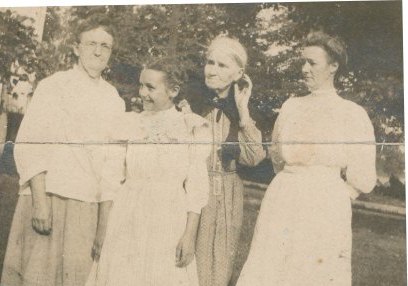
Stephen Greenleaf Bulfinch, Post 24

By Elaine Grublin

The following excerpt is from the diary of Stephen Greenleaf Bulfinch.

Saturday, Aug. 1, 1863

Have sympathized with the relatives of Henry Foster, who died by his own rash or bewildered act, at New Orleans, and of my friend Rev. T. B. Fox’s son, who received a mortal wound at Gettysburg.

Wednesday, Aug. 12th, 1863

Monday, we had the pleasure of welcoming home our young neighbors, C. & D. Weymouth, who arrived with their regiment, the 42d. They have been prisoners in Texas, and since then in a paroled camp near New Orleans…Today, the village (Bridgewater) is lively with the mustering-out & paying off, of three companies of the returned Third Regiment.


Happy Twitterversary JQA!

By Nancy Heywood, Collection Services

John Quincy Adams (JQA) had a remarkable life and over the course of almost 70 years assembled an extraordinary number of diaries.  JQA began keeping a diary in 1779 at the age of twelve and continued writing diary entries until shortly before his death in 1848.  All in all, his diary entries fill 51 volumes, over 14,000 pages.  JQA’s diaries are part of the Adams Family Papers at the Massachusetts Historical Society (MHS).  MHS shares this American treasure in many ways:

By making page images of the entire set of diary volumes available

By making the Adams Papers Editorial Project’s authoritative transcriptions of JQA’s diary entries for 1779-1788 available as part of the Adams Papers Digital Edition

By tweeting his succinct line-a-day diary entries about his life 200 years ago via a Twitter account

The diaries are important because they share the life and thoughts of a man who held many important public offices and interacted with many world figures.  John F. Kennedy summarized JQA’s significance this way:

John Quincy Adams—until his death at eighty in the Capitol—held more important offices and participated in more important events than anyone in the history of our nation, as Minister to the Hague, Emissary to England, Minister to Russia, head of the American Mission to negotiate peace with England, Minister to England, Secretary of State, President of the United States and member of the House of Representatives.  He figured, in one capacity or another, in the American Revolution, the War of 1812 and the prelude to the Civil War. Among the acquaintances and colleagues who march across the pages of his diary are Sam Adams (a kinsman), John Hancock, Washington, Jefferson, Franklin, Lafayette, John Jay, James Madison, James Monroe, John Marshall, Henry Clay, Andrew Jackson, Thomas Hart Benton, John Tyler, John C. Calhoun, Daniel Webster, Lincoln, James Buchanan, William Lloyd Garrison, Andrew Johnson, Jefferson Davis and many others. (John F. Kennedy, Profiles in Courage, NY: 1956, pages 35-36.)

John Quincy Adams often kept several different types of diary volumes simultaneously, and for many dates there are several entries—long entries, short entries, lists, draft entries, and also “line-a-day” entries.  The line-a-day entries are short –the words describing one day fit on one handwritten line, and each page contains entries for one month.  These succinct summaries of JQA’s activities fit within Twitter’s 140-character limit and in on 5 August 2009 MHS began tweeting JQA’s line-a-day diary entries 200 years after the day he described. 

We enjoy hearing from JQA’s followers and thought we’d share a few tweets that we’ve received via the JQA Twitter account:  

@JQAdams_MHS I look forward to the tweets every morning. 🙂 I feel as if I actually know him. lol.   [From Susan T. @marypoppins68 9:41 AM – 19 Jul 13]

@JQAdams_MHS has been dead for 165 years and he still tweets more than most people I know. [From Sean Junkins  @sjunkins 5:04 AM – 15 Jun 13]

@JQAdams_MHS it is amazing that these entries can be so old and still stir such emotion. This project has really humanized JQA for me.   [From JD Miller @jdudemill 7:18 AM – 15 Sep 12]


The Letters of Rev. John Higginson’s Merchant Sons

By Andrea Cronin, Reader Services

“Dear Brother Nathaniel. It is now sixteen years since you left England, from whence, while you were there, I had often refreshing letters from you,” wrote Salem merchant John Higginson to his brother Nathaniel Higginson on 16 April 1699, in a letter contained in the Higginson Family Papers held by the MHS. John Higginson and Nathaniel Higginson were both sons of Rev. John Higginson of Salem. While Nathaniel Higginson ventured off to England after graduating from Harvard College in 1670, John Higginson remained in Salem to become a merchant and member of the Governor’s council. The elder brother continued his letter, echoing sentiments that occur with repetition in the family letters:

But now, what climate have you got into that makes you forget your Father’s house? I have not received one line from you since you left England, though you have had so many opportunities by England, Holland, Barbadoes. What is it that we have offended you in, that you will not afford one line in so many years? Have the honours, profits, &c., of the world quite swallowed you up?

What climate did Nathaniel Higginson find himself in? After his education at Harvard, the young New Englander traveled to England in 1674 where he acted as  steward and tutor to Lord Wharton’s children for seven years. This departure from New England happened just before King Philip’s War, when troubled relations between the Native Americans and colonists perhaps factored into the young man’s decision to visit his relatives in England. Higginson was later employed under Lord Wharton in the mint of the Tower of London. In 1683 he left England and sailed to India. In his early thirties at the time, he established himself as a merchant at Fort St. George in Madras, eventually becoming the colonial governor of Madras. He was handed the keys to the garrison and city of Madras by Elihu Yale, the namesake of Yale College, on 23 October 1692.

Nathaniel Higginson never returned to New England, despite his brother John’s pleading to come home. On 20 June 1697, John clearly demostrates his wish to see his brother again, writing to Nathaniel:

Dear Brother,
I request you to give me a particular account of your circumstances; and I hope you do not intend to spend all your days in India, but will return into England, and so into New England. We want such men; and now you have gotten you an estate, the business is to contrive how to lay it out for the glory of God and the good of yourself and yours; which, I conceive, may be done as well in New England as any where.

The nomadic brother did make some effort to return to New England. In 1700, he sailed with his wife and five children from India to England to settle his affairs with plans to sail to Salem or Boston. However, Nathaniel Higginson died in London on 31 October 1708, in the same year as his father Reverend John Higginson died in Salem.

Of Reverend John Higginson’s other sons, Thomas Higginson became a goldsmith in England and later left for Africa, after which he was never heard of again. Francis Higginson went to England, was educated at the University of Cambridge, and died of small pox in London in his mid-twenties. Henry Higginson became a merchant in Barbados and died of small pox in 1685. Reverend John Higginson’s eldest son, the letter writer John, was the only son to remain in New England. He lived until 1720 to the age of 73, flourishing in Salem as an East Indies trader.

Interested in the Higginson family or East Indies trade?  Visit the library at Massachusetts Historical Society to check out the Higginson family papers. If you are not located within the Boston area, the Hathi Trust has provided a digital edition of the transcription of these letters from the Collections of the Massachusetts Historical Society, 3rd series, Volume 7 (1838).

Life on the French Front during WWI: Margaret Hall’s Memoir

By Emilie Haertsch, Publications

In the forthcoming MHS publication Letters and Photographs from the Battle Country, 1918-1919, Red Cross volunteer Margaret Hall recounts through letters, diary entries, and photographs her time working close to the front lines in France during World War I. She worked at a canteen at Châlons-sur-Marne, a village with a critical railroad juncture that made it a target to the Axis and also provided a steady stream of soldiers and wounded passing through. Her sincere, plucky voice depicts both the hopeful moments and the tragedies of a ravaged country towards the end of the war.

Hall often stayed in makeshift, unsanitary quarters and had to remain ever vigilant for air raids. This September 29, 1918, diary entry reveals the struggle for basic necessities like rest and hygiene.

Great bombardment all night. People couldn’t sleep. My sleep disturbed, for when that is going on you feel that something is wrong and you can’t rest calmly. It is certainly a nervous life. I don’t take off my clothes at night now. Am eaten alive with fleas and suffer untold agony. Scarcely have time to wash my hands or do my hair; am a perfect pig to behold, but there is so much doing that I couldn’t shut myself up for long enough to do anything.

Despite her difficult living circumstances, however, and the long hours she spent working in the canteen feeding soldiers and refugees, Hall maintained a sense of curiosity about what was going on around her. Later in the same entry she describes an interesting scene she encountered.

Saw the sweetest procession go over the bridge today; a little circus parade, each little cart drawn by a big sturdy horse. They were carrier pigeons going up to the front in their little houses, which were very neat and freshly painted. They had windows to look out and it was the only soothing thing I’ve seen in the long endless moving stream. . . . Saw also a hundred dogs going up to the front. They were walking round the streets here, two to one master, looking awfully sweet and young, all different kinds, but so affectionate to their masters. They had little tin boxes on their collars. I hated to think they had to catch it too.

University of Connecticut English professor and MHS fellow Margaret Higonnet is editing Margaret Hall’s memoir, which has an expected 2014 publication date. Stay tuned for future posts following Hall’s experiences in the Great War.

The Boston – Brewster Road

By Dan Hinchen, Reader Services

Each summer for the last ten years I have been fortunate enough to call Cape Cod home, specifically, the town of Brewster. As someone who travels to the Cape as a summer employee, I have occupied a position of not-quite-a-local but also not a tourist. Over the past three years, as my full-time employment on the Cape morphed to part-time labor (coincidental with my employment at the Historical Society) I have become much more familiar with the tourists’ view of things as I repeatedly travel the road from Boston to Brewster.

The roughly 90-minute drive from South Boston to Brewster that I repeat each week consists of three main phases: exiting the city on I-93, merging onto Rt. 3, and then crossing the Cape Cod Canal and cruising on Rt. 6. The elevated road out of Boston, I-93, gives drivers glimpses of Boston Harbor to the east and Dorchester and the Blue Hills to the west. After about 10 miles, drivers merge onto Route 3 which carries travelers through many towns of the South Shore between Quincy/Braintree and Plymouth. As a Boston-Cape Cod commuter I am familiar with the names of these towns as their signs pass by – Norwell, Hanover, Duxbury, Pembroke – but I rarely see the towns themselves. Instead, this section lends little to the eye except two lanes of highway and ubiquitous scrub pines for about 45 miles. Then, things change suddenly but briefly as the Cape Cod Canal appears. At the apex of the Sagamore Bridge the driver (or better, the passenger) is afforded a view west-southwest along the canal and, to the east-northeast, a view of Cape Cod Bay expanding to the horizon. However, this vista is fleeting and soon the driver returns to a road that is not that dissimilar from the many miles just traveled. Now it is a matter of time before the highway is left behind and the destination reached.

Traveling to Cape Cod was not always this way. For one thing, the modes of transportation have changed. According to an account of a trip to Cape Cod on 29 Aug 1827, Thomas Wren Ward (1786-1858) “left Boston at half past Seven in a carryall with two horses, our own (Blackfoot) and one of Mr. Groggs, (the miller,) and proceeded over the Neck through Dorchester on our way to Sandwich.” But with no highway to breeze by every town between here and there, Mr. Wren provides several comments relating to the character and people of these towns:

Hingham a very neat & beautiful village – no people seen in the streets – every one about his business. The people of Hingham close, calculating, & very economical – habits good – & a town thriving…Great place for eggs.

From Scituate you pass over part of Hanover, Pembroke, Kingston to Plymouth, about 20 miles. A good house at Pembroke 10 miles from Plymouth…Pembroke and Kingston, the latter especially, very pretty towns.

Great appearance of neatness and industry in all the towns on the So. Shore. At Plymouth, Mrs. Nicholson’s—good tavern—near the court house.

Ward’s fairly brief account gives some insight into the character of the people and places of the South Shore and through comparison we can see what has changed.

Trout in the Small brooks on the road across to Buzzard’s Bay, which is six miles from Sandwich. Oysters plenty across the neck of land; this is the place where the Canal was talked of.

And though he does not provide specific time sets for his journey, in reading the entire text it becomes clear that this trip probably took at least a couple of days:

[Mr. Elisha] Pope has a store – obliging man – very civil to us. The taverns full. Met Mr. Goodwin, who carried us to Mrs Newcombe’s who was persuaded to take us in.

Moving ahead just 20 years, Sarah Augusta Mayo (1830-1886), a Brewster native, relates a story of traveling in the opposite direction and, despite advances in travel, the reader gets some idea of what an undertaking it was to move from Brewster to Boston. In the published edition of her diary, Ms. Mayo records some details about her journey:

The stage driver called for us at four o’clock before which we had our breakfast by lamp light. This was the first time I had been to Boston by land. We went by Higgins’ stage line to Yarmouth Port where we changed at Sears’ hotel for Boyden’s coach to Sandwich. Plymouth was the nearest railroad point to Cape Cod at this time.

We stopped at Pope’s hotel in Sandwich, where we took a third stage coach for Plymouth. This was a long drive. We took our dinner at a forlorn place in the woods called Cornish’s tavern. Soon after our arrival at Plymouth we took a train at 3 P.M. for Boston and reached Chelsea at 7 in the evening…

Then, as now, the land route was not the only option for people making the trip from Boston to Brewster. As Ms. Mayo notes in her writing, “On the 15th of July 1850 I left Brewster on the steamer Naushon arriving at Boston at 3 o’clock P.M.” We do not know when she boarded the vessel but, given her arrival time, it can be fairly assumed that this route did not take as long as the overland track.

With the re-introduction of rail service from Boston to Cape Cod, travelers once again have three primary options for making the trip: boat, rail, and, personal conveyances (substituting cars for carryalls). And yet, it is not so hard to imagine that there might be a day when traveling to Brewster in highway traffic takes quite as long as Ms. Mayo’s journey via stage and rail. Which would you prefer?


On the Road to Richmond: The Letters of Civil War Sharpshooter Moses Hill, Part 4

By Susan Martin, Collection Services

Welcome back to our series on the letters of Moses Hill, part of the Frank Irving Howe, Jr. family papers here at the MHS. In my last post, I described Moses’ experiences during the Siege of Yorktown as part of McClellan’s Army of the Potomac. After the siege, Rebel forces retreated to the Confederate capital of Richmond, Virginia, with the Union army hard on their heels. Moses’ regiment, the 1st Massachusetts Sharpshooters, had been attached to the 15th Regiment  Massachusetts Infantry, Sedgwick’s Division, since April 1862. They traveled up the York River to West Point, arriving in the midst of the fighting there, then continued west through New Kent toward Richmond.

Some of my favorite letters in the collection were written during this time. Moses was especially reflective and honest after nearly a year of hard service. On 26 May 1862, he wrote to his mother Persis (Phipps) Hill:

Some times it looks rather dark and as if the war might last for some time yet, and some times It looks as if it might close soon. I supose you have seen all my letters that I have sent Eliza so I will not write meny poticulers but I can say I have seen some hard times….I am sick of fighting and shooting our Brother man.

Dear Mother I do not see such times as I use to when I could go to the old cupboard and eat of your cooking and eat my fill of boild vitils and custard pie and every thing that was good. I cannot have that now….I hope I shal live to come home and eat one good meal with you. How I would enjoy it.

Love to all, From your never forgetful Son Moses Hill

While Moses approached Richmond, two of his sister’s sons, John and Albert Fales, were serving under Gen. Nathaniel P. Banks in the 2nd Regiment Massachusetts Infantry, Company E, and currently fighting Stonewall Jackson’s troops in the Shenandoah Valley. Moses worried about his nephews in his usual understated way:

They dont know what fighting is and I hope the[y] never will. I have seen enough of it and I hope I shal not see any more….It is not very agreeable.

Unfortunately, just days later, Moses would take part in the worst battle he had seen yet. The Battle of Seven Pines, otherwise known as the Battle of Fair Oaks, was fought from 31 May-1 June 1862 on the outskirts of Richmond. Moses described it to his wife Eliza in gruesome day-to-day detail:

The Surgents [surgeons] was cutting of[f] legs and armes, and dressing wounds all night. The grones was terible. I did not sleep that night. [31 May]

The dead and wonded lay one top of another when the Battle was through. The ded lay on all sides of us where they was kiled the day before. Along the fences they lay some with their faces up, and some with their fases down and in all shapes. It was a horable sight. [1 June]

The dead was about all buared today. Our armey did not bring meny shovels with them so it took some time….There was one on each side of where I slep that lay dead with in a few feet of me. They s[c]ented very bad. The magets was on them, but they burried them as fast as they could. [2 June]

If you see any body that complains of hardship tell them to come into this armey and they will begin to find out what it is.

Even in the darkest times, however, Moses never seemed to lose sight of the humanity of his enemy. He wrote about the Confederate soldiers captured by the Union army:

They Belonged to Georgia Alabamma North Carlonia. I went and talked with them. They said they wanted to get home. The ground was so wet that it was very uncomftible for them. I pitied them from the Bottom of my heart. The ground was most all coverd with water. One of them asked me for my pipe and I gave it to him to smoke.

McClellan failed to take the city of Richmond and was driven back by Robert E. Lee in the Seven Days Battles. Stay tuned to the Beehive for more!


**Image: “War Views. Panoramic View of Richmond, Va. From Libby Hill, looking west.” Published by E. & H. T. Anthony & Co. (New York, N.Y.). Original photographer unknown. From Adams-Thoron Photographs, MHS. 

John Quincy Adams: Summer Chronicles

By Jim Connolly, Publications

So, have you noticed the heat? For your refreshment, here is a little historical commiseration from the diaries of John Quincy Adams.

21 July 1820:

IV:30. Thunder Shower in the night, which made it almost a sleepless night to me. . . . The day was sultry and damp, a temperature which always affects unfavourably my Spirits.

My Spirits are affected too. This weekend, severe thunderstorms are expected break the heat wave in New England. The relief should be well worth the Sturm und Drang.

27 July 1820:

There was one of the most violent Thunder Showers that I ever witnessed. For about half an hour the clash of electric clouds was immediately over the City—the flashes of lightening, followed instantly by the thunderclap, and at intervals of scarcely a minute from each other. Fahrenheit had been in the morning at 90, but fell about 10 degrees immediately after the shower— The evening was cool, and Mrs. Adams rode out with the children.

Here JQA describes his summer evening routine.

30 July 1820:

After dinner, while day-light lasts I read the Newspapers, but from the dusk of Evening, pass an hour or two of total vacancy, sitting at the porch of the door, or the chamber window; almost gasping for breath and maintaining the war with Spiders, bugs and musquitoes.

Did you know that JQA’s diaries are reproduced in full on the Society’s website? Perfect reading for an impossibly stuffy night, don’t you think?


**All quotations from diary 31 of The Diaries of John Quincy Adams: A Digital Collection.

Guest Post: Using the MHS to Learn about Women in WWI

By Elizabeth Pacelle, John Winthrop Student Fellow

Working with the MHS primary source documents for the John Winthrop Fellowship was an amazing and rewarding experience for me.  Besides analyzing various pieces of the Constitution and other common writings, I had never worked so closely with first hand historical documents.  For my fellowship, I wrote a paper investigating women’s involvement in World War I overseas, and how their achievements directly linked to women’s suffrage.  The MHS documents provided such rich evidence for the themes that I was exploring in my paper.  

I was able to analyze the original letters of a young woman named Nora Saltonstall as written to her family.  Nora was a Boston socialite who yearned to contribute to the American war efforts in WWI more actively and directly than women had done previously.  She volunteered to go overseas to Europe to work on the warfront.  It was fascinating to read Nora’s intimate letters and get a glimpse into a personal experience that related to such a greater movement.  At points in the letters, Nora’s sense of humor and wittiness were evident which reminded me that she was indeed human and brought to life the events that transpired, in a way that textbooks are unable to. The collection contains digitized images of the very stationery she wrote on and her actual handwriting.  She dated and gave her location to each of her letters and conveyed the events in her own words, giving the reader such a vivid perspective into Nora’s world at that time. The MHS also had photographs of Nora and her companions, her lodgings and workplaces, and even her passport.  These primary source documents, gave me an eyewitness view to her experience, and made for a more interesting paper.

It is amazing how many letters and other primary sources from the MHS collection have been digitized, making them so easy to access.  The MHS also provides transcriptions of all the digitized documents, which make it easier to search the documents for specific evidence you might be looking for.  The online collection is well-organized and easy to navigate.  It allows you to search by subject, era (from Colonial Era to the present) or medium (photographs, maps, even streaming medium), so you can directly access information on the topic you are pursuing and view different types of sources, which provide different layers of evidence.  In my project I analyzed letters in the form of manuscripts, and backed up my claims with descriptions of photographs and other gallery images that further emphasized my points.  I would suggest looking for correlations between the photographs and writings provided as different means of evidence.

I based my project on the documents in the Massachusetts Historical Society’s online catalog, Abigail, but the MHS library is also an incredibly valuable resource. If you are looking to get a firsthand glimpse into a historical figure’s life, you should check out the MHS collection.  I suppose what I liked most was the ability to interpret the original documents on my own and draw my own conclusions around the actual evidence, rather than directly being told a conclusion by a third party.  The MHS collection is well-worth looking into when you are researching American history topics.


**In 2013, the MHS awarded its first two John Winthrop Fellows. This fellowship encourages high school students to make use of the nationally significant documents of the Society in a research project of their choosing. Please join us in congratulating our fellows: Shane Canekeratne and his teacher Susanna Waters,  Brooks School, and Elizabeth Pacelle and her teacher, Christopher Gauthier, Concord-Carlisle High School.


Stephen Greenleaf Bulfinch Diary, Post 23

By Elaine Grublin

The following excerpt is from the diary of Stephen Greenleaf Bulfinch.

Friday, July 12th, 1863

4th. The great anniversary, rendered still more famous now, was very quietly spent here. At ½ past 1, I went into Boson, & at the depot bought a paper, containing the announcement by the President of the successful issue so far of the three days’ fight at Gettysburg, – which I read with thankfulness & hope.

Friday, July 19th, 1863

The great theme of conversation has been the riots in New York & Boston, occasioned by the Conscription. Blood shed in both. Law triumphant here, and I trust also there.

Meantime, thanks to God for victory at Port Hudson, – near Vicksburg, – in Arkansas, – and some success near Charleston.

“Yet my conscience presses me on”: JQA and the Cost of Conscience

By Amanda A. Mathews, Adams Papers

John Quincy Adams, whose 246th birthday is tomorrow, often used birthdays as a moment to take stock of what he had and had not accomplished and what his priorities were. His conscience, and his sense of duty to make himself useful to his country and worthy of his family’s heritage, focused his reflections on the part he had fulfill in his limited time and his capacity for doing so, even when duty to his own conscience cost him (and often his family) a high price.

One of the most compelling occasions of this takes place in 1841, as Adams, who having successfully navigated the Amistad case, considers his larger role in the growing anti-slavery debate. In this striking diary passage, Adams fully lays out the stakes and comes down on the side of conscience and duty outweighing any personal sacrifice:

“The world, the flesh, and all the devils in hell are arrayed against man, who now, in this North-American Union, shall dare to join the standard of Almighty God, to put down the African Slave-trade—and what can I, upon the verge of my seventy-fourth birth-day, with a shaking hand, a darkening eye, a drowsy brain, and with all my faculties dropping from me, one by one, as the teeth are dropping from my head, what can I do for the cause of God and Man? for the progress of human emancipation? for the suppression of the African Slave-trade?— Yet my conscience presses me on—let me but die upon the breach.—”

This led to a renewed war by Adams in the House of Representatives against the increasingly oppressive “Gag Rule,” for which Adams was reviled, threatened, and harassed both inside and outside of Congress, much to the distress of his family.

Want to hear more about Adams and the cost of conscience? Tomorrow, I will be one of the speakers at the annual wreath-laying ceremony, held at noon at United First Parish Church in Quincy Center, better known as the “Church of the Presidents,” the long-time church for the Adams family, and the final resting place for both John and Abigail Adams as well as John Quincy and Louisa Catherine Adams. The event is free and open to the public.