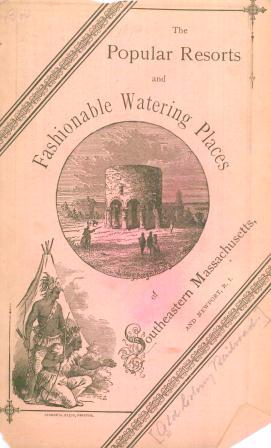

Fashionable Watering Places and How to Reach Them … in 1879

By Andrea Cronin, Reader Services

“Within a few hours’ ride from the metropolis are sections of country and seaboard, which in variety of character, loveliness of climate, and grandeur of scenery, are unsurpassed by any of the celebrated and more distant watering places on the continent,” wrote the unknown author of an Old Colony Railroad Company publication entitled, “Southeastern Massachusetts: Its Shores and Islands, Woodlands and Lakes, and How to Reach Them.” Having spent a few weeks utilizing the Old Colony Railroad system to travel throughout southeastern Massachusetts, the author wrote a guide for other adventurous vacationers in what is essentially a wonderfully descriptive, 49-page advertisement. The pamphlet lists more than 70 destinations, including traditional summer locales such as Provincetown, Martha’s Vineyard, and Nantucket and the less exotic locations such as Taunton, Foxboro, and Attleboro.
The author lays heavy praise on Newport, Rhode Island. “In Newport, however, the walks are probably more sought after than the drives. Foremost among these is the Cliff Walk among the sea bluffs, on which the pedestrian may continue his rambles to Easton’s Beach and round the southern point of Fort Adams.” Of course! The famous Cliff Walk of Newport is listed within the guide and is still as popular today as it was in 1879. Our Cliff Walk is dotted with gilded mansions. What might that scenic “ramble” have looked like in 1879 before these remarkable homes — Rosecliff, the Breakers, Marble House, Ochre Court, and Rough Point, to name a few –peaked over the cliffs?

The author directs the reader from a distant third-person narration, a change from the way many guidebooks are written today. Yet the suggestions of what to do at Monument Beach inspire today’s reader just the same. “From Monument Beach, a boat sail to Burgess Point, a distant about a mile and a half, or across to Marion, some six miles, or along the eastern shore, can scarcely be equaled. The bay is studded with gems of beauty.” Monument Beach is located within Bourne, MA near Phinney’s Harbor for all those interested vacationers reading this blog.

Though one might find the author’s descriptions fascinating, the pamphlet existed to  advertise the Old Colony Railroad. It concludes most helpfully with a list of hotels near the Old Colony Railroad’s stations to aid the traveling vacationer.

While the Old Colony Railroad no longer traverses southeastern Massachusetts as it did in 1879, parts of the system are still used today by modern commuters. Planning a summer get away? Why not get inspired to plan a trip to southeastern Massachusetts this summer? Visit the library at Massachusetts Historical Society — no sunblock required, but reading glasses are suggested — to check out this publication and others on early tourism in Massachusetts.

The “Exhilarating Effect of Wiry Transit”: America’s Nineteenth-Century Cycling Boom

By Anna J. Cook, Reader Services

As the Boston bike share program, Hubway, settles in for its third successful season of supporting urban cyclists, other cities around the country are rolling out their own infrastructure – encouraging more city dwellers to pick the efficient, environmentally-friendly mode of transportation. While bicycling is not an option for everyone, bike share stations make it possible to combine a bike ride with walking and public transit in flexible, efficient ways. As a first-time Hubway participant, I am re-leaning my adopted city (and the rules of the road!) this summer from the seat of what was once called “the safety bicycle.”

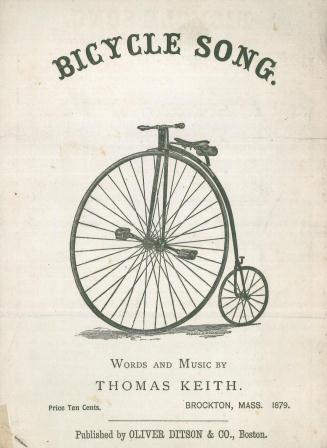
The safety bicycle, developed in the 1880s and popularized in the 1890s, was designed with two wheels of the same size. It was easier to ride and less dangerous than previous models. It was also a model of bicycle marketed to women as well as men. The late nineteenth and early twentieth century saw a boom in cycling for utilitarian transport and for pleasure. The Massachusetts Historical Society’s collection documents some of the ways in which the popularity of cycling made its mark on Boston. For example, in 1886 Geo. H. Walker & Co. published a Bicycling and Driving Road Map of Boston and Vicinity, the title of which prioritizes cyclists over those new-fangled motorcars.

We also hold a copy of the 1880 volume Lyra Bicyclica: Forty Poets on the Wheel, published in Boston and edited by one J.G. Dalton. Dalton prefaces the poems included therein with the autobiographical note, “The author-compiler is one of the very first Bostonians to ride and write into notice the bicycle in this country.” He goes on to describe how “under the early exhilarating effect of the wiry transit … he called upon our native poets … to favor us with a song or two for the new move, declaring that its peculiar charms and potencies and awaited an adequate celebration” (1-2).

One such song, albeit written in 1879, comes down to us as a specimen of sheet music in four-part harmony written by Thomas Keith. The three-verse ode begins:

Come ye whose sore and weary feet
With corns and blisters walk the street;
Come mount with us this easy seat
And ride in a way that can’t be beat.

We match for speed the fleeting wind,
The lagging coach leave far behind.
With wheel and axle underpin’d,
We ask no favors of that kind.

Then mount with us this easy seat,
And ride in a way that’s fun complete.
A cordial welcome all shall greet,
Who undertake to learn this feat.

Our family papers document members’ participation in the League of American Wheelmen, Harvard’s competitive collegiate cycling team of 1888-1901, and include photographs of women and men, girls and boys, posing proudly with their bicycles. I am sure our nineteenth-century predecessors would be asking us what took us so long to re-discover the “exhilarating effect of the wiry transit.”

Stephen Greenleaf Bulfinch Diary, Post 22

By Elaine Grublin

The following excerpt is from the diary of Stephen Greenleaf Bulfinch.

June 18th, 1863

So too let me feel in regard to my suffering, bleeding country. We have heard within a few days, of the sudden aggressive movement of the rebel army, & its inroad into Pennsylvania. May the Ruler of nations grant that the pressure of each immediate danger may arouse a spirit that shall not slumber till it brings conquest and peace! The fine, calm eradication by President Lincoln of his course in making arrests, is worth noting at this time. God be thanked for our firm, honest chief magistrate!

Mysteries Solved! Using Harbottle Dorr’s Index to Find Missing Pamphlets

By Peter Steinberg, Collection Services

The newly-launched website presenting MHS’s collection of Harbottle Dorr, Jr.’s annotated newspapers includes transcriptions of the indexes he created for each of the four volumes he assembled. The task of transcribing these indexes proved inspirational and provoked inquiry. The Massachusetts Historical Society has held the first three volumes, covering the years 1765-1771, for many years. The first volume contained no extra material other than a brief two-page Appendix. However, in both Volumes Two and Three Dorr included contemporarily published pamphlets on topics related to the articles he annotated.

We do not know when this happened, but the volumes were disbound at some point for, among other reasons, preservation. As part of this process, the pamphlets originally collected by Dorr for Volumes Two and Three were removed and added to the Society’s general collection of printed materials. These two volumes came to the MHS in 1798 and have been in use for more than 210 years. This means there is a long period of time in which some of the documents Dorr collected may have been separated and moved around. In 2011, the MHS acquired the fourth volume of Dorr’s Annotated Newspapers via auction. Working at the MHS when this fourth volume arrived, and seeing how it looked in its original organization and binding, I became intrigued about the existence of those pamphlets that had been separated from the earlier volumes, and where they might be located within the building.

You may be wondering: What does the removal of the pamphlets have to do with the index? In transcribing the index, we grew to be familiar with the pagination of the volumes. The newspapers collected and page-numbered by hand by Dorr went only so high. For example, Volume Two’s last newspaper page number is 788 (The Boston-Gazette, and Country Journal, 25 December 1769). However, in the index for this volume there were entries for page numbers higher than page 788. This was an indication that there were supplemental items (i.e. pamphlets) that had been removed and the same was true for Volume Three.

I began to track those index terms where the page number is higher than page 788 (for Volume Two) and page 642 (for Volume Three) in order to try and gauge the subjects of the pamphlets. Then, using these extracted terms in conjunction the library’s ABIGAIL catalog, Google, and WorldCat, a global catalog of library collections, I was able to eventually track down six pamphlets and a broadside formerly included in these volumes. The tell-tale sign that these pamphlets belonged to the collection was the presence of Dorr’s distinctive numbering at the top-center of each page. Once found, these items were photographed in-house and are digitally reassembled with their original volumes via the Harbottle Dorr, Jr. Annotated Newspapers website. Each pamphlet found felt like a significant accomplishment. In finding the pamphlets and having access to them, it has led to a better understanding of how Dorr’s collection originally looked. Finding some encouraged me to look for the others, which were harder to locate.

As I worked on this this blog post, I continued searching for missing pamphlet’s and in the process, uncovered addition items. In browsing Dorr’s Index to Volume Two for indexed terms for which we had no pages, I found the entry “Statute De Tallagio non concedendo.” This term appears on Index page 13 and refers to page 814, which fell within a page range, 789-830, that was still absent from the collection. I searched ABIGAIL for “Tallagio,” as it is a word that would likely yield few if any hits, and was presented with three records: two printed editions of Henry Care’s English liberties, or The free-born subject’s inheritance. Containing Magna Charta, Charta de Foresta, the statute De Tallagio non Concedendo, the Habeas Corpus Act, and several other statutes (1721 and 1774) and one small manuscript: “Appendix of an unidentified manuscript, ca. 1790-1810.” I was familiar enough with Dorr’s Index to know that many of documents contained in Care’s book appear as terms (though largely Anglicized). Could it be that Dorr copied some of the text from Care’s book? The printed books had none of those tell-tale signs of being annotated by Harbottle Dorr. However, the small manuscript was indeed an original Dorr manuscript: the previously unknown “Appendix” to Volume Two! You might say I developed Appendix-itis as a result!

There are currently two page ranges within Volume Two for which we still do not have images: 939 to 946 and 1041-1098.  However, from an index entry and research, I have concluded that the first range (939-946) is the breathtakingly titled pamphlet: A Third extraordinary budget of epistles and memorials between Sir Francis Bernard of Nettleham, Baronet, some natives of Boston, New-England, and the present Ministry; against N. America, the true interest of the British Empire, and the rights of mankind by Sir Francis Bernard (1769). Likewise, index terms for the second range listed above (1041-1098) lead us to conclude that this span consisted of parts of three separate almanacs published in 1768 and 1769. See the Collection Outline for Volume Two for details. While we currently do not know where Dorr’s copies are, we at least know what they are… Also unaccounted for are seven pages (996-1003) from Volume Three, which deals with the Boston Massacre trial of and verdict for Edward Manwaring, John Monru, Hammond Green, and Thomas Greenwood. Research uncovered this to be an Appendix (pages 211-217) to The Trial of William Wemms, James Hartegan, William M’Cauley, Hugh White, Matthew Killroy, William Warren, John Carrol, and Hugh Montgomery… (1770). The first printing of this book included the Appendix, however, reprints did not (See end of note 1 here). We surmise that Dorr obtained a copy of the Appendix somehow, which explains why it is not a part of the copy he included in Volume Three. The MHS holds copies of these pamphlets and all the almanacs, as we created a page of Explanatory Notes  to help define what’s what.

As stated above, the first volume is the exception to the other three: there were no pamphlets. However, mysteries still abound about the first volume. Dorr’s original page numbering had the index appearing after a two-page Appendix which followed the last newspaper. But, between the Appendix (pages 790-791) and the Index (pages 794-801) there are two pages (792-793) that are missing. There are references in Dorr’s Index to the missing page 792 (see pages 796 and 799). In the latter, “Stamp Act Rise of it, vide a Letter from E Dyar 203 vide Huskes Letter in the Appendix 792,” Huske’s letter was printed originally on the front page of the 29 October 1764 issue of The Boston-Gazette and Country Journal. This is curious in and of itself as the letter was printed in a 1764 newspaper, which is the year prior to the start of Dorr’s first volume.

The recently-found pamphlets for volumes Two and Three, as well as the appendix to volume Two and a short title list of known missing items, are easily accessible via the Collection Outline page within the Dorr website: www.masshist.org/dorr/outline.

The White Mountains in Summer: Maria G. Webber’s Travel Diary, 1837

By Andrea Cronin, Reader Services

“Left Boston at ½ past two in the afternoon in a carry all with Mr. Webber and little Maria, went through Cambridge, Lexington, Concord to Acton, where we arrived about 8 oclock, it rained quite fast most of the way but we wrapt up well and were very comfortable,” wrote Maria G. Webber in her travel journal on 27 June 1837. Accompanied by husband Aaron Webber and their infant daughter, Maria Webber embarked on a journey from Boston, Massachusetts to the White Mountain range in New Hampshire in 1837 via a horse-drawn carriage known as a “carryall”. The White Mountain range begins approximately 140 miles northwest of Boston, by way of modern highways. In 1837, however, the journey was not so direct! Maria Webber recounts many of her stops with her family in the villages and towns along the way from Boston to Crawford Notch near Bartlett, New Hampshire. Over the 16-day trip, the Webbers stopped in 41 different towns and villages and made note of seeing several mountains.

The Webbers crossed the state line — from their last noted location in Pepperell, Massachusetts into New Ipswich, New Hampshire — with little fanfare on 28 June 1837. Along the way, Mr. Webber gathered some wild strawberries. In Jaffrey, NH the couple and child stopped due to the bad road conditions and requested accommodation at the house of Mr. Prescott. They were refused! But Mr. Prescott’s father and brother in the next house down the road took the travelers in for the night. By the next evening, the family entered Bellows Falls, where they shared their strawberries with their host and hotelier, Mr. Hyde.

As the family crosses the state line, Webber notes that “the horses did not prove as good as recommended.” On 1 July 1837 outside Orford, New Hampshire, the horses give out, much to Webber’s dismay. Twice the family had to ask the assistance of locals to let their horses rest. Finally, Aaron Webber left the carryall and horses with local family and borrowed a wagon. The Webbers only traveled four miles in four hours that day. The group did not reach Mr. Morse’s Tavern, their hotel for the evening, until 9 PM. Maria Webber commented that Mr. Morse’s Tavern was about four miles from “home,” as her mother and sister lived in the area. Maria Webber certainly had a superb grasp on the geography of her native state and diligently recorded the locations within her diary.

One of the most remarkable mentions of a landmark in the diary is Webber’s description of the Old Man in the Mountain.On 5 July 1837 she wrote:

Arose quite refreshed, took breakfast, and went down to see the profile of the Old man in the mountain, it was very foggy, and we were obliged to wait a quarter of an hour before we could see it, we were pleased with it and Mr. Webber drew a sketch of it…

Her comments about the Old Man of the Mountain are full of both pleasure and impatience. To the modern reader it is remarkable to think that although Maria Webber’s diary has been preserved for the past 176 years, the Old Man of the Mountain has not. On 3 May 2003, the precariously perched profile of the Old Man collapsed. While it is still a recognizable symbol of the Granite State, one can no longer stand where Webber stood all those years ago to view.

Much like the profile of the Old Man of the Mountain, Maria Webber’s opinion of the horses continued to deteriorate throughout the journey. Not only were the horses exhausted by the road conditions but the carriage fell apart on 11 July 1837. Perhaps best summarizing her thoughts on the journey, the last line in the diary reads, “Had a pleasant journey but should have enjoyed it better if our horses were not such miserable ones, they were so unacquainted with the roads.”

Care to find out the other towns the Webbers visited? You can visit the library and find out more about their visit to the White Mountains in Maria Webber’s travel diary in the Webber Family Papers at the Massachusetts Historical Society.

Adams Family Advice upon Commencement

By Amanda A. Mathews, Adams Papers

When 20-year-old John Quincy Adams graduated from Harvard in 1787, both John and Abigail Adams, like all parents, had plenty of advice for the young man about to embark on legal studies and adulthood. Writing from London, where he was serving as the first American Minister to Great Britain, John Adams advised his son on practical and specific habits to improve in his chosen profession. “When you Attend the Superiour Court,” the father and lawyer counseled, “carry always your Pen and Ink & Paper and take Notes of every Dictum, every Point and every Authority. But remember to show the same respect to the Judges and Lawyers who are established in Practice before you, as you resolved to show the President Tutors Professors, and Masters and Batchelors at Colledge.”

Abigail Adams, on the other hand, offered more general words of motherly wisdom to guide him on his life’s journey and finding that essential balance:

I congratulate you upon your Success at Commencment, and as you have acquired a reputation upon entering the stage of the World, you will be no less solicitious to preserve and increase it, through the whole drama. . . . it is natural to the humane Heart to swell with presumption when conscious of superiour power, yet all humane excellence is comparative, and he who thinks he knows much to day, will find much more still unatained, provided he is still eager in persuit of knowledge. Your Friends are not anxious that you will be in any danger through want of significant application, but that a too ardent persuit of your studies will impair your Health, & injure those bodily powers and faculties upon which the vigor of the mind depends. Moderation in all things is condusive to human happiness, tho this is a maxim little heeded by Youth, whether their persuits are of a sensual, or a more refined and elevated kind.

In this commencement season, parents everywhere are giving important advice to their freshly launched adult children, but the advice serves a dual purpose, for, in helping their children achieve all they can, as Abigail noted upon hearing of the success of her son at Harvard, “there is no musick sweeter in the Ears of parents, than the well earned praises of their children.”


Lodge, Kennedy, and the 1952 Massachusetts Senate Election

By Emilie Haertsch, Publications

Massachusetts will hold a special election on June 25 to fill the United States senate seat left vacant by John Kerry, whom President Obama appointed to Secretary of State in February. The recent primary determined that the contest will be between Republican former Navy SEAL Gabriel Gomez and Democratic Congressman Ed Markey. Having just survived an extremely contentious senate race in the fall, in which Senator Elizabeth Warren emerged the victor, many Massachusetts residents now suffer from election fatigue. But this is not the first time that the state has faced hard-fought battles for these senate seats. Over 50 years ago, John F. Kennedy, then a Democratic congressman, contested incumbent Republican Henry Cabot Lodge, Jr. for his senate seat. What many believed would be an easy win for the popular Lodge turned into a tight race, and eventually an upset.

Lodge was a moderate and he was concerned about the conservative movement he saw developing in his party. The Republican frontrunner for the 1952 presidential election was Sen. Robert Taft, a conservative and isolationist who opposed NATO. Concerned about the possibility of Taft winning election, Lodge and a number of other Republicans convinced Dwight D. Eisenhower, a popular war hero, to run against him in the Republican primary. At a heated Republican National Convention, complete with accusations of “stolen delegates” on both sides, Eisenhower won the nomination and went on to a national campaign against Democratic governor Adlai Stevenson. Lodge became the manager for the “Eisenhower-for-President” campaign, a major impediment to his own reelection campaign at home in Massachusetts.

With Lodge often away and focused on Eisenhower’s election, Kennedy took advantage of the opportunity for an intensive ground campaign in Massachusetts. He used his candidacy announcement on April 7, 1952 to attack Lodge, saying, “Other states have vigorous leaders in the United States Senate to defend the interests of their citizens – men who have definite goals based on constructive principles and who move towards these goals unswerving. Massachusetts has need of such leadership.” Kennedy also accused Lodge of being too often absent from Massachusetts while working for Eisenhower.

In response, Lodge criticized Kennedy’s roll call record in Congress, with the slogan: “Would you hire a man who came to work one third of the time? Reelect Lodge! Lodge is on the job!” Lodge also called Kennedy a “rubber stamp…for the White House” in an October 17, 1952 speech on WBZ-TV. Lodge emphasized his moderate beliefs, saying he has “struggled hard and publicly against reactionary elements in both parties.” He even employed jingles as a way of drumming up support, including one to the tune of “Doin’ What Comes Naturally” from Annie Get Your Gun:

He fills the bill on Capitol Hill
In Washington down yonder
He serves with skill and dignity
Doin’ what comes naturally!

Despite Lodge’s efforts, Kennedy ran a stronger campaign at home by making many appearances across Massachusetts. He also mobilized the large Irish immigrant population in the state, and his strong ties in Boston also caused Lodge to lose ground there. On Election Day in November 1952, Lodge lost by a narrow margin.

In his concession speech, Lodge thanked the people of Massachusetts for electing him three times to the senate seat, and congratulated Kennedy and wished him well. Privately, however, the loss was a great blow. In an angry letter on Dec. 7, 1952, Quincy resident Willie James summed up his feelings about Lodge and what might have led to his loss: “There are thousands like myself in Massachusetts, always voted for you and your family but now good and sick of your actions…You have work to do in your own backyard.”

With Lodge’s great loss, however, came a great victory. Eisenhower was elected president. Lodge received many consolation letters on his senate defeat, and one theme was strong throughout. Philip Schlossberg wrote on November 5, 1952, “We feel that in [getting Eisenhower elected] you neglected your own chances for reelection with the U.S. Senate.” Many also believed that Lodge would earn an appointment from Eisenhower for his part in the presidential campaign. John Mason Brown wrote in a Western Union telegram, “You have fought your share in the general’s victory and the services you have rendered the country. Here’s to more of those services when you will be the best secretary of state or defense American has had.” This notion was correct, and when Eisenhower entered office he named Lodge U.S. ambassador to the United Nations.

Kennedy’s senate election led to a great family political dynasty in the state of Massachusetts, one which still continues today, while it contributed to the decline of the Lodge family’s influence in Massachusetts politics. How the current upcoming special election for the Massachusetts senate seat will change the course of state history is yet to be determined. To learn more about the 1952 Massachusetts senate race, view the guide for the Henry Cabot Lodge Papers in the Society’s collections.

A Fair Trial for the Boston Massacre Soldiers

By Emilie Haertsch, Publications

In the aftermath of the tragic Boston Marathon bombings, the question remains of how to handle the trial of suspect Dzhokhar Tsarnaev. There has been a public outcry for punishment, and it seems unlikely that the defense will be able to obtain an unbiased jury in a case as high profile as this. But this is not the first time that the desire for punishment has clashed with procedure in Boston’s legal history. On National Public Radio, Cokie Roberts rightly made the connection between this current case and the Boston Massacre trial of almost 250 years ago, when John Adams, in providing legal defense for the British soldiers involved in the Massacre, dealt with similar issues.

In 1768 the British Parliament stationed troops in Boston to protect customs commissioners, since they collected the unpopular taxes on imports and feared for their safety. Bostonians resented the presence of troops in their city and animosity grew between the locals and soldiers over the next year and a half. On March 5, 1770, tensions came to a head. A crowd gathered to harass the sentry posted outside the Custom House, and Capt. Thomas Preston and a small group of soldiers came to his aid. When the crowd refused to leave, the British soldiers fired on them. Three members of the crowd were killed instantly, and two later died from their wounds. The captain and his soldiers were placed in jail.

Following the Boston Massacre deaths, some Patriot leaders used propaganda to enflame feelings of rancor in Boston towards the British. Paul Revere created a famous engraving of the scene with uniformed British soldiers firing at close range into a crowd and a sign that read “Butcher’s Hall” hanging over the Custom House. Many Patriots hoped that the pressure of public opinion would lead to a murder conviction for the soldiers and aid the cause for independence.

The level of outrage in Boston made it very unlikely that the soldiers would get a fair trial. Government and judicial officials delayed the beginning of the trial in hopes that time would calm public opinion. Amidst this tumult, John Adams, Robert Auchmuty, Jr., and Josiah Quincy, Jr., were hired to defend the soldiers. The trial began on November 27, 1770.

The defense could not make the argument that the soldiers fired in self-defense without also hurting Boston’s reputation, so they tread carefully. In addition, since Capt. Preston was found to be not guilty, the soldiers could not claim they were following his orders when they fired. Adams opened his defense dramatically with a quotation from the Marquis Beccaria: “If I can but be the instrument of preserving one life, his blessing and tears of transport, shall be a sufficient consolation to me, for the contempt of all mankind.” He argued that because it was impossible to tell which soldiers fired the fatal shots, finding all of the soldiers guilty would inevitably lead to the wrongful conviction of some innocents.

On December 5, 1770, the jury delivered its verdict: six of the soldiers were found not guilty, and two were found guilty of manslaughter. None were convicted of murder. The soldiers who were convicted of manslaughter were branded on their right thumbs with the letter “M.”

The verdict quieted the mood in Boston and reflected well on the colonies internationally. Years later, Adams wrote in his diary that he believed a “Judgment of Death against those Soldiers would have been as foul a Stain upon this Country as the Executions of the Quakers or Witches, anciently.”

The Society has in its collections several manuscripts related to the Boston Massacre; there is a good introduction to them here. Robert Treat Paine prosecuted the soldiers, and you can learn more about his papers here. You can also read more about Adams’s views on the Boston Massacre and trial in this previous post.

Whist & Poetry in 19th Century Brookline

By Andrea Cronin, Reader Services

Of the many social club records held by the Massachusetts Historical Society, the Brookline Whist Club’s records are unique. Established in early 1874, the Whist Club’s members gathered to socialize with crackers, cheese, and sherry and to play whist. The club’s record book curiously holds far more whimsy than winning records; it does not contain proceedings of the organization or lists of appointed officers, but rather a volume of poetry produced during the Saturday evening meetings.

The Brookline Whist Club record book contains many poems created by members of the club, including Thacher Loring, Robert S. Peabody, Moorfield Storey, and Charles Storrow. The poetry was most likely later recorded into the volume by a single unknown individual, but in most cases the individual poets are identified. Boston lawyer and financier Moses Williams recited this small poem as recorded into the volume.  

Moses.

A flight of fancy takes me,
the divine afflatus shakes me,
And I quiver with the thoughts of that thro me thrill,
As before my sight them passes,
Such a group of lads and lasses
That my song with sweetest memoirs of I would fill

For those readers wondering, “what is in the world is whist,” whist is a 17th-century English card game closely related to bridge, which was hugely popular in the 19th century. Four people play in two partnered teams, using a 52-card deck. Each player is dealt 13 cards. The object of the game is to win tricks, which is accomplished by playing the highest value card of a particular suit in each round. According to a longtime member of the club, Edward Stanwood in Annals of the Brookline Whist Club, 1873-1907, his club played by the following rules:

Short whist is the game. Five points constitute a game. If more than eight members are present, the waiting member is taken in at the table at which a rubber is first finished, when the players “cut out,” “the highest out.” At the conclusion of the next rubber the newcomer stays and the other three cut out; then one of the two who have been longest playing retires; and finally the fourth man retires sua sponte. If ten members are present they retire from and enter the game by twos. Each member keeps an account of the number of games he has won and lost.

If you would like to read more poetry produced by the Brookline Whist Club, please visit the library to view the Brookline Whist Club record book. You can learn more about the club’s background in Edward Stanwood’s Annals of the Brookline Whist Club, 1873-1907.


Advertising in America

By Dan Hinchen, Reader Services

If you are someone who regularly reads Boston newspapers, then you probably have noticed a few advertisements within the pages. In fact, on a given day you might find several pages worth of advertisements in a single issue. And then there is the Sunday edition which comes with an entire section composed solely of ads. Occasionally, these can be useful to inform about upcoming events, special deals at a department store, or penny-saving coupons at the grocery story. More often, though, they can seem a bit of a nuisance and waste of material, taking up space and distracting from the articles.


But did you know that the first time a paid advertisement appeared in an American newspaper it happened here in Boston?


By the start of the 18th century, the New England colonies were thriving and the population was steadily increasing along with its wealth, enterprise, and intelligence. Even foreign countries began to look at Massachusetts with interest, and colonists desired acquaintance with affairs in England, Europe, and the other colonies in British America. “Such increase of population and trade must naturally call for a publication, of the common character of newspapers.”[i]

The Boston News-Letter, the first regularly published newspaper in the British Colonies of North America, began publication on 17 April 1704. This newspaper was “published by authority” and featured all of the latest news from London, though with the time it took to cross the Atlantic, there was usually a delay of three months or so. At the very end of the inaugural issue, publisher John Campbell included a short paragraph announcing that any person could insert a small notice at a “reasonable rate.”


It was only two weeks later in issue number three, dated 1 May – 8 May 1704, 309 years ago this week that the first three paid advertisements appeared. The ads called for the recovery of stolen goods, information about lost anvils, and even information about real estate available on Long Island, New York.

While these ads appear to be regarding fairly mundane matters, readers only had to wait a couple of weeks for this new “social media” to get more interesting. In issue number five, 15 May-22 May 1704, readers looking for adventure got their opportunity.

Sadly, only two weeks later, one would also see two ads that, by today’s standards, are a bit more insidious. In issue number eight, we are reminded that Massachusetts was not always a cradle of liberty and that people were property.

What do you think today’s advertisements will look like to researchers in 300 years? Maybe they will wonder how we ever got by driving automobiles relying on fossil fuels or how we kept time with something as simple as a Cartier watch. Will they look at personal ads as a definition of human interaction in our time?

To see more examples of the early days of advertising in American newspapers, consult our online catalog, ABIGAIL, or visit the library at the MHS to see what other early Massachusetts newspaper titles we have in our collections!


[i] Bradford, Alden, History of Massachusetts, for two hundred years: from the year 1620 to 1820, Boston: Hilliard, Gray, 1835.