“My whole mind is at home”: The Letters of Civil War Sharpshooter Moses Hill, Part 2

By Susan Martin, Collection Services

A few weeks ago, I introduced you to Moses Hill of the 1st Massachusetts Sharpshooters, whose letters form part of the Frank Irving Howe, Jr. family papers. When we left Moses, in January 1862, his company was traveling along the C&O Canal. Unfortunately, weather and camp conditions were very poor, and illness became a major problem. Moses wrote to his wife Eliza: “I do not dred a Battle so much as I do sickness.” And with good reason: many soldiers died from typhoid and other diseases that winter.

However, each Union victory renewed Moses’ hope that the war would end soon and he would be home with his family by spring. His two children were growing fast. 13-year-old Lucina was now 5 feet and 1 inch tall, and Moses was impressed with the letters he received from her. The proud father bragged:

I think Lucina must of improved very much at school for she wrote me the best letter that she ever wrote before. I could not of believed she wrote so well as she wrote in that letter. I must say it was the best wrote letter that I have received since I left home.

His son George, or “Bub,” had been just two years old when his father left for the war, and Moses longed to see “the little fellow.” He drew pictures for Bub at the bottom of his letters, mostly rabbits, roosters, and other animals. In March 1862, Eliza sent him a photograph of their son, which he cherished:

I found a letter here when I got back to Camp. I found a great preasant in it. I found bubs picture. It is every thing to me. I shall kiss it every time I get a chance.

Moses’ homesickness is palpable. The separation from his family was both an emotional and a physical pain. And although the collection contains very few of the letters they sent to him, it’s clear the feeling was mutual. He assured his wife:

Dear Eliza you wrote that you dremped that I come home and I did not take any notice of you. Your Dream will never come to pass for if I come home or live to come home, and do not take notice of you and family I am mistaken. I think of home as much as you do of me and I think more. Why should I not out here in virginia. I think I ought to….You do not know what war is.

Moses had begun his military service, if not with enthusiasm, at least with optimism. But by March 1862, he had already taken part in many battles, and the war was taking its toll. He wrote: “I am sick of it. I want to come home I asure you but here we are.” On 27 Mar. 1862, the 1st Massachusetts Sharpshooters left for Yorktown, Va., where they would play a pivotal role in the month-long siege that spring. Please check back at the Beehive for the next installment of Moses Hill’s story.

Harbottle Dorr Launched

By Peter Steinberg, Collection Services

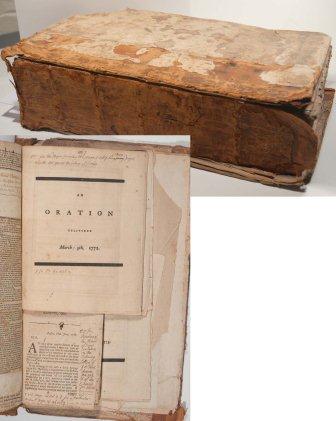
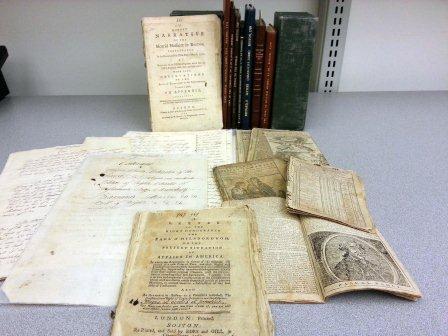
The Massachusetts Historical Society (MHS) holds an important collection of Revolutionary-era newspapers assembled, annotated, and indexed by a Bostonian shopkeeper named Harbottle Dorr, Jr. The Society has just launched a digital presentation of this collection. Dorr’s index terms and annotations offer a fascinating glimpse into his perspective and reactions to events, issues, and people discussed in newspapers of his time.

On Monday, 27 August 2012, I posted on The Idiosyncratic Index Subjects of Harbottle Dorr, Jr. In that blog post, I highlighted some of the more quirky index entries from Volumes 1 and 2 of the Harbottle Dorr, Jr. Annotated Newspapers collection, and also mentioned that a second posting would be forthcoming. Were you holding your breath? The wait is over! You can exhale now.


Volume 3

Cold Water, the Pernicious effects of drinking too much in hot weather &c. 212
Dogs Mad, Symptoms of 11
Drowned Persons Recover’d 638
Earth opening & swallowing Person’s at Quebec     601
Mcdougal Capt. presented with venison (in Prison)     50
Rum Danger of drawing it by candlelight      192
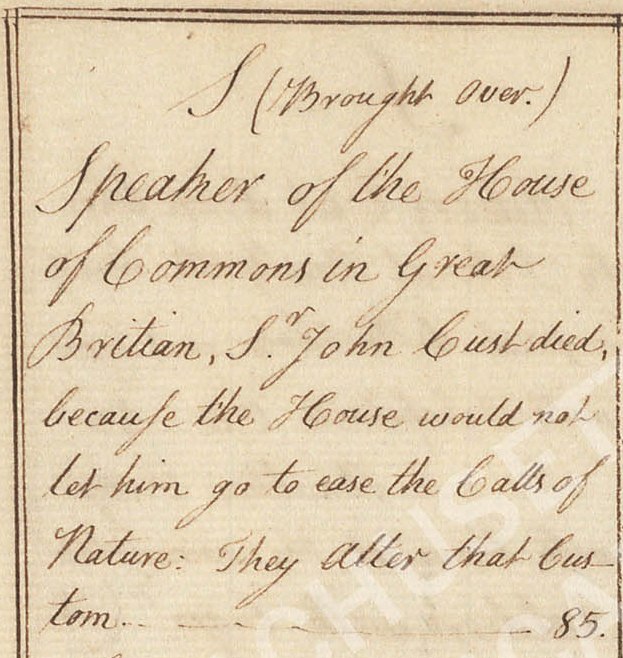
Speaker of the House of Commons in Great Britain Sir John Cust died because the House would not let him go to ease the Calls of Nature; They Alter that Custom      85
Tea, Ladies of Boston sign not to drink any vid. Under Agreement 31.
Thunder Terrible, Broke on a Magazine & produced terrible Consequences. 418.

Volume 4

Auctioneer put up the Ministry for sale. 470.
America of what vast importance to Great Britain: the extent of it: will be the greatest Empire in the World: the King of Great Britain in time it’s probable will fix his empire there, & great Britain become dependant on her, &c. 148.
Denmark Queen of, imprisoned (for attempting to poison the King.) with her paramour, &c. 52.
Deposition of John Mills, respecting a Tar Barrel put on the Beacon. 328.
Goal never intended as a place of Punishment. 24.
Giant at Hingham. 194.
Gun Powder Since found out, mens lives have been preserved, & c, & c, * 891.
Herculaneum City of in Naples, discovered, after being 1700 years buried by an eruption of Mount Vesuvius. 77.
Hillsborough Lord, on his intended resignation: a miserable wretched Creature. 164
Lemmons, wine, &c: a great hardship, to oblige the Americans to enter them in England. 198.
Snow, will make Puddings in the Room of Eggs. 223.

The indexes are now all transcribed and encoded, and available on the new website (www.masshist.org/dorr). The MHS has worked hard to make it as easy to use as possible, and are confident you will find the images stunningly clear and, while Harbottle Dorr, Jr. did have very good handwriting, we hope that the transcriptions provided will be accurate and helpful.

Since I have your attention, perhaps you will allow a sidebar? We are not yet presenting on the website transcriptions of the annotations from the newspaper issues themselves, but in working with the newspapers and their digital surrogates, we noticed from time to time humorous marginal commentary. Here is one such annotation that Dorr made to a speech by “his Excellency Sir Francis Bernard,” which was published in The Boston Evening-Post from 3 June 1765. It is in Volume 1, numbered by Dorr page 95: “This Speech the House did not Answer, perhaps they did not understand it. Who could?”

Not thinking myself better than Dorr, I have endeavored to read and understand Bernard’s Speech. Bernard begins by admitting, “I have no Orders from his Majesty to communicate to you; nor any thing to offer myself but what relates to your internal Policy: I shall therefore take this Opportunity to point out such domestic Business as more immediately deserves your attention.” I take this that the gentlemen of the council were hijacked – as you are right now by me – by Bernard’s ego! The rest of the speech is on Bernard’s desire to see an increased production and export of “Pot-Ash, Hemp and the carrying Lumber to the British Markets.”

Harbottle adds another personal opinion on two of Bernard statements in this same speech:

“The general Settlement of the American Provinces, which has been long ago proposed, and now probably will be prosecuted to its utmost Completion, must necessarily produce some Regulations, which, from their Novelty only, will appear disagreeable”

and

“In an Empire, extended and diversified as that of Great-Britain, there must be a supreme Legislature, to which all other Powers must be subordinate.”

To these Dorr writes, “Now the Wolf shews himself notwithstanding his Sheeps Cloathing.”


“Our Splendid Misery”: Louisa Catherine Adams in the White House

By Amanda A. Mathews, Adams Papers

Many Americans have strong opinions about the White House. It is simultaneously a government building housing the executive branch and a private dwelling for the president and his family. As its care and maintenance falls to the public, both public access to and perception of this building, and its inhabitants, has long been a sensitive subject.

In April 1825, Louisa Catherine Adams wrote a colorful letter to her son, Charles Francis, on her impressions upon moving into the White House:

It is and has been ever since I first saw the House a matter of wonder to me how a Lady of so much delicacy as Mrs. Monroe could endure to live in a house in which I declare from what I saw she had not the comforts of any private mechanic’s family and I believe it would be difficult to find such an assortment of rags and rubbish even in an Alms House as was exhibited to the Publick after their departure—

The State of things was such that knowing the impression on the publick mind concerning the general splendour of the Mansion I thought it best to throw open the House and by admitting the people to see it in the real state correct the absurd and preposterous notions which had gone abroad by giving them the opportunity to judge for themselves— Some people pretend I have done wrong but as we are pretty much in the situation of the Man and his Ass in the Fable I do not care at all who likes or who dislikes. I respect my Masters the Sovereign People with great sincerity but I am not so much alarmed at the idea of going out at the end of four yeas as to desire to make any sacrifice of actual comfort for the sake of prolonging my sojourn in this would be magnificent habitation which after all like every thing else in this desolate City is but an half finished Barn— . . . I am obliged to close my Letter with a wish that you had seen our splendid misery which on the subject of Internal improvement certainly would have inspired you to do it ample justice—

Louisa’s lively wit, jabbing at her new residence, the public’s misimpressions, along with a controversial political topic of the day, internal improvements, reveals a political climate not so far removed from our own.


Maple Sugaring: Thomas Jefferson’s Sugar Maples

By Andrea Cronin, Reader Services

“The Sugar maple, it appears, is the most delicate of the whole number, for all of them are totally lost,” reported son-in-law Thomas Mann Randolph to Thomas Jefferson in a letter dated 27 March 1792. While Jefferson spent most of that year in Philadelphia, Randolph managed the Monticello estate and garden including the planting of 60 sugar maples. Jefferson and Randolph must have delighted in this type of letter for they shared an avid interest in horticulture. Thomas Jefferson considered horticulture a refuge from politics. Thomas Mann Randolph would later become a founder and president of the Albemarle Agricultural Society in Virginia. The loss of the sugar maples in 1792 was undoubtedly disappointing for both horticulturalists. Why had Jefferson cultivated such an interest in sugar maples?

Thomas Jefferson’s interest in these trees can be traced to fellow founding father and physician of Philadelphia, Dr. Benjamin Rush. Rush extolled the political advantages of maple sugar over West Indies cane sugar in a letter to Thomas Jefferson in 1791. According to Rush, domestically produced maple sugar would not require the slave labor force used to produce cane sugar, but maple sugar could also be cultivated to supply the domestic demand, lessen dependence on imported cane sugar, and be exported for profit. Resolute in this reasoning despite being a slave owner himself, Jefferson purchased 60 sugar maples in July 1791 from nurseryman William Prince of Flushing, New York, and began his experiment in homegrown maple sugaring. His large order of fruit trees and roses including the sugar maples was completed in November 1791 upon which Randolph began supervising the planting of these specimens.

However, it was not a fruitful year for Monticello according to Randolph. “It gives some consolation however to know with certainty that [the Sugar maple] is abundant about Calf-pasture, & that the hemlock-spruce-fir is a native of [Monticello],” Randolph continued in the letter to Jefferson. “Another unproductive year in y.r orchards of the low country increases the value of the mountains by giving reason to think that their summits in a short time will be the only region of Virginia habitable by fruit trees.” Randolph’s frustration with the meager survival of the trees was evident. Within two years, Jefferson indicates in his garden book that there are only eight sugar maples alive.

Despite Jefferson’s disappointing planting in Virginia, the maple sugaring tradition remains alive and well in New England today. In the Northeast, maple sugaring season starts in February and continues through April. The tapping process collects sap from the trees to be made into maple sugar or maple syrup through boiling. While the neighboring state of Vermont is best known for its quality maple syrup, Massachusetts also produces the sticky pancake accoutrement. Approximately 40-50 gallons of sap are needed to produce one gallon of syrup. Shocking, isn’t it?

If you are not too busy daydreaming about pancakes now, you can find out more about the sugar maples and other fruit trees at Monticello in Jefferson’s garden book and correspondence in the Coolidge Collection of Thomas Jefferson manuscripts.   

Tutankhamon’s Tomb: Connections between Boston and Cairo

By Andrea Cronin, Reader Services

“The inner chamber of Tutankamon’s tomb privately opened today,” Alice Daland Chandler wrote in her diary on 16 February 1923. “Mr. Winlock one of those going in.” Alice Daland Chandler, the wife of Massachusetts Institute of Technology Professor of Architecture F. W. Chandler, recorded details of many events occurring in and around Boston in her diaries, which span from 1886 to 1932 with some gaps. The Chandler family resided on Marlborough Street in Boston directly across the river from MIT. Surely it was an easy commute for F. W. Chandler to his work place. But how was it that the news of Egyptologist Howard Carter’s private opening of the boy pharaoh Tutankhamun’s tomb reached Alice Chandler in Boston so soon?

The then associate curator of Egyptian art at the Metropolitan Museum of Art, Herbert Eustis Winlock was Alice Daland Chandler’s son-in-law. Winlock assisted Carter during the excavations as part of his work with the Metropolitan Museum of Art. Winlock had attended Harvard University where he earned Bachelor’s degree in archaeology and anthropology in 1906, and began working at the Met in 1909.  In 1912, he married Helen Chandler, one of Alice Chandler’s three adult children. Helen and their daughter Frances were with Winlock in Egypt, and throughout the 1920s Herbert and Helen wrote to F. W. and Alice Chandler from Cairo, informing the family of their excavation endeavors and daily lives.

In April 1923, Alice Chandler made note in her diary of the death of Lord Carnarvon, a sponsor of Howard Carter’s excavations in Egypt. Lord Carnarvon died on 5 April 1923 in Cairo, purportedly of a severely infected mosquito bite. His sudden death, and the deaths of others who had entered the tomb of Tutankhamun, gave rise to the legend of the curse of Tutankhamun. In spite of having entered the inner chamber of the tomb on 16 February 1923, Herbert Winlock, as most of the other men with him that day, would live a long life. He continued his celebrated career in Egyptology and became the director of the Metropolitan Museum of Art in 1932.

If you are interested in Egyptology, visit the MHS library to view the Chandler and Winlock correspondence in the Chandler Family Papers. Alice Chandler’s diaries are contained in the Charles Pelham Curtis Papers.


John Adams on the Case: Untangling Myths of the Massacre

By Amanda A. Mathews, Adams Papers

The basic outlines of the Boston Massacre are well known. March 5, 1770, that fateful and bloody night, led to trials that have become almost as famous. That the British soldiers were successfully defended by staunch patriot John Adams has certainly increased their fame. Myth cloaks the reasons why he took on these cases, but in examining the Adams papers, a different, but far more interesting story reveals itself.

To hear Adams tell it, as he did in his Autobiography written following his bitter defeat to Thomas Jefferson in 1800, he was merely standing up for the principles of law, upholding the great ideal that all men deserved a good defense and a fair trial, even at the expense of his own interests, reputation, and bank account, all three of which suffered for this gallant action. History has generally taken him at his word and heralded his actions as the pure disinterested idealism of a heroic patriot.

But reality was not as picturesque as this portrayal. Adams’s own recollection (he kept no diary at the time), is tainted by a long and often torturous public service that left him feeling unappreciated for his many sacrifices to his country. Moreover, while there may have been some gossip, on the whole Adams did not suffer with the patriot community of Massachusetts. In fact, within three months of taking the case (but before the actual trials) Adams was elected to the Massachusetts provincial assembly; and even immediately after the verdict, continued getting work as an attorney. He was even asked by the patriot leaders of Boston to give the annual oration on the third anniversary of the Massacre, an honor he declined.

So why did he take the case? As are human motives generally, his reasons were complex. It is important to remember that these cases were just two out of hundreds in his career and when put in that larger context, they appear less extraordinary. He mistrusted mob action as a rule and he defended patriots against the crown, and Tories against patriot wrongs. No doubt the knowledge that these cases would be well recorded encouraged him and his ego as well. Finally, the balance of power between the Crown and the colonies was still in flux. Adams was determined to appear neutral until the winds were evident. In 1768, he had been offered the position of the Crown’s advocate general in Massachusetts. He declined. On the other hand, Adams wanted it known that he was not controlled by the Boston patriot leadership. He would be an independent man at all times. It was a theme and standard he maintained throughout his life and one quite evident throughout the Massacre trials.

MHS Painting Featured in Missouri Classroom

By Anna J. Cook, Reader Services

Last semester, students in Professor Norton Wheeler’s Age of Jefferson and Jackson course at Missouri Southern State University (Joplin, Missouri) read a critical edition of Nathaniel Hawthorne’s novel The Blithedale Romance (1852) alongside nonfiction works such as Sean Wilentz’s The Rise of American Democracy (2006). Hawthorne’s novel draws heavily on his own experience at Brook Farm, a short lived utopian community established in West Roxbury, Massachusetts, where he lived in 1841. Wheeler observed to me by email:

My students enjoyed the novel, along with documents detailing connections of Hawthorne, George Ripley, Ralph Waldo Emerson, Margaret Fuller, and others to the historical Brook Farm. They found the social and cultural history embedded in these texts to be a helpful complement to the political history they had been reading.

To help his students visualize the setting of the novel, Professor Wheeler contacted us to obtain a digital image of one of our two paintings of Brook Farm by Josiah Wollcott, Brook Farm with Rainbow, painted by the artist in 1845 and pictured above (his second rendering can be viewed here).


Wheeler sent us a photograph of his students in class, with the painting hung on the wall (right corner of bulletin board), for us to share with you here at The Beehive.

In addition to Wollcott’s two paintings, the Massachusetts Historical Society holds a collection of Brook Farm records and the papers of founder George Ripley, as well as memoirs, pamphlets, and other materials related to the West Roxbury utopian experiment. We also hold several early editions of The Blithedale Romance, the full text of which can be read online through Project Gutenberg, or downloaded in a variety of formats from the Internet Archive.


Lincoln’s Early Views on Slavery

By Emilie Haertsch, Publications

Today is President Abraham Lincoln’s 204th birthday. In honor of the occasion, we examine his early, often guarded, views on slavery. In a letter to his close friend Joshua Fry Speed, Lincoln reveals his personal beliefs prior to his presidency and the Civil War.

Speed and Lincoln met in 1837 when they became roommates, living above the store that Speed co-owned in Springfield, Illinois. Both men were from Kentucky, and they worked together to grow the Whig Party in the Springfield area.

Lincoln wrote this letter to Speed on 24 August 1855. At the time, the North and South were reaching a crisis over the issue of slavery in the United States. Senator Stephen A. Douglas of Illinois had introduced the Kansas-Nebraska Bill, which proposed allowing the new territories to determine the legality of slavery within their borders by popular sovereignty. This undermined the Missouri Compromise of 1820 and created the potential for an unbalanced relationship between the number of free and slave states.

In reference to his feelings about slavery, Lincoln mentions a river trip he and Speed took in 1841. They encountered a group of slaves on the boat, and it made a lasting impression on Lincoln. He writes:

You may remember, as I well do, that from Louisville to the mouth of the Ohio, there were, on board, ten or a dozen slaves, shackled with irons. That sight was a continual torment to me; and I see something like it every time I touch the Ohio, or any other slave-border.

Speed and Lincoln did not agree about the Kansas-Nebraska Bill or slavery in general, but Lincoln felt no qualms about addressing their differing viewpoints. He continues:

It is hardly fair for you to assume, that I have no interest in a thing which has, and continually exercises, the power of making me miserable. You ought rather to appreciate how much the great body of the Northern people do crucify their feelings, in order to maintain their loyalty to the Constitution of the Union. I do oppose the extension of slavery, because my judgment and feelings so prompt me; and I am under no obligation to the contrary. If for this you and I must differ, differ we must.

Despite their divergent views, Lincoln signed the letter, “Your friend forever A. Lincoln.” And they did remain friends – even through the divisive Civil War.

Want to learn more about birthday boy Lincoln? Two exhibitions currently on display at the MHS explore his life and work: “Lincoln in Manuscript and Artifact” and “Forever Free: Lincoln and the Emancipation Proclamation.” In addition, this online gallery features Lincoln-related artifacts from the Society’s collections.


A Blizzard of Memories

By Amanda A. Mathews, Adams Papers

New England winters have often inspired memorable descriptions as the amazing power and beauty of the storms unite. As we remember the Blizzard of ’78, and dig out from Winter Storm Nemo, in March 1820, John Adams wrote to his daughter-in-law, Louisa Catherine Adams, describing the scene he encountered upon waking, following an overnight snowstorm:

If Nature in scattering her bounties had bestowed upon me the genius of a Poet or a Painter I would entertain you with a description of a scene of sublimity, beauty, and novelty, such as eighty four winters never before presented to my sight: when I arose in the morning, the Sun was rising, the heavens were not of Brass but the Sky was a vast concave of clear blue marble and the earth was of burnished silver and the trees bending under the weight of millions of millions of Diamonds. the splendor and glory of the scene was too dazzling for mortal eyes to behold for any long time. A violent rain had descended warm and liquid from a height in the atmosphere into the region below then as cold as Russia, every drop had frozen as it fell, and clung to the trees, and then descending in icicles hung upon every bough and sprig. So much for the bright ride of the picture; now, for the dark side the trees every where bending under the immense load of ice which encumbered them; the trunks in some places splitting; the limbs every where breaking and falling; the elms, the button wood’s, the balm of Gilead’s, stript of many of their branches; the fruit trees, the shrubbery’s, especially the evergreens, very much injured. in short, the havoc and destruction is estimated by many to be greater than in either of the two great storms which have spread such desolation within fifteen years past.

In a letter to his grandson-in-law, John P. De Windt, two days later, Adams summed up the awe-inspiring and sublime moment: “I have seen a Queen of France with eighteen Millions of Livers of diamonds upon her person—and I declare that all the charms of her face and figure added to All the glitter of her jewels did not make an impression upon me equal to that presented by every Shrub—”

While large snowstorms often prove troublesome and destructive, we would do well to, like John Adams, stop for a moment and experience the sheer splendor of nature’s power.


“Preeminently a Good Hater”: Lucius Manlius Sargent

By Dan Hinchen, Reader Services

The MHS is celebrating the Emancipation Proclamation, signed into law 150 years ago last month, through two exhibitions, “Forever Free: Lincoln & the Emancipation Proclamation,” and “Lincoln in Manuscript & Artifact.”  While myriad considerations were taken into account during the planning and passage, it is also important to not lose sight of the many people that staunchly opposed the action for an equal number of reasons. Not just the southern enslavers but also their northern counterparts who worked to justify and maintain institutional slavery, often belittling those against it. It is important to remember this other side of the debate, not to revile them through the polished lens and brilliant clarity of hindsight, but to see how even such a seemingly sensible and morally upright idea can carry such fierce opposition by so many well-educated people.

One such person was Lucius Manlius Sargent, author, antiquary, temperance advocate, and member of the Massachusetts Historical Society. Born in Boston in 1786, the youngest of seven children, Sargent attended Phillips Exeter Academy until 1804 when he moved on to Harvard. At Harvard he produced one of his first publications, No. 1 of the New Milk Cheese, or, The Comi-heroic Thunderclap: a Semi-globular Publication Without Beginning and Without End. Quite a title! This work heaped scorn on a college official for a dispute Sargent had with him about the quality of the food served at the commons table. The backlash prevented Sargent from completing his course at Harvard. Harvard would eventually grant him a degree, in 1842, acknowledging his public services and excusing his earlier behavior.

Sargent studied law and was admitted to the bar in 1811. He never practiced the profession to any extent, though, thanks in part to an inheritance and some conservative speculation. Instead, he turned to literature and published translations of Virgil into English verse, produced a volume of poems, and even penned an ode, “Wreaths for the Chieftain,” sung at the Boston peace celebration in 1815. Later, he took up the temperance banner and produced dozens of writings on the issue, including a series of 21 Temperance Tales created between 1833 and 1843. His writings and speeches on the topic were so vigorous that he became one of the most conspicuous leaders in the fight against liquor.

In the 1850s he leveled his criticism at prominent Bostonians who favored abolition. In August and September 1857 Sargent, writing under the pen name Sigma, sparred with William Lloyd Garrison in a series of newspaper columns. Published in the Boston Transcript, Sargent attacked abolitionist Parker Pillsbury, accusing him of, among other things, baptizing dogs. He also slammed ‘the infidel Garrison’ as a ‘brazen-faced blasphemer and slanderer,’ stating that Garrison was ‘slimy and slippery’ and seemed ‘to have an almost congenital diathesis towards falsehood and prevarication.’ When Garrison tried to respond the Transcript would not publish his comments so he resorted to publishing the retorts in his own Liberator.

Sargent carried his contempt with him publishing an item titled Ballad of the Abolition Blunder-buss (1861), again as Sigma. The pamphlet was a criticism of Govenor John A. Andrew, Ralph Waldo Emerson, and the entire Massachusetts legislature, for a ‘high love-feast’ they held in January of that year and, more generally, for their anti-slavery views.

For a lengthier look at the life of Lucius Manlius Sargent, a man who  “was preeminently a good hater, but … a conspicuous man in his day … making rather valuable contributions to local history.”[1] see John Sheppard’s reminiscence of him in the New England Historical and Genealogical Register and Antiquarian Journal, Vol. XXV, No. 3 (July 1871).


[1] Sidney Gunn, “Sargent, Lucius Manlius,” Dictionary of American Biography, XVI (1937): 367.