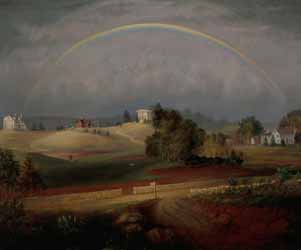

The Diary of Ann Powell, 1789

By Susan Martin, Collection Services

The MHS has just acquired a manuscript copy of the fascinating 18th-century diary of a young woman named Ann Powell. In it, Ann describes a trip down the Saint Lawrence River, 11 May-June 1789, with her brother William Dummer Powell and his family. The Powells were United Empire Loyalists who had emigrated to Canada ten years earlier. Now William, newly appointed first judge of the Court of Common Pleas of the Hesse District, Province of Quebec, was relocating his entire household from Montreal to Detroit, Michigan.

Along the way, the party had the good fortune to witness a council of the Six Nations at which about 200 chiefs were assembled. Ann was impressed:

I was very much struck with the figures of these Indians as they approached us. They are remarkably tall and finely made and walk with a grace and dignity you can have no idea of. I declare our beaux looked quite insignificant by them – one man called to my mind some of Homer’s finest heroes.

She documented, in great detail, the dress and manners of the tribal people. She heaped praises on Mohawk Chief David Hill (Karonghyontye), and Seneca Chief Red Jacket (Sagoyewatha) amused her, but she was “by no means pleased” with Mohawk Joseph Brant (Thayendanegea). Another interesting passage relates to the social position of elderly Indian women in the Great Lakes region:

 In England, when a man grows infirm and his talents are obscured by age, the wits decide upon his character by calling him an old woman. On the banks of Lake Erie, a woman becomes respectable as she grows old, and I suppose the greatest compliment you can pay a young hero, is that he is as wise as an old woman, a good trait of savage understanding. These ladies preserve a modest silence in the debates (I fear they are not like women of other countries) but nothing is determined without their advice and approbation.

The diary is a 19th-century copy, written mostly in an unknown hand, but it was compiled and annotated between 1863 and 1870 by Boston’s own Eliza Susan Quincy. Eliza, a historian and writer in her own right, took an interest in the manuscript and the Powell family, to which she was distantly related through her grandmother Abigail Phillips Quincy. She researched Ann’s story and added footnotes to the manuscript, presumably in preparation for its publication.

As far as I can tell, the diary has been published just twice in the 224 years since it was written, but never in its complete form. The first printed version—Eliza’s—appeared in the July 1880 issue of The Magazine of American History, pp. 37-47. Not only were whole paragraphs and the names of some individuals redacted, but most of Eliza’s notes didn’t make the cut.

 This juicy story was among those excluded, probably for obvious reasons:

We spent one night at the house of a Captain Duncan, whose wife I had heard often mentioned by my sisters….She is now only nineteen, and has been five years married to a man who is old, disagreeable and vicious. But he was supposed to be rich and her friends absolutely forced her to marry him….I never heard of such a series of cruelties being practised on any poor creature in my life….I felt very much interested by this sweet young woman, and should feel great pleasure in hearing her tyrant was dead; the only means by which she can be released.

Forty years later, Ann’s diary was published again in William Renwick Riddell’s Old Province Tales: Upper Canada, pp. 64-95. Riddell’s version includes some of the previously redacted passages, but is still incomplete, and differs from the MHS copy in many ways.

Although Eliza Susan Quincy’s copy of the diary is only one of many, it does include a substantial section (about half of the volume) entitled “Letters and incidents relative to an accidental acquaintance with the family of Miss Powell. 1833, to 1844.” This section consists of transcripts of Eliza’s correspondence with descendants of Ann Powell. The letters were not printed in 1880 or 1920 and contain a good deal of contextual information about the diary and the Powell family.

Ann Powell married merchant and fellow Loyalist Isaac Winslow Clarke and died in 1792. Her original diary is probably still in private hands.

For more information on Eliza Susan Quincy, search at our website or in our online catalog ABIGAIL.

The Personal Problems of a Social Reformer

By Emilie Haertsch, Publications

We could all learn a thing or two from 19th-century reformer and essayist Caroline Dall. An abolitionist and advocate for women’s suffrage, Dall worked for societal change throughout her life. We have her papers in our collections and published the Selected Journals of Caroline Healey Dall, Volume I (1838-1855), edited by Helen R. Deese, in 2006. The second volume (1855-1866) is in production for this year.

Despite Dall’s renown as a literary and reform figure, she had trouble in her personal life just like the rest of us. She fought tirelessly to end slavery and earn the vote for women, and she was even a founder of the American Social Science Association, but relationships comprised the messiest part of her life. Dall’s marriage was a failure. Her husband, Charles, a minister, took a missionary post in India in 1855 and left her to raise their two children alone in the United States.

Dall also struggled in her friendships and often managed to alienate others without understanding why. Although she had encouraged and fostered Louisa May Alcott’s literary talent, she insulted the Alcott family when she authored a critical review of Louisa’s first book, Moods. On August 1, 1865, Dall wrote in her journals, “Well—I was to blame somewhere—perhaps in time, God will show me where.” Earlier that year, Dall similarly turned off another group. Some members of the congregation where she was Sunday School superintendent disliked her and made the fact known. Dall subsequently lost the position. On May 14, 1865, her last day in the post, she wrote that one member of the congregation “turned her back & drew her veil down” when she approached and another “merely lowered her eye-lids.”

Acknowledging her struggles in life, however, Dall chose to maintain a positive outlook. “[All] my trouble was well,” she wrote in her journal on March 27, 1865. Even snubs from the Boston literati couldn’t keep her down. On February 18, 1865, she wrote: 

I often wonder what my lot would been like, if I had been beautiful, and as attractive to men as I am to the young women of my reading class. Then, I suppose I should have belonged to the Atlantic Club, and have been able to get an article into the N. American without maneuvering or waiting.

Dall’s only interest in being beautiful or more successful socially was in how it could benefit her work. But even that would not have been worth it, as she later concluded. She wrote in her journal the next day, “But God cannot carry great reforms, by wrapping them in jelly. They get no hold on men, till they are swallowed like genuine medicine, with full knowledge of their quality & full faith in their power.”

Dall’s desire for an easier life was motivated only by the possibility of benefit to her work, and her trials she met as necessary to her effectiveness at advocating for her causes. In facing life’s personal obstacles, we could all take a little inspiration from her writings.

To read more about Caroline Dall see these earlier posts by Jim Connolly: “Bostonians Respond to Union Loss at 2nd Bull Run” and “Caroline Dall Gears Up for Summer in 1862.”


“The Sublimest Thing Ever Exhibited in America”: Inauguration Day 1797

By Amanda A. Mathews, Adams Papers

The ceremony and celebration of Inauguration Day such as the nation witnessed this past Monday as President Barack Obama began his second term, has been a long cherished tradition in the United States. Of the 57 inaugurations performed over the past nearly 225 years, the last Inauguration Day of the eighteenth century, while it may not have included star-studded performances, stands out as the first orderly change of leadership under the new Constitution as John Adams became the second president.

This historic occasion, and the last held in the temporary capital at Philadelphia, despite the large crowds, was missing one very important person for the incoming president—his wife, Abigail. He drew a picture of the scene in a letter to her the following day, “In the Chamber of the House of Representatives, was a Multitude as great as the Space could contain, and I believe Scarcely a dry Eye but Washingtons. The Sight of the Sun Setting full orbit and another rising tho less Splendid, was a novelty.”

Aware of the enormous responsibility and hardships that the office held, and the relief Washington must have felt at reaching retirement, Adams remarked, “it was made more affecting to me, by the Presence of the General [Washington], whose Countenance was as serene and unclouded as the day. He Seem’d to me to enjoy a Tryumph over me. Methought I heard him think Ay! I am fairly out and you fairly in! See which of Us will be happiest.”

As he set off in uncharted waters, following the beloved Washington, he lamented his family’s absence, in another letter to Abigail two weeks later, “It would have given me great Pleasure to have had some of my Family present, at my Inauguration which was the most affecting and overpowering Scene I ever acted in— I was very unwell had no sleep the night before, and really did not know but I should have fainted in Presence of all the World.— I was in great doubt whether to Say any Thing or not besides repeating the Oath— And now, the World is as silent as the Grave—” With the celebrations over, the real work began. Still, he could confidently tell her, “All Agree that taken all together it was the sublimest Thing ever exhibited in America.” This triumphant moment of democracy in action remains so for our nation today.

Three Centuries of Molasses in Massachusetts

By Andrea Cronin, Reader Services

The molasses trade has a long and sticky history in Massachusetts. Though sugar is far more common in the kitchen cupboard today, molasses lingers in the cultural lore of Boston. Looking back over that tradition one sees how far back those roots go. In a letter to Judge William Tudor on 11 August 1818 John Adams credited molasses as helping usher in American independence:

Witts may laugh at our fondness for Molasses & we ought all join in the laugh with as much good humour as General Lincoln did, Genal Washington however always asserted & proved that Virginians loved Molasses as well as New Englandmen did. I know not why we should blush to confess that Molasses was an essential Ingredient in American Independence. Many great Events have proceeded from much smaller causes.

How could the secret ingredient in pot roasts have influenced the course of history in Massachusetts and the nation? In the 18th century, the Sugar Islands experienced an exponential demand for sugar from European colonizers. There was profit not only in sugar but in distilling the by-product of sugar production, molasses, into rum. The abundance of molasses gave rise in part to the ‘Triangle Trade’ exchange: New England rum to West Africa and Europe, West African slaves to the Sugar Islands, and Sugar Islands’ molasses to New England rum distilleries. With the Molasses Act of 1733 Great Britain imposed a tax on molasses imported from foreign colonies, such as the French or Dutch West Indies. Some point to this act as the stirrings of the beginning of the American Revolution, as the tax struck fear in the northern colonies by affecting their rum trade.

Oh, the rum! With incoming shipments of Sugar Islands’ molasses, Massachusetts entertained a booming rum industry. There were over 25 distilleries in Boston alone by the mid-eighteenth century. The surrounding cities, including Watertown, Haverhill, Charlestown, and Medford soon followed the “city upon a hill” into rum distillation.

Then, nearly a century after Adams wrote to Judge Tudor molasses literally engulfed part of Boston. Yesterday marked the 94th anniversary of the great Boston molasses flood, affecting Commercial Street in the North End on 15 January 1919. It was on this unusually warm day that the US Industrial Alcohol/Purity Distilling Company tank filled with 2,300,000 gallons of molasses spilled into the streets and harbor. The flood killed 21 individuals and injured more than 150 others while damaging an estimated $100,000,000 of property. The 1919 tragedy inundated the newpapers with conspiracies and conjecture about how the tank had failed so epically. It is said that even now it is not uncommon to hear that on a hot summer day there is a lingering scent of molasses in the North End.

Stephen Greenleaf Bulfinch, #19

By Elaine Grublin

The following excerpt is from the diary of Stephen Greenleaf Bulfinch.

Saturday, Jan 11th, 1863

The close of the year ’62 brought to mind its course, as one of great public trials, and of some—though tempered with great mercies—in my private relation. The entrance of ’63 was marked by an event which is sublime in the hopes it yields, though not without its great perils, – the definite Proclamation of freedom to the slaves. Who dared to hope for such rapid progress in public sentiment as now to authorize this step, two years ago?

Military events of late, of chief interest, have been the gallant but unfortunate battle of Fredericksburg, the victory at Manfreesboro, and a partial repulse at Vicksburg, – with the landing of Banks’ expedition at New Orleans. At Fredericksburg fell in battle my former neighbor & friend, Rev. Arthur B. Fuller. He was among the volunteers to force a landing. I question the propriety of a clergyman taking the place of the common soldier; but I believe he acted not only by the impulse of his brave heart, but with the feeling that he ought to set an example to others in all things which he encouraged them to do. In the same battle died my young parishioner, John. H. Blackswain, – a good and affectionate boy. W. Edward Blake, another young volunteer from my parish, died in a hospital near the same place, shortly after. His remains were brought on, & his funeral numerously attended, at my church.


The 1811 Richmond Theater Fire

By Susan Martin, Collection Services

December 26 is the 201st anniversary of the tragic Richmond Theatre fire in Richmond, Va. The fire broke out during the evening performance when an oil lamp ignited pieces of stage scenery, sending the packed house of 600 running for the exits. But the theater, built long before fire safety regulations, couldn’t accommodate the escaping crowd, and in the end, 72 people were killed. Horrific accounts of the event appeared in newspapers across the country.

Harriet Otis, daughter of U.S. Senate Secretary Samuel Allyne Otis, was living in Washington, D.C. at the time. On December 28, 1811, she wrote: 

Papa came home at noon with the sad intelligence of the destruction of the Richmond theatre by fire, in which many noted and interesting people perished—among others Lieut Gibbons [James Gibbon, U.S. Navy] who was here a little while since—so little while, that I felt a sensation of horror at hearing he was no more—the particulars of this horrible catastrophe I do not yet know.

Two days later, she had a little more information:

Every tongue utters some new circumstance of horror respecting the Richmond sufferers—Poor Gibbon! hard as seems his fate well may his mother, rescued by him, exult in such a son—He had saved her and rushed back to save Miss [Sallie] Conyers a lady to whom he had long been attached—his efforts were vain and they both perished.

 Bostonian Sophia (Sewall) Wood didn’t hear about the fire until January 7. While newspaper reports had overestimated the loss of life, Sophia was deeply affected by the story:

This eve heard of a most melancholly heart-rending account of a dreadful fire at Richmond in Virginia. The Theatre burnt to ashes & 150 Persons fell victims to the flames. This news, so distressing we cannot contemplate unmoved. Oh! but how littlecan we feel for those sufferers & yet how much.

Religious leaders were soon speculating about metaphysical causes. Was the fire a punishment from God for the institution of slavery? For theater-going and other “vices”? The MHS holds a number of sermons preached shortly after the fire, one of which boasts the colorful title: Repent! repent! or likewise perish!…on the late calamity at Richmond, Virginia.

Sophia Wood took a similar line: 

Good often arises from the most calamitous events & tis to be devoutly wish’d, that this signal distress, will direct the minds of the disapated inhabitants of V___a to that divine sun of truth & religion, without which our lives are blanke here & the prospect of the future is indeed melancholly.

Harriet Otis, however, hesitated to pass judgment. On January 5, she described a sermon by Senate chaplain John Brackenridge that drew parallels to a Biblical story:

Mr Breckenridge warned us in a very good discourse not to think that “those Jews on whom the tower of Siloam fell were sinners above all others”—Alas who could be so dead to compassion as to pronounce such a sentence on the Richmond sufferers.

The Richmond Theatre building had been entirely consumed, and in 1814 Monumental Church was constructed on the site as a memorial to those who died.


Experiments in Historical Libations

By Emilie Haertsch, Publications

This holiday, would you like to fancy up your cocktail by adding some founding father authenticity? Then the MHS has just the recipe for you in our collections. Ben Franklin sent James Bowdoin his recipe for “Milk Punch” on October 11, 1762. Here is the transcription of it as it appears in Franklin’s own hand:

Take 6 quarts of Brandy, and the Rinds
of 44 Lemons pared very thin; Steep the
Rinds in the Brandy 24 hours; then strain
it off. Put to it 4 Quarts of Water,
4 large Nutmegs grated, 2 quarts of
Lemon Juice, 2 pound of double refined
Sugar. When the Sugar is dissolv’d,
boil 3 Quarts of Milk and put to the rest
hot as you take it off the Fire, and stir
it about. Let it stand two Hours; then
run it thro’ a Jelly-bag till it is clear;
then bottle it off. – 


Now modern readers likely don’t cook on a fire or have jelly bags lying around, so the MHS provides an updated version of the recipe here. For the benefit of readers, I dutifully submitted myself to the task of testing it out to see how it would stand up to holiday festivities. My findings: if you want to get your party hopping fast, Franklin’s your man. His milk punch packs a wallop.

This is not a party drink you can decide to make at the last minute, however, because it requires more than 24 hours to prepare. The first step is to grate and juice your lemons. You will be up to your neck in lemons with this recipe (note that the original recipe calls for 44), so definitely give yourself plenty of time to grate and juice them. With the task completed, I placed the zest in a bowl with the brandy, covered it, and refrigerated it overnight. The lemon juice I set aside for the next day.

When I eagerly returned home the following day to inspect the brandy infusion, a heavenly citrus aroma wafted from the bowl. I removed the lemon zest from the brandy and added water, lemon juice, and sugar. Because I didn’t exactly have a whole nutmeg lying around (Stop & Shop was fresh out), I had to cheat a bit with that part of the recipe. I substituted the pre-grated spice instead, estimating the amount. I stirred the concoction until the sugar dissolved, but let’s face it – it was still mostly brandy. The temptation to try it then was strong, but I held out for the true Franklin experience.

For the next step, I brought the milk to a boil on the stove and then added it to the lemon/brandy mixture. Lemon juice causes milk to curdle, which is intentional in this recipe. This was hard for me to wrap my mind around because usually if I curdle milk while working on a recipe I have done something very wrong. But as the curdled texture began to form in the punch I trusted in Franklin’s wisdom. This was all part of the process. To allow for a full curdling experience, I set the punch aside for two hours. Finally, I strained the curds out to leave a smooth liquid.

It was time to reap the fruits of my labor. I poured myself a glass and garnished it with a little nutmeg sprinkled on top. At last I experienced Franklin’s milk punch, and it was worth the effort. It is quite strong, although the tart, citrus taste hides that at first. The punch reminds me a bit of a whiskey sour, which I wouldn’t expect from a drink with the word “milk” in the title. But today I shared my experiment with other MHS staffers, and they weren’t all as enthusiastic. Some enjoyed it, but others found the flavor a bit medicinal. That’s not a bad thing for everyone – it could be a nice alternative to the hot toddy.

For myself, I would definitely make this recipe again for the right crowd. So if you decide you really want to make an impression at your bash this holiday, let ol’ Franklin help you out. You will be continuing a tradition that goes back at least 250 years. Now that’s worth a toast.


Making History @ MHS

By Kathleen Barker, Education Department

Pop Quiz! Which bloody seventeenth-century skirmish brought English settlers into conflict with local Wampanoags? The answer, of course, is King Philip’s War, a series of attacks that killed many colonists and Native American in 1675 and 1676, destroyed several New England towns, and cost the life of Wampanoag leader Metacom (or King Philip). Over the past few months, thirty-plus students from Boston University have been scouring the Society’s collections to learn more about this intriguing episode from Massachusetts’s past. Under the tutelage of Professor James Johnson, students became historians as they examined artifacts, transcribed documents, and tried to make sense of the relationships forged between colonists and native inhabitants, and where those relationships disintegrated.

Students visited the MHS several times, both as a class and as individual researchers. They had the opportunity to analyze a series of manuscripts and published documents. Pamphlets such as John Eliot’s Strength Out of Weakness (1652), describe Puritan’s attempts to convert Indians to Christianity, while other works, like William Hubbard’s The Present State of New-England: Being a Narrative of theTroubles with the Indians in New-England (1677) suggest that not all native peoples were willing to adopt English customs or religious principles. Class members also transcribed a number of documents from the Winslow family papers, which include the papers of Edward and Josiah Winslow, colonial governors of Plymouth Colony from 1638-1680. Several letters in the collection detail colonists’attempts to negotiate with Metacom and other native inhabitants, even as native groups began forming alliances against the English settlers.

All of this hard work culminated in an exhibition and public program hosted by the MHS on 13 December 2012. More than 100 guests visited the MHS that evening to hear the students talk about their discoveries. The program began with Professor Johnson and his students providing a brief introduction to the principles of the course, as well as colonial-native relations, growing tensions,and the war itself. Students then became docents as program attendees viewed a special exhibition assembled by the class. Small groups of students discussed the particular materials they had studied, while also answering questions about their experiences as budding history detectives.

Ultimately, this program combined many of the things that we love to do here at the MHS: we introduced a new group of people to our collections through our research library; we piqued the interest of young historians; and we provided history enthusiasts with an entertaining and informative program. For more information about visiting our library to conduct your own research, checkout our visiting the library page. You can also visit our web calendar for information about upcoming education & public programs.

When Adams Met Lincoln

By Amanda A. Mathews, Adams Papers

Recent viewers of Steven Spielberg’s film Lincoln may be wondering whether an Adams-Lincoln connection exists as the Adamses always seem connected to the major figures of American history. John Quincy Adams and Abraham Lincoln indeed served together in the 30th Congress for three months before John Quincy Adams died on February 23, 1848. Lincoln served on the Committee of Arrangements for Adams’s funeral, but that is the only conclusive connection between the two. They shared similar political outlooks, particularly on slavery, but what Adams thought about the young Lincoln, history does not record.

We do know, however, what John Quincy Adams’s son Charles Francis Adams, minister to Great Britain during the Civil War, thought of President Lincoln. “Mr Lincoln is a tall, illformed man,” Adams wrote in his diary after their first meeting in February 1861, “with little grace of manner or polish of appearance, but with a plain, goodnatured, frank expression which rather attracts one to him.” Adams, part of the Boston elite, had little respect for his ability as a social host or leader. Shaking hands with Lincoln at his inauguration ball on March 4, Lincoln appeared to have forgotten him. “Were it any body but a Western man I should have construed it as an intentional slight,” Adams wrote.

Lincoln’s handling of the Civil War only partially softened Adams’s impression. “Mr Lincoln has certainly in some respects acquitted himself with honor,” Adams wrote on March 30, 1865, “But nothing could ever make him a gentleman, or a sagacious administrator in the selection of agents.”

Upon hearing of Lincoln’s assassination in April 1865, Adams’s final assessment is in true Adams style, accurately recognizing Lincoln’s larger place in history as well as the questions left unanswered:

To the country, the loss of Lincoln is hardly reparable. There was a grandeur about the national movement under his direction which even he might not have been able fully to sustain, but which his successor will not attempt to continue. For his own fame, the President could not have selected a more happy close. The just doubts about his capacity for reconstruction are scattered to the winds in the solemnity of the termination. From that moment his fame becomes like that of Washington the priceless treasure of the Nation.


Images: Top, John Quincy Adams (17 -1848), carte de visite of daguerrotype (1847) by Brady’s National Photographic Portrait Galleries, [Matthew B. Brady], after 1860; Middle, Abraham Lincoln (1809-1865), photomechanical, from Portraits of American Abolitionists, MHS photograph #81.410; Bottom, Charles Francis Adams (1807-1886), photogravure, from Portraits of American Abolitionists, MHS photograph #81.2