
Stephen Greenleaf Bulfinch, Post 14

By Elaine Grublin

The following excerpt is from the diary of Stephen Greenleaf Bulfinch.

Thursday, June 19th, 1862

Of public events the chief worthy of record is the sudden irruption of the rebel force into central Virginia, occasioning the retreat of Gen. Banks, & an instant rally to arms in this state and elsewhere. The first personal acquaintance I have lost in this war (as far as I yet know) was killed in the encounter, at Port Royal, with Jackson’s Force, – Capt. Wm. P. Ainsworth of Nashua, a fine young man of my former parish.

Come back to read Bulfinch’s July entry where he reflects on the increasing loss of life in battle and Lincoln’s call for 300,000 new volunteers. 

A Boylston Family Mystery

By Susan Martin, Collection Services

Boylston Street, the address of the MHS, is named for Boston philanthropist Ward Nicholas Boylston (1749-1828). No full-length biography of Boylston has been written, but what we know about his life is intriguing. He was born Ward Nicholas Hallowell and changed his surname in 1770 as a condition of his inheritance from his uncle. Although he was a Loyalist during the American Revolution and lived in London between 1775 and 1800, his first wife was the daughter of an American revolutionary, and his second cousin was President John Adams. He was estranged from his oldest son Nicholas (for unknown reasons) and bequeathed him a small annuity in his will…as long as Nicholas never returned to live in Massachusetts.

 Now, staff here at the MHS have come across another Boylston family plot twist.

One of the editors on the Adams Papers Editorial Project recently found what seemed to be an error in a footnote: the birth dates of Ward Nicholas Boylston’s two younger sons. Records indicate that Thomas and John Lane Boylston were born in 1785 and 1789, respectively. However, Boylston’s first wife Ann died in 1779, and he didn’t re-marry until 1807. So who was the mother of Thomas and John?

The most likely explanation was that one of the dates was wrong. But a careful look through the MHS collection of Boylston family papers confirmed that Ann (Molineux) Boylston died in 1779 on a voyage to America, and that Ward married Alicia Darrow, or Darrham, at Boston’s Trinity Church in 1807. Had he been married in London during the intervening years? If so, we have no record of it.

One letter in the collection suggests an answer to the mystery. The letter was written by Robert Bentham, the uncle of Boylston’s grandson Henry, on 23 Mar. 1840. It relates to Henry’s inheritance.

My nephew claims an Interest in this property as the only surviving Son of Nicholas Boylston (now deceased) the eldest Son (indeed the only lawful Son) of Ward Nicholas Boylston…. I pass over the doubt which exists & has for many years existed, as to the marriage of the present Mrs. [Alicia] Boylston (the styled widow of Ward Nicholas Boylston) or the legitimacy of her children. When I first became personally acquainted with the family she went by the name of Davis. All her elder children went by the name of Davis…. The fact was notorious in the neighborhood.

On this statement various & important questions must of course arise, which I shall not be so indelicate to propose, & far less to obtrude an observation on, or answer thereto….

His implication is clear. Assuming that Thomas and John were Alicia’s sons, they were born before she was Boylston’s lawful wife. It’s possible that Alicia had been previously married, to a Mr. Davis, but Bentham had no knowledge of it.

The historical record is often fragmentary and misleading, and we may never know the truth behind Bentham’s claims. Unfortunately, the Boylston collection contains very little personal correspondence between the family members directly involved. A thorough search through the papers of Boylston’s contemporaries might shed some light on the subject. I’m told Louisa Catherine Adams had an appetite for gossip. Maybe one of our intrepid researchers will take up the challenge…?

Excursion to the Pacific: Rail Travel Then and Now

By Andrea Cronin, Reader Services


On 23 May 1870, the first transcontinental train left Boston for San Francisco. Here are a few of George Gordon Byron DeWolfe’s words celebrating its departure, as captured on a broadside held by the MHS:

The train left St. James Park in the “Hub,” also known as Boston, on a Monday morning at a quarter past nine o’clock. The eight-car train arrived in San Francisco on Saturday, 28 May, but the entire trip lasted approximately 39 days. The group returned to Boston on 2 July 1870.

What a train ride! Consider it against modern rail travel. In the present, you can travel via train from Boston to San Francisco in approximately 86 hours (3.5 days), which excludes wait time at stations. Boston-San Francisco is approximately 3,000 miles or a 50-hour drive via car. A 6-day journey in 1870 – that’s pretty good timing for the first transcontinental train! Some of you readers are, no doubt, thinking, “Why do that now when you can just fly?”

But there is something so captivating about trains. George Pullman, inventor of the Pullman sleeping railcar, designed this eight-car train for the journey. The train cars included the following: a baggage car, a smoking car, two commissary cars (the St. Charles and the St. Cloud), two hotel and drawing room cars (the Revere and the Arlington), and two saloon cars (the Palmyra and the Marquetta). Note to Amtrak: start naming the train cars things like Revere, Arlington, Boylston, Fenway, etc. Those names are much more appealing than train car no. 2106. The café car could be named Batali, Lagasse, or Oliver! Although that may be a little misleading; microwaved hot dogs are not haute cuisine. This train was clearly finely-made and comfortable for travel, as DeWolfe mentions.

So who was aboard this tricked-out train? Members of the Boston Board of Trade and their families made this journey, spending a few weeks in California. They planned to visit Yosemite National Park, and the itinerary for the return journey included  stops in Salt Lake, Omaha, Chicago, and Niagara. Among the families on board were well-known names in the Boston area like Peabody, Forbes, Houghton, Rice, Prentiss, Dana, Farnsworth, Hunnewell, Warren, and many more. The list of passengers on the broadside suggests approximately 125 persons traveled on this train. If that sounds a little crowded to you, just think of the commuter rail in rush hour. Eight cars for 125 people sounds spacious in comparison.

If you’d like to find out more about this particular journey, transcontinental railways, or rail travel in Massachusetts, please visit our online catalog, ABIGAIL. The broadside shown here is the “Excursion to the Pacific” by George G. B. DeWolfe. Plan a visit to the library to view it in person.


A Yankee in King George’s Court

By Amanda A. Mathews, Adams Papers

This year Great Britain celebrates Queen Elizabeth II’s Diamond Jubilee year, and here at the Adams Papers our forthcoming volumes, Adams Family Correspondence, Volume 11 and Papers of John Adams, Volume 17, provide a glimpse at America’s earliest diplomatic meetings with the monarchy.

On June 1, 1785, John Adams entered the Court of St. James for a private audience with King George III. He made three bows and presented himself as the first minister of the newly independent United States. After a moving exchange of formalities, the king mentioned the rumor that Adams was not particularly fond of France. Adams found the perfect reply that neither praised nor insulted France or England. “I must avow to your Majesty, I have no Attachments but to my own Country.” To which the King replied “An honest Man will never have any other.” After the encounter, Adams confidently reported to Congress, that he had been treated precisely as all other foreign ministers were.

Ten years later John Quincy Adams, sent by Congress on a special errand over from The Hague, was led through the same procedures of etiquette for his audience. He recorded his experience in his diary. When asked by King George if it was his father who was currently governor of Massachusetts (that was Samuel Adams), Adams, no doubt with a bit of pride, replied, “No Sir, he is Vice-President of the United States.”

These events, full of pomp and circumstance, are illustrative of the complicated view Americans have of the monarchy, which they find both absurd and fascinating. The difficulty of embracing this unique opportunity without getting caught up in the extravagance is evident in the Adamses’ writings. Abigail Adams, for example, though fatigued by the occasion, nevertheless paid close attention to the details, as she described the ceremony of her own presentation at Court to her sister. Such sentiment seems to have become a staple in American life. The mixture of excitement and cynicism with which Americans met last year’s wedding of the Duke and Duchess of Cambridge (better known as William and Kate) reveals the likelihood that our conflicted sensibilities regarding monarchy are also not going away soon.

Anatomy of a Pun: 1813 Edition

By Emilie Haertsch


Humor, like beauty, is in the eye of the beholder. This colorful broadside will be featured in the MHS’s upcoming War of 1812 exhibition, Mr. Madison’s War, which opens on June 18. A broadside such as this would have been posted on the side of a building or kept for home consumption by a patriotic family. In its day, it would have been considered as funny – and meaningful – as our contemporary newspaper’s political cartoons or television news spoofs such as The Colbert Report. But without context, a great deal of this broadside’s wit could be lost to today’s reader.

With the title “Huzza for the American Navy,” the picture features a heavyset man in uniform. Two winged insects sting him on either side as he runs, brandishing his sword, to get away. They are on the beach, and two ships are visible at sea in the background. The caption below reads, “John Bull stung to agony by the Wasp and the Hornet.”

The man is “John Bull,” the personification of Great Britain, and his uniform is hand-painted in scarlet. The “Wasp” and the “Hornet” refer to American ships that won victories over Britain early in the War of 1812. USS Wasp defeated HMS Frolic on October 15, 1812, and USS Hornet sunk HMS Peacock on February 24, 1813.

The first insect says, “You’ll bridge the Atlantic, won’t you? Oh then you’ll have a Bane to your Bridge, friend Johnny.” The use of “Bane” and “Bridge” refers to William Bainbridge, who was captain of USS Constitution when it captured HMS Java on December 29, 1812.

John Bull replies, “Are these your Wasps and Hornets! Oh! I’m Hull’d already!!” “Hull” was Isaac Hull, who commanded USS Constitution during an earlier cruise when it defeated HMS Guerrière on August 19, 1812.

The second insect says, “How comes on your Copper-bottom at Bombay? Here is something for you between Wind and Water.” “Copper-bottom at Bombay” appears to be a taunt. When the Constitution defeated and then destroyed the Java off the coast of Brazil, the Royal Navy frigate was transporting the new commander-in-chief of British forces in India, Sir Thomas Hislop, to Bombay, along with copper to sheath the hull of a new 74-gun ship. Copper sheathing prevented a ship from being slowed by marine growth on its hull over the course of a long voyage. The loss of the Java and its cargo of copper delayed the completion of HMS Cornwallis.

“Between Wind and Water” denotes the way sailing ships engaged in battle. They aimed their cannons for the opponent vessel’s waterline, to “hull” it. A hit there was likely to do the most damage because a ship’s waterline rose and fell as wind and waves rocked the ship. But it also works as a double entendre, with the insect stinging John Bull between where he created “wind” and “water – as does the word “Bombay.”

Although this broadside has no inscription, due to the timely nature of its content it likely was printed in March or April of 1813, soon after the Hornet returned from its victory over the Peacock off of the coast of Guyana. The Hornet anchored at Holmes’ Hole in Martha’s Vineyard on March 19, 1813.

Some of the jokes hidden inside this broadside we will likely never know, but a little bit of context provides insight not just into the events of the war but also into what made Americans laugh in 1813, when the pun was the epitome of wit.

To see more documents from the Society’s collections related to the war, as well as more information about our upcoming exhibition and other planned events in the Boston area, please visit our War of 1812 web feature.


A Battle Among the Icebergs

By Emilie Haertsch

“Since last we met a great battle has been fought among the icebergs and under the star-filled skies of the North Atlantic.” These words began Rev. Edward Cummings sermon at Boston’s South Congregational Church just one week after the sinking of the RMS Titanic on April 15, 1912. Over 1,500 people died on the Titanic – one of the worst peacetime death tolls from a sea wreck. Edward Everett Hale, the minister emeritus at South Congregational Church, admired this sermon, and the Society has his 20-page handwritten copy of it in its collection.

Often remembered today as the father of poet E. E. Cummings, Edward Cummings was famous in his own right in his day. His first career was as a professor of sociology at Harvard University, but his second, as a minister, began when Hale recruited Cummings to preach at South Congregational. Cummings became a prominent Unitarian minister and was active in many social causes, including the World Peace Foundation, the Russian Famine Relief Committee, Hale House Settlement, the Massachusetts Civic League, and the Massachusetts Prison Association.

The tragedy of the Titanic affected Cummings deeply. His language betrays a feeling that this, too, was a matter of social justice. In his sermon on April 21, 1912, he said of the passengers, “A little band of heroic men and women, betrayed into deadly peril by those in whom they placed implicit trust, found themselves battling empty-handed with the scythe-armed specter of inimitable death.”

News of the Titanic’s end spread quickly and the resulting public shock and outrage created political fallout. Another prominent figure, the historian Henry Adams, wrote in a letter to Elizabeth Cameron on April 16, 1912, “In half an hour, just in a summer sea, were wrecked the Titanic; President Taft; the Republican party, Boyce Penrose, and I. We all foundered and disappeared. Old and sinful as I am, I turn green and sick when I think of it.” At the time, the laws regulating sea travel and concerning ship safety were lax – one of the reasons, perhaps, why there were only 20 lifeboats on board the Titanic. In the aftermath of the Titanic’s sinking, Sen. William Auden Smith from Michigan launched an investigation that led to the passage of a law creating tighter regulation of maritime travel.


Even Civil War Soldiers Played Ball

By Elaine Grublin

The Boston Red Sox meet the Detroit Tigers today in the first regular season game of the 2012 season. The arrival of baseball season is always a welcome treat in Boston. Getting myself into a baseball frame of mind, my thoughts wandered to a letter one of our volunteers, Joan, had shown to me several months ago. I know I love the distraction of baseball, a game that is simultaneously exciting and relaxing, but until I saw that letter I had not known that baseball was also a welcome distraction for soldiers during the American Civil War. 

In this 3 May 1862 letter Captain Richard Cary of the 2nd Massachusetts Volunteer Infantry Regiment describes for his wife a game played between men from the 2nd and men from the 3rd Wisconsin Volunteer Infantry.  The text reads:

The men of the Wisconsin 3d challenged our men to a game of base ball & this afternoon it was played & at the end the tally stood 75 for our side & 7 for theirs so I hardly think they will care to play a return match; we have some of the best players of quite a celebrated ball club from Medway & some of the playing was admirable. 

The men of the 2nd might have had an advantage, as Cary indicates there were baseball clubs in Massachusetts and some of the men were experienced players. I am not certain how familiar the Wisconsin men would have been with the game — and if the Massachusetts regiment was playing by the rules of the Massachusetts Game (common in the mid-19th century) the Wisconsin team may have been more familiar with a different set of rules.

As a final thought, wouldn’t it be splendid if another Massachusetts/Wisconsin match-up brought similar results? A Red Sox 75, Brewers 7 score the final game of the World Series sounds pretty good to me. 


Stephen Greenleaf Bulfinch, Post 11

By Elaine Grublin

The following excerpt is from the diary of Stephen Greenleaf Bulfinch.

March 2d (Sunday) 1862

Public events approach a crisis. Clarksville & Nashville, Tenn. have been surrendered to the Union forces, and from the Potomac we hear, – after some days’ embargo of the telegraph, – of the advance of General Banks’s Division into Virginia, probably to be accompanied by the rest of the great army. On the other hand, Davis has just been inaugurated president for six years, of the Southern states. We have not ceased to be astonished at public sentiment in England taking so much the Southern side; but signs of a change are visible.


Sunday March 16th, 1862

The war continues with great advantage on our part, especially at the west; but a week since the achievements of the rebel iron-plated steamer “Merrimack” or “Virginia” startled the land. Happily she was met and driven back by the “Monitor.” We are looking with intense interest for further intelligence.

Look for post #12 in April and read Bulfinch’s comments on the anniversary of the attack on Fort Sumter and the abolition of slavery in the District of Columbia.

“A Season of Cold”: The Diary of Persis Seaver (Long) Bartlett

By Susan Martin

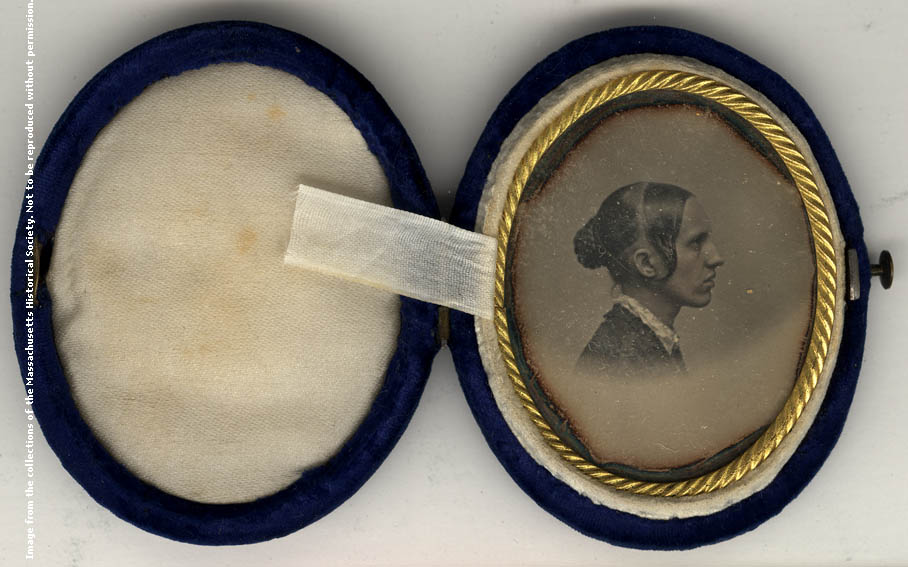
As we constantly work to update and improve descriptions of our holdings here at the MHS, we often find interesting and unexpected items buried in large collections, usually items by previously unidentified or misidentified relatives. A staff member recently identified the author of an anonymous diary in the papers of Massachusetts Governor John Davis Long. The diary was kept by Long’s sister, Persis Seaver (Long) Bartlett (1828-1893), from 14 Oct. 1889 to 30 June 1892.

Unfortunately, the circumstances that prompted Persis to write the diary were very sad ones. Her younger son, Percival Temple Bartlett, suffered from tuberculosis, and he and Persis were traveling West in hopes that a change in climate would alleviate his condition. The trip was ultimately unsuccessful, and Percy died in San Antonio, Texas, on 20 May 1890 at the age of 27. The diary documents his deteriorating health and his mother’s feelings at every stage of his illness and after his death. It’s a very personal and fascinating account of loss that still resonates 120 years later.

By 1889, Persis had been a widow for over 20 years. She had also lost her parents, a sister, a brother, and a daughter. Her older son, Stephen Long Bartlett, was a businessman in Boston, and her brother John and his family lived in Hingham, Mass. But writing so many miles from home, Persis described her feelings of isolation, helplessness, and anxiety as the sole caretaker of her weakening son. A typical diary entry reads: “I am thinking of him, so much, as I sit in my room adjoining his, while he sleeps and breathes, too short, and coughs too often….His case looks very discouraging to me. I hope I am mistaken.”

Persis recorded the daily changes in Percy’s symptoms, treatment, appetite, energy, and attitude. At various times, he suffered from the measles, “the grippe,” lameness, depression, and even, for some time, lost his voice entirely. Persis also worried about the weather and its effect on her son’s health. For example: “Clear and cold. Now comes their winter here, frost that has killed the strawberries and vegetables, and stripped the trees of their leaves and blossoms. A season of cold never known here before. Some how bad luck follows us where we go.”

The most poignant diary entries are those containing little details of Percy’s gradual decline. On 10 Mar. 1890, Persis wrote: “Percy and I walk to the Ice factory, a short distance, to be weighed. He weighs 115. I 132. Can it be possible this is my bright, sunny, strong Percy that walk[s] by my side so weak…[?]” The seats on a streetcar “are hard for his poor thin body.” A little later, “Percival and I ride a little way. I can see he reluctantly allows me to get out and open the gate. His shortness of breath and weakness is terrible for me to see, but how much harder for him to bear.”

After Percy’s death and her return to Massachusetts, Persis continued, on every page, to express her longing for him. She noted the monthly anniversaries of his death. Whenever her other son, Stephen, showed any sign of illness, she was overcome with anxiety. (In fact, Stephen would survive her by 44 years.) She also maintained a close relationship with a Miss Minnie Speare, who had been, it seems, Percy’s sweetheart. And although her lost son would never be far from her mind, Persis was able to write, on 3 Mar. 1891: “Sometimes I can bear it better than at others. Some days I am a little braver.”

For more information about the diary of Persis Seaver (Long) Bartlett, see the collection record in our online catalog ABIGAIL. Or visit the library to spend time reading the diary.

Stephen Greenleaf Bulfinch, Post 10

By Elaine Grublin

The following excerpt is from the diary of Stephen Greenleaf Bulfinch, including Bulfinch’s thoughts on the events of the past year and some comment on the Trent Affair. 

Thursday, January 2d

The close of the year 1861 has led back my thoughts over its course. It has been one of sadness to the country, and in some degree of disgrace, from the madness on one side, the imbecility at first on the other, and the unprincipled manner in which people have used the national sufferings to promote their private fortunes. But there is much to thank God for, in the noble resurrection of patriotic feeling. We are just delivered, – we trust, – from the great danger of a war with England, about the capture of Mason & Slidell. Their surrender, consummated yesterday, is in accordance with American views of the rights of neutrals, & will, we hope, remove in some degree the bitter prejudice of our English cousins, – in whom we feel a good deal disappointed.

Monday, January 13th

We have news of a great expedition going down the Mississippi from Cairo, – & of Gen. Burnside’s expedition from Annapolis for parts unknown, – which the army of the Potomac are held in readiness for a speedy advance. God save the United States!

From abroad, we hear of a somewhat better feeling in England towards us, which we hope will be increased when they hear of our acquiescence in their demand for release of our prisoners, Slidell, Mason & etc. There is a good deal of incitation here however, at the cause which England has pursued. Another item of recent news is the death of Prince Albert, who seems to have been universally esteemed & lamented.

Be sure to check back in February to read Bulfinch’s comments on the Burnside Exposition and the Union victories at Forts Henry  and Donelson.