
Diary Offers a Unique Glimpse of the Civil War

By Zach Reisch, Intern

Searching for material to include in the Civil War Monthly Document feature on the MHS website, I came across the diary of Stephen Greenleaf Bulfinch. Within this extensive diary–described in more detail below–Bulfinch gives an (almost) month-by-month account of the Civil War. Sometimes spending just a few lines on the national conflict, sometimes dedicating an entire entry, Bulfinch provides commentary on many of the most important events in “public affairs” from the divisive election of Abraham Lincoln in 1860 to the status of reconstruction after the war. 

Discussing the diary with Elaine Grublin, who oversees the Civil War Monthly Document project, we concluded it would be too difficult to choose just one entry from this rich diary to include in that project.  Instead we decided to share all of Bulfinch’s Civil War entries through the Beehive. These snippets from Bulfinch’s larger diary entries offer a unique perspective on the war.  By both reporting and reflecting on events Bulfinch provides his views on themes such as the conflict’s division of families, the role of women and children in the war, public opinion as events unfolded, religious leaders going into battle, and the cost of war — in human life — felt by his own neighborhood.

Stephen Greenleaf Bulfinch was born on 18 June 1809 in Boston, Massachusetts to architect Charles Bulfinch and his wife Hannah Apthorp. The youngest of seven children, Bulfinch graduated from Columbian College in Washington, D.C., and Harvard Divinity School.  He proceeded from there to preach as a Unitarian minister. He was married twice, first to Maria Howard, who died in childbirth, and later to Caroline Phelps.

The MHS holds two volumes of Bulfinch’s diaries in the Bulfinch Family Papers. The first volume contains intermittent descriptions of the Bulfinch’s travels between 1827 and 1830. The second volume covers of his settled life in Massachusetts,  containing entries from 23 December 1856 to 31 December 1865, with some gaps. This volume details various familial events such as the death of his brother Charles and his constant worry about his sickly daughter, Maria. Bulfinch also discusses his struggles with the Unitarian Church’s doctrine and his resignation from his preaching position after concluding that he believes in the Holy Trinity. The diary then turns to Bulfinch’s attempts to find work, as well as his renewed passion for completing a work of fiction he had previously started.  He sees this work, Honor, or the Slave-dealer’s Daughter published in 1864.

Transcriptions of the Civil War focused diary entries will be published to the Beehive providing both an objective timeline of the Civil War and offering a unique perspective on the events as seen through a civilian’s eyes.  Starting with a number of entries in quick succession to bring Beehive readers up to September 1861, in September we will add a post the first of each month, so be sure to follow the Civil War series to stay current with Stephen Greenleaf Bulfinch’s diary. 

In Search of Mercy Otis Warren

By Elaine Grublin

For almost sixty years the MHS has been home to the Mercy Otis Warren Papers, a manuscript collection comprised of three boxes of loose manuscripts and a large letterbook volume. Primarily the correspondence of noted author, historian, and patriot Mercy Otis Warren, this collection is rich with material concerning the political climate in Massachusetts before, during, and in the aftermath of the American Revolution.  Available on microfilm in the MHS library, this collection attracts the attention of a wide range of researchers including people working on projects involving the study of the American Revolution, the role of women in early American life, friendship networks, the art of letter writing, the relationships between gender and state, and those that are simply Mercy Otis Warren enthusiasts.   

This collection has always held special interest for me and I have enjoyed having the opportunity to meet with many of the researchers that have worked on Mercy Otis Warren projects here at the MHS.  In an attempt to learn more about Mercy, I struck out and visited Plymouth, MA — the town in which Mercy lived most of her adult life — to visit her gravesite and her home.  

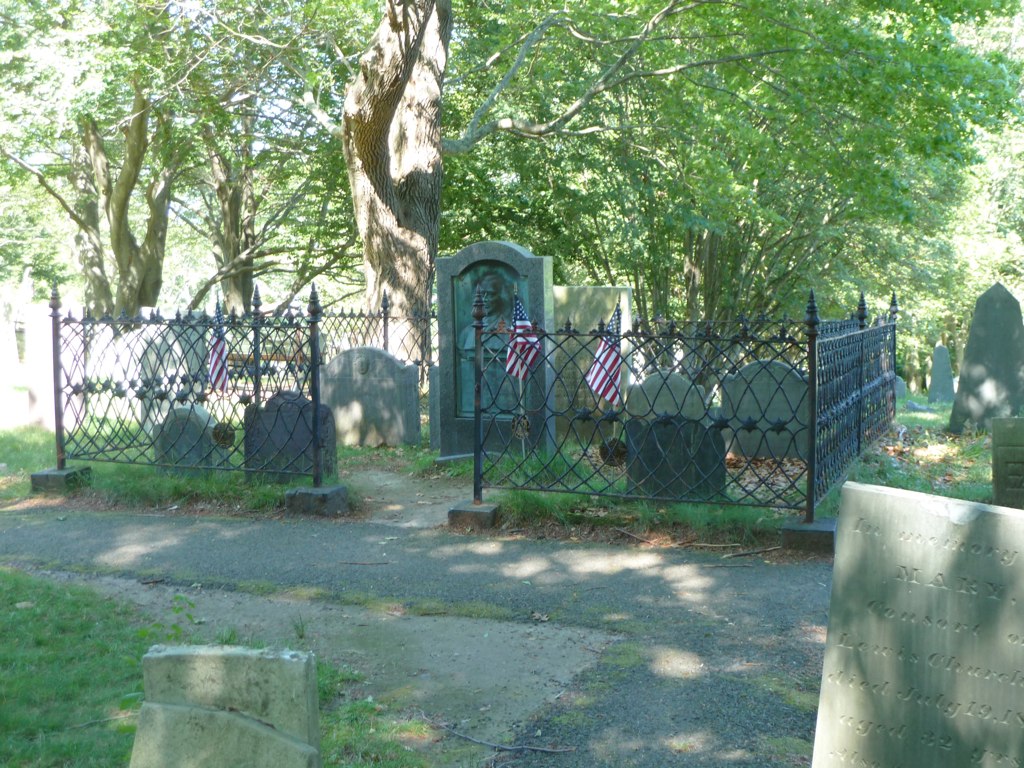
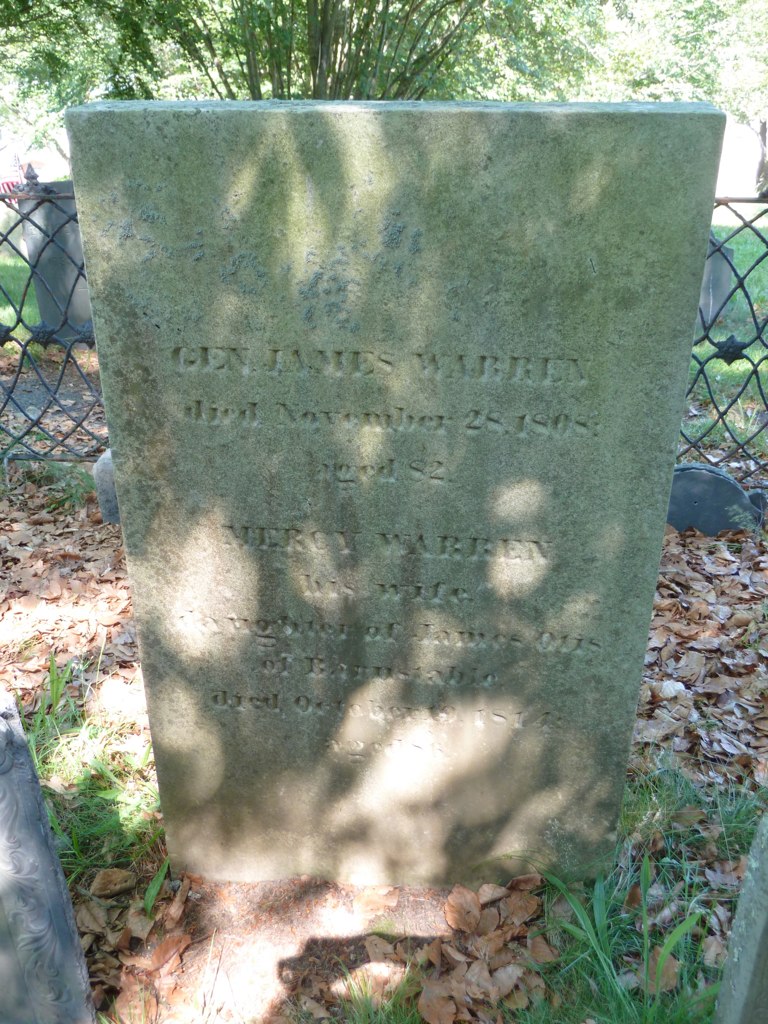
The grave of Mercy Otis Warren is located in Burial Hill Cemetary, just off of Leyden Street in Plymouth.  The Warren plot — easy to find just to the right of the main path through the cemetery — contains stones for Mercy and her husband James Warren, in addition to several of James Warren’s ancestors. Mercy Otis Warren died October 19, 1814, at the age of 86.  

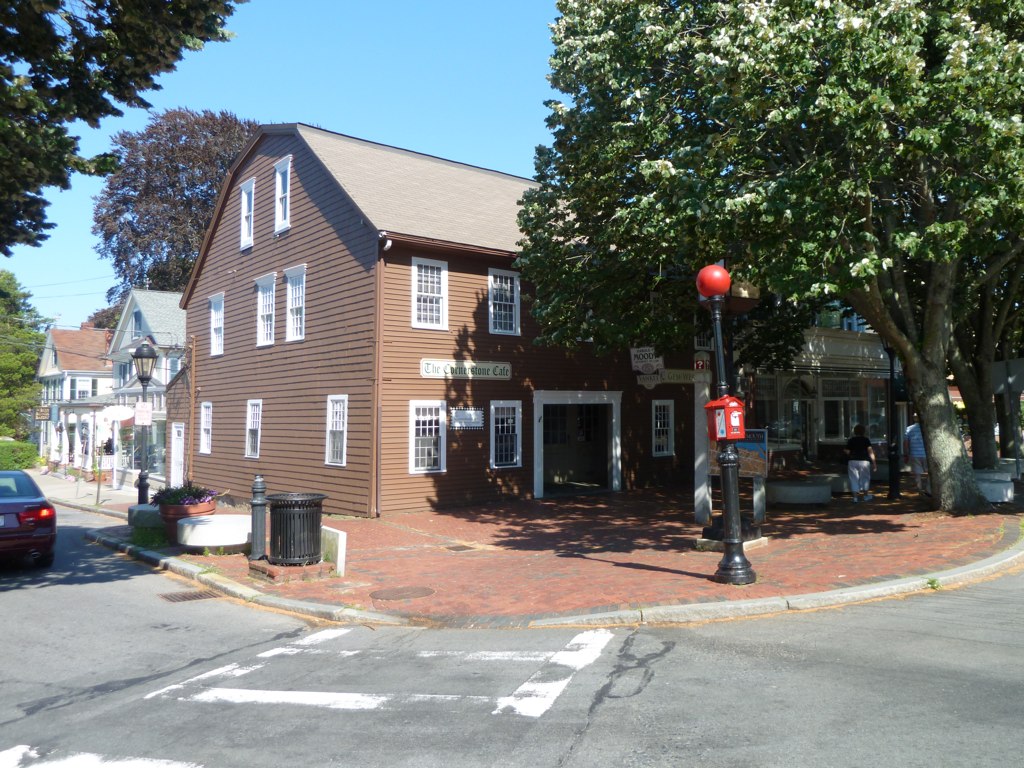
The Winslow Warren House stands on the corner of North and Main Streets in Plymouth, a short walk from the cemetery.  This structure was built in 1726 by John Winslow, a British General and grandson of Edward Winslow, one of the original inhabitants of the Plymouth colony.  Mercy and James Warren moved into the house in 1757.  It was in this house that Mercy wrote her satirical plays and her three volume History of the Rise, Progress, and Termination of the American Revolution

Although these sites are located quite a distance from the MHS, they are well worth the visit for any Mercy Otis Warren enthusiast and are a perfect complement to a research visit to our library. 

A Description of One Letter John Quincy Adams Sent to his Father in June 1811

By Nancy Heywood

In recognition of Father’s Day we’d like to share one example of a letter that a noteworthy son (John Quincy Adams) sent to his noteworthy father (John Adams).


In June 1811, John Quincy Adams (JQA), his wife, Louisa Catherine, and their youngest son, Charles Francis Adams, were all living in St. Petersburg, where JQA was serving as the U. S. Minister to Russia.  JQA, the oldest son of John and Abigail Adams, wrote letters fairly often to his parents.  One letter (dated 30 May and 7 June because it was written on two days in 1811) offers an example of the thoughtfulness, eloquence, and respect JQA displayed towards his father. 

The long letter, written when JQA was 43 years old, mainly focuses on his decision to decline an appointment to the U. S. Supreme Court and to remain at his diplomatic post in Russia.  For more details and context about this opportunity presented to JQA, please consult one of the biographies listed below.  The intention of this blog post is to share a few sentences written by JQA to his father, who was a former diplomat, former President of the United States, and a notable letter writer himself. 

In the letter, JQA states how honored he felt to be nominated by President Madison for the Supreme Court and also expresses his surprise at the Senate’s unanimous approval.  JQA appreciates the encouragement of his parents, who urged him to accept the position and return home to his country after nearly two years abroad; however he cites several reasons why he decided not to accept the position.  A key reason related to “a simple and very natural circumstance in the condition of my family….”  He is referring to his wife’s pregnancy, although he doesn’t use that exact word.  He states that he is not tempted to make a long ocean voyage and “to expose the lives of a wife and infant to the dangers inseparable from such a passage ….”  

The letter conveys JQA’s concern with how his parents will regard his decision and actions.  He clearly cares about the opinions of his parents, “…in the whole course of my life I scarcely ever did a responsible act, of which I was proud or ashamed, without feeling my soul soothed or galled with the reflection of how it would affect the sensibility of my Parents….” He also writes that he looks to his father’s life and past actions for guidance:  “As a direction for my conduct upon every occurrence involving public principle, I know of no human law more unerring than your example.”  JQA clearly hopes that he has explained his reasoning convincingly and that his father will understand and support his decision.  Towards the end of the letter, he writes, “I feel … a cheerful confidence that after fully weighing the difficulties of my situation, you will approve the grounds upon which I have rested.”

A published version of most of the letter (the long section he wrote on 7 June 1811) can be found in The Writings of John Quincy Adams, volume 4, 1811-1813. Edited by Worthington C. Ford. New York: Macmillan Company, 1914. See pages 98-102.  This is available online through GoogleBooks.

The manuscript (Letter from John Quincy Adams to John Adams, 30 May – 7 June 1811) is a four-page letter, and is part of the Adams Family Papers at the Massachusetts Historical Society. This manuscript collection has been microfilmed and this letter appears on reel 411.

Three biographies that provide more detailed information about JQA’s nomination to the U. S. Supreme Court:

 Hecht, Marie B.  John Quincy Adams: A Personal History of an Independent Man. (NY: Macmillan Company, 1972).

 Nagel, Paul C.  John Quincy Adams: A Public Life, A Private Life.  (NY: Alfred A. Knopf, 1997).

 Remini, Robert V.  John Quincy Adams.  (NY: Times Books, 2002).

Happy Bunker Hill Day!

By Elaine Grublin

Today, 17 June 2011, marks the 236th anniversary of the Battle of Bunker Hill.  The battle that occurred on that “decisive day” has taken on an almost mythical quality in telling the story of the American Revolution and is still being studied and interpreted by scholars and history enthusiasts here in Boston and around the globe. The MHS holds a number of original documents, maps, and artifacts that help tell the story of the early days of the American Revolution, including the Battle of Bunker HIll.  As you mark this day please visit our website and check out a few of those Bunker HIll related items.

View a high resolution image of this manuscript map, drawn by a British soldier several months after the battle, here.

Read a letter written by Colonel William Prescott, a leader of the rebel troops at Bunker HIll, to John Adams, attending the Second Continental Congress in Philadelphia, describing the events of Bunker Hill here.

Also, this month our Object of the Month web display features an important MHS artifact related to the battle. The swords of Colonel Prescott and Captain John Linzee, of the Royal Navy, were brought together when William Hickling Prescott, a grandson of Colonel Prescott, married Susan Amory, a Linzee descendant, in the 19th century.  You can read the full story, and view a high resolution image of the swords here

Paul Revere’s Ride

By Elaine Grublin

A recent news story has resulted in renewed interest in Paul Revere’s famous ride to Lexington, Massachusetts on the night of 18 April 1775.  Within our collections the MHS holds three accounts of the evening’s events, all written by Revere.  Two of the accounts are a draft and fair copy of a deposition likely prepared for the Provisional Congress in 1775, shortly after the events occurred. The third document is a letter written by Revere to Jeremy Belknap, founder of the MHS, circa 1798, in which Revere offers a detailed description and some reflection on the evening’s events. 

Paul Revere’s deposition, draft, circa 1775

Paul Revere’s deposition, fair copy, circa 1775

Letter from Paul Revere to Jeremy Belknap, circa 1798 

In addition to the documents listed above the MHS holds a large collection of Revere family papers – spanning several generations – which is available to researchers in our reading room.  A guide to the collection is available here.

Tornado Strikes Worcester County in 1953

By Nancy Heywood

The devastation caused by the tornadoes that touched down in Springfield, Monson, and other Massachusetts towns on Wednesday (June 1st) is sobering. The damage is substantial–several fatalities, many injuries, buildings and property utterly destroyed, and widespread power outages.

The staff of the Massachusetts Historical Society offers our condolences to those who have suffered losses and hope recovery efforts proceed smoothly for all in the affected communities.

Thankfully, tornadoes are relatively rare in New England but the events of this week are not entirely unprecedented. The tornado that touched down in Worcester County, Massachusetts on 9 June 1953 killed 94 people, injured more than 1,000, and damaged 4,000 buildings. The Massachusetts Historical Society holds an album containing 72 photographs of the Worcester tornado taken by Alfred K. Schroeder. The images depict damage to cars, houses, and other town buildings. Several of these photographs were used in a segment that aired on a local television station in 2003 about the 50th commemoration of the tornado and are available for viewing on the MHS website:

Damage to Assumption College from Worcester tornado

Girl in Kitchen of house damaged by Worcester tornado 

Car in tree after Worcester tornado

Damage to neighborhood from Worcester tornado

Damage and house on road from Worcester tornado

A Patriotic Shawl for Mrs. Andrew

By Elaine Grublin

On Wednesday, 24 April 1861. the following story ran in the third column of page two of the Boston Evening Transcript  (Vol. XXXII, no. 9507):

“APPROPRIATE PRESENTATION TO MRS. GOV. ANDREW. A large and elegantly wrought shawl, patriotic in every feature, was this morning presented to Mrs. Gov. Andrew, by Messrs. R. H. Stearns & Co., Summer street. It is of the finest worsted, in red, blue and white stripes, with thirty-four stars and the Union shield of the same material, so arranged as to give the whole a symmetrical appearance and an exceedingly fine effect. It was designed and executed by a lady in Newton, and for its novelty and appropriateness to the times is well worthy of examination. It may be seen for a few days in Messrs. R. H. Stearns & Co.’s window, 15 Summer street.” (View the original page online through Google News.)

In May 1922, Edith and Henry Hersey Andrew, the children of Gov. & Mrs. Andrew, gave the shawl described in the Transcript to the MHS and it has been part of our collections since that time.  Currently Anne Bentley, our art curator, is preparing the shawl to be loaned to the American Textile History Museum in Lowell, Massachusetts. The shawl, along with other MHS artifacts, will be displayed as part of the ATHM’s upcoming exhibition Homefront & Battlefield: The Civil War through Quilts and Context, which is scheduled to open in spring/summer 2012.  Anne’s recent work with the shawl has given many MHS staff members a chance to view the item up close.  It is an interesting and intricate piece, as you can see in the detail photograph below. 


You can contact the library staff if you are interested in making an appointment to view the item at the MHS.  Naturally it will not be available for viewing here during the time it is out on loan, but can otherwise be made available to researchers on an appointment basis.

Photography by Anne Bentley, Curator of Art


April 12, 1861 — The Brothers’ War Begins

By Elaine Grublin

Today, we commemorate the sesquicentennial of the attack on Fort Sumter in Charleston harbor.  On that date, 12 April 1861, William Gray Brooks, a Boston merchant and diarist, writes “The evening papers gave us a telegraph announcing ‘Fort Sumter has been provisioned and not a shot fired’ no particulars & the report may well be doubted.”  Yet by the following day reports of the attack were available — if still questionable.  Below is a transcription of Brooks’ diary entry from 13 April 1861, where he summarizes the events in Charleston as he has heard them reported and reflects on the start of the conflict that would become known as the American Civil War. 

Saturday. We are at last at War accounts came last night &
this morning by telegraph giving accounts of the attack on
Fort Sumter by the Confederate powers, and have been con-
tinued through the day causing the greatest excitement through
out the country as well as here. The newspaper offices have
been thronged – by these reports the rebels opened a fire on
Fort Sumter yesterday morning from four different points
and the tenor of the whole up to this evening that of complete
success by the confederate troops and the perilous situation
of Col. Anderson these telegrams are not confidently relied
upon as correct, as it is known the telegraph at Charlestown
is in the hands & under the control of the rebels – it is almost
impossible that all the vessels, five in number sent by our
government, should be as reported lying outside the harbour
& our troops at Fort Sumter receiving no assistance – none are
reported as killed on either side after a whole days fighting.
The greatest anxiety exists regarding the safety of Washington
& the capital as it is supposed in case the Confederation
is successful Virginia and the Border States will join it &
make a descent there. Troops are concentrating there and
as we are now fairly engaged in a civil war where is it to
end. Can it be that, all this war is going on in the south
and all their slavery will remain quietly – We are fallen
upon evil times – our glorious & so much exalted & boasted
Union sent in pieces and brothers engaged against brothers.
I never expected to live to see this day.

Transcription by Sabina Beauchard

Looking at the Civil War

By Elaine Grublin

Have you seen this month’s selection in Looking at the Civil War: Massachusetts Finds Her Voice, our monthly feature showcasing Civil War-era materials from the Massachusetts Historical Society’s rich collections?  If not, you should definitely take a look.

This month we feature an eight page letter written on 28 April 1861 by Charles Bower, a man from Concord, MA, who served protecting the federal capital with the Fifth Regiment Massachusetts Volunteer Militia from May to July 1861.  The letter is a detailed description of Bowers’ journey from Concord to Washington — a journey that took nine days — with the Fifth.  Along the way Bowers’ travels by foot, train, and ship and makes a few interesting stops.  

If this is your first time visiting our Civil War feature, you can also browse the archive to see the items posted in January, February, and March.  

A Winter Poem

By Elaine Grublin

As we welcome March, with the winter of 2010-2011 already on record as one of the ten snowiest winters in Boston since records have been kept, we share a poem written on 1 March 1780, noting the severity of the winter of 1779-1780. I think we all can agree that there is a sense of kindred spirit here.

On the Severity of the Past Winter

Long Winter rul’d with unrelenting sway,
And shook his icy sceptre o’er the day –
His snowy magazine’s enormous door
Ope’d wide, nor shut, till drain’d of all its store
Repeated torrents overwhelm the ground;
The earth was in a fleecy deluge drown’d.
The winds let loose impetuously sweep,
The tortured surface of the candid deep
This way & that, with all their fury blow
And raise huge billows of the yielding snow;
Stiffen’d at length, when no more storms arose
Or of descending or ascending snows,
But wearied all in calm & silence lies
Then all the power of cold fierce [illegible] tries
Thy fire began to dread it’s empire lost
Victory hung dubious,’ twixt the fire & frost
While the front suffer’d, smashing with the fire
The cold assailed us, pressing on our rear
But when oblig’d to leave the friendly hearth
Down to the lungs the cold congeal’d our breath
With quick’ned step, we hasted thro’ the streets
The threshold soon salutes the impatient feet.
Pale Phoebus shot oblique his feeble ray
Soon leaving us to mourn his transient stay.
Thanks to that Power who had the seasons roll
Commanding Sol to visit either pole
He now approaches to our hemisphere
And Aries waits him to renew the year
His beams now more direct dissolve the snow
The waters steal away & hide below. –
He who hath plac’d his shining bow on high
Which stands his faithful witness in the sky
That while the earth remains in order due
Day shall to night & heat to cold ensue
Is now beginning to unseal our hands
And gradually loose Orion’s bands –
Let us like him of vows e’er mindful prove
And let us like the Sun obedient move,
To the wise orders of the Lord above:
Nor from the paths of his commandments stray
Whose will the earth & air & heavens obey.

Finis.

The manuscript copy of this poem is contained in the Mellen Family Papers. Our preservation librarian, Kathy Griffin, came upon it in the early fall while processing that collection. At the time we hoped that the poem would not be fitting to post in the coming March. But I must say we have had a winter to rival the one this poet describes.

Transcription by Betsy Boyle.