“Send us every regiment … ” – May Object of the Month

By Jeremy Dibbell

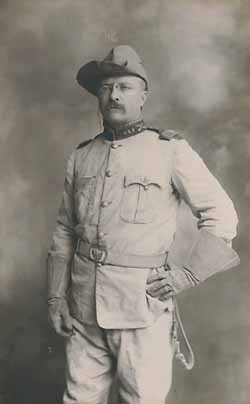
Our Object of the Month for May is a fascinating 3 July 1898 letter from Theodore Roosevelt to Henry Cabot Lodge, written just after the famous Battle of San Juan Hill, as the siege of Santiago continued. Roosevelt (pictured at left in his Rough Rider uniform) urges his friend, “Cabot,” to “Tell the President for Heavens sake to send us every regiment and above all every battery possible. … We are within measurable distance of a terrible military disaster; we must have help — thousands of men, batteries, & food & ammunition.” Roosevelt has even added at the corner of the front page of the letter, “For God’s sake have heavy reinforcements sent us instantly.”

As the Object essay notes, “Few documents show so vividly the contingency of history: Roosevelt believed the situation was so dire that he was prepared to go outside the army chain of command to send a message directly to the president. In fact, the result of the battle on 1 July was almost exactly opposite what Roosevelt expected. Within two weeks the Spanish would lose their naval squadron at Santiago and surrender the city.”

You can read a transcription of the letter, see images of all four pages and learn more about the background of the document here.

This Object of the Month celebrates the publication of The War Lovers: Roosevelt, Lodge, Hearst, and the Rush to Empire, 1898 (New York: Little, Brown and Company, 2010) by Evan Thomas, a corresponding fellow of the Historical Society, who spoke here about the book last week. In The War Lovers, Thomas argues that, more than the American Civil War, or even World War II, the Spanish-American War was a harbinger–if not the model–of modern American wars. The “splendid little war” against Spain was a “war of choice,” not immediately vital to national security but ostensibly waged for broader and sometimes shifting humanitarian purposes. A sampling of the letters, diaries, and photographs of Theodore Roosevelt and Henry Cabot Lodge that Thomas used in writing The War Lovers will be on display here at 1154 Boylston each afternoon from 1:00-4:00 p.m., Monday-Saturday, through 5 June 2010.

Collection Profile: Francis Blake Photographs

By Jeremy Dibbell

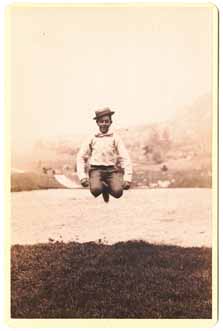
One of the most interesting of our image collections here at MHS are the Francis Blake photographs, more than 1,000 images taken by physicist and amateur photographer Francis Blake (mostly during the years 1875-1898). Blake is known for his early use of high-speed photography: “In the mid-1880s, Blake designed a focal-plane shutter that allowed him to take photographs with exposure times of 1/1000 to 1/2000 of a second. (The average working speed of a contemporary commercial shutter was about 3/100 of a second.) The resulting stop-action images of trains, pigeons, horses, bicyclists, and athletes were exhibited in Boston, Philadelphia, and London from 1891 to 1893 to critical acclaim.”

We’ve digitized a selection of Blake’s photographs, including a few of his well-known portraits and high-speed images; these are browsable here. The image included here (taken c. 1886-1889) is an “action shot” of Blake’s son Benjamin.

You can read more about Blake and his photos in a short biographical essay introducing the digital images.

Interact with Jefferson in new “Notes” Site

By Jeremy Dibbell

On the eve of Thomas Jefferson’s 267th birthday, we at MHS are delighted to annouce a new web presentation of the manuscript copy of Jefferson’s Notes on the State of Virginia, his only full-length book. Read more about the manuscript here.

By way of introduction to the new site: “When Jefferson was in Paris in 1785 representing the United States as a diplomat, he paid to have 200 copies of Notes printed for private distribution. Prior to publication, Jefferson reworked an earlier version of his manuscript by using sealing wax to attach corrections and changes written on small additional pieces of paper to full handwritten pages. He also expanded the text by inserting additional full pages. These changes show the evolution of Jefferson’s ideas on a number of topics, and the supplemental information he gathered as he wrote. This website allows the reader to interact directly with Jefferson’s complex manuscript by reading the original manuscript and by following all the changes that he made to the text before it was first published – including the opportunity to see passages written by Jefferson that have been hidden by attachments for more than two centuries.”

Our digital projects team has really worked some pretty amazing magic with this presentation – you can literally lift attachments off the page and see what Jefferson wrote underneath – or flip up additions and check out what’s on the back. It’s a little complicated at first, so I encourage you to use the Tutorial before you begin. It helps, believe me! Once you’ve mastered the navigation, you can start browsing at page 1, select your chapter, choose a selected passage, or search.

Also check out the list of sources for further reading, and some additional documents compiled by Jefferson during the composition of this work (including a table of Virginia birds).

Enjoy!


Notes of the State of … Connecticut??

By Jeremy Dibbell

You’ve probably heard of Thomas Jefferson’s Notes on the State of Virginia (and if you haven’t, just wait until next week, and watch this space!), but you may not have heard that Jefferson’s text was an expanded version of answers to a set of questions posed by François Marbois, the secretary to the minister from France, Anne-César, Chevalier de La Luzerne. In late 1780 and early 1781, Marbois sent lists of queries to representatives of each state (some with 16 questions, some with 22), requesting information ranging from “descriptions of the state boundaries and natural resources to the religion and social customs of its people. He asked for information about state history, population (including Native American peoples), manufacturing, and colleges, as well as specific information about how each state handled estates taken from Tories.”

Our April Object of the Month is a draft of Roger Sherman’s reply to Marbois, which he wrote in November 1782. Sherman, a Connecticut representative to the Continental Congress from 1774-81 and again in 1783-84, notes in his letter that he has delayed answering until he was “able to obtain an account of all the articles about which you desire to be informed.” He goes on to provide answers to Marbois’ questions, and enclosing several additional lists and texts. Of the principal manufactures, he writes: “Coarse linens & Woolens. Potash. Salt Petre, of which more than 100 Tons has been made in Connecticut Since the present war. & a Sufficient quantity of G. powder. Most kinds of Iron ware is also manufactured here, such as Cannon, & Cast Iron of all kinds & Edge Tools Such as Axes Sythes &c.” Of Tory property: “The Estates of the Rebels who have joined the Enemy or voluntarily taken probation under them are forfeited to the State, & disposed of for the expence of the war.” You can see images of the full draft letter, or read a transcription, here.

In her Object of the Month essay, Digital Projects Coordinator Nancy Heywood also touches on the other known responses to Marbois. John Witherspoon penned “A Description of the State of New-Jersey” (viewable here via Google Books), and we have a copy of Marbois’ queries regarding that state in the William Livingston papers II (viewable online here). And General John Sullivan answered Marbois in December 1780 regarding the state of New Hampshire, of which the original is at the Huntington Library (we have copies of both Marbois’ queries and Sullivan’s reply in our Miscellaneous Bound collection). The Historical Society of Pennsylvania holds Marbois’ letter to Thomas McKean with queries about Delaware, although we don’t know if any response exists. Of course the most famous reply, which was what grew into Jefferson’s Notes on the State of Virginia (the original manuscript copy of which is part of the Coolidge Collection of Thomas Jefferson manuscripts at MHS, and is now viewable online here).

Are there other “Notes on the state of ___” still out there? We suspect it’s entirely possible, and welcome news on any of them!


Presidential Letters Guide Launched

By Tracy Potter

Over the last several months Jeremy Dibbell, Anna Cook, and I have been tantalizing all of you with peeks into the library’s latest project, Presidential Letters at the Massachusetts Historical Society: An Overview.  I am glad to announce that as of the 23 February 2010 the project has finally come to its completion and the completed finding aid is now available online at http://www.masshist.org/findingaids/doc.cfm?fa=fa0329.

This subject guide is an overview of the MHS’ holdings of all known letters written by presidents found in the Society’s manuscript and autograph collections.  The guide now lists over 5,400 letters written by every U.S. president except for William Clinton, George W. Bush, and Barack Obama. This number does not include the letters found in the Adams Family Papers and the Coolidge Collection of Thomas Jefferson Manuscripts for John Adams, John Quincy Adams, and Thomas Jefferson. 

This very large project was completed over a relatively small period of time (five months to be exact), which could not have been done without the assistance of several people. 

 – L. Dennis Shapiro, a Trustee of the Society, who developed the original idea of the project with Peter Drummey, provided funding for the project through the Arzak Foundation, and gave feedback throughout the project. 

– Peter Drummey, the Stephen T. Riley Librarian, who developed the original idea of the project with Trustee L Dennis Shapiro, helped brainstorm formatting and content, provided me with locations of important letters and tidbits of information on presidents. 

– Brenda Lawson, the Director of Collections Services, who helped brainstorm formatting and content and who also edited endless pages of presidential letter descriptions.

– Susan Martin, Manuscript Processor and EAD Coordinator, who helped encode the finding aid and gave both Sarah and me a tutorial on the use of XMetal. 

– Sarah Desmond, Semester Intern from Endicott College, who spent 35 hours a week for three months looking through catalogs and collections, describing presidential letters, and formatting and encoding the finding aid. 

I also would like to mention the assistance of the staff of the MHS who provided me with feedback and locations of letters that fell through the cracks.  

Although the bulk of the guide is complete, please keep in mind that this is an ongoing project. As new collections come in and new collections are processed new letters could be added to the guide. 

It was a pleasure working on this project and I hope all will enjoy it.  

You can browse the guide here.

Presidents at the MHS

By Jeremy Dibbell

Back in November Anna Cook recapped a brown-bag event on the progress of the “Presidential Papers Project” at MHS, headed by my colleague Tracy Potter, with assistance last semester by intern Sarah Desmond. The end product of this survey will be a web-accessible subject guide to letters written by U.S. Presidents within the collections of the MHS, which we hope to have available in the near future. Tracy provided me with a few “sneak peeks” into the data, though, so I could offer a Presidents’ Day preview:

Not yet counting the letters of John and John Quincy Adams (of which there are many thousands in our collections), Tracy’s tabulated 12,988 presidential letters at MHS. We have manuscripts from all of the presidents excepting the three most recent (Obama, George W. Bush, Clinton). Our top five holdings (again without the Adamses) are:

5. Eisenhower (386 letters)

4. Theodore Roosevelt (440 letters)

3. Monroe (568 letters)

2. Washington (621 letters)

1. Jefferson (9,446 letters)*

Tracy also highlights just one collection which is particularly rich in presidential manuscripts: the Edward Everett papers contain correspondence from fourteen presidents! That’s each chief executive from Washington to Lincoln except for Madison and William Henry Harrison.

Watch this space for a link to the presidential guide when it’s launched, and many thanks to Tracy for giving us a chance for a preview.


*Note: all numbers may continue to change slightly with the final tabulations.

Reading “Silence Dogood”

By Nancy Heywood

Many people have heard of Silence Dogood, and recognize that name as a pseudonym used by Benjamin Franklin, but how many people have read “her” words? The MHS has just launched a web exhibition, “Silence Dogood: Benjamin Franklin in The New-England Courant”  featuring contextual essays about the topic as well as digital images and transcriptions of the 14 pieces appearing in a Boston newspaper between March and October of 1722 “by” the outspoken widow Silence Dogood.

In 1722 Boston-born Benjamin Franklin was 16 years old and busy working as an apprentice for his brother James, the printer and publisher of The New-England Courant. The Courant wasn’t officially tied to the colonial government of Massachusetts and the newspaper became known for publishing opinionated, lively, and satirical pieces, some of which questioned the political and religious establishment. In his autobiography Benjamin Franklin remembered how he wanted to write for the paper but thought his brother wouldn’t accept or print any pieces he submitted.  So Benjamin thought of a less direct method to get his writing published: he recalled, “I contriv’d to disguise my Hand, and writing an anonymous Paper I put it in the Night under the Door of the Printing House.” This “anonymous Paper” was the first essay written by “Silence Dogood” that was published as a letter to the editor in the 26 March-2 April 1722 issue of the Courant.

The appearance of Silence’s letter in the newspaper (followed by a note from the publisher, James Franklin, with suggestions to Mrs. Dogood about how to ensure the safe delivery of future letters to the newspaper) prompted Benjamin to continue writing. Over the next 7 months, thirteen more essays appeared in the newspaper. Silence Dogood shared her life story (see essay one to read a dramatic account of her birth on board a ship), advocated for the rights of women (essay 5), quoted a lengthy piece from a London newspaper about freedom of speech (essay 8) and commented on the vice of drunkenness (essay 12), which includes what is perhaps one of the longest lists ever compiled of all the harmless sounding terms used to describe a state of drunkenness: “boozey, cogey, tipsey, fox’d, merry, mellow, fuddl’d, groatable, Confoundedly cut, See two Moons, are Among the Philistines, In a very good Humour, See the Sun, or, The Sun has shone upon them … .”).

Also available within the MHS’s web presentation of the Dogood essays are links to online displays of the full issues of the 14 newspapers in which the essays appear. Website visitors have the opportunity to browse a few sample issues and see the output of the publishing house where Benjamin Franklin learned many aspects of the printing trade.

“A Good Stiff Grog”

By Jeremy Dibbell

Our February Object of the Month is a 15 February 1939 letter from President Franklin D. Roosevelt to historian Roger Merriman, FDR’s former teacher at Harvard and in 1939 the vice president of the MHS. In this letter, Roosevelt bemoans what he calls the “We who are about to die, salute you” attitude exhibited by the British, recounting to Merriman a recent visit by the British ambassador, Lord Lothian which made him “mad clear through.” He ends his letter thus: “What the British need today is a good stiff grog, inducing not only the desire to save civilization but the continued belief that they can do it. In such an event they will have a lot more support from their American cousins — don’t you think so?”

You can see images of the letter, read a transcription, and get some more background here, in Tracy Potter’s Object of the Month essay.

The Thomas Shepards and Their Books [Part 3]

By Jeremy Dibbell

Just a brief update on some of the latest discoveries in our research on the Thomas Shepard books (see Part 1 and Part 2 for earlier posts):

More than 100 extant copies of books (at ten different libraries) once belonging to the Shepards have now been identified, as Steve Ferguson notes in a post from Princeton, and each day we’ve discovered a few more. I’ve created an online version of the Shepard Library, which you can now browse here (just click on “Your Library” for the whole collection, or on each instution to see the books they now hold). Please note: as of 28 January this catalog is not yet complete – the largest portion of books, at Princeton University and Princeton Theological Seminary, still need to be added. But we’re getting there!

One neat find from our collections here at MHS was a note (at left) in Thomas Shepard III’s copy of John Danforth’s An almanack or register of coelestial configurations &c. for the year of our Lord God 1679 (Cambridge: Samuel Green, 1679), which is among our holdings. Shepard kept notes in the interleaved almanac (mostly in shorthand), including one in which he describes receiving books from the estate of his friend and ministerial colleague Daniel Russell, who died of smallpox on 4 January 1678/9. In his will, Russell left Shepard a choice of books from his library, and Shepard reports choosing fourteen titles. Two of these, we were delighted to find, are now held at Princeton, and each contains an inscription by Shepard noting that it came from Russell’s library. You can see catalog records for the fourteen books here.


The Thomas Shepards and Their Books [Part 2]

By Jeremy Dibbell

Picking up right where we left off yesterday, this post continues the saga of the Shepard library biblio-sleuthing expedition. As I wrote, I thought it might be worth checking to see whether we had any Shepard family books here at MHS, and if so whether they exhibited any of the marking patterns seen in the copies at Princeton. Our various catalogs resulted in the discovery of six books with Shepard provenance (and I suspect there may be a few more lurking in the stacks that I’ve yet to find). The titles we know so far are:

1. Thomas Goodwin, The returne of prayers: a treatise vvherein this case, how to discerne Gods answers to our prayers, is briefly resolved : with other observations upon Psal. 85.8 concerning Gods speaking peace, &c. (London: Printed for R. Dawlman, and L. Fawne at the signe of the Brazen serpent in Pauls Church-yard, 1636).

Notes: On front pastedown: MHS bookplate, noting Gift of “Miss Susan Minns, May 1, 1931”; inscribed below bookplate, “W. Beaman [?] 1905”; inscribed on title page [A2r]: “price 1s 4d”; inscribed on verso of title page [A2v]: “Thomas Prince Charlestown 1707 / [1?]s 4d silver.”; inscribed sideways on A3r, in ornate script: “Thomas Shepard me dedit 1652”; inscribed at top margin, A3r: line of shorthand, above which “Prince” (partially obliterated); inscribed on p. 396, sideways: “Thomas Shepard me tenet [?] and several shorthand marks at foot of page. Contains the “TS” stamp on the top edge.

2. William Gouge, A learned and very useful commentary on the whole epistle to the Hebrews : wherein every word and particle in the original is explained … : being the substance of thirty years Wednesdayes lectures at Black-fryers, London by that holy and learned divine Wiliam Gouge … : before which is prefixed a narrative of his life and death: whereunto is added two alphabeticall tables (London: Printed by A.M., T.W. and S.G. for Joshua Kirton, 1655). Second volume.

Notes: Inscribed on front flyleaf: “Tho: Shepards Booke / 1659: May. 19 / prot. 40s”; below same: “Warham Williams his Book 1738”; in pencil further down on page: “From J.B. Thayer / Feb. 1886”; inscribed on title page: “Warham Williams 1738 25/”. Contains a very clear “TS” mark on the top edge (pictured below).

3. Christopher Airay, Fasciculus praeceptorvm logicorum: In gratiam juventutis Academicae compositus & typis donatus (Oxoniae: Excudebat H.H. Impensis Jos. Godw., 1660).

Notes: Inscribed on front pastedown: “Presented to the Mass Hist’l Soc’y by Horatio G. Somerby”; inscribed on title page: “Thomas Shepardus [ejus?] liber prst[?] / 18 . 8’o 1674”; inscribed on verso of title page: “Edward Michesson [?] / His Book / 69”; inscribed on page *3, upside down at foot: “John green His Book / 1670”. Contains several glosses in text. Smudged/unclear “TS” mark on top edge.

4. John Cotton, Some treasure fetched out of rubbish: or, Three short but seasonable treatises (found in an heap of scattered papers) which providence hath reserved for their service who desire to be instructed, from the Word of God, concerning the imposition and use of significant ceremonies in the worship of God (London: [n.p.], 1660).

Notes: Inscribed sideways on title page: “Thomas Shepards booke 1660 5s [?]”; additional notes on title page; scattered shorthand and plaintext glosses through p. 15. No “TS” mark on top edge (too thin).

5. John Cotton, Of the holinesse of church-members (London: Printed by F.N. for Hanna Allen, and are to be sold at the Crown in Popes-head Alley, 1650).

Notes: Title inscribed on front flyleaf in an early hand; below this, “Wm Jenks A’o 1814.”; inscribed on second front flyleaf, long paragraph in shorthand with short plaintext gloss; inscribed on title page: “Thomas Shepard’s Book”; further note on verso of title page; inscribed on last leaf (blank): “Thomas Shepard’s Book 1660”; below this, notes referring back to pp. 42, 90. No “TS” mark on top edge (too thin).

6. [Synopsis purioris theolgiæ: disputationibus quinquaginta duabus comprehensa, ac conscripta per Iohannem Polyandrum, Andream Rivetum, Antonium Walæum, Antonium Thysium (Lvgduni Batavorvm: Ex officina^ Elzeviriana, 1632).]

Notes: Missing title page. On front pastedown: MHS bookplate noting gift of “Horatio G. Somerby / Nov. 1 1843”; inscribed on first blank: “Thomae Shepardi liber / 21. 3’o 1677”; inscribed below: “Edwardi Parsoni / Liber ex dono superscripti quondam possesoris / 1677” Lightly next to this, “Pret 3s-6d.”; inscribed below this: “Sam’th Parson / 1714”; various pen tests (mostly ggggg) around page. Later notes (librarian’s) on verso of ffep given title information (suggesting this is the 1652 edition, with later penciled note suggesting 1625). Insribed on last full leaf: additional note about Somerby gift to MHS, 1843, and some partially torn away earlier notes on the verso. No “TS” mark on top edge.

Beyond these books at MHS, we’ve also been able to confirm a few other Shepard titles at other libraries, including six that ended up in the Mather collection now at the American Antiquarian Society (I think before we’re done we’ll discover that they have a few more Shepard books, too); one at the John Carter Brown Library; and one at the Morgan Library. Those at the AAS all have the “TS” mark on the top edge (look for a blog post from them on this topic too), and our former MHS colleague Kim Nusco who’s now at the JCB reports that their book was rebound and gilded, probably destroying any edge-mark that used to be there (there’s a glimmer of hope that a trace of the mark might remain).

These discoveries seem to indicate that at least some of the Shepard books probably left the family and did not travel the same path as the Princeton books did, although we’ve yet to determine exactly how they made their way down through the centuries. That remains to be explored, but the names gathered from our copies (i.e. Thomas Prince, Warham Williams, William Jenks, Edward Parson) offer some interesting leads and points of exploration, some of which will be explored in future posts. In the meantime, if you know of any additional Shepard books, please let us know!