The Thomas Shepards and Their Books [Part 1]

By Jeremy Dibbell

Biblio-sleuthing is one of my very favorite things to do, so it was fun to be able to spend some time last Thursday working on a really interesting project in collaboration with Stephen Ferguson, Curator of Rare Books at Princeton University; Diann Benti, Assistant Reference Librarian at the American Antiquarian Society; and staff at the New England Historic Genealogical Society (NEHGS).

The project got underway when, as Stephen Ferguson noted in a blog post, they found at Princeton more than twenty books from the library of the Thomas Shepards. That’s three generations of early (and famed) New England ministers, each named Thomas Shepard. Or as we’ve taken to calling them, TS1 (1605-1649); TS2 (1635-1677); and TS3 (1658-1685). Most of the Shepard books, Ferguson found, were each “branded” or stamped on the top edge with a “TS” monogram (quite an uncommon practice in early New England, as far as we’ve been able to discover so far). In a follow-up post, Ferguson notes some of the most interesting finds.

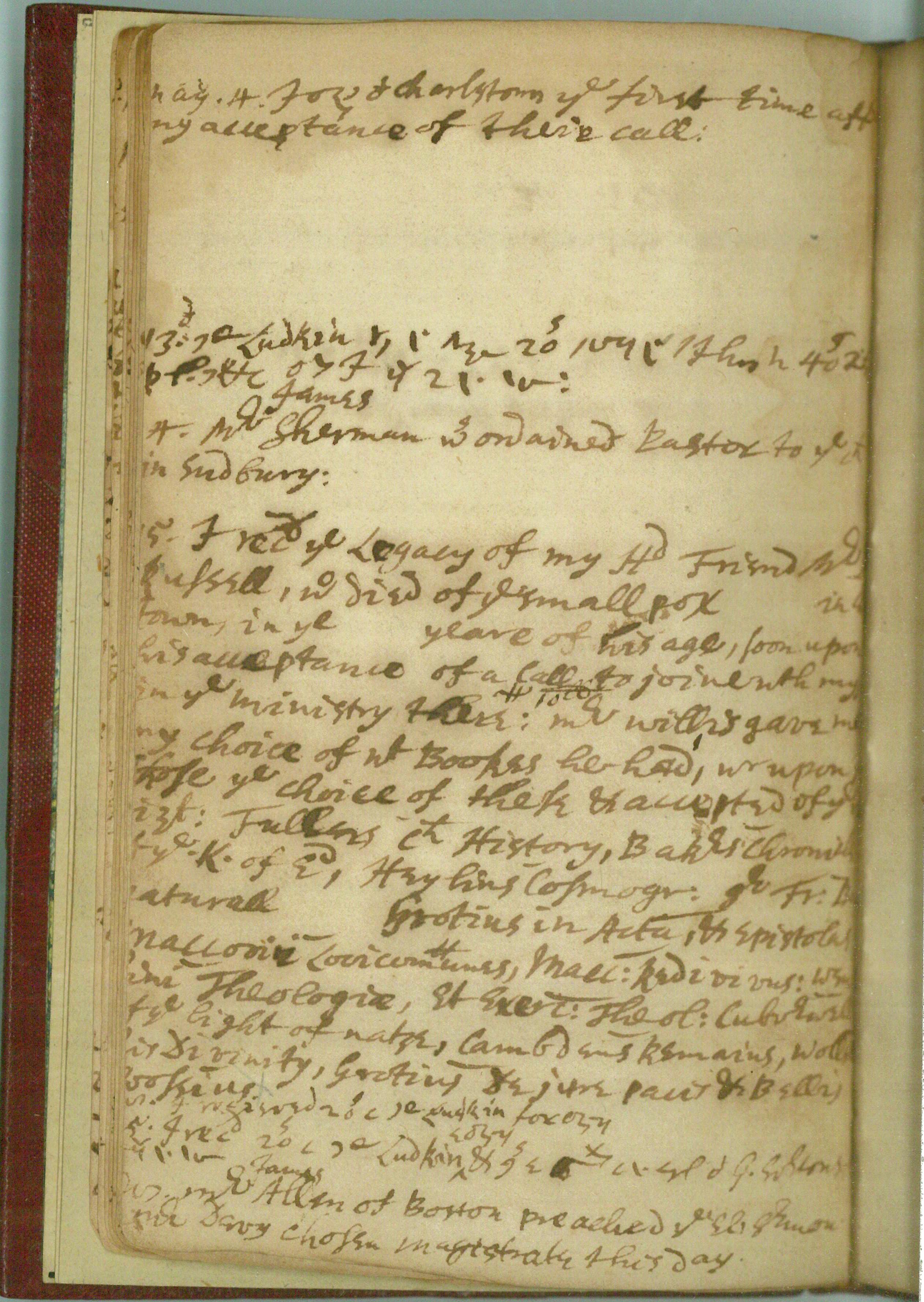
Steve called me to see if I could find out a little about the wills and probate inventories of the Shepards, to see if there might be a list of the libraries included there, so off I went to NEHGS and looked through their microfilm copies of the seventeenth-century Middlesex County probate records. Frustratingly, the Shepard probate documents are vague (as so many are) about the contents of the library. TS1’s will leaves to his son Thomas “all my Bookes, manuscripts & paper which last named, viz: bookes, manuscripts & papers, although be propriety of my sonne Thomas yet they shall bee for the use of my wife and my other children.” The inventory lists, as the final item “about two hundred and sixty printed bookes” valued at £100, reiterating that they are to go to TS2.

TS2’s 1677 will leaves to “my son Thomas my whole library, both printed books &  writings, which though the property of my son, shall be also, occasionally, for the use of my wife, & daughters, as they may need, and desire the perusal thereof.” The inventory lists “his Library”, again valued at £100.

TS3, who died in his mid-twenties, left no known will or inventory. His widow Mary (nee Anderson) later married Rev. Samuel Hayman. Hayman died in 1712; his will doesn’t mention a library, and there is no inventory. Mary died in 1717; her will also doesn’t mention a library. Thomas and Mary had one surviving child, a daughter Hannah (or Anne) who married Rev. Henry Smith of New York. Steve has some ideas about how the books now at Princeton made their way there, which I’m sure he’ll share in good time, and he’s also found some good evidence to prove a statement Cotton Mather made about TS3 in his Magnalia Christi Americana (Volume II, p. 124 of the 1820 edition): “… his piety was accompanied with proportionable industry, wherein he devoured books even to a degree of learned gluttony; insomuch, that if he might have changed his name, it must have been Bibliander. … he had hardly left a book of consequence … in his library (shall I now call it, or his laboratory) which he had not so perused as to leave with it an inserted paper, a brief idea of the whole book, with memorandums of more notable passages occurring in it, written in his own diligent and so enriching hand.”

When I got back to MHS from NEHGS, I decided to take a peek through our “manuscript catalog,” which sometimes lists annotations or signatures found in books. Jackpot! I quickly discovered a few Shepard titles in our collections here at MHS … and I look forward to sharing those with you tomorrow. Did those here also have the “TS” mark on the top edge? Where’d they come from? Stay tuned! And what other institutions have Shepard books today?

Coming Full Circle: Our 100th Object of the Month

By Jeremy Dibbell

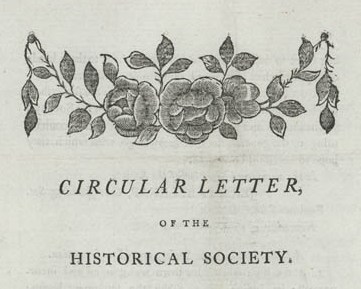
To mark the 100th Object of the Month, we’ve decided to go back to our very deepest roots, highlighting one of the first published documents produced by the MHS (and probably my personal favorite of all the things under the roof). It’s the “Circular Letter, of the Historical Society“, in which Jeremy Belknap and the other founders lay out their goals for the organization: “to collect, preserve, and communicate, materials for a complete history of this country.”

Read more about the Circular Letter, Belknap, and the founding of the MHS in Library Assistant Rakashi Chand’s Object of the Month essay. You can also find high-quality scans and a transcription of the Letter there.

You can browse all 100 Objects by clicking here.

Spotlight on Phillis Wheatley

By Jeremy Dibbell

Part of our new website design (well not so new anymore, I can’t believe it debuted in September!) is a rotating “Spotlight” section, where we highlight one of our various digital collections. Currently we’re focusing on Phillis Wheatley: click here to see digital images of manuscript poetry by Wheatley, letters by and about the poet, and information on a writing desk in the Society’s collections believed to have been used by Wheatley.

December’s Object: Abigail’s Pocket

By Jeremy Dibbell

Our December Object of the Month is one of the MHS’ recent acquisitions: a “dimity pocket” once owned and used by Abigail Adams. It came to the Society as a gift from antique purse collectors Paula Novell Higgins of Georgia and Lori Rose Blaser of California, who purchased it from an estate in Adams, NY. The pocket was previously in the possession of Abigail’s granddaughter Elizabeth “Lizzie” Coombs Adams, possibly passed to her directly from Abigail under the terms of her will, in which she left “all my Cloathing–body Linnen &–not already heirred shall be equally divided between my five Grand daughters and Louisa Catherine Smith.”

A note by Lizzie Adams attesting to the original ownership of the pocket accompanies the piece.

To read more about dimity pockets in general and this one in particular, and for further reading suggestions, see Adams Papers Assistant Editor Sarah Sikes’ Object of the Month essay.

November Object: American POW in WWI

By Jeremy Dibbell

Our November Object of the Month is up: it’s an October 1918 photograph of a group of American prisoners of war taken at the German prison camp Landshut. Atlantic Monthly correspondent (and fighter pilot) James Norman Hall, one of those prisoners, sent the photo along with a note to Atlantic editor Ellery Sedgwick.

See the photograph, and read background on Hall, Segwick and others here. And remember to check out our current exhibition: “Atlantic Harvest: Ellery Sedgwick and The Atlantic Monthly, 1909-1938.”

Remember, Remember …

By Jeremy Dibbell

Most of us probably don’t tend to think of 5 November as a holiday, but in colonial Boston it was one of the most festive days of the year. In Britain the holiday was (and still is) known as Guy Fawkes Day; here in New England it was called Pope’s Day, or Pope Night. There is an excellent introduction to the holiday at 5th of November in Boston, a site mounted by our sister institution the Bostonian Society.

There are many items in our collections relating to Pope’s Day, but I wanted to highlight one of them today: the James Freeman notebook. Rev. James Freeman (1759-1835), was one of the founders of the Historical Society, and his little historical notebook (given to the Society in 1791) “contains notes on population, prices, epidemics, unusual weather, and earthquakes in Massachusetts, particularly the earthquake of 1755; also, descriptions of Guy Fawkes Day pageants and riots in Boston, and of the public reaction in Boston to the Stamp Act of 1765.” These aren’t personal recollections by Freeman, but rather contemporary newspaper accounts that he copied later.

On the first page of the notebook, under the heading “1745,” Freeman writes: Nov’r 5. Two Popes were made & carried thro the streets in the evening 1 from the N. & ye other from ye S. attended by a vast number of negroes & white servants w/ clubs &c., who were very abusive to ye inhab. insulting persons and breaking windows &c of such as did not give them money to their satisfaction, & even of those who had given them liberally, & ye 2 Popes meeting in Cornhill their followers fell upon one another w/ ye utmost rage & fury. Several were wounded & bruised & some left for dead, & rendered incapable of business for a long time. Fleets Evening Post.” This account appeared almost verbatim in the Boston Evening-Post issue dated 11 November 1745, which also included a letter to the printer “written by a Gentleman of great Character.” The gentleman urged Mr. Fleet not to suffer the riot “to pass off without a public Rebuke … What a Scandal and Infamy to a Protestant Mob, be it of the rudest and lowest Sailor; out of Boston, or even of the very Negroes of the Town, to fall upon one another with Clubs and Cutlasses, in a Rage and Fury which only Hell could inspire, or Devils broke loose from their Chains there, could well represent!”

For 5 November 1764, Freeman writes: “It was formerly a custom on these anniversaries for ye lower class of people to celebrate the evening in a manner peculiar to themselves, by having carried images erected on stages, representing the Pope, his attendant, &c. and these were generally carried thro’ the streets by negroes & other servants, that ye minds of ye vulgar might be impressed w/ a sense of their deliverance from popery, & money was generally given to them, to regale themselves in the evening, when they burnt the images. But of late those who are concerned in this pageantry make a party affair of it, & instead of spending the evening agreeably, the champions of both ends of the town prepare to engage each other in battles under the denomination of S. end & N. end. In ye afternoon the magistrates & other officers of the town went to the respective places of their rendezvous, & demolished their stages, to prevent any disorders, which they did without opposition. Notw/standing which as soon as it was dark, they collected again, & mended their stages, which being done they prepared for a battle, & about 8 o’clock the two parties met near the mill bridge where they fought with clubs, staves, brick bats, &c for about half an hour, when those of ye S. end gained the victory, carrying off not only their own, but their antagonist’s stages &c which they burnt on Boston neck. In the fray many were much bruised & wounded in their heads & arms, some dangerously. It should be noted that these parties do not much subsist at any other time.” This account appeared in the Boston Evening-Post of 12 November 1764.

The following year, in the wake of the Stamp Act riots, Freeman’s entry indicate that things turned out a little differently: “It has long been the custom in Boston on ye 5th of Nov’r for Nos. of persons to exhibit on stages some pageantry denoting their abhorrence of popery & the horrid plot which was to have been executed on that day in the year 1605. These shows have of late years, been continued in the even’g, & we have often seen the bad effects attending them at such a time; the servants & negroes would disguise themselves & being armed with clubs would engage each other with great violence whereby many came off badly wounded. In short, they carried it to such lengths that two parties were created in ye town under the appellation of N. end & S. end. But the disorders which had been committed from time to time induced several gentlemen to try a reconciliation between the 2 parties; accordingly the chiefs met on the 1st of this inst., & conducted the affair in a very orderly manner. In ye even’g the commander of ye N. & after making general overtures they reciprocally engaged in an Union, & the former distinctions to subside, at the same time the chiefs with their assistants engaged their honour no mischief should arise by their means, & that they would prevent any disorders on ye 5th. When the day arrived about noon the pageantry representing the Pope, the Devil, & several other effigies signifying tyranny, oppression, slavery, &c. were brought on stages from the N. & S. & met in Kings Str. where the union was established in a very ceremonial manner, & having given three huzzas, they interchanged ground, the S. marched to ye N. & the N. to the S. parading thro’ ye streets until they again met near ye Court House. The whole then proceeded to Liberty tree, under the shadow of which they refreshed themselves for a while, & then returned to ye Northward agreeably to their plan. They reached Cop’s hill before 6 o’clock, where they halted, & having enkindled a fire, the whole pageantry was committed to the flames & consumed.” This account appeared in the Boston Evening-Post of 11 November 1765.


For more information on Pope’s Day, I recommend 5th of November in Boston, plus the excellent Pope Night series at Boston1775. Brendan McConville’s excellent book The King’s Three Faces (University of North Carolina Press, 2006) contains much background and context. On James Freeman, see F.W.P. Greenwood’s memoir of him, published in Collections of the Massachusetts Historical Society, 3d. Series Volume V (1836), pp. 255-271.

American Indian Photographs at MHS

By Jeremy Dibbell

One of the MHS digital collections currently being highlighted on our homepage is Photographs of Native Americans, a compilation of portraits and other photos collected by four Bostonians during the late 19th and early 20th centuries. “Charles W. Jenks and Francis Parkman collected carte de visite and tintype portraits of American Indians during the 1860s as historical records of tribal groups and their role in contemporary American politics. After a visit to southern California, Boston collector Kingsmill Marrs brought home platinotypes of southwestern Indians taken by Adam Clark Vroman in the late 1890s. An anonymous donor was inspired to collect Joseph Kossuth Dixon’s photogravures from the Wanamaker Indian expeditions of the early 1900s after hearing Dixon lecture in 1912.”

The fellow at left is a Chippewa man, photographed in Washington, D.C. in 1862 by Charles D. Fredericks & Co. The carte de visite is from the Charles W. Jenks collection.

You can find background text and links to many more photographs here.

Invade Canada?

By Rakashi Chand

This is a lovely time of year to visit the beautiful province of Quebec, Canada. Quebec City is a special hidden gem, the feel of Europe without boarding a plane! But many Americans crossing the border are not aware of American invasions of Canada (most significantly, the Quebec expedition, during the American Revolution).

The first Continental Congress invited the French-Canadians to join their cause, hoping to appeal to their desire to be rid of British rule. Although this union never came to fruition, there was perhaps the possibility of a fourteenth colony. France had recently lost the Province of Quebec to the British in the French and Indian War so the Americans forces hoped the French Canadians would join them in over-turning British rule in North America when they invaded Quebec. This was the first major military excursion for the young Continental Army. General Richard Montgomery led a successful campaign in Montreal, but his snow-storm assault on the last day of the year in 1775 ended in disaster below the heavily fortified walls of Quebec City.

The six-week trek from Boston to Quebec City through the Maine wilderness led to the creation of an interesting array of documents in testimony of the hardships endured and the battle which ensued. Here at the MHS, researchers can view the William Dorr Journal, 1775-1776, which describes the journey to Maine up the Kennebec River and down the Chaudiere to Quebec and the hardships incurred; Jonathan Hill Journal, 1776, which recounts the march from New York to Montreal (and is written on the back pages of an arithmetic copy book); the handsome penmanship of Benedict Arnold in a letter regarding the siege of Quebec in the Hector McNeill papers, 1765-1812. Alternatively, researchers can get the British perspective, through the Journal of an officer of the 47th Regiment of Foot, 1776-1777, kept during campaigns in Canada describing the regiment’s activities under Gen. Guy Carleton while reinforcing the Quebec area against American forces in 1776.

There are also numerous printed documents recounting the “Canadian Invasion.” The Quebec expedition turned out to be much more than what the Continental Army could manage the winter of 1775-76, but don’t take our word for it. You can read about the expedition through journals, letters, books and even a drama (The death of General Montgomery, in storming the city of Quebec: A tragedy By H. H. Brackenridge (Norwich [Conn.]: Printed by J. Trumbull, for and sold by J. Douglass M’Dougall, on the west side of the Great-Bridge, Providence, 1777). If this topic piques your interest, please use our on-line catalog, ABIGAIL, to do a subject search for “Canadian Invasion, 1775-1776”; to see a list of available sources. And the next time you cross the border or if you ever have a chance to walk through the fortifications of Old Quebec City, you can imagine the hardships encountered by General Montgomery, Benedict Arnold, and the continental army as they attempted to “take Canada”.

A Captain in John Brown’s Army

By Jeremy Dibbell

Our September Object of the Month is a commission signed by John Brown, making Aaron Dwight Stevens a captain in the “army Brown hoped to raise under a provisional antislavery constitution for the United States.” The document was signed the night before Brown’s raid on Harpers Ferry, in which both he and Stevens were captured (both were later executed).

Brown’s provisional constitution, drawn up in a secret May 1858 meeting, would have outlawed slavery in the United States. You can read more about the constitution, Brown, and Aaron Dwight Stevens here.

To commemorate the 150th anniversary of John Brown’s attack on Harpers Ferry, the Historical Society will present an exhibition of personal papers, photographs, engravings, and artifacts that document the 1859 raid and Brown’s trial and execution later that year, together with evidence of continuing arguments about the morality and meaning of Brown’s actions ever since. The exhibition will be open to the public from 1:00-4:00 PM, Monday-Saturday, from 12 October – 23 December 2009.

Punch Before Tea?

By Jeremy Dibbell

Our August Object of the Month is the Edes Punch Bowl, famously used to quench the thirst of a group gathered at the home of Benjamin Edes on the afternoon of 16 December 1773, just hours before the Boston Tea Party.