One Donor’s Rationale

By Jeremy Dibbell

The sharp-eyed crew from the MHS Publications department alerted me to a very interesting section in one of our collections, the John Pierce memoirs, 1788-1849 (Ms. N-714). Rev. Pierce (1773-1849) was the minister of the First Parish Congregational Church in Brookline, and was also a longtime member of the MHS (elected in 1809, and a member of the Council from 1813 through 1834).

In his eighteen-volume memoir, Pierce includes “death notices and sketches of other ministers, Harvard classmates of the Class of 1797, and others; notes on attendance at annual Harvard commencements and public exhibitions, conventions of Congregational ministers, dedications of churches and other institutions; and attendance at numerous meetings of local societies and clubs, among them the Mass. Bible Society, Phi Beta Kappa, Thursday lectures, Society for Propagating the Gospel Among the Indians and Others in North America, various temperance societies, Dudleian lectures at Harvard, and the Mass. Congregational Charitable Society. The volumes also contain notes on various journeys and visits with individuals, his work as a minister, Boston ministers, and Harvard classmates; and copies of letters” (text from the collection description).

In the first volume of a “new series” of his memoir, begun in June 1843, Pierce wrote a short introduction to the project, noting that he as a Harvard student he began “to write certain memoranda.” In January 1806, he continues, he “procured a bound volume, and began … to make a more formal record, than I had before attempted.” His original series, including transcriptions of his pre-1806 notes, filled ten volumes, and covered “a period of precisely forty years.” Pierce writes that he did not originally intend to continue keeping such a record, but “though on the borders of threescore years and ten, as my health remains so firm, I have concluded to prolong my Memoirs, so long as God shall continue the ability for such a service.”

Following this brief introduction, Pierce writes “I intend, that all these volumes, lettered on the back, Memoirs, shall be deposited by my Executor or Administrator, be they more or fewer, in the Library of the Massachusetts Historical Society.

“My reasons are, that this is the place expressly designed for such deposits, where they will be will kept most safely, and can be consulted most conveniently.

“Were they left to my family, it is probable, that they would, ere long, be scattered, defaced, and lost.

“But in a public Library, where no Manuscripts are allowed to be taken away, they stand the best chance of preservation.

“These Memoirs are not such as I could desire, being written without alteration or amendments, as the events, which they relate, transpired. I doubt not, that many errors may be detected, and that many of the records may savor of the prejudices and partial judgments of their writer.

“But such as they are, they are bequeathed, without reserve to The Massachusetts Historical Society by one of its devoted members, John Pierce.”

Following his death in 1849, Pierce’s memoirs did come to the Historical Society as per his wishes. They remain available for convenient consultation to this day, both in original form and in the form of long extracts published in various volumes of the Proceedings.
Serendipity Strikes!

By Jeremy Dibbell

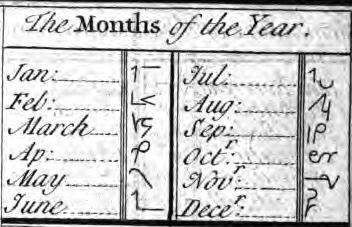
Well I have to say I can’t quite believe what I’m about to write. Literally hours after typing up my short introduction to the “Anonymous cipher diary“, I decided to spend a little time surfing around on Google Books and see what I could find in terms of 18th century short-hand manuals. There are a few there, but I was positively shocked to hit paydirt on the second title in the list! James Weston’s Stenography Compleated, or the art of short-hand brought to perfection was first published in 1727; Google Books has scanned a copy of the 1743 edition, and right there on page 30 [XXX] is what may be the smoking gun: the months of the year:


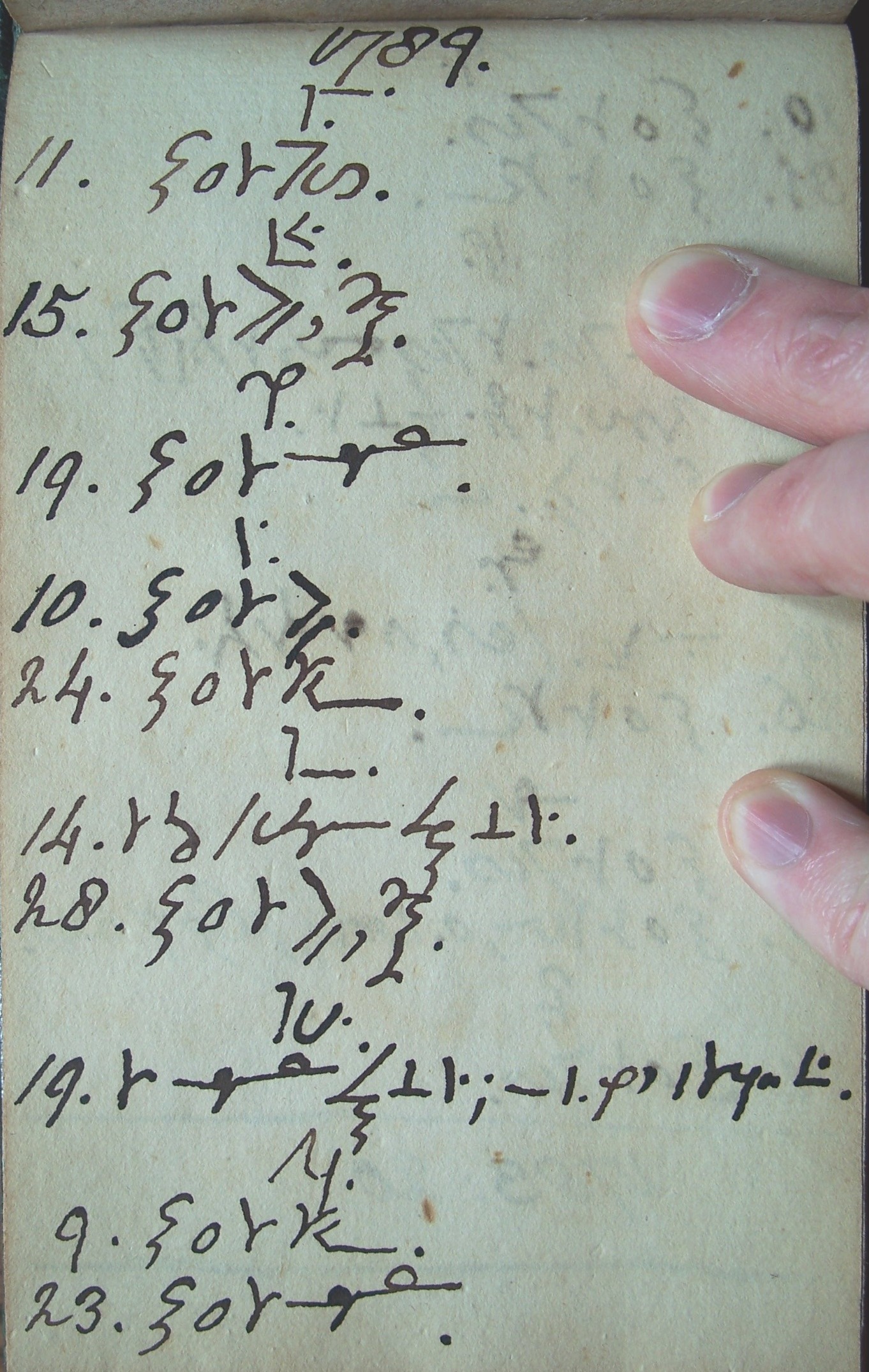
These match those used by our anonymous writer exactly. Here are the first short entries for 1789, showing the notations for January, February, April, May, June, July, and August (please pardon my fingers). Our writer appears to be adding some punctuation markings, which I still have to figure out, and I’m not entirely sure just yet just how much of Weston’s system our diarist is using – some portions of the short-hand seem to be homegrown. But confirming the months gives us much more of a start on actually reading this diary than I thought possible even a few hours ago.

You just never know when serendipity will strike, I guess. And now I know what I’ll be up to this weekend! More on my findings and on the possible identity of our diarist on Monday.


Can you Crack the Cipher?

By Jeremy Dibbell

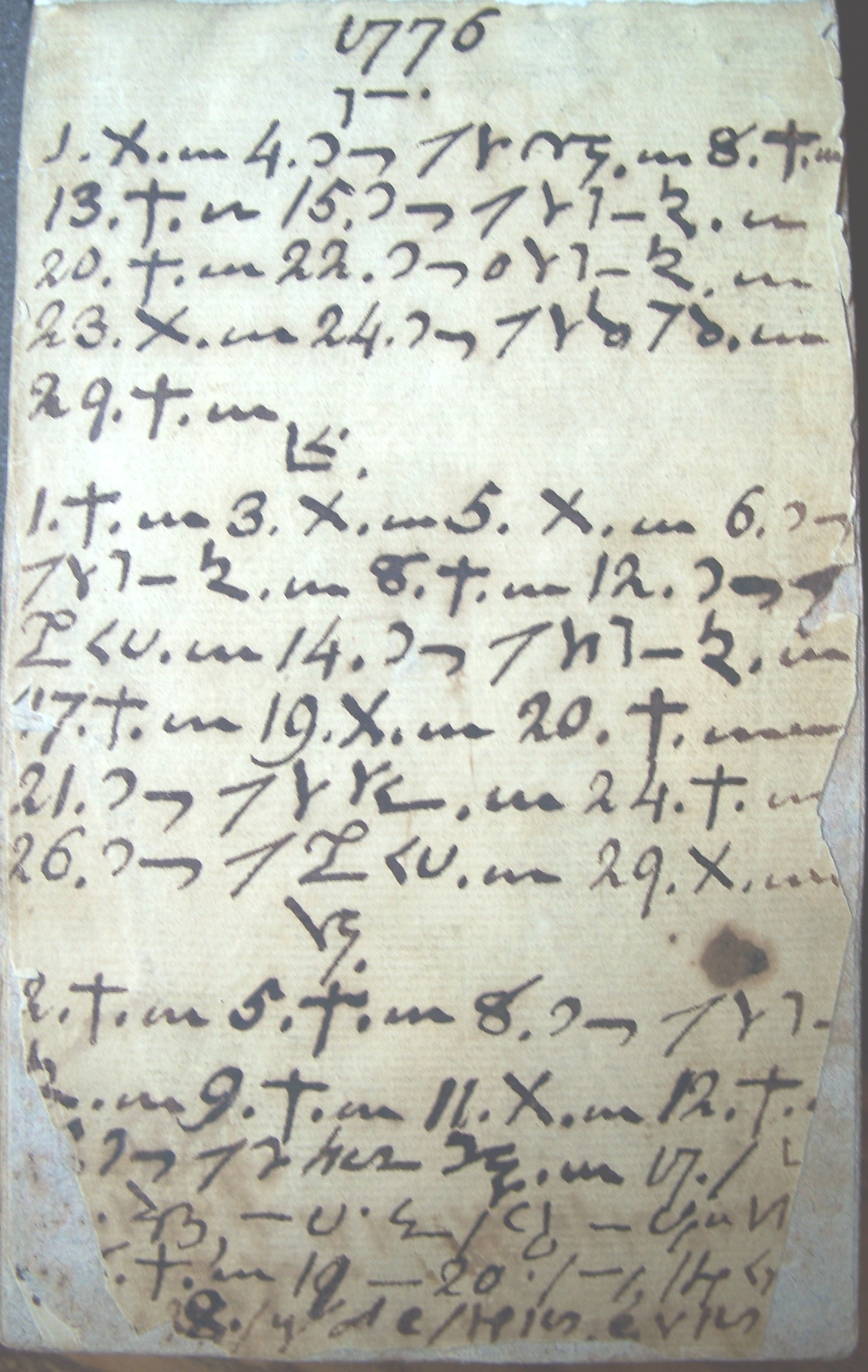
One of the items in our collections I find most intriguing is the “Anonymous cipher diary, 1776-1845” (known by its call number, Ms. Sbd-133). It is a small bound volume containing ciphered or shorthand notations broken down by years, months, and days, with long entries on one side of the sheets and shorter entries on the opposite side. The writer used Arabic numerals, so tracking years and dates is possible, and the notations for each month are evident from the entries. Beyond that, the contents are almost a complete mystery (and since the years covered by the diary are of some considerable interest, I’ve long thought it would be fascinating to try and puzzle this out).
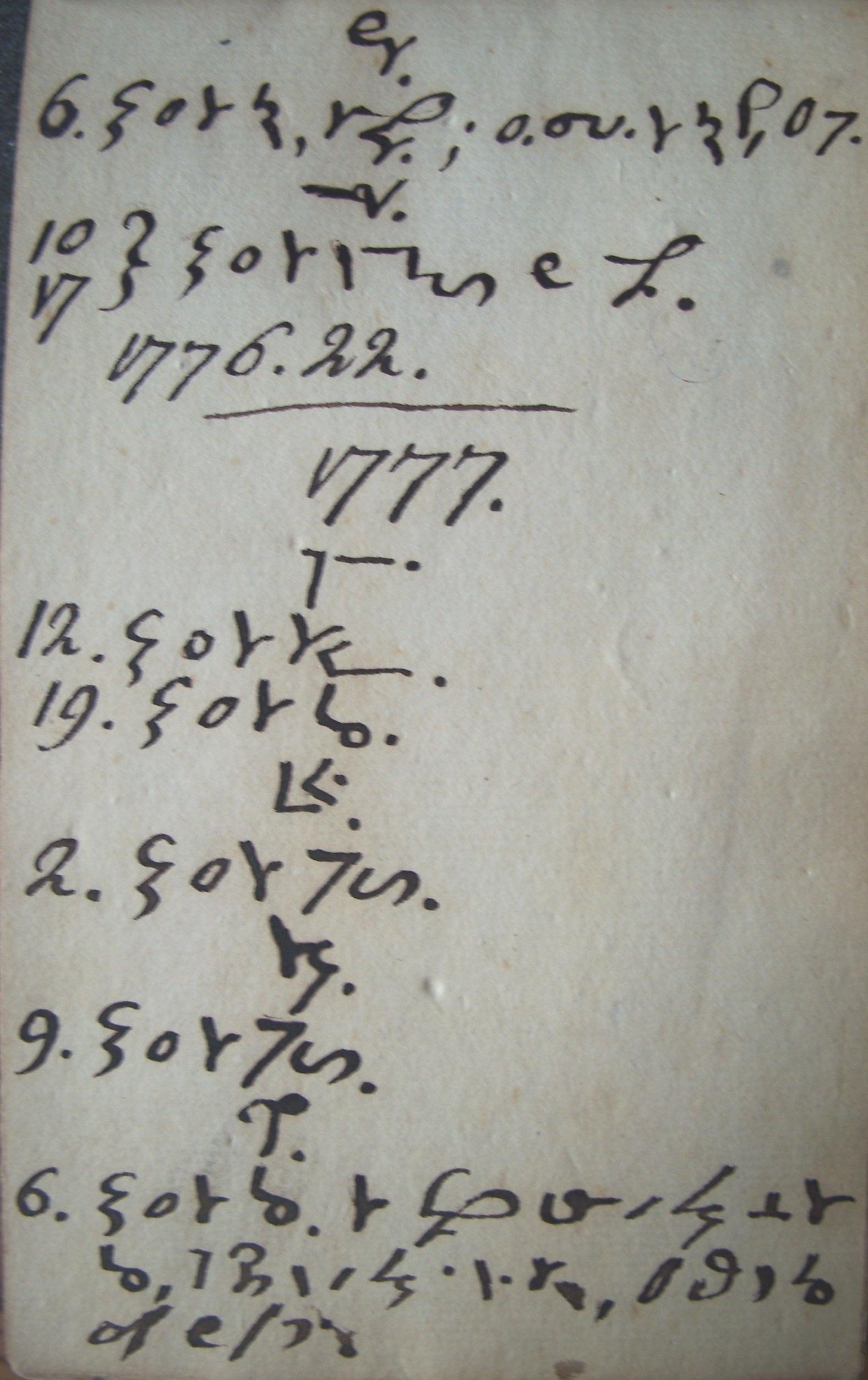
The diary was given to MHS member (and former president) Judge John Davis in 1841 by Theophilus Parsons [Jr.] (1797-1882), a legal scholar and longtime Dane Professor of Law at Harvard. A note on the first pages of the diary, written on 27 March 1845 by Davis, reads:

“This book, probably a Diary, I received from Theophilus Parsons, Esq. in the year 1841. It was found in his father’s Library after his decease, its origin and contents unknown. I hoped to find some person of sufficient skill in stenography, to decipher the pages. But it is still, to me & those whom I have consulted, a Sealed Book. With the consent of my friend from whom I rec’d [the] Book, it is now offered to the acceptance of the Mass. Hist’l Society. The late B.L. Oliver who had some skill in stenography, tho’ unacquainted with the characters in this volume, expressed to me an opinion that it was a diary of a Clerygman, perhaps as has been conjectured, of Rev. Moses Parsons of Byfield. But the entries extend to 1799 – sixteen years after the death of that gentleman. J. Davis.”

Theophilus Parsons [Sr.] (1749-1813), a well-known Massachusetts politician (of the Federalist persuasion), jurist and the chief justice of the Supreme Judicial Court from 1806 to 1813, left an extensive library at his death; when it was sold at auction in 1814, the catalog ran to twenty-three printed pages. Among the volumes in his collection, and apparently retained for a time by the Parsons family, was this curious little book. The man consulted by Davis about the diary was Benjamin Lynde Oliver, Jr., (1788-1843), a legal author (and noted chess player). In his diary (which is held at MHS as part of the Oliver Family Papers), Oliver writes on Saturday, 13 August 1842 “Go to see Judge Davis & get of him his treatise on shorthand, which is supposed to be the one used in the Mss. Book he lent me to decipher.” Over the next several months, Oliver reports additional visits with Davis, but does not mention the manuscript again (so far as I have been able to determine).

In his note, Davis records the “conjecture” that perhaps the diary had been written by Rev. Moses Parsons (1716-1783), the father of Theophilus. But, as he helpfully points out, Moses died well before the diary entries stop. Perhaps there is another clergyman member of the Parsons family who might have kept a ciphered diary? I’ll examine a possible (and potentially really fascinating) contender in a future post. In the meantime, if anyone out there recognizes this method of shorthand, I’d certainly be fascinated to hear any insight you can provide.

Organizing the 54th

By Jeremy Dibbell

Our “Object of the Month” for May is a letter from Massachusetts governor John A. Andrew to Francis Shaw. In the letter, dated 30 January 1863, Governor Andrew lays out his reasons for forming what would become the 54th Massachusetts, the first regular army regiment of African American soldiers raised in the North during the Civil War. Enclosed with the letter was a note to Francis’ son Robert, offering him command of the regiment. Francis Shaw personally carried Andrew’s letter to his son, then in winter encampment with the 2nd Massachusetts Infantry in Virginia. Robert was at first not entirely enthused about the idea, but his father proved persuasive … and the rest, as they say, is history.

You can read the whole story, see digital versions and transcriptions of Andrew’s letters to Francis and Robert Gould Shaw, and get ideas for further reading and research here.