“A good house where we had a good bedroom…”: Edwin F. Atkin’s Travel Diary, 1872

By Bonnie McBride

While our mission statement here at the Massachusetts Historical Society proclaims that we hold materials dedicated to the study of the history of Massachusetts and the United States, we also hold materials that may be of interest to scholars researching other countries. As I am returning on a trip to Norway this summer, I decided one day to search and see what manuscripts (if any) we hold related to that country.

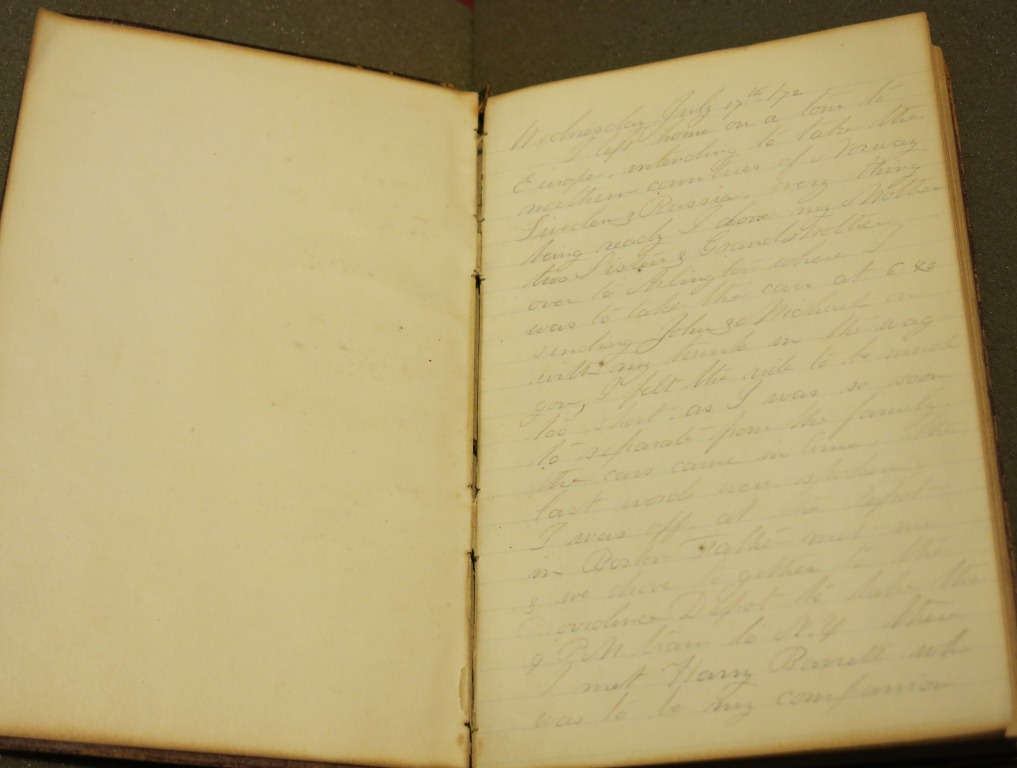
I was especially interested in reading about other travelers’ impressions and thoughts on the country, and so I chose to look through Edwin F. Atkins travel diary of what seems to be his first solo trip through Europe, at the age of 22 in 1872. He starts off with writing of how hard it was to say goodbye to his mother and sisters in Arlington as he left for Boston, first traveling by train to Providence and then onward to New York City, where he boarded a steamer bound for Plymouth in the United Kingdom. After a rough day at sea he writes “I think that I never again will travel by sea while anything remains to be seen in my own country.” Looking closer at the Atkins family papers, I did learn that Edwin did travel abroad again, many times to Cuba to visit his plantations there.  Apparently he either got used to sea travel, or decided that some discomfort was worth the rewards of travel. 

Reading through his diary, I started to make connections between a travel diary of the past and how we keep track of journeys today – often through a blog or social media. Similarities end there though, because travel journals in the 19th century were not intended to be shared in the same public way a travel blog is shared in the 21st century. A diary was kept mainly for yourself, to remind you of places you visited, how the food was, and to record interesting tidbits about your day. Reading each page of Edwin’s diary puts me in the mind of someone recording their thoughts so he could then recall what happened each day when choosing to share the trip with other people. For example, most of his daily entries are similar to this entry from 10 August 1872 “At Christiania [which is now Oslo, the capital of Norway] we went to Victoria House, a very good house we had a nice room and a good supper.” He was not one to speak in superlatives, often just noting the “fine scenery” and “clear weather.”

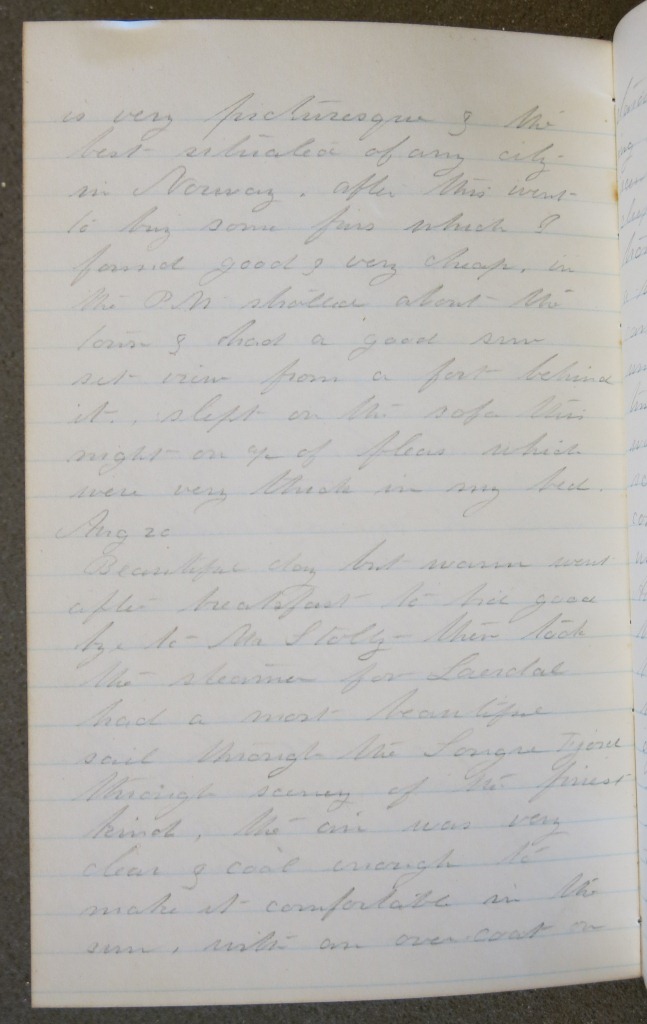
Because of his usually reserved writing, when he writes in great detail I knew he was writing of something special. On 20 August 1872, Edwin is on a steamer sailing through the Sognefjord, which he noted had “scenery of the finest kind.” He decided to spend the night sleeping on the deck: “We made a landing which woke me up; we were among scenery of the grandest – snow covered mountains just above us; from here we ran to Andal down a fjord where the rocks rose some two and three thousand feet right out of the water. Coming back through the same branch of the fjord, we entered another leading to Gudvangen more beautiful than the other with many beautiful waterfalls coming down from the rocks above more small villages…” Having been on a very similar ferry ride through the same fjord, I can completely understand his awe at the beauty surrounding him.

Edwin’s journal goes on to detail his travels around Norway and then into Sweden, and abruptly ends upon his entry into Germany. His last full entry is dated 2 September 1872 and while the next page holds the date 3 September, nothing else is written. I’d like to imagine that Edwin, like so many other travelers (myself included), was so caught up in his travels that he had no time to jot down his memories. If you are interested in reading travel diaries from faraway places, be sure to check out ABIGAIL to discover our collections here at MHS!


The Stamp Act and Liberating Knowledge

By Amanda M. Norton, Adams Papers

This August marks the 250th anniversary of the publication of the first part John Adams’s “A Dissertation on the Canon and Feudal Law.” This rather arcane title can obscure the profound message that his essay brought to that colonial resistance to the Stamp Act that had been imposed on the colonies in the spring of 1765 by the British Parliament. In this four-part series published in the Boston Gazette from August to October 1765 in the flush of opposition to this new tax, Adams attacked the Stamp Act from a different angle than simply opposition to “taxation without representation.” It was not merely the fact of a tax, but what Britain taxed: “it seems very manifest from the [Stamp Act] itself, that a design is form’d to strip us in a great measure of the means of knowledge, by loading the Press, the Colleges, and even an Almanack and a News-Paper, with restraints and duties.”

Adams, ever the lawyer, looked back over history and examined the two major legal systems that had ruled much of Europe up to the modern age—the canon law, the law of the Roman Catholic Church, and the feudal law, the law of medieval governments. In both of these legal systems, Adams saw a systematic attempt to keep knowledge from the people. In the first part of his essay, he explained how “the great” worked “to wrest from the populace, as they are contemptuously called, the knowledge of their rights and wrongs, and the power to assert the former or redress the latter. I say RIGHTS, for such they have, undoubtedly, antecedent to all earthly government—Rights that cannot be repealed or restrained by human laws—Rights derived from the great legislator of the universe.” In England, an alliance between these two systems had formed and it “was this great struggle, that peopled America. It was not religion alone, as is commonly supposed; but it was a love of universal Liberty, and an hatred, a dread, an horror of the infernal confederacy, before described, that projected, conducted, and accomplished the settlement of America.”

In the final installment of his essay, Adams’s rhetoric soars as he calls for Americans to look into and stand up for their rights. They should use this moment when the British attempted to subjugate America and oppose their efforts through education. “Let us tenderly and kindly cherish, therefore the means of knowledge. Let us dare to read, think, speak and write. Let every order and degree among the people rouse their attention and animate their resolution. Let them all become attentive to the grounds and principles of government, ecclesiastical and civil.” And Adams argued that just as the reigns of James I and Charles I produced some of the greatest British statesmen, “The prospect, now before us, in America, ought in the same manner to engage the attention of every man of learning to matters of power and of right, that we may be neither led nor driven blindfolded to irretrievable destruction.”

John Adams’s continued commitment to education as an essential component in a free society was evident in his draft of the Massachusetts Constitution of 1780, which included a chapter specifically calling for “The Encouragement of Literature” within the commonwealth.

If you want to learn more about the Stamp Act and the coming of the Revolution in Boston, a couple weeks are remaining to view the MHS exhibit, God Save the People! From the Stamp Act to Bunker Hill.


This Week @ MHS

By Dan Hinchen

Summer is speeding along and we enter a new month. Here is what is on tap at the Society in the first week of August.

On Wednesday, 5 August, we have a Brown Bag lunch talk taking place at noon. “African Americans and the Cultural Work of Freemasonry: From Revolution Through Reconstruction” is presented by research fellow Sueanna Smith of the University of South Carolina. This talk is free and open to the public. Pack a lunch and come on by.

Also on Wednesday, beginning at 6:00PM, is a public author talk. This talk features journalist James Schlett presenting his new book, A Not Too Greatly Changed Eden: The Story of the Philosophers’ Camp in the Adirondacks. Registration is required for this event at no cost, please RSVP. There will be a pre-talk reception at 5:30PM. 

And on Saturday, 8 August, there is a free tour of the Society beginning at 10:00PM. The History and Collections of the MHS is a 90-minute, docent-led tour through the buildings public spaces which touches on the history, art, architecture, and collections of the MHS. No reservation needed for individuals or small groups. Parties of 8 or more should contact Curator of Art Anne Bentley in advance at 617-646-0508 or abentley@masshist.org

Porcineographs and Piggeries: William Baker Emerson and Ridge Hill Farms

By Dan Hinchen

Occasionally, when going through the stacks here at the MHS, something that you are not looking for catches your eye and makes you stop and take a look. Sometimes, you just take a quick look and then go back to what you were doing. Other times, though, the item piques your interest and prompts you to start doing a little bit of digging, even if only to fill up a blog post. Conveniently enough, just such a scenario played itself out for me this week.

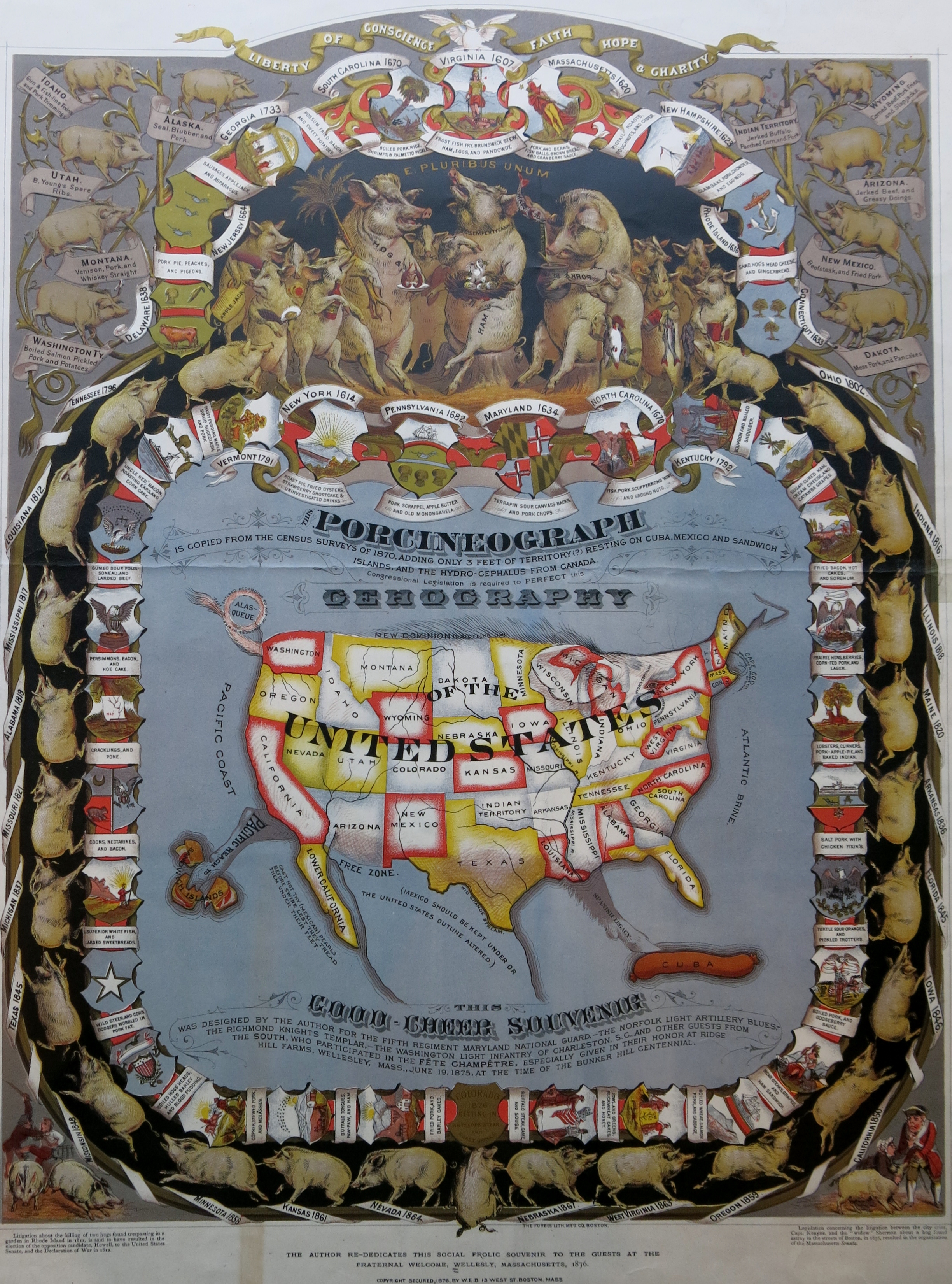
While going through some of the Society’s broadsides the other day, looking for an item requested by a researcher, I saw a large broadside folder with the word “Porcineograph” written on it. Curious, I opened the folder and found a fairly beautiful, 19th century map of the United States made to look like….a pig. Bordering the pig-map were crests for each state of the Union accompanied by local cuisine involving pork products. I immediately scanned for Illinois – my home state – to see what was usual back in 1877 and was not disappointed: “Prairie hens, berries, corn-fed pork, and lager.” That sounds like a nice and balanced meal to me!

I made a mental note to take another look at this broadside and then looked it up in our online catalog, ABIGAIL, to see what little I could find out about it there. And here’s what I found!

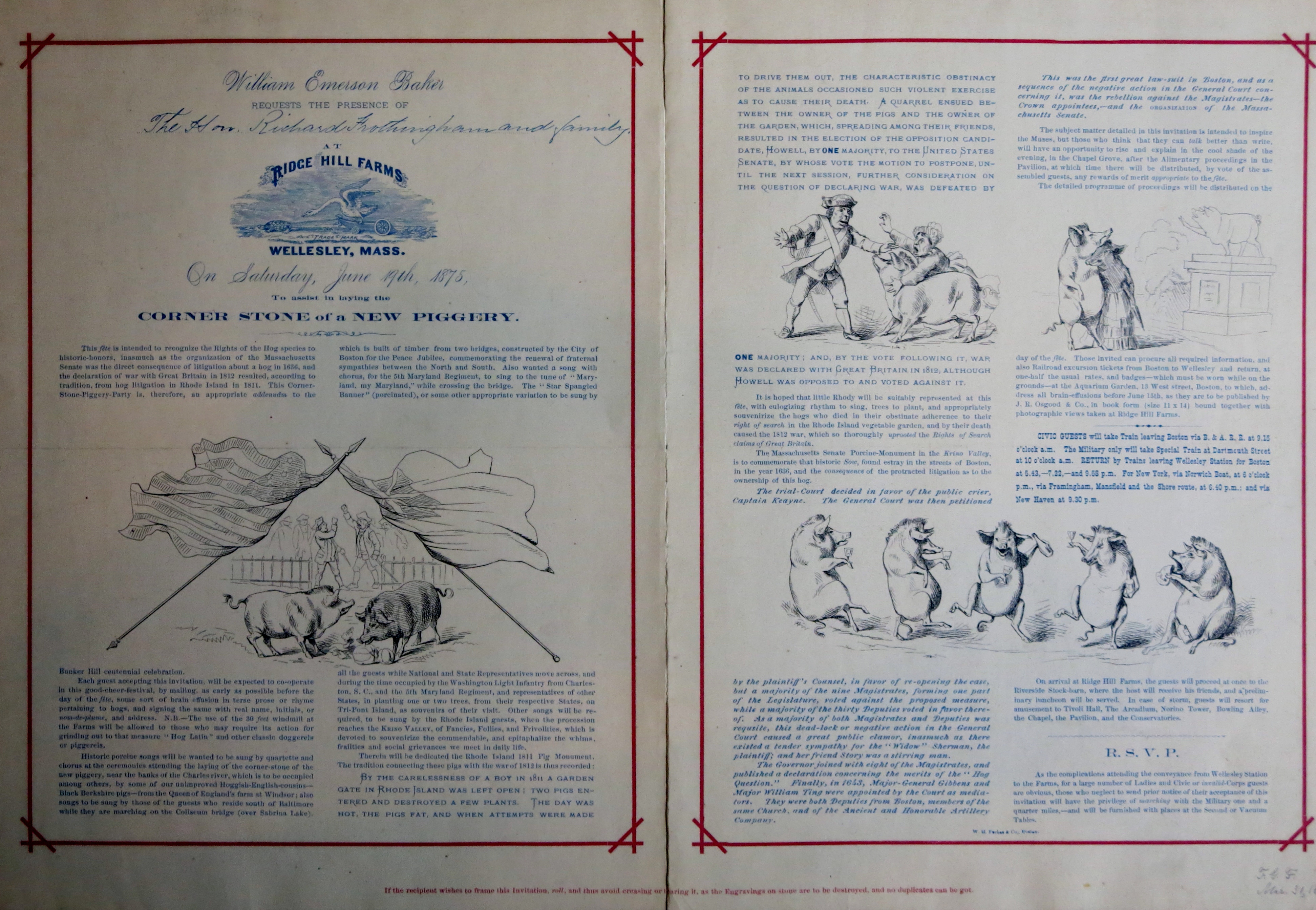
In looking at the catalog record for the Porcineograph, I found that it was created by a man named William Emerson Baker and was meant as a souvenir for guests at his estate, Ridge Hill Farm, where the invitees were to have a dual celebration: commemorating the centennial of the Battle of Bunker Hill, and the establishment of a new “Sanitary Piggery” on his farm. Using the subjected headings in the catalog record I was able to find the subject term Swine—Massachusetts in our catalog and thus identified two copies of invitations to the event.

Through a little bit of investigation online, I found that Baker, a man who made a fortune in the mid-19th century making sewing machines and retired at the age of 40, bought up several adjacent farms in the town of Needham, Mass., and established an 800-acre estate called Ridge Hill Farm. The farm featured things like a man-made lake, bear pits for exotic animals, extensive gardens, and a 200+-room luxury hotel.

While somewhat eccentric and seemingly frivolous, Baker’s idea of a sanitary piggery was a bit revolutionary in that he recognized the potential links between poor care of livestock, low-quality foodstuffs, and public health. He believed that by taking better care of livestock, the food which they were used to produce would improve, and thus, public health would also improve. I find this interesting considering this was a good 25-30 years before the publication of Upton Sinclair’s The Jungle.

Unfortunately, after Baker’s death in 1889, the estate did not last much longer. The hotel succumbed to fire, the land was subdivided, and the ornate pillars and statues crumbled. However, as evidence of what once was, we have in our collections here a published Guide to the Ridge Hill Farms, detailing all of the wonders that existed there in its heyday.

If you are interested in reading more about this man and his estate, check out the articles I found online (linked below) and which provided some of the information in this post. And, as always, come on in to the MHS library to see the items from our collections up-close!

________


–          H.D.S. Greenway, “A Lost Estate,” Boston Globe, April 8, 2010. Accessed 7/31/2015 at www.boston.com/yourtown/needham/articles/2010/04/08/little_remains_of_19th_century_eccentrics _wondrous_estate_in_needham/

–          Rebecca Onion, “An Eccentric Millionaire’s 1875 Pork Map of the United States,” Slate. Accessed 7/31/2015 at www.slate.com/blogs/the_vault/2014/01/31/pork_map_william_emerson_baker_s_porcinegraph _of_the_united_states.html [Includes image that can be blown-up.] 

–          “Once Upon a Time at the Baker Estate,” Gloria Greis, Needham Historical Society. Accessed 7/31/2015 at needhamhistory.org/features/articles/baker-estate


He Said, She Said

By Susan Martin, Collection Services

The Hall-Baury-Jansen family papers at the MHS include ten small diaries kept in Pine Bush, N.Y. between 1858 and 1878. Most of them belonged to a young farmer named John Egbert Jansen, but three were written in another, unidentified hand. By checking the diaries against each other, I was able to confirm that the second diarist was John’s wife, Margaret A. (Wisner) Jansen.

John and Margaret weren’t married until 1862, but both kept diaries in 1858 and 1859, during their courtship. A side-by-side comparison of these two years makes for some fun reading. Both John and Margaret wrote in their diaries every day, and while the entries are short, repetitive, and often dry, taken as a whole, they give us a glimpse into the couple’s relationship as it develops. And it’s hard to resist speculating on what some of the more elusive entries mean.

At the beginning of 1858, Margaret was a lonely young woman of 17. She disliked the days she spent at home alone and was disappointed when she received no letters or visits. Some of her early diary entries are forlorn: “I do wonder if any body likes me.” Her first reference to John comes on 21 January 1858: “To tea with J.E. Nice visit.” His entry for that date doesn’t mention her, but that was apparently the day he decided to “quit chewing tobacco.” (Coincidence? Hmm.) A week later, Margaret wrote that John “called for a singing book.” The corresponding entry in John’s diary discusses other matters before noting that he “made a call.” This circumspect little phrase was almost invariably the way he described his visits to Margaret.

The relationship of the young couple was moving along, and when he visited, she often had “a real funny time,” while he enjoyed himself “very much” or “finely.” He even helped with chores around her house. It’s possible that Margaret and John had known each other for years, if not their whole lives, considering how small the town of Pine Bush was. The Wisners and the Jansens ran in the same social circles and attended the same church and many of the same events. These included singing school, bible class, lectures, and parties. On 15 March 1858, Margaret attended a party at the home of John’s aunt and stayed until the wee hours of the morning. Her entry for that date reads: “Went to a party to Mrs. Jane Jansens. Had a splendid time. Saw ___. Came home about four A.M.” He wrote more succinctly that he “staid all night.”

John began calling at Margaret’s house more frequently, often multiple times a week. She now expected his visits and  made a note in her diary when he didn’t come. But of course their relationship, like all others, had its rocky patches. Margaret sometimes doubted that her feelings were reciprocated. Once she complained: “I think I may easily say I am thinking of those who think not of me & perhaps care not for me. I have one in my mind.” Other days, she was more dreamy and sanguine and “had some very pleasant thoughts.” One wistful entry just trails off: “Freligh Lyon called. I wish – ” And she still had those downcast days: “Did various little things. Took a little walk in the evening. Here on the rock I post this thinking, looking, all alone.”

If only she could have read John’s diaries! While he was more subdued in expression and less confessional in tone, he definitely thought she was “pleasant” and “agreeable.” He wrote happily about joining her and her friends on fishing trips and picnics. He still referred to her coyly as “a companion” or just by initials or a blank line, but we can use her diary to confirm that he did, in fact, mean her. And she might have been interested to know how disappointed he was the day she didn’t attend church and he felt “some what forgotten.” The end of the year made him philosophical: “Where will I be next year this time? I would like to know. I do not know! Do you?”

At the beginning of 1859, there was trouble in paradise, and the two different perspectives sometimes present a startling contrast. John thought his 1 Mar. 1859 visit to Margaret was “pleasant,” but she wrote: “J.E. called. Was much out of humor.” (I don’t know if she meant John or herself.) On another visit, she thought he was “very anxious to get away. Can’t say why.” He described some of the calls he made to her that spring as “miserable,” even “disgusting.” Neither wrote explicitly about their problems, but Margaret did confess that “one will get provoked occasionally.”

Whatever their differences, the couple rode them out, and their diaries contain many endearing, if terse, references to each other. She wished his visits lasted longer: “Johnie called, one minute. Always in a hurry.” For that matter, so did he: “Made a call. Sorry could not stay. Sorry to leave indeed.” He began to call her “Maggie” near the end of 1859, and her lonely days seemed to be a thing of the past. Her diary entry for 6 August 1859 reads, in part: “This is a good world but some mighty quear people in it.” Along the side of the page, she added, apparently later: “Some very nice good ones too.”

Reading John and Margaret’s diaries side-by-side also paints a picture of a typical man and woman of the time. While she spent days cleaning, sewing, and doing other housework, he was working on his farm, haying, logging, etc. It’s a rare treat to see two lives lined up so perfectly, each diary fleshing out and enriching the other to create a fuller picture…not to mention giving us a little peek at what these two young people really thought of each other!


An American Woman in Egypt, 1914-1915: Wadi Halfa to Asswan

By Anna J. Clutterbuck-Cook, Reader Services

Today we rejoin our anonymous female diarist as she journeys down the Nile in the winter of 1914-1915. You can read previous installments of this series here (introduction), here (Cairo to Aysut), here (Aysut to Asswan) and here (Asswan to Abu Simbel).

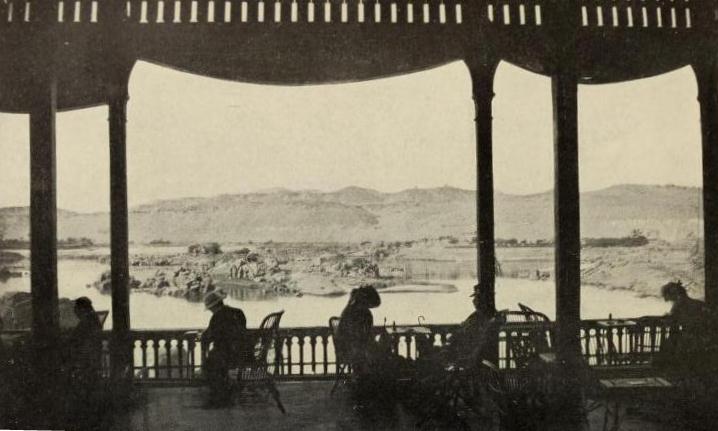
Image: “The Oriental Lounge of the Cataract Hotel at Assuan,” from Douglas Sladen, Queer Things About Egypt (1910)


In today’s entries, our diarist tours various sites on the border of Egypt and Sudan, in an area today bordering (and in some cases subsumed by) the Lake Nasser/Lake Nubia reservoir. In one case, visiting the Temple Kalabsha, she would have seen the temple in its original location nearly half a century before it was moved to accommodate the rising waters of the lake as the Aswan Dam was constructed (between 1958-1971).

On December 15th our narrator departs the steamer on which she has been traveling and takes the train north to Asswan once more, where she checks into the Cataract Hotel at which she will spend her Christmas holidays. These entries continue to illustrate how, as an American tourist, she experienced the country through which she traveled, and the people she encountered there.


Dec. 11. A.M. wrote post cards & at lunch we arrived at Wadi Halfa. Went on shore after lunch & walked around, then went up to train and saw people off for Khartoum. Went to P.O. for stamps. After tea went ashore again with dragoman & walked through [illegible phrase]. Saw Nubian village & then Sudanese on the desert.

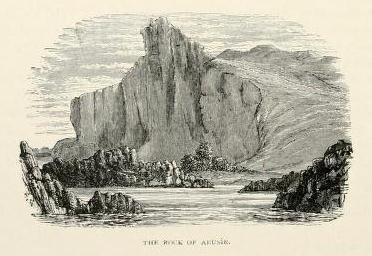
Dec. 12. Had early breakfast & left in small boat at 8:30. Miss M. did not go. Were rowed across first to shore & then towed along for about an hour’s ride. Then landed & got onto donkeys & rode over the desert to the rock of Abu Seer, 1 ½ hours. Went up on rocks & saw two [illegible word] shoot the rapids. Rode back to river bank & had lunch in a little hut there. Then visited Temple of [illegible phrase] took boats again & were rowed back to our steamer in time for tea. After it wrote a letter. Fine full moon.

Image: “The Rock of Abusir” from Amelia B. Edwards, A Thousand Miles Up the Nile (1890)


Dec. 13. Had early breakfast & at 8:30 went ashore in row boats to see rock temple of Sebel Addeli 4 papyrus columns with bud capitals — used as a Christian church. Soon after leaving this we passed Abu Simbel again. Wrote till noon time. Sailed along all the afternoon.

Dec. 14. Reached Kalabsha just at breakfast & immediately after went ashore — a large group of [visitors?] – went to rock temple of Beit-El Wali, a vestibule [illegible phrase]. Only side walls of vestibule standing, interesting historical reliefs. Some coloring in the hall & sanctuary. Then went back to river, took boats & rowed into temple of Kalabsha, which is partly submerged — never finished — has [illegible phrase] rooms — 1st vestibule has [illegible word] columns with floral capitals, the roof is gone. The other 3 rooms have walls, preserved reliefs with vivid coloring. Arrived at Shellal at noon. Most of people took 3pm train to Asswan. After they had gone Miss M., Miss Gillender & I had a boat & went around to Philae & back for tea & stayed on boat overnight.

Dec. 15. Left Prince Abbas* after an early breakfast at 7.30 & took 8.30 train to Asswan going to Cataract Hotel to get room. Then walked round to steamer “Arabia” and made a call on the Phelps’, stepping into Cook’s on the way. After lunch lay down & slept, then  sat on my balcony & watched sunset then went down & wrote till dinner. Talked with two English ladies in evening.

In our next installment, we’ll see how our diarist’s routines change (as well as stay the same) once she is no longer traveling daily from place to place but instead residing in a fixed location with a revolving cast of European guests.

*The first mention of it in this diary, I believe Prince Abbas may be the name of the boat our diarist had been staying on.

This Week @ MHS

By Dan Hinchen

Once again this week, the MHS hosts another three-day teacher workshop. “Maritime Massachusetts: Salem Stories and Sources” takes place in Salem, Mass. starting Monday, 20 July, and continuing through Wednesday, 22 July. The program is open to all educators and history enthusiasts with a fee of $35.To Register / For more information: complete this registration form, or contact the education department at education@masshist.org or 617-646-0557.
And on Saturday, 25 July, there is another tour of the Society. Stop by at 10:00AM for “The History and Collections of the MHS.” This free tour is open to the public with no need for reservations for individuals or small groups. Parties of 8 or more should contact Curator of Art Anne Bentley in advance at 617-646-0508 or abentley@masshist.org

This Week @ MHS

By Dan Hinchen

It is all about the teachers this week at the Society as we host another three-day teacher workshop, starting on Tuesday, 14 July. This time around, participants have the opportunity to get acquainted with John and Abigail Adams in “John & Abigail: A Life in Letters.” For more information: contact the education department at education@masshist.orgor 617-646-0557. To register: visit The Education Cooperative website: http://www.tec-coop.org/sites/default/files/PD-Sum15-AbigailandJohn.pdf

Also, on Saturday, 18 July, join us for a tour of the Society. “The History and Collections of the MHS” is an opportunity for visitors to get an informational look at the art, architecture, collections, and history of the MHS. Free and open to the public, the tour is docent-led and lasts about 90 minutes. No need for individuals or small groups to make reservations. However, parties of 8 or more should contact the Curator of Art, Anne Bentley, at 617-646-0508 or abentley@masshist.org

MHS Staff Meet with Librarians from Uzbekistan

By Nancy Heywood, Collection Services

Although there are many miles between Boston, Massachusetts and Tashkent, Uzbekistan (6,148 miles according to Google) and although the English language is quite different from the Uzbek language, librarians from the National Library of Uzbekistan and staff of the Massachusetts Historical Society found much common ground and camaraderie during a recent meeting at MHS. 

The scheduling logistics for the group – comprised of the Director, Deputy Director, Head, Reading Halls Lead Specialist, and Head of IT and Access to Foreign Library Collections – were handled by WorldBoston. The focus of the meeting and tour, which took place on 5 June, was on how the MHS makes special collections materials available to researchers both remotely and on-site.  During the visit, with the aid of two highly skilled interpreters, we were able to convey information about cataloging, archival storage, and collections management issues.

Following Librarian Elaine Heavey’s  brief introduction to the MHS’s history and collections, Digital Projects Coordinator Nancy Heywood and Web Developer Bill Beck showed some examples of how we make selections of our collections available online. The MHS website features a few different types of digital presentations—some sections of the website present sets of materials comprised of relatively small numbers of items with lots of contextual information and transcriptions, but other sections of the website present large sets of documents and/or fully digitized collection with minimal descriptive information and usually without transcriptions.

Elaine Heavey then conveyed information about how researchers use online catalogs and collection guides to prepare for their research visit and she demonstrated Portal1791, our new researcher request system.  The group toured the building and saw the spaces that researchers use (orientation room, reading room, catalog room) as well as some staff areas including the conservation lab and one of the larger stack floors.  They also saw a few highlights from the collections.