This Week @ MHS

By Dan Hinchen

The Society is closed on Monday, 20 April, in observance of Patriot’s Day. Good luck to the marathon runners!

On Tuesday, 21 April, there are three events taking place that all focus on comics and history. First, beginning at 2:00PM, is “Comic History: Making Your Own Comic History.” This Family Day program for young historians, parents, and grandparents features historian John L. Bell telling the story of the riots that followed the passage of the Stamp Act in 1765 from a child’s point of view. Follwoing the talk, local comic book artists will help the young historians create their own historical comics. Finished products will be part of a temporary display. Registration is required at no cost; please RSVP

Then, at 6:00PM, join us for “Colonial Comics.” Editor Jason Rodriguez, Fulcrum Publishing, will speak about the process of putting together a collection of twenty stories focusing on the colonial period from 1620 to 1750. Registration is required at no cost; please RSVP. A reception will precede the talk starting at 5:30PM. Following the event, at 7:30PM, MHS Associate Members (age 40 and under) are invited to join Mr. Rodriguez for Colonial Comics Happy Hour, a chance to continue the discussion about historical events as subject matter for comic books and graphic novels. The event will take place at a nearby restaurant. Registration required at no cost. Please call 617-646-0543 for more information. 

On Thursday, 23 April, join us for a History of Women and Gender seminar discussion. “Mildred Jefferson and the Right to Life Revolution of 1976” is presented by Jennifer Donnally of Hollins University with Sara L. Dubow, Williams College, providing comment. Seminars are free and open to the public; RSVP requiredSubscribe to receive advance copies of the seminar papers. 

Finally, on Saturday, 25 April, there is a special event taking place at the Society starting at 9:00AM. “Massachusetts History Lab” is a program designed for students in grades 5-8 to learn more about the behind-the-scenes activities at one of the country’s oldest organizations devoted to our nation’s history. Registration is required at no cost; please RSVP. Students must register with an adult chaperone. For more information, contact the Education department at education@masshist.org or 617-646-0557. 

Untangling North Atlantic Fishing, 1764-1910, Part 3: The Reciprocity Treaty of 1854

By Andrea Cronin, Reader Services

As discussed in a prior post, Great Britain and the United States negotiated fishing rights throughout the early 19th century. One of the important agreements made between the British North American colonies and the United States regarding trade, tariffs, and fishing was the Reciprocity Treaty of 1854. Under this agreement, negotiated by British North American Governor General Lord James Bruce Elgin and Secretary of State William L. Marcy, the provinces offered the right to coastal and inshore fisheries and the use of the St. Lawrence River to the United States. In exchange, the United States established free trade with the provinces by removing tariffs from natural products including grain, meats, produce, coal, timber, and lumber.

Reciprocity, by definition, is the exchange of privileges with others for mutual benefit. Free trade meant that the United States’ markets faced an exponential flood of British North American products without any protective tariffs to secure the national, regional, and local markets. Additionally, many Americans did not view the treaty favorably because the rights to coastal fishing in Canada had previously been theirs in the Treaty of Paris in 1783. While the American agricultural markets faced market saturation, the Reciprocity Treaty favored New England and New York fishing industries due to Secretary of State William L. Marcy’s negotiations. Born in Southbridge, Mass., and residing in Albany, New York, Americans accused Marcy of sectionalism, referring to the Reciprocity Treaty contemptuously as “Mr. Marcy’s treaty.”

An author using the nom de plume “Middle State Farmer” raised several objections to the agreement in his pamphlet The Agriculture Interest in 1854:

But we have thrown our markets as wide open as though these British provinces were States of this Union – markets which they will seek to sell in, receiving only in payment our precious metals, or exchange on England, to pay for the goods they buy of her. Everything they can grow on soil, produce from their forests or their mines, we shall have to take on these terms.

What do they give us in return besides their river to navigate, which they can’t navigate much themselves – being frozen tight six months in the year, and a hazardous navigation the other six – and a right to catch fish where we had always caught them before? What real reciprocity can they offer us in the way of markets?

The reciprocity agreement met increasing disapproval over the following decade. American protectionism, exemplified here in the Middle State Farmer’s argument, led to the abrogation of the treaty by the United States in 1866.


An American Woman in Egypt, 1914-1915: Aysut to Asswan

By Anna J. Clutterbuck-Cook, Reader Services

Image: Watercolor from A Nile Journal by Emily Horby (1908)


In the previous installment of An American Woman in Egypt, we left our narrator journeying south from Aysut by steamer. During the first week of December, the travelers continue down the Nile stopping at a number of archeological sites and luxury tourist resorts along the way. In this post, I have interleaved our anonymous diarist’s narrative with excerpts from a contemporary travel guide and published memoir describing the same locations.

Dec. 1. Had early breakfast, reached Denderah & went ashore there at 8.30. Took donkies [sic] & rode to Denderah Temple in 2 hours. Temple of Hathor.  Great vestibule of Pharaohs 24 columns with heads of Hathor. Went up on the roof for view. Got back for lunch. Just at tea time reached Luxor. Miss Goeller & we two went ashore with Dr. Hodson who took us over the Winter Palace Hotel & gardens. Then we walked out to Luxor temple & looked at ships.

Dec. 2. Started on donkies at 9.30 & rode to Karnak. Very hot day. Saw temple of Kurnah then rode dromedaries little way to temple of Ammon. Finally went on top for view and got home just before one p.m. Very warm & slept after lunch; had tea at 4 & then went out to see Luxor temple. A beautiful sunset & we stayed behind to see the color on the water then went to Winter Palace & P.O.

 A short distance from the river, on the west bank, a little to the north of the village of Denderah, stands the Temple of Denderah, which marks the site of the classical Tentyra or Tentyris … where the goddess Hathor was worshipped. … The wonderfully preserved Temple now standing there is probably not older than the beginning of our era; …hence it must be considered as the architectural product of a time when the ancient Egyptian traditions of sculpture were already dead and nearly forgotten. It is, however, a majestic monument worthy of careful examination.
The Nile: Notes for Travellers in Egypt, 9th edition (London: Thos. Cook & Son, 1905).

Dec. 3. Breakfast at 7.30, left at 8.30 & sailed across to W. bank where we took donkies & road to mortuary chapel of Sethos I. Then rode on to tombs of Kings & reached 4 — Ramses IX – Ramses VI – Sethor I – Amenophis II – then walked up over hill for view & down to rest-house for lunch. At 2 walked to temple of Darr El-Bahre of Queen Hatsh[epsut]. Then rode back to river & took boats home in time for tea. After it went to buy cards.

Dec. 4 – Early breakfast at 7.30. Left at 8 & rode first to ruins of Rames great temple of Ramses Srenk II, then road to temples of Derr-El-Medenah, judgement halls of Osiris, & temple of Ramses III. … finest in Egypt. Passed Colosses of Memmon (Amenophsis III) on way back to boat. Got back to steamer just for lunch. P.M. took pad[dle] on Nile for 1 hr with Miss Phelps & Miss Marell, mailed my Christmas cards after tea went to Hotel [illegible phrase] walked along shore to see sunset, then went into shops.

Came to a lovely grove of palm trees, where we lunched. Donkeys arrived…and we had a very pleasant ride on to Karnak, a good way further. Pigeons flying in clouds over fields. Must be very destructive, but picturesque. Soon the obelisk was seen in the distance, and at last we came to the avenue of the sphinxes, which has only been lately thoroughly uncovered. Enormous creatures, each with a little figure on their knees.
A Nile Journal by E. H. [Emily Hornby] (Liverpool: J.A. Thompson, 1908)

Dec. 5. Sailed very early from Luxor & about 10 arrived at Esna after going thro’ a lock. Walked to the temple, as it was very near. Temple of Khnum goat-headed local deity. Pronave 24 columns in 6 rows with different floral capitals – similar to  of temple Hathor at Denderah. From there sailed on & reached Edfou about 3, took donkeys & some walked to the temple of Horus, best preserved ancient temple in the world. A great [?] & we went to top up a dark stairway for view 242 steps. Crest surrounded on 3 sides by colonnade of 32 columns in the different floral (^ & palm) capitals [illegible phrase] wall also decorated. In evening we had a lecture on the Nile by the doctor. Got back from temple for tea.

Side-by-side it is possible to see how the genre of travel writing, published and unpublished, often contains strikingly similar observations, despite differences in tone (the Cook’s authoritative, the Hornby self-consciously poetic in her descriptions). It is likely that our diarist would have read one or more commercially-published travel guide before or during her tour, and it is clear that Dr. Hodson, mentioned in the December 5 entry above, mediates her interpretation of the archeological sites the group encounters. 

In two weeks we will continue our journey down the Nile. In the meantime, I encourage you to explore the lavish watercolor illustrations and personable narration of Emily Hornby’s Nile Journal at Internet Archive.

“The Long Agony Is Over”: The Trial of John White Webster

By Susan Martin, Collection Services

With all the coverage of the Tsarnaev trial here in Boston, I’m reminded of another case that rocked the city 165 years ago: the murder of George Parkman in Nov. 1849. Harvard Medical College lecturer John White Webster, who owed Parkman a significant sum of money, was accused of killing him and attempting to destroy his body by burning it in a furnace. Webster was convicted on 30 Mar. 1850 and sentenced to execution by hanging. The gruesome nature of the crime and the high social standing of both men meant that not just all of Boston, but the entire country, was riveted.

The story has been covered so well and so thoroughly by others that I won’t go into the details of the case, but I was curious about contemporary reactions to the crime and the trial. Manuscript collections at the MHS give us a nice cross-section of opinions. For example, the day after the verdict came down, a young woman named Harriet Hayward wrote in her diary:

Has been a dismal day. Poor Dr Webster is pronounced guilty; the verdict was brought in last night, and we heard of it this morning. I have felt fairly sick today, and totally unfit to take charge of a class at Sunday school. What a barbarous and wicked law! A man taken from his wife and children to be put in prison for a short time, and afterwards hung [sic], while the family is made wretched. When a poor man is once fairly shut up in prison, and not able to say a word for himself, all kinds of stories are circulated about him, that have no foundation. If I were a person of some importance and could say or do any thing to save his life I would do it, but I feel my own insignificance now more than ever. I hope mercy will be shown him in another world.

It’s unclear to me what Hayward thought of Webster’s guilt or innocence, but she certainly objected to the sentence of death, and her reaction was not atypical. Letters started pouring into Massachusetts Governor George N. Briggs’ office from all over the country petitioning for clemency for Webster. Some argued he was innocent, that he had not received a fair trial, or that the evidence against him was circumstantial. (One anonymous letter claims Webster couldn’t possibly have committed the crime because the writer did it himself!) Others accepted his guilt but opposed capital punishment on religious or moral grounds. Many called the murder unpremeditated and believed Webster was sincerely penitent.

The prosecutor in the case, John H. Clifford, was exhausted after the trial. He wrote in a letter on 2 Apr. 1850, “The long agony is over, and I am once more by my own hearth stone, trying to restore the equilibrium which two weeks straining of my entire being has deranged & disturbed. […] I cannot help feeling this trial to have been a great crisis in my life.” He called Webster “almost soulless” and was satisfied with the outcome, but pitied the man’s family.

Webster’s wife Harriet and their four daughters steadfastly maintained his innocence and banished any who doubted it from their Cambridge home, but some extended family members were unconvinced. Harriet’s sister Amelia (Hickling) Chambers Nye had no trouble believing Webster guilty. In letters written between June 1850 and Feb. 1851, Nye made her case against her brother-in-law. In fact, she had suspected him all along:

Is it not strange that when Eliza and I saw the first advertisement about Dr. P’s disappearance and Dr. Webster being the last person who saw him the thought struck us both that he knew more of his disappearance. The same thing struck both sister Prescott and Susan and Emma so that every one who knew him best, suspected him first. On the Wednesday before Thanksgiving he went to Mrs. Cunningham’s to a party, a lady said to him so Dr. you were the last person who saw Dr. Parkman what if you should be suspected. He immediately replied, “what do you think I look like a murderer?” and went on talking about something else.

In her long, somewhat rambling letters, Nye described the Websters’ financial problems, her brother-in-law’s “bad qualities,” and other heinous crimes she believed he’d committed years before. She thought Harriet and the children were deluded. Since they refused to read the papers, they were unaware that “one half the people in Boston believe it was a premeditated act.” Much of what Nye wrote was hearsay and rumor, but her animosity toward Webster is unmistakable. His penitence was feigned, she claimed. His family would be better off without him, and even execution would be preferable to the shame of life imprisonment, a fate she described as “a living death to all of them.”

After his conviction, John White Webster confessed to killing George Parkman in a fit of rage over the debt. He also wrote to Francis Parkman, George’s brother, asking for forgiveness. Gov. Briggs, however, did not commute his sentence, and Webster was hanged on 30 Aug. 1850. Boston merchant Frederic Cunningham read a description of the execution in the newspaper and wrote about it in his diary, commending Webster’s self-possession: “He walked firmly to the scaffold & fell 8 feet.” According to Cunningham, the people of Boston were “better disposed towards him” after his death.

Though opinions were sharply divided, the case held an undeniable fascination. Three weeks after the trial, in spite of her horror at the verdict, young Harriet Hayward and some friends visited the Harvard Medical College laboratory where the crime had taken place. Amelia Nye’s friend Miss Jennison told her that “she never saw so many carriages in Cambridge before. They rode round the square purposely to look at the [Websters’] house.” As for Nye, she wrote of John White Webster, “I cannot help shuddering when I think of him.”


Selections from MHS in the New “Remembering Lincoln” Digital Collection

By Nancy Heywood, Collection Services

On 14 April 1865, while attending a play at Ford’s Theatre in Washington, D.C., President Abraham Lincoln was shot by John Wilkes Booth.  The event was tragic and shocking. Lincoln died the next morning, 15 April, and people all over the country struggled to comprehend what had happened.

Ford’s Theatre, a National Historic Site and a working theatre, has recently launched a new digital collection, Remembering Lincoln.  Two dozen institutions, including the Massachusetts Historical Society, have contributed digital images, metadata, and transcriptions of materials about the assassination of President Lincoln to this online collection. Researchers can read first-person accounts of the startling event, examine newspaper articles, explore printed documents and broadsides, and look at artifacts.

Several remarkable manuscripts from the collections of the MHS are included in the Remembering Lincoln collection.  Two letters were written by Augustus Clark, a War Department employee, who was one of the men who moved Lincoln after he was shot from Ford’s Theatre to Petersen’s boarding house.  One of Clark’s letters (addressed to S. M. Allen) fully describes his impressions of the evening and the tragic event.  In the other letter, written to Massachusetts Governor John A.  Andrew, Clark mentions enclosing a piece of cloth with Lincoln’s blood with the correspondence.  Both letters (letter to S. M. Allen and letter to Gov. Andrew) and also the towel fragment are viewable on the website. 

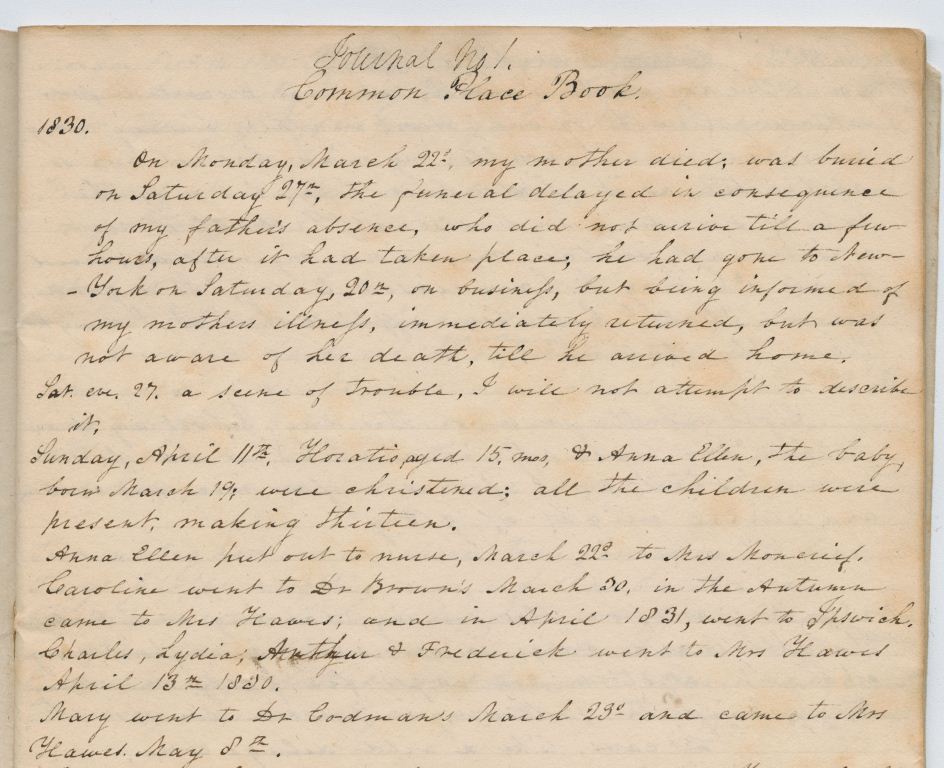
Another item featured in the digital collection is an excerpt from the young Boston diarist, Sarah Gooll Putnam.  Only 14 years old in April of 1865, her reaction was poignant.  She drew a shocked face on her diary page along with the following words:   

Now guess my feelings, when coming down to breakfast, at mother’s saying “The president is killed!” I stared so [handwritten mark pointing to illustration] for a few minutes without speaking. I cannot realize it yet.  Poor, dear, old, Abe.

Please explore the whole Remembering Lincoln website:  http://rememberinglincoln.fords.org/


A browse display of the items that MHS contributed to Remembering Lincoln is also available:  http://rememberinglincoln.fords.org/contributor?uid=40


This Week @ MHS

By Dan Hinchen

On Tuesday, 14 April, there is an Environmental History seminar taking place at 5:15PM. Join us as Joel Tarr of Carnegie Mellon University presents “Legacy Pollution Issues in Energy Development: The Cases of Manufactured Gas and Natural Gas.” Patrick Malong, Brown University, provides comment. Seminars are free and open to the public, though RSVP is required. You can also subscribe to receive advance copies of the seminar papers. 

And on Wednesday, 15 April, there is a Brown Bag talk, starting at noon, in which Mary Draper of the University of Virginia presents “The Urban World of the Early Modern British Caribbean.” Draper’s project examines the history fo the early modern British Caribbean through its cities and urban residents. This event is free and open to the public. 

Also on Wednesday is the fourth installment of the Lincoln & the Legacy of Conflict series which features John Stauffer, Professor of English and African American Studies at Harvard University. “Mourning Lincoln & Racial Equality” explores the responses of Frederick Douglass and other black and white abolitionists to Lincoln’s assassination and the degree to which it prompted Northerners to consider and accept full black citizenship. Registration is required for this event with a fee of $20 (no charge for Fellows and Members). Please RSVP. There will be a short reception beginning at 5:30PM with the program beginning at 6:00PM. 

Finally, on Saturday, 18 April, stop by the Society for a free tour. The History and Collections of the MHS is a 90-minute docent-led tour that explores all of the public spaces in the Society’s building on Boylston Street, touching on the history, art, architecture, and collections of the MHS. The tour begins at 10:00AM and is open to the public with no need for reservations for individuals or small groups. If would like to bring a larger group (8 or more) please contact Curator of Art Anne Bentley at 617-646-0508 or abentley@masshist.org. While you are here you will also have the opportunity to view our current exhibition, “God Save the People! From the Stamp Act to Bunker Hill.” 

Please note that the Society is closed on Monday, 20 April, in observance of Patriot’s Day.

Military Manuscripts at the MHS and Beyond

By Dan Hinchen

It is not uncommon for the MHS library to receive copies of new publications from authors that did research here. In fact, we have an entire set of shelves devoted to displaying this type of new publication. After some time on display, these volumes are typically moved to our closed stacks and then available by request. Less often, we receive a new publication from a researcher that we deem appropriate to move immediately into our reference collection.

We recently received a newly published book called Military Manuscripts at the State Historical Societies in New England (2014). This volume, put together by Paul Friday, provides extensive documentation of manuscript collections relevant to military history in New England. Each chapter shines a spotlight on one individual institution and provides detailed lists of manuscript collections that contain materials related to military matters.

Since I started working at the MHS in 2011, Mr. Friday’s face has been one of the more familiar ones in the reading room. Over the years he placed scores of requests to consult manuscript materials from myriad collections in our holdings. The result is a box-level, sometimes folder-level inventory of military-related papers that the Society preserves. The sources include a large variety of material types, from maps and charts to correspondence and orderly books to printed materials like broadsides. The materials he worked with encompass a large chronology, going back as far as the Pequot War of the 1630s all the way up to the Vietnam War.

The countless hours of work that Mr. Friday did result in extremely valuable identifications of military papers held here. From documenting a single letter by Gen. John Burgoyne in the Bromfield family papers, to identifying thirty-five boxes, seven volumes, and three oversize items in the Clarence Ransom Edwards papers.

In addition to identifying such relevant collections, Mr. Friday also provides explanations in each chapter about the various organization schemes used by the different institutions, catalogs available for researchers (online and physical), procedures for requesting materials, hours of operation, and so forth.

At the back of the volume there are four appendices made up of several glossaries and complementary information. Also, there are five separate indices and a section introducing them.

Because he used available finding aids and collection guides to locate collections with military papers, Mr. Friday acknowledges that each historical society holds additional relevant collections that did not have companion finding aids and so did not show up in the volume. Despite this limitation, the volume as a whole will surely prove a tremendous help for researchers performing primary source research into the military history of New England and the United States. 


This Week @ MHS

By Dan Hinchen

It is an active week here at the Society. Here is what is on tap.

Kicking things off on Monday, 6 April, is a special book launch featuring author David Grayson Allen and his new publication Investment Management in Boston: A History. This book explores the history of Boston’s evolution as a center of American money management, from early settlement to the twenty-first century. This event begins at 5:30PM and is open to the public. Please RSVP by calling 617-646-0578. 

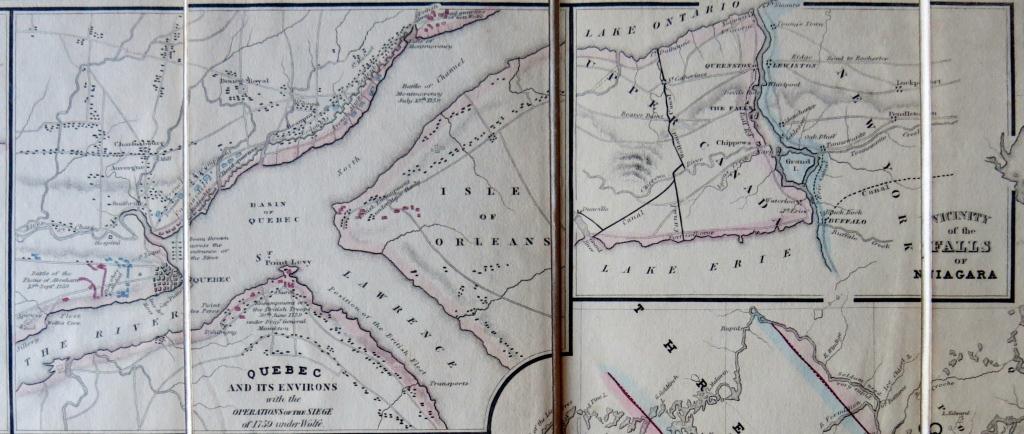
On Wednesday, 8 April, stop by at noon for a Brown Bag lunch talk. This time around we have Jacqueline Reynoso of Cornell University presenting “When ‘the Fourteenth Colony’ Lost its Place: Quebec after 1776.” This event is free and open to the public. 

Also on Wednesday is the third program in the Lincoln & the Legacy of Conflict series. Join us as Martha Hodes, Professory of History – New York University, presents “Mourning Lincoln.” This event is open to the public with a fee of $20 (no charge for Fellows and Members). Registration is required so please RSVP. Reception begins at 5:30PM and the program begins at 6:00PM. 

And on Thursday, 9 April, begins “‘So Sudden an Alteration’: The Causes, Course, and Consequences of the American Revolution.” This conference continues on Friday and Saturday, 10 and 11 April and consists of a variety of sessions focused on discussion of academic papers circlated prior to the conference. While the conference is open to the public, registration is required to attend the various sessions

Kicking off the conference on Thursday evening is the keynote address given by Holton McCauslan, Professor of History at the University of South Carolina. McCausland’s talk, “‘Not Yet’: The Originality Crisis in American Revolution Studies” begins at 5:00PM and is followed by a reception, 6:00PM-8:00PM. All are welcome to attend. RSVP by email or phone 617-646-0568.

Please note that the library closes early at 3:30PM on Thursday, 9 April, and remains closed on Friday and Saturday, 10-11 April. Normal hours resume on Monday, 13 April. 

Untangling North Atlantic Fishing, 1764-1910, Part 2: Anglo-American Treaties regarding the Fishery, 1783-1818

By Andrea Cronin, Reader Services


As discussed in a prior post, Great Britain previously held claim to the fish in the North Atlantic. American negotiators successfully secured the right to fish the North Atlantic in the post-Revolution negotiations at Paris in 1783:

It is agreed that the People of the United States shall continue to enjoy unmolested the Right to take Fish of every kind on the Grand Bank and on all the other Banks of Newfoundland, also in the Gulf of Saint Lawrence and at all other Places in the Sea, where the Inhabitants of both Countries used at any time heretofore to fish … American Fishermen shall have Liberty to dry and cure Fish in any of the unsettled Bays, Harbors, and Creeks of Nova Scotia, Magdalen Islands, and Labrador.

As you can see, successful treaty negotiations in 1783 allowed the Americans to retain the right to fish in the region, and also to use British North American coastal lands for drying and curing, allowing them to better preserve their catches.

Yet, British impressment continued despite the stipulation that United States citizens “continue to enjoy unmolested the right to take fish.”  British maritime strength relied on the ability to force able seamen of any nation into service to fight its wars and replace the dead and deserters. Well aware of the injustice of the practice, the United States House of Representatives submitted a report entitled Legislative Provision Necessary for the Relief of American Seamen Impressed into the Service of Foreign Powers on 25 February 1796. The report’s proposals were twofold: relieve impressed seamen and provide documentation of citizenship. The House committee promoted “a provision for support of two or more agents, to be appointed by the Executive, and sent, the one to Great Britain, the other to such places in the West-Indies, where the greatest number of British ships of war may resort, and to continue there for such time as the President may deem necessary.” This plan did not cease the practice of impressment. British economic sanctions against the United States and increasing American outrage regarding impressment led to the War of 1812.

Following the British victory, the Treaty of Ghent in 1814 reversed much of the previous agreement regarding fishing rights made in 1783. Chief negotiator John Quincy Adams, Secretary of the Treasury Albert Gallatin, and statesmen Henry Clay, James A. Bayard, and Jonathan Russell met with Lord James Gambier, Doctor William Adams, and Under Secretary of State Henry Goulburn in Ghent, Belgium in 1814 to negotiate a peace. The British vied for retention of gains made during the war while Americans held fast to pre-war boundaries and rights. In manuscript copies of Henry Goulburn’s correspondence held at MHS, the British negotiator outlines the important topics for discussion: British maritime rights, Indian protection, establishing borders, and fishing rights. While the third article of the Treaty of Ghent stipulated the restoration of prisoners of war, the British retained the right to impress men into maritime service.

Anglo-American land and sea disputes may have continued ad nauseam without the circumstances and consequential agreements following the War of 1812. The end of the Napoleonic wars in 1815 reduced British impressment of American seamen. The Rush-Bagot Treaty of 1817 restricted naval armaments from the Great Lakes and Lake Champlain. The Treaty of 1818 resulted in the solidification of the 49th parallel as the northern land boundary between the United States and British North America. The British confirmed the United States’ right to fish the coast of Newfoundland, Magdalen Islands, and Labrador and to dry and cure in unsettled Newfoundland and Labrador. In exchange, “the United States hereby renounce for ever, any Liberty heretofore enjoyed or claimed by the Inhabitants thereof, to take, dry, or cure Fish on, or within three marine Miles of any of the Coasts, Bays, Creeks, or Harbours of His Britannic Majesty’s Dominions in America.” These agreements established important borders that remain today. This middle ground agreement between Great Britain and the United States held for nearly two decades before resuming contestation.


“More fool than Knave”: Dr. George Logan and the Logan Act

By Amanda A. Mathews, Adams Papers

Over the last few weeks the Logan Act, a bill passed by Congress and signed by President John Adams in late January 1799 has been widely discussed in the national news. Here at the Adams Papers, work has just begun on Adams Family Correspondence, volume 13, in which Dr. George Logan, whose actions provoked this legislation, is a major topic of conversation for the Adamses on both sides of the Atlantic.

In September 1798, tensions between France and the United States were running high. The specter of war loomed large as the revelation of France’s bribery attempt in the XYZ Affair and continued attacks on American vessels led to a buildup of American armed and naval forces with growing chants of “millions for defense, but not a sixpence for tribute.” It was in this climate that from their place in Berlin, John Quincy and Thomas Boylston Adams reported on the arrival of Logan in Europe. John Quincy detailed that Logan was claiming to be an envoy representing the Democratic-Republican Party, which opposed John Adams’s administration. At first refused a passport into France, Logan continued to represent himself as officially representing the United States while waiting in the Netherlands, and was eventually granted permission to enter France and given audiences with members of the French government to discuss the differences between the two nations. Thomas summarized his views on Logan—“a villain & a traitor to his Country.”

After Logan returned to the United States in November, he met with President Adams to discuss what he had learned from his meetings with the French government and to convince Adams that the French had peaceful intentions. Abigail’s nephew, William Smith Shaw, serving as John’s secretary, reported to the First Lady, who had remained in Quincy: “[Logan] then said, that he had just come from France and that he had the pleasure to inform the president that the directory had altered their conduct respecting America and had become more pacifick. Why then, said the president, have they not repealed their decrees against our commerce? here Logan stammered and said they were making preparations to do it.” John next asked if Logan believed that France would faithfully maintain a new treaty with the US, and he answered affirmatively claiming “the firm and united conduct of the Americans had proved to the directory the impolicy of their conduct.” Shaw reported that this response made John “burst into a broad laugh.” Adams continued his questioning, as Logan became increasingly uncomfortable until he “seemed to want some lurking place like the Turtle to draw in his head and to hide his face.” From this report, Abigail ultimately concluded in a letter to her husband that Logan was “more fool than Knave.”

Whether fool or knave, hero or villain, the Federalist controlled Congress had no patience with his meddling and passed the act prohibiting unauthorized private citizens from negotiating with foreign governments on behalf of the United States. The law has been in force ever since.